
The Methane Problem — Where Plain Orbital Overlap Runs Out
Valence bond theory handled well: two half-filled 1s orbitals overlap, the potential energy drops to its minimum at 74 pm, and a bond of 435.8 kJ/mol appears. It also handled (p-p overlap) and HF (s-p overlap). On methane it falls short.
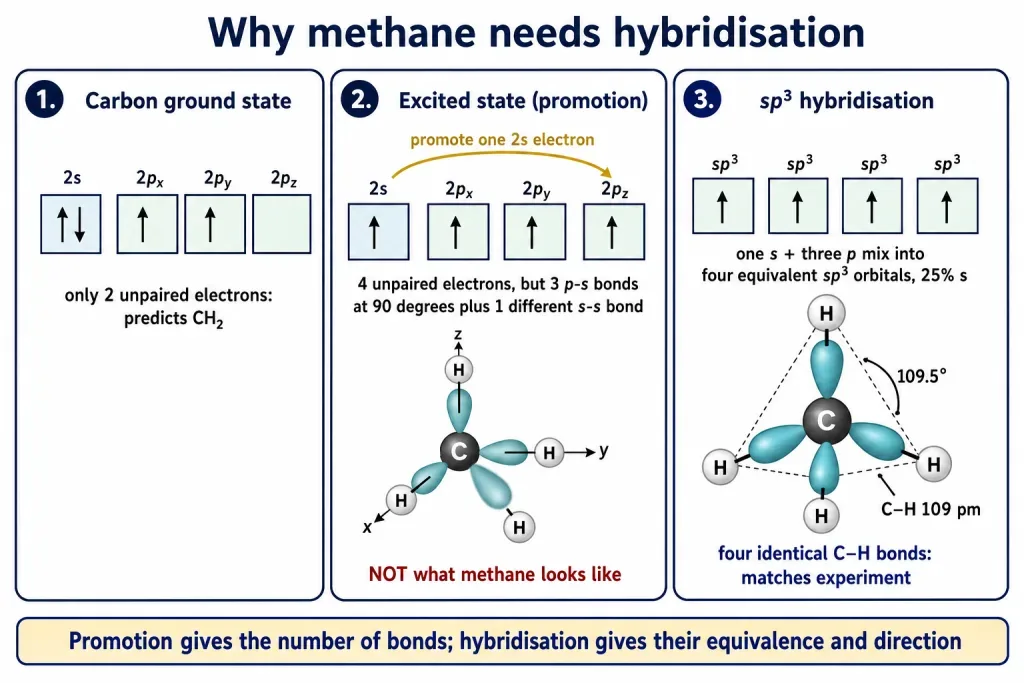
Step 1: count carbon's unpaired electrons
Carbon is ; the valence shell is — only two unpaired electrons. Plain overlap theory predicts two bonds, , not .
Step 2: promote an electron
Lift one 2s electron into the empty orbital. The cost is small, since the 2s and 2p levels are close in energy, and the two extra bonds repay it. Carbon in this excited state is — four unpaired electrons.
Step 3: look at the bonds you would get
If carbon used those four orbitals as they are, the four C-H bonds would not be alike:
| Carbon orbital used | Hydrogen orbital | Type of overlap | Direction |
|---|---|---|---|
| 1s | p-s | along the x-axis | |
| 1s | p-s | along the y-axis | |
| 1s | p-s | along the z-axis | |
| 1s | s-s | no direction at all (spherical) |
That predicts three bonds of one kind at 90° to each other, plus one bond of a different kind with no preferred direction. Methane in fact has four identical C-H bonds, each 109 pm long and of the same strength, pointing to the corners of a regular tetrahedron with every H-C-H angle equal to 109.5°.
Key Point: Promotion explains how many bonds carbon makes, but not why they are all the same and not why the angle is 109.5°. The pure 2s and 2p orbitals have the wrong shapes and directions for methane.
The puzzle repeats elsewhere: beryllium () has no unpaired electrons yet is linear; oxygen has two unpaired p electrons at 90° yet the angle in water is 104.5°.
The way out
Pauling saw that the mistake was treating the 2s and 2p orbitals as fixed, separate things. Orbitals are mathematical waves, and waves on the same atom can be added. Mix one 2s wave with three 2p waves and you get four new waves — identical in shape and energy, pointing to the corners of a tetrahedron. That mixing is hybridisation.
Promotion and hybridisation stay separate ideas: promotion increases the number of unpaired electrons, hybridisation changes the shape and direction of the orbitals. It can happen without promotion, and even with full orbitals.
[Board] The two-line version: "Carbon in the excited state would give three p-s bonds at 90° and one s-s bond of different character. Methane actually has four equivalent bonds at 109.5°, which pure orbitals cannot explain; hybridisation is needed."
Pauling's Idea — Definition, Features and Conditions
Key Point (Definition): Hybridisation is the process of intermixing of the orbitals of slightly different energies (on the same atom) so as to redistribute their energies, resulting in the formation of a new set of orbitals of equivalent energy and shape. The new orbitals are called hybrid orbitals, and it is these, not the pure atomic orbitals, that the atom uses to form bonds.
Each phrase carries weight. "Slightly different energies" — the 2s and 2p of carbon, not the 1s and 2p. "On the same atom" — this is not overlap between two atoms. "Equivalent energy and shape" — every orbital of carbon is the twin of every other.
What a hybrid orbital looks like
Every s-p hybrid has a large positive lobe on one side of the nucleus and a very small negative lobe on the other: a lopsided dumb-bell, neither a sphere (s) nor a symmetric dumb-bell (p). The big lobe reaches further than a 2s or 2p lobe could, so it overlaps the partner atom's orbital more heavily — and heavier overlap means a stronger bond.
Salient features of hybridisation
- The number of hybrid orbitals formed equals the number of atomic orbitals mixed. Mix two, get two (); three, get three (); four, get four (). Orbitals are never created or destroyed, only reshaped.
- The hybrid orbitals are always equivalent in energy and shape. All four orbitals of carbon are identical, which is why methane's four C-H bonds are identical.
- Hybrid orbitals form stronger, more stable bonds than pure atomic orbitals, their big lobe giving more effective overlap along the bond axis.
- Hybrid orbitals are directed in space in preferred directions so that electron pairs are as far apart as possible. Minimum repulsion, so the type of hybridisation tells you the geometry of the molecule — linear, trigonal planar, tetrahedral. That is the bridge back to VSEPR: VSEPR gave the shapes, hybridisation supplies the orbitals pointing in those directions.
Important conditions for hybridisation
| Condition | What it means in practice |
|---|---|
| (i) Only orbitals of the valence shell hybridise | Carbon mixes 2s and 2p, never 1s. Phosphorus mixes 3s, 3p (and 3d), not 2p. |
| (ii) The orbitals must have almost equal energy | 2s with 2p, yes. 2p with 3s, no. This is why d orbitals join in only from the third period, where 3d is close to 3s and 3p. |
| (iii) Promotion of an electron is not essential before hybridisation | Nitrogen in and oxygen in hybridise without promoting anything. Carbon happens to promote, but that is a separate step. |
| (iv) It is not necessary that only half-filled orbitals take part | A filled orbital can hybridise too. The lone pairs of and sit in filled hybrid orbitals. An empty orbital can also be part of the set: in the adduct the fourth orbital of boron was empty until it received the lone pair donated by nitrogen. |
Conditions (iii) and (iv) are the ones students get wrong. A hybrid orbital can hold zero, one or two electrons; what decides the hybridisation is the number of orbitals mixed, not how many electrons they carry. Nitrogen's five valence electrons fill its four orbitals as 2, 1, 1, 1; oxygen's six fill them as 2, 2, 1, 1.
Three things hybridisation is not
- It is not a physical event you could watch. It is a mathematical model applied after the shape is known, one that reproduces every shape we measure — not the cause of the shape. Isolated atoms in the gas phase are not hybridised; the concept applies to atoms in molecules.
- It is not the same as overlap. Hybridisation reshapes orbitals on one atom; overlap joins orbitals on two atoms.
- It does not create energy from nowhere. Hybrid orbitals sit at an energy between the s and p they came from; the molecule is more stable only because the better-directed bonds pay back the cost of promotion and mixing.
[JEE/NEET] The "which statement is incorrect" option is usually one of: "hybrid orbitals have different energies", "only half-filled orbitals hybridise", "promotion must precede hybridisation", "the number of hybrid orbitals is more than the orbitals mixed".
sp Hybridisation () and Hybridisation ()
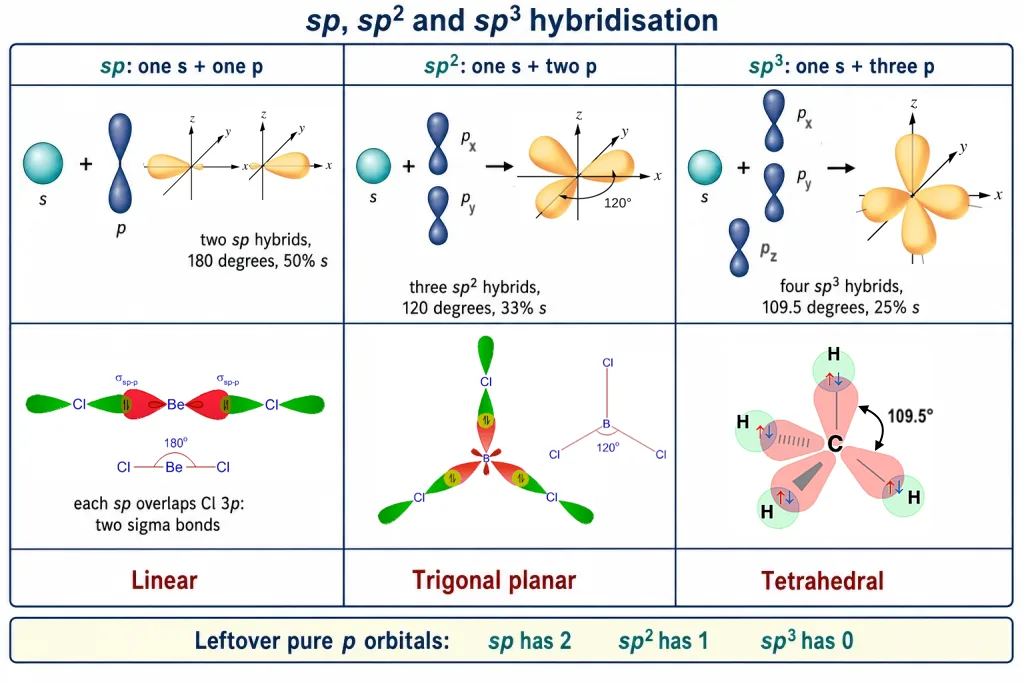
An hybrid is made from one s and one p orbital, an from one s and two p, an from one s and three p. Each case runs through the same three moves — configuration, mixing, overlap.
sp hybridisation: mix one s with one p
Take one 2s and one 2p orbital (say , for hybrids along the z-axis). Adding them gives two equivalent hybrid orbitals, each 50% s-character and 50% p-character, their big lobes pointing in opposite directions, 180° apart, which makes overlap particularly effective. An -hybridised central atom bonded to two other atoms is linear; because the hybrids lie on one diagonal through the nucleus, this is sometimes called diagonal hybridisation. The two remaining p orbitals ( and ) stay pure and unhybridised, at right angles to the molecular axis — ethyne will use them.
Beryllium chloride, . Beryllium's ground state is — no unpaired electrons, which cannot explain a bivalent atom. In the excited state one 2s electron is promoted into an empty 2p orbital: . These two half-filled orbitals hybridise to two orbitals at 180°, each overlapping axially (end-on) with a half-filled 3p orbital of chlorine to form an -p sigma bond: , linear, angle 180°.
| Molecule | Central atom | Ground state | Excited state | Orbitals mixed | Hybrids | Shape | Angle |
|---|---|---|---|---|---|---|---|
| Be | one s + one p | two | linear | 180° | |||
| B | one s + two p | three | trigonal planar | 120° | |||
| C | one s + three p | four | tetrahedral | 109.5° |
hybridisation: mix one s with two p
Mix one 2s with two 2p orbitals ( and ) and you get three equivalent hybrid orbitals, each 33.3% s-character and 66.7% p-character, lying in one plane and pointing to the corners of an equilateral triangle, 120° apart. The third p orbital, , is left out and stands perpendicular to that plane. Ethene will need it.
Boron trichloride, . Boron's ground state is — one unpaired electron. In the excited state one 2s electron is promoted to a vacant 2p orbital, giving and three unpaired electrons. These hybridise to three orbitals in a trigonal planar arrangement, each overlapping axially with a half-filled 3p orbital of chlorine to form a B-Cl sigma bond. The molecule is flat, boron at the centre, three chlorines at the corners of a triangle, every Cl-B-Cl angle 120°. Boron's unused orbital is empty and perpendicular to the plane; that is why and are electron-pair acceptors (Lewis acids), and why boron changes to the moment it accepts a lone pair (Question 7 below).
Why the angles are what they are
Twin hybrids spread as far apart as possible, and the furthest two directions can be is opposite (180°). Three twins in a plane can be no further apart than 120°; four in three dimensions land on the tetrahedron at 109.5°.
Key Point: → 2 hybrids, linear, 180°, 50% s. → 3 hybrids, trigonal planar, 120°, 33% s. → 4 hybrids, tetrahedral, 109.5°, 25% s. The unhybridised p orbitals left over are 2 for , 1 for and 0 for — exactly the orbitals available for pi bonds.
[NEET] "In the Be-Cl bonds are formed by overlap of …": the answer is hybrid orbital of Be with the 3p orbital of Cl, since chlorine's valence shell is 3, not 2. In it would be of Be with 1s of H.
Hybridisation — Methane, Ammonia and Water
Methane: the problem solved
Carbon in its excited state has . Mix all four valence orbitals and you get four equivalent hybrid orbitals, each 25% s-character and 75% p-character, spreading to the corners of a regular tetrahedron, 109.5° between any two. Each overlaps axially with a hydrogen 1s orbital to form an -s sigma bond: four identical C-H bonds, each 109 pm, every H-C-H angle 109.5° — methane, exactly as measured.
| Pure 2s and 2p orbitals | Four hybrids | |
|---|---|---|
| Number of bonds | 4 (after promotion) | 4 (after promotion) |
| Are the bonds equivalent? | No — three p-s, one s-s | Yes — all -s |
| Bond angles | 90° for the three p bonds | 109.5° for all six angles |
| Bond strength | ordinary | stronger (better overlap) |
| Matches experiment? | No | Yes |
Ammonia: one lone pair in the set
Nitrogen's valence shell is . No promotion is needed (condition iii) and one orbital is already full (condition iv) — hybridise anyway. Three of the four hybrids hold one electron each and overlap with hydrogen 1s orbitals to form three N-H sigma bonds; the fourth holds the lone pair. All four still point roughly to tetrahedral corners, but the lone pair, having only one nucleus pulling on it, spreads out more and repels the bond pairs more strongly than they repel each other. The H-N-H angle drops from 109.5° to 107°, and the shape (atoms only) is a trigonal pyramid.
Water: two lone pairs in the set
Oxygen's valence shell is . Again no promotion; the one 2s and three 2p orbitals give four orbitals, two with one electron each and two with a pair. The four adopt the tetrahedral arrangement, two corners occupied by hydrogen atoms and two by lone pairs. Two lone pairs squeeze harder than one, so the H-O-H angle shrinks from 109.5° to 104.5°. The molecule is V-shaped (bent, angular).
Key Point: , and are all -hybridised with the same tetrahedral arrangement of four orbitals. They differ only in how many of those orbitals hold lone pairs: 0, 1, 2. Angles: 109.5°, 107°, 104.5°. Shapes (atoms only): tetrahedral, pyramidal, bent.
| Molecule | Valence electrons on central atom | orbitals used for bonds | orbitals holding lone pairs | Bond angle | Shape of molecule |
|---|---|---|---|---|---|
| 4 | 4 | 0 | 109.5° | tetrahedral | |
| 5 | 3 | 1 | 107° | trigonal pyramidal | |
| 6 | 2 | 2 | 104.5° | bent (V-shaped) | |
| 4 (5 for N, less one for the positive charge) | 4 | 0 | 109.5° | tetrahedral | |
| 5 (6 for O, less one for the positive charge) | 3 | 1 | about 107° | trigonal pyramidal |
Two common confusions cleared
"Water is , so why isn't it tetrahedral?" Hybridisation describes the arrangement of orbitals, tetrahedral in water. The shape of the molecule is the arrangement of atoms, and two of the four corners are occupied by lone pairs you cannot see.
"Oxygen has two unpaired p electrons at 90°, so why hybridise?" Because the measured angle is 104.5°, much closer to the tetrahedral 109.5° than to 90°. The model with two lone pairs squeezing the angle down a little from 109.5° fits; the pure-p model with the angle somehow opened up from 90° does not. (Heavier analogues like at about 92° really do lean towards pure p bonding — that belongs to the JEE Corner.)
[Board] For "Explain the shape of on the basis of hybridisation": nitrogen's valence configuration; one 2s and three 2p undergo hybridisation giving four hybrids, three with one electron and one with a pair; three overlap with H 1s to give N-H sigma bonds; lone pair-bond pair repulsion exceeds bond pair-bond pair repulsion, so the angle reduces from 109.5° to 107°; shape pyramidal.
Carbon Three Ways — Ethane, Ethene and Ethyne
, and show , and side by side. The recipe is the same each time: decide the hybridisation of each carbon, use the hybrids for sigma bonds, use whatever p orbitals were left out for pi bonds.
Ethane, : and only sigma bonds
Both carbons are -hybridised. One orbital of each overlaps axially with an orbital of the other to form the - sigma bond — the C-C bond; the remaining three on each carbon overlap with hydrogen 1s orbitals to form six -s sigma bonds. Seven sigma bonds, zero pi bonds. The C-C bond length is 154 pm, each C-H bond 109 pm, every bond angle close to 109.5°. Being a single sigma bond, the C-C lets the two groups rotate freely.
Ethene, : plus one pi bond
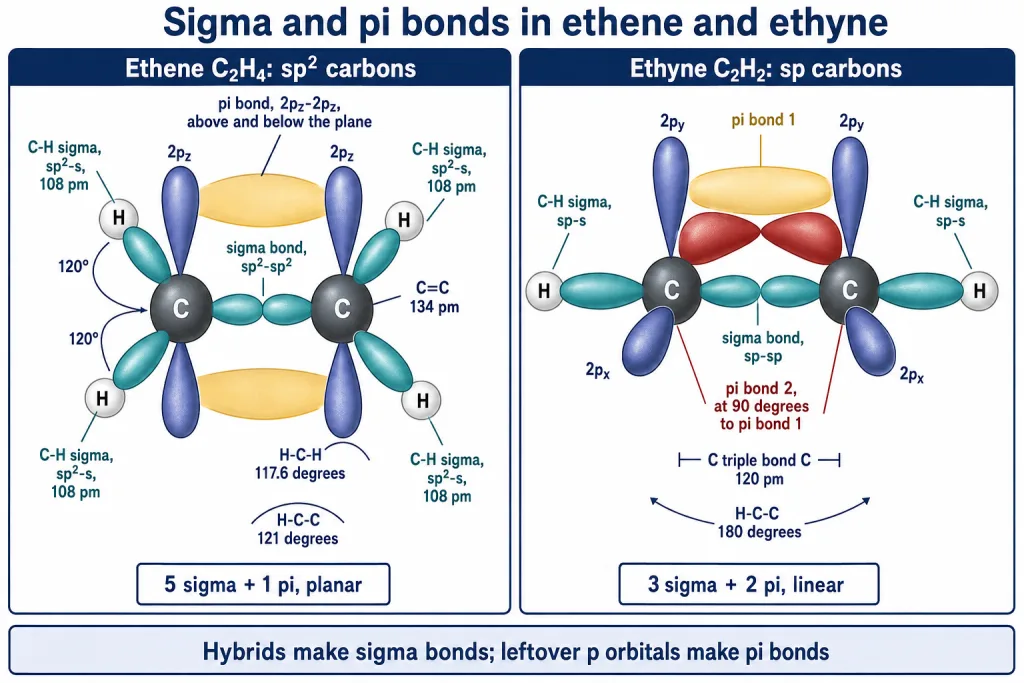
Both carbons are -hybridised, each with three hybrids in a plane and one unhybridised orbital perpendicular to it. One orbital of each carbon overlaps axially with one of the other to form the C-C sigma bond (-); the other two on each carbon overlap with hydrogen 1s orbitals to form four -s sigma bonds. The leftover orbitals then overlap sideways to form a pi bond — two equal electron clouds, above and below the plane of the six atoms.
The carbon-carbon double bond in ethene is one sigma bond (-) plus one pi bond (p-p):
| Bond in ethene | Made from | Length |
|---|---|---|
| C=C | one - sigma + one - pi | 134 pm |
| C-H | -s sigma | 108 pm |
Angles: H-C-H = 117.6° and H-C-C = 121°, adding up to 360° at each carbon (117.6 + 121 + 121 = 359.6, rounding), which confirms the molecule is flat. They are not exactly 120° because the C=C bond, with its four electrons, pushes on the C-H bonds a little more than a single bond would. Since the pi bond needs the two orbitals to stay parallel, rotation about a C=C bond is not free.
Ethyne, : plus two pi bonds
Both carbons are -hybridised, each with two hybrids pointing in opposite directions and two unhybridised p orbitals ( and ) at right angles to the axis and to each other. One orbital of each carbon overlaps axially with one of the other to form the C-C sigma bond (-); the other overlaps with a hydrogen 1s orbital to form an -s sigma bond. The orbitals then overlap sideways to form one pi bond, the orbitals a second at right angles to the first, the two clouds wrapping the sigma bond like a cylinder.
The triple bond is one sigma bond (-) plus two pi bonds (p-p). The C≡C bond length is 120 pm and the molecule is linear, H-C-C angle 180°.
The three side by side
| Molecule | Hybridisation of C | C-C bond | Sigma bonds | Pi bonds | C-C length | Angle at C | Shape |
|---|---|---|---|---|---|---|---|
| ethane | single: 1 | 7 | 0 | 154 pm | 109.5° | tetrahedral at each C | |
| ethene | double: 1 + 1 | 5 | 1 | 134 pm | 117.6° (H-C-H), 121° (H-C-C) | planar | |
| ethyne | triple: 1 + 2 | 3 | 2 | 120 pm | 180° | linear |
The C-C bond shortens as more bonds pile between the same two atoms: 154 → 134 → 120 pm. Two things shrink it at once — the extra pi bonds pulling the nuclei together, and the growing s-character of the hybrids ( → → ) making the sigma bond.
[JEE/NEET] Every single bond is one sigma; every double bond one sigma + one pi; every triple bond one sigma + two pi. Ethyne: 2 C-H + 1 C-C = 3 sigma, 2 pi. Ethene: 4 C-H + 1 C-C = 5 sigma, 1 pi.
s-Character, the Steric-Number Shortcut and the Valence-Electron Formula
What s-character controls
The fraction of s in a hybrid is fixed by the mix: has 50% s, has 33.3% s, has 25% s. An s orbital is spherical and hugs the nucleus; a p orbital reaches further out. The more s a hybrid contains, the closer to the nucleus its electrons sit and the shorter and fatter its big lobe becomes.
| More s-character means … | Why | Evidence |
|---|---|---|
| Larger bond angle | s has no direction; spreading orbitals further apart is what a higher s-fraction does | 180° > 120° > 109.5° |
| Shorter, stronger bond | electrons held closer to the nucleus, so the atom "reaches" a shorter distance to its partner | C-H length: ethyne (about 106 pm) < ethene 108 pm < ethane 109 pm |
| More electronegative carbon | electrons closer to the nucleus are held more tightly, so the hybridised atom pulls harder on a shared pair | electronegativity of C: > > ; this is why the C-H of ethyne is weakly acidic and ethyne reacts with sodium, while ethane does not |
The chain in one line: more s-character → wider angle, shorter bond, higher electronegativity of the hybridised atom. Reverse every arrow for more p-character. The finer version — how lone pairs and electronegative substituents shift s-character within one molecule (Bent's rule) — is in the JEE Corner.
The steric-number shortcut
A faster route than writing ground and excited states gives the same answer every time for s-p hybridisation:
Key Point: Steric number = (number of sigma bonds from the central atom) + (number of lone pairs on the central atom). Steric number 2 → ; 3 → ; 4 → . (5 → and 6 → come in the next section.)
Two rules make it work. Count sigma bonds, not bonds: a double bond and a triple bond each contribute one sigma bond, because their pi bonds use the unhybridised p orbitals. And count lone pairs on the central atom only.
| Species | Sigma bonds from central atom | Lone pairs on central atom | Steric number | Hybridisation | Shape |
|---|---|---|---|---|---|
| 2 | 0 | 2 | linear | ||
| () | 2 | 0 | 2 | linear | |
| () | 2 | 0 | 2 | linear | |
| 3 | 0 | 3 | trigonal planar | ||
| 2 | 1 | 3 | bent | ||
| 3 | 0 | 3 | trigonal planar | ||
| 2 | 1 | 3 | bent | ||
| , | 4 | 0 | 4 | tetrahedral | |
| , | 3 | 1 | 4 | pyramidal | |
| 2 | 2 | 4 | bent |
and deserve a second look: two sigma bonds plus one lone pair gives steric number 3, so they are and bent at roughly 120° — not and linear, even though the formula looks like . The lone pair is the whole difference. needs a resonance structure with one S=O and one S-O (or two S=O with an expanded octet); either way the sigma count is 2.
The valence-electron formula
For a central atom with only single-bonded monovalent neighbours, an even faster count skips the Lewis structure:
where = number of valence electrons of the central atom, = number of monovalent atoms (H, F, Cl, Br, I) attached to it, = positive charge on the cation, = negative charge on the anion. is the steric number: 2 → , 3 → , 4 → , 5 → , 6 → . A divalent oxygen or sulphur attached to the central atom contributes 0 to .
| Species | Hybridisation | |||||
|---|---|---|---|---|---|---|
| 2 | 2 | 0 | 0 | 2 | ||
| 3 | 3 | 0 | 0 | 3 | ||
| 4 | 4 | 0 | 0 | 4 | ||
| 5 | 4 | 1 | 0 | 4 | ||
| 6 | 3 | 1 | 0 | 4 | ||
| 3 | 4 | 0 | 1 | 4 | ||
| 4 | 0 | 0 | 0 | 2 | ||
| 6 | 0 | 0 | 0 | 3 | ||
| 4 | 0 | 0 | 2 | 3 | ||
| 5 | 0 | 1 | 0 | 2 | ||
| 5 | 0 | 0 | 1 | 3 |
[JEE Main] The formula and the steric-number count are the same thing written two ways. The formula is quickest for ions of halides and hydrides (, , , ); the sigma-plus-lone-pair count is safer with double bonds and oxygens, because then you can see the lone pair. The formula does not give the shape when lone pairs are present.
Traps worth naming
- Resonance does not change hybridisation. Every resonance structure of gives carbon three sigma bonds; carbon is in all of them.
- Hybridisation is decided per atom, not per molecule. Propene has one carbon and two carbons (Question 11).
- Same shape, different hybridisation happens — (bent, ) versus (bent, ). When asked for hybridisation, report the steric number, not the shape.
Solved Examples
Question 1: Define hybridisation and describe the shapes of , and hybrid orbitals
What is meant by hybridisation of atomic orbitals? Describe the shapes of , and hybrid orbitals.
Answer:
Hybridisation is the mixing of orbitals on the same atom that have slightly different energies (like 2s and 2p) to give a fresh set of orbitals identical in energy and shape. The atom uses these hybrid orbitals, not the original s and p, to make bonds. Mix two and I get two; mix four and I get four.
Every s-p hybrid has the same shape: a lopsided dumb-bell, one big lobe on one side of the nucleus and a tiny lobe on the other. The big lobe overlaps the partner atom, and being bigger than a plain s or p lobe it makes a stronger bond.
(one s + one p): two hybrids, 50% s and 50% p, pointing in opposite directions along a straight line, 180° apart — linear, as in .
(one s + two p): three hybrids, 33% s and 67% p, in one plane pointing to the corners of a triangle, 120° apart — trigonal planar, as in . One p orbital is left out, perpendicular to the plane.
(one s + three p): four hybrids, 25% s and 75% p, pointing to the four corners of a tetrahedron, 109.5° apart — tetrahedral, as in .
Ans: Hybridisation is the intermixing of valence orbitals of nearly equal energy on one atom to give an equal number of equivalent hybrid orbitals. : two orbitals, linear, 180°; : three, trigonal planar, 120°; : four, tetrahedral, 109.5°.
Question 2: Why is linear?
Beryllium has the configuration with no unpaired electron. Explain, using hybridisation, how it forms two bonds in and why the molecule is linear.
Answer:
Beryllium's valence shell is — a full orbital, nothing unpaired, so on its own it could not form even one bond.
One 2s electron moves up into an empty 2p orbital, giving and two unpaired electrons, matching beryllium being bivalent.
The 2s and the 2p (say ) hybridise to two orbitals of the same energy and shape, each 50% s and 50% p. Two identical orbitals push each other as far apart as they can, which is directly opposite — 180°.
Each orbital overlaps end-on with a half-filled 3p orbital of a chlorine atom, forming two -p sigma bonds. Since the hybrids point in opposite directions, the two chlorines sit on opposite sides of beryllium.
Ans: Be undergoes hybridisation ( excited state) giving two hybrids at 180°; each overlaps with a Cl 3p orbital, so is linear with a bond angle of 180°.
Watch out: Promotion gives the number of bonds; hybridisation gives the direction.
Question 3: The shape of and the fate of boron's third p orbital
Explain the trigonal planar shape of on the basis of hybridisation. What happens to the 2p orbital of boron that is not used?
Answer:
Boron is — only one unpaired electron. To make three bonds, one 2s electron is promoted into an empty 2p orbital: , three unpaired electrons.
The 2s, and hybridise to three orbitals, each 33% s, spreading as far apart as they can in a plane — 120° apart, pointing to the corners of an equilateral triangle.
Each orbital overlaps axially with a half-filled 3p orbital of chlorine, giving three B-Cl sigma bonds. The chlorines sit at the corners with boron in the middle, every Cl-B-Cl angle 120°, all four atoms in one plane.
The did not join the mix, so it stays a pure p orbital, empty, at right angles to the plane. An empty orbital on an atom with only six electrons around it is an invitation: readily accepts a lone pair from a donor like (Question 7), and the moment it does, boron switches to .
Ans: Boron is -hybridised (excited state ); three orbitals at 120° overlap with Cl 3p orbitals, giving a trigonal planar molecule. The unhybridised, empty orbital is perpendicular to the plane and makes boron an electron-pair acceptor.
Watch out: Whatever is left out of the mix is a pure p orbital — empty in boron, half-filled in ethene's carbon.
Question 4: Same set, three different angles
Methane, ammonia and water are all described as -hybridised, yet their bond angles are 109.5°, 107° and 104.5°. Explain, and predict which of and has the larger H-N-H angle.
Answer:
Carbon (after promotion), nitrogen and oxygen each mix one s and three p to give four hybrids pointing to the corners of a tetrahedron. If all four held bond pairs, every angle would be 109.5°.
Then I count lone pairs. Carbon's four valence electrons put all four hybrids into C-H bonds: no lone pairs, 109.5°. Nitrogen has five, so three hybrids bond and the fourth holds a lone pair. Oxygen has six, so two bond and two hold lone pairs.
A lone pair belongs to only one nucleus, so it spreads out and pushes the neighbouring bond pairs harder than bond pairs push each other. One lone pair in ammonia closes H-N-H from 109.5° to 107°; two lone pairs in water close H-O-H to 104.5°. With the lone pairs invisible, methane is tetrahedral, ammonia a trigonal pyramid and water bent.
In nitrogen's lone pair has been used to bond a fourth proton, so all four orbitals hold bond pairs. Nothing is left to squeeze: a perfect tetrahedron at 109.5°, larger than the 107° of .
Ans: All three are with tetrahedral orbital arrangements; the angle falls 109.5° → 107° → 104.5° as the number of lone pairs rises 0 → 1 → 2, because lone pair-bond pair repulsion is stronger than bond pair-bond pair repulsion. (109.5°) has a larger angle than (107°).
Watch out: "" fixes the orbital arrangement, lone pairs fix the distortion.
Question 5: Hybridisation of the central atom in a list
Find the hybridisation of the central atom and the shape of each species: (a) , (b) , (c) , (d) , (e) , (f) , (g) .
Answer:
I use the steric number: sigma bonds from the central atom + lone pairs on it. 2 means , 3 means , 4 means . A double or triple bond counts as one sigma bond.
(a) : two Be-F sigma bonds, no lone pair — 2, , linear, 180°.
(b) , : two sigma bonds, one in each double bond, no lone pair on carbon — 2, , linear.
(c) : two sigma bonds to oxygen plus one lone pair on sulphur — 3, , bent, angle a little under 120°.
(d) : four N-H sigma bonds, the lone pair used up in the fourth — 4, , tetrahedral, 109.5°.
(e) : three O-H sigma bonds plus one lone pair, oxygen having given one of its two to the proton — 4, , trigonal pyramidal, about 107°.
(f) : three sigma bonds to oxygen (one C=O and two C-O in any resonance structure), no lone pair — 3, , trigonal planar, 120°.
(g) , : two sigma bonds on carbon (one to H, one inside the triple bond), no lone pair — 2, , linear.
Ans: (a) , linear; (b) , linear; (c) , bent; (d) , tetrahedral; (e) , pyramidal; (f) , trigonal planar; (g) (carbon), linear.
Watch out: The trap is a lone pair on the central atom ( versus ) or a multiple bond counted twice.
Question 6: Change in the hybridisation of aluminium when picks up a chloride ion
Describe the change in hybridisation (if any) of the Al atom in the reaction .
Answer:
Aluminium's valence shell is . Promote one 3s electron: . These hybridise to three orbitals that overlap with chlorine 3p orbitals to form three Al-Cl sigma bonds. is trigonal planar, 120°, and aluminium keeps an empty, unhybridised orbital. Formula check: , so .
donates a lone pair into that empty orbital, forming a fourth Al-Cl bond — a coordinate bond, but once formed just another sigma bond.
Aluminium now has four sigma bonds and no lone pair: steric number 4. The 3s and all three 3p orbitals must mix, giving four orbitals at 109.5°. Formula check: , so . Trigonal planar becomes tetrahedral , the Cl-Al-Cl angle dropping from 120° to 109.5°.
Ans: Aluminium changes from (trigonal planar ) to (tetrahedral ).
Question 7: meets — who changes hybridisation?
Is there any change in the hybridisation of B and N atoms as a result of the reaction ?
Answer:
In boron has three sigma bonds, no lone pair, and an empty orbital perpendicular to the plane: steric number 3, , trigonal planar, 120°. In nitrogen has three sigma bonds plus one lone pair: steric number 4, , trigonal pyramidal, 107°.
Nitrogen's lone pair is donated into boron's empty orbital, forming a B-N coordinate bond. In the adduct, each of B and N is joined to four atoms.
Boron after: four sigma bonds, no lone pair, steric number 4. It must use all four valence orbitals, so it becomes , the fluorines pushed out of the plane into a tetrahedral arrangement (F-B-F drops from 120° towards 109.5°).
Nitrogen after: still four electron pairs, but all four are now bond pairs. Steric number is still 4, so nitrogen stays ; its lone pair has become a bond pair, so H-N-H opens slightly from 107° towards 109.5°.
Ans: Boron changes from to ; nitrogen remains throughout, its lone pair simply becoming the B-N bond pair.
Watch out: The donor keeps its hybridisation, since a lone pair and a bond pair both count as one in the steric number; the acceptor gains a pair and goes up one level.
Question 8: Describe the bonding in ethene
Describe the formation of the double bond in ethene, , in terms of hybridisation. Give the bond lengths and bond angles.
Answer:
Each carbon (excited state ) mixes its 2s with two of the 2p orbitals to give three orbitals in a plane at 120°. The third p orbital () is left alone at right angles to the plane, with one electron in it.
One orbital of each carbon overlaps end-on with an orbital of the other: the C-C sigma bond (-). The remaining two on each carbon overlap with hydrogen 1s orbitals: four C-H sigma bonds (-s). All six atoms lie in one plane.
The orbitals, parallel and side by side, overlap sideways to form a pi bond whose electron cloud sits in two halves, above and below that plane.
So the double bond is one sigma (-) plus one pi (-), length 134 pm, shorter than the 154 pm C-C single bond of ethane. Each C-H bond is 108 pm. H-C-H = 117.6° and H-C-C = 121°, adding to 360° around each carbon as they must for a flat molecule. Because the pi bond needs the two p orbitals parallel, the molecule cannot twist about the C=C bond.
Ans: Ethene has two carbons; the C=C consists of one - sigma bond and one - pi bond (134 pm); C-H bonds are -s (108 pm); H-C-H = 117.6°, H-C-C = 121°; the molecule is planar with 5 sigma and 1 pi bond.
Watch out: Hybrids make sigma bonds, leftover p orbitals make pi bonds, and that pi bond locks the molecule flat.
Question 9: Describe the bonding in ethyne and compare the three C-C bonds
Explain the formation of the triple bond in ethyne, . Then arrange the carbon-carbon bond lengths of ethane, ethene and ethyne in order and explain the trend.
Answer:
Each carbon mixes its 2s with only one 2p orbital, giving two orbitals pointing in opposite directions (180°). Two p orbitals ( and ) are left unhybridised, each with one electron, at right angles to the axis and to each other.
One orbital of each carbon overlaps end-on with an orbital of the other to give the C-C sigma bond (-); the other overlaps with a hydrogen 1s orbital to give a C-H sigma bond (-s). With the orbitals at 180°, the four atoms lie on a straight line: H-C-C angle 180°.
The orbitals overlap sideways to form one pi bond; the orbitals form a second at 90° to the first, their clouds surrounding the C-C axis like a cylinder. Triple bond = one sigma + two pi; whole molecule 3 sigma (2 C-H + 1 C-C) and 2 pi, C≡C length 120 pm.
Lengths in order: ethane C-C 154 pm > ethene C=C 134 pm > ethyne C≡C 120 pm. Two things shorten the bond together — more bonds between the same two nuclei pull them closer, and the sigma bond is made from hybrids with rising s-character ( 25% → 33% → 50%), which hold their electrons closer to the nucleus.
Ans: In ethyne each carbon is ; the C≡C consists of one - sigma bond and two p-p pi bonds (120 pm), the molecule is linear (180°), with 3 sigma and 2 pi bonds in all. Bond length order: (154 pm) > (134 pm) > (120 pm).
Watch out: Number of leftover p orbitals = number of pi bonds: 0 for , 1 for , 2 for .
Question 10: s-character and the C-H bond
The C-H bond lengths in ethane, ethene and ethyne are roughly 109, 108 and 106 pm. (a) Explain the trend using s-character. (b) Which of the three has the most electronegative carbon? (c) Why does ethyne react with sodium to release hydrogen while ethane does not?
Answer:
First the s-character: ethane's carbons are (25% s), ethene's are (33% s), ethyne's are (50% s).
(a) An s orbital sits close to the nucleus; a p orbital reaches out. A hybrid with more s keeps its bonding electrons closer in, so the hydrogen is held closer too. The length falls from ethane (109 pm) to ethene (108 pm) to ethyne (about 106 pm), and the bond strength rises in the same order.
(b) Electrons closer to the nucleus are held more tightly, so an carbon pulls harder on a shared pair than an or carbon. Electronegativity of carbon: > > . Ethyne's carbon is the most electronegative.
(c) In ethyne the carbon pulls the shared C-H electrons towards itself, leaving the hydrogen slightly positive and easier to remove as . Ethyne is therefore weakly acidic and reacts with sodium metal to give sodium acetylide and hydrogen gas. Ethane's carbon holds those electrons much more evenly, so its hydrogens are not acidic at all.
Ans: (a) C-H shortens as the s-character of carbon rises ( 25% → 33% → 50%); (b) the carbon of ethyne is the most electronegative; (c) the electronegative carbon makes ethyne's C-H bond polar enough for the hydrogen to be lost to sodium, which ethane's C-H is not.
Question 11: Hybrid orbitals used by carbon in organic skeletons
Which hybrid orbitals are used by the carbon atoms in the following molecules? (a) ; (b) ; (c) ; (d) ; (e) .
Answer:
Carbon has no lone pairs in these molecules, so its steric number is just the number of atoms it is bonded to, each double bond counting once. Four neighbours → ; three neighbours (one double bond) → ; two neighbours (a triple bond, or two double bonds) → .
(a) Ethane: each carbon is bonded to three H and one C — four neighbours, all single. Both .
(b) Propene: the carbon has four single bonds, . The middle carbon has one H, one C (single) and one C (double) — three neighbours, . The terminal carbon has two H and one double-bonded C, .
(c) Ethanol: the carbon has four single bonds, ; the carbon has two H, one C and one O, all single, . (Oxygen, if asked, is with two lone pairs.)
(d) Ethanal: the carbon is ; the aldehyde carbon has one H, one C and one double-bonded O — three neighbours, .
(e) Ethanoic acid: the carbon is ; the carboxyl carbon has one C, one O (double) and one O (single, carrying the H) — three neighbours, .
Ans: (a) , ; (b) , , ; (c) , ; (d) (methyl), (CHO); (e) (methyl), (COOH).
Watch out: A C=O behaves exactly like a C=C for this count.
Question 12: The valence-electron formula on ions and oxides
Use to find the hybridisation of the central atom in (a) , (b) , (c) , (d) , (e) , and check each answer by counting sigma bonds and lone pairs. Then arrange , and in order of decreasing O-N-O bond angle.
Answer:
In the formula = valence electrons of the central atom, = monovalent atoms attached (H or halogen; a doubly bonded O counts 0), = charge on a cation, = charge on an anion. = 2, 3, 4 gives , , .
(a) : , , , so , . Check: four N-H sigma bonds, no lone pair. Tetrahedral.
(b) : , , , so , . Check: three O-H sigma bonds plus one lone pair = 4. Pyramidal.
(c) : , , , so , . Check: , two sigma bonds, no lone pair on N. Linear, 180°.
(d) : , , , so , . Check: two sigma bonds (one N=O, one N-O) plus one lone pair on N = 3. Bent.
(e) : , , , so , . Check: three sigma bonds to oxygen, no lone pair. Trigonal planar, 120°.
Angle order: has no non-bonding electron on nitrogen, so it is and linear at 180°. (neutral, odd-electron) is with a single unpaired electron on nitrogen, and a lone electron repels less than a lone pair, so the angle is pushed only to about 134°. is with a full lone pair, which squeezes harder: about 115°.
Ans: (a) ; (b) ; (c) ; (d) ; (e) . Bond angle: (180°) > (about 134°) > (about 115°).
Watch out: The formula is faster for ions, the count safer when you need the angle, because only the count tells you whether a position holds a lone pair, a lone electron or nothing.