
Why We Need a Third Theory: Hund and Mulliken (1932)
Valence bond theory explained why bonds form, what sigma and pi bonds are, and — through hybridisation — why is tetrahedral and is linear. But it has one clear failure. Liquid oxygen poured between the poles of a strong magnet sticks to them: oxygen is paramagnetic, so it has unpaired electrons. Draw the Lewis structure , or build it with VBT, and every electron comes out paired.
Molecular orbital (MO) theory, developed by F. Hund and R. S. Mulliken in 1932, fixes this. It changes the viewpoint. VBT keeps atoms as atoms and lets their orbitals overlap where they meet. MO theory says the bonded molecule has its own set of orbitals — molecular orbitals — spread over all the nuclei, and the molecule's electrons fill these just as an atom's electrons fill , , .
Key Point (Definition): A molecular orbital is a one-electron wave function for a molecule. It belongs to the molecule, not to any one atom, and describes the probability of finding an electron around the whole group of nuclei.
The salient features of MO theory
| # | Feature | What it means in plain words |
|---|---|---|
| (i) | Electrons in a molecule are present in molecular orbitals, just as electrons in an atom are present in atomic orbitals. | The molecule gets its own orbital ladder. |
| (ii) | Atomic orbitals of comparable energy and proper symmetry combine to form molecular orbitals. | Not every pair of atomic orbitals can mix; there are rules (next block). |
| (iii) | An electron in an atomic orbital feels one nucleus; an electron in a molecular orbital feels two or more nuclei. So an atomic orbital is monocentric while a molecular orbital is polycentric. | "Mono" = one centre, "poly" = many centres. |
| (iv) | The number of molecular orbitals formed equals the number of atomic orbitals combined. Two atomic orbitals give two molecular orbitals: one bonding, one antibonding. | Orbitals are conserved; nothing is lost or created. |
| (v) | The bonding MO has lower energy (greater stability) than the corresponding antibonding MO. | Electrons prefer the bonding one. |
| (vi) | Just as an atomic orbital gives the electron probability distribution around a nucleus, a molecular orbital gives the electron probability distribution around a group of nuclei. | The MO is a map of where the electrons are in the molecule. |
| (vii) | Molecular orbitals are filled by the aufbau principle, obeying the Pauli exclusion principle and Hund's rule. | Lowest energy first; two electrons per orbital with opposite spins; degenerate orbitals get one electron each before pairing. |
Feature (vii) explains oxygen. Filling oxygen's MOs by aufbau leaves two electrons for a pair of orbitals of equal energy. Hund's rule puts one in each with parallel spins — two unpaired electrons. The full working comes in a later block.
Monocentric versus polycentric
An electron in a hydrogen atom lives in a orbital, a sphere around one proton. Bring a second proton close and the electron is attracted to both nuclei; its wave function reshapes to reflect that. It belongs to the pair, not to atom A or atom B. That two-centre wave function is a molecular orbital. In benzene some MOs spread over all six carbon nuclei at once.
[Board] "Write any four salient features of molecular orbital theory" is a standard 2-3 mark question. Features (ii), (iii), (iv) and (v) are the safest four.
[JEE/NEET] The year (1932) and the names (Hund and Mulliken) appear in match-the-column questions. Do not confuse them with Heitler and London (1927), who started valence bond theory, or with Pauling and Slater, who developed it.
LCAO: Building Bonding and Antibonding Orbitals
An atomic orbital is a wave function from the Schrödinger equation, which can be solved exactly only for one-electron systems, so molecular orbitals cannot be pulled directly out of it. The way around this is an approximation called the linear combination of atomic orbitals (LCAO): each molecular orbital is built by adding or subtracting the atomic orbitals of the bonding atoms.
The hydrogen molecule as the model
Take two hydrogen atoms A and B, each with one electron, wave functions and . Two atomic orbitals must give two molecular orbitals (feature iv), and LCAO produces them as the two possible combinations:
Addition gives the bonding molecular orbital, written . Subtraction gives the antibonding molecular orbital, written ("sigma star").
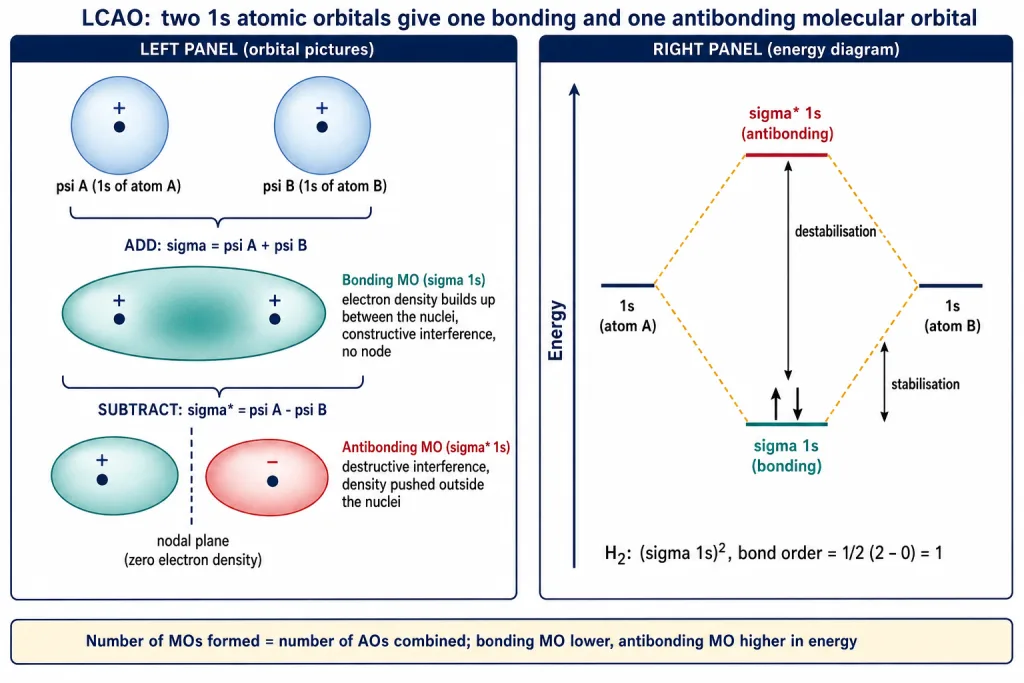
Constructive and destructive interference
Electrons are waves, and two waves can meet crest-to-crest and reinforce (constructive interference) or crest-to-trough and cancel (destructive interference).
- Bonding (): the waves reinforce between the nuclei, so electron density there is increased. That negative charge pulls both nuclei inward and screens them, keeping nucleus-nucleus repulsion small. An electron here stabilises the molecule.
- Antibonding (): the waves cancel in the middle. Electron density is pushed away from between the nuclei, and there is a nodal plane — a surface of exactly zero electron density — midway between them. Unscreened, the nuclei repel strongly, so an electron here destabilises the molecule.
Key Point: A bonding MO always has lower energy than either atomic orbital that made it; an antibonding MO always has higher energy than either. The bonding energy is lowered because the electron sits between two attracting nuclei; the antibonding energy is raised because electron-electron repulsion and the exposed nucleus-nucleus repulsion outweigh the attraction.
A bookkeeping rule goes with this: the total energy of the two molecular orbitals equals the total energy of the two original atomic orbitals. The bonding orbital goes down by roughly what the antibonding orbital goes up. (Strictly, the antibonding orbital is raised slightly more than the bonding one is lowered — this asymmetry is why , with both filled, is actually unstable rather than merely neutral. For Class 11 the symmetric picture is what you draw.)
What the plus and minus signs mean
The and on orbital lobes are not electric charges. They are the sign (phase) of the wave function in that region, like the crests and troughs of a water wave. Electron density is , positive everywhere; the sign of matters only when orbitals combine. Lobes of the same sign reinforce (bonding); lobes of opposite sign cancel (antibonding).
Conditions for the combination of atomic orbitals
Three conditions must be satisfied.
- Same or nearly the same energy. A orbital combines with another , but not with a , which is much higher in energy. (For very different atoms this rule loosens, but for homonuclear diatomics it is strict.)
- Same symmetry about the molecular axis. By convention the internuclear axis is the -axis. A orbital of one atom combines with the of the other, but not with its or , whose symmetry about the axis differs. This holds even if the energies match — same energy is necessary, not sufficient.
- Maximum overlap. Greater overlap means greater electron density between the nuclei and a stronger bonding MO.
[Board] "State the conditions for the linear combination of atomic orbitals" is a 3-mark standard. Write all three with one example each: with not (energy); with not (symmetry); overlap must be maximum.
[JEE Main] A refuses to combine with a because the net overlap is zero. The lobes point along the axis, one and one ; the lobes sit perpendicular. Same-sign overlap on one side of the axis is exactly cancelled by opposite-sign overlap on the other, and zero net overlap means no MO forms.
Types of Molecular Orbitals: Sigma and Pi
Molecular orbitals of diatomic molecules are labelled by their symmetry about the bond axis, using Greek letters: (sigma), (pi), (delta). For Class 11 only sigma and pi matter.
Key Point (Definition): A sigma () molecular orbital is symmetrical about the bond axis — rotate it around the axis and it looks the same. A pi () molecular orbital is not symmetrical about the axis; it has a positive lobe above and a negative lobe below the molecular plane.
Throughout this section the internuclear axis is the -axis. If an exam question says "taking the -axis as the internuclear axis", swap the labels accordingly.
Sigma MOs from orbitals
Two orbitals give two MOs, both symmetric about the axis, so both sigma: (bonding) and (antibonding). The same happens with orbitals: and .
Sigma MOs from orbitals
A orbital points along the axis. Two of them approaching head-on overlap end-to-end, and the result is again symmetric about the axis: (bonding, density built up between the nuclei) and (antibonding, with a nodal plane between the nuclei).
Pi MOs from and orbitals
A orbital points perpendicular to the axis, so two of them overlap only sideways — upper lobes above the axis, lower lobes below. The resulting MO has electron density above and below the axis and none on the axis itself, so it is a pi orbital. The bonding has a large electron density above and below the internuclear axis; the antibonding has, in addition, a node between the nuclei. The orbitals do the same in the perpendicular plane, giving and . Since and are equivalent, and have the same energy (they are degenerate), and so do and .
The complete set for a second-period diatomic
Each second-period atom contributes , , and , so two atoms give eight valence atomic orbitals and must produce eight molecular orbitals.
| Atomic orbitals combined | Bonding MO | Antibonding MO | Type | Overlap |
|---|---|---|---|---|
| sigma | head-on | |||
| sigma | head-on (along axis) | |||
| pi | sideways | |||
| pi | sideways |
Adding the pair gives and : ten MOs from ten atomic orbitals. The electrons sit deep inside the atom and hardly overlap, so their bonding and antibonding contributions cancel; is often written KK, meaning "the K shell of both atoms is full and does not affect bonding".
Where the nodes are
| MO | Node(s) relevant to bonding |
|---|---|
| , , | none between the nuclei |
| , , | one nodal plane perpendicular to the axis, midway between the nuclei |
| , | one nodal plane containing the axis (the molecular plane) |
| , | two: the molecular plane and a plane between the nuclei |
In VBT language a sigma bond forms by axial overlap and a pi bond by sideways overlap, and the MO labels mean the same: is the axial combination, and the sideways ones. A double bond in MO language is one filled plus one filled (net), a triple bond one plus two — except for the odd case of , which comes later.
[JEE Main] A nodal plane containing the internuclear axis belongs to any or orbital, never to a . A nodal plane perpendicular to the axis between the nuclei belongs to any antibonding orbital ( or ). A has both.
Energy-Level Diagrams: The Two Orderings You Must Know
Filling the ten MOs needs their order of energy. The energies have been determined experimentally from spectroscopy, and second-period diatomics do not all follow the same order. There are two orderings, and you need both.
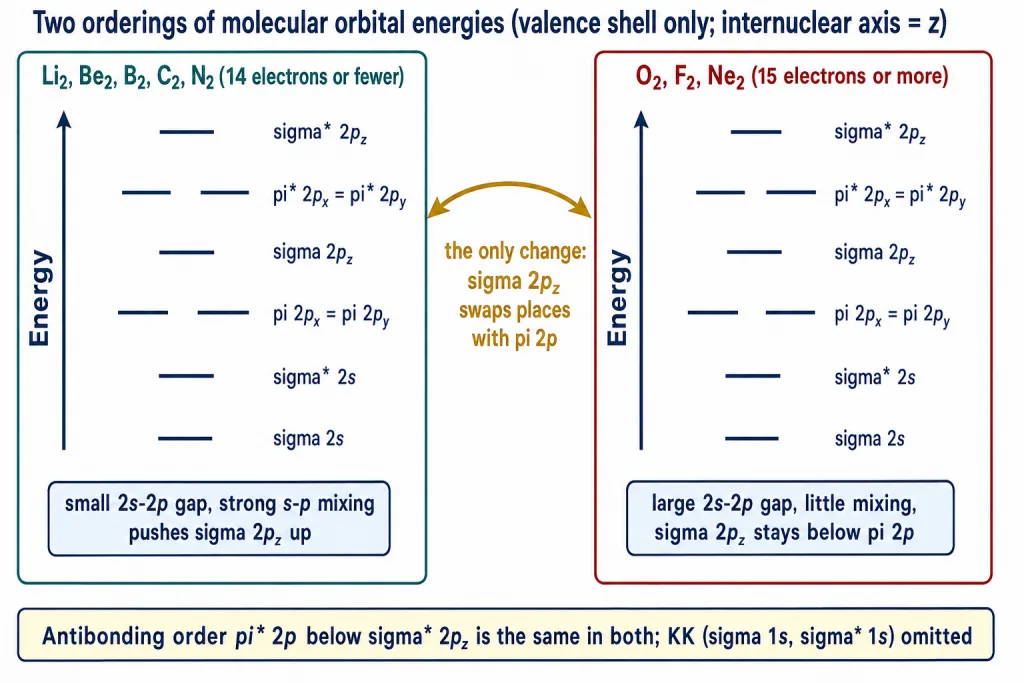
Ordering A: for , (and )
This is the "expected" order. Head-on overlap is stronger than sideways pi overlap, so is lowered more than and sits below it. The antibonding orbitals mirror this: below .
Ordering B: for , , , ,
Only one thing has changed: has moved above and . Everything else — , , , at the bottom, then at the top — stays put. That single swap is the whole difference between the two diagrams.
Key Point: For the lighter molecules to the energy of is higher than that of and . For , and , is lower than and . The antibonding order is the same in both.
Why the swap happens: - mixing
The and orbitals have the same symmetry (both sigma), and orbitals of the same symmetry and comparable energy can interact. When they do, they push each other apart: a little lower, a little higher. The orbitals have a different symmetry, so they are untouched. How far is pushed up depends on the - energy gap in the atom.
| Atom | - gap | - mixing | Effect on | Ordering |
|---|---|---|---|---|
| Li, Be, B, C, N | small (few eV) | strong | pushed up above | B |
| O, F, Ne | large (the orbital has dropped far below as nuclear charge rises) | weak | stays below | A |
Across the period the effective nuclear charge rises and the orbital, which penetrates closer to the nucleus, drops faster than . By oxygen the gap is too big for the two sigma orbitals to interact, the mixing switches off, and order A returns.
[JEE Main] A memory aid: up to nitrogen, pi comes first. For a total electron count ( and lighter, including ions like , , , , ) use ordering B; for 15 electrons and more (, , and their ions) use ordering A. For the common exam species the bond order comes out the same with either ordering, because both and the pair are bonding — what changes is which orbital holds the last electrons, and hence the magnetism of species like and .
Where the orderings make a difference:
has 10 electrons. After KK and , two remain. With ordering A they would pair up in : diamagnetic. With ordering B (the correct one for boron) they go one each into the degenerate and by Hund's rule: paramagnetic, two unpaired electrons. Experiment says is paramagnetic, which proves ordering B is right for the light molecules.
The KK shorthand
In the second period both atoms have a full shell, so and are completely filled, contribute nothing net to bonding, and are abbreviated KK. So is written rather than . Both forms are accepted; use KK when you have many species to write.
Electronic Configuration and Molecular Behaviour
With the MOs in order, the molecule's electrons are poured in by aufbau: lowest orbital first, two per orbital with opposite spins (Pauli), one each into degenerate orbitals before pairing (Hund). The result is the electronic configuration of the molecule, and it gives four things: stability, bond order, bond length and magnetism.
Stability: count bonding against antibonding
Let be the number of electrons in bonding MOs and the number in antibonding MOs.
- If , the bonding influence wins and the molecule is stable.
- If , the antibonding influence wins and the molecule is unstable.
- If , the two cancel; there is no net bond and the molecule does not exist.
Bond order
Key Point (Definition): Bond order is one half the difference between the number of electrons in bonding and antibonding molecular orbitals:
| Bond order | Meaning |
|---|---|
| 1, 2, 3 | single, double, triple bond — the classical bond order |
| , , | fractional bond orders, perfectly allowed in MO theory; they appear in ions and odd-electron molecules (, , ) |
| 0 | : no bond, the molecule does not exist (, , ) |
A positive bond order () means a stable molecule; a zero or negative bond order means an unstable one. The larger the bond order, the more stable the molecule.
Bond order, bond length and bond enthalpy
Bond order is a good approximate guide to both bond parameters.
- Bond length decreases as bond order increases. More bonding electrons pull the nuclei closer: (bond order 3, 109 pm), (bond order 2, 121 pm), (bond order 1, 144 pm).
- Bond enthalpy increases as bond order increases. More energy is needed to pull the atoms apart: 946 kJ/mol, 498 kJ/mol, far weaker.
To rank species by bond length or bond strength, compute the bond orders: highest bond order = shortest, strongest bond.
Magnetic nature
- If all molecular orbitals are doubly occupied (every electron paired), the substance is diamagnetic — weakly repelled by a magnetic field.
- If one or more molecular orbitals are singly occupied (unpaired electrons), the substance is paramagnetic — attracted into a magnetic field. More unpaired electrons means stronger paramagnetism.
is the famous example: two unpaired electrons, paramagnetic. has all electrons paired and is diamagnetic.
A worked mini-example
Nitrogen is , so has electrons. It is lighter than oxygen, so ordering B applies (pi before sigma).
Bonding electrons in , , , , give ; antibonding electrons in , give .
A triple bond — one sigma () and two pi (, ), exactly as says. No unpaired electrons, so diamagnetic. Short bond (109 pm), very large bond enthalpy (946 kJ/mol), unreactive gas.
[Board] Write the full configuration first, then count and on separate lines, then apply the formula — examiners give method marks for these even if the arithmetic slips. KK is zero net, but if the question wants and separately, KK contributes 2 to each. For a quick valence-only bond order, ignore KK and count only the valence-shell MOs; the answer is identical.
Bonding in Homonuclear Diatomic Molecules: From to
For each molecule: total electrons, fill by aufbau using the correct ordering, count and , bond order, magnetism.
The first period: and
Hydrogen, . Two electrons in all, both into : A single covalent bond. Bond dissociation energy 438 kJ/mol, bond length 74 pm. No unpaired electrons: diamagnetic.
Helium, . Each atom is , so four electrons. Two fill , the next two are forced into : Zero bond order: is unstable and does not exist. Removing one antibonding electron gives , bond order , and that ion does exist.
The second period
| Molecule | Electrons | Configuration (beyond KK) | B.O. | Magnetism | Note | ||
|---|---|---|---|---|---|---|---|
| 6 | 4 | 2 | 1 | diamagnetic | exists in the vapour phase | ||
| 8 | 4 | 4 | 0 | — | does not exist | ||
| 10 | 6 | 4 | 1 | paramagnetic (2 unpaired) | proves ordering B | ||
| 12 | 8 | 4 | 2 | diamagnetic | double bond = two bonds | ||
| 14 | 10 | 4 | 3 | diamagnetic | 109 pm, 946 kJ/mol | ||
| 16 | 10 | 6 | 2 | paramagnetic (2 unpaired) | 121 pm, 498 kJ/mol | ||
| 18 | 10 | 8 | 1 | diamagnetic | 144 pm | ||
| 20 | all ten MOs full, ending | 10 | 10 | 0 | — | does not exist |
(In the and columns KK is counted as 2 bonding and 2 antibonding; drop both if you are counting valence electrons only — the bond order is unchanged.)
Lithium, . Lithium is ; six electrons. , bond order , all electrons paired — a stable diamagnetic single-bonded molecule, known in the vapour phase.
Carbon, . Carbon is ; twelve electrons. With ordering B the last four fill and completely before is touched: . Bond order , diamagnetic — and diamagnetic has been detected in the vapour phase. The double bond in consists of two pi bonds and no sigma bond, because the four bonding electrons are all in pi MOs. In almost every other molecule a double bond is one sigma plus one pi.
Oxygen, . Oxygen is ; sixteen electrons, and ordering A applies ( below ):
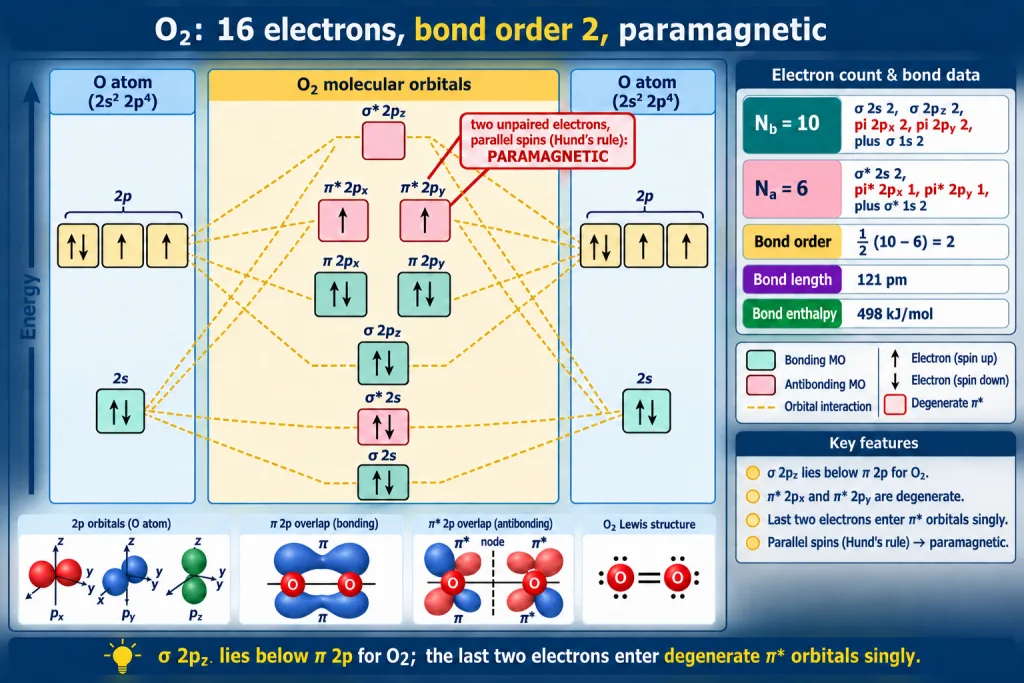
Fourteen electrons fill everything up to ; the remaining two go into the degenerate pair , , one in each with parallel spins by Hund's rule. So , , bond order — a double bond, 121 pm, 498 kJ/mol — and two unpaired electrons in and , so is paramagnetic. This matches the experiment that the Lewis structure and VBT could not explain, and it is the most-quoted success of MO theory.
The Ions
Adding or removing an electron changes the bond order by a simple rule: an electron removed from a bonding MO lowers bond order; an electron removed from an antibonding MO raises it; adding does the opposite. Work from the parent molecule's configuration.
| Species | Electrons | Change from parent | B.O. | Unpaired | Magnetism | ||
|---|---|---|---|---|---|---|---|
| 1 | 1 | 0 | 1 | paramagnetic | |||
| 2 | 2 | 0 | 1 | 0 | diamagnetic | ||
| 3 | 2 | 1 | 1 | paramagnetic | |||
| 3 | 2 | 1 | 1 | paramagnetic | |||
| 13 | remove one from | 9 | 4 | 1 | paramagnetic | ||
| 14 | — | 10 | 4 | 3 | 0 | diamagnetic | |
| 15 | add one to | 10 | 5 | 1 | paramagnetic | ||
| 16 | add one each to , | 10 | 6 | 2 | 2 | paramagnetic | |
| 15 | remove one from | 10 | 5 | 1 | paramagnetic | ||
| 16 | — | 10 | 6 | 2 | 2 | paramagnetic | |
| (superoxide) | 17 | add one to | 10 | 7 | 1 | paramagnetic | |
| (peroxide) | 18 | fill both | 10 | 8 | 1 | 0 | diamagnetic |
Two orders fall straight out of the table:
- Bond order (= stability = bond strength):
- Bond length:
[JEE Main] Ionisation acts in opposite directions for the two molecules. removes a bonding electron, so bond order drops (3 to 2.5) and the bond gets longer and weaker. removes an antibonding electron, so bond order rises (2 to 2.5) and the bond gets shorter and stronger. and both have bond order 2.5; is ranked more stable because it has fewer antibonding electrons (4 against 5), and antibonding electrons destabilise slightly more than bonding electrons stabilise. So .
Isoelectronic species share a configuration. , and each have 14 electrons, like ; with ordering B they all come out with bond order 3 and diamagnetic. has 15 electrons like : bond order 2.5, one unpaired electron, paramagnetic. Counting the electrons and matching to a homonuclear molecule answers most heteronuclear questions at JEE Main level.
Solved Examples
Question 1: Hydrogen and helium — the molecule that exists and the one that doesn't
Write the molecular orbital electronic configuration of and . Calculate the bond order of each, state their magnetic behaviour, and explain why is a stable molecule while does not exist.
Answer:
has 2 electrons, would have 4. Two orbitals give (bonding, lower) and (antibonding, higher).
In both electrons go into the lower orbital with opposite spins: . , , . One single bond; bond length 74 pm, bond dissociation energy 438 kJ/mol. All paired, diamagnetic.
In the first two electrons fill and the next two have nowhere to go but : . , , . The bonding electrons are cancelled by the antibonding ones, so with no net bond the atoms do not stay together.
Ans: , bond order 1, diamagnetic, stable. , bond order 0, does not exist.
Watch out: Zero bond order means no molecule at all — that is how MO theory accounts for the noble gases being monatomic.
Question 2: The half-bond family — , and
does not exist, yet has been detected. Write the MO configurations and bond orders of , and , state which are paramagnetic, and explain why can exist when cannot.
Answer:
Electron counts first. : . : . : .
has one electron in the lowest MO: . , , . One unpaired electron, paramagnetic.
In two electrons fill and the third goes into : . , , . One unpaired electron, paramagnetic.
also has three electrons, so it fills the same way: , bond order , one unpaired electron, paramagnetic.
Compared with , the electron removed comes out of the antibonding , so the bond order climbs from 0 to — small but positive — and the ion holds together weakly.
Ans: , B.O. ; , B.O. ; , B.O. . All three are paramagnetic. exists because its bond order is positive, unlike whose bond order is zero.
Watch out: Fractional bond orders are real. Any positive bond order, even one half, means the species can exist.
Question 3: Conditions for atomic orbitals to combine
State the conditions that must be satisfied for atomic orbitals to combine and form molecular orbitals. Then decide, taking the -axis as the internuclear axis, which of these pairs can form a molecular orbital: (a) and ; (b) and of a homonuclear molecule; (c) and ; (d) and .
Answer:
The three conditions are:
- Energy. Same or nearly the same energy. A can combine with another , but not with a , which is much higher in energy (this relaxes for very different atoms, but not here).
- Symmetry. Same symmetry about the molecular () axis. Same energy is not enough on its own: combines with , but not with or , because the symmetries differ and the net overlap is zero.
- Overlap. Maximum overlap. Greater overlap means greater electron density between the nuclei and a stronger bond.
Testing each pair: (a) and have the same energy, are both spherical and overlap well, giving and . (b) and share symmetry but their energies are far apart, so condition 1 fails. (c) and have the same energy and overlap head-on along the axis, giving and . (d) and have the same energy but different symmetry about the axis, so condition 2 fails.
Ans: (a) yes, ; (b) no (energy mismatch); (c) yes, ; (d) no (symmetry mismatch).
Watch out: Test any proposed pair against all three conditions — energy match, symmetry match, maximum overlap. A pair can pass one and fail another.
Question 4: Why does not exist
Use molecular orbital theory to explain why the molecule does not exist.
Answer:
Beryllium is , so each atom has 4 electrons and would have 8.
Two orbitals give and ; two orbitals give and . Filling in order: , or .
Bonding electrons sit in and (), antibonding in and (), so . Every bonding electron is cancelled by an antibonding one, leaving nothing to hold the atoms together.
Ans: has the configuration with , so its bond order is zero and it does not exist.
Watch out: Any molecule whose last electrons complete an antibonding level matching a filled bonding level ends with bond order 0. , and all fail the same way.
Question 5: Bond orders of , , and
What is meant by the term bond order? Calculate the bond order of , , and .
Answer:
Bond order is one half the difference between the number of electrons in bonding MOs () and in antibonding MOs (): . It gives the number of bonds (1, 2, 3 for single, double, triple), and a higher bond order means a shorter, stronger, more stable bond.
, 14 electrons, pi-before-sigma ordering: . , , .
, 16 electrons, sigma-before-pi ordering: . , , .
, 15 electrons: removing one from 's highest occupied level, , ends it at . , , .
, 17 electrons: adding one to ends it at . , , .
Ans: : 3; : 2; : 2.5; : 1.5.
Watch out: In the oxygen family every electron added or removed is an antibonding electron, so each one changes the bond order by exactly one half.
Question 6: Comparing the nitrogen species , , and
Compare the relative stability of , , and and indicate their magnetic properties.
Answer:
Starting from , 14 electrons: . , , B.O. . No unpaired electrons, diamagnetic.
, 13 electrons: one comes out of the highest occupied MO, , leaving . , , B.O. . One unpaired electron, paramagnetic.
, 15 electrons: the extra one goes into the next empty level, , giving . , , B.O. . One unpaired electron, paramagnetic.
, 16 electrons: the two extra ones go one each into and by Hund's rule. , , B.O. . Two unpaired electrons, paramagnetic.
Ranking by bond order, (3) is most stable and (2) least, with and tied at 2.5. has 4 antibonding electrons against 5 for , and antibonding electrons destabilise slightly more than bonding electrons stabilise, so is marginally more stable.
Ans: Stability (bond orders 3, 2.5, 2.5, 2). Magnetism: diamagnetic; , and paramagnetic (one, one and two unpaired electrons respectively).
Watch out: For nitrogen, losing an electron empties a bonding orbital and gaining one fills an antibonding orbital, so both lower the bond order. Bond order alone ties and at 2.5; the antibonding count breaks the tie.
Question 7: Comparing the oxygen species , , and
Compare the relative stability of , , (superoxide) and (peroxide), indicate their magnetic properties, and arrange them in order of increasing bond length.
Answer:
The parent has 16 electrons: . B.O. , two unpaired electrons, paramagnetic. Every ion below differs only in the filling, so stays 10.
, 15 electrons: one electron removed, ending . B.O. , one unpaired electron, paramagnetic.
, 17 electrons: one electron added, ending . B.O. , one unpaired electron, paramagnetic.
, 18 electrons: two added, ending . B.O. , all paired, diamagnetic.
Higher bond order means more stable and shorter, so bond length runs opposite to stability.
Ans: Stability (bond orders 2.5, 2, 1.5, 1). Magnetism: , and paramagnetic (1, 2, 1 unpaired electrons); diamagnetic. Increasing bond length: .
Watch out: Every electron added here lands in , so the bond order falls by 0.5 per electron. Peroxide, with both orbitals full, is the only diamagnetic member.
Question 8: The odd double bond of , and why is paramagnetic
Write the MO configurations of and . Find their bond orders and magnetic behaviour, and explain why the double bond in is said to have no sigma bond in it.
Answer:
Both molecules are lighter than , so the pi orbitals lie below :
, 10 electrons: uses 8, and the last two go one each into the degenerate and by Hund's rule. , , B.O. . Two unpaired electrons, paramagnetic. Under the sigma-first ordering they would pair in and would be diamagnetic; experiment finds it paramagnetic, direct evidence that lies above for the lighter molecules.
, 12 electrons: the four electrons fill and completely before is reached, giving . , , B.O. . All paired, diamagnetic — and diamagnetic has been detected in the vapour phase.
The and contributions cancel, so all the net bonding comes from the four electrons. The double bond in is two pi bonds with no sigma bond, unlike the usual one-sigma-plus-one-pi double bond.
Ans: : , B.O. 1, paramagnetic. : , B.O. 2, diamagnetic; its double bond consists of two pi bonds because is empty.
Watch out: The pi-before-sigma ordering is not a formality — it makes paramagnetic and gives a bond built from pi electrons only.
Question 9: Why is paramagnetic while is diamagnetic?
Liquid oxygen is attracted to a magnet; liquid nitrogen is not. Explain this using molecular orbital theory, and say why the Lewis structure of could not predict it.
Answer:
Attraction into a magnetic field means unpaired electrons (paramagnetism); no attraction means every electron is paired (diamagnetism). So has unpaired electrons and does not.
The Lewis picture fails. with two lone pairs on each oxygen uses all 12 valence electrons in pairs and predicts diamagnetism, which is wrong. VBT, built on paired electrons, has the same problem.
, 14 electrons: . Every MO is doubly occupied and the antibonding levels are empty. No unpaired electrons, so diamagnetic, as observed.
, 16 electrons: . Fourteen electrons fill everything up to , and the last two must go into the degenerate pair and , one in each with parallel spins by Hund's rule. Two unpaired electrons, so paramagnetic, as observed.
Lewis and VBT have no concept of two orbitals of equal energy that must be half-filled before pairing. MO theory builds the degenerate pair into the diagram, and the filling rules do the rest.
Ans: has all 14 electrons paired (bond order 3), so it is diamagnetic. 's two extra electrons occupy the degenerate antibonding orbitals and singly with parallel spins, giving two unpaired electrons and paramagnetism (bond order 2). The Lewis structure pairs every electron and cannot show this.
Watch out: The two unpaired electrons of oxygen live in , not in any bond you could draw. This is MO theory's signature result.
Question 10: What happens to the bond when a molecule is ionised?
When one electron is removed from and from , in which case does the bond become stronger, and in which does it become weaker? Justify using bond orders, and predict the effect on bond length in each case.
Answer:
Ionisation removes the electron from the highest occupied molecular orbital, so I identify that orbital for each molecule.
For it is , a bonding orbital. Removing a bonding electron reduces from 10 to 9, so the bond order falls from to : weaker and longer.
For it is , an antibonding orbital. Removing an antibonding electron reduces from 6 to 5, so the bond order rises from to : stronger and shorter.
Bond length decreases as bond order increases, so has a longer bond than (109 pm) and a shorter one than (121 pm). Both ions end at bond order 2.5 with one unpaired electron and paramagnetism, arriving from opposite directions.
Ans: Ionising removes a bonding electron: bond order 3 to 2.5, bond weaker and longer. Ionising removes an antibonding electron: bond order 2 to 2.5, bond stronger and shorter.
Watch out: Always ask which orbital the electron comes from or goes to. A bonding electron out or an antibonding electron in weakens the bond; an antibonding electron out or a bonding electron in strengthens it.
Question 11: Nodes, signs and symmetry — which combinations work?
(a) What do the plus and minus signs drawn on orbital lobes signify? (b) Taking the -axis as the internuclear axis this time, which of the following pairs will form a sigma MO, a pi MO, or no MO at all: with ; with ; with ; with ? (c) How many nodal planes does a orbital have?
Answer:
(a) The and on lobes are the sign (phase) of the wave function in that region, not electric charges. They matter only when orbitals combine: same-sign lobes reinforce and give a bonding MO (constructive interference), opposite-sign lobes cancel and give an antibonding MO (destructive interference) with a node between the nuclei.
(b) The internuclear axis is now , so points along the bond and , are perpendicular to it — the usual roles of and are swapped.
with : spherical, same energy, head-on overlap — a sigma MO (, ).
with : both along the axis, so end-to-end overlap symmetric about it gives a sigma MO (, in this convention).
with : both perpendicular, so sideways overlap gives lobes above and below the axis — a pi MO (, ).
with : same energy but different symmetry. Same-sign overlap on one side is cancelled by opposite-sign overlap on the other, so net overlap is zero and no MO forms.
(c) A bonding orbital already has one nodal plane containing the internuclear axis, and adds a second perpendicular to the axis, between the nuclei — two in total.
Ans: (a) the signs are the phases of the wave function — same-sign overlap gives bonding, opposite-sign gives antibonding; (b) : sigma; : sigma; : pi; : no MO; (c) two nodal planes.
Watch out: Read the stated axis before answering. Whichever axis the question chooses, the orbital along it gives sigma, the two perpendicular ones give pi, and a mixed pair gives nothing.
Question 12: Isoelectronic with — , and ; and
Using the electron-count analogy with homonuclear molecules, find the bond order and magnetic behaviour of , , and . Which of them has the shortest bond, and which is paramagnetic?
Answer:
First the electron counts. : . : . : . : .
Fourteen electrons matches ; fifteen matches (or ). Isoelectronic species share a configuration, so they share bond order and magnetism.
The three 14-electron species take the same configuration as , using the pi-before-sigma ordering: . , , B.O. , all paired, diamagnetic. This is why is written and why and both carry a triple bond.
has one electron more than , and it goes into . , , B.O. , one unpaired electron, paramagnetic. This is the odd-electron molecule from the octet-rule section.
All three 14-electron species have bond order 3 and so a shorter bond than (2.5). Among the three, exam questions usually treat them as comparable; if forced to choose, comes first because the positive charge contracts the orbitals. The safe statement is . Also, removes an antibonding electron, so bond order goes 2.5 to 3 and the bond shortens, as with .
Ans: , and : bond order 3, diamagnetic. : bond order 2.5, paramagnetic. has the longest bond and is the only paramagnetic one.
Watch out: Count the electrons and borrow the homonuclear diagram. 14 behaves like (B.O. 3, diamagnetic); 15 like (B.O. 2.5, paramagnetic); 16 like (B.O. 2, two unpaired electrons).