
What Is a Hydrogen Bond?
Hydrogen fluoride, HF, has molar mass 20. Hydrogen chloride, HCl, is almost twice as heavy, and heavier molecules usually boil higher because there is more electron cloud for van der Waals forces to grab. Yet HF boils at about 19.5°C (293 K) while HCl boils at -85°C (188 K). Something holds HF molecules together far more tightly than ordinary intermolecular forces can explain: the hydrogen bond.
Nitrogen, oxygen and fluorine are the three most electronegative elements. When one of them is covalently bonded to hydrogen, the shared pair is pulled hard towards the electronegative atom, leaving the hydrogen almost bare — a tiny nucleus with very little electron cloud, carrying a partial positive charge (). That exposed hydrogen is strongly attracted to the lone pair of an electronegative atom on a neighbouring molecule.
Key Point (Definition): A hydrogen bond is the attractive force which binds the hydrogen atom of one molecule with the electronegative atom (F, O or N) of another molecule — or, in some cases, of the same molecule. It is written with a dotted line; the ordinary covalent bond is a solid line.
For hydrogen fluoride:
Any single hydrogen here is held to one fluorine by a solid line (a proper covalent bond) and to the fluorine of the next molecule by a dotted line. The hydrogen acts as a bridge between two electronegative atoms, gripping one covalently and the other by the hydrogen bond.
Where the hydrogen bond sits among the forces you know
A covalent bond has a bond enthalpy of a few hundred kJ/mol — H-F about 565 kJ/mol, O-H about 464.5 kJ/mol on average. Van der Waals attraction between two small non-polar molecules is worth only a kJ/mol or so. A hydrogen bond sits in between: typically 10 to 40 kJ/mol, the strongest (in HF) around 40 kJ/mol and those in water around 20 kJ/mol.
| Interaction | Typical energy | Example |
|---|---|---|
| Covalent bond | 200 to 950 kJ/mol | (565), (946) |
| Hydrogen bond | 10 to 40 kJ/mol | (about 40), (about 20) |
| van der Waals (dispersion) | 0.5 to 5 kJ/mol | between two molecules |
So the hydrogen bond is weaker than a covalent bond but stronger than van der Waals forces — strong enough to organise liquids and solids, weak enough to break and re-form at ordinary temperatures.
The two players that must both be present
- A donor: a hydrogen atom covalently bonded to F, O or N, so it carries a real charge.
- An acceptor: an F, O or N atom carrying a lone pair, on which that hydrogen can land.
Miss either one and there is no hydrogen bond. Methane, , has plenty of hydrogens, but they are on carbon, which is not electronegative enough — no donor. Diethyl ether has an oxygen with two lone pairs (an acceptor), but every hydrogen in it is on carbon — again no donor. Neither compound hydrogen-bonds with itself. Water has both: two donors and two lone pairs per molecule.
[JEE/NEET] F, O and N are the three atoms to remember. Chlorine has the same electronegativity as nitrogen (3.0 on the Pauling scale) but is too large — its charge is spread over a bigger atom — so does not form effective hydrogen bonds. Both high electronegativity and small size are needed.
[Board] When you are asked to "define hydrogen bond", give the definition in the Key Point above word for word, draw the chain with the dotted lines, and add one line comparing its strength with covalent and van der Waals forces. That is a complete answer.
Why the Hydrogen Bond Forms
Understanding why the bond forms tells you when it will form.
Step 1: a very polar covalent bond
In any bond with X strongly electronegative, the shared pair moves far towards X. Hydrogen ends up with a fractional positive charge, , and X with .
HCl is polar too. What makes F, O and N special is the degree of polarity. With Pauling electronegativities F 4.0, O 3.5 and N 3.0 against hydrogen's 2.1, the differences are 1.9, 1.4 and 0.9 — large enough to strip hydrogen of most of its electron density.
Step 2: hydrogen has nothing to hide behind
Hydrogen has no inner-shell electrons. Every other atom keeps its core electrons after the valence electrons are pulled away, so its positive charge stays screened. When hydrogen loses its share of the bonding pair, what remains is essentially a bare proton — extremely small, with a very concentrated positive charge. That is why the partial positive charge on hydrogen acts far more strongly than the same charge on carbon in .
Step 3: the exposed proton finds a lone pair
The hydrogen of one molecule is pulled electrostatically towards a lone pair on the atom of a neighbour, where the electron density is concentrated:
Key Point: The hydrogen bond is mainly an electrostatic attraction between a strongly hydrogen (bonded to F, O or N) and the lone pair of an electronegative atom (F, O or N). Its strength grows with the electronegativity of the atoms involved and falls as those atoms get bigger.
Why only F, O and N
Two conditions must be met by X, and only three elements satisfy both well:
| Requirement | Why it matters | Who passes |
|---|---|---|
| High electronegativity | Only then is the bond polar enough to leave H with a real | F, O, N (Cl is borderline) |
| Small size | A small atom concentrates its and its lone pair into a small volume, so the hydrogen can approach very closely | F, O, N (Cl, S, Br are too big) |
Chlorine is the instructive failure. Its electronegativity (3.0) equals nitrogen's, but its lone pairs are spread over a much larger atom, so the attraction it offers a hydrogen is feeble. HCl behaves like an ordinary polar molecule, boiling at -85°C, while HF, of the same shape and smaller mass, boils at 19.5°C.
Strength depends on physical state
The extent of hydrogen bonding is maximum in the solid, where molecules are locked in place; less in the liquid, where bonds break and re-form as molecules tumble; and minimum in the gas, where molecules are far apart. That is why it shows up most strongly in melting points, boiling points and crystal structures.
Strength ranking
Fluorine is the most electronegative and smallest of the three, so is the strongest hydrogen bond of all — around 40 kJ/mol, strong enough that the ion survives in the salt . Oxygen comes next, nitrogen last.
[JEE Main] Strength order of the common hydrogen bonds:
This follows the electronegativity of the acceptor atom. Yet water boils higher than HF — resolved not by strength but by the number of hydrogen bonds per molecule, in the next block.
A hydrogen bond is not a chemical bond in the usual sense: it creates no new molecule, it only holds existing molecules (or parts of one molecule) together. And has a covalent bond, with no hydrogen bonding at all.
Types of Hydrogen Bond
Hydrogen bonds come in two kinds, depending on whether the bridge links two different molecules or two parts of the same molecule.
1. Intermolecular hydrogen bonding
A hydrogen bond formed between two different molecules, of the same compound or of different compounds.
Hydrogen fluoride. HF molecules link into long zig-zag chains in the solid and the liquid, each fluorine holding one hydrogen covalently and the next molecule's hydrogen through a hydrogen bond. The chain zig-zags because the hydrogen bond points along fluorine's lone pair, which sits at an angle to the covalent bond; the angle is close to 120°. Even in the vapour just above the boiling point, HF exists mostly as clusters.
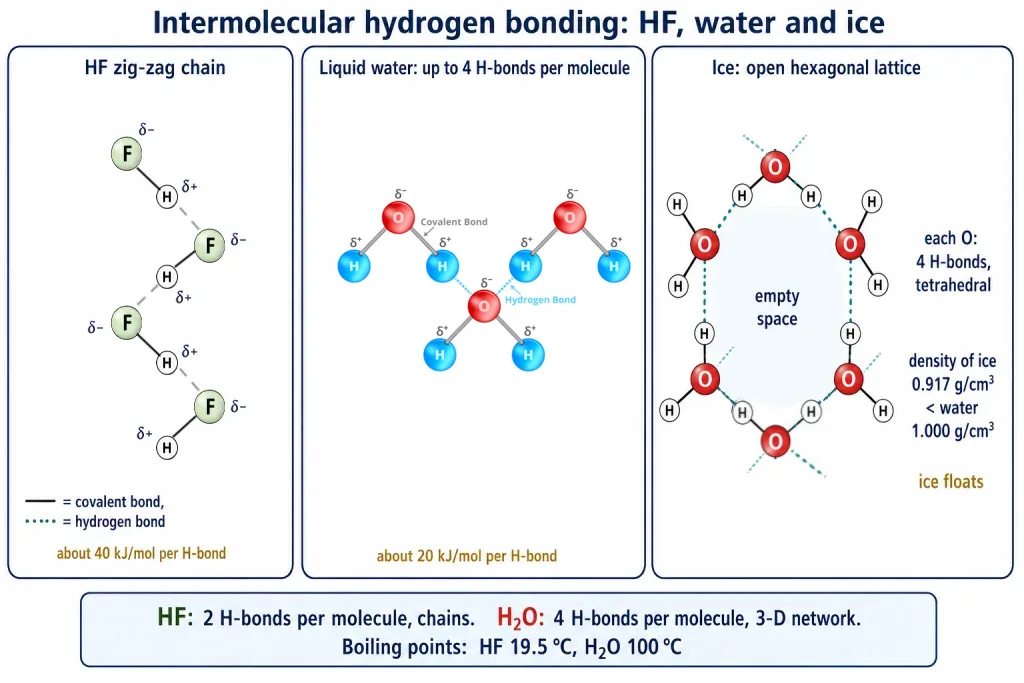
Water. Each molecule has two bonds (donors) and two lone pairs on oxygen (acceptors), so it can take part in up to four hydrogen bonds. In liquid water these form and break continually, averaging a little over three per molecule; in ice all four are formed, and every oxygen sits at the centre of a tetrahedron of four other oxygens.
Alcohols. Ethanol, , has one group, so its molecules chain together through bonds. Ethanol (molar mass 46) boils at 78°C while its isomer dimethyl ether, (same molar mass 46, no bond), boils at -24°C.
Ammonia. Nitrogen has one lone pair and three bonds, so forms bonds — weaker than those of water and HF, but enough to raise its boiling point to -33°C against -88°C for .
Carboxylic acids. Two acetic acid molecules pair head-to-head through two bonds to form a dimer — an eight-membered ring in which each acid's bonds to the oxygen of the other. The dimer is stable enough that acetic acid and benzoic acid show a molar mass in benzene double the formula mass, and acetic acid vapour contains dimers even at its boiling point.
Between different compounds. Ethanol dissolves in water in any proportion because bonds form between ethanol and water as easily as within either pure liquid. Ammonia is very soluble for the same reason: and bonds form freely.
2. Intramolecular hydrogen bonding
Here the hydrogen sits between two highly electronegative atoms (F, O, N) within the same molecule. The geometry must let the donor and the acceptor come close enough — in practice the bond has to close a ring of five or six atoms.
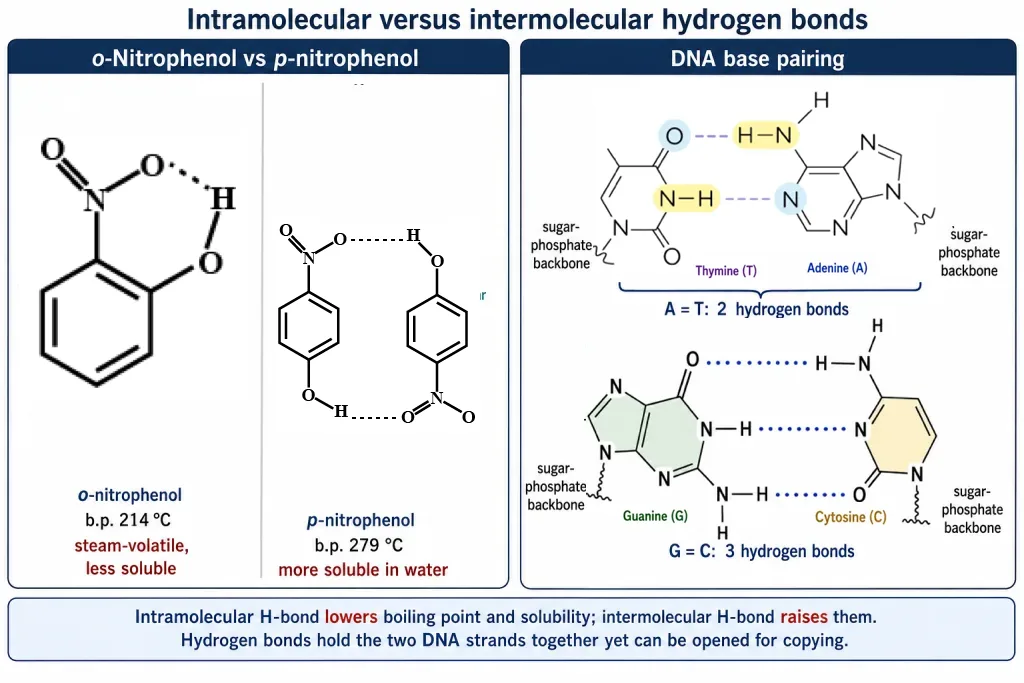
The classic example is o-nitrophenol (2-nitrophenol). The phenolic and the nitro group sit on adjacent carbons of the benzene ring, close enough for the hydrogen to bond to one nitro oxygen, closing a six-membered ring (H, O, C, C, N, O). That hydrogen is now busy inside its own molecule and unavailable to neighbours.
Two more with the same six-membered-ring pattern:
| Compound | Donor group | Acceptor atom | Ring closed |
|---|---|---|---|
| o-Nitrophenol | phenolic | O of | six-membered |
| Salicylaldehyde (o-hydroxybenzaldehyde) | phenolic | O of | six-membered |
| Salicylic acid (o-hydroxybenzoic acid) | phenolic | O of | six-membered |
This ring-closing hydrogen bond is called chelation, and its effect on physical properties is sometimes called the ortho effect.
Key Point: Intermolecular hydrogen bonding increases boiling point, melting point and water solubility. Intramolecular hydrogen bonding decreases them relative to isomers that can only bond intermolecularly, because the hydrogen is tied up inside the molecule.
The standard comparison: o-nitrophenol boils at 214°C and is steam-volatile with low water solubility, while p-nitrophenol (groups on opposite sides of the ring, unable to reach each other) boils at 279°C and is much more water-soluble. In the para isomer every is free to link to neighbours and to water; in the ortho isomer it is locked up. Steam distillation separates them — the ortho isomer comes over with the steam, the para stays behind.
[NEET] Ortho isomer with an intramolecular H-bond → lower boiling point, lower solubility, more volatile. Para (and meta) isomer → higher boiling point, higher solubility. Do not reverse this.
Consequences I: Abnormal Boiling Points
A liquid whose molecules hydrogen-bond needs extra energy to let them escape into the vapour, so its boiling point goes up.
The hydrides of groups 15, 16 and 17
| Group 16 hydride | Boiling point | Group 17 hydride | Boiling point | Group 15 hydride | Boiling point |
|---|---|---|---|---|---|
| 100°C (373 K) | 19.5°C (293 K) | -33°C (240 K) | |||
| -60°C (213 K) | -85°C (188 K) | -88°C (185 K) | |||
| -41°C (232 K) | -67°C (206 K) | -62°C (211 K) | |||
| -2°C (271 K) | -35°C (238 K) | -17°C (256 K) |
Read each column from the second row downward and the normal trend appears: , , . The molecules get heavier and more polarisable, van der Waals forces grow, and the boiling point rises. Extending that line back to the first member would predict near -80°C, HF near -100°C and near -110°C.
Instead the first member of each group sits far above its neighbours. That is the hydrogen bond at work — only O, F and N can form it.
Key Point: Because of intermolecular hydrogen bonding, , and have abnormally high boiling points compared with the other hydrides of their groups. From the second member onward, the boiling point rises normally with molar mass.
The orders you must be able to write
- Group 16:
- Group 17:
- Group 15:
Group 15 is the odd one. Ammonia's bonds are the weakest of the three kinds, so they lift above and but not above the heavy , whose large van der Waals forces win. In groups 16 and 17 the hydrogen bonds are strong enough that water and HF top their columns outright.
Water above HF — the number-of-bonds argument
The bond (about 40 kJ/mol) is stronger than the bond (about 20 kJ/mol). So why does water boil at 100°C and HF at only 19.5°C?
Count the bonds each molecule can make. HF has three lone pairs on fluorine but only one hydrogen, so each molecule donates once and, on average, accepts once: two hydrogen bonds, and only one-dimensional chains. Water has two hydrogens and two lone pairs, a perfect match, so each molecule forms four hydrogen bonds and builds a three-dimensional network. Twice as many bonds, each half as strong, spread through three dimensions: the network wins. Ammonia has three hydrogens but only one lone pair, so the lone pair is the bottleneck and each forms only about two weak bonds.
| Molecule | Donor H atoms | Lone pairs | H-bonds per molecule | Structure | Boiling point |
|---|---|---|---|---|---|
| 1 | 3 | 2 | zig-zag chains | 19.5°C | |
| 2 | 2 | 4 | 3-D network | 100°C | |
| 3 | 1 | about 2 | weak, limited | -33°C |
So the boiling-point order is , while the strength order of the individual bonds is . Keep the two lists separate.
Organic pairs
| Pair (same or similar molar mass) | Boiling points | Reason |
|---|---|---|
| Ethanol vs dimethyl ether | 78°C vs -24°C | ethanol has , the ether does not |
| Methanol (32) vs ethane (30) | 65°C vs -89°C | methanol hydrogen-bonds, ethane cannot |
| Acetic acid (60) vs propan-1-ol (60) | 118°C vs 97°C | acid forms doubly hydrogen-bonded dimers |
| o-Nitrophenol vs p-nitrophenol | 214°C vs 279°C | ortho bonds intramolecularly, para intermolecularly |
[JEE/NEET] To arrange boiling points, ask three questions in order: (1) Which molecules can hydrogen-bond at all (need H on F, O or N)? (2) Among those, how many bonds per molecule and how strong? (3) Among the rest, which is heaviest and most polarisable? Intramolecular H-bonding, where present, lowers the boiling point.
Consequences II: Water, Ice, Solubility and Viscosity
Water's strange properties all trace back to the bond.
Why ice floats
Almost every substance is denser as a solid, because an ordered crystal packs molecules closer. Water is the exception: ice (0.917 g/cm³ at 0°C) is less dense than liquid water (1.000 g/cm³ at 4°C), so ice floats.
The reason is the geometry of the hydrogen bonds. In ice every water molecule forms all four of its possible hydrogen bonds, pointing to the corners of a tetrahedron around the oxygen (the angle of 104.5° is close to the tetrahedral angle, so the fit is natural). Four tetrahedral neighbours produce an open, cage-like hexagonal lattice — the lattice behind the six-fold symmetry of snowflakes — with much empty space in the hexagonal channels. On melting, about 15% of these bonds break, the cages collapse, and molecules fall into the empty spaces, so the liquid packs more tightly than the solid.
Key Point: Ice has an open hexagonal structure in which each water molecule is hydrogen-bonded tetrahedrally to four others. This open structure has more empty space than liquid water, so ice is less dense than water and floats on it.
Water is densest at 4°C: between 0°C and 4°C, warming breaks more leftover ice-like cages and the liquid contracts, and above 4°C thermal expansion takes over. So lakes freeze from the top down, and the ice layer insulates the water below.
High specific heat and heat of vaporisation
Raising water's temperature means stretching and partly breaking hydrogen bonds, so water absorbs an unusually large amount of heat for a small rise: its specific heat capacity is about 4.18 J/g/K, higher than almost any other common liquid. Turning water into steam breaks those bonds completely, which is why its enthalpy of vaporisation (about 40.7 kJ/mol at 100°C) is so large. That makes water a superb coolant — in car radiators, in sweat evaporating from skin, and in the oceans that moderate the planet's climate.
High surface tension and viscosity
Molecules at a liquid surface are pulled inward by neighbours below, and in water those pulls are hydrogen bonds. The result is the highest surface tension of any common liquid (about 72 mN/m at 25°C) — enough for water striders to walk on ponds and for water to form near-spherical droplets. Hydrogen bonds also resist one layer sliding over another, giving water a higher viscosity than a non-bonded liquid of similar size.
Glycerol, , is the extreme case: three groups per molecule tie it to its neighbours by a whole net of hydrogen bonds. It is about a thousand times more viscous than water, pours like syrup, and boils at 290°C. Sugars, with five or more groups, are so strongly hydrogen-bonded that they are crystalline solids.
Solubility
Small alcohols dissolve in water in all proportions because their groups hydrogen-bond with water. Glucose, with five groups and an aldehyde oxygen, dissolves readily for the same reason, and ammonia and small amines dissolve through and bonds. Hexane, with no F, O or N, simply floats on water.
As the hydrocarbon part of an alcohol grows, the single is outnumbered by non-bonding groups and solubility drops: methanol, ethanol and propanol are fully miscible, butanol only partly, octanol hardly at all.
Association of carboxylic acids
Two acetic acid molecules form two bonds at once, each acid's to the other's oxygen, closing an eight-membered ring. The consequences:
- Acetic acid and benzoic acid give double the expected molar mass in a non-polar solvent such as benzene.
- Acetic acid vapour near its boiling point is largely dimeric.
- Acetic acid boils at 118°C, well above propan-1-ol (97°C) of the same molar mass, because breaking two bonds per pair is harder than breaking one.
[Board] For "why is ice lighter than water?", answer in three lines — tetrahedral hydrogen bonding, open hexagonal cage with empty space, cages collapse on melting so the liquid packs closer.
Consequences III: Hydrogen Bonds in Life, and a Few Loose Ends
DNA: the two strands are held by hydrogen bonds
DNA is a double helix of two strands, not covalently joined — if they were, the cell could not unzip them to copy or read the code. They are held by hydrogen bonds between complementary bases, and the pairing is strict:
| Base pair | Number of hydrogen bonds | Bonds involved |
|---|---|---|
| Adenine with thymine (A=T) | 2 | one and one |
| Guanine with cytosine (G≡C) | 3 | two and one |
Because G-C pairs have three bonds and A-T only two, a stretch of DNA rich in G-C is harder to separate and melts at a higher temperature. The rule of heredity — A always with T, G always with C — is a hydrogen-bonding rule: only these combinations bring donors and acceptors into the right positions.
Proteins: hydrogen bonds set the shape
A protein is a long chain of amino acids with an group and a group at every link. bonds between links pull the chain into the two commonest shapes in biology — the -helix, where the chain coils and each bonds to a four links along, and the -pleated sheet, where neighbouring stretches lie side by side and bond across. Heat an egg and these bonds break: the protein unfolds and the white turns solid.
Cellulose, wool, silk and nylon owe their strength as fibres to hydrogen bonds between parallel chains; nylon's bonds are the same kind that hold a -sheet.
Key Point: Hydrogen bonds have a powerful effect on the structure and properties of many compounds. In biology they work because they are strong enough to hold a structure together but weak enough to open and close — DNA can be unzipped for copying and proteins can fold and unfold, which no covalent bond would allow at body temperature.
HF: a weak acid that makes a strange salt
Hydrofluoric acid is a weak acid in water, while HCl, HBr and HI are strong. Two reasons, both about fluorine: the bond is the strongest hydrogen halide bond (565 kJ/mol against 431 kJ/mol for ), so it is harder to break; and HF's hydrogen bonding with water and with fluoride ions keeps the hydrogen from being released freely as . The formed grabs another HF to give the very stable hydrogen-bonded ion :
So HF forms the salt potassium hydrogen fluoride, (), while there is no : no other halide ion can hydrogen-bond strongly enough to hold an extra HX. The bond in is the strongest hydrogen bond known, the hydrogen sitting symmetrically midway between the two fluorines — proof that F-H···F tops the strength ranking.
Other everyday signs of hydrogen bonding
- Hydrated salts. Crystals such as hold water molecules through hydrogen bonds to the sulphate oxygens (four of the five are bound to copper, the fifth is hydrogen-bonded).
- Ammonium and hydronium ions. and are strongly hydrated through hydrogen bonds; the proton in acid solution travels along chains of hydrogen-bonded water molecules.
- Ice creeps and glaciers flow because hydrogen bonds can rearrange under pressure.
The whole section on one card
| Property | Effect of hydrogen bonding | Example |
|---|---|---|
| Boiling and melting point | Raised (intermolecular); lowered relative to isomers (intramolecular) | 100°C vs -60°C; o- vs p-nitrophenol |
| Density | Ice less dense than water | ice floats, water densest at 4°C |
| Specific heat, heat of vaporisation | Both very high | water as coolant |
| Surface tension, viscosity | Raised | water droplets; glycerol |
| Solubility in water | Raised for F, O, N compounds | alcohols, sugars, ammonia |
| Molar mass in solution | Doubled by dimerisation | acetic acid in benzene |
| Biological structure | Holds DNA strands and protein folds | A=T (2), G≡C (3); -helix |
| Acid strength of HF | Reduced | HF weak; exists |
[Board] For "explain on the basis of hydrogen bonding", name the type (inter- or intramolecular), state which atoms are involved using the dotted-line notation, and connect it to the property in one sentence.
Solved Examples
Question 1: Define a hydrogen bond and compare its strength with van der Waals forces
Define hydrogen bond. Is it weaker or stronger than the van der Waals forces?
Answer:
A hydrogen bond is the attractive force that binds the hydrogen atom of one molecule with the electronegative atom (F, O or N) of another molecule, or of the same molecule. It forms because the bond (X = F, O, N) is so polar that hydrogen carries a partial positive charge, and this hydrogen is attracted to a lone pair on the electronegative atom of a neighbour.
I show the covalent bond as a solid line and the hydrogen bond as a dotted line: . Each hydrogen bridges two fluorines, one covalently and one by the hydrogen bond.
For strength: a hydrogen bond is worth about 10 to 40 kJ/mol, van der Waals forces only a few kJ/mol at most, a covalent bond a few hundred kJ/mol.
Ans: A hydrogen bond is the attraction between a hydrogen atom covalently bonded to F, O or N and an electronegative atom (F, O, N) of another (or the same) molecule. It is stronger than van der Waals forces but weaker than a covalent bond.
Watch out: Three tiers to keep straight — covalent (hundreds of kJ/mol) > hydrogen bond (10 to 40 kJ/mol) > van der Waals (a few kJ/mol).
Question 2: Which of these molecules can hydrogen-bond with themselves?
State, with reasons, which of the following show intermolecular hydrogen bonding in the pure liquid: , , (dimethyl ether), , , (formic acid).
Answer:
My test: to hydrogen-bond with its own kind, a molecule needs a hydrogen attached to F, O or N (a donor) and an F, O or N atom with a lone pair (an acceptor). So I look for an , or group.
: no. All four hydrogens are on carbon — no donor, no acceptor.
: yes. Three donors and one lone pair on nitrogen, forming bonds — weakest of the three types, but real.
Dimethyl ether: no. The oxygen has two lone pairs, so it can accept a bond from water, but all six hydrogens sit on carbon, so it does not bond with itself.
: yes. One donor and two lone pairs on oxygen, giving chains.
: effectively no. Chlorine is electronegative but too large, and its lone pairs are too diffuse to hold a hydrogen, so any hydrogen bonding is negligible.
: yes. The acid bonds to the oxygen of another molecule, and two such bonds close a ring to make a dimer.
Ans: , and show intermolecular hydrogen bonding; , and do not.
Watch out: An oxygen with no hydrogen on it (ethers, ketones) can accept a hydrogen bond but cannot bond with its own kind.
Question 3: Boiling point of water versus hydrogen sulphide
Water and hydrogen sulphide have the same shape and oxygen is lighter than sulphur, yet water boils at 100°C and at -60°C. Explain.
Answer:
Without hydrogen bonding I would expect the opposite. (molar mass 34) is heavier and more polarisable than (18), so its van der Waals forces are larger; down the group the trend is indeed .
Water is different because oxygen is small and highly electronegative (3.5). The bond is strongly polar and the hydrogen carries a large , so each molecule forms up to four bonds, building a three-dimensional network.
Sulphur cannot do this: its electronegativity (2.5) is too low and its atom too big, so the bond is barely polar and the lone pairs diffuse. molecules are held only by weak dipole and van der Waals forces.
To boil water I must break the network (about 20 kJ/mol per bond, several bonds per molecule), needing far more energy than pulling molecules apart.
Ans: Water has extensive intermolecular hydrogen bonding () that lacks, so its boiling point is abnormally high.
Watch out: Whenever the first member of a group boils far above the second, suspect hydrogen bonding — it only happens with F, O and N.
Question 4: Arrange the hydrogen halides in order of boiling point
Arrange HF, HCl, HBr and HI in increasing order of boiling point and justify the order.
Answer:
First I separate the hydrogen-bonder from the rest. Only HF has hydrogen attached to F, O or N; it forms strong bonds (about 40 kJ/mol) and exists as zig-zag chains. HCl, HBr and HI cannot hydrogen-bond effectively.
Then I order the non-bonders by van der Waals forces. Among HCl (36.5), HBr (81) and HI (128), the heavier molecule has a larger, more easily polarised electron cloud, so dispersion forces grow: . Their dipole moments actually fall from 1.07 D to 0.38 D, but dispersion dominates.
HF's hydrogen bonds beat even HI's dispersion forces, so HF goes to the top despite being the lightest. The numbers agree: HCl -85°C, HBr -67°C, HI -35°C, HF 19.5°C.
Ans: .
Watch out: The first member jumps to the top because of hydrogen bonding; the rest follow molar mass. The same pattern gives .
Question 5: Why boils above but does not boil above
Ammonia hydrogen-bonds and phosphine does not, so (-33°C) boils above (-88°C). Yet stibine, , boils at -17°C — above ammonia. In group 17, on the other hand, HF stays above even HI. Explain the difference.
Answer:
Two forces compete. The first hydride in each group is lifted by hydrogen bonding, and every hydride is lifted by van der Waals forces that grow with molar mass. Whether the first member stays on top depends on how big its boost is against the van der Waals forces of the heaviest member.
HF gets a large boost. Fluorine is the most electronegative atom, so is the strongest hydrogen bond, around 40 kJ/mol — more than HI's dispersion forces can match. Hence .
gets a small boost. Nitrogen is the least electronegative of the three (3.0), so is the weakest hydrogen bond, and ammonia has three hydrogens but only one lone pair, so on average about two bonds per molecule. That is enough to overtake and but not (molar mass 125), whose large, polarisable electron cloud gives big dispersion forces.
So — group 15: ; group 17: ; group 16: , because water with four strong bonds per molecule is far ahead.
Ans: The hydrogen-bond boost is large for HF (strong ) and small for (weak , one lone pair), so HF tops its group while is overtaken by the heavy .
Watch out: Group 15 is the trap — sits third, not first. The group 16 and 17 first members do sit first.
Question 6: Ethanol versus dimethyl ether
Ethanol () and dimethyl ether () are isomers with molar mass 46. Ethanol boils at 78°C, dimethyl ether at -24°C. Account for the difference, and predict which is more soluble in water.
Answer:
Same mass means similar van der Waals forces, so any big difference must come from a force one has and the other lacks. I look for .
Ethanol has one: a hydrogen on oxygen (donor) plus two lone pairs on that oxygen (acceptor), so its molecules link into chains through bonds. Dimethyl ether has its oxygen between two carbons and all six hydrogens on carbon — no donor, so its molecules cannot hydrogen-bond with each other. Breaking ethanol's bonds needs extra energy, so it boils about 100°C higher.
Both can accept a hydrogen bond from water's through their oxygen lone pairs, so both are water-soluble. But ethanol can also donate, forming twice as many bonds with water, so it mixes in all proportions while dimethyl ether is only moderately soluble.
Ans: Ethanol has intermolecular hydrogen bonding and dimethyl ether does not, so ethanol boils far higher and is the more water-soluble of the two.
Watch out: An ether oxygen can accept a hydrogen bond but never donate one.
Question 7: o-Nitrophenol versus p-nitrophenol
o-Nitrophenol boils at 214°C and is steam-volatile; p-nitrophenol boils at 279°C and is not. Explain on the basis of hydrogen bonding, and state which is more soluble in water.
Answer:
Both isomers have a phenolic (a donor) and a nitro group whose oxygens carry lone pairs (acceptors). The only difference is where the groups sit on the ring.
In o-nitrophenol they are on adjacent carbons. The phenolic hydrogen reaches one nitro oxygen and forms an intramolecular hydrogen bond, closing a six-membered ring (chelation). That hydrogen is now occupied and cannot bond to neighbours, so the molecules are held only by van der Waals forces and separate easily — lower boiling point, volatile enough to distil with steam.
In p-nitrophenol the groups are on opposite sides of the ring, far too far apart to reach each other. The hydrogen is free and forms intermolecular hydrogen bonds with the nitro oxygens of neighbours, linking them into a network. Separating them needs much more energy — higher boiling point, not steam-volatile.
Water dissolves molecules that can hydrogen-bond with it, so the para isomer's free makes it more soluble; the ortho isomer's hydrogen is tied up internally.
Ans: o-Nitrophenol has intramolecular hydrogen bonding (lower boiling point, steam-volatile, less soluble); p-nitrophenol has intermolecular hydrogen bonding (higher boiling point, more soluble in water).
Watch out: Intramolecular hydrogen bonding lowers boiling point and solubility compared with the isomer that can only bond intermolecularly. The same story applies to salicylaldehyde and salicylic acid versus their para isomers.
Question 8: Why is HF a weak acid but able to form ?
HF is a weak acid in water while HCl, HBr and HI are strong. Yet HF forms the salt and HCl forms no . Explain both facts.
Answer:
HF is weak for two reasons. The bond is the strongest hydrogen-halide bond (about 565 kJ/mol against 431 for ), so it is hardest to break to release . And HF molecules hydrogen-bond strongly with water and with each other, holding the hydrogen back; any formed is at once grabbed by another HF through a strong bond.
That grabbing gives . The (hydrogen difluoride) ion is a linear unit with the hydrogen exactly midway between the fluorines. Its hydrogen bond is the strongest known, around 150 kJ/mol, because fluorine is the most electronegative and smallest acceptor and the negative charge helps.
So when KF dissolves in aqueous HF, the ions combine with HF to form and the salt crystallises. This is why one mole of KOH neutralises two moles of HF here: .
Chlorine is bigger and less electronegative, so is far too weak to hold an ion together in a stable salt. HCl just dissociates fully in water.
Ans: HF is a weak acid because of its very strong bond and its extensive hydrogen bonding; the same strong bonding stabilises and lets HF form , which HCl cannot do.
Watch out: The existence of and the absence of are the standard evidence that is the strongest hydrogen bond.
Question 9: Why does ice float on water?
Ice has a density of 0.917 g/cm³ while liquid water at 4°C has a density of 1.000 g/cm³. Explain in terms of structure why the solid is less dense than the liquid, and why this matters.
Answer:
Each water molecule has two hydrogens and two lone pairs on oxygen, and in ice it uses all of them: four hydrogen bonds, two through its own hydrogens to neighbouring oxygens and two through its lone pairs to neighbouring hydrogens.
Those four bonds point to the corners of a tetrahedron, because the angle (104.5°) and the lone-pair directions are roughly tetrahedral, so every oxygen is surrounded tetrahedrally by four others.
That linking builds an open, cage-like hexagonal lattice with lots of empty space in the six-sided channels. The molecules are held apart at fixed hydrogen-bond distances and cannot fill the holes.
On melting, about 15% of the hydrogen bonds break. The rigid cages collapse and freed molecules slip into the holes, so the liquid packs more tightly — denser by about 9%.
So ice floats: a lake freezes from the top, the ice layer insulates the water below, and aquatic life survives winters. Water is densest at 4°C, where the last ice-like cages have collapsed but thermal expansion has not yet taken over.
Ans: In ice each water molecule is hydrogen-bonded tetrahedrally to four neighbours, giving an open hexagonal cage structure with much empty space; on melting some bonds break and the structure collapses into a denser liquid, so ice floats.
Watch out: Three phrases answer every ice-density question — open tetrahedral hydrogen-bonded lattice, more empty space, cages collapse on melting.
Question 10: Hydrogen bonds per molecule and the boiling points of HF, and
The hydrogen bond in HF (about 40 kJ/mol) is stronger than that in water (about 20 kJ/mol), which is stronger than that in ammonia. Yet the boiling points are -33°C < HF 19.5°C < 100°C. Work out how many hydrogen bonds each molecule can form and use that to explain the order.
Answer:
A hydrogen bond needs one hydrogen (donor) and one lone pair (acceptor), so the number per molecule is limited by whichever is scarcer.
HF has one hydrogen and three lone pairs on fluorine. The single hydrogen is the bottleneck: each molecule donates one bond and, on average, accepts one — about two per molecule, giving one-dimensional zig-zag chains, two lone pairs unused.
has two hydrogens and two lone pairs, a perfect match: four bonds per molecule, giving a three-dimensional network with every lone pair and hydrogen used.
has three hydrogens but only one lone pair, so the lone pair is the bottleneck. Each molecule accepts only one bond, so only about two bonds form on average and two hydrogens sit idle. And is the weakest of the three.
Multiplying strength by number: HF about kJ/mol in a chain; water about kJ/mol but locked into a three-dimensional network that must break in every direction to boil; ammonia about kJ/mol or less.
Ans: HF forms about 2 hydrogen bonds per molecule (chains), water 4 (3-D network) and ammonia about 2 weak ones (one lone pair limits it), so the order is .
Watch out: Bond strength order and boiling point order are both true at once — water wins on count, not strength.
Question 11: Why are the HF chains zig-zag rather than straight?
Solid and liquid HF contain long chains in which the angle is about 120°, not 180°. Explain the shape, and say what happens to the chain when HF is heated to a gas.
Answer:
The hydrogen of one HF molecule is attracted to a lone pair on the fluorine of the next, and the bond forms along that lone pair's direction.
Fluorine in HF has one bond pair and three lone pairs — four electron pairs. By the electron-pair repulsion idea from earlier in this chapter, four pairs arrange themselves roughly tetrahedrally, so each lone pair makes an angle of about 109° to 120° with the bond, never 180°.
The incoming hydrogen bond therefore arrives at an angle to the covalent bond. Each fluorine carries one covalent hydrogen and one hydrogen-bonded hydrogen at roughly 120°, so the chain bends at every fluorine; the observed crystal angle is about 120°.
On heating: hydrogen bonding is greatest in the solid, less in the liquid, least in the gas. Near the boiling point the vapour still holds rings and short chains, with around 6, which is why the molar mass of HF vapour just above 19.5°C is far higher than 20. Only at higher temperatures do the chains break into single molecules.
Ans: The hydrogen bond forms along a lone-pair direction on fluorine, at an angle to the bond, so successive molecules link at about 120° and the chain zig-zags. On heating the chains shorten and eventually break into individual molecules in the gas.
Watch out: Hydrogen bonds are directional — they follow the lone pair. That is also why ice is tetrahedral and DNA bases pair only in one orientation.
Question 12: Predict the order of boiling points and explain each step
Arrange the following in increasing order of boiling point, giving your reasoning: propane (, molar mass 44), ethanol (, 46), dimethyl ether (, 46), acetic acid (, 60), and propan-1-ol (, 60).
Answer:
First I sort them into hydrogen-bonders and non-bonders. Ethanol, propan-1-ol and acetic acid have groups and hydrogen-bond with themselves; propane and dimethyl ether do not, since all their hydrogens are on carbon.
Among the non-bonders, propane is non-polar while dimethyl ether has a polar unit and a small dipole. Masses are similar, so the ether's dipole-dipole attraction puts it slightly above: propane (-42°C) < dimethyl ether (-24°C).
Among the hydrogen-bonders I go by mass first. Ethanol (46) and propan-1-ol (60) both form single chains, and the heavier one has larger van der Waals forces too: ethanol (78°C) < propan-1-ol (97°C).
Acetic acid has the same mass as propan-1-ol but forms dimers held by two hydrogen bonds each, and its is more polar because of the adjacent : acetic acid 118°C.
All the hydrogen-bonders sit above all the non-bonders, because the boost (tens of kJ/mol) outweighs the small mass differences.
Ans: propane < dimethyl ether < ethanol < propan-1-ol < acetic acid.
Watch out: Split by hydrogen bonding first, then order each pile by molar mass and polarity, and give carboxylic acids an extra push for their doubly bonded dimers.