
Formal Charge — Keeping the Books on Electrons
A Lewis structure shows shared pairs and lone pairs, but not which atom owns which electrons. In the positive charge belongs to the ion as a whole, not to one atom. Assign every electron to an atom, then ask whether it ended up with more or fewer electrons than it started with: that gives the formal charge.
Key Point (Definition): The formal charge of an atom in a polyatomic molecule or ion is the difference between the number of valence electrons of that atom in the free (isolated) state and the number of electrons assigned to that atom in the Lewis structure.
The formula
One assumption drives the count: an atom owns both electrons of each lone pair and one electron of each shared pair. Its assigned electrons are therefore its lone-pair electrons plus half its bonding electrons. Subtract that from the valence electrons of the free atom:
| Symbol | Meaning | How to find it |
|---|---|---|
| valence electrons of the free atom | group number for main-group elements (H 1, B 3, C 4, N 5, O 6, F 7, S 6, Cl 7) | |
| non-bonding (lone-pair) electrons on the atom in the structure | count the dots on that atom: each lone pair is 2 | |
| bonding (shared) electrons around the atom | each single bond is 2, double 4, triple 6 |
Shortcut form: , since half the shared electrons is the number of bond lines. Both give the same answer.
A three-step routine
- Draw the Lewis structure completely — every bond, every lone pair.
- For each atom, count , and .
- Apply the formula, then check that the formal charges add up to the total charge of the species (zero for a neutral molecule).
Step 3 is the safety net: if the sum is wrong, you have miscounted.
Ozone, worked in full
Ozone, , shows all three results in one molecule. O(1) is central, O(2) the end atom double-bonded to it, O(3) the end atom single-bonded to it:
Total valence electrons: . O(1) carries one lone pair, O(2) two and O(3) three: lone-pair electrons plus bonding electrons, total 18.
| Atom | ||||
|---|---|---|---|---|
| O(1), central, one lone pair, one double + one single bond | 6 | 2 | 6 | |
| O(2), end, two lone pairs, double bond | 6 | 4 | 4 | |
| O(3), end, three lone pairs, single bond | 6 | 6 | 2 |
Sum: , the charge on a neutral ozone molecule. Ozone carries a on the central oxygen and a on the single-bonded end oxygen; the double-bonded end oxygen is neutral.
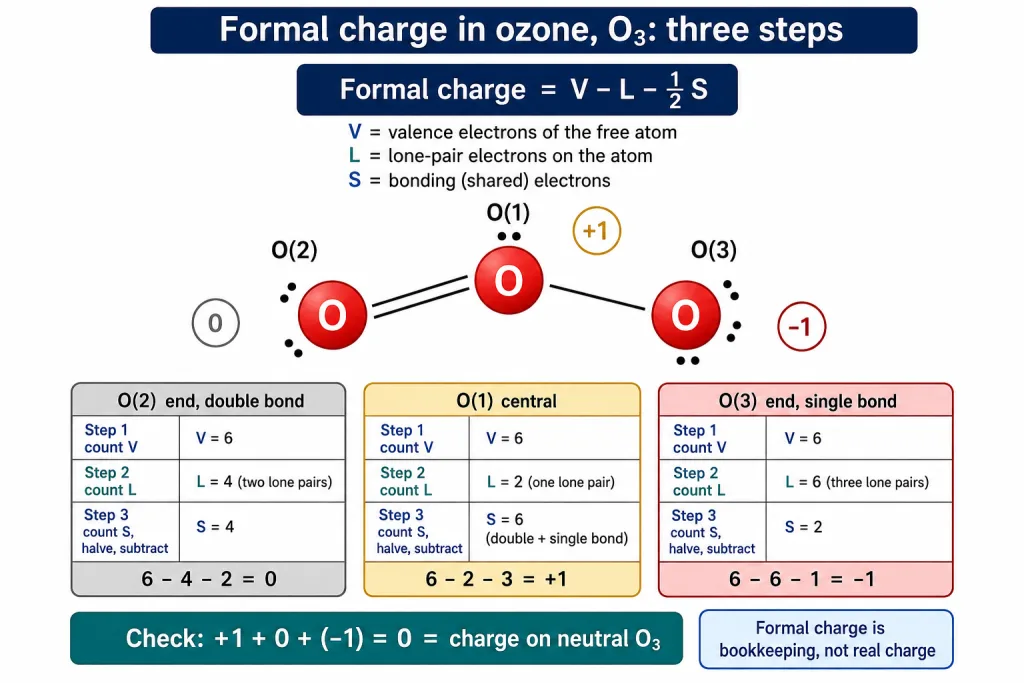
A pattern worth memorising: oxygen with three lone pairs and one bond is always ; two lone pairs and two bonds is ; one lone pair and three bonds is .
[Board] The definition, the formula in words (valence electrons of the free atom minus non-bonding electrons minus half the bonding electrons) and the ozone example answer "What is formal charge? Illustrate with an example." Show the sum-to-charge check, and take from the group number, never from the electrons the atom has in the structure.
Formal Charge in Common Species — Building Your Reference Table
Every species runs on the same three steps as ozone.
Carbonate ion,
Carbon central, one and two ; no lone pair on carbon; two lone pairs on the double-bonded oxygen, three on each single-bonded oxygen. Total electrons .
| Atom | F.C. | |||
|---|---|---|---|---|
| C (no lone pair, 4 bonds) | 4 | 0 | 8 | |
| O in (2 lone pairs) | 6 | 4 | 4 | |
| each O in (3 lone pairs) | 6 | 6 | 2 |
Sum: . The two negative charges sit on the single-bonded oxygens — any two, since the three oxygens are actually equivalent. That is resonance, in Section 4; each of the three resonance structures carries this same set of charges on different oxygens.
Nitrite ion,
with one lone pair on nitrogen. Total electrons .
| Atom | F.C. | |||
|---|---|---|---|---|
| N (1 lone pair, 3 bonds) | 5 | 2 | 6 | |
| O in | 6 | 4 | 4 | |
| O in | 6 | 6 | 2 |
Sum , on the single-bonded oxygen.
Ammonium ion,
Four bonds, no lone pair on nitrogen, 8 electrons in all.
| Atom | F.C. | |||
|---|---|---|---|---|
| N (0 lone pairs, 4 bonds) | 5 | 0 | 8 | |
| each H | 1 | 0 | 2 |
Sum . In nitrogen has 3 bonds and 1 lone pair, so . Turning that lone pair into a fourth bond costs nitrogen its neutrality.
Carbon monoxide,
The only structure giving both atoms an octet is a triple bond, , with one lone pair on each atom (10 electrons: ).
| Atom | F.C. | |||
|---|---|---|---|---|
| C (1 lone pair, triple bond) | 4 | 2 | 6 | |
| O (1 lone pair, triple bond) | 6 | 2 | 6 |
Sum . The negative formal charge lands on carbon and the positive one on oxygen — the opposite of what electronegativity suggests. Formal charge is a bookkeeping number, not a statement about where the electrons really are. One real fact does match it: the carbon end of CO binds metal ions, and haemoglobin.
Hydrogen cyanide,
with one lone pair on nitrogen; 10 electrons.
| Atom | F.C. | |||
|---|---|---|---|---|
| H | 1 | 0 | 2 | |
| C (0 lone pairs, 4 bonds) | 4 | 0 | 8 | |
| N (1 lone pair, 3 bonds) | 5 | 2 | 6 |
All zero — the ideal for a neutral molecule.
Sulphate ion,
Two Lewis structures are drawn for it, and formal charge tells them apart. Total electrons .
Octet structure: four single bonds, each oxygen with three lone pairs. S: ; each O: . Sum .
Expanded-octet structure: two and two bonds, 12 electrons around sulphur. S: ; each double-bonded O: ; each single-bonded O: . Sum .
Both add up correctly. The second has smaller charges, one reason it is often preferred for sulphur, a third-period element that can hold more than eight electrons.
The quick reference
| Atom and its bonding pattern | Formal charge |
|---|---|
| C with 4 bonds, 0 lone pairs | |
| C with 3 bonds, 1 lone pair | |
| N with 3 bonds, 1 lone pair | |
| N with 4 bonds, 0 lone pairs | |
| N with 2 bonds, 2 lone pairs | |
| O with 2 bonds, 2 lone pairs | |
| O with 1 bond, 3 lone pairs | |
| O with 3 bonds, 1 lone pair | |
| H with 1 bond | |
| halogen with 1 bond, 3 lone pairs |
[JEE/NEET] One rule covers every row: an atom is neutral when its bonds equal its normal valence (C 4, N 3, O 2, H 1, halogen 1). One extra bond made from a lone pair gives ; one bond fewer, electrons kept as a lone pair, gives .
Using Formal Charge — Choosing Between Candidate Structures
Formal charge tracks the valence electrons, so you can check a structure is drawn correctly. It also picks, from several possible Lewis structures, the one that best represents the species.
The selection rules
Key Point: Generally the lowest-energy structure is the one with the smallest formal charges on the atoms. Formal charges help in the selection of the lowest-energy structure from a number of possible Lewis structures for a given species.
Apply these in order:
- Smallest magnitudes. All charges zero beats and ; that beats a or anywhere.
- Negative charge on the more electronegative atom. If a non-zero charge is unavoidable, on oxygen or nitrogen beats on carbon or sulphur.
- Like charges not on adjacent atoms. Two charges next to each other, or two , are strongly disfavoured.
Worked contrast: HCN versus HNC
Both and can be drawn with complete octets and 10 electrons.
| Structure | H | middle atom | end atom |
|---|---|---|---|
| (lone pair on N) | C: | N: | |
| (lone pair on C) | N: | C: |
The first has no formal charges, the second a separation of charge. HCN is the stable familiar compound; hydrogen isocyanide, HNC, exists only as a high-energy, short-lived species.
Worked contrast: dinitrogen oxide,
The skeleton is , nitrogen in the middle, since oxygen rarely sits between two other atoms. With 16 electrons three octet structures are possible:
| Structure | end N | central N | O | Verdict |
|---|---|---|---|---|
| (1 lone pair on end N, 3 on O) | best: small charges, on the most electronegative atom | |||
| (2 lone pairs on end N, 2 on O) | acceptable; on N rather than O | |||
| (3 lone pairs on end N, 1 on O) | poor: a , and on oxygen |
Each row sums to zero, as it must for a neutral molecule. The first two are the important resonance contributors; the third barely matters.
Formal charge is not a real charge
Key Point: Formal charges do not indicate real charge separation within the molecule. They are a factor based on a purely covalent view of bonding, in which every shared pair is split equally between the two atoms. Indicating the charges on the atoms in the Lewis structure only helps in keeping track of the valence electrons.
Carbon monoxide proves it: C gets and O , yet oxygen is far more electronegative and pulls the shared electrons towards itself. The real distribution is nearly balanced — CO has a dipole moment of only about 0.1 D.
The oxidation number makes the opposite extreme assumption: the more electronegative atom takes all the shared electrons.
| Species | Atom | Formal charge (equal sharing) | Oxidation number (all to the more electronegative atom) |
|---|---|---|---|
| C | |||
| O | |||
| N | |||
| O | |||
| central O |
Neither number is the true charge; the truth lies in between, described by bond polarity in Section 5.
Formal charge and resonance — a first look
The three resonance structures of carbonate share one pattern: on C, on one O, on each of the other two. In the real ion all three bonds are identical and each oxygen carries . Formal charge in a single structure is a snapshot; the hybrid averages the snapshots. Equal sharing among structures with identical formal charges is one of the important aspects of resonance developed in Section 4.
[JEE Main] Questions often show two or three Lewis structures for the same ion — cyanate , thiocyanate , azide — and ask which is most stable. Compute every atom's formal charge in each, then apply the three rules in order. An option whose charges do not add up to the ion's charge is wrongly drawn and can be eliminated at once.
Limitations of the Octet Rule I — Incomplete Octets and Odd-Electron Molecules
The octet rule explains most organic compounds and works well for the second-period elements. But it is a rule of thumb, not a law of nature, and fails in three well-defined ways plus a few more general ones.
Key Point: The octet rule, though useful, is not universal. It applies mainly to the second-period elements. There are three types of exceptions: the incomplete octet of the central atom, odd-electron molecules, and the expanded octet.
Exception 1: the incomplete octet of the central atom
In some compounds the number of electrons surrounding the central atom is less than eight. This is especially the case with elements having fewer than four valence electrons — lithium, beryllium, boron and aluminium. They cannot bring enough electrons to build an octet by sharing.
| Compound | Central atom and its valence electrons | Bonds formed | Electrons around the central atom | Short of an octet by |
|---|---|---|---|---|
| Li, 1 | 1 | 2 | 6 | |
| Be, 2 | 2 | 4 | 4 | |
| Be, 2 | 2 | 4 | 4 | |
| B, 3 | 3 | 6 | 2 | |
| B, 3 | 3 | 6 | 2 | |
| Al, 3 | 3 | 6 | 2 |
In , , beryllium contributes 2 electrons and each hydrogen 1, so the molecule has only 4 electrons, both shared pairs on beryllium — eight is unreachable. In boron shares three pairs with three chlorines for 6 electrons; each chlorine has its octet (one bond pair, three lone pairs) but boron sits two short. Same for and .
The deficiency decides chemistry. and are strong Lewis acids: the empty orbital on boron accepts an electron pair from a donor such as , forming . For the same reason and form chlorine-bridged dimers and chains in the solid state, the electron-poor metal atom borrowing lone pairs from neighbouring chlorines.
[Board] "Give two examples of molecules in which the central atom has an incomplete octet" — (4 electrons around Be) and (6 electrons around B). Always state the electron count.
Exception 2: odd-electron molecules
The octet rule wants electrons in pairs. A molecule with an odd total number of valence electrons cannot pair them all, so at least one atom is left with an odd, incomplete count.
| Molecule | Valence electron count | Where the odd electron sits |
|---|---|---|
| , nitric oxide | on N; N has 7 electrons around it, O has 8 | |
| , nitrogen dioxide | on N; N has 7 electrons around it | |
| , chlorine dioxide | on Cl |
Nitric oxide is drawn as with two lone pairs on oxygen, one lone pair on nitrogen and one unpaired electron on nitrogen: , leaving nitrogen 7 electrons, not 8. In , with the lone electron on nitrogen also gives nitrogen 7. No odd-electron structure can satisfy the octet rule for every atom.
The unpaired electron shows up experimentally: NO and are paramagnetic, attracted into a magnetic field, and are reactive free radicals. pairs its odd electrons by dimerising to colourless at low temperature, which has an even count (34) and a proper Lewis structure.
Key Point: In molecules with an odd number of electrons, like NO and , the octet rule is not satisfied for all the atoms. Such molecules are paramagnetic and usually very reactive.
[NEET] To spot an odd-electron molecule, add the group numbers. Any odd total (11 for NO, 17 for , 19 for ) breaks the octet rule automatically. Ions can be odd too: has 13 valence electrons and has 11.
Limitations of the Octet Rule II — The Expanded Octet
The third exception goes the other way: some central atoms have more than eight electrons around them.
Why third-period and heavier atoms can do it
Elements in and beyond the third period have, apart from the and orbitals, the orbitals also available for bonding. In a number of their compounds there are more than eight valence electrons around the central atom. This is termed the expanded octet, and the octet rule does not apply in such cases. Second-period atoms (C, N, O, F) have only and three orbitals — four orbitals, eight electrons, no . That is why nitrogen never forms although phosphorus forms .
| Compound | Central atom | Bonds | Lone pairs on central atom | Electrons around central atom |
|---|---|---|---|---|
| P (period 3) | 5 single | 0 | 10 | |
| P | 5 single | 0 | 10 | |
| S (period 3) | 6 single | 0 | 12 | |
| S | 2 + 2 | 0 | 12 | |
| S | 4 single | 1 | 10 | |
| Cl (period 3) | 3 single | 2 | 10 | |
| I (period 5) | 7 single | 0 | 14 | |
| Xe (period 5) | 4 single | 2 | 12 |
: phosphorus makes five bonds, so 5 bond pairs, 10 electrons. : six bond pairs, 12. : seven bond pairs, 14. In sulphur is double-bonded to two oxygens and single-bonded to two groups: .
Many coordination compounds also fall here — a metal ion accepting six electron pairs from six ligands, as in , holds far more than an octet.
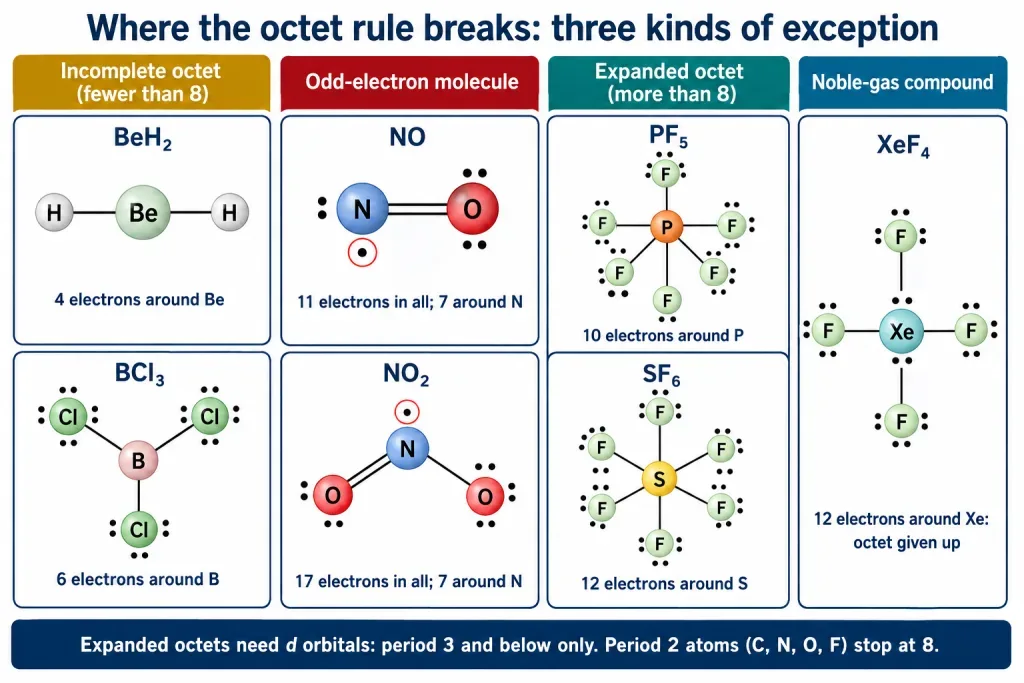
The same element can obey the rule or break it
Sulphur also forms many compounds in which the octet rule is obeyed: in and it has two bonds and two lone pairs, an octet. But in it has 10 and in 12. Whether the octet expands depends on the partner: small, highly electronegative atoms like fluorine and oxygen coax a third-period atom into using more than four orbitals. Phosphorus is the same — an octet in , ten electrons in .
Expanded octet and formal charge: the sulphate case again
The strict-octet structure of (four single bonds) gives sulphur and every oxygen . The expanded structure (two double bonds, 12 electrons on S) gives sulphur , two oxygens and two oxygens . Smaller formal charges are the usual argument for drawing , , and with double bonds. Both are accepted in Board answers if the electron count is right; for a question on the expanded octet, use the double-bonded version and state "12 electrons around sulphur".
A quick way to classify any molecule
- Add up the valence electrons. Odd total means an odd-electron molecule — stop there.
- Draw the Lewis structure and count the electrons around the central atom.
- Fewer than 8 and the central atom is Li, Be, B or Al: incomplete octet.
- Exactly 8: obeys the octet rule.
- More than 8: expanded octet — the central atom must be from period 3 or below.
| Molecule | Valence electron total | Electrons on central atom | Category |
|---|---|---|---|
| 4 | 4 | incomplete octet | |
| 24 | 6 | incomplete octet | |
| 8 | 8 | obeys | |
| 11 | 7 on N | odd-electron | |
| 17 | 7 on N | odd-electron | |
| 20 | 8 | obeys | |
| 40 | 10 | expanded | |
| 48 | 12 | expanded | |
| 56 | 14 | expanded |
[JEE/NEET] For "which of the following does not obey the octet rule?", memorise: incomplete — , , , , ; odd — , , ; expanded — , , , , , , , , . Decoys that do obey: , , , , , , , .
Other Drawbacks of the Octet Theory — and Why We Still Teach It
Beyond the three structural exceptions, the octet rule has three deeper failings.
Drawback 1: noble gases are not inert after all
The rule was built on the chemical inertness of the noble gases — eight outer electrons as a configuration nothing wants to disturb. Yet some noble gases, xenon and krypton in particular, do combine with fluorine and oxygen to form stable compounds: , , , , and .
| Compound | Bonds on the noble-gas atom | Lone pairs on it | Electrons around it |
|---|---|---|---|
| 2 | 3 | 10 | |
| 2 | 3 | 10 | |
| 4 | 2 | 12 | |
| 6 | 1 | 14 | |
| 2 + 1 | 2 | 12 |
Xenon starts with a perfect octet and gives it up to make these compounds. So the octet cannot be the fundamental reason for stability; it is a pattern that holds for the light elements because they have exactly four valence orbitals to fill. The real explanation is the energy of the whole molecule, which needs valence bond theory and molecular orbital theory (Sections 7 to 10).
Drawback 2: the rule says nothing about shape
The Lewis structure of water, with two lone pairs, is a flat drawing. It does not tell you the real molecule is bent with an angle of , nor that carbon dioxide is linear, nor that methane is a tetrahedron with angles. The octet theory does not account for shape at all. That job belongs to VSEPR theory (Section 6) and hybridisation (Sections 8 and 9), which start from the Lewis structure and add ideas the octet rule never had.
Drawback 3: the rule is silent about energy and relative stability
The octet rule cannot tell you that is far more stable than , or that is paramagnetic, or why the bond has an enthalpy of 435.8 kJ/mol while has 946.0 kJ/mol. It does not explain the relative stability of molecules, being totally silent about the energy of a molecule. Two molecules can both satisfy the octet and differ enormously in stability.
Key Point: Other drawbacks of the octet theory: (i) it is based on the inertness of noble gases, yet xenon and krypton form compounds like , and ; (ii) it does not account for the shape of molecules; (iii) it does not explain the relative stability of molecules and is silent about their energy.
The complete answer on definition, significance and limitations
Definition. Atoms of different elements combine with each other by transferring or sharing valence electrons so as to have eight electrons in their outermost shell, the configuration of the nearest noble gas.
Significance.
- Explains the formation of ionic compounds (, ) by electron transfer and of covalent molecules (, , , ) by electron sharing.
- Gives a simple recipe for writing Lewis structures, including multiple bonds, for most compounds of second-period elements and nearly all organic compounds.
- Predicts the common valences of elements (for a non-metal, 8 minus its number of valence electrons).
Limitations.
- Incomplete octet of the central atom — , , , (Li, Be, B have only 1, 2, 3 valence electrons).
- Odd-electron molecules — (11 electrons), (17 electrons).
- Expanded octet — (10), (12), (12), (14), using d orbitals of period-3 and heavier atoms.
- Noble gases such as xenon and krypton form compounds (, , ), although the rule is based on their inertness.
- It does not account for the shape of molecules.
- It does not explain the relative stability or the energy of molecules.
Why the rule is still worth keeping
It is right far more often than it is wrong, and it is the starting point of every later theory. VSEPR needs a Lewis structure to count electron pairs; hybridisation needs the bonds and lone pairs around an atom. Even the molecules that break the rule are described as octet plus or octet minus.
[Board] When a question asks for limitations, give both kinds: the three structural exceptions with an example and an electron count each, and the three general drawbacks (noble-gas compounds, shape, energy). Six points, six marks.
Solved Examples
Question 1: Formal charges in ozone
Draw the Lewis structure of ozone and assign a formal charge to each oxygen atom. Show that the charges add up correctly.
Answer:
Three oxygens, 6 each, gives 18 valence electrons.
The structure is : central O(1) has one lone pair, the double-bonded end O(2) two, the single-bonded end O(3) three. That is 6 bonding plus 12 lone-pair electrons, 18 in all, every octet complete.
Central O(1): free O has 6 valence electrons; here it owns its lone pair (2) and half of its 6 bonding electrons (3), so .
End O(2): two lone pairs (4), half of 4 bonding electrons is 2, so .
End O(3): three lone pairs (6), half of 2 bonding electrons is 1, so .
Check: , the charge on a neutral molecule.
Ans: Central O ; double-bonded end O ; single-bonded end O ; total zero.
Watch out: In a neutral molecule the formal charges must sum to zero. If they don't, recount the lone pairs.
Question 2: Formal charges in the carbonate ion
Assign formal charges to all atoms in one resonance structure of and comment on how this connects with resonance.
Answer:
Electrons: C 4, three O 18, plus 2 for the charge, so 24.
Carbon sits in the middle with one and two , no lone pair on carbon, two lone pairs on the double-bonded oxygen and three on each single-bonded one. Bonding electrons 8, lone-pair electrons , total 24.
Carbon, four bonds and no lone pair: . Double-bonded oxygen: . Each single-bonded oxygen: . Check: , matching the ion's charge.
Any of the three oxygens could be the double-bonded one, so three equivalent structures share this pattern. In the real ion the three bonds are identical and the is spread evenly, per oxygen — which is why the ion is a resonance hybrid, not any single drawing.
Ans: C ; the oxygen ; each oxygen ; total . The three resonance structures share this pattern, and the hybrid averages it to per oxygen.
Watch out: Formal charges are worked out on one resonance structure at a time; the hybrid averages them.
Question 3: Formal charges in the nitrite ion
Write the Lewis structure of and calculate the formal charge on each atom.
Answer:
Electrons: N 5, two O 12, plus 1 for the charge, so 18.
The structure is with a lone pair on nitrogen. Bonding electrons 6; lone pairs one on N (2), two on the double-bonded O (4), three on the single-bonded O (6), so . Every atom has an octet.
Nitrogen: . Double-bonded oxygen: . Single-bonded oxygen: . Check: .
Ans: N , oxygen , oxygen .
Watch out: Nitrogen with three bonds and one lone pair is always neutral — the same pattern as in .
Question 4: Formal charges in and
Find the formal charge on every atom in (a) the ammonium ion, and (b) the sulphate ion drawn with four single bonds. Then redraw the sulphate ion with two bonds and compare.
Answer:
Ammonium: electrons , four bonds, no lone pair on N. Nitrogen: . Each hydrogen: . Sum . The charge is formally on nitrogen: it used its own lone pair for the fourth bond and now owns only one electron of that pair.
Sulphate, octet structure: electrons , four single bonds (8 electrons) and three lone pairs on each oxygen (24). Sulphur: . Each oxygen: . Sum . Correct, but the charges are large.
Sulphate, expanded structure: two and two , 12 electrons around sulphur. Sulphur: . Each double-bonded O: . Each single-bonded O: . Sum .
The expanded structure has the smaller charges, largest magnitude 1 instead of 2. Sulphur is a third-period atom with d orbitals available and can hold 12 electrons, so it is usually preferred.
Ans: (a) N , each H . (b) Octet form: S , each O ; expanded form: S , two O , two O . The expanded form is preferred for its smaller formal charges.
Watch out: When a third-period central atom carries a large positive formal charge in the octet structure, turning lone pairs on oxygen into double bonds usually brings the charges down.
Question 5: Carbon monoxide — the surprising charges
Write the Lewis structure of CO and compute the formal charges. Why do they look "the wrong way round", and what does this tell you about formal charge?
Answer:
C 4 plus O 6 gives 10 electrons. With a single or double bond one atom is short of an octet, so a triple bond is needed: with one lone pair on carbon and one on oxygen, , both octets complete.
Carbon: . Oxygen: . Sum zero.
Oxygen is much more electronegative, so I would expect the negative end to be oxygen. But formal charge assumes every bond is shared exactly equally and ignores electronegativity. Oxygen contributed two of the three shared pairs from its own lone pairs, so on an equal-share count it has lost an electron () and carbon gained one ().
So formal charge is a bookkeeping device, not a measure of real charge. The molecule has only a small dipole moment, about 0.1 D, because electronegativity pulls the shared electrons back towards oxygen and almost cancels the formal-charge picture.
Ans: C , O . The charges reflect equal sharing of bond electrons, not actual charge separation; formal charge is a counting tool only.
Watch out: Formal charge and electronegativity can point in opposite directions. When they do, the real charge distribution is somewhere in between.
Question 6: HCN or HNC — which structure is better?
Both and can be drawn with 10 electrons and complete octets. Use formal charges to decide which represents the more stable molecule.
Answer:
Structure A, with the lone pair on N. H: . C, four bonds and no lone pair: . N, three bonds and one lone pair: . All zero.
Structure B, with the lone pair on C. H: . N, four bonds and no lone pair: . C, three bonds and one lone pair: . Sum zero, but with a separation of charge.
Smaller formal charges mean lower energy. A has none; B has and , and its sits on carbon, the less electronegative atom, which is worse still. HCN is the well-known stable compound and HNC a rare, high-energy isomer, so formal charge predicts correctly.
Ans: , with all formal charges zero, is the preferred structure.
Watch out: Zero everywhere beats any charge separation; and if there must be a negative charge, it belongs on the more electronegative atom.
Question 7: The best Lewis structure of
Dinitrogen oxide has the skeleton . Draw the three possible octet structures, assign formal charges and pick the most important one.
Answer:
The count is electrons. The skeleton needs at least two bonds (4 electrons), leaving 12 for lone pairs and multiple bonds. All three atoms get an octet with four bonds in total: 8 bonding and 8 lone-pair electrons.
Structure I, , one lone pair on the end N, three on O. End N: . Central N, four bonds and no lone pair: . O: . Sum .
Structure II, , two lone pairs on the end N, two on O. End N: . Central N: . O: . Sum .
Structure III, , three lone pairs on the end N, one on O. End N: . Central N: . O: . Sum .
III has a and puts on oxygen, the most electronegative atom, so I reject it. I and II have charges of magnitude 1 only; in I the is on oxygen, in II on nitrogen, so I is the better single structure. II remains a significant contributor, and the real molecule is a hybrid of mainly I and II.
Ans: (end N , central N , O ) is the most important structure; is the second contributor; is negligible.
Watch out: Write every candidate, compute every charge, then apply the rules in order: smallest magnitudes, negative on the electronegative atom, no adjacent like charges.
Question 8: Cyanate and thiocyanate ions
For the cyanate ion and the thiocyanate ion (carbon central in both), draw the octet structures with a double-double and a single-triple arrangement, assign formal charges, and say which structure is most important for each ion.
Answer:
Cyanate has 16 electrons and three octet structures with carbon in the middle:
- , two lone pairs on O, two on N: O ; C ; N .
- , three lone pairs on O, one on N: O ; C ; N .
- , one lone pair on O, three on N: O ; C ; N .
Each sums to . The third is out, for its and its on oxygen. The other two are reasonable, but the second puts the on oxygen, the most electronegative atom, so is the most important contributor, with next.
Thiocyanate also has 16 electrons and the same three patterns with S for O:
- : S , C , N .
- : S , C , N .
- : S , C , N (rejected).
Here the electronegativity order is reversed: nitrogen (about 3.0) beats sulphur (about 2.5). So , with on nitrogen, leads, and is close behind. Thiocyanate binds metal ions through either sulphur or nitrogen because both ends carry appreciable negative character in the hybrid.
Ans: : (charge on O) is most important. : (charge on N) is most important. In both, the structure with a is negligible.
Watch out: Swapping O for S flips which end is more electronegative and so flips the preferred structure. Only the electronegativities changed.
Question 9: Sorting molecules by their octet status
Classify each of the following as (i) obeying the octet rule, (ii) incomplete octet of the central atom, (iii) odd-electron molecule, or (iv) expanded octet: , , , , , , , , , .
Answer:
First I look for odd electron totals. : , odd. : , odd. Both are odd-electron molecules; no drawing gives every atom an octet.
Then I count electrons on the central atom for the rest:
- : Be forms two bonds, 4 electrons — incomplete.
- : B forms three bonds, 6 electrons — incomplete.
- : C forms four bonds, 8 — obeys.
- : O has two bonds and two lone pairs, 8 — obeys.
- : S has two bonds and two lone pairs, 8 — obeys.
- : P forms five bonds, 10 — expanded.
- : S forms six bonds, 12 — expanded.
- : Xe has two bonds and three lone pairs, 10 — expanded.
As a check, every expanded-octet central atom (P, S, Xe) is from period 3 or below, where d orbitals are available, and each incomplete one (Be, B) has fewer than four valence electrons.
Ans: (i) Obey: , , . (ii) Incomplete: (4), (6). (iii) Odd-electron: (11), (17). (iv) Expanded: (10), (12), (10).
Watch out: Odd total first, then count the central atom. Sulphur appears in both the obeys and the expanded lists — the rule depends on the compound, not just the element.
Question 10: Electron counts around the central atom
State the number of electrons around the central atom in , , , , , and , and explain why phosphorus can form while nitrogen cannot form .
Answer:
I count bond pairs and lone pairs on the central atom, each pair being 2 electrons.
- : 5 bond pairs, 0 lone pairs: 10.
- : 6 bond pairs, 0 lone pairs: 12.
- : two (4 pairs) plus two (2 pairs), no lone pair: 12.
- : 7 bond pairs: 14.
- : 4 bond pairs plus 2 lone pairs: 12.
- : 3 bond pairs, no lone pair: 6.
- : on nitrogen, one double bond (4) plus one lone pair (2) plus one unpaired electron (1): 7.
Phosphorus is in period 3: its valence shell has , three and five orbitals, so it takes more than four electron pairs. Nitrogen is in period 2, with only and three — four orbitals, eight electrons at most. Five bonds need a fifth orbital it does not have, so nitrogen stops at (three bonds, one lone pair, 8 electrons) while phosphorus forms both and .
Ans: 10, 12, 12, 14, 12, 6, 7 (on N). Nitrogen has no d orbitals in its valence shell, so it cannot expand beyond an octet; phosphorus has orbitals available.
Watch out: Period 2 stops at 8. Any expanded octet you are shown has a central atom from period 3 or heavier.
Question 11: Define the octet rule, and write its significance and limitations
Answer:
Atoms combine, by transferring electrons from one to another or by sharing electrons, so that each atom ends up with eight electrons in its outermost shell — the stable configuration of the nearest noble gas. That is the octet rule.
Significance: it explains why sodium gives one electron to chlorine to make (both ions reach an octet), why two chlorine atoms share one pair in , why carbon shares four pairs in , and why needs a triple bond. It gives a method for writing Lewis structures, works for almost all organic compounds and most second-period compounds, and predicts the usual valences (for a non-metal, 8 minus its valence electrons).
Structural exceptions:
- Incomplete octet: (2 electrons on Li), (4 on Be), and (6 on B or Al). Elements with fewer than four valence electrons cannot reach eight by sharing.
- Odd-electron molecules: (11 electrons) and (17). An odd number cannot all be paired, so some atom is left short.
- Expanded octet: (10 on P), (12 on S), (12 on S), (14 on I). Third-period and heavier atoms have d orbitals and can hold more than eight.
General drawbacks: the rule rests on the inertness of noble gases, yet xenon and krypton form , , , and ; it says nothing about the shape of a molecule; and it says nothing about the energy or relative stability of molecules.
Ans: Octet rule: atoms transfer or share electrons to attain eight electrons in the valence shell. Significance: explains ionic and covalent bond formation, Lewis structures and valence. Limitations: incomplete octet (, ), odd-electron molecules (, ), expanded octet (, , ), noble-gas compounds (, ), no information on shape, and no information on stability or energy.
Watch out: For a five- or six-mark answer, give a one-line definition, two or three significance points, and all six limitations with one example each.
Question 12: Why xenon fluorides embarrass the octet rule
Xenon already has eight valence electrons, yet it forms , and . Count the electrons around xenon in each, and explain what this says about the octet rule as an explanation of stability.
Answer:
: 2 bond pairs plus 3 lone pairs, 10 electrons. : 4 bond pairs plus 2 lone pairs, 12. : 6 bond pairs plus 1 lone pair, 14. Each gives xenon more than an octet. Totals check out for : electrons — 4 bonding, 6 on Xe, 12 on the fluorines.
The octet rule was built on the observation that noble gases do not react, explaining that inertness by saying eight electrons is the arrangement atoms strive for. Xenon starts with exactly that arrangement and still reacts with fluorine, giving up its perfect octet to hold 10, 12 or 14 electrons.
So an octet is not the reason atoms are stable. It is a pattern that works for period-2 elements because they have four valence orbitals, no more. What decides whether a molecule forms is energy: xenon fluorides form because the bonds release enough energy to beat separate and . The octet rule cannot do that calculation; it says nothing about energy, and nothing about why is linear and square planar.
Helium, neon and argon really are inert, being too small and holding their electrons too tightly. Xenon and krypton are larger, with loosely held outer electrons and empty d orbitals nearby, so fluorine and oxygen can bond to them.
Ans: 10, 12 and 14 electrons around Xe in , and . Their existence shows that having an octet is not the fundamental reason for stability, and that the octet rule is silent about the energy, relative stability and shape of molecules.
Watch out: An octet is not the cause of stability, only a common pattern.