
How to Use This Section
This section is for the night before the paper, and again in the queue outside the hall.
Nothing new is taught here. Every card compresses something Sections 1 to 16 worked through properly, in the same notation and with the same numbers. If a line surprises you, go back and reread that section instead of memorising the line.
Eight cards, one mistake checklist, one 60-second panic list. Screenshot the three figures.
| Card | Topic | Sections it compresses | Who needs it most |
|---|---|---|---|
| 1 | Kössel-Lewis approach — Lewis symbols, octet rule, Lewis-structure recipe, formal charge, octet exceptions | 1, 2 | Everyone |
| 2 | Ionic bond — conditions, NaCl energy balance, lattice enthalpy, Fajans' rules | 3 | Board, JEE |
| 3 | Bond parameters — length, angle, enthalpy, order, resonance | 4 | Everyone |
| 4 | Dipole moment and percentage ionic character | 5 | Everyone |
| 5 | VSEPR — the shape table with angles and examples | 6 | Everyone |
| 6 | Valence bond theory and hybridisation — overlap, sigma/pi, sp to spd | 7, 8, 9 | Everyone |
| 7 | Molecular orbital theory — energy orders, bond orders, magnetism | 10 | JEE, NEET |
| 8 | Hydrogen bonding — types, consequences, boiling-point orders | 11 | Board, NEET |
Key Point: The whole chapter is one question asked five ways: why do atoms stick together, and in what shape? Kössel-Lewis answers with electron counting (octets, dots, formal charge). The ionic model answers with energy (lattice enthalpy beats the cost of making ions). VSEPR answers with repulsion (electron pairs stay as far apart as they can). Valence bond theory answers with orbital overlap, plus hybridisation to get the angles right. Molecular orbital theory answers with delocalised orbitals, and predicts bond order and magnetism that nothing else can. Hydrogen bonding is the after-story — what molecules do to each other once they are made. Hold that map and the cards below are just the numbers.
Card 1 — The Kössel-Lewis Approach
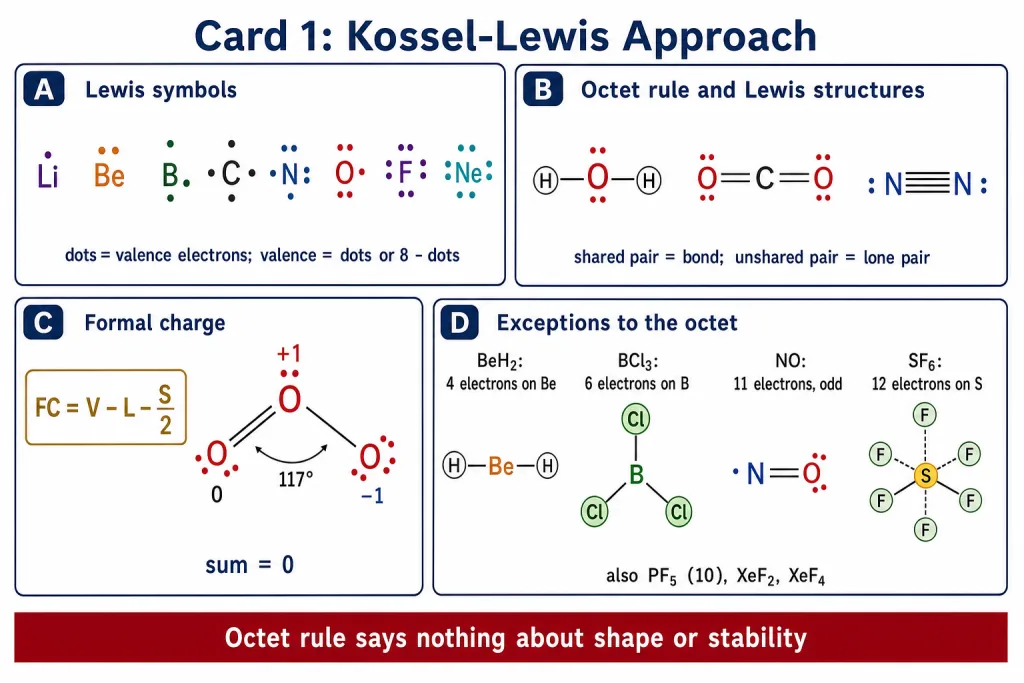
Lewis symbols and the octet rule
Key Point (Definition): A Lewis symbol is the element symbol with its valence electrons shown as dots. Group 1 to 18 main-group elements carry 1, 2, 3, 4, 5, 6, 7 and 8 dots. Period 2 in dots: Li 1, Be 2, B 3, C 4, N 5, O 6, F 7, Ne 8. Valence of a main-group element = number of dots, or 8 minus the number of dots (O: 6 dots, valence 2; Cl: 7 dots, valence 1).
Key Point (Definition): Octet rule (Kössel and Lewis, 1916): atoms combine by transfer or sharing of valence electrons so that each atom acquires eight electrons in its outer shell (the nearest noble-gas configuration). A covalent bond is a shared pair; one shared pair is a single bond, two a double bond, three a triple bond. Electrons not shared are lone pairs.
| Molecule | Shared pairs | Lone pairs | Written as |
|---|---|---|---|
| 1 | 3 on each Cl | ||
| 2 | 2 on O | ||
| 4 (two double bonds) | 2 on each O | ||
| 6 (one double C=C) | 0 | ||
| 3 (one triple) | 1 on each N | ||
| 5 (one triple CC) | 0 |
The Lewis-structure recipe (five steps)
| Step | Do this | Example: |
|---|---|---|
| 1 | Add up the valence electrons of all atoms; add one per negative charge, subtract one per positive charge | |
| 2 | Write the skeleton: the least electronegative atom is usually central (H and F are never central) | N in the middle, three F around |
| 3 | Put one shared pair (2 electrons) in each bond | 3 bonds, 6 electrons used |
| 4 | Distribute the rest as lone pairs, terminal atoms first, until every atom has an octet | 20 electrons left: 3 lone pairs on each F (18), 1 on N (2) |
| 5 | If the central atom still lacks an octet, convert lone pairs of neighbours into multiple bonds | not needed here |
Counts worth memorising: has electrons, four bonds, no lone pair. has : one , two . has : one , one , one lone pair on N. has 10: a triple bond, one lone pair on each atom. has 18: one , one , central O carries one lone pair.
Formal charge
Key Point (Definition): where = valence electrons of the free atom, = lone-pair (non-bonding) electrons on that atom in the structure, = shared (bonding) electrons around it. It is a bookkeeping number, not a real charge. Formal charges on all atoms must add up to the charge of the species. The structure with the lowest formal charges (and negative ones on the more electronegative atoms) is the most stable.
The ozone card, with 18 electrons:
| Atom | Formal charge | |||
|---|---|---|---|---|
| Central O (one lone pair, one double + one single bond) | 6 | 2 | 6 | |
| Terminal O of the double bond (two lone pairs) | 6 | 4 | 4 | |
| Terminal O of the single bond (three lone pairs) | 6 | 6 | 2 |
Sum: , the charge on . Correct.
The four exceptions to the octet rule
| Exception | What happens | Examples |
|---|---|---|
| Incomplete octet of the central atom (fewer than 8) | Elements with fewer than four valence electrons cannot reach eight | , (4 electrons on Be), (6 on B), |
| Odd-electron molecules | An odd total means one atom cannot have an octet | (11 electrons), (17 electrons) |
| Expanded octet (more than 8) | Period 3 and heavier central atoms use their orbitals | (10 on P), (12 on S), (12 on S), (14 on I) |
| Noble-gas compounds | Xe and Kr, with complete octets, still form compounds | , , , , |
Three further limitations: the rule says nothing about the shape of a molecule; it says nothing about the relative stability or energy of molecules; and it rests on the "inertness" of noble gases, which Xe and Kr disobey.
[NEET] , and are electron-deficient (incomplete octet, Lewis acids). and are hypervalent (expanded octet). and are paramagnetic because of the odd electron.
Card 2 — The Ionic (Electrovalent) Bond
When an ionic bond forms
Key Point: An ionic bond is the electrostatic attraction between oppositely charged ions formed by complete transfer of one or more electrons. It is favoured when the metal has a low ionization enthalpy (easy to make the cation), the non-metal has a highly negative electron gain enthalpy (easy to make the anion), and the crystal has a high lattice enthalpy (the ions pack tightly and release a lot of energy). Electrovalence = number of unit charges on the ion: Ca is +2, Cl is in .
The NaCl energy balance — the numbers
| Step | Equation | Enthalpy / |
|---|---|---|
| Ionization of sodium | ||
| Electron gain by chlorine | ||
| Net cost of making the gaseous ions | ||
| Lattice formation | ||
| Net | (strongly exothermic) |
The electron transfer alone is uphill by 147.1 kJ/mol; the crystal forms because the lattice enthalpy (788 kJ/mol) pays for it many times over. The lattice, not the electron transfer, is why NaCl exists.
Lattice enthalpy
Key Point (Definition): The lattice enthalpy of an ionic solid is the energy required to completely separate one mole of the solid ionic compound into gaseous constituent ions. For NaCl it is 788 kJ/mol: , kJ/mol. (Written the other way, as formation of the lattice from gaseous ions, it is .)
| Factor | Effect on lattice enthalpy | Example |
|---|---|---|
| Charge on the ions — the stronger effect | higher charges, larger lattice enthalpy (attraction ) | MgO (2+, 2) NaF (1+, 1) |
| Size of the ions | smaller ions, shorter distance, larger lattice enthalpy (attraction ) | LiF > NaF > KF > RbF > CsF; NaF > NaCl > NaBr > NaI |
| Lattice type (packing) | closer packing releases more energy | a JEE-level refinement; the Born-Haber cycle sums all the steps |
Lattice enthalpy is not measured directly; it comes from a Born-Haber cycle (Hess's law) or is estimated from the Coulomb interaction of the ions.
Fajans' rules — covalent character in an ionic bond (one-liners)
| Rule | Covalent character increases when |
|---|---|
| Cation size | the cation is small (high charge density, polarises the anion): more covalent than |
| Anion size | the anion is large (easily polarised): more covalent than |
| Charge | the charge on either ion is high: more covalent than |
| Cation configuration | the cation has a pseudo-noble-gas shell (, , ) rather than a noble-gas shell (, ) |
These are trends, not laws.
[JEE Main] Rank covalent character with the "small cation, large anion, high charge" mantra: and . Melting point and solubility in water run the other way (more ionic, higher melting point, more soluble in water).
Properties of ionic compounds in one line: crystalline solids, high melting and boiling points, conduct electricity only when molten or dissolved (ions must be free to move), soluble in polar solvents, insoluble in non-polar ones, hard but brittle.
Card 3 — Bond Parameters and Resonance
The definitions
| Parameter | Definition | Units |
|---|---|---|
| Bond length | equilibrium distance between the nuclei of two bonded atoms | pm |
| Covalent radius | half the distance between the nuclei of two like atoms joined by a single covalent bond (: 198 pm, so 99 pm) | pm |
| van der Waals radius | half the distance between the nuclei of two non-bonded atoms of adjacent molecules in the solid (: 180 pm) | pm |
| Bond angle | angle between the orbitals containing the bonding pairs around the central atom (H-O-H in water 104.5°) | degrees |
| Bond enthalpy | energy needed to break one mole of a particular bond in gaseous molecules; for polyatomic molecules use the average | kJ/mol |
| Bond order | number of bonds (shared pairs) between two atoms in a molecule | none |
Bond-length data
| Bond | Length / pm | Bond | Length / pm |
|---|---|---|---|
| O-H | 96 | C=O | 121 |
| C-H | 107 | N=O | 122 |
| N-O | 136 | C=C | 133 |
| C-O | 143 | C=N | 138 |
| C-N | 143 | CN | 116 |
| C-C | 154 | CC | 120 |
| Molecule | Length / pm | Molecule | Length / pm |
|---|---|---|---|
| 74 | 92 | ||
| 144 | 127 | ||
| 199 | 141 | ||
| 228 | 160 | ||
| 267 | 109 | ||
| 121 | (both O-O) | 128 |
Rules: single > double > triple in length (C-C 154, C=C 133, CC 120); bond length rises with atom size (HF 92 to HI 160; 144 to 267). Bond length of a covalent bond = sum of the two covalent radii.
Bond-enthalpy data
| Bond broken | / |
|---|---|
| 435.8 | |
| 498 | |
| 946.0 | |
| 502 | |
| 427 | |
| Average O-H in water |
Rules: enthalpy rises with bond order (H-H single 435.8, O=O double 498, NN triple 946); larger bond enthalpy means stronger, shorter bond. The two O-H bonds of water do not cost the same to break — hence the average.
Bond order — the counting rules
| Species | Bond order | Isoelectronic partners with the same bond order |
|---|---|---|
| , , | 1 | — |
| 2 | — | |
| 3 | , (14 electrons each) | |
| 3 | , |
Key Point: Isoelectronic molecules and ions have identical bond orders. As bond order rises, bond enthalpy rises and bond length falls.
Resonance — the rules and the hybrids
Key Point (Definition): When a single Lewis structure cannot describe a molecule, several canonical (resonance) structures are written, and the real molecule is the resonance hybrid. The hybrid is more stable than any single canonical structure by the resonance stabilisation energy. Canonical structures exist only on paper; the molecule does not flip between them.
| Rule | Meaning |
|---|---|
| Same positions of nuclei | only electrons move, never atoms |
| Same number of unpaired electrons | all canonical forms have the same spin state |
| Bond lengths in the hybrid are all equal | : both O-O bonds 128 pm, between O-O 148 and O=O 121; : all three C-O bonds equal |
| Bond order of the hybrid | total bonds between the atom pair, divided by the number of positions |
| Species | Canonical structures | Bond order of each bond |
|---|---|---|
| 2 | ||
| 3 | ||
| 3 | ||
| 2 | ||
| (benzene) | 2 (Kekulé) | |
| 3 | 2 (the form dominates) | |
| 2 |
[JEE/NEET] In the measured C-O length is 115 pm — shorter than a normal C=O (121 pm) and longer than a CO (110 pm); that is the fingerprint of resonance among , and .
Card 4 — Polarity, Dipole Moment and Ionic Character
The formula
Key Point (Definition): Dipole moment , where is the magnitude of the separated charge and the distance between the charge centres. It is a vector; the arrow points from the positive end to the negative end (crossed at the positive end). Units: debye, C m. For a molecule with several polar bonds, is the vector sum of the bond dipoles and the lone-pair contributions.
Check on water: C m.
Zero or non-zero — the table
| Molecule | Shape | / D | Why |
|---|---|---|---|
| , | linear diatomic | 0 | identical atoms, no bond polarity |
| diatomic | 1.78 | polar bond; the most polar hydrogen halide | |
| diatomic | 1.07 | electronegativity difference falls down the group | |
| diatomic | 0.79 | ||
| diatomic | 0.38 | ||
| bent | 1.85 | two O-H dipoles add, lone pairs help | |
| bent | 0.95 | smaller electronegativity difference | |
| trigonal pyramidal | 1.47 | lone-pair dipole adds to the N-H resultant | |
| trigonal pyramidal | 0.23 | lone-pair dipole opposes the N-F resultant | |
| tetrahedral, unsymmetrical | 1.04 | C-Cl dipoles no longer cancel | |
| linear | 0 | two equal C=O dipoles cancel | |
| trigonal planar | 0 | three B-F dipoles at 120° cancel | |
| , | tetrahedral | 0 | four identical dipoles cancel |
| , , , , | symmetric | 0 | symmetric arrangement, all lone pairs opposite each other |
NH versus NF — the classic
Both are pyramidal with one lone pair on N. In nitrogen is the more electronegative atom, so the three N-H bond dipoles point towards N, in the same direction as the lone-pair dipole; they add, D. In fluorine is more electronegative, so the N-F dipoles point away from N, against the lone pair; they partly cancel, D. Same shape, opposite arithmetic.
Percentage ionic character
Key Point: Example: HCl with pm gives C m D; observed 1.07 D, so ionic character .
Rule-of-thumb from electronegativity difference: a difference of about 1.7 gives roughly 50% ionic character; larger than 1.7 is mostly ionic, smaller is mostly covalent. A purely covalent bond () has zero; even the "most ionic" bonds (CsF) fall short of 100%.
[JEE Main] For a symmetric molecule the answer is "zero dipole moment" no matter how polar the bonds are; the question is testing geometry. The order among the hydrogen halides () and the pair are the two rankings asked most.
Card 5 — VSEPR Theory
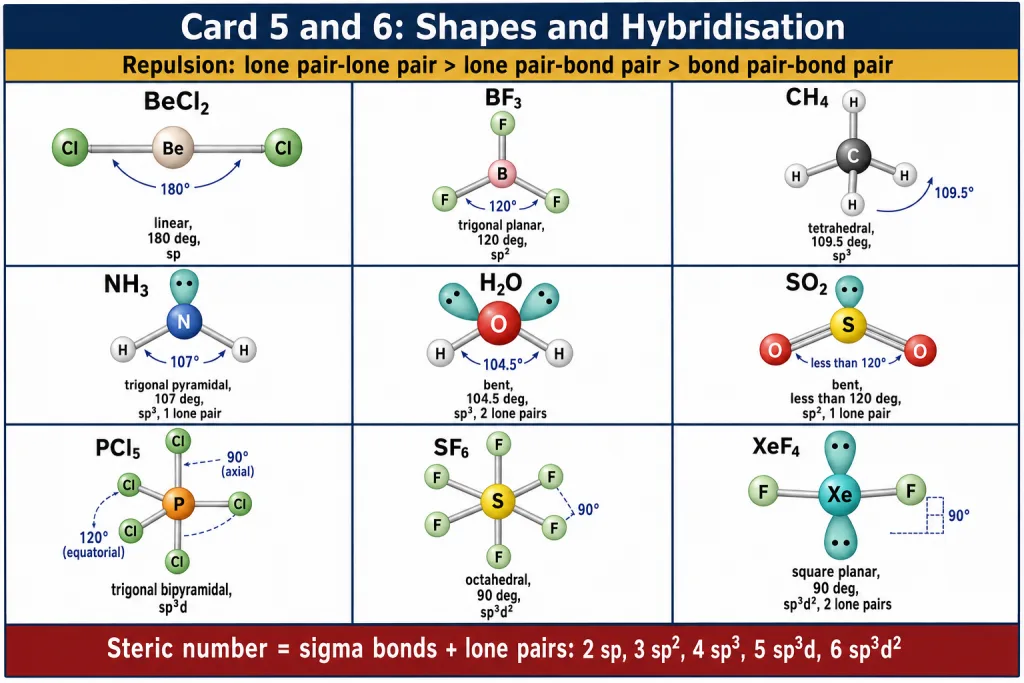
The postulates (Sidgwick and Powell 1940, Nyholm and Gillespie 1957)
| # | Postulate |
|---|---|
| 1 | The shape depends on the number of valence-shell electron pairs (bonding and non-bonding) around the central atom |
| 2 | Electron pairs repel one another because their clouds are negatively charged |
| 3 | The pairs occupy positions that minimise repulsion and hence maximise distance |
| 4 | The valence shell is taken as a sphere with the pairs at maximum distance on its surface |
| 5 | A multiple bond is treated as a single electron pair, and its two or three pairs as one super pair |
| 6 | Where a molecule has two or more resonance structures, VSEPR applies to any one of them |
The repulsion order
Key Point: A lone pair belongs to one nucleus only, so it is fatter and closer to the central atom; it pushes the bond pairs together and shrinks the bond angle. One lone pair costs about 2.5°, two cost about 5° in the tetrahedral family: 109.5°, 107°, 104.5°.
VSEPR predicts the molecular shape from the electron-pair geometry, with lone pairs distorting the angles.
The full shape table
| Type | Bond pairs | Lone pairs | Electron-pair geometry | Molecular shape | Angle(s) | Examples |
|---|---|---|---|---|---|---|
| 2 | 0 | linear | linear | 180° | , , | |
| 3 | 0 | trigonal planar | trigonal planar | 120° | , , , | |
| 2 | 1 | trigonal planar | bent (V-shape) | < 120° | , , | |
| 4 | 0 | tetrahedral | tetrahedral | 109.5° | , , , | |
| 3 | 1 | tetrahedral | trigonal pyramidal | 107° | , , | |
| 2 | 2 | tetrahedral | bent | 104.5° | , , | |
| 5 | 0 | trigonal bipyramidal | trigonal bipyramidal | 120° (equatorial), 90° (axial) | , | |
| 4 | 1 | trigonal bipyramidal | see-saw | < 120°, < 90° | ||
| 3 | 2 | trigonal bipyramidal | T-shape | < 90° | , | |
| 2 | 3 | trigonal bipyramidal | linear | 180° | , | |
| 6 | 0 | octahedral | octahedral | 90° | , | |
| 5 | 1 | octahedral | square pyramidal | < 90° | , | |
| 4 | 2 | octahedral | square planar | 90° | , |
Where the lone pairs sit
| Geometry | Lone-pair position | Why |
|---|---|---|
| Trigonal bipyramidal | equatorial | an equatorial pair has only two 90° neighbours; an axial pair has three |
| Octahedral | any one position; a second one goes opposite (trans) | keeps the two lone pairs 180° apart |
| Tetrahedral, trigonal planar | any position (all equivalent) | — |
In the two axial bonds are longer (and weaker) than the three equatorial ones, because each axial pair suffers three 90° repulsions against only two for an equatorial pair — the reason is so reactive.
[NEET] Angle-ordering questions: (109.5°) > (107°) > (104.5°); > > (bigger central atom, less electronegative, bond pairs sit farther out, less repulsion); > > for the same reason; > (F pulls the bond pairs away from N).
Card 6 — Valence Bond Theory and Hybridisation
Orbital overlap — the rules
Key Point: (Heitler and London 1927, Pauling and Slater.) A covalent bond forms when two half-filled atomic orbitals with electrons of opposite spin overlap. Greater overlap, stronger bond. As two H atoms approach, attractions (nucleus-electron of the other atom) and repulsions (nucleus-nucleus, electron-electron) compete; the potential energy falls to a minimum at 74 pm, the bond length, and the depth of that well is the bond enthalpy, 435.8 kJ/mol. Energy is released when the bond forms and absorbed when it breaks.
| Type of overlap | Along the axis or sideways | Bond formed | Examples |
|---|---|---|---|
| - | end-on (axial) | ||
| - | end-on | , | |
| - end-on | along the axis | , | |
| - sideways | lateral (parallel axes) | the second bond of , the two extra bonds of |
Sigma versus pi — the facts
| Feature | bond | bond |
|---|---|---|
| Overlap | end-to-end along the internuclear axis | sideways, above and below the axis |
| Extent of overlap | larger | smaller |
| Strength | stronger | weaker |
| Rotation about the bond | free | restricted |
| Electron cloud | symmetric about the axis | two lobes, a nodal plane containing the axis |
| Order of formation | first bond of any pair is always | second and third bonds |
| Can exist alone? | yes | no — only with a |
Counting rule: every single bond = 1 ; double bond = 1 + 1 ; triple bond = 1 + 2 . : 3 , 2 . : 5 , 1 . : 2 , 2 . Benzene: 12 , 3 . : 1 , 2 .
Hybridisation
Key Point (Definition): Hybridisation is the intermixing of atomic orbitals of slightly different energies to form the same number of new equivalent orbitals of equal energy and identical shape. Only orbitals of comparable energy mix; half-filled, fully filled and empty orbitals can all take part; hybrid orbitals are more directional and give stronger bonds; the hybridisation is of the central atom and it is a model applied once the shape is known, not an observed event or a cause. Promotion of an electron is not required before hybridisation.
| Hybridisation | Orbitals mixed | Hybrids | s-character | Geometry | Angle | Examples |
|---|---|---|---|---|---|---|
| one + one | 2 | 50% | linear | 180° | , , (each C), | |
| one + two | 3 | 33.3% | trigonal planar | 120° | , , (each C), , , benzene C | |
| one + three | 4 | 25% | tetrahedral | 109.5° | , (107°), (104.5°), , | |
| one + three + | 5 | 20% | trigonal bipyramidal | 120°, 90° | , , , , | |
| one + three + + | 6 | 16.7% | octahedral | 90° | , , , (outer-orbital complex) | |
| two inner + + three | 6 | 16.7% | octahedral | 90° | (inner-orbital complex) |
The steric-number rule: Steric number = number of bonds around the central atom + number of lone pairs on it. 2 gives , 3 gives , 4 gives , 5 gives , 6 gives . bonds are not counted. More -character means a shorter, stronger bond and a larger angle ( C-H is the shortest and most acidic).
CH, CH and CH — the data
| Molecule | C hybridisation | C-C bond | C-C length / pm | C-C enthalpy / kJ mol | C-H length / pm | Angles | / |
|---|---|---|---|---|---|---|---|
| Ethane | one (-) | 154 | 348 | 109 | 109.5° | 7 / 0 | |
| Ethene | one (-) + one (-) | 134 | 614 | 108 | H-C-H about 117.6°, H-C-C about 121°; planar | 5 / 1 | |
| Ethyne | one (-) + two (, ) | 120 | 839 | 106 | 180°; linear | 3 / 2 |
The bond in ethene is worth about kJ/mol, less than the (348) — sideways overlap is the weaker kind.
[JEE Main] uses the orbital; uses and . In the promotion is ; in , . For (5 pairs, 3 lone) the hybridisation is and the shape linear; for (6 pairs, 2 lone) and square planar.
Card 7 — Molecular Orbital Theory
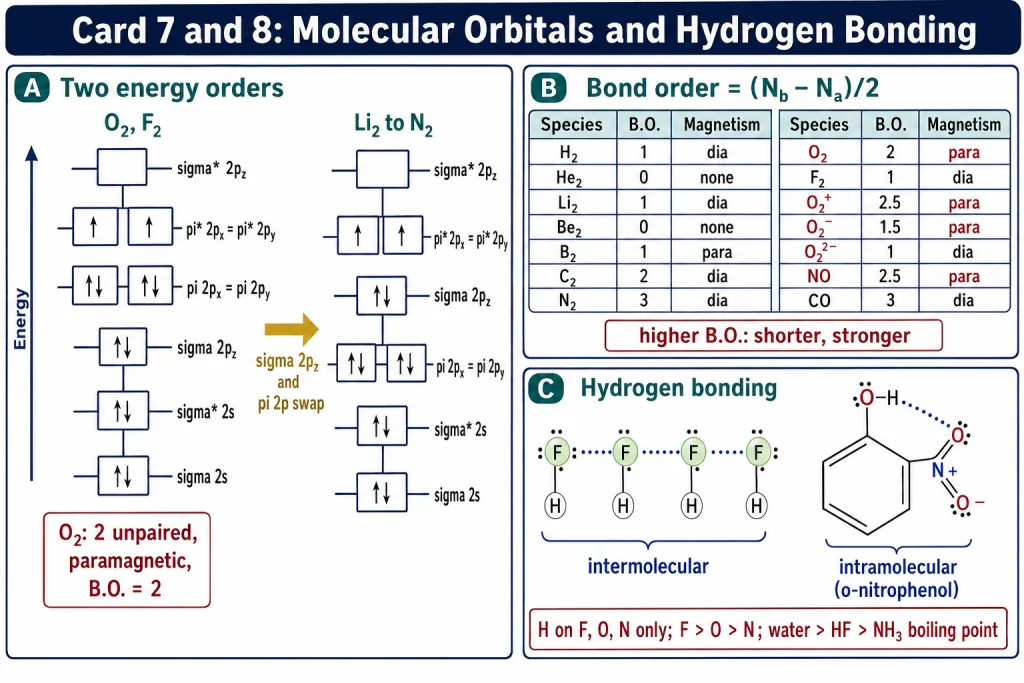
LCAO and the conditions
Key Point: (Hund and Mulliken, 1932.) Atomic orbitals combine by Linear Combination of Atomic Orbitals: addition gives a bonding MO (, lower energy, electron density between the nuclei), subtraction gives an antibonding MO (, higher energy, a node between the nuclei). Two AOs always give two MOs. The bonding MO is stabilised by about as much as the antibonding is destabilised. Molecular orbitals are polycentric (belong to the whole molecule); atomic orbitals are monocentric. Filling follows Aufbau, Pauli and Hund's rule exactly as for atoms.
| Condition for combination | Consequence |
|---|---|
| Same or nearly the same energy | combines with , not with |
| Same symmetry about the molecular axis | combines with , not with (with as the bond axis) |
| Maximum overlap | greater overlap, greater electron density between the nuclei, stronger bond |
Naming with as the internuclear axis: orbitals give and ; and give the degenerate pairs , and , . A MO is symmetric about the axis; a MO has a nodal plane containing the axis.
The two energy orderings
| Molecules | Order | Why |
|---|---|---|
| , (and ) | large - energy gap, no mixing | |
| to (, , especially) | - mixing pushes above the pair |
The only difference: for , , the pair fills before . Get this wrong and comes out diamagnetic (it is paramagnetic) and comes out paramagnetic (it is diamagnetic).
Bond order
Key Point (Definition): = electrons in bonding MOs, = electrons in antibonding MOs. Positive bond order means the molecule is stable; zero or negative means it does not exist. Bond order 1, 2, 3 correspond to single, double, triple. Higher bond order: shorter bond, higher bond enthalpy. Any unpaired electron in an MO makes the species paramagnetic; all paired, diamagnetic.
The master table
| Species | Electrons | Configuration (valence MOs) | Bond order | Magnetism | ||
|---|---|---|---|---|---|---|
| 2 | 2 | 0 | 1 | diamagnetic | ||
| 1 | 1 | 0 | 0.5 | paramagnetic | ||
| 3 | 2 | 1 | 0.5 | paramagnetic | ||
| 4 | 2 | 2 | 0 | does not exist | ||
| 6 | 4 | 2 | 1 | diamagnetic | ||
| 8 | 4 | 4 | 0 | does not exist | ||
| 10 | 6 | 4 | 1 | paramagnetic | ||
| 12 | 8 | 4 | 2 | diamagnetic (both bonds ) | ||
| 14 | 10 | 4 | 3 | diamagnetic | ||
| 13 | remove one from | 9 | 4 | 2.5 | paramagnetic | |
| 16 | 10 | 6 | 2 | paramagnetic (2 unpaired) | ||
| 15 | one fewer electron | 10 | 5 | 2.5 | paramagnetic (1) | |
| (superoxide) | 17 | one more electron | 10 | 7 | 1.5 | paramagnetic (1) |
| (peroxide) | 18 | full | 10 | 8 | 1 | diamagnetic |
| 18 | 10 | 8 | 1 | diamagnetic | ||
| 20 | 10 | 10 | 0 | does not exist | ||
| 14 | like | 10 | 4 | 3 | diamagnetic | |
| 15 | like | 10 | 5 | 2.5 | paramagnetic (1) | |
| 14 | like | 10 | 4 | 3 | diamagnetic | |
| 14 | like | 10 | 4 | 3 | diamagnetic |
stands for , the non-bonding inner shells.
The rankings that follow
| Question | Answer |
|---|---|
| Bond length order | (bond order 2.5, 2, 1.5, 1) |
| Bond strength (enthalpy) order | |
| Removing an electron from versus | : bond order 3 to 2.5, bond weakens; : 2 to 2.5, bond strengthens (the electron leaves an antibonding orbital) |
| Same bond order as | , , (all 14-electron, bond order 3) |
| Highest bond order in the second period | (3); has the highest bond enthalpy, 946 kJ/mol |
| Paramagnetic among , , , , | and |
[NEET] The paramagnetism of (liquid oxygen sticks to a magnet) is the single fact valence bond theory cannot explain and MO theory explains at once — the two unpaired electrons sit one each in the degenerate and orbitals by Hund's rule.
Card 8 — Hydrogen Bonding
The definition
Key Point (Definition): When hydrogen is bonded to a highly electronegative, small atom (F, O or N), the shared pair is pulled away and the H becomes a bare, positive centre. This H is attracted to the lone pair of an electronegative atom of another molecule (or of the same molecule). That attraction is a hydrogen bond, written with a dotted line: . It is weaker than a covalent bond (about 10-40 kJ/mol against 400 or more) but much stronger than ordinary van der Waals forces, and it is largely electrostatic.
Strength order: , following electronegativity (F 4.0 > O 3.5 > N 3.0). Chlorine is electronegative enough (3.0) but too large, so HCl does not hydrogen-bond appreciably.
The two types
| Type | Where | Examples | Consequence |
|---|---|---|---|
| Intermolecular | between different molecules | HF (zig-zag chains), (each molecule bonds to four neighbours in ice), , alcohols, carboxylic acid dimers, p-nitrophenol | molecules cling together: higher boiling point, higher solubility in water, association |
| Intramolecular | within the same molecule, forming a ring (usually 5- or 6-membered) | o-nitrophenol, salicylaldehyde, o-hydroxybenzoic acid | no clinging between molecules: lower boiling point, lower water solubility, more volatile, chelation |
The consequences
| Observation | Explanation |
|---|---|
| Water is a liquid, a gas, although S is heavier | O-HO hydrogen bonds hold water molecules together; S is too large and not electronegative enough |
| Ice floats on water | in ice every water molecule is hydrogen-bonded tetrahedrally to four others in an open cage with empty space; on melting some bonds break and molecules pack closer, so liquid water is denser (maximum density at 4 °C) |
| HF has the highest boiling point among the hydrogen halides | F-HF bonds; HCl, HBr, HI have none, so their boiling points follow molar mass |
| boils higher than | N-HN bonds; P cannot hydrogen-bond |
| Ethanol boils at 78 °C, dimethyl ether at °C, same formula | ethanol has O-H and hydrogen-bonds; the ether has no H on O |
| Ethanol and ammonia dissolve freely in water; the DNA double helix holds together; proteins keep their shape | hydrogen bonds to water; AT (two) and GC (three) hydrogen bonds between bases |
| o-nitrophenol is steam-volatile, p-nitrophenol is not | o-isomer has an intramolecular bond (no association), p-isomer forms intermolecular chains |
Boiling-point orders to write from memory
| Series | Order | Reason |
|---|---|---|
| Group 16 hydrides | water anomalous (H-bonding); the rest rise with molar mass (van der Waals) | |
| Group 17 hydrides | HF anomalous; the rest rise with molar mass | |
| Group 15 hydrides | anomalous (H-bonding lifts it above and ), but the N-HN bond is the weakest of the three, so the very heavy still boils higher | |
| Group 14 hydrides | no hydrogen bonding in any (C not electronegative enough); pure molar-mass order | |
| Water versus HF versus | (100 °C) (19.5 °C) ( °C) | water averages two hydrogen bonds per molecule when each bond is counted once — it takes part in four, two through its own H atoms and two through its lone pairs; HF has one H but three lone pairs, three H but one lone pair, so each is limited to one |
[Board] Two-mark answer in two lines: "Hydrogen bond is the attractive force between the hydrogen atom attached to a highly electronegative atom (F, O, N) of one molecule and the electronegative atom of another molecule. Example: HF, in which chains raise its boiling point above HCl."
The Mistakes That Cost the Most Marks
Each of these was flagged somewhere in Sections 1 to 16, ordered roughly by how often it shows up in answer scripts.
1. Counting bonds and lone pairs when deciding the hybridisation. Steric number = bonds + lone pairs on the central atom. A double bond is one . So is (2 , 0 lone pairs), is (2 + 1 lone pair), is (3 + 1), is (2 + 3), is (4 + 2).
2. Writing the O energy order for N (or the N order for O). Up to : below . From on: below the pair. Bond orders do not change ( 3, 2 either way), but the magnetism of (paramagnetic) and (diamagnetic) does, and so do the configurations you are asked to write.
3. Calling O diamagnetic because "all its electrons are paired in the Lewis structure". The MO configuration ends : two unpaired electrons, paramagnetic, bond order 2. is also paramagnetic; , , , , , are diamagnetic; , , have one unpaired electron.
4. Ranking bond length by charge instead of bond order. Bond order decides: (2.5) (2) (1.5) (1) in length; the reverse in strength. Removing an electron from strengthens the bond (antibonding electron leaves); removing one from weakens it (bonding electron leaves).
5. Giving a polar molecule a zero dipole moment, or a symmetric one a non-zero value. , , , , , , , , : zero (symmetric, dipoles cancel). 1.85, 1.47, 1.04, , , 0.23: non-zero. And because the lone pair adds in one and opposes in the other.
6. Forgetting the lone-pair angle squeeze. 109.5°, 107°, 104.5° — all , angles shrink because lone pair-bond pair repulsion beats bond pair-bond pair. Do not write "109.5°" for water. And in a trigonal bipyramid the lone pairs go equatorial, so is T-shaped and linear, not bent.
7. Formal charge that does not add up. . Ozone: central O , single-bonded O , double-bonded O ; sum 0. In nitrogen is ; in each single-bonded O is and the total is . If your sum is not the charge on the ion, a count is wrong.
8. Saying the electron transfer is what makes NaCl form. Making the ions costs kJ/mol — endothermic. It is the lattice enthalpy (788 kJ/mol) that makes the overall process exothermic. And lattice enthalpy is the energy to separate one mole of solid into gaseous ions, a positive number.
9. Mixing up bond order in resonance hybrids. Divide total bonds by positions: 1.5, 1.5, 1.5, benzene 1.5, 1.33, 1.33. All bonds in the hybrid are equal (both O-O in ozone 128 pm). Canonical structures do not exist and the molecule does not oscillate between them.
10. Using "octet" for BF, PCl or NO. Boron has six electrons in (incomplete), phosphorus ten in and sulphur twelve in (expanded), NO has an odd number (11). Period 2 elements can never expand ( does not exist; no orbitals).
11. Sigma/pi miscounts. Single = 1 ; double = 1 + 1 ; triple = 1 + 2 . Benzene 12 and 3 ; 3 and 2 ; 2 and 2 ; a bond never exists without a ; is stronger than .
12. Hydrogen bonding with the wrong atom, or the wrong isomer. Only H bonded to F, O, N counts — not Cl (too large), not C. HF boils above HCl, water above , above ; but is the lowest in its group. o-nitrophenol (intramolecular) is more volatile and less soluble than p-nitrophenol (intermolecular). Ice floats because its hydrogen-bonded cage is open.
Key Point: Two more that cost single marks: writing the debye conversion as C m (not J or C/m), and giving the covalent radius of Cl as 198 pm instead of 99 pm (half the Cl-Cl distance; the van der Waals radius is 180 pm).
The 60-Second Revision
The irreducible minimum, for the queue outside the hall.
Lewis. Dots = valence electrons (Li 1 to Ne 8). Octet rule: transfer or share to reach eight. Recipe: count electrons (add for negative, subtract for positive charge), least electronegative atom central, one pair per bond, lone pairs on outer atoms first, multiple bonds if the centre is short. ; ozone . Exceptions: incomplete ( 4, 6), odd (, ), expanded ( 10, 12, 14), noble-gas (, , ). Octet says nothing about shape or stability.
Ionic. Low IE + very negative EGH + high lattice enthalpy. NaCl: ; lattice ; net kJ/mol. Lattice enthalpy = energy to separate one mole of solid into gaseous ions; grows with charge and with smaller ions. Fajans (trends, not laws): small cation, large anion, high charge, cation give covalent character.
Bond parameters. Length: single > double > triple (C-C 154, C=C 133, CC 120); H-H 74, NN 109, O=O 121, F-F 144, Cl-Cl 199, HF 92, HCl 127. Covalent radius Cl 99 (van der Waals 180). Enthalpy: H-H 435.8, O=O 498, NN 946; O-H average 464.5. Higher bond order: shorter, stronger. Isoelectronic species share bond order (, , : 3). Resonance hybrids: 1.5 (128 pm both), 1.33, 1.33, benzene 1.5 — one hybrid, not interconverting forms.
Dipole. ; 1 D C m; water 1.85 D C m. HF 1.78 > HCl 1.07 > HBr 0.79 > HI 0.38; 1.47 > 0.23 (lone pair adds versus opposes); 1.85, 0.95, 1.04. Zero: , , , , , , . % ionic = observed/calculated .
VSEPR. Pairs repel: lp-lp > lp-bp > bp-bp; lone pairs distort the angles. 2 pairs linear 180° (); 3 trigonal planar 120° (), 1 lone pair bent (); 4 tetrahedral 109.5° (), pyramidal 107° (), bent 104.5° (); 5 trigonal bipyramidal 120°/90° (), see-saw (), T (), linear (); 6 octahedral 90° (), square pyramidal (), square planar (). Lone pairs equatorial in a bipyramid, trans in an octahedron. Axial P-Cl longer than equatorial.
VBT and hybridisation. Half-filled orbitals, opposite spins, overlap; minimum at 74 pm, 435.8 kJ/mol. : end-on, stronger, free rotation; : sideways, weaker, needs a . Single 1; double 1@@GYANGHAR_MATH@@591; triple 1@@GYANGHAR_MATH@@612. Steric number = bonds + lone pairs: 2 180° (50% s), 3 120° (33%), 4 109.5° (25%), 5 (uses ), 6 (uses , ). Hybridisation is a model fitted to the known shape. Ethane 154 pm; ethene 134 pm, 5@@GYANGHAR_MATH@@741, planar; ethyne 120 pm, 3@@GYANGHAR_MATH@@772, linear.
MOT. LCAO: add gives bonding, subtract gives antibonding (node). Same energy, same symmetry, maximum overlap. Order up to : ; from : before . . 1, 0, 1, 0, 1 (para), 2 (dia), 3 (dia), 2 (para, 2 unpaired — the case VBT cannot handle), 1, 0. 2.5, 1.5, 1; 2.5; , , 3; 2.5. Higher order: shorter, stronger.
Hydrogen bond. H on F, O, N only; strength F > O > N; 10-40 kJ/mol. Intermolecular (HF, water, p-nitrophenol: higher b.p., soluble) versus intramolecular (o-nitrophenol: volatile). Water > HF > in boiling point; ; ; ; lowest in group 14. Ice floats: open tetrahedral cage.
That is the whole chapter.