
Why We Need a Better Theory of the Covalent Bond
Take hydrogen and fluorine. On paper and look identical: one shared pair, one single bond, octet (or duplet) complete. The experimental numbers disagree.
| Molecule | Lewis picture | Bond enthalpy | Bond length |
|---|---|---|---|
| , one shared pair | 435.8 kJ/mol | 74 pm | |
| , one shared pair | 155 kJ/mol | 144 pm |
The same "one shared pair" gives a bond nearly three times stronger in one case than the other. The Lewis picture cannot tell you how a bond forms, how strong it is, or how long it is, and it says nothing about the shapes of polyatomic molecules.
VSEPR fixes the shape problem only half-way. It predicts that water is bent and methane tetrahedral and gets the angles roughly right, but it does not explain them from the physics of the electrons. It is a counting rule with a limited range of application, not a theory of bonding.
Key Point: The Lewis approach describes bonds but does not explain their formation, and gives no reason for the different bond enthalpies and bond lengths of (435.8 kJ/mol, 74 pm) and (155 kJ/mol, 144 pm). VSEPR gives the geometry of simple molecules but does not theoretically explain it. Two quantum-mechanical theories fill this gap: valence bond (VB) theory and molecular orbital (MO) theory.
Where valence bond theory came from
Valence bond theory was introduced by Heitler and London in 1927 and developed further by Pauling and Slater. Pauling turned it into the language of overlap and hybridisation used ever since.
The full theory rests on four things:
- the shapes of atomic orbitals ( spherical, dumbbell-shaped) and the electronic configurations of elements;
- the overlap criterion for atomic orbitals, the heart of this section;
- the hybridisation of atomic orbitals, the next section;
- the quantum-mechanical principles of variation and superposition, beyond Class 11.
Everything here stays qualitative; no wave functions are solved.
The plan for this section
| Step | Question it answers | Where |
|---|---|---|
| 1 | How does the simplest bond, , actually form? What are the forces, and where does the 435.8 kJ/mol come from? | the hydrogen molecule and its potential-energy curve |
| 2 | What does "overlap" mean, when is it positive, negative or zero, and why do bonds point in definite directions? | the orbital-overlap concept |
| 3 | What kinds of overlap exist? What are sigma and pi bonds, which is stronger, and how do we count them? | types of overlap |
[Board] "State two limitations of the Lewis concept that led to the development of valence bond theory" is a standard two-mark question: (i) it does not explain how a covalent bond forms or why it is stable, and (ii) it does not account for differing bond enthalpies and bond lengths (quote and ) or the shapes of polyatomic molecules.
[JEE Main] VB theory: Heitler and London, 1927, extended by Pauling and Slater. MO theory: Hund and Mulliken, 1932. Do not mix the two pairs up.
The Hydrogen Molecule — Forces, Energy and the 74 pm Bond
Two hydrogen atoms A and B sit far apart, each with a nucleus (, ) and one electron (, ). At large distance there is no interaction, and we set that energy as zero. Bring them closer and every charged particle in one atom feels every charged particle in the other.
Attractive forces
- Each nucleus attracts its own electron: and . These already existed inside the isolated atoms.
- Each nucleus now also attracts the other atom's electron: and . These are new.
Repulsive forces
- The two electrons repel each other: .
- The two nuclei repel each other: .
Both are new. Four new interactions switch on as the atoms approach: two pulling in, two pushing apart.
| Type | Between | Effect |
|---|---|---|
| Attractive (old) | , | holds each atom together |
| Attractive (new) | , | pulls the atoms together |
| Repulsive (new) | pushes the atoms apart | |
| Repulsive (new) | pushes the atoms apart |
Key Point: Attractive forces tend to bring the two atoms close; repulsive forces tend to push them apart. Experimentally, the magnitude of the new attractive forces is greater than that of the new repulsive forces. Attraction wins, so the atoms keep approaching and the potential energy keeps falling.
The potential-energy curve
Plot potential energy against internuclear distance and read it from right to left, the direction the atoms travel.
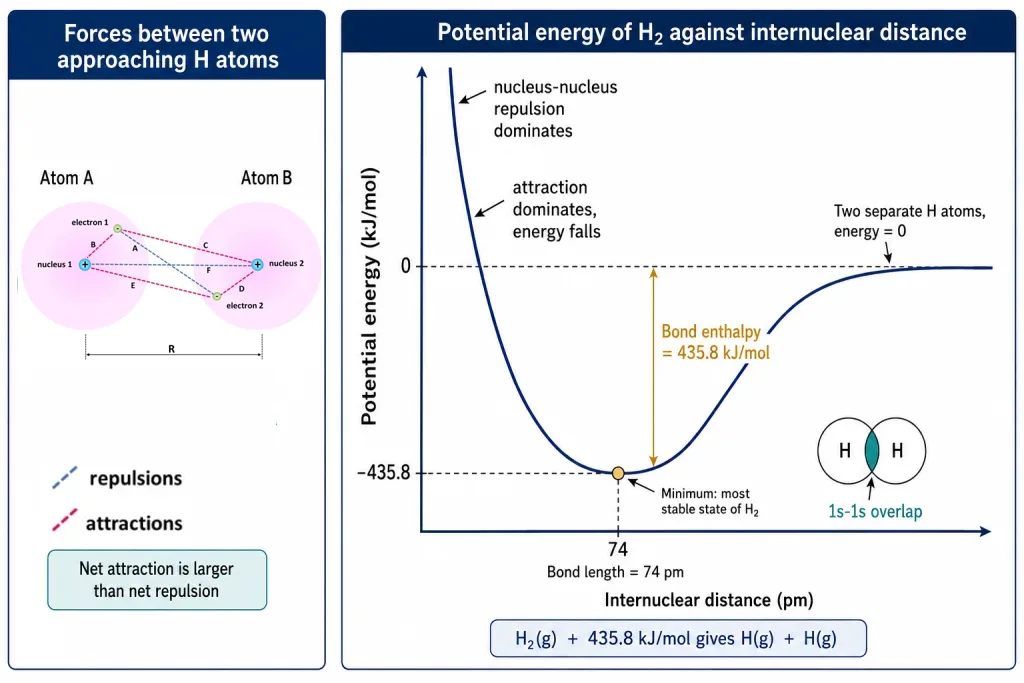
- Far right, large distance. Energy zero: two separate atoms, no interaction.
- Moving left. The new attractions dominate and the energy falls below zero. The system is more stable than the separated atoms.
- The minimum. The curve bottoms out at an internuclear distance of 74 pm, where net attraction exactly balances net repulsion. There is no net force on the nuclei and the energy is lowest. The atoms are bonded, and 74 pm is the bond length of .
- Closer than 74 pm. The repulsion shoots up and the curve climbs steeply, so the atoms do not stay there.
Bond enthalpy: the same number, seen from the other side
The depth of the well is the energy released when a mole of bonds forms, 435.8 kJ per mole of , and this is the bond enthalpy. Because energy is released, is more stable than two isolated H atoms. Run the process backwards and the same energy must be supplied:
So 435.8 kJ/mol is both the energy released on forming one mole of bonds and the energy required to dissociate one mole of .
Key Point (Definition): For , the minimum of the potential-energy curve lies at an internuclear distance of 74 pm (the bond length) and a depth of 435.8 kJ/mol below the separated atoms (the bond enthalpy). The minimum corresponds to the most stable state of the molecule.
Reading the curve
| Feature of the curve | Physical meaning |
|---|---|
| Energy zero at large distance | separated, non-interacting atoms |
| Energy falls as atoms approach | net attraction, system stabilising |
| Minimum at 74 pm | equilibrium bond length; attraction balances repulsion |
| Depth of minimum, 435.8 kJ/mol | bond enthalpy; energy released on bond formation |
| Steep rise at short distance | nucleus-nucleus repulsion dominates |
[Board] For "explain the formation of the hydrogen molecule on the basis of valence bond theory", give the two atoms with labelled nuclei and electrons, list the four forces, state that attraction exceeds repulsion, and land on 74 pm and 435.8 kJ/mol.
[JEE Main] A deeper well means a stronger and usually shorter bond. On the same axes the curve is shallower (155 kJ/mol) with its minimum further right (144 pm) — the theory explaining what the Lewis picture could not.
The Orbital Overlap Concept and the Direction of Bonds
The potential-energy curve tells you that the atoms settle at 74 pm. The orbital picture tells you what is happening there.
Each hydrogen atom carries its electron in a orbital, a sphere of electron density. At the minimum-energy distance the two orbitals partially interpenetrate — the spheres merge between the nuclei. This partial merging is called overlapping, and it lets the two electrons pair up.
Key Point (Definition): According to the orbital overlap concept, a covalent bond between two atoms is formed by the pairing of two electrons with opposite spins, present in half-filled valence-shell orbitals of the two atoms, when those orbitals overlap. The extent of overlap decides the strength of the bond: in general, the greater the overlap, the stronger the bond.
| Condition | Why it matters |
|---|---|
| Half-filled orbitals | A full orbital already has two electrons; there is no room for a partner. Only an orbital with one electron can pair. |
| Opposite spins | The Pauli principle allows two electrons in the same region only if their spins are opposite (). Two parallel spins cannot pair. |
| Overlap | The electrons must occupy the same region of space between the nuclei. Without overlap there is no shared density and no bond. |
Overlap makes a bond because the shared electron density sits between the two nuclei, where both attract it. The more density there, the harder the nuclei are held and the stronger the bond. Bond enthalpy measures how much the overlap lowered the energy, and bond length is the distance at which the overlap gain best balances nucleus-nucleus repulsion.
Bonds have directions
An orbital is a sphere and looks the same in every direction. A orbital is a dumbbell pointing along a definite axis, , or , so a bond formed by overlapping it must lie along that direction. Overlap has a direction, so bonds have directions. That is why molecules have shapes.
In , and the question is not just whether a bond forms but where it points — why methane is tetrahedral with H-C-H angles of 109.5°, why ammonia is pyramidal, why water is bent at 104.5° instead of linear. Valence bond theory answers these through overlap and hybridisation.
A first attempt with pure orbitals, and why it fails
Test the idea on methane. Carbon's ground state is : only two unpaired electrons, so only two bonds. Promote one electron into the empty orbital and the excited state is , with four unpaired electrons. The promotion energy is more than repaid by forming four C-H bonds instead of two.
Now overlap each of the four singly occupied carbon orbitals with the singly occupied of a hydrogen. The three orbitals point along , and at 90° to one another, so the three C-H bonds they make would be at 90°. The orbital is spherical and can overlap in any direction, so the fourth C-H bond has no fixed direction at all.
That is not methane, which has four identical bonds at 109.5°. The same argument gives 90° for the H-N-H angle in ammonia and the H-O-H angle in water, against the measured 107° and 104.5°.
Key Point: Simple overlap of pure atomic orbitals explains why bonds form and why they are directional, but it does not account for the actual directions of bonds in , and . It predicts 90° angles; the real angles are 109.5°, 107° and 104.5°. Pauling's remedy is hybridisation, the subject of the next section.
The failure does not mean the overlap idea is wrong. Carbon simply does not bond with its raw and orbitals but with a mixed set: the overlap picture stays, only the orbitals change.
| Molecule | Pure-orbital prediction | Observed angle | Fix |
|---|---|---|---|
| three bonds at 90°, one undirected | 109.5° | hybridisation | |
| 90° | 107° | hybridisation + lone pair | |
| 90° | 104.5° | hybridisation + two lone pairs |
[NEET] The overlap criterion applies uniformly to homonuclear diatomics (, ), heteronuclear diatomics () and polyatomic molecules (): half-filled orbitals, opposite spins, maximum overlap. Covalent bonds are directional because and hybrid orbitals have definite orientations and a bond forms only along the direction of maximum overlap; ionic bonds are non-directional because an ion's electrostatic field is the same in all directions.
Positive, Negative and Zero Overlap — the Sign of the Lobes
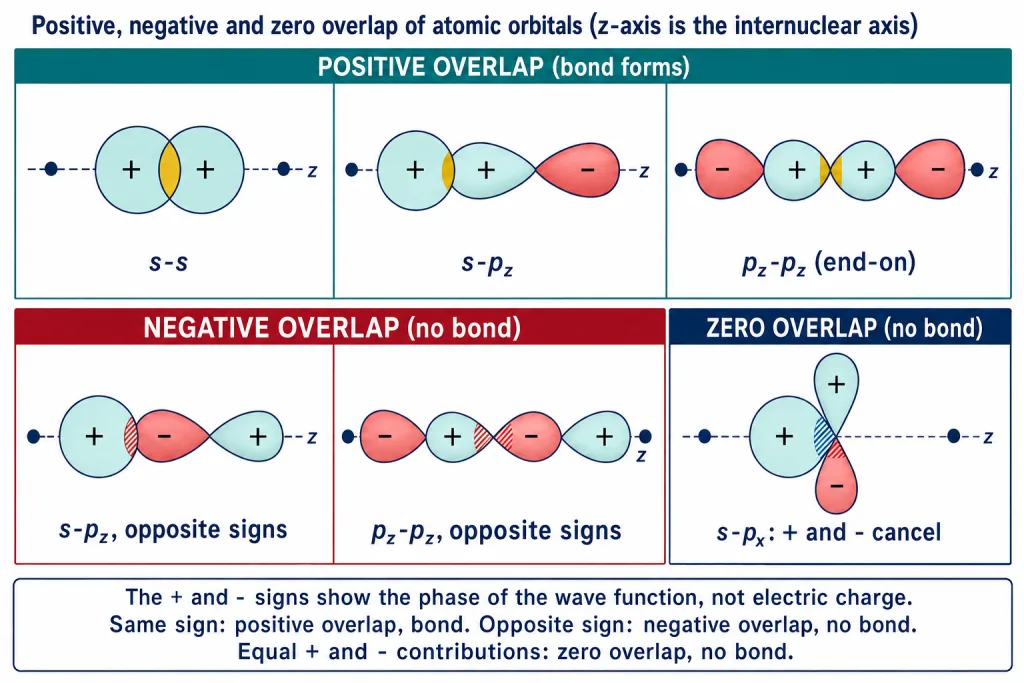
A orbital is drawn with two lobes, a plus sign on one and a minus sign on the other. These signs are not electric charges.
Key Point (Definition): The and signs on boundary-surface diagrams of orbitals show the sign (phase) of the orbital wave function in that region of space. They have nothing to do with electric charge. An orbital has the same sign everywhere (usually drawn ); a orbital has a lobe and a lobe on opposite sides of the nucleus, with a node (where ) at the nucleus.
The wave function is a wave, with crests and troughs; the sign says which one you are in. Electron density is , positive in both lobes, so the lobe holds electrons just as happily as the lobe. But when two waves meet, their signs decide whether they reinforce or cancel, and so whether a bond can form.
Three possible outcomes
Overlap can be positive, negative or zero, depending on the sign (phase) of the lobes that meet and on the orientation of the orbitals.
| Overlap | What meets | What happens to between the nuclei | Result |
|---|---|---|---|
| Positive | lobes of the same sign ( with , or with ), pointing along the internuclear axis | waves reinforce, electron density builds up between the nuclei | a bond forms |
| Negative | lobes of opposite sign ( with ) | waves cancel, electron density is pushed out from between the nuclei | no bond; the atoms repel (antibonding) |
| Zero | orientation such that same-sign and opposite-sign overlaps cancel exactly | no net constructive or destructive interference | no bond; the orbitals do not interact |
Key Point: Orbitals forming a bond must have the same sign (phase) and the right orientation in space. This is positive overlap, and it is the only kind that produces a bond.
The six standard pictures
Take the internuclear axis as the -axis.
Positive overlap (bond possible)
- with . Two spheres, both , touching along the axis. Positive.
- with . A sphere meets the lobe of a orbital pointing straight at it. Positive.
- with , end-on. Two orbitals along the axis, the lobe of one meeting the lobe of the other. Positive.
Negative overlap (no bond)
- with , wrong lobe. The sphere meets the lobe of the orbital. Negative.
- with , wrong phase. The two orbitals along the axis arranged so a lobe meets a lobe. Negative. (Also the picture for sideways overlap in which meets and meets .)
Zero overlap (no interaction)
- with , sideways. A sphere beside a orbital perpendicular to the axis overlaps its and lobes equally, so the contributions cancel exactly. The same happens for with (one along the axis, one perpendicular): whatever the lobe gains, the lobe loses.
The one rule that generates all six
- Are the lobes that meet of the same sign? If yes, and they meet in one region, positive. If no, negative.
- Is the arrangement symmetric so that a region and a region overlap equally? If yes, zero.
[JEE/NEET] Zero overlap is the case that gets asked. The classic pair is an orbital (or a orbital) with a or orbital when is the internuclear axis. The answer is one sentence: the orbital lying perpendicular to the axis overlaps a same-sign region and an opposite-sign region by equal amounts, so the net overlap is zero and no bond forms.
Types of Overlap — Sigma and Pi Bonds
Positive overlap happens in two geometrically different ways, giving two kinds of covalent bond.
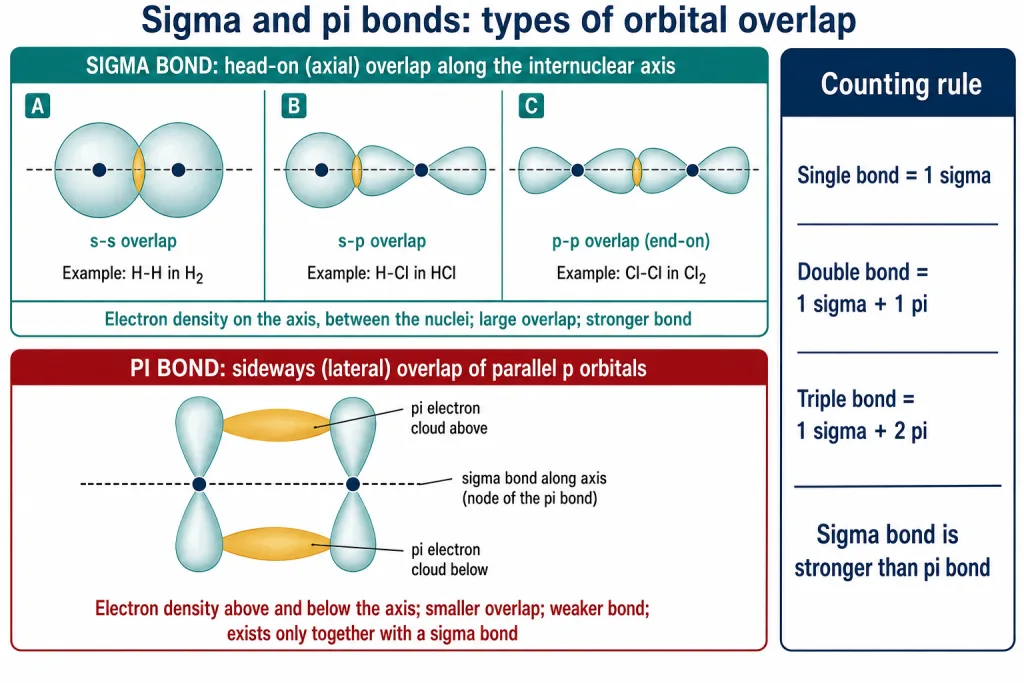
Key Point (Definition): A sigma () bond is formed by the end-to-end (head-on, axial) overlap of bonding orbitals along the internuclear axis. A pi () bond is formed by the sideways (lateral) overlap of two orbitals whose axes remain parallel to each other and perpendicular to the internuclear axis.
Sigma bonds: three ways to make one
Take the internuclear axis as the -axis. Any orbital pointing along can do head-on overlap.
| Type | Orbitals | Example | Picture in words |
|---|---|---|---|
| half-filled orbital of each atom | in | two spheres merging along the axis | |
| half-filled of one atom, half-filled of the other | in HF, in HCl | a sphere merging with one lobe of a dumbbell pointed at it | |
| (axial) | half-filled orbital of each atom, both along the axis | in , | two dumbbells, end to end, one lobe of each merging |
In every case the shared density lies on the axis, between the nuclei, and the cloud is symmetrical about that axis. That is why atoms joined by only a sigma bond rotate freely about it.
Pi bonds: sideways only
Two orbitals on neighbouring atoms parallel to each other and perpendicular to the axis — say two orbitals with as the axis — cannot meet head-on, only side by side. The lobe of one overlaps the lobe of the other above the axis, the lobe overlaps the lobe below it. Both are positive overlap, so a bond forms, but the shared density sits in two sausage-shaped regions above and below the plane of the atoms, with a node (zero density) on the axis itself.
| Feature | Sigma bond | Pi bond |
|---|---|---|
| Overlap | head-on, along the axis | sideways, parallel orbitals |
| Orbitals | , , (axial), hybrid orbitals | only (in Class 11 chemistry) |
| Electron density | on the axis, between the nuclei | above and below the axis; zero on the axis |
| Symmetry | cylindrically symmetric about the axis | one nodal plane containing the axis |
| Extent of overlap | large | smaller |
| Strength | stronger | weaker |
| Rotation about the bond | free | restricted; rotating would break the sideways overlap |
| Can exist alone? | yes, a single bond is a sigma bond | no, only alongside a sigma bond |
| Shape | decides the shape of the molecule | does not decide the shape |
Why a sigma bond is stronger than a pi bond
Head-on overlap points the fat end of each orbital straight at the other, so a large volume merges. Sideways overlap only lets the edges of the lobes touch, splitting the shared region into two thin slices.
Key Point: The extent of overlap is larger in a sigma bond than in a pi bond, so a sigma bond is stronger than a pi bond. In a multiple bond between two atoms, the pi bond (or bonds) is formed in addition to a sigma bond, never instead of it.
Two atoms sharing one pair make a sigma bond first. A second pair cannot overlap head-on — the axis is taken — so it goes sideways: a pi bond. A third pair uses the other perpendicular orbital: a second pi bond.
| Bond | Made of | Example |
|---|---|---|
| Single bond | in ethane, 154 pm | |
| Double bond | in ethene, 134 pm | |
| Triple bond | in ethyne, 120 pm |
Adding pi bonds pulls the atoms closer (154 to 134 to 120 pm) and strengthens the link, though each pi bond adds less than the sigma bond did. A double bond is stronger than a single bond, but not twice as strong.
[JEE Main] For sigma bonds from pure orbitals, the extent of overlap, and so the strength, is usually taken to increase as , because orbitals are directional. It is a working rule, not a law, and hybrid orbitals (, , ) overlap better still.
Counting Sigma and Pi Bonds, and Two Questions VBT Answers
The rule for counting sigma and pi bonds is short.
Key Point: In any Lewis structure, every bond line contributes exactly one sigma bond, and every extra line in a multiple bond is a pi bond. So: single ; double ; triple . The number of sigma bonds equals the total number of bonds (count each connection once); the number of pi bonds equals the number of double bonds plus twice the number of triple bonds.
Worked table
Draw the structure, count connections, count extra lines.
| Molecule | Structure in words | Connections | Double | Triple | ||
|---|---|---|---|---|---|---|
| 1 | 0 | 0 | 1 | 0 | ||
| 1 | 1 | 0 | 1 | 1 | ||
| 1 | 0 | 1 | 1 | 2 | ||
| 2 | 2 | 0 | 2 | 2 | ||
| 2 | 0 | 1 | 2 | 2 | ||
| ethane | 6 C-H, 1 C-C | 7 | 0 | 0 | 7 | 0 |
| ethene | 4 C-H, 1 C=C | 5 | 1 | 0 | 5 | 1 |
| ethyne | 2 C-H, 1 C≡C | 3 | 0 | 1 | 3 | 2 |
| benzene | 6 C-C ring (3 double), 6 C-H | 12 | 3 | 0 | 12 | 3 |
| (one canonical form) | 2 | 1 | 0 | 2 | 1 |
In a ring, connections = ring atoms plus substituents: benzene has six ring bonds, not five. For a resonance-stabilised species, count in any one canonical structure; all give the same answer (ozone : , ; carbonate: , ).
A quick way for hydrocarbons
For an open chain with no rings, sigma bonds = (number of atoms) minus 1. Ethene has 6 atoms, so 5. Propyne has 7 atoms, so 6 sigma bonds, and its triple bond gives 2 pi bonds. Each ring adds one more sigma bond.
Why does not form
Helium is : its only orbital is completely filled. The overlap concept requires half-filled orbitals with opposite-spin electrons that can pair, and helium has nothing to pair. If two filled orbitals overlapped, four electrons would crowd into one region, which the Pauli principle forbids; repulsion wins and there is no energy minimum, so helium stays monatomic. (MO theory says the same: bond order zero, in Section 10.)
The same logic covers the noble gases generally, and explains why an atom's covalency equals its number of unpaired electrons: hydrogen 1, oxygen 2, nitrogen 3, carbon 4 (after promotion).
The water angle: 104.5°, not 180°
Oxygen is : two half-filled orbitals at 90° to each other. Each overlaps a hydrogen orbital, so the two O-H bonds point in different directions at roughly a right angle, not opposite ones. A linear molecule would need two orbitals 180° apart, and oxygen has none. The angle opens to 104.5° because of hybridisation and bond-pair repulsion, but water is bent at all because oxygen's bonding orbitals are directional.
Key Point: Directional orbitals give directional bonds. Molecules are bent, pyramidal or tetrahedral because the orbitals that overlap point in definite directions; the exact angles need hybridisation.
Summary card
| Idea | One-line version |
|---|---|
| Why VBT | Lewis and VSEPR describe bonds but do not explain bond formation, bond energies, bond lengths or shapes |
| attraction (, ) beats repulsion (, ); minimum at 74 pm; 435.8 kJ/mol | |
| Overlap concept | bond = pairing of opposite-spin electrons in overlapping half-filled orbitals; more overlap, stronger bond |
| Signs on orbitals | phase of , not charge; same sign gives positive overlap (bond); opposite gives negative; symmetric cancellation gives zero |
| Sigma | head-on overlap along the axis (, , ); stronger; free rotation |
| Pi | sideways overlap of parallel orbitals; weaker; only with a sigma bond |
| Counting | single ; double ; triple |
| Strength order (JEE) | for sigma; any sigma stronger than any pi from the same orbitals |
[Board] When counting sigma and pi bonds in a written answer, show the structure first, then write " bonds: … ; bonds: …". A bare number gets no partial credit if it is wrong.
Solved Examples
Question 1: Formation of the hydrogen molecule by valence bond theory
Explain the formation of the molecule on the basis of valence bond theory.
Answer:
I start with two hydrogen atoms A and B, each with a nucleus (, ) and one electron (, ) in a orbital. Far apart they do not interact, so I take that energy as zero.
As they approach I list the forces. Attractions: each nucleus with its own electron (, ), and, new, each nucleus with the other atom's electron (, ). Repulsions, also new: between the two electrons () and between the two nuclei ().
Experimentally the new attractive forces are larger than the new repulsive ones, so the atoms keep coming closer and the potential energy keeps falling.
At 74 pm the net attraction exactly balances the net repulsion and the energy is lowest. The atoms are bonded, and 74 pm is the bond length of . Closer than this, nucleus-nucleus repulsion takes over and the energy climbs steeply.
In orbital language, at 74 pm the two orbitals overlap and their electrons pair up with opposite spins in the region between the nuclei. That shared density holds the nuclei together.
Forming one mole of bonds releases 435.8 kJ, the bond enthalpy, and the same energy is needed to break the molecule apart: . Because energy is released on formation, is more stable than two separate H atoms.
Ans: New attractions (, ) outweigh new repulsions (, ); the energy falls to a minimum at 74 pm, where the two half-filled orbitals overlap and the opposite-spin electrons pair. The energy released, 435.8 kJ/mol, is the bond enthalpy.
Question 2: Reading the potential-energy curve
The potential energy of two hydrogen atoms is plotted against the distance between their nuclei. Explain the shape of the curve: why does the energy first fall, then reach a minimum, then rise sharply? What do the position and depth of the minimum represent?
Answer:
At the far right the atoms do not feel each other, so the energy is zero. That is my reference: two free hydrogen atoms.
Moving inwards, each nucleus starts to pull on the other atom's electron. These new attractions are stronger than the new repulsions (electron-electron and nucleus-nucleus), so the system loses energy and becomes more stable.
At 74 pm the attractions and repulsions exactly balance, there is no net force, and the energy is as low as it can get. This equilibrium position is the bond length. The depth of the well below zero, 435.8 kJ/mol, is the energy released when one mole of bonds forms: the bond enthalpy.
Closer than 74 pm the two positive nuclei are very near each other and their mutual repulsion grows faster than any attraction. Pushing further costs energy, so the atoms are pushed back out. That is why the molecule vibrates about 74 pm rather than collapsing.
The minimum means stability because any system sits at its lowest available energy. The molecule at 74 pm has less energy than the separated atoms, so it does not fall apart on its own; 435.8 kJ/mol must be supplied to climb back to the separated-atom level.
Ans: The curve falls because attraction exceeds repulsion as the atoms approach; it reaches a minimum at 74 pm where the forces balance (the bond length, the depth of 435.8 kJ/mol being the bond enthalpy); and it rises sharply at shorter distances because nucleus-nucleus repulsion dominates.
Watch out: Position of the minimum is the bond length; depth of the minimum is the bond enthalpy. A deeper, narrower well means a stronger, shorter bond.
Question 3: The meaning of plus and minus signs on orbitals
Write the significance of a plus and a minus sign shown in representing the orbitals.
Answer:
Every orbital is described by a wave function , and like any wave it is positive in some regions and negative in others. The and signs on the lobes show the sign, or phase, of there.
They are not electric charges. Electron density is , positive everywhere, so the lobe of a orbital holds just as much negative electron charge as the lobe. An orbital has the same sign throughout; a orbital has one lobe and one lobe with a nodal plane through the nucleus where .
The signs matter when two orbitals overlap. Same-sign lobes reinforce each other, density builds up between the nuclei and a bond forms: positive overlap. Opposite-sign lobes cancel, density is removed and no bond forms: negative overlap. If a same-sign region and an opposite-sign region overlap equally, the net effect is nothing: zero overlap.
Ans: The and signs represent the phase of the orbital wave function, not charge. Same-sign overlap is positive and leads to bond formation; opposite-sign overlap is negative and gives no bond; an arrangement in which the two cancel gives zero overlap.
Question 4: Which overlaps give a sigma bond along the x-axis?
Considering the -axis as the internuclear axis, which of the following will not form a sigma bond, and why? (a) and ; (b) and ; (c) and ; (d) and .
Answer:
A sigma bond needs head-on overlap along the internuclear axis, here the -axis. So of each pair I ask: can these two orbitals meet end-to-end along ?
(a) and are both spherical, so they overlap along whatever line joins the nuclei. Sigma bond, as in .
(b) and : the points along the -axis, straight at the sphere, and one lobe overlaps it head-on. Sigma bond, the overlap of or .
(c) and both point along , perpendicular to the axis. They cannot meet head-on, only side by side above and below the -axis. That sideways overlap gives a pi bond, not a sigma bond.
(d) and are both spherical, so they overlap along the axis. Sigma bond.
Ans: (c) and will not form a sigma bond — their axes are parallel to each other and perpendicular to the internuclear -axis, so they overlap sideways to give a pi bond. (a), (b) and (d) all overlap head-on along the axis and give sigma bonds.
Watch out: Whatever axis the question names, the orbital along that axis makes sigma; the two orbitals perpendicular to it make pi.
Question 5: Distinguishing a sigma bond from a pi bond
Distinguish between a sigma bond and a pi bond.
Answer:
A sigma bond forms by head-on (axial, end-to-end) overlap along the line joining the nuclei; a pi bond by sideways (lateral) overlap of two orbitals parallel to each other and perpendicular to that line. Sigma bonds use , , axial or any hybrid orbital; pi bonds use only unhybridised orbitals (in Class 11).
In a sigma bond the density lies on the internuclear axis, symmetrical around it. In a pi bond it sits in two lobes above and below the axis, with zero density on the axis itself.
Head-on overlap is larger, so a sigma bond is stronger. It can also exist by itself — every single bond is a sigma bond — while a pi bond exists only together with a sigma bond between the same two atoms.
Atoms joined by a sigma bond alone rotate freely about it. A pi bond stops that rotation, because turning one atom would break the side-by-side overlap. Sigma bonds decide the shape of a molecule; pi bonds do not.
Ans:
| Sigma bond | Pi bond |
|---|---|
| head-on overlap along the axis | sideways overlap of parallel orbitals |
| , , (axial), hybrids | only |
| density on the axis, cylindrically symmetric | density above and below the axis, node on the axis |
| stronger (greater overlap) | weaker (smaller overlap) |
| can exist alone | exists only with a sigma bond |
| free rotation; decides shape | restricts rotation; does not decide shape |
Watch out: Any three rows of that table make a full three-mark answer. Lead with "head-on versus sideways" and "stronger versus weaker".
Question 6: Double and triple bonds between carbon atoms
Describe, as you would draw them, the formation of the double bond in and the triple bond in from carbon orbitals.
Answer:
For ethene, , I put the two carbons on the -axis with all six atoms in the -plane, the plane of the page. Each carbon uses three orbitals in that plane (the hybrids of the next section) for three sigma bonds: two C-H and one C-C. The C-C sigma bond is head-on overlap along the -axis, an oval of density between the nuclei.
Each carbon has one unhybridised orbital left, sticking out of the plane. The two are parallel to each other and perpendicular to the C-C axis, so their lobes merge above the plane and their lobes below it. That sideways overlap is the C-C pi bond, two sausage-shaped clouds flanking the sigma bond.
So is . The molecule is planar and the bond length is about 134 pm.
For ethyne, , the four atoms lie in a straight line along the -axis. Each carbon uses two orbitals along the axis ( hybrids, next section) for one C-H and one C-C sigma bond, head-on.
Each carbon now has two unhybridised orbitals left, and , at right angles to each other and to the axis. The pair overlaps sideways to give a pi bond above and below the axis; the pair gives a second pi bond in front of and behind it.
So is one sigma bond wrapped by two pi bonds in perpendicular planes: , the two pi clouds together forming a cylinder around the sigma bond. The molecule is linear and the bond length is about 120 pm.
Ans: In the C=C bond is one head-on sigma overlap along the C-C axis plus one sideways overlap of the two parallel orbitals perpendicular to the molecular plane (). In the C≡C bond is one sigma overlap plus two sideways overlaps of the two pairs of mutually perpendicular orbitals ().
Watch out: Draw the sigma bond first, on the axis. Each pi bond is a pair of lobes flanking that axis, and the two pi bonds of a triple bond are at 90° to each other.
Question 7: Sigma and pi bonds in ethyne and ethene
What is the total number of sigma and pi bonds in (a) and (b) ?
Answer:
Every connection contains one sigma bond. A double bond adds one pi bond; a triple bond adds two.
(a) Ethyne, . Connections: H-C, C≡C, C-H — three sigma bonds. The triple bond carries two extra lines, so two pi bonds.
(b) Ethene, . Connections: four C-H plus one C=C — five sigma bonds. The double bond carries one extra line, so one pi bond.
Check with the open-chain shortcut, sigma = atoms minus 1: ethyne 4 atoms gives 3, ethene 6 gives 5.
Ans: (a) : 3 sigma bonds and 2 pi bonds. (b) : 5 sigma bonds and 1 pi bond.
Question 8: Sigma and pi bonds in benzene, acrylonitrile, carbon dioxide and sulphur dioxide
Count the sigma and pi bonds in (a) benzene , (b) , (c) and (d) .
Answer:
(a) Benzene has six carbons in a ring, each with one hydrogen. A ring of six atoms has six C-C bonds, not five, plus six C-H: 12 connections, 12 sigma bonds. In one Kekulé structure three ring bonds are double, so 3 pi bonds. The other Kekulé structure gives the same count.
(b) . Every connection: two C-H on the first carbon, one C=C, one C-H on the second carbon, one C-C, one C≡N. That is sigma bonds. Extra lines: one from the double bond, two from the triple, so 3 pi bonds. Check: 7 atoms, open chain, sigma.
(c) is : two connections, both double. 2 sigma, 2 pi.
(d) : one canonical form is with a lone pair on sulphur — two connections, one double. 2 sigma, 1 pi. The other resonance form swaps which S-O is double and gives the same numbers.
Ans: (a) benzene: , ; (b) : , ; (c) : , ; (d) : , .
Watch out: Rings have as many bonds as atoms. All resonance forms give the same sigma and pi counts, so pick any one.
Question 9: Sigma, pi or zero along the z-axis
Take the -axis as the internuclear axis. Classify each of the following overlaps as forming a sigma bond, a pi bond or no bond at all: (a) with ; (b) with ; (c) with ; (d) with ; (e) with .
Answer:
My rule with as the axis: an orbital along overlaps head-on (sigma); two orbitals perpendicular to and parallel to each other overlap sideways (pi); one along the axis meeting one perpendicular to it, or two perpendicular ones at right angles, overlap and regions equally, giving zero.
(a) with : both along the axis, end to end. Sigma.
(b) with : both perpendicular to and parallel, overlapping above and below the axis. Pi.
(c) with : both perpendicular to but at 90° to each other, so each lobe of overlaps the and lobes of equally. Net zero; no bond.
(d) with : the sphere meets the lobe of pointing at it, head-on. Sigma.
(e) with : the sphere sits beside a orbital perpendicular to the axis, overlapping its and lobes equally. Net zero; no bond.
Ans: (a) sigma; (b) pi; (c) zero overlap, no bond; (d) sigma; (e) zero overlap, no bond.
Watch out: Along the axis, sigma. Both perpendicular and parallel, pi. One along and one across, or two across at right angles, zero.
Question 10: Ordering the strength of sigma bonds by overlap type
Arrange the sigma bonds formed by , and overlap in order of increasing strength, and explain the order.
Answer:
Bond strength follows the extent of overlap: more overlap, more shared density between the nuclei, stronger bond.
An orbital is a sphere with density spread evenly in all directions, so only a small slice points along the bond axis. Two spheres () overlap the least.
A orbital is directional, its density concentrated in two lobes along one line. When that line is the bond axis, the whole fat end of the lobe points at the partner. So overlaps more than , and end to end more still.
Two footnotes. The order compares the type of overlap for otherwise similar orbitals, so it cannot be used blindly across periods: the bond at 435.8 kJ/mol is far stronger than the bond at 155 kJ/mol, because fluorine's lone pairs repel and its orbitals are smaller and more compact. And hybrid orbitals (, , ) overlap head-on better than pure , one reason hybridisation happens at all.
Ans: . The more directional the orbitals, the more effectively they concentrate overlap along the bond axis, so orbitals overlap better than spherical orbitals.
Watch out: This ordering is a working rule for competitive exams, not a universal law. State it with the reason "directional orbitals overlap more effectively", and remember that any sigma bond beats any pi bond made from the same orbitals.
Question 11: Why helium does not form according to valence bond theory
Hydrogen readily forms but helium does not form . Explain using valence bond theory.
Answer:
Valence bond theory says a covalent bond forms when half-filled orbitals on two atoms overlap and their opposite-spin electrons pair up.
Hydrogen is , so its orbital is half-filled. Two hydrogen atoms bring one electron each, the electrons pair with opposite spins in the overlap region, the energy falls to a minimum at 74 pm and 435.8 kJ/mol is released.
Helium is . Its only orbital is completely filled with a paired set (), so there is no unpaired electron and no room left. If two helium atoms overlapped their orbitals, four electrons would have to occupy the overlap region. The Pauli principle allows at most two of opposite spin in one orbital, so the extra pair raises the energy instead of lowering it: repulsion dominates, there is no energy minimum, and the atoms push apart.
Helium therefore exists as single atoms. More generally, an atom's covalency equals its number of half-filled orbitals after any promotion; helium has zero.
Ans: forms because each H atom has a half-filled orbital whose electrons can pair on overlap. He is with a fully filled orbital and no unpaired electron, so overlap cannot lead to electron pairing; repulsion dominates and no bond forms.
Watch out: No half-filled orbital, no bond. This is the VB version of the MO result that the bond order of is zero.
Question 12: Why is water bent and not linear?
Using the orbitals of oxygen and hydrogen, explain why the H-O-H angle in water is 104.5° rather than 180°. What angle does simple valence bond overlap predict, and why does the real angle differ?
Answer:
Oxygen is , with exactly two half-filled orbitals, and , at 90° to each other because orbitals lie along perpendicular axes.
Each half-filled orbital overlaps head-on with the half-filled of a hydrogen to make an O-H sigma bond, and since a orbital points in a definite direction, each O-H bond points along the axis of the orbital that formed it.
The two bonds therefore point along two different perpendicular directions, and simple overlap predicts 90°. Nothing in oxygen's orbitals points 180° apart, so a linear molecule is impossible from the start. Water is bent because its bonding orbitals are directional.
The measured angle is 104.5°, not 90°, for two reasons. The two O-H bond pairs carry electron density and repel each other, pushing the bonds apart. And oxygen uses hybrid orbitals (next section), not pure ; their natural angle of 109.5° is squeezed to 104.5° by the two lone pairs.
Compare , linear at 180°: beryllium uses two hybrid orbitals that point in opposite directions. The angle follows the directions of the orbitals doing the overlapping.
Ans: Oxygen's two half-filled orbitals are perpendicular, so simple VB overlap with two hydrogen orbitals predicts a bent molecule with a 90° angle, never a linear 180° one. The observed 104.5° is larger than 90° because of repulsion between the bond pairs and because oxygen actually bonds through hybrid orbitals, whose 109.5° angle is reduced by the two lone pairs.
Watch out: Pure overlap already rules out linear water; hybridisation and lone-pair repulsion fix the exact number.