
Non-Polar and Polar Covalent Bonds
A 100 per cent ionic bond and a 100 per cent covalent bond are both ideal limits; every real bond lies between them. Even has a trace of ionic character, and NaCl a little covalent character. This section measures where a bond sits on that line.
When the sharing is equal: non-polar bonds
In a bond between two identical atoms — , , , , — both atoms have the same electronegativity and pull equally. The shared pair sits midway between the nuclei, so neither end carries charge. That is a non-polar covalent bond.
Key Point (Definition): A covalent bond between two atoms of the same electronegativity (typically two identical atoms, as in , , ) has its shared pair placed symmetrically between the two nuclei. It is a non-polar covalent bond; the molecule has no separation of charge.
When the sharing is unequal: polar bonds
Bond hydrogen to fluorine instead. Fluorine (electronegativity 4.0) pulls far harder than hydrogen (2.1), so the shared pair spends much more time near fluorine. Fluorine's end becomes slightly negative, hydrogen's slightly positive. We mark these partial charges and :
The bond is still covalent — one shared pair — but the sharing is lopsided. This is a polar covalent bond, and the shift of the electron cloud toward the more electronegative atom is called polarisation of the bond.
Key Point (Definition): A covalent bond between two atoms of different electronegativity has its shared pair displaced toward the more electronegative atom, giving that atom a partial negative charge and the other atom a partial positive charge . This is a polar covalent bond. Example: , , in water, in ammonia.
The symbol means "a fraction of one electronic charge", not a whole charge. In HF each end carries roughly . A whole would make the bond ionic, .
The electronegativity difference is the dial
| Bond | Electronegativity difference | Nature |
|---|---|---|
| , | 0 | non-polar covalent |
| 0.4 | very weakly polar (usually treated as non-polar) | |
| 0.4 | weakly polar | |
| 0.7 | polar | |
| 0.9 | polar | |
| 1.4 | strongly polar | |
| 1.9 | very strongly polar (about 40 per cent ionic) | |
| 2.1 | predominantly ionic |
There is no sharp line where "polar covalent" becomes "ionic". Chemists loosely take a difference above about 1.7 to 2.0 as a mostly ionic bond, but the real picture is a continuous slide: as the difference grows the bond gains more ionic character, until the electron pair is essentially owned by one atom.
[JEE/NEET] "Polar bond" and "polar molecule" are not the same thing. A molecule can be full of polar bonds and still be non-polar overall if the bond polarities cancel by symmetry — , and . Handling this needs a measure of polarity with both size and direction: the dipole moment.
[Board] A common two-mark question is "explain a polar covalent bond with a suitable example". Give the definition (unequal sharing because of an electronegativity difference), name HF or HCl, show the and , and say which atom gets which and why. That is a full-marks answer.
Dipole Moment — Putting a Number on Polarity
A polar bond has a small positive charge at one end and an equal small negative charge at the other. Two equal and opposite charges separated by a distance form an electric dipole, and its strength is charge times separation.
Key Point (Definition): The dipole moment of a molecule is the product of the magnitude of the charge and the distance between the centres of positive and negative charge: where is the magnitude of the charge at either end and is the distance between the two charge centres. It is a vector quantity.
The unit: debye
With in coulomb and in metre, comes out in coulomb metre (C m). Molecular dipoles are around C m, so chemists use the debye (symbol D), named after Peter Debye.
Memorise that conversion to three figures: C m.
For calibration, put a full charge C at each end of a bond 100 pm long:
A fully ionic bond of 100 pm gives about 4.8 D. Real polar covalent molecules (HF 1.78 D, HCl 1.07 D, water 1.85 D) fall far below this — that is what "partial charge" means. Keep 4.8 D per 100 pm in your head as a one-line check on every ionic-character calculation.
Going the other way, water's 1.85 D is
Direction: the crossed-arrow convention
Since is a vector it needs a direction, and here chemistry and physics disagree.
- In physics, the dipole moment vector points from the negative charge to the positive charge (tail on , head on ).
- In chemistry, we draw a crossed arrow on the Lewis structure: the cross (the tail, drawn like a plus sign) sits on the positive end and the arrow head points to the negative end, showing where electron density has shifted.
For hydrogen fluoride:
Key Point: The chemist's crossed arrow points toward the more electronegative atom, the negative end, i.e. in the direction the electrons have moved. This is opposite to the physics direction. In an exam, draw the cross on the atom and the head on the atom.
Reading a dipole moment
A dipole moment tells you three things at once:
- Whether the molecule is polar. means polar; means non-polar.
- How polar. Bigger means a bigger charge separation (larger , larger , or both).
- What the molecule looks like. With polar bonds present, can only happen if the bond dipoles cancel, which requires a symmetric shape. A measured dipole moment is therefore structural evidence: it can tell a linear molecule from a bent one.
That third point needs one more idea: how bond dipoles add up in a molecule with more than one bond.
[Board] If a question gives in debye and asks for charge in coulomb, convert D to C m first, then divide by in metres ( m). A molecular charge should come out as a fraction of C.
Polyatomic Molecules — Adding Bond Dipoles as Vectors
In a diatomic molecule the single bond dipole is the molecular dipole. With several bonds, each polar bond contributes a bond dipole and the molecular dipole moment is their vector sum. Because vectors can cancel, the result depends not only on how polar each bond is but on the shape of the molecule.
Key Point: In a polyatomic molecule the dipole moment depends on (i) the individual bond dipoles and (ii) the spatial arrangement of the bonds. It is the vector sum of the bond dipoles: symmetric arrangements cancel, unsymmetric ones do not.
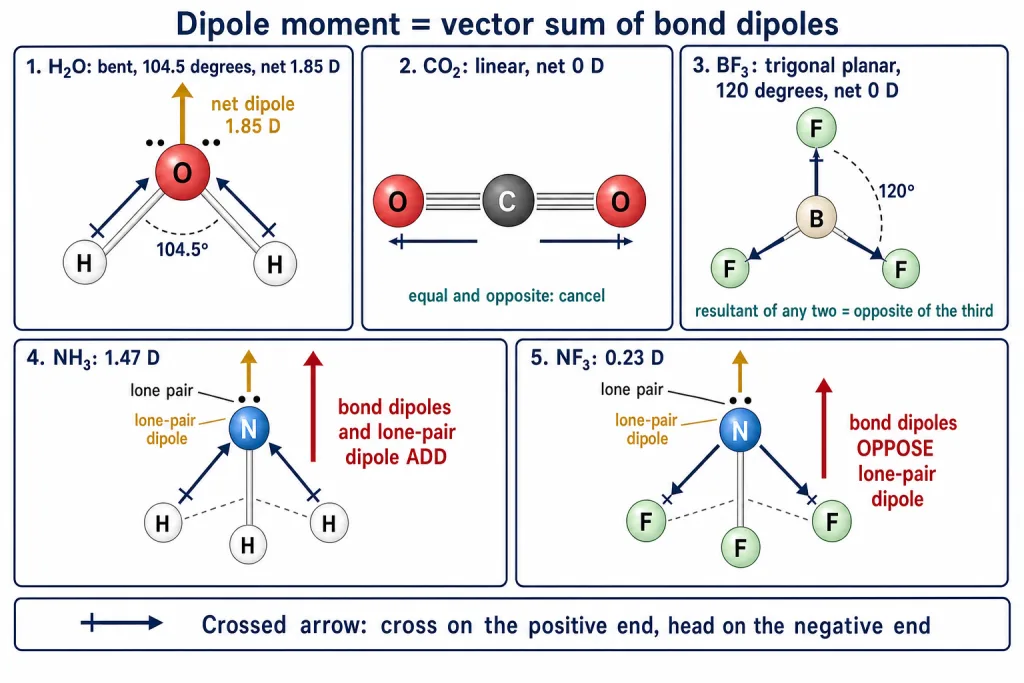
Water: bent, so the dipoles add
Water has two strongly polar bonds at , each arrow pointing from H toward O. The molecule is bent, so the arrows are not opposite; both lean toward the oxygen side, and their resultant runs along the bisector of the angle from the hydrogens toward the oxygen. Net dipole moment: 1.85 D, or C m.
The parallelogram law takes it apart. For two equal bond dipoles at an angle ,
For water, and , so , giving an bond dipole of about 1.51 D.
Beryllium fluoride and carbon dioxide: linear, so the dipoles cancel
is linear, , bond angle . Each bond is very polar, but the two dipoles are equal and exactly opposite, so they cancel: is zero. Same for and .
repeats this with double bonds: , linear, two equal dipoles pointing away from carbon in opposite directions, so is zero even though each bond is polar. This is how dipole moment settles shape — a bent would have a non-zero moment.
Boron trifluoride: three at 120 degrees, still zero
is trigonal planar, three bonds at . Three equal coplanar vectors at sum to zero — the resultant of any two is equal and opposite to the third — so has a zero dipole moment despite three strongly polar bonds. and behave the same way.
Methane and carbon tetrachloride: tetrahedral, zero
Four equal bond dipoles pointing to the corners of a regular tetrahedron ( apart) also sum to zero, so and are non-polar, . Replace one Cl in by H and the bonds are no longer identical — three dipoles and one weak dipole — so the cancellation breaks: has D, 1.87 D and 1.60 D.
The rule behind all of these
| Shape | Example | Bonds identical? | |
|---|---|---|---|
| Linear | , | yes | 0 |
| Bent | , , | yes | non-zero |
| Trigonal planar | yes | 0 | |
| Trigonal pyramidal | , | yes | non-zero |
| Tetrahedral | , | yes | 0 |
| Tetrahedral, mixed | , | no | non-zero |
| Trigonal bipyramidal | yes | 0 | |
| Octahedral | yes | 0 | |
| Square planar | yes | 0 |
Key Point: A molecule whose central atom carries no lone pair and is surrounded by identical atoms in a regular geometry (linear, trigonal planar, tetrahedral, trigonal bipyramidal, octahedral, square planar) has zero dipole moment. Lone pairs on the central atom, or different substituents, usually break the symmetry and give a non-zero moment.
[JEE Main] Two exceptions. has two lone pairs, but they sit opposite each other above and below the square plane and cancel, so . Trans-1,2-dichloroethene has its two dipoles on opposite sides of the double bond and ; the cis isomer has them on the same side, D.
The NH3 versus NF3 Puzzle, and the Dipole Moment Table
Ammonia and nitrogen trifluoride share a shape: trigonal pyramidal, nitrogen at the apex, three bonds below, a lone pair on top. Fluorine (4.0) is far more electronegative than hydrogen (2.1), so each bond is more polar than each bond, and should have the larger dipole moment. It does not, by a wide margin:
The lone pair has its own dipole
The lone pair is concentrated negative charge sticking out away from the three bonds — itself a dipole, the orbital dipole or lone-pair dipole, pointing from the nitrogen nucleus out toward the lone pair along the axis of the pyramid.
Now look at where the bond dipoles point.
- In , nitrogen is more electronegative than hydrogen, so each dipole points from H toward N, up toward the lone pair. The resultant of the three runs up the axis, as does the lone-pair dipole, so they add: 1.47 D.
- In , fluorine is more electronegative than nitrogen, so each dipole points from N toward F, down away from the lone pair. The resultant runs down the axis against the lone-pair dipole, so they largely cancel: 0.23 D.
Key Point: In the lone-pair (orbital) dipole runs in the same direction as the resultant of the three bond dipoles, so they reinforce and is large (1.47 D). In it opposes the resultant of the three bond dipoles, so they partly cancel and is small (0.23 D). Same shape, opposite outcome, because the bond polarity has flipped direction.
Hydrogen sulphide
is bent like water (angle about ), so its two dipoles add and the molecule is polar. But sulphur (2.5) is much less electronegative than oxygen (3.5), so each bond is far less polar: D against 1.85 D for water.
The table you should know
| Type | Molecule | (D) | Geometry |
|---|---|---|---|
| AB | HF | 1.78 | linear |
| HCl | 1.07 | linear | |
| HBr | 0.79 | linear | |
| HI | 0.38 | linear | |
| 0 | linear | ||
| 1.85 | bent | ||
| 0.95 | bent | ||
| 0 | linear | ||
| 1.47 | trigonal pyramidal | ||
| 0.23 | trigonal pyramidal | ||
| 0 | trigonal planar | ||
| 0 | tetrahedral | ||
| 1.04 | tetrahedral | ||
| 0 | tetrahedral |
Two patterns to read off it.
Hydrogen halides fall down the group. HF 1.78 > HCl 1.07 > HBr 0.79 > HI 0.38 D. Electronegativity falls from F to I, so falls sharply; the bond length grows from 92 pm to 160 pm, nowhere near enough to compensate.
Symmetry beats bond polarity. , , and all contain polar bonds and all have .
What dipole moment is used for
- Deciding whether a molecule is polar. This governs solubility ("like dissolves like"), boiling points and intermolecular forces.
- Deciding the shape. A zero moment points to a symmetric geometry (linear , planar ), a non-zero moment to an unsymmetric one (bent , pyramidal ).
- Estimating per cent ionic character, by comparing the observed moment with the value expected for complete electron transfer.
- Telling cis from trans isomers. Cis-1,2-dichloroethene has a dipole moment; the trans isomer has none.
- Comparing electronegativities: among molecules of similar bond length, a larger means a bigger electronegativity difference.
[NEET] The lone-pair argument also gives , and . Comparing two molecules of the same shape, ask first which way the bond dipoles point relative to the lone pair.
[Board] "Write the significance or applications of dipole moment" is a standard three-mark question. Give at least three of the five points above with one example each.
Per Cent Ionic Character from the Dipole Moment
If a bond were completely ionic, one full electron would have moved across and the dipole moment would be a whole electronic charge times the bond length. The measured value is always smaller; the ratio of the two gives the fraction of an electron that has actually shifted.
Key Point (Definition): where C and is the bond length.
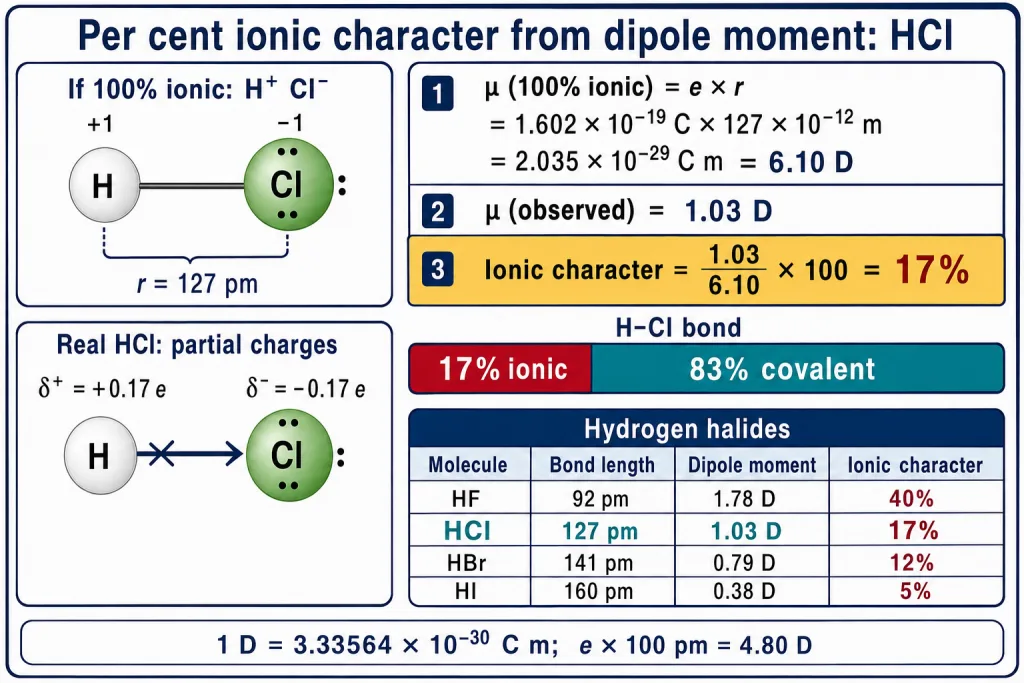
The HCl case, step by step
HCl has a bond length of 127 pm and an observed dipole moment of 1.03 D. (The previous table lists 1.07 D; 1.03 D is the more precise gas-phase value. Either gives about 17 per cent.)
Step 1. Dipole moment if HCl were 100 per cent ionic, i.e. with a full charge at each end:
In debye:
(Against the 4.8 D per 100 pm rule of thumb: D.)
Step 2. Compare with what is observed:
So is about 17 per cent ionic and 83 per cent covalent: hydrogen carries and chlorine .
HF: the most ionic hydrogen halide
bond length 92 pm, observed D.
KBr: a "real" ionic compound in the gas phase
A gaseous KBr molecule (an ion pair, not the crystal) has a bond length of 282 pm and D.
Even KBr is only about three-quarters ionic by this measure — the point behind "no bond is purely ionic or purely covalent".
The hydrogen halides side by side
| Molecule | (pm) | (D) | (D) | Ionic character |
|---|---|---|---|---|
| HF | 92 | 1.78 | 4.42 | about 40% |
| HCl | 127 | 1.03 | 6.10 | about 17% |
| HBr | 141 | 0.79 | 6.77 | about 12% |
| HI | 160 | 0.38 | 7.69 | about 5% |
The order HF > HCl > HBr > HI is the order of electronegativity difference. The "100 per cent ionic" column rises down the group (longer bonds) while the observed column falls, so the percentage drops even faster than the raw dipole moment.
[JEE Main] The calculation runs both ways: from ionic character and bond length, and for the charge on each atom. Shortcut, since D: For HCl, D. Show the full calculation in a Board answer and use this to check it.
Fajans' Rules — The Covalent Character of Ionic Bonds
Ionic bonds also carry some covalent character, sometimes a lot. Kazimierz Fajans worked out in the 1920s which ionic compounds are the most covalent. His rules are trends, not laws — guides to which of two compounds is more covalent, not exact predictions.
The mechanism: polarisation of the anion
A cation is a small, dense ball of positive charge; an anion is a large, soft cloud of electrons. The cation pulls the anion's cloud toward itself, so the cloud bulges into the space between the nuclei. The anion has been polarised (distorted), and the cation is said to have polarising power.
That bulge is extra electron density piled up between the nuclei — which is what a covalent bond is. The more the anion is polarised, the more the bond behaves like a covalent one.
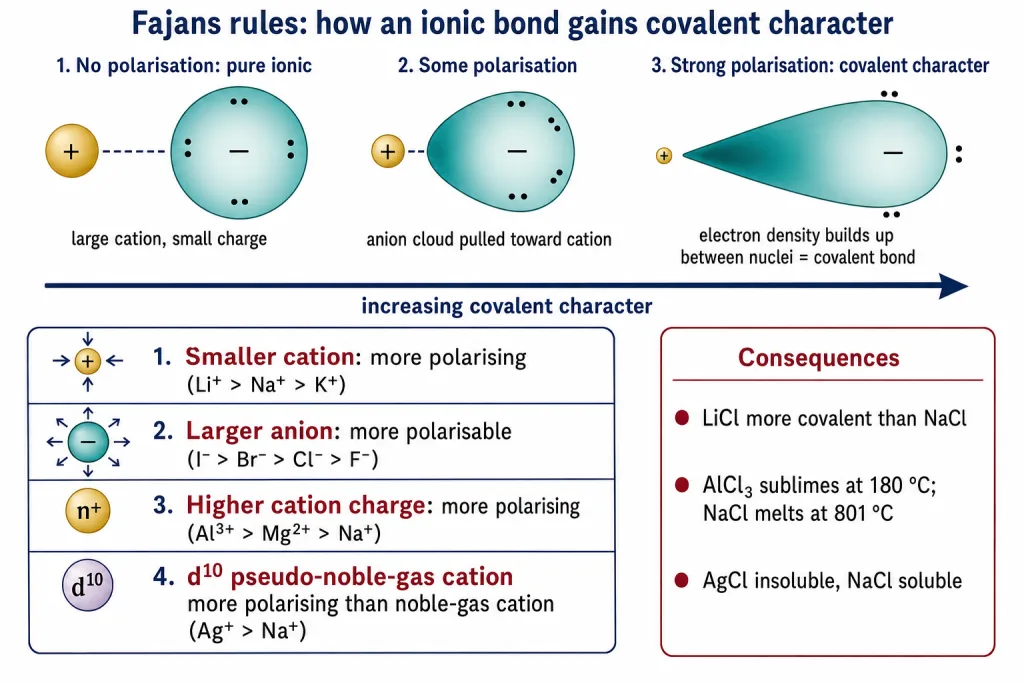
Key Point: The polarising power of the cation, the polarisability of the anion and the resulting extent of polarisation of the anion together decide the per cent covalent character of an ionic bond. More polarisation means more covalent character.
The rules
Key Point (Fajans' Rules): These are trends, not rigid laws. The covalent character of an ionic bond generally increases with:
- Smaller cation. A small cation packs its charge into a small volume, so its electric field at the anion's surface is intense. It pulls hard on the anion cloud.
- Larger anion. A big anion holds its outer electrons loosely and far from its own nucleus, so its cloud is easily distorted (high polarisability).
- Higher charge on the cation (and on the anion). A cation pulls far harder than a cation of the same size.
- Cation electronic configuration. For cations of the same size and charge, one with an configuration (typical of transition metals, e.g. , , ) is more polarising than one with a noble-gas configuration (typical of alkali and alkaline-earth cations, e.g. , , ), because electrons shield the nuclear charge poorly, so the anion "sees" a larger effective positive charge.
Rules 1 and 3 together: polarising power rises with charge/size, written , the ionic potential.
What the rules predict
| Comparison | Which is more covalent? | Reason |
|---|---|---|
| LiCl, NaCl, KCl | LiCl > NaCl > KCl | cation size grows Li < Na < K, so polarising power falls |
| NaF, NaCl, NaBr, NaI | NaI > NaBr > NaCl > NaF | anion size grows F < Cl < Br < I, so polarisability rises |
| NaCl, , | > > NaCl | cation charge rises , , (and size falls) |
| , , , | most covalent | smallest cation of the group |
| NaCl versus AgCl | AgCl | () is far more polarising than () of similar size |
| CuCl versus NaCl | CuCl | is , a pseudo-noble-gas cation |
The consequences show up in the laboratory.
- LiCl dissolves in ethanol and other organic solvents and is deliquescent; NaCl is a textbook ionic solid. The lithium salt is more covalent because is tiny (76 pm) against (102 pm).
- sublimes at about 180 C and is a covalent dimer in the vapour; NaCl melts at 801 C. The charge on a small polarises chloride so heavily that the bond is essentially covalent.
- AgCl is insoluble in water while NaCl dissolves freely. (115 pm) is even a little larger than , so on size alone AgCl should be more ionic. But its 18-electron outer shell shields the nucleus poorly, so chloride feels a much larger effective charge and is strongly polarised.
- Colour. Increasing polarisation often deepens colour: AgCl white, AgBr pale yellow, AgI yellow; white while is golden yellow. The large, highly polarisable iodide ion is the reason.
[JEE Main] Rule 4, the pseudo-noble-gas or 18-electron cation rule, is the one most often forgotten. Set a cation (, , , , ) against an alkali or alkaline-earth cation of similar size and charge and the compound is generally more covalent, less soluble in water, often lower-melting or more coloured.
Two sides of one coin
| Bond starts as | Departure from the ideal | Measured by | Governed by |
|---|---|---|---|
| Covalent | acquires partial ionic character | dipole moment, per cent ionic character | electronegativity difference |
| Ionic | acquires partial covalent character | polarisation of the anion | Fajans' rules (cation size and charge, anion size, cation configuration) |
The dipole moment tells you how far a covalent bond has slid toward ionic; Fajans' rules tell you how far an ionic bond has slid toward covalent.
[NEET] For a quick ranking, ask three things in order: which cation is smaller or more highly charged; which anion is larger; whether either cation has a shell. The compound that wins on more of these is generally the more covalent.
Solved Examples
Question 1: Polar covalent bond, with an example
Explain, with the help of a suitable example, what a polar covalent bond is.
Answer:
I start from the ordinary covalent bond. Two atoms share a pair of electrons. If they are the same, as in or , they pull equally and the pair sits in the middle. Neither end is charged, so the bond is non-polar covalent.
Now I make the atoms different. In , fluorine (electronegativity 4.0) pulls much harder than hydrogen (2.1), so the shared pair spends most of its time on the fluorine side.
Partial charges appear: fluorine becomes slightly negative (), hydrogen slightly positive (), written . These are fractions of an electron (about in HF), not whole charges, so the bond is still covalent.
Such a bond — shared pair displaced toward the more electronegative atom, one end and the other — is a polar covalent bond. Other examples: , the bonds in water, the bonds in ammonia.
Ans: A polar covalent bond is one in which the shared electron pair is pulled toward the more electronegative atom, so that atom carries and the other ; e.g. in HF the pair lies nearer fluorine, giving .
Watch out: Full marks need all three parts — unequal sharing, the electronegativity difference as the cause, and an example with and on the right atoms.
Question 2: Electronegativity versus electron gain enthalpy
Define electronegativity. How does it differ from electron gain enthalpy?
Answer:
Electronegativity is the tendency of an atom in a compound to attract the shared pair of electrons of a bond toward itself. It is a property of a bonded atom, not an isolated one.
Electron gain enthalpy is the enthalpy change when an isolated gaseous atom in its ground state accepts an electron to form a gaseous anion: . It is a property of the free atom.
Side by side:
| Electronegativity | Electron gain enthalpy | |
|---|---|---|
| Refers to | an atom inside a molecule, sharing a bond pair | a free, isolated gaseous atom |
| What happens | the atom pulls on electrons it is sharing | the atom gains a whole extra electron |
| Measured? | not measured directly; a relative number on a scale (Pauling scale, F = 4.0) | measured experimentally |
| Units | none | |
| Fixed value? | changes a little with the atom's oxidation state and bonding partners | one fixed value for each element |
| Sign | always positive | usually negative (energy released), positive for noble gases and some others |
The two are related but not identical. An atom with a very negative electron gain enthalpy usually also has a high electronegativity (fluorine, chlorine), but electronegativity depends on ionization enthalpy too, and the two describe different situations.
Ans: Electronegativity is the ability of a bonded atom to attract shared electrons; it is dimensionless and relative. Electron gain enthalpy is the measurable energy change () when an isolated gaseous atom gains an electron outright.
Watch out: "Bonded atom, shares, no units" versus "isolated atom, gains, kJ per mol".
Question 3: A single bond dipole in coulomb metre
The dipole moment of HF is 1.78 D and its bond length is 92 pm. (a) Express the dipole moment in C m. (b) Find the magnitude of the partial charge on each atom, and state what fraction of an electronic charge it is. ( C m, C.)
Answer:
(a) Converting to SI,
(b) I use with m m.
Comparing with :
Each atom carries about 0.40 of an electronic charge: H is , F is .
Check: pm is 4.80 D, so pm is 4.42 D, and D — back to the given 1.78 D.
Ans: (a) C m; (b) C, about on each atom (H , F ), i.e. the bond is about 40 per cent ionic.
Watch out: The fraction is the fractional ionic character — this is the per cent ionic character calculation under another name.
Question 4: Water is bent, carbon dioxide is linear
Both and are triatomic molecules, yet water is bent and carbon dioxide is linear. Explain this on the basis of dipole moment.
Answer:
Both molecules contain polar bonds. In each dipole points from C toward the more electronegative O; in each dipole points from H toward O. Bond polarity alone cannot tell them apart — the shape does. The measured values differ: and D.
Zero means the bond dipoles cancel. Two equal dipoles cancel only if they point in exactly opposite directions, and that needs the three atoms in a straight line: at . A bent would give a non-zero resultant along the bisector.
Non-zero means they do not cancel. Water's 1.85 D is the resultant of two dipoles, so they cannot be opposite. The molecule must be bent, with the resultant along the bisector of the angle (), pointing from the hydrogens toward the oxygen. A linear water molecule would have like .
Ans: has because its two equal bond dipoles point in opposite directions and cancel, which is only possible for a linear molecule. has D because its two dipoles at do not cancel and add along the bisector, which requires a bent molecule.
Watch out: Dipole moment is an experimental probe of shape: polar bonds in both, and zero versus non-zero settles linear versus bent.
Question 5: BeH2 has polar bonds but no dipole moment
Explain why the molecule has a zero dipole moment although the bonds are polar.
Answer:
The bonds really are polar. Hydrogen (2.1) is more electronegative than beryllium (1.5), so each pair is shifted toward hydrogen: Be is , each H is , and each bond dipole points from Be to H.
The shape is linear. Beryllium has two bond pairs and no lone pairs, so the bonds spread to : .
The two bond dipoles are equal in magnitude (same bond, same atoms) and exactly opposite along the line of the molecule, so their vector sum is zero. The centre of positive charge (on Be) and the centre of negative charge (midway between the two H atoms, also at Be) coincide.
Ans: is linear; its two polar bond dipoles are equal in size and opposite in direction, so they cancel and the net dipole moment is zero.
Watch out: "Polar bonds" and "polar molecule" are different claims. The second needs the first plus an unsymmetric shape. , , and all fail the second test.
Question 6: NH3 versus NF3
Which of and has the higher dipole moment, and why?
Answer:
Both are trigonal pyramidal, nitrogen at the top, three bonds pointing down and a lone pair up along the axis.
Fluorine is more electronegative than hydrogen, so each bond is more polar and I would expect to win. The measured values say otherwise: 1.47 D, only 0.23 D.
The lone pair is the key. It is a lump of negative charge on the axis, contributing its own dipole (the orbital dipole) pointing from N outward toward the lone pair.
In the dipoles add: N is more electronegative than H, so each dipole points from H up toward N, and the resultant of the three runs up the axis the same way as the lone-pair dipole.
In they fight: F is more electronegative than N, so each dipole points from N down toward F, and the resultant runs down the axis, opposite to the lone-pair dipole.
Ans: (1.47 D) has the higher dipole moment. In the lone-pair dipole runs in the same direction as the resultant bond dipole and adds to it; in it opposes the resultant bond dipole and cuts it to 0.23 D.
Watch out: When two molecules share a shape and a lone pair, ask which way the bond dipoles point relative to that lone pair. The same trick explains .
Question 7: What dipole moment is good for
Write the significance or applications of dipole moment.
Answer:
Polarity of the molecule. means non-polar, means polar. , , are non-polar; HCl, , are polar. Polarity then decides solubility (polar dissolves in polar) and the strength of intermolecular forces.
Shape of the molecule. Bond dipoles add as vectors, so a zero moment with polar bonds means a symmetric shape and a non-zero moment an unsymmetric one. (0 D) is linear, (1.85 D) bent; (0 D) trigonal planar, (1.47 D) trigonal pyramidal; (0 D) a regular tetrahedron while (1.04 D) is not.
Per cent ionic character. Comparing the observed with the fully ionic value (): for HCl, .
Cis versus trans isomers. In trans-1,2-dichloroethene the two dipoles are on opposite sides and cancel (); in the cis isomer they are on the same side and add ( D).
Comparing electronegativities. For bonds of similar length, a larger dipole moment means a larger electronegativity difference. The falling series HF > HCl > HBr > HI tracks the falling electronegativity of the halogen.
Ans: Dipole moment is used to (i) decide whether a molecule is polar, (ii) deduce or confirm its shape, (iii) calculate the per cent ionic character of a bond, (iv) distinguish cis and trans isomers, and (v) compare electronegativity differences.
Question 8: Per cent ionic character of HCl
The bond length of HCl is 127 pm and its dipole moment is 1.03 D. Calculate the per cent ionic character of the bond. ( C, C m.)
Answer:
First I imagine the bond fully ionic — , a whole electronic charge at each end, 127 pm apart.
I convert to debye to compare with the given value:
The real molecule shows only 1.03 D, so only a fraction of an electron has shifted:
So is roughly 17 per cent ionic and 83 per cent covalent, with partial charges of about .
Ans: About 17 per cent ionic character.
Watch out: The quick check gives in debye in one step — here D.
Question 9: Zero or non-zero?
Predict whether each of the following has a zero or a non-zero dipole moment, with a one-line reason: , , , , , , trans-1,2-dichloroethene.
Answer:
I work out each shape first, then ask whether the bond dipoles cancel. Two things break the cancellation: a lone pair on the central atom not balanced by another opposite it, or substituents that are not all the same.
| Molecule | Shape | Lone pairs on central atom | Do the dipoles cancel? | |
|---|---|---|---|---|
| linear, | 0 | two equal, opposite dipoles | zero | |
| bent, about | 1 | two dipoles add along the bisector | non-zero (1.6 D) | |
| trigonal bipyramidal | 0 | three equatorial at cancel; two axial cancel each other | zero | |
| see-saw | 1 | the lone pair occupies one equatorial slot; the two remaining equatorial dipoles have an uncancelled resultant | non-zero (0.63 D) | |
| square planar | 2 | four dipoles cancel in pairs; two lone pairs sit opposite each other and cancel too | zero | |
| tetrahedral, but four different bonds | 0 | one strong dipole is not balanced by the weak dipoles | non-zero (1.87 D) | |
| trans-1,2-dichloroethene | planar, Cl atoms on opposite sides of | 0 | the two dipoles are equal and opposite | zero |
The three easy zeros (, , the trans isomer) are regular arrangements of identical bonds. is the subtle one: it has lone pairs, but two of them exactly opposite, so they cancel as the bonds do. The non-zeros come from a single lone pair with nothing opposite it (, ) or unequal substituents ().
Ans: Zero: , , , trans-1,2-dichloroethene. Non-zero: , , .
Watch out: A lone pair usually means non-zero, unless a second lone pair sits directly opposite it (square planar , linear ).
Question 10: Ordering the hydrogen halides
Arrange HF, HCl, HBr and HI in decreasing order of dipole moment, and explain the trend. Then state whether the order of per cent ionic character is the same.
Answer:
HF 1.78 D, HCl 1.07 D, HBr 0.79 D, HI 0.38 D, so the order is HF > HCl > HBr > HI.
Two factors pull in opposite directions, since . Down the group the bond lengthens (: 92, 127, 141, 160 pm), which alone would raise . But the halogen's electronegativity falls (F 4.0, Cl 3.0, Br 2.8, I 2.5), so the difference with hydrogen and hence the partial charge falls sharply. The drop in from HF to HI is far larger than the growth in , so falls steadily.
Per cent ionic character is . Its numerator falls and its denominator rises, so the ratio falls even faster than : HF about 40%, HCl 17%, HBr 12%, HI 5%. Same order, HF > HCl > HBr > HI.
Ans: Dipole moment HF > HCl > HBr > HI, because the halogen's electronegativity and hence the charge separation fall down the group far more than the bond length rises. Per cent ionic character follows the same order (about 40, 17, 12 and 5 per cent).
Watch out: When and move in opposite directions, the charge effect almost always dominates.
Question 11: Covalent character by Fajans' rules
Arrange each set in increasing order of covalent character, giving the rule you used: (a) LiCl, NaCl, KCl; (b) NaCl, , ; (c) NaF, NaCl, NaBr, NaI.
Answer:
One idea runs through all three. A cation pulls the anion's electron cloud toward itself; the more the anion is polarised, the more electron density piles up between the nuclei and the more covalent the bond. Small or highly charged cations pull harder, large anions are pulled more easily — trends, not exact laws.
(a) Same anion, cation size changes: (76 pm) < (102 pm) < (138 pm). The smallest cation has the most concentrated charge and polarises chloride most, so KCl < NaCl < LiCl. This is why LiCl dissolves in ethanol and NaCl does not.
(b) Same anion, cation charge changes: , , carry , , and shrink in that order (102, 72, 54 pm). Both effects push the same way, making the strongest polariser: NaCl < < . Melting points agree — NaCl 801 C, 714 C, sublimes at about 180 C.
(c) Same cation, anion size changes: (133 pm) < (181 pm) < (196 pm) < (220 pm). Iodide holds its outer electrons most loosely and is polarised most, so NaF < NaCl < NaBr < NaI.
Ans: (a) KCl < NaCl < LiCl (smaller cation, more covalent); (b) NaCl < < (higher cation charge and smaller size, more covalent); (c) NaF < NaCl < NaBr < NaI (larger anion, more covalent).
Watch out: Cation small, cation highly charged, anion large — each on its own increases covalent character, and the effect is strongest when several act together.
Question 12: Working backwards from ionic character
A diatomic molecule has a bond length of 150 pm. (a) If the bond were 100 per cent ionic, what dipole moment (in debye) would it have? (b) Its measured dipole moment is 1.20 D. Find the per cent ionic character and the actual charge on each atom in coulomb. (c) A second molecule with the same bond length is found to be 25 per cent ionic; predict its dipole moment. ( C, C m.)
Answer:
(a) The fully ionic dipole moment:
Quick check: D.
(b) Ionic character:
The fraction of an electron that has shifted is , so
Or directly, C.
(c) Same bond length, so the same D, of which 25 per cent has shifted:
Ans: (a) 7.20 D; (b) 16.7 per cent ionic, with C ( on A, on B); (c) 1.80 D.
Watch out: One equation, three directions: , where is the fractional ionic character. Give any two of , and and the third follows.