
How to Use This Section
You have done the theory. Sections 1 to 11 carried you from Lewis dot symbols to hydrogen bonds, and each of them ended with its own set of worked questions. This section is different: it is one long problem set — 35 fully worked questions arranged from the easiest to the hardest — and it deliberately covers every in-text worked problem and every end-of-chapter exercise, because those are the exact questions Boards recycle year after year. The last four go a step beyond, into the formal-charge, per-cent-ionic-character, dipole-vector and heteronuclear-MO problems that JEE Main and NEET set.
Most questions in this chapter are "explain" questions, so students read the answer, nod, and move on. Then in the exam they write "water is bent because of lone pairs" and lose two of the three marks, because they never said how many lone pairs, what those pairs repel, or what number the angle becomes. The cure is to work the questions on paper, with every dot count, charge, angle and bond order written out. So work these.
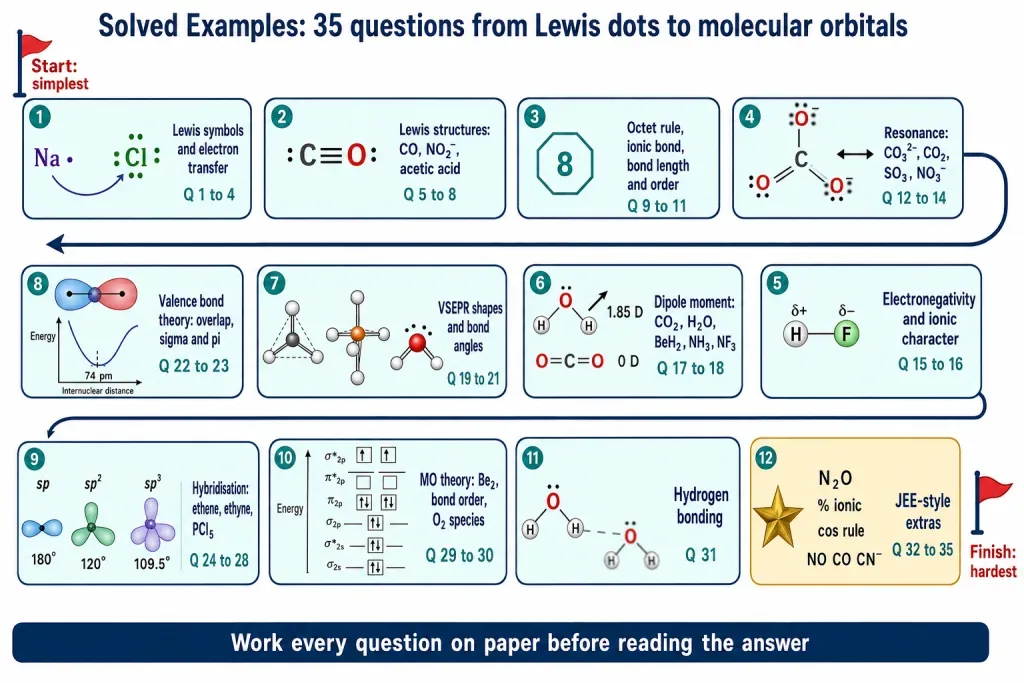
The working method
- Cover the answer. Attempt the question first, on paper. Draw the Lewis structure, count the electrons, write the configuration. Reading a solution feels like learning and is not.
- Compare your reasoning line by line. In this chapter the marks are in the details — the number of lone pairs, the exact angle, the bond order to one decimal place, the word "paramagnetic". Check that your answer has every one of them.
- Read the Watch out line. Most questions end with one. That is the transferable part; the numbers and the particular examples are disposable.
The data used throughout
Key Point: Ionization enthalpy of Na 495.8 kJ/mol, electron gain enthalpy of Cl kJ/mol, lattice enthalpy of NaCl 788 kJ/mol. Bond lengths: H 74, N 109, O 121, HF 92, HCl 127 pm; C-C 154, C=C 134, C≡C 120, C=O 121, C≡O 110 pm; C-O in CO 115 pm. Bond enthalpies: H-H 435.8, O=O 498, N≡N 946.0 kJ/mol. Dipole moments: HF 1.78, HCl 1.07, HO 1.85, HS 0.95, NH 1.47, NF 0.23, CO 0, BF 0 D; 1 D C m. Bond angles: CH 109.5°, NH 107°, HO 104.5°, BF 120°, BeCl 180°, PCl 120° and 90°, SF 90°. Electronegativities (Pauling): H 2.1, Li 1.0, K 0.8, C 2.5, N 3.0, O 3.5, F 4.0, S 2.5, Cl 3.0.
Solved Examples
Question 1: Why does a chemical bond form at all?
Explain the formation of a chemical bond.
Answer: A chemical bond is just the attractive force that holds atoms (or ions) together in a molecule or a crystal. Atoms bond because the bonded state has lower energy than the separated atoms, and nature always settles into the lower-energy arrangement.
The octet idea explains the rest. Kössel and Lewis noticed that noble gases hardly react, and every noble gas except helium has eight electrons in its outermost shell. So they said atoms bond in order to reach that stable noble-gas arrangement, eight electrons in the outer shell (two for hydrogen, which copies helium).
There are two ways to get there. An atom can transfer electrons or share them.
- Transfer gives ions. Sodium () hands its one outer electron to chlorine (); both end up with eight, and the and ions pull on each other electrostatically. That is an ionic (electrovalent) bond.
- Sharing gives molecules. Two chlorine atoms, each with seven outer electrons, share one pair, and each now counts eight around itself. That is a covalent bond. Sharing two pairs gives a double bond (as in ), three pairs a triple bond ().
Either way, the atoms settle at the distance where the attractions (each nucleus for the other's electrons) balance the repulsions (nucleus-nucleus and electron-electron). At that distance the energy is at its minimum, and the energy released is the bond enthalpy, 435.8 kJ/mol for H for example.
Ans: Atoms combine to lower their energy and reach a stable noble-gas octet, either by transferring electrons (ionic bond, e.g. NaCl) or by sharing pairs of electrons (covalent bond, e.g. Cl, HO). The bond is the attractive force holding the resulting ions or atoms together.
Watch out: A "why do atoms bond" answer has three parts, lower energy, octet, and transfer or share. I write all three and give one example of each bond type.
Question 2: Lewis dot symbols for atoms
Write Lewis dot symbols for atoms of the following elements: Mg, Na, B, O, N, Br.
Answer: A Lewis symbol is the element's symbol with one dot for each electron in the outermost (valence) shell. Core electrons don't get drawn. For main-group elements the number of dots is the group number for groups 1 and 2, and the group number minus 10 for groups 13 to 18.
I get the valence electrons from the configuration.
| Atom | Configuration | Valence electrons | Lewis symbol |
|---|---|---|---|
| Mg | 2 | Mg with 2 dots | |
| Na | 1 | Na with 1 dot | |
| B | 3 | B with 3 dots | |
| O | 6 | O with 6 dots (two pairs, two singles) | |
| N | 5 | N with 5 dots (one pair, three singles) | |
| Br | 7 | Br with 7 dots (three pairs, one single) |
The dots also tell me how many bonds each atom likes to form: Mg gives 2 electrons (valence 2), Na gives 1, B shares 3, and O, N and Br need 2, 3 and 1 more electrons to finish their octets (8 minus the dot count).
Ans: Mg: 2 dots; Na: 1 dot; B: 3 dots; O: 6 dots; N: 5 dots; Br: 7 dots, one dot per valence electron.
Watch out: Bromine's ten d electrons are core electrons, so I never draw them. Dots = valence electrons = group number (or group number minus 10).
Question 3: Lewis symbols for atoms and their ions
Write Lewis symbols for the following atoms and ions: S and S; Al and Al; H and H.
Answer: For ions the rule is simple. Each negative charge means one extra electron has been added; each positive charge means one electron has been taken away. I draw the dots for the new count and put the charge on the symbol, usually in square brackets.
Sulphur: S is , so 6 dots. has gained two electrons, so 8 dots, a full octet, written with eight dots around it.
Aluminium: Al is , so 3 dots. has lost all three, so no dots at all, written . Its outer shell is now just the neon core.
Hydrogen: H has 1 dot. (the hydride ion) has gained one electron and has 2 dots, a helium-like duplet, written with two dots.
Ans: S: 6 dots; S: 8 dots with charge . Al: 3 dots; Al: no dots with charge . H: 1 dot; H: 2 dots with charge .
Watch out: Cations of groups 1, 2 and 13 lose all their dots; anions of groups 15 to 17 fill up to eight. Hydrogen's "octet" is only a duplet of two.
Solved Examples (continued)
Question 4: Electron transfer with Lewis symbols
Use Lewis symbols to show electron transfer between the following atoms to form cations and anions: (a) K and S, (b) Ca and O, (c) Al and N.
Answer: The bookkeeping is the same each time. The metal loses all its valence dots and becomes a cation with a noble-gas core; the non-metal takes in dots until it has eight. I pick the number of atoms of each so that electrons lost equal electrons gained.
(a) K has 1 dot, S has 6. Sulphur needs 2 electrons, so two potassium atoms each give one: Product: . Each is now and is also .
(b) Ca has 2 dots, O has 6. One calcium gives both electrons to one oxygen: Product: .
(c) Al has 3 dots, N has 5. Nitrogen needs 3 and aluminium gives 3, so it's a perfect one-to-one match: Product: .
Ans: (a) (KS); (b) (CaO); (c) (AlN). In every case the cation has zero dots and the anion has eight.
Watch out: I balance the electrons first. The number of each atom comes from "electrons lost = electrons gained", which is why KS needs two potassiums.
Question 5: Lewis structures of five species
Draw the Lewis structures for the following molecules and ions: HS, SiCl, BeF, CO, HCOOH.
Answer: My recipe: count all valence electrons (add one per negative charge). Put the least electronegative atom in the centre (hydrogen is never central). Join the atoms with single bonds, spread the leftover electrons as lone pairs to complete octets on the outer atoms and then on the central atom. If the centre is still short, I turn lone pairs from outer atoms into double or triple bonds.
HS. Electrons: . Skeleton uses 4; the other 4 sit on sulphur as two lone pairs. Sulphur has 2 bond pairs and 2 lone pairs, an octet, just like water.
SiCl. Electrons: . Silicon in the centre with four Si-Cl single bonds (8 electrons); the other 24 go as three lone pairs on each of the four chlorines. Every atom has an octet.
BeF. Electrons: . uses 4; the remaining 12 are three lone pairs on each fluorine. Beryllium ends up with only 4 electrons around it. That's an accepted incomplete octet, not a mistake.
CO. Electrons: . Three C-O single bonds use 6; 18 more as three lone pairs on each oxygen completes every oxygen but leaves carbon with only 6. So one oxygen lone pair becomes a second bond: one (oxygen with two lone pairs, formal charge 0) and two (each oxygen with three lone pairs, formal charge ). Total charge , carbon's octet done. There are three equivalent resonance structures (see Question 12).
HCOOH (formic acid). Electrons: . Skeleton: H on C; C bonded to two oxygens; one oxygen bonded to the second H. Four single bonds use 8; the remaining 10 go as lone pairs, but that leaves carbon with only 6. So I make the C-O bond to the oxygen without hydrogen a double bond: , with two lone pairs on the carbonyl oxygen and two on the hydroxyl oxygen. Now every atom obeys its rule.
Ans: HS: bent-drawn , two lone pairs on S. SiCl: Si with four single bonds, three lone pairs on each Cl. BeF: , three lone pairs per F, Be with only four electrons. CO: one C=O and two C-O, 24 electrons in all. HCOOH: with two lone pairs on each oxygen.
Watch out: Count first, bond second, lone pairs third, and only then upgrade to double bonds. If the electron total comes out wrong, the structure is wrong no matter how nice it looks.
Solved Examples (continued)
Question 6: The Lewis structure of carbon monoxide
Write the Lewis dot structure of the CO molecule, and give the formal charge on each atom.
Answer: First I count. Carbon has 4 valence electrons, oxygen has 6. Total .
Only two atoms, so the skeleton is . A single bond uses 2 electrons. I give oxygen three lone pairs (6 electrons) to complete its octet, and the last 2 make a lone pair on carbon. Carbon now has only electrons around it, way short of eight.
So I upgrade the bond. Moving two of oxygen's lone pairs into the bond makes a triple bond: . Now carbon has 6 bonding electrons plus one lone pair ; oxygen has 6 bonding plus one lone pair . Both octets are satisfied with exactly 10 electrons used.
Formal charge valence electrons non-bonding electrons (bonding electrons).
- Carbon: .
- Oxygen: .
The charges add to zero, which they must for a neutral molecule.
Ans: , a triple bond, one lone pair on each atom, formal charges on C and on O.
Watch out: CO is the odd case where the octet forces a triple bond and the less electronegative atom ends up with the negative formal charge. That lone pair on the negatively charged carbon is why CO binds to metals through carbon. CO has the same 10 valence electrons and bond order 3 as N, CN and NO.
Question 7: The Lewis structure of the nitrite ion
Write the Lewis structure of the nitrite ion, NO.
Answer: Count first. N () gives 5, each O () gives 6, and the negative charge adds 1: electrons.
Nitrogen is less electronegative than oxygen, so it goes in the middle: . Two single bonds use 4 electrons.
I give each oxygen three lone pairs (12 electrons), which makes 16 used. The remaining 2 form a lone pair on nitrogen. Nitrogen now has electrons, one pair short.
So I shift one lone pair from one oxygen into its bond with nitrogen: . Nitrogen now has 3 bond pairs and 1 lone pair (octet complete); the double-bonded oxygen keeps two lone pairs; the single-bonded oxygen keeps three.
Formal charges: N: . Double-bonded O: . Single-bonded O: . They add to , matching the ion.
The double bond could just as well be on the other oxygen, so NO is a hybrid of two equivalent structures, and both N-O bonds are identical with bond order 1.5.
Ans: with one lone pair on N, two on the doubly bonded O and three on the singly bonded O (which carries the formal charge); two equivalent resonance forms, N-O bond order 1.5.
Watch out: For an anion I add the charge to the electron count before anything else. And when a double bond could sit in two equivalent places, I say the word "resonance", it's usually worth a mark.
Question 8: Correcting the skeleton of acetic acid
The skeletal structure of CHCOOH is written with carbon bonded to three hydrogens and to a second carbon, that carbon bonded to two oxygens, and one oxygen bonded to hydrogen — but with every bond shown as a single bond. The skeleton is right; some bonds are wrong. Write the correct Lewis structure for acetic acid.
Answer: Count: electrons.
I test the all-single-bond version first. The skeleton has 7 single bonds ( C-H, C-C, C-O, O-H), which use 14 electrons. The remaining 10 go as lone pairs: three pairs on the oxygen bonded only to carbon (6) and two pairs on the O-H oxygen (4). Now the carboxyl carbon has just three bonds, 6 electrons. Its octet is incomplete, so the all-single-bond picture is wrong.
To fix it I turn one lone pair on the oxygen that has no hydrogen into a second bond with carbon. That oxygen now has plus two lone pairs; the carboxyl carbon has , and , four bonds, eight electrons.
Final check: electrons used in bonds pairs (7 single + the extra pair of the double bond) , plus two lone pairs on each oxygen . Total 24. Every carbon has 8, every oxygen has 8, every hydrogen has 2, and every formal charge is zero.
Ans: : the methyl carbon has four single bonds; the carboxyl carbon has a double bond to one oxygen (two lone pairs on it) and a single bond to the hydroxyl oxygen (two lone pairs on it).
Watch out: In a carboxylic acid the oxygen without the hydrogen always takes the double bond. A carbon with only three bonds is the give-away that something needs a double bond.
Solved Examples (continued)
Question 9: The octet rule, its significance and its limitations
Define the octet rule. Write its significance and limitations.
Answer: The octet rule says that atoms of main-group elements combine, by giving away, taking or sharing electrons, so that each atom ends up with eight electrons in its outer shell, like the nearest noble gas. Hydrogen is the exception, it only wants two (a duplet).
Why it matters: it tells me why NaCl is and not , why chlorine goes around as , why oxygen makes two bonds and nitrogen three. It also gives me a simple way to draw Lewis structures for most compounds, especially the ones made of second-period elements.
Where it fails: I keep three kinds of molecules in mind that break it, plus three things the rule just can't tell me.
| Limitation | Examples | What is wrong |
|---|---|---|
| Incomplete octet of the central atom | LiCl, BeH, BCl | Central atom has 2, 4 or 6 electrons only |
| Odd-electron molecules | NO (11 valence electrons), NO (17) | No way to give every atom eight |
| Expanded octet | PF (10 around P), SF (12 around S), HSO | Third-period atoms use d orbitals |
| Says nothing about shape | — | Lewis structures are flat |
| Says nothing about relative stability or energy | — | Cannot rank molecules |
| Noble gases do form compounds | XeF, XeF, XeF, KrF | Xenon already had an octet |
Ans: Atoms bond so as to get eight valence electrons (two for H). The rule explains the formulas and Lewis structures of most compounds, but fails for incomplete octets (BeH, BCl), odd-electron species (NO, NO), expanded octets (PF, SF) and noble-gas compounds (XeF), and it can't predict shape or stability.
Watch out: Three exceptions with an example each, then "shape, stability, xenon" for the rest. That's the whole answer, don't stop at the first three.
Question 10: Favourable factors for an ionic bond, with the NaCl energy check
Write the favourable factors for the formation of an ionic bond. Show, using the sodium chloride numbers, that the crystal lattice is what makes the bond favourable.
Answer: For an ionic bond I need one atom that gives up electrons easily, another that takes them readily, and then the ions have to pack into a lattice that releases a lot of energy. So the three favourable factors are: low ionization enthalpy of the metal (group 1 and 2 metals fit), high negative electron gain enthalpy of the non-metal (group 16 and 17 fit), and high lattice enthalpy of the crystal, which small, highly charged ions that pack closely give me.
The third one is the one people forget, so I check it with the NaCl numbers. Adding these gives kJ/mol. Making the two gaseous ions actually costs energy. If this were all, NaCl would never form.
The lattice is what pays for it. When the gaseous ions come together into the crystal, 788 kJ/mol is released: Net: kJ/mol, which is strongly favourable.
The definition I quote: lattice enthalpy is the energy needed to completely separate one mole of a solid ionic compound into its gaseous ions. It can't be measured directly, so it comes from a Born-Haber cycle.
Ans: Low ionization enthalpy of the metal, high negative electron gain enthalpy of the non-metal, and high lattice enthalpy of the solid. For NaCl, forming the ions costs kJ/mol but the lattice releases 788 kJ/mol, so overall the process is favourable by about 641 kJ/mol.
Watch out: "The ions attract, so the bond forms" is only half the story. Electron transfer by itself is endothermic; it's the lattice that makes it worthwhile.
Question 11: Bond length, bond order and bond strength
(a) Define bond length. (b) How is bond strength expressed in terms of bond order?
Answer: (a) Bond length is the equilibrium distance between the centres (nuclei) of two bonded atoms in a molecule. It's measured by X-ray diffraction or spectroscopy. For a covalent bond it's just the sum of the two covalent radii: in Cl the bond length is 199 pm, so chlorine's covalent radius is about 99 pm. Some values I remember: H-H 74 pm, C-C 154 pm, C=C 134 pm, C≡C 120 pm, N≡N 109 pm.
(b) Bond order is the number of bonds between two atoms: 1 for H and F, 2 for O, 3 for N. In MO terms it's .
The rule is simple. Higher bond order means a stronger bond (higher bond enthalpy) and a shorter one. The numbers show it:
| Molecule | Bond order | Bond enthalpy (kJ/mol) | Bond length (pm) |
|---|---|---|---|
| H | 1 | 435.8 | 74 |
| O | 2 | 498 | 121 |
| N | 3 | 946.0 | 109 |
One more thing that helps: isoelectronic species share a bond order. N, CO and NO all have 14 electrons and bond order 3; F and O have 18 electrons and bond order 1. So bond order lets me predict strength without measuring anything.
Ans: (a) Bond length is the equilibrium internuclear distance between two bonded atoms (e.g. 74 pm in H). (b) Bond strength rises with bond order: bond order 3 (N, 946 kJ/mol) 2 (O, 498 kJ/mol) 1 (H, 435.8 kJ/mol); higher bond order also means a shorter bond.
Watch out: Bond order up, bond enthalpy up, bond length down. Whenever I'm asked to compare bond strengths I find the bond orders first.
Solved Examples (continued)
Question 12: Resonance in the carbonate ion and in carbon dioxide
(a) Explain the important aspects of resonance with reference to the CO ion. (b) Explain the structure of the CO molecule.
Answer: (a) The Lewis structure of carbonate (from Question 5) has one and two bonds. A double bond should be shorter (about 121 pm) than a single bond (about 143 pm). But experiment says all three C-O bonds in carbonate are the same length, somewhere in between. One Lewis structure can't show that.
The fix is resonance. I can put the double bond on any of the three oxygens, which gives three structures (I, II, III) that differ only in where the electrons sit, not where the atoms are. These are the canonical (resonance) structures. The real ion is the resonance hybrid, one structure that's the average of the three, with each C-O bond having bond order and each oxygen carrying charge.
The points I make sure to write:
- Resonance stabilises the species. The hybrid has lower energy than any single canonical form, and the difference is the resonance energy.
- Resonance averages bond lengths, bond orders and charges.
- The canonical forms don't really exist. The ion doesn't flip between them, there's no equilibrium between them, and the hybrid can't be drawn as one Lewis structure.
(b) For CO the measured C-O bond length is 115 pm. A normal double bond is 121 pm and a triple bond is 110 pm. So the real bond is shorter than a double bond, and on its own isn't enough. I write three canonical forms: Structure I has all formal charges zero; II and III each put on the triply bonded oxygen and on the singly bonded one. The hybrid gives each C-O bond a bit of triple-bond character, and that's why 115 pm sits between 121 and 110.
Ans: (a) CO is a hybrid of three canonical structures, each with one C=O and two C-O; all three bonds are equal with bond order 1.33, the hybrid is more stable than any single form, and the forms have no separate existence. (b) CO (bond length 115 pm, between C=O 121 and C≡O 110) is a hybrid of and the two forms and .
Watch out: The signal for resonance is always the same: measured bond lengths don't match any single Lewis structure. Then I draw the forms (electrons move, atoms stay), average them, and remember the hybrid is more stable than any one form.
Question 13: Are the two structures of phosphorous acid resonance forms?
HPO can be written as structure 1 — phosphorus bonded to one H, two OH groups and one O by a double bond — and as structure 2 — phosphorus bonded to three OH groups and carrying a lone pair. Can these two structures be taken as canonical forms of a resonance hybrid representing HPO? If not, give reasons.
Answer: Canonical structures of one species must have the same arrangement of atoms and differ only in where the electrons are (and they must have the same number of unpaired electrons). Only electrons are allowed to move.
Now I compare the two. In structure 1 one hydrogen is bonded directly to phosphorus (). In structure 2 that same hydrogen is bonded to an oxygen (). A hydrogen atom has physically moved from P to O.
An atom changed position, so structures 1 and 2 aren't resonance structures. They're tautomers, two different molecules in equilibrium with each other, just like the keto and enol forms in organic chemistry. Resonance forms are never in equilibrium; they're different drawings of one and the same molecule.
The real one is structure 1. Phosphorous acid actually exists with a , a and two groups. That's why it's dibasic, only the two O-H hydrogens are acidic.
Ans: No. The two structures differ in the position of a hydrogen atom (P-H in one, O-H in the other), while canonical forms may differ only in the position of electrons. They're tautomers in equilibrium, not resonance structures.
Watch out: "Do the atoms move?" is my one-line test. Atoms moving means tautomerism (a real equilibrium); only electrons moving means resonance (no equilibrium at all).
Question 14: Resonance structures of SO, NO and NO
Write the resonance structures for SO, NO and NO.
Answer: SO: valence electrons . In the octet-obeying picture sulphur has one double bond and two single bonds. Formal charges: S ; the doubly bonded O is 0; each singly bonded O is . The double bond can go on any of the three oxygens, so there are three equivalent canonical structures, and the hybrid has three identical S-O bonds. (Sulphur can also expand its octet and be drawn with three bonds and zero formal charges; either version is fine as long as I explain the resonance.)
NO: valence electrons . That's odd, so one electron has to stay unpaired. I draw with the odd electron on nitrogen. The doubly bonded oxygen has two lone pairs (formal charge 0); the singly bonded oxygen has three lone pairs (formal charge ); nitrogen, with one lone electron and three bond pairs, has . Swapping which oxygen gets the double bond gives the second form. So two canonical structures, and both N-O bonds come out equal.
NO: valence electrons . Nitrogen in the centre, one and two ; formal charges N , doubly bonded O , each singly bonded O , total . The double bond can be with any of the three oxygens, so three equivalent canonical structures; all N-O bonds identical, bond order .
Ans: SO: three canonical forms, each with one S=O and two S-O (S formal charge ). NO: two forms of with the odd electron on N. NO: three forms, each with one N=O and two N-O (N formal charge ); N-O bond order 1.33.
Watch out: The number of canonical forms is just the number of equivalent places the double bond can sit: three for a central atom with three identical oxygens, two for one with two. Quick bond order for these ions is : for NO and CO, for NO.
Solved Examples (continued)
Question 15: Electronegativity, electron gain enthalpy and the polar covalent bond
(a) Define electronegativity. How does it differ from electron gain enthalpy? (b) Explain, with a suitable example, what a polar covalent bond is.
Answer: (a) Electronegativity is the tendency of an atom in a molecule to pull the shared pair of electrons towards itself. It isn't an energy I can measure; it's a relative number on a scale (Pauling gave fluorine 4.0, the highest) and it has no units. It also changes with the atom's oxidation state and hybridisation.
Electron gain enthalpy is different. It's the enthalpy change when an isolated gaseous atom picks up an electron to form a gaseous anion, . This one is measurable, has units of kJ/mol (for chlorine it's kJ/mol), and it belongs to a free atom, not a bonded one.
The differences side by side:
| Electronegativity | Electron gain enthalpy | |
|---|---|---|
| Refers to | atom in a molecule | isolated gaseous atom |
| What it measures | pull on a shared pair | energy change on gaining a whole electron |
| Units | none (relative scale) | kJ/mol |
| Measurable? | no, defined on a scale | yes, experimentally |
| Highest value | fluorine | chlorine (most negative) |
(b) When two identical atoms share a pair (H, Cl, N), the pair sits exactly in the middle, so the bond is non-polar. When the two atoms differ in electronegativity, the more electronegative one pulls the pair closer. In HF, fluorine (4.0) drags the pair away from hydrogen (2.1); fluorine gets a partial negative charge () and hydrogen a partial positive charge (). The bond is still covalent (a shared pair) but polar (unequal sharing), and the molecule has a dipole moment, 1.78 D for HF. HCl (1.07 D) and the O-H bonds in water are other examples.
Ans: (a) Electronegativity is the power of a bonded atom to attract the shared electron pair, a unitless relative property of an atom in a molecule; electron gain enthalpy is the measurable energy change (kJ/mol) when an isolated gaseous atom gains an electron. (b) A polar covalent bond is a shared pair pulled towards the more electronegative atom, giving and ends, as in .
Watch out: "In a molecule, no units" against "isolated atom, kJ/mol" is the whole distinction. And bond polarity follows the electronegativity difference: HF > HCl > HBr > HI.
Question 16: Ordering ionic character
Arrange the bonds in order of increasing ionic character in the molecules: LiF, KO, N, SO and ClF.
Answer: The bigger the electronegativity difference between the two bonded atoms, the more the shared pair gets pulled to one side and the more ionic the bond. Zero difference means purely covalent.
So I work out each difference (Pauling values: Li 1.0, K 0.8, N 3.0, O 3.5, S 2.5, Cl 3.0, F 4.0).
| Bond | Electronegativities | Difference |
|---|---|---|
| N-N in N | 3.0 and 3.0 | 0 |
| S-O in SO | 2.5 and 3.5 | 1.0 |
| Cl-F in ClF | 3.0 and 4.0 | 1.0 |
| K-O in KO | 0.8 and 3.5 | 2.7 |
| Li-F in LiF | 1.0 and 4.0 | 3.0 |
The ends are easy. N is two identical atoms, purely covalent, least ionic. LiF pairs the most electronegative element with an alkali metal, so it's the most ionic. KO, a metal with oxygen, comes just below it.
The tie is the only tricky bit. SO and ClF both show a difference of 1.0 on the rounded scale. The accepted order puts ClF above SO: fluorine is the strongest electron-puller there is, and each Cl-F bond is a plain single bond with its pair dragged towards fluorine, while in SO the S-O bonding is spread over multiple bonds by resonance. The gap is small, so the part that really matters is the two ends and KO.
Ans: (increasing ionic character).
Watch out: Electronegativity difference decides ionic character: zero for identical atoms, largest for an alkali metal with fluorine. I keep N at the bottom and LiF at the top and fit the rest between.
Solved Examples (continued)
Question 17: What dipole moment tells you, and why CO is linear but HO is bent
(a) Write the significance and applications of dipole moment. (b) Both CO and HO are triatomic molecules, yet HO is bent while CO is linear. Explain this on the basis of dipole moment.
Answer:
(a) Dipole moment is the size of the charge at either end of a polar bond multiplied by the distance between the centres of positive and negative charge: . It's a vector, and I draw it from the positive end to the negative end. The unit is debye, C m. For a whole molecule I add up the bond dipoles as vectors.
What I use it for:
- Polar or non-polar. means non-polar (H, CO, CH, BF); means polar (HCl, HO, NH).
- Shape. If a molecule has polar bonds but zero dipole moment, it has to be symmetric — linear, trigonal planar, tetrahedral or square planar — because that's the only way the bond dipoles cancel.
- Per cent ionic character. I compare the measured dipole moment with what a fully ionic bond would give, and the ratio is the fraction of ionic character (Question 33).
- Comparing polarity. HF 1.78 D HCl 1.07 D HBr 0.79 D HI 0.38 D, which matches the falling electronegativity difference.
(b) In CO each bond is polar because oxygen is more electronegative, but the measured dipole moment is zero. Two equal bond dipoles can only cancel completely if they point in exactly opposite directions. So the molecule must be linear, , with a 180° angle.
In water each bond is polar too, but the measured dipole moment is 1.85 D, not zero. So the two O-H dipoles don't cancel. They must sit at an angle and add up to a resultant. That makes water bent, and the angle comes out as 104.5°. If water were linear its dipole moment would be zero, like CO's.
Ans: (a) , in debye, a vector from to ; used to decide polarity, work out shape, estimate per cent ionic character and compare bond polarities. (b) CO has , so its two C=O dipoles cancel and it is linear; HO has D, so its O-H dipoles don't cancel and it is bent (104.5°).
Watch out: Polar bonds plus zero dipole moment means a symmetric shape. Non-zero means the dipoles survive, so the shape is unsymmetrical.
Question 18: BeH has no dipole moment; NH beats NF
(a) Explain why the BeH molecule has a zero dipole moment although the Be-H bonds are polar. (b) Which of NH and NF has the higher dipole moment, and why?
Answer:
(a) Hydrogen (2.1) is more electronegative than beryllium (1.5), so each bond is polar, with the dipole pointing from Be to H.
Beryllium has two bond pairs and no lone pairs, so by VSEPR (and sp hybridisation) the molecule is linear: , angle 180°.
Two dipoles of equal size pointing in exactly opposite directions add to zero. So the bond dipoles are real, but the molecular dipole moment is zero. Same thing happens in CO and BF.
(b) Fluorine is much more electronegative than hydrogen, so each N-F bond is more polar than each N-H bond. I first expected NF to have the bigger dipole moment. But the measured values are NH 1.47 D and NF only 0.23 D.
The lone pair is what decides it. Both molecules are trigonal pyramidal with a lone pair on nitrogen, and that lone pair is itself a dipole pointing away from nitrogen along the axis of the pyramid.
In NH, nitrogen (3.0) is more electronegative than hydrogen (2.1), so the three N-H dipoles point towards nitrogen — the same direction as the lone-pair dipole. They add up and give a large resultant, 1.47 D.
In NF, fluorine (4.0) pulls electrons away from nitrogen, so the three N-F dipoles point away from nitrogen, opposite to the lone-pair dipole. They partly cancel it, leaving a small resultant, 0.23 D.
Ans: (a) BeH is linear (180°), so its two equal and opposite Be-H bond dipoles cancel and . (b) NH (1.47 D) has the higher dipole moment because its N-H dipoles point the same way as the lone-pair dipole and reinforce it, while in NF (0.23 D) the N-F dipoles oppose the lone-pair dipole.
Watch out: I ask two things: which way do the bond dipoles point, and which way does the lone pair point? Same direction, add; opposite, subtract. The reason NH NF is the lone pair, not electronegativity.
Solved Examples (continued)
Question 19: VSEPR shapes of six molecules
Discuss the shape of the following molecules using the VSEPR model: BeCl, BCl, SiCl, AsF, HS, PH.
Answer:
My method is always the same. I count the electron pairs around the central atom, bond pairs plus lone pairs. Those pairs spread out as far as they can to cut down repulsion. The pairs fix the geometry; the positions of the atoms alone give the shape. Lone pairs repel more than bond pairs, so they squeeze the bond angles below the ideal value.
Working each molecule:
| Molecule | Valence e on centre | Bond pairs | Lone pairs | Geometry of pairs | Shape of molecule | Bond angle |
|---|---|---|---|---|---|---|
| BeCl | 2 | 2 | 0 | linear | linear | 180° |
| BCl | 3 | 3 | 0 | trigonal planar | trigonal planar | 120° |
| SiCl | 4 | 4 | 0 | tetrahedral | tetrahedral | 109.5° |
| AsF | 5 | 5 | 0 | trigonal bipyramidal | trigonal bipyramidal | 120° (equatorial), 90° (axial) |
| HS | 6 | 2 | 2 | tetrahedral | bent (V-shaped) | less than 109.5° (about 92°) |
| PH | 5 | 3 | 1 | tetrahedral | trigonal pyramidal | less than 109.5° (about 94°) |
The two with lone pairs need a line each. In HS, sulphur has two bond pairs and two lone pairs, four pairs in a tetrahedral arrangement; the two lone pairs push the two S-H bonds closer together, so the molecule looks bent, like water. In PH, phosphorus has three bond pairs and one lone pair; the lone pair sits at one corner of the tetrahedron and pushes the three P-H bonds down into a pyramid, like ammonia.
The angles in HS and PH are much smaller than in water and ammonia because sulphur and phosphorus are bigger and less electronegative than oxygen and nitrogen. The bond pairs sit further from the central atom and repel each other less, so the lone pairs win by more and the angles drop well below 107° and 104.5°.
Ans: BeCl linear (180°); BCl trigonal planar (120°); SiCl tetrahedral (109.5°); AsF trigonal bipyramidal (120° and 90°); HS bent, with two lone pairs on S; PH trigonal pyramidal, with one lone pair on P.
Watch out: With no lone pairs the shape is the geometry. With lone pairs I name the geometry first, then the shape the atoms actually make.
Question 20: Why water's angle is smaller than ammonia's, and what bond and lone pairs are
(a) Although the geometries of NH and HO are both distorted tetrahedral, the bond angle in water is less than that in ammonia. Discuss. (b) What do you understand by bond pairs and lone pairs of electrons? Give one example of each.
Answer:
I'll do (b) first because (a) uses it.
(b) A bond pair is a pair of electrons shared between two atoms, and it counts as a bond; each O-H bond in HO is a bond pair. A lone pair is a pair of valence electrons that stays on one atom and isn't shared; the two pairs left on oxygen in water, or the one pair on nitrogen in NH, are lone pairs. Lone pairs take up space and repel, but they don't appear in the name of the shape.
(a) N in NH has 3 bond pairs + 1 lone pair = 4. O in HO has 2 bond pairs + 2 lone pairs = 4. Both have four pairs in a tetrahedral arrangement, so the ideal angle for both would be 109.5°.
The repulsion order is lone pair-lone pair lone pair-bond pair bond pair-bond pair. A lone pair belongs to one nucleus only, so its cloud is fatter and sits closer to the central atom, and it pushes harder than a bond pair.
In NH one lone pair pushes on three bond pairs and squeezes the H-N-H angle from 109.5° down to 107°. In HO two lone pairs push on two bond pairs, and on each other too, so the bonds get squeezed even more, from 109.5° down to 104.5°.
Ans: (a) Both have four electron pairs (tetrahedral geometry), but water has two lone pairs against ammonia's one; lone pairs repel more strongly than bond pairs, so the extra lone pair in water compresses the H-O-H angle to 104.5° compared with 107° in NH. (b) Bond pair: the shared O-H pair in water; lone pair: the unshared pairs on O in water or on N in ammonia.
Watch out: CH 109.5°, NH 107°, HO 104.5° — each extra lone pair takes roughly 2.5° off. I quote all three numbers and the repulsion order.
Question 21: Why methane is not square planar
Apart from tetrahedral geometry, another possible geometry for CH is square planar, with the four H atoms at the corners of a square and the C atom at its centre. Explain why CH is not square planar.
Answer:
First I compare the angles. In a square planar arrangement the four C-H bonds lie in one plane with 90° between neighbours. In a tetrahedron the four bonds point to the corners of a tetrahedron with 109.5° between every pair, which is the largest angle four directions from a point can share.
Carbon in CH has four bond pairs and no lone pairs. Bond pairs repel each other, and the arrangement that keeps them furthest apart is the tetrahedron. Square planar would force every pair of bonds 19.5° closer, which raises the repulsion and the energy. The molecule takes the lower-energy shape.
Hybridisation gives the same answer. Carbon uses sp hybrid orbitals, one 2s and three 2p mixed into four equivalent orbitals, and those four point tetrahedrally at 109.5°. No mix of s and p orbitals gives four bonds at 90° in a plane; square planar needs dsp, and that needs d orbitals carbon doesn't have.
Experiment agrees too. All four C-H bonds are identical (109 pm), the measured H-C-H angle is 109.5°, and CHCl exists as one compound, not as two square-planar isomers.
Ans: CH is tetrahedral because four bond pairs are furthest apart at 109.5° (tetrahedral) rather than 90° (square planar), which minimises repulsion; carbon's sp hybrid orbitals are tetrahedrally directed, and it has no d orbitals to form a square-planar dsp set.
Watch out: Bigger angle means less repulsion and lower energy. 109.5° beats 90°, so four identical bonds around a small atom come out tetrahedral.
Solved Examples (continued)
Question 22: Forming H by valence bond theory, and the meaning of orbital signs
(a) Explain the formation of the H molecule on the basis of valence bond theory. (b) What is the significance of the plus and minus signs shown in representing orbitals?
Answer:
(a) I take two hydrogen atoms A and B, with nuclei N and N and electrons e and e. When they're far apart there's no interaction, and I take the potential energy as zero.
As they come closer, new forces appear. Attractive ones: each nucleus for its own electron and, more importantly, for the other atom's electron (N-e and N-e). Repulsive ones: the two electrons for each other (e-e) and the two nuclei for each other (N-N).
Experiment shows the attractions are bigger than the repulsions, so the potential energy falls as the atoms approach and energy is released.
At one particular distance the net attraction just balances the net repulsion and the energy is at its lowest. That distance is the bond length, 74 pm for H, and the energy released, 435.8 kJ/mol, is the bond enthalpy. If I push the atoms closer than 74 pm the nuclear repulsion shoots up and the energy rises again. So the atoms settle at 74 pm, and a molecule of H has formed by overlap of the two 1s orbitals. Going the other way, I'd need to supply 435.8 kJ/mol to break one mole of H back into atoms.
(b) An orbital is a wave function, and a wave has crests and troughs. The and written on orbital lobes are the signs of the wave function in that region. They have nothing to do with electric charge. They matter when orbitals overlap: two lobes of the same sign add up (positive overlap, a bond forms); lobes of opposite sign cancel (negative overlap, no bond, antibonding); and if the positive and negative overlaps exactly cancel, the net overlap is zero. An s orbital is all one sign; a p orbital has one lobe and one lobe.
Ans: (a) As two H atoms approach, nucleus-electron attractions exceed electron-electron and nucleus-nucleus repulsions, so the energy falls; it reaches a minimum at 74 pm with 435.8 kJ/mol released, and that is the H-H bond, formed by 1s-1s overlap. (b) The plus and minus signs are the signs of the orbital wave function, not charges; same-sign overlap is positive and bonding, opposite-sign overlap is negative and antibonding.
Watch out: The signs on orbitals are signs of the wave function, not charges. Writing "positive charge" there is an easy mark to lose.
Question 23: Which overlaps give a sigma bond, and how sigma differs from pi
(a) Taking the x-axis as the internuclear axis, which of the following will not form a sigma bond, and why? (i) 1s and 1s; (ii) 1s and 2p; (iii) 2p and 2p; (iv) 1s and 2s. (b) Distinguish between a sigma and a pi bond.
Answer:
(a) A sigma bond needs head-on overlap along the internuclear axis. Any orbital that points along the x-axis, or is spherical, can do that. An orbital lying perpendicular to the x-axis can only overlap sideways.
Checking each pair:
- (i) 1s and 1s: both spherical, so they overlap head-on along x. Sigma. This is H.
- (ii) 1s and 2p: the p lobe points along the x-axis, straight at the s orbital. Sigma. This is the H-F type of bond.
- (iii) 2p and 2p: both lobes lie along y, perpendicular to the bond axis. They can only overlap sideways, above and below the axis. That gives a pi bond, not a sigma bond.
- (iv) 1s and 2s: both spherical. Sigma.
(b) The differences:
| Sigma () bond | Pi () bond | |
|---|---|---|
| Overlap | end-to-end, along the axis | sideways, lateral |
| Orbitals | s-s, s-p, p-p (end-on), hybrid orbitals | p-p (side-on) only |
| Electron cloud | symmetric about the bond axis | two lobes, above and below the axis, zero density on the axis |
| Extent of overlap | larger | smaller |
| Strength | stronger | weaker |
| Rotation about the bond | free | restricted |
| Occurs | in every bond, on its own in single bonds | only along with a sigma bond (double = 1 + 1 ; triple = 1 + 2 ) |
Ans: (a) 2p with 2p will not form a sigma bond, because both orbitals lie perpendicular to the x-axis and can overlap only sideways, giving a pi bond; the other three pairs overlap head-on along the axis and give sigma bonds. (b) Sigma: axial overlap, stronger, symmetric about the axis, present in every bond; pi: lateral overlap of p orbitals, weaker, cloud above and below the axis, present only in multiple bonds.
Watch out: I check which axis the question names. Orbitals along it or spherical give sigma; orbitals across it give pi. If the question had named the z-axis instead, 2p with 2p would still give a pi bond, but 1s with 2p would give zero net overlap and no bond at all.
Solved Examples (continued)
Question 24: Hybridisation and the shapes of sp, sp and sp orbitals
What is meant by hybridisation of atomic orbitals? Describe the shapes of sp, sp and sp hybrid orbitals.
Answer: Hybridisation is when orbitals on the same atom, with slightly different energies, mix together and give the same number of new orbitals that are all identical. These are the hybrid orbitals. They have the same energy and the same shape, and they point in directions that give the best overlap and the least repulsion. Only valence-shell orbitals join in, and they don't all have to be filled. One thing I always check: the number of hybrids that come out equals the number of orbitals that went in.
Every hybrid orbital looks the same: one big lobe and one small lobe on opposite sides of the nucleus. The big lobe does the bonding, which is why hybrid orbitals overlap better than a plain s or p orbital and make stronger bonds.
sp: one s and one p mix to give two sp hybrids pointing opposite ways, at 180°. That's linear. Each one is half s and half p. BeCl is the usual example, and each carbon in ethyne.
sp: one s and two p give three sp hybrids, all in one plane, pointing at the corners of an equilateral triangle at 120°. Trigonal planar, 33% s character. The third p orbital is left alone, standing perpendicular to the plane. Examples are BCl and each carbon in ethene.
sp: one s and three p give four sp hybrids pointing at the corners of a regular tetrahedron, 109.5° apart, 25% s character. CH is the clean case. NH is also sp but one hybrid holds the lone pair, so the angle drops to 107°, and in HO two hybrids hold lone pairs and the angle is 104.5°.
| Hybridisation | Orbitals mixed | Hybrids formed | Shape | Angle | s-character | Example |
|---|---|---|---|---|---|---|
| sp | 1 s + 1 p | 2 | linear | 180° | 50% | BeCl, CH |
| sp | 1 s + 2 p | 3 | trigonal planar | 120° | 33% | BCl, CH |
| sp | 1 s + 3 p | 4 | tetrahedral | 109.5° | 25% | CH, NH, HO |
Ans: Hybridisation is the mixing of an atom's valence orbitals of nearly equal energy into the same number of equivalent hybrid orbitals, each with a large bonding lobe and a small back lobe. sp: two orbitals, linear, 180°; sp: three orbitals, trigonal planar, 120°; sp: four orbitals, tetrahedral, 109.5°.
Watch out: Orbitals mixed = hybrids formed = number of directions. More s-character means a shorter, stronger bond and a bigger angle, so sp sp sp.
Question 25: Building the double bond of ethene and the triple bond of ethyne; counting sigma and pi bonds
(a) Describe, in words, the diagrams showing the formation of a double bond between the carbon atoms in CH and a triple bond in CH. (b) What is the total number of sigma and pi bonds in (i) CH and (ii) CH?
Answer: (a) Ethene first. Each carbon is sp. Its 2s and two of its 2p orbitals (say 2p and 2p) mix into three sp hybrids in a plane at 120°, and the 2p is left over, sticking up perpendicular to that plane. One sp orbital from each carbon overlaps head-on with an sp orbital of the other carbon, and that's the C-C sigma bond. The other two sp orbitals on each carbon overlap with hydrogen 1s orbitals, giving four C-H sigma bonds. Now the two leftover 2p orbitals, one on each carbon, overlap sideways. That's the pi bond, and its two clouds sit above and below the plane of the molecule. So is one sigma plus one pi. All six atoms are in one plane; C=C is 134 pm, C-H is 108 pm, H-C-H is 117.6° and H-C-C is 121°.
Ethyne is the same idea with one more p orbital left unhybridised. Each carbon is sp: 2s and 2p mix into two sp hybrids at 180°, and 2p and 2p are left over, perpendicular to each other. One sp orbital on each carbon overlaps head-on with the other carbon's sp orbital (C-C sigma), and the remaining sp orbital on each carbon overlaps with a hydrogen 1s (two C-H sigma bonds). Then the two 2p orbitals overlap sideways to make one pi bond, and the two 2p orbitals overlap sideways to make a second pi bond at right angles to the first. So is one sigma plus two pi. The molecule is linear and C≡C is 120 pm.
(b) The counting rule I use: every bond between two atoms has exactly one sigma bond. A double bond adds one pi on top, a triple bond adds two.
- CH is : 2 C-H singles + 1 C≡C triple. Sigma = 2 + 1 = 3, pi = 2.
- CH is : 4 C-H singles + 1 C=C double. Sigma = 4 + 1 = 5, pi = 1.
Ans: (a) In ethene each sp carbon makes a C-C sigma bond (sp-sp) and two C-H sigma bonds (sp-s), and the two unhybridised 2p orbitals overlap sideways to give the pi bond; in ethyne each sp carbon makes a C-C sigma and one C-H sigma bond, and the two pairs of unhybridised p orbitals give two mutually perpendicular pi bonds. (b) CH: 3 sigma, 2 pi. CH: 5 sigma, 1 pi.
Watch out: Sigma count = number of bonds between atoms (count a single, double or triple bond once each); pi count = number of double bonds + 2 × number of triple bonds. Don't forget the sigma bonds to hydrogen, I've skipped them more than once.
Solved Examples (continued)
Question 26: Which hybrid orbitals carbon uses in five organic molecules
Which hybrid orbitals are used by the carbon atoms in the following molecules? (a) CH-CH; (b) CH-CH=CH; (c) CH-CH-OH; (d) CH-CHO; (e) CHCOOH.
Answer: I just look at what each carbon is bonded to. Four single bonds (four sigma, no pi) means sp. One double bond (three sigma + one pi) means sp. A triple bond, or two double bonds, (two sigma + two pi) means sp. An O or H hanging off by a single bond doesn't change anything; only the carbon's own multiple bonds count.
Going carbon by carbon:
| Molecule | Carbon | Bonds on that carbon | Hybridisation |
|---|---|---|---|
| (a) CH-CH | both C | four single | sp, sp |
| (b) CH-CH=CH | CH carbon | four single | sp |
| CH carbon | one double (to CH) + two single | sp | |
| CH carbon | one double + two single | sp | |
| (c) CH-CH-OH | CH carbon | four single | sp |
| CH carbon | four single (C, H, H, O) | sp | |
| (d) CH-CHO | CH carbon | four single | sp |
| CHO carbon | C=O double + C-H + C-C | sp | |
| (e) CHCOOH | CH carbon | four single | sp |
| COOH carbon | C=O double + C-O + C-C | sp |
A quick sanity check: every sp carbon is tetrahedral (109.5°) and every sp carbon is planar (120°). So in acetaldehyde and acetic acid the carbonyl carbon and the three atoms on it sit in one plane, which is what you'd expect.
Ans: (a) sp, sp; (b) sp, sp, sp; (c) sp, sp; (d) sp, sp; (e) sp, sp.
Watch out: Count the pi bonds on the carbon: 0 gives sp, 1 gives sp, 2 gives sp. Draw the structure out first, because the C=O in an aldehyde or acid is the pi bond that's easy to miss when it's written as CHO or COOH.
Question 27: Does hybridisation change in a reaction? AlCl with Cl and BF with NH
(a) Describe the change in hybridisation (if any) of the Al atom in the reaction . (b) Is there any change in the hybridisation of the B and N atoms in the reaction ?
Answer: (a) Al is . In AlCl it makes three bonds with three sp hybrids, so it's trigonal planar with 120° angles and only six electrons around Al. The octet is incomplete and there's an empty 3p orbital sitting there.
The chloride ion pushes a lone pair into that empty orbital and a fourth Al-Cl bond forms. Now aluminium has four bond pairs and needs four equivalent orbitals, so it goes to sp. AlCl is tetrahedral, 109.5°.
(b) Boron is the same story. B in BF is , three bonds, sp, trigonal planar, with an empty 2p orbital. NH donates its lone pair into that orbital, boron ends up with four bond pairs, and it becomes sp and tetrahedral.
Nitrogen is where I had to think for a second. N in NH has three bond pairs and one lone pair, four pairs total, so it's already sp. In the adduct that lone pair has just turned into the fourth bond pair (the N→B bond). Still four pairs around nitrogen, so it stays sp. Nothing changes for N.
Ans: (a) Al goes from sp (trigonal planar AlCl) to sp (tetrahedral AlCl). (b) B goes from sp to sp; N stays sp in both NH and the adduct.
Watch out: Hybridisation follows the number of electron pairs around the atom. Picking up a fourth pair moves sp to sp, but turning a lone pair into a bond pair keeps the count, and the hybridisation, the same.
Question 28: spd hybridisation in PCl and the long axial bonds
Describe the hybridisation in PCl. Why are the axial bonds longer than the equatorial bonds?
Answer: Ground-state P is , which is only three unpaired electrons, enough for PCl but not PCl. To get five bonds one 3s electron is promoted into an empty 3d orbital. The excited configuration is , five unpaired electrons.
Now the one 3s, three 3p and one 3d orbital mix into five equivalent spd hybrids. They point to the corners of a trigonal bipyramid: three in one plane at 120° to each other (equatorial), and two pointing straight up and down, perpendicular to that plane (axial). Each hybrid overlaps with a half-filled 3p orbital on a chlorine, giving five P-Cl sigma bonds.
For the bond lengths I count how many close neighbours each bond has. An equatorial P-Cl bond has only two neighbours at 90° (the two axial bonds); its other two neighbours are out at 120°. An axial P-Cl bond has three neighbours at 90° (all three equatorial bonds). The axial bond pairs feel more close-range repulsion, so they get pushed slightly further from phosphorus. That's why the axial bonds are longer (about 219 pm against 204 pm) and weaker.
Because those axial bonds are weak, PCl is quite reactive and happily drops two chlorines to give PCl. It also means the five bonds aren't all equivalent.
Ans: Phosphorus ( in the excited state) uses five spd hybrid orbitals to form PCl, trigonal bipyramidal with three equatorial bonds at 120° and two axial bonds at 90° to the plane. The axial bonds are longer because each axial bond pair is repelled by three bond pairs at 90°, while an equatorial pair is repelled by only two at 90°.
Watch out: "Three repulsions at 90° versus two" is the actual reason, so write that out; just saying "axial bonds are weaker" isn't an explanation. The same idea is why lone pairs sit in equatorial positions in SF, ClF and XeF.
Solved Examples (continued)
Question 29: Conditions for LCAO, and why Be does not exist
(a) Write the important conditions required for the linear combination of atomic orbitals to form molecular orbitals. (b) Use molecular orbital theory to explain why the Be molecule does not exist.
Answer: (a) Two atomic orbitals can add or subtract their wave functions to give a bonding and an antibonding molecular orbital only if three things hold.
- They have the same or nearly the same energy. A 1s combines with a 1s, a 2s with a 2s. A 1s won't combine usefully with a 2s on the other atom.
- They have the same symmetry about the molecular axis. Taking z as the axis, 2p combines with 2p and 2p with 2p, but 2p of one atom doesn't combine with 2p of the other, because the positive overlap on one side cancels the negative overlap on the other side.
- They overlap as much as possible. More overlap means more electron density between the nuclei and a stronger bond.
(b) Each Be is , so Be has 8 electrons. I fill the molecular orbitals in order of increasing energy: , , , .
Bonding electrons (in and ), antibonding (in and ).
Bond order zero means every bonding electron is cancelled by an antibonding one. There's no net bond and nothing is gained by bringing the two atoms together, so Be isn't a stable molecule. It's the same situation as He (, bond order 0).
Ans: (a) The combining atomic orbitals must have the same or similar energy, the same symmetry about the molecular axis, and must overlap as much as possible. (b) Be (8 electrons) has the configuration , so and the bond order is zero: no bond, no molecule.
Watch out: Bond order zero means the molecule doesn't exist. He (4 electrons) and Be (8 electrons) are the two standard cases; any homonuclear diatomic where every filled bonding orbital has its antibonding partner filled too is out.
Question 30: Bond orders and the stability and magnetism of O and its ions
(a) What is meant by bond order? Calculate the bond order of N, O, O and O. (b) Compare the relative stability of O, O, O (superoxide) and O (peroxide), and state their magnetic properties.
Answer: (a) Bond order is half the difference between the number of electrons in bonding molecular orbitals and the number in antibonding ones: . Positive means a stable molecule, zero means it doesn't form, and a higher bond order means a stronger, shorter bond.
N has 14 electrons. Up to N the orbitals sit below : , , B.O. . A triple bond, no unpaired electrons, so diamagnetic.
O has 16 electrons. For O and F the order flips and sits below : , , B.O. . The last two electrons go one each into the two degenerate orbitals (Hund's rule), so O has two unpaired electrons and is paramagnetic.
For the ions I just add or remove electrons from the level. stays at 10 every time; only moves.
| Species | Electrons | Bond order | Unpaired electrons | Magnetism | ||
|---|---|---|---|---|---|---|
| O | 15 | 10 | 5 | 1 | paramagnetic | |
| O | 16 | 10 | 6 | 2 | paramagnetic | |
| O (superoxide) | 17 | 10 | 7 | 1 | paramagnetic | |
| O (peroxide) | 18 | 10 | 8 | 0 | diamagnetic |
(b) Higher bond order means a stronger bond and a more stable species, so the order is . Bond length goes the opposite way: O shortest, O longest.
Ans: (a) Bond order ; N: 3, O: 2, O: 2.5, O: 1.5. (b) Stability O (2.5) O (2) O (1.5) O (1); O, O and O are paramagnetic with 1, 2 and 1 unpaired electrons, and O is diamagnetic.
Watch out: Every electron added to O lands in an antibonding orbital and drops the bond order by 0.5; every electron removed raises it by 0.5. O has 2 unpaired electrons, O and O have 1 each, and only the peroxide is diamagnetic.
Solved Examples (continued)
Question 31: The hydrogen bond and how strong it is
Define hydrogen bond. Is it weaker or stronger than the van der Waals forces? Illustrate its effect with one example.
Answer: When a hydrogen atom is covalently bonded to a small, very electronegative atom (nitrogen, oxygen or fluorine), the shared pair gets pulled hard towards that atom. The hydrogen is left almost bare and strongly positive, and it gets attracted to the lone pair on an electronegative atom of a neighbouring molecule (or another part of the same molecule). That attraction is a hydrogen bond. I show it with a dotted line: or .
It can be intermolecular, between molecules, like the zig-zag chains in liquid HF, the network in water and ice, the pairs of carboxylic acid molecules, or the base pairs in DNA. It can also be intramolecular, inside one molecule, like the O-H bonded to the nitro oxygen in o-nitrophenol.
On strength, a hydrogen bond is only an electrostatic attraction, not a shared pair, so it is much weaker than a covalent bond. A typical O-H covalent bond is about 464 kJ/mol, while a hydrogen bond is about 10 to 40 kJ/mol. But it is much stronger than van der Waals forces, which are the weak short-range attractions that exist between all molecules. So the order is covalent bond hydrogen bond van der Waals forces.
For the effect, my favourite example is water. Water boils at 100 °C, but HS, which is heavier and has the same shape, boils at °C. Each water molecule is hydrogen-bonded to its neighbours and those extra attractions have to be broken before water can boil. HF boils far above HCl for the same reason. And in ice every water molecule is hydrogen-bonded to four others in an open cage, so ice is less dense than water and floats.
Ans: A hydrogen bond is the attraction between a hydrogen atom bonded to N, O or F and the lone pair of another electronegative atom, shown as a dotted line. It is weaker than a covalent bond but stronger than van der Waals forces. It gives water its high boiling point and makes ice float.
Watch out: Only N, O and F count. Chlorine is electronegative too, but it is too big and diffuse to make a proper hydrogen bond.
Question 32: Using formal charge to choose the best structure of NO [JEE Main]
Nitrous oxide, NO, has the skeleton N-N-O. Three Lewis structures satisfy every octet: (I) , (II) , (III) . Calculate the formal charge on every atom in each structure and decide which contribute most to the resonance hybrid.
Answer: First I count the valence electrons: . Each of the three structures uses 8 bonding electrons (four bonds) and 8 non-bonding electrons (four lone pairs). Formal charge valence lone-pair electrons (bonding electrons).
Structure I, . The terminal N has two lone pairs and a double bond, the central N has no lone pair and two double bonds, and O has two lone pairs and a double bond.
- Terminal N: .
- Central N: .
- O: .
Structure II, . The terminal N has one lone pair and a triple bond, the central N has none, and O has three lone pairs and a single bond.
- Terminal N: .
- Central N: .
- O: .
Structure III, . The terminal N has three lone pairs and a single bond, the central N none, and O has one lone pair and a triple bond.
- Terminal N: .
- Central N: .
- O: .
Now I judge them. The rules I use: keep formal charges small, put any negative charge on the more electronegative atom, and avoid big charges or like charges on neighbouring atoms. Structure III has a and puts on oxygen, the most electronegative atom, so it contributes almost nothing. Structures I and II only have . Structure II puts the on oxygen, which is what electronegativity wants, while structure I has zero on oxygen and on nitrogen. Both matter, but II is usually taken as the major contributor and I as a close second.
As a check, the charges in every structure add up to zero, which they must for a neutral molecule.
Ans: I: N(), N(), O(0). II: N(0), N(), O(). III: N(), N(), O(). Structures I and II are the main contributors (II slightly favoured because the negative charge sits on oxygen); III is negligible because of its and the positive charge on oxygen.
Watch out: Formal charge is just bookkeeping, not a real charge. Also, the central atom in NO is nitrogen, not oxygen, and it carries in every single structure.
Solved Examples (continued)
Question 33: Per cent ionic character from dipole moment [JEE Main]
The measured dipole moment of HCl is 1.07 D and its bond length is 127 pm. (a) Calculate the dipole moment HCl would have if it were completely ionic, i.e. with one electronic charge at each end. (b) Hence find the per cent ionic character of the H-Cl bond. (c) Repeat for HF (1.78 D, 92 pm). Take C and C m.
Answer: (a) If the bond were 100% ionic, a whole electron would have moved across, so and is just the bond length: Then I convert to debye:
(b) The real bond only has a fraction of this dipole moment, and that fraction is the ionic character: So HCl is about 17.5% ionic and 82.5% covalent. That makes sense for a polar covalent bond with an electronegativity difference of 0.9.
(c) Same thing for HF. C m D.
HF has the bigger electronegativity gap (1.9), so it comes out far more ionic than HCl, 40% against 17.5%, even though its bond is shorter.
Ans: (a) 6.10 D; (b) about 17.5% ionic character in HCl; (c) about 40% ionic character in HF.
Watch out: Keep everything in SI (metres, coulombs) until the last line, then divide by to get debye. A quick shortcut I use: pm D, so in debye is just (bond length in units of 100 pm).
Question 34: Adding bond dipoles with the cosine rule [JEE Main]
(a) The dipole moment of water is 1.85 D and the H-O-H angle is 104.5°. Treating the molecule as two identical O-H bond dipoles at that angle, find the dipole moment of one O-H bond. (b) If each C-Cl bond dipole in a dichlorobenzene is taken as 1.5 D, find the dipole moments of the ortho (60° between the bond dipoles), meta (120°) and para (180°) isomers. Take , and .
Answer: Bond dipoles are vectors, so I add them like vectors. Two vectors of equal size at an angle give a resultant
(a) For water I know D, , , and I want : Each O-H bond dipole is about 1.51 D. It is a bit smaller than the molecule's 1.85 D because at 104.5° the two bonds only partly reinforce each other.
(b) Now I go the other way, with D.
Ortho, 60°: , so D.
Meta, 120°: , so D. That is exactly one bond dipole, because two equal vectors at 120° add up to a vector of the same size.
Para, 180°: , so and . The two dipoles point opposite ways and cancel.
So ortho (2.60 D) meta (1.50 D) para (0). It is the same idea as CO versus water: the closer the two dipoles are to pointing the same way, the bigger the resultant.
Ans: (a) Each O-H bond dipole is about 1.51 D. (b) Ortho 2.60 D, meta 1.50 D, para 0 D.
Watch out: For two equal bond dipoles, . The three special cases are worth memorising: 60° gives , 120° gives , 180° gives 0. Real dichlorobenzenes shift the numbers a little, but the order ortho meta para stays.
Solved Examples (continued)
Question 35: Bond order and magnetism of NO, CO and CN by molecular orbital theory [JEE Main]
Using the appropriate molecular-orbital energy order for each species, write the MO configurations of NO, CO and CN, calculate their bond orders, state whether each is paramagnetic or diamagnetic, and arrange NO, NO and NO in order of increasing bond length.
Answer: First I count electrons. NO: . CO: . CN: . CO and CN have 14 electrons, the same as N, so I use the N-type order: . NO has 15 electrons, so I use the O-type order ( below ), just as for O. The bond order comes out the same either way, because and are both bonding.
CO and CN, 14 electrons each: , , B.O. . Every electron is paired, so both are diamagnetic. Both have a triple bond like N, which is why CO is such a strong bond (about 1070 kJ/mol) and why CN is written .
NO, 15 electrons. It has one electron more than CO, and that extra one has to go into the antibonding level: , , B.O. . One unpaired electron, so NO is paramagnetic.
For the ions I just take that electron away or add another one. NO: 14 electrons, bond order 3, diamagnetic, same as N and CO. NO: 16 electrons, , , bond order 2, two unpaired electrons, paramagnetic, same as O.
Higher bond order means a shorter bond, so
| Species | Electrons | Bond order | Unpaired electrons | Magnetism |
|---|---|---|---|---|
| CO | 14 | 3 | 0 | diamagnetic |
| CN | 14 | 3 | 0 | diamagnetic |
| NO | 14 | 3 | 0 | diamagnetic |
| NO | 15 | 2.5 | 1 | paramagnetic |
| NO | 16 | 2 | 2 | paramagnetic |
Ans: CO and CN: bond order 3, diamagnetic. NO: bond order 2.5, paramagnetic (one unpaired electron). Bond length increases in the order NO NO NO.
Watch out: The total electron count decides everything: 14 gives bond order 3 and diamagnetic (N, CO, CN, NO), 15 gives 2.5 and paramagnetic (NO, O), 16 gives 2 with two unpaired electrons (O, NO). Removing an electron from NO actually strengthens the bond, because the electron that leaves is an antibonding one.