
Bond Length
A bond is not a rigid stick. The two nuclei vibrate about one separation where attractions and repulsions balance, and that separation is the bond length.
Key Point (Definition): Bond length is the equilibrium distance between the nuclei of two bonded atoms in a molecule.
Bond lengths are measured by spectroscopy, X-ray diffraction (for solids) and electron diffraction (for gases), all in picometres, where 1 pm is m. Typical bond lengths lie between about 70 pm and 270 pm; older books use the angstrom ( pm).
Each atom contributes its share — the covalent radius
In a covalent bond A-B each atom contributes part of the total distance, and that part is its covalent radius:
where is the bond length and , are the covalent radii.
Key Point (Definition): The covalent radius of an atom is approximately the radius of the atom's core that is in contact with the core of an adjacent atom in a bonded situation. For two like atoms joined by a single covalent bond, it is half the distance between the two nuclei.
Chlorine's covalent radius comes from the Cl-Cl bond: the bond length is about 198 pm, so pm. Covalent radii are roughly additive: with pm, the C-Cl bond length comes out as pm, close to the measured 178 pm in chloromethane.
The other size of an atom — the van der Waals radius
In solid chlorine, atoms of different molecules are not bonded — they simply touch. The distance between two such nuclei is much larger than a bond length, and half of it is the van der Waals radius.
Key Point (Definition): The van der Waals radius represents the overall size of an atom, including its valence shell, in a non-bonded situation. It is half the distance between two similar atoms in separate molecules in a solid.
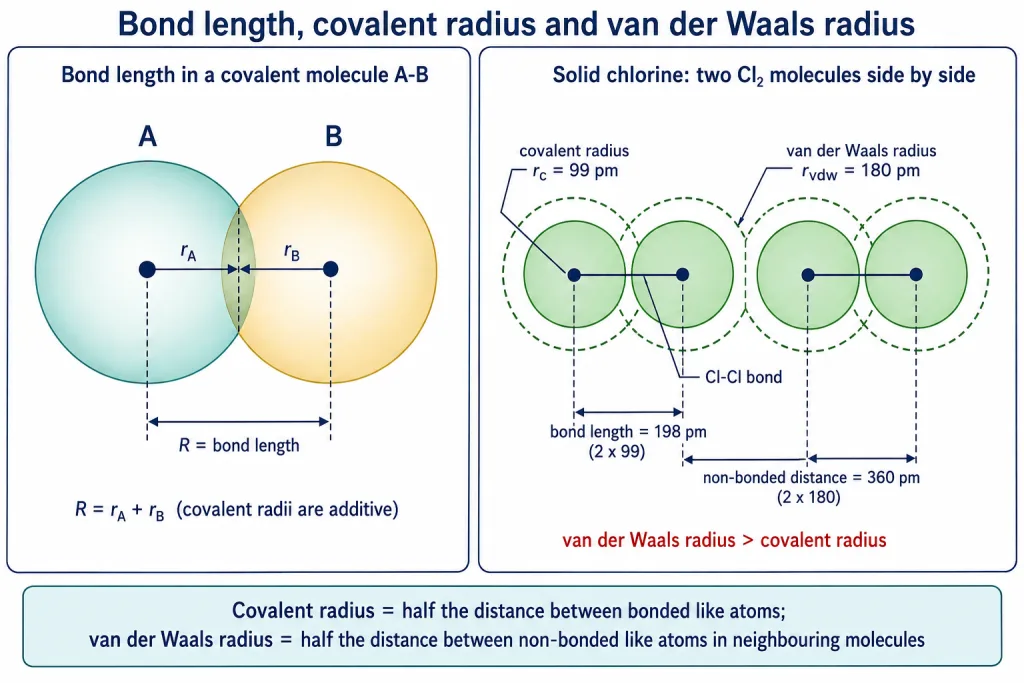
| Quantity | Symbol | Value | Where it comes from |
|---|---|---|---|
| Covalent radius | 99 pm | half the Cl-Cl bond length inside one molecule (198 pm) | |
| van der Waals radius | 180 pm | half the distance between two non-bonded Cl atoms of neighbouring molecules (360 pm) |
In a bond the electron clouds overlap heavily, so the nuclei come close. Between molecules there is no shared pair; the filled valence shells repel and the atoms stop where their outer clouds just touch. The van der Waals radius is the real outer size of the atom; the covalent radius is its size when squeezed into a bond.
[JEE/NEET] For any given element the order is always van der Waals radius > covalent radius. Metallic radius, where the concept applies, lies between the two.
Covalent radii of common elements
These are single-bond radii; multiple-bond radii are shorter, since extra shared pairs pull the atoms closer.
| Element | (pm) | Element | (pm) |
|---|---|---|---|
| H | 37 | Cl | 99 |
| C | 77 (C=C 67, CC 60) | Br | 114 |
| N | 74 (N=N 65, NN 55) | I | 133 |
| O | 66 (O=O 57) | Si | 117 |
| F | 64 | P | 110 |
| S | 104 | Ge | 122 |
Two trends echo Chapter 3. Across a period the covalent radius shrinks (C 77 > N 74 > O 66 > F 64): nuclear charge rises while the electrons stay in the same shell. Down a group it grows (F 64 < Cl 99 < Br 114 < I 133): a new shell is added each time. Bond lengths inherit both trends.
Reading the Bond-Length Tables
Thousands of measurements show a regularity: a bond type has nearly the same length whichever molecule it appears in. A C-H bond is close to 107 pm in methane, ethanol, benzene or a protein. So we can tabulate average bond lengths for each bond type and predict distances in molecules nobody has measured.
Average bond lengths for single, double and triple bonds
| Bond type | Bond length (pm) | Bond type | Bond length (pm) |
|---|---|---|---|
| O-H | 96 | C=O | 121 |
| C-H | 107 | N=O | 122 |
| N-O | 136 | C=C | 133 |
| C-O | 143 | C=N | 138 |
| C-N | 143 | CN | 116 |
| C-C | 154 | CC | 120 |
In the carbon-carbon series C-C 154, C=C 133, CC 120 pm, every extra shared pair pulls the nuclei closer. Same for carbon-oxygen (C-O 143, C=O 121 pm) and carbon-nitrogen (C-N 143, C=N 138, CN 116 pm).
Key Point: For the same pair of atoms, bond length decreases as the number of bonds between them increases: single > double > triple.
Bond lengths depend on both atoms. "Double bond = 121 pm" is only C=O; C=C is 133 pm and N=O is 122 pm. Always quote the bond type with the number.
Bond lengths in some common molecules
| Molecule | Bond length (pm) | Molecule | Bond length (pm) |
|---|---|---|---|
| (H-H) | 74 | (O=O) | 121 |
| (F-F) | 144 | HF (H-F) | 92 |
| (Cl-Cl) | 199 | HCl (H-Cl) | 127 |
| (Br-Br) | 228 | HBr (H-Br) | 141 |
| (I-I) | 267 | HI (H-I) | 160 |
| (NN) | 109 |
Three lessons:
- Down a group, bonds get longer. 144 < 199 < 228 < 267 pm, and HF 92 < HCl 127 < HBr 141 < HI 160 pm. Bigger atoms, longer bonds.
- Hydrogen makes the shortest bonds. H-H at 74 pm is the shortest here; hydrogen's covalent radius is only 37 pm.
- Multiple bonds are short even between large atoms. Triple-bonded is only 109 pm, shorter than every single bond here except H-H and H-F.
A quick check on additivity
| Bond | Measured | |
|---|---|---|
| H-Cl | 37 + 99 = 136 pm | 127 pm |
| Cl-Cl | 99 + 99 = 198 pm | 199 pm |
| C-C | 77 + 77 = 154 pm | 154 pm |
| H-F | 37 + 64 = 101 pm | 92 pm |
For like atoms the sum is exact — that is how the radii were defined. For atoms of very different electronegativity, such as H-F and H-Cl, the measured bond is noticeably shorter than the sum, because the polar bond pulls the atoms closer. Additivity is a good first estimate, not a law.
[JEE Main] Two factors shorten a bond: higher bond order and higher -character ( C-H bonds are shorter than ones). Two lengthen it: larger atoms and lower bond order. To rank bond lengths, check bond order first, then atom size.
Bond Angle and Bond Enthalpy
Bond angle — the shape parameter
Bond length says how far apart two atoms are, but nothing about the direction of the bonds. The bond angle does.
Key Point (Definition): Bond angle is the angle between the orbitals containing bonding electron pairs around the central atom in a molecule or complex ion. It is expressed in degrees and is determined experimentally by spectroscopic methods.
The bond angle shows how the orbitals are distributed around the central atom, which fixes the shape of the molecule. In water the H-O-H angle is 104.5°, so the molecule is bent (V-shaped). At 180° it would be linear like ; at 109.5° the bonds would point to two corners of a regular tetrahedron. That 104.5° is a little less than 109.5° is a clue: the two lone pairs on oxygen push the bonding pairs slightly closer together. VSEPR theory turns that clue into a full explanation.
| Molecule | Bond angle | Shape |
|---|---|---|
| 180° | linear | |
| 120° | trigonal planar | |
| 109.5° | tetrahedral | |
| 107° | trigonal pyramidal | |
| 104.5° | bent |
Bond enthalpy — the strength of the bond
A bond that is hard to break is a strong bond, and strength is measured by the energy needed to break it.
Key Point (Definition): Bond enthalpy (bond dissociation enthalpy) is the amount of energy required to break one mole of bonds of a particular type between two atoms in the gaseous state. Its unit is .
The gaseous state is essential. In a liquid or solid, part of the energy would go into overcoming intermolecular forces, and the number would no longer describe the bond alone.
The subscript "a" stands for atomisation. The pattern: single bond H-H 435.8, double bond O=O 498, triple bond NN 946.0 kJ/mol. The larger the bond dissociation enthalpy, the stronger the bond. The nitrogen triple bond at 946 kJ/mol is one of the strongest known for a diatomic molecule, which is why is so unreactive.
[NEET] Bond enthalpy is always positive — breaking bonds absorbs energy, and bond formation releases the same amount. The potential-energy curve in the valence bond section has its minimum exactly 435.8 kJ/mol below two separated atoms, at 74 pm.
Polyatomic molecules — the mean bond enthalpy
A diatomic molecule has one bond, so "the" bond enthalpy is unambiguous. In a polyatomic molecule the bonds break one after another, each in a different chemical environment. Water is the standard example:
Both steps break an O-H bond, yet differ by 75 kJ/mol. Once the first hydrogen leaves, the remaining OH fragment is a different species with a different electron distribution, so its O-H bond is not the bond it was in intact water. For the same reason the O-H bond enthalpy in ethanol, , is not identical to that in water.
To get one usable number, chemists average:
Key Point (Definition): The mean (average) bond enthalpy of a bond in a polyatomic molecule is the total bond dissociation enthalpy divided by the number of bonds broken.
So "the O-H bond enthalpy is 464.5 kJ/mol" means the mean value, and water's two O-H bonds need kJ/mol for complete atomisation.
[Board] A frequent two-mark question: why is the term mean bond enthalpy used for polyatomic molecules? Answer with the water example and both numbers, and say that the bonds break in different chemical environments, so each successive dissociation enthalpy differs.
Bond Order — Counting the Bonds
Definition and simple examples
In the Lewis picture one shared pair is a single bond, two a double bond, three a triple bond. That count has a name.
Key Point (Definition): In the Lewis description of a covalent bond, the bond order is the number of bonds between the two atoms in a molecule, that is, the number of shared electron pairs.
| Species | Shared pairs between the two atoms | Bond order |
|---|---|---|
| , | 1 | 1 |
| , | 2 | 2 |
| , | 3 | 3 |
| CO, | 3 | 3 |
| , | 1 | 1 |
| , | 1 | 1 |
Carbon monoxide has three shared pairs between C and O, with a lone pair on each atom, so its bond order is 3, the same as nitrogen. The two also have the same number of electrons (14), which is no coincidence.
Isoelectronic species have the same bond order
Key Point: Isoelectronic molecules and ions (same number of electrons, same number of atoms) have identical bond orders.
- , CO and all have 14 electrons: bond order 3 in each.
- and (peroxide ion) both have 18 electrons: bond order 1 in each.
- has 16 electrons: bond order 2, and so does its isoelectronic partner .
The Lewis structure (and later the molecular-orbital filling) depends on the electron count, not on which nuclei supply the electrons. So for an unfamiliar diatomic ion, find a familiar molecule with the same electron count.
The correlation that ties the parameters together
Key Point: With increase in bond order, bond enthalpy increases and bond length decreases.
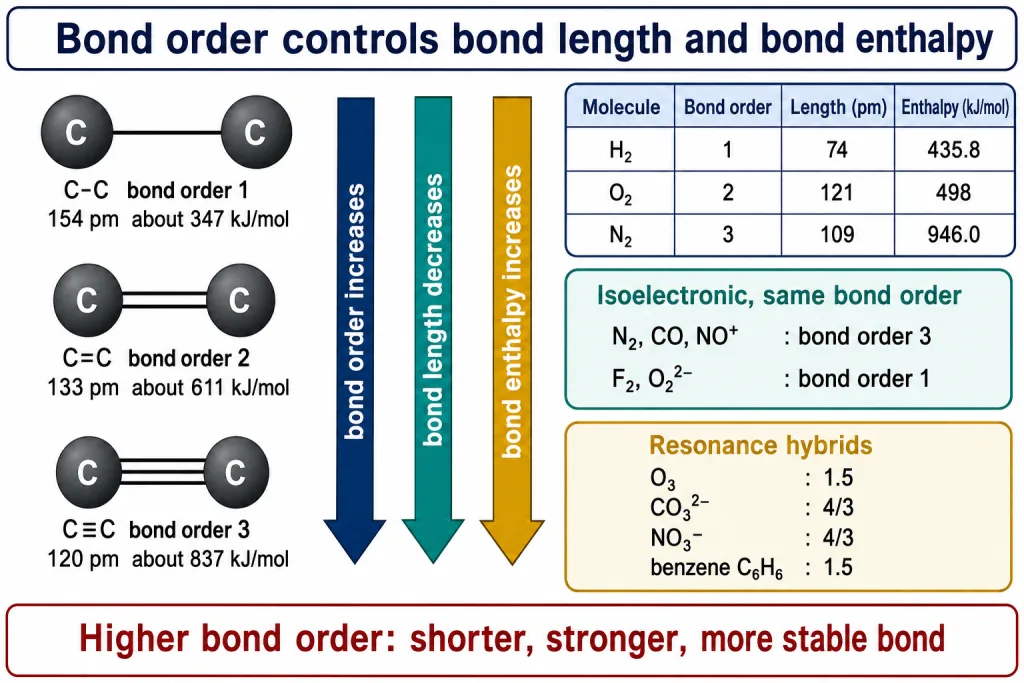
| Bond | Bond order | Bond length (pm) | Bond enthalpy (kJ/mol) |
|---|---|---|---|
| C-C | 1 | 154 | about 347 |
| C=C | 2 | 133 | about 611 |
| CC | 3 | 120 | about 837 |
| O=O | 2 | 121 | 498 |
| NN | 3 | 109 | 946.0 |
(The carbon-carbon bond enthalpies are typical average values from data books; the lengths and the and values are those in your bond-parameter tables.)
Down the carbon rows, each extra bond shortens the link by roughly 15-20 pm and adds a few hundred kJ/mol of strength. Between and , the triple bond is both shorter (109 versus 121 pm) and nearly twice as strong (946 versus 498 kJ/mol). But a triple bond is not three times a single bond: 837 is less than . The second and third bonds — the pi bonds of valence bond theory — are individually weaker than the first sigma bond.
[JEE/NEET] Three phrases, one idea:
- Bond order up → bond length down.
- Bond order up → bond enthalpy up.
- Bond order up → stability up (harder to break).
Molecular orbital theory will later give a formula, , that reproduces these Lewis bond orders and also handles species like (bond order 2.5) that Lewis structures cannot. For now Lewis counting is enough, with one extension: a molecule needing resonance can have a fractional bond order.
Resonance — When One Lewis Structure Is Not Enough
The ozone puzzle
Ozone, , has 18 valence electrons (3 × 6). Its Lewis structure is a central oxygen bonded to two terminal oxygens, with one O=O double bond and one O-O single bond, so every atom has an octet.
Structure I: — left bond double, right bond single. The central O has three bond pairs and one lone pair, formal charge ; the single-bonded terminal O has three lone pairs, formal charge ; the double-bonded terminal O has two lone pairs, formal charge 0.
Structure II: — the same molecule with the double bond on the right.
Experiment disagrees with both. A normal O-O single bond is 148 pm and a normal O=O double bond is 121 pm, so either structure predicts one short and one long bond. Instead both oxygen-oxygen bonds in ozone are exactly the same length, 128 pm, between the single-bond and double-bond values. Resonance solves this.
The concept of resonance
Key Point (Definition): Whenever a single Lewis structure cannot describe a molecule accurately, a number of structures with similar energy, the same positions of nuclei, and the same numbers of bonding and non-bonding electron pairs are taken as the canonical structures (or resonance structures, or contributing structures) of a resonance hybrid that describes the molecule accurately. Resonance is shown by a double-headed arrow () between the canonical structures.
For ozone, I and II are the canonical forms. The real molecule is the resonance hybrid, structure III, in which each oxygen-oxygen bond is a "one-and-a-half" bond — a full single bond plus half a double bond, drawn as a solid line with a dashed line alongside. The negative charge is spread over both terminal oxygens ( each) and the central oxygen keeps its . Each O-O bond order in the hybrid , and 128 pm is what a bond of order 1.5 should be: shorter than 148, longer than 121.
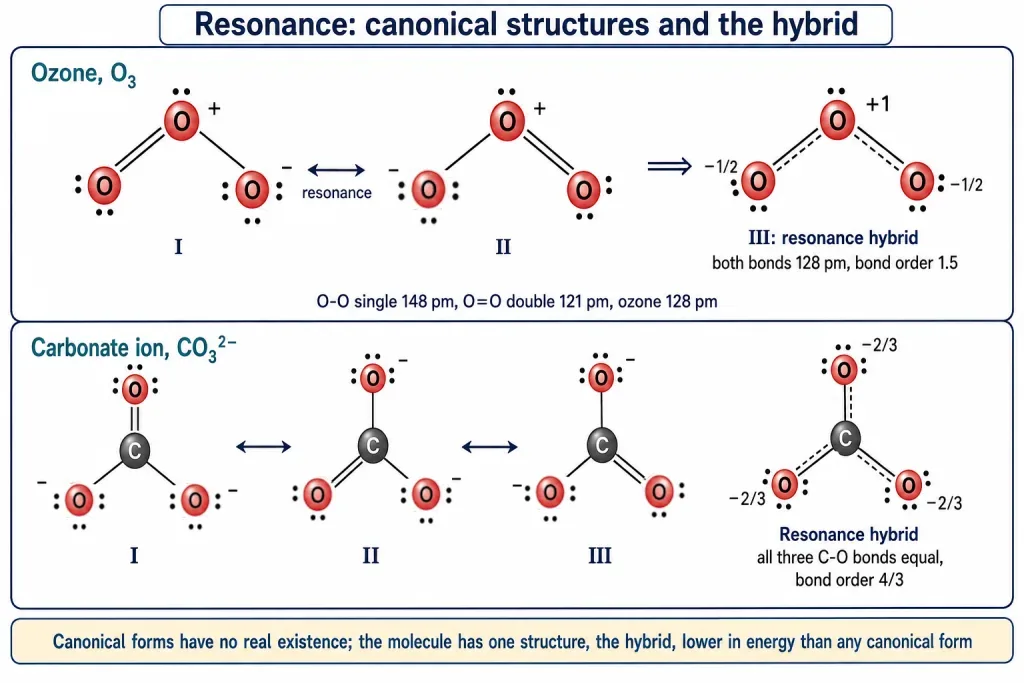
The electrons of the "extra" bond do not sit between one particular pair of atoms; they are spread, or delocalised, over all three. Delocalisation is the physical content of resonance.
The carbonate ion,
Carbonate has valence electrons. Carbon completes its octet with one C=O double bond and two C-O single bonds, which gives three structures differing only in which oxygen carries the double bond:
- I: double bond to ; and single-bonded, each with three lone pairs and formal charge .
- II: double bond to ; and carry the charges.
- III: double bond to ; and carry the charges.
In each, carbon and the double-bonded oxygen have formal charge 0, so the total is , as it must be. Any single one predicts one short bond (121 pm) and two longer bonds (143 pm), but experiment says the three carbon-oxygen bonds are all equivalent. Carbonate is therefore the resonance hybrid of I, II and III: each C-O bond has order (four bonds over three positions) and each oxygen carries a charge of . The ion is trigonal planar with three identical bonds.
Carbon dioxide,
The usual picture predicts two C=O double bonds of 121 pm. The measured C-O bond length in is 115 pm, shorter than a C=O double bond (121 pm) but longer than a triple bond (110 pm). One structure cannot explain this, so three canonical forms are written:
- I: (both bonds double, all formal charges zero).
- II: (single bond to the left oxygen, which has three lone pairs and ; triple bond to the right oxygen, which has one lone pair and ).
- III: (the mirror image of II).
Structure I, with no formal charges, is the major contributor, but II and III mix in enough to pull the bond length below 121 pm, so each C-O bond in the hybrid is a little stronger than a plain double bond.
[Board] Exercise-style questions on and want you to (i) state the experimental fact (equal bonds / 115 pm), (ii) show why one Lewis structure fails, (iii) draw or describe the canonical forms with formal charges, and (iv) name the resonance hybrid. All four steps, every time.
The Rules of Resonance and the Misconceptions to Avoid
What resonance does for a molecule
Two results follow whenever resonance is needed:
- Resonance stabilises the molecule. The hybrid's energy is less than that of any single canonical structure; the difference is the resonance energy (or delocalisation energy). Ozone lies below both structure I and II on the energy scale.
- Resonance averages the bond characteristics. Bond lengths, bond enthalpies and charges in the hybrid are averages over the canonical forms — why all three C-O bonds in carbonate are alike and why both O-O bonds in ozone are 128 pm.
Conditions for writing canonical structures
Not every pair of drawings counts as resonance. Canonical structures must satisfy all of these:
| Condition | What it means in practice |
|---|---|
| Same positions of all nuclei | Only electrons move; no atom changes its place |
| Same number of unpaired electrons | Cannot pair up or unpair electrons between forms |
| Nearly equal energy | Structures with many charges, or charges on the wrong atoms, contribute little |
| Each obeys the normal valence rules | Octets where required, no five-bonded carbons |
The structure with the fewest formal charges, and negative charge on the more electronegative atom, is the major contributor. Equivalent structures (as in , , , benzene) contribute equally, and resonance stabilisation is largest then.
The tautomer trap:
Phosphorous acid can be drawn two ways: structure 1 with one P=O double bond, two P-OH groups and one P-H bond, or structure 2 with three P-OH groups and a lone pair on phosphorus. They are not canonical structures of a hybrid — going from 1 to 2 a hydrogen atom moves from phosphorus to oxygen, so the nuclei sit in different positions and the first condition fails. They are tautomers, two genuinely different molecules that interconvert and exist in equilibrium. Experimentally is structure 1: the P-H bond is real, which is why phosphorous acid is only dibasic.
In one line — resonance: only electrons move, one real structure, double-headed arrow. Tautomerism: an atom (usually H) moves, two real structures in equilibrium, ordinary equilibrium arrows.
Misconceptions you must drop
Key Point: Four statements about resonance:
- The canonical forms have no real existence.
- The molecule does not spend a fraction of its time in one canonical form and a fraction in another.
- There is no equilibrium between canonical forms of the kind that exists between tautomers (such as keto and enol forms).
- The molecule has a single structure, the resonance hybrid, which simply cannot be drawn as one Lewis structure.
The word "resonance" suggests something vibrating back and forth, but nothing oscillates. A mule is a hybrid of a horse and a donkey, not a horse for half the day and a donkey for the other half. The canonical structures are the horse and the donkey; the molecule is the mule.
Fractional bond orders in resonance hybrids
The hybrid's bond order is the total bonds between a given pair of atoms across all structures, divided by the number of equivalent structures. Quicker: total bonds at the central atom divided by the number of equivalent bonding positions.
| Species | Canonical forms | Bonds to be shared | Positions | Bond order |
|---|---|---|---|---|
| 2 | 3 | 2 | 1.5 | |
| 3 | 4 | 3 | 1.33 | |
| 3 | 4 | 3 | 1.33 | |
| 2 | 3 | 2 | 1.5 | |
| (octet structures) | 3 | 4 | 3 | 1.33 |
| Benzene | 2 | 9 C-C bonds | 6 | 1.5 |
Benzene is the classic organic case: two Kekulé structures with alternating double bonds, a hybrid whose six C-C bonds are identical at 139 pm (between 154 and 133 pm), bond order 1.5.
[NEET] Bond orders CO 3 > 2 > 1.33, so bond lengths run CO < < and bond strengths the opposite way. Similarly for N-O bond length: (3) < NO (2.5) < (1.5) < (1.33).
Solved Examples
Question 1: Defining bond length and how it is measured
Define bond length. Name the techniques used to measure it, and explain what is meant by saying that each atom "contributes" to the bond length.
Answer:
Bond length is the equilibrium distance between the nuclei of two bonded atoms in a molecule. The atoms vibrate about this average separation, where attraction and repulsion balance.
It is measured by spectroscopy, X-ray diffraction (for crystals) and electron diffraction (for gases), all in picometres: H-H in is 74 pm, Cl-Cl in is 199 pm.
For the contribution, I picture the bonded atoms as balls pressed together. The distance from A's nucleus to the point of contact is the covalent radius of A, and the same for B, so . For two identical atoms the covalent radius is just half the bond length; for chlorine, pm.
Ans: Bond length is the equilibrium internuclear distance between two bonded atoms, measured by spectroscopy, X-ray diffraction or electron diffraction; it equals the sum of the covalent radii, .
Watch out: "Equilibrium distance between nuclei" is the phrase that scores; "distance between atoms" is too vague for full marks.
Question 2: Covalent radius versus van der Waals radius in chlorine
In solid chlorine the distance between the nuclei of two chlorine atoms within a molecule is about 198 pm, while the shortest distance between chlorine atoms of neighbouring molecules is 360 pm. Find the covalent radius and the van der Waals radius of chlorine and explain why they differ.
Answer:
The two atoms inside a molecule are joined by a covalent bond, so half that bond length is the covalent radius:
Atoms in neighbouring molecules are not bonded; they just touch. Half that distance is the van der Waals radius:
They differ because in a bond the electron clouds overlap and the nuclei get close, while between molecules there is no shared pair — the filled outer shells repel and the atoms stop where their clouds touch. So the van der Waals radius measures the atom's full outer size, the covalent radius the atom squeezed into a bond, and it is always the larger.
Ans: Covalent radius of Cl = 99 pm; van der Waals radius of Cl = 180 pm. The van der Waals radius is larger because it describes a non-bonded atom whose valence shell is not overlapped by a neighbour.
Question 3: Estimating bond lengths from covalent radii
Using the covalent radii H 37 pm, C 77 pm, N 74 pm, O 66 pm, Cl 99 pm and Br 114 pm, estimate the bond lengths of C-Cl, C-Br, N-H, C-H and C-O. Compare the last two with the tabulated values 107 pm (C-H) and 143 pm (C-O). Then comment on why the H-F bond (measured 92 pm) is shorter than the sum of the radii (37 + 64 = 101 pm).
Answer:
Bond length is roughly the sum of the covalent radii, so I add them:
- C-Cl: pm (measured about 178 pm in chloromethane).
- C-Br: pm.
- N-H: pm (measured about 101 pm in ammonia).
- C-H: pm (tabulated average 107 pm).
- C-O: pm, exactly the tabulated average.
For C-O the sum matches the table exactly; for C-H it overshoots the measured 107 pm by about 7 pm.
For H-F the sum is 101 pm but the bond is 92 pm. Fluorine is far more electronegative than hydrogen, so the bond is strongly polar; the partial charges attract and pull the atoms closer than two neutral atoms would sit. The same shortening appears in all very polar bonds to hydrogen (H-F, H-O, H-N, H-Cl).
Ans: C-Cl about 176 pm, C-Br about 191 pm, N-H about 111 pm, C-H about 114 pm, C-O 143 pm. Polar bonds such as H-F come out shorter than the sum of covalent radii, because of the extra attraction between the partial charges.
Watch out: Additivity is a good first estimate — exact for like atoms, best for atoms of similar electronegativity. Expect polar bonds to come out a little short.
Question 4: Bond order and bond strength
How do you express the bond strength in terms of bond order? Illustrate with , and , and explain why , CO and all have the same bond order.
Answer:
Bond order is the number of bonds, or shared electron pairs, between two atoms. has one shared pair, so bond order 1; two, so 2; three, so 3.
More shared pairs pull the nuclei together more strongly, so the bond gets harder to break: H-H 435.8, O=O 498, NN 946.0 kJ/mol. The bond also gets shorter (O=O 121 pm, NN 109 pm). Higher bond order means higher bond enthalpy and shorter bond length, so bond order is a direct measure of bond strength.
For the isoelectronic set I count electrons: has 14, CO has , has . Species with the same number of electrons and atoms build the same Lewis structure — three shared pairs — so all three have bond order 3 and are strongly bonded. CO's bond enthalpy is about 1072 kJ/mol, even higher than nitrogen's.
Ans: Bond strength increases with bond order: (1) < (2) < (3), with bond enthalpies 435.8 < 498 < 946.0 kJ/mol. , CO and are isoelectronic (14 electrons each), so all have bond order 3.
Watch out: "Isoelectronic, so same bond order" is a two-second shortcut. Count electrons first, then look for a familiar molecule with the same count.
Question 5: Mean bond enthalpy of the O-H bond in water
The following data are given: , kJ/mol; , kJ/mol. (a) Why are the two values different, though both break an O-H bond? (b) Calculate the mean O-H bond enthalpy. (c) How much energy is needed to convert one mole of gaseous water completely into atoms?
Answer:
(a) The first O-H bond breaks in an intact water molecule; the second breaks in the OH radical, a different species with a different arrangement of electrons around oxygen. The environment has changed, so the strength has changed. This happens in every polyatomic molecule — the same bond type has slightly different enthalpies in different surroundings, which is also why the O-H bond in ethanol differs from that in water.
(b) I add the energy needed to break all bonds of that type and divide by the number of bonds:
(c) Water has two O-H bonds, so the atomisation enthalpy is the sum of the two steps:
which equals . That is what makes the mean value useful: multiply it by the number of bonds.
Ans: (a) The two bonds are broken in different chemical environments ( versus OH). (b) Mean O-H bond enthalpy = 464.5 kJ/mol. (c) 929 kJ/mol.
Watch out: Mean bond enthalpy hides the fact that successive bonds differ, but it is the value thermochemistry calculations use.
Question 6: What the bond angle in water reveals
The bond angle in water is 104.5°. What does a bond angle mean, what does this particular value tell you about the shape of the water molecule, and how would the shape differ if the angle were 180°?
Answer:
The bond angle is the angle between the orbitals holding the bonding pairs around the central atom, measured in degrees by spectroscopy. In water it is the angle between the two O-H bonds at the oxygen.
At 104.5° the hydrogens are not on opposite sides of the oxygen but bunched to one side, so water is bent (V-shaped). Since the angle is below the tetrahedral 109.5°, the picture that fits is an oxygen with four electron pairs pointing roughly to the corners of a tetrahedron — two bonding, two lone. The lone pairs take up more room and push the bonding pairs closer, shrinking the angle to 104.5°.
At 180° the molecule would be linear, in a straight line like . The two O-H bond dipoles would cancel and water would have no dipole moment, which is not what we observe (1.85 D). The bent shape is what makes water polar.
Ans: Bond angle is the angle between bonding orbitals at the central atom. The 104.5° angle shows water is bent, with the oxygen's two lone pairs squeezing the bonding pairs below the tetrahedral 109.5°. A 180° angle would make water linear and non-polar.
Question 7: Resonance in the carbonate ion
Explain the important aspects of resonance with reference to the ion. Give the formal charge on every atom in a canonical structure and the bond order of each C-O bond in the hybrid.
Answer:
First I count the valence electrons: carbon 4, three oxygens , plus 2 for the charge — 24 electrons, 12 pairs.
Then one Lewis structure. Carbon in the middle, three oxygens around it: three single bonds use 3 pairs and the remaining 9 pairs go on the oxygens, three each. Carbon then has only 6 electrons, so I move one oxygen lone pair in to make a C=O double bond — one C=O and two C-O single bonds, octets everywhere.
Formal charges: carbon ; double-bonded O ; each single-bonded O . Total , matching the ion's charge.
This predicts one short bond (C=O, 121 pm) and two longer bonds (C-O, 143 pm), but experimentally the three C-O bonds are identical, so one Lewis structure is inadequate. The double bond can go on any of the three oxygens, giving three canonical structures I, II and III, identical in energy. The real ion is the resonance hybrid of all three, four bonds spread over three positions:
Each oxygen carries and every C-O bond has the same length, between 121 and 143 pm. The hybrid also has lower energy than any single canonical form.
Ans: is a resonance hybrid of three equivalent canonical structures, each with one C=O and two C-O bonds (formal charges: C 0, double-bonded O 0, single-bonded O each). All three C-O bonds are equivalent, with bond order , and the hybrid is more stable than any individual structure.
Watch out: For any -type species (carbonate, nitrate, sulphur trioxide): three equivalent structures, bond order , trigonal planar, all bonds equal.
Question 8: The structure of carbon dioxide
The measured C-O bond length in is 115 pm. A C=O double bond is 121 pm and a triple bond is 110 pm. Explain the structure of in terms of resonance.
Answer:
has valence electrons, and the obvious Lewis structure is : two double bonds, no lone pairs on carbon, two on each oxygen, all formal charges zero.
A double bond should be 121 pm, but the actual bond is 115 pm — shorter than a double bond, longer than a triple bond (110 pm). So the bond order lies between 2 and 3, which one Lewis structure cannot show. I write three canonical structures:
- I: , both bonds double, all formal charges 0.
- II: : single bond on the left (that oxygen has three lone pairs, formal charge ), triple bond on the right (that oxygen has one lone pair, formal charge ).
- III: , the mirror image of II.
is the resonance hybrid of I, II and III. Structure I, with no charges, contributes most; II and III contribute enough to give each bond some triple-bond character, which is why the bond is shorter than 121 pm. II and III are mirror images, so their contributions are equal, both C-O bonds stay identical, and the molecule stays linear with zero dipole moment.
Ans: cannot be described by alone, because its 115 pm bond length lies between C=O (121 pm) and (110 pm). It is a resonance hybrid of , and , with both bonds equivalent.
Watch out: Resonance is invoked whenever the measured bond length matches no single Lewis structure. State the numbers: 115 between 121 and 110.
Question 9: Why the two structures of phosphorous acid are not resonance structures
can be drawn as structure 1, with a P=O double bond, two P-OH groups and one P-H bond, or as structure 2, with three P-OH groups and a lone pair on phosphorus. Can these be taken as the canonical forms of a resonance hybrid? Give reasons.
Answer:
The test is that canonical structures must have the same positions of all nuclei — only electrons may move, no atom may change its place.
In structure 1 a hydrogen is bonded directly to phosphorus; in structure 2 it is bonded to an oxygen. Going from 1 to 2 moves an H atom from P to O, so the nuclei sit in different positions.
So 1 and 2 are not canonical forms of a hybrid. They are two different molecules, tautomers, related by the migration of a hydrogen atom. Tautomers are real species that can exist in equilibrium; canonical forms have no independent existence at all. Experiment shows the P-H bond is genuine: phosphorous acid has only two ionisable hydrogens, it is dibasic, and that is the behaviour of structure 1.
Ans: No. The two structures differ in the position of a hydrogen atom (P-H in one, O-H in the other), and resonance structures must have identical positions of all nuclei. They are tautomers, not canonical forms.
Watch out: If you have to move an atom to get from one drawing to the other, it is not resonance. Electrons move in resonance; atoms move in tautomerism.
Question 10: Resonance structures of , and
Write (describe) the resonance structures of , and , with formal charges, and give the bond order of the S-O or N-O bonds in each hybrid.
Answer:
has 24 valence electrons. With sulphur obeying the octet rule: one S=O double bond and two S-O single bonds. Formal charges: S ; double-bonded O ; each single-bonded O ; net charge 0. The double bond can sit on any of the three oxygens, so there are three equivalent canonical structures: four bonds over three positions, bond order , trigonal planar with three equal S-O bonds. Because sulphur is in period 3, structures with two or three S=O bonds and an expanded octet are also often drawn; they describe the same equal-bond hybrid.
has 17 valence electrons, an odd number. Nitrogen sits in the middle with one N=O double bond, one N-O single bond and the odd electron on nitrogen. Formal charges: N ; double-bonded O (two lone pairs) ; single-bonded O (three lone pairs) . Swapping the double and single bonds gives the second structure, so there are two equivalent canonical structures: three bonds over two positions, bond order 1.5. The molecule is bent, and the odd electron makes paramagnetic and eager to dimerise to .
has 24 valence electrons and is isoelectronic with , so the pattern repeats: one N=O and two N-O single bonds. Formal charges: N ; double-bonded O ; each single-bonded O ; net . Three equivalent canonical structures, bond order , trigonal planar, all N-O bonds equal.
Ans: : three equivalent structures (one S=O, two S-O, S at ), bond order . : two equivalent structures (one N=O, one N-O, N at with the unpaired electron), bond order 1.5. : three equivalent structures (one N=O, two N-O, N at ), bond order .
Watch out: Count electrons, draw one octet structure, compute formal charges, then rotate the double bond around the equivalent oxygens. Bond order = total bonds ÷ positions.
Question 11: Bond orders in resonance hybrids and ordering bond lengths
(a) Find the bond order of each carbon-carbon bond in benzene and each oxygen-oxygen bond in ozone. (b) Arrange the carbon-oxygen bonds in CO, and in order of increasing bond length and decreasing bond enthalpy.
Answer:
(a) Benzene has six carbons in a ring. Its two Kekulé structures put three double bonds in alternating positions, so between any adjacent pair of carbons there is a double bond in one structure and a single bond in the other:
Equivalently, nine C-C bonds over six positions gives . All six bonds are 139 pm, between C-C (154) and C=C (133).
Ozone has two canonical structures, each with one O=O and one O-O, so each bond is double in one and single in the other: bond order . Both bonds are 128 pm, between O-O (148) and O=O (121).
(b) Bond orders first. CO has three shared pairs, bond order 3. is , bond order 2 — a little triple-bond character from resonance, but still about 2. is a hybrid of three structures, bond order . Higher bond order means a shorter and stronger bond, so length rises as bond order falls and enthalpy falls with it.
- Increasing bond length: CO (110 pm) < (115 pm) < (about 130 pm).
- Decreasing bond enthalpy: CO > > .
Ans: (a) Benzene C-C bond order 1.5; ozone O-O bond order 1.5. (b) Bond length: CO < < ; bond enthalpy: CO > > .
Question 12: Ozone and the meaning of resonance
Both O-O bonds in ozone are 128 pm, though a normal O-O single bond is 148 pm and an O=O double bond is 121 pm. (a) Explain this observation. (b) A student says, "Ozone keeps switching between its two resonance structures, so on average the bonds look the same." Point out what is wrong with this statement and give the correct picture. (c) Is the resonance hybrid higher or lower in energy than a canonical structure?
Answer:
(a) Either Lewis structure of ozone has one single and one double bond, predicting bonds of 148 pm and 121 pm. The real molecule has two identical bonds of 128 pm, in between. Each bond is a "one-and-a-half" bond of order 1.5, with the extra pair of electrons delocalised over all three oxygens instead of parked between one particular pair. That is what the resonance hybrid of I and II describes.
(b) The student treats the canonical structures as real states the molecule hops between. They are not real — they are two incomplete drawings that together describe one real molecule. Ozone does not spend half its time as structure I and half as II, and there is no equilibrium between them of the kind that exists between tautomers. The molecule has a single structure, the hybrid, at every instant, and 128 pm is not a time-average but the actual, permanent length of both bonds.
(c) The hybrid is lower in energy than either canonical structure. Delocalising electrons over more atoms lowers their energy, and the difference is the resonance energy — why ozone, carbonate, nitrate and benzene are more stable than a single Lewis structure suggests.
Ans: (a) Ozone is a resonance hybrid of two equivalent structures; each O-O bond has order 1.5, so both are 128 pm, between single (148) and double (121). (b) Canonical forms have no real existence and the molecule does not oscillate between them; it has one fixed structure, the hybrid. (c) The hybrid is lower in energy than any canonical structure by the resonance energy.