Enthalpy of Atomisation and Bond Dissociation Enthalpy
Every chemical reaction is bond-breaking followed by bond-making. Breaking a bond costs energy; making one returns energy. If the energy of each bond were known, the enthalpy of a reaction could be worked out without ever running it. That is what this part of thermochemistry sets up, starting with the most complete kind of bond-breaking, where a molecule is torn down to free atoms.
Key Point (Definition): The enthalpy of atomisation, ΔaH∘, is the enthalpy change when one mole of a substance is broken down completely into free gaseous atoms.
H2(g)→2H(g);ΔaH∘=435.8 kJmol−1
CH4(g)→C(g)+4H(g);ΔaH∘=1665 kJmol−1
Atomisation is always endothermic: pulling atoms apart never releases energy, so ΔaH∘ is positive for every substance.
For a metal, atomisation only means getting whole atoms into the gas phase:
Na(s)→Na(g);ΔaH∘=108.4 kJmol−1
For sodium the enthalpy of atomisation and the enthalpy of sublimation are the same number, because sublimation of the metal already delivers single gaseous atoms. This equality holds for metals, not for a molecular solid like iodine, where sublimation gives I2(g) and atomisation has to break the I−I bond as well.
Key Point (Definition): The bond dissociation enthalpy is the enthalpy change when one mole of a particular covalent bond is broken in the gas phase, with the reactant and both fragments gaseous.
For a diatomic molecule there is only one bond, so its bond dissociation enthalpy and its enthalpy of atomisation are the same quantity with two names:
Cl2(g)→2Cl(g);ΔCl−ClH∘=242 kJmol−1
O2(g)→2O(g);ΔO=OH∘=498 kJmol−1
The gas-phase requirement is not decoration. A bond enthalpy counts the energy of the bond and nothing else, so every species involved must be free of intermolecular forces.
[Board] For a diatomic molecule the enthalpy of atomisation equals the bond dissociation enthalpy. For a polyatomic molecule the enthalpy of atomisation equals the sum of all the bond enthalpies in the molecule, not any single one.
Why the Word "Mean" Is Needed
A polyatomic molecule has several bonds, and they do not come apart at the same cost even when they look identical on paper.
Water is the cleanest case. Its two O−H bonds are the same length in the intact molecule, yet they break at different enthalpies:
H2O(g)→H(g)+OH(g);ΔbondH∘=502 kJmol−1
OH(g)→H(g)+O(g);ΔbondH∘=427 kJmol−1
After the first bond breaks, the fragment left behind is OH, a different species from H2O with its own electron distribution. The second O−H bond being broken is no longer a bond in a water molecule, so the two figures have no reason to match.
Adding the two steps gives the atomisation:
H2O(g)→2H(g)+O(g);ΔaH∘=502+427=929 kJmol−1
ΔO−HH∘=2929=464.5 kJmol−1
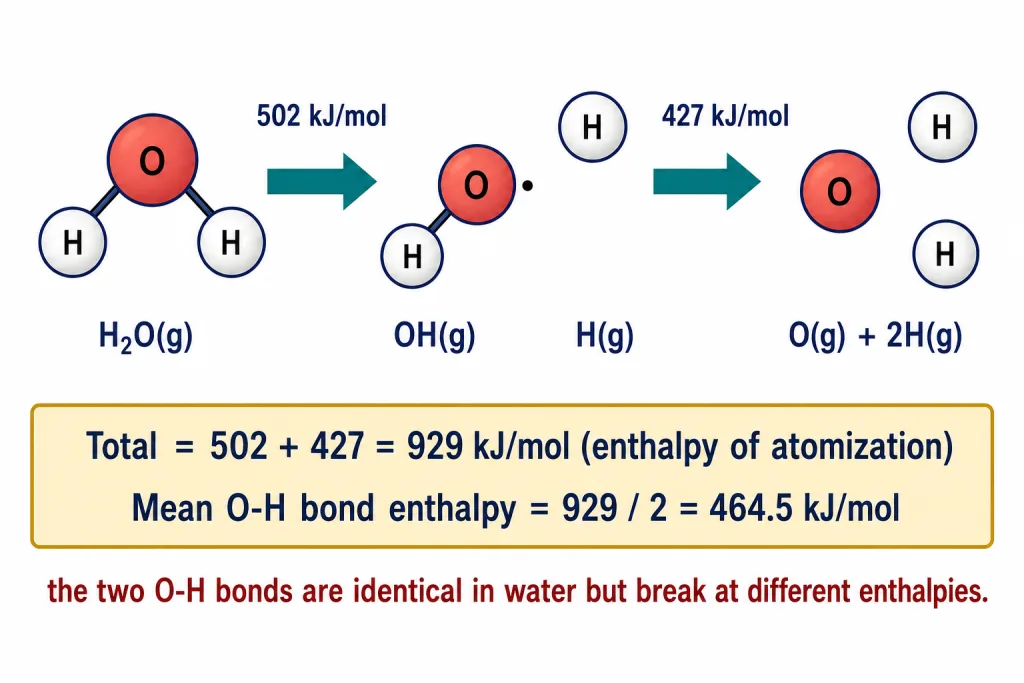
Key Point (Definition): The mean bond enthalpy of a bond in a polyatomic molecule is the enthalpy of atomisation divided by the number of such bonds in the molecule. It is an average over the successive dissociation steps, and no single step need equal it.
Methane makes the same point over four steps. Its four C−H bonds are identical in every chemical sense, yet:
| Step |
ΔbondH∘ / kJ mol−1 |
| CH4(g)→CH3(g)+H(g) |
427 |
| CH3(g)→CH2(g)+H(g) |
439 |
| CH2(g)→CH(g)+H(g) |
452 |
| CH(g)→C(g)+H(g) |
347 |
| Sum =ΔaH∘ |
1665 |
ΔC−HH∘=41(1665)=416 kJmol−1
None of the four steps is 416. That number is a bookkeeping average, useful because it can be carried from methane to ethane to propane with only small error.
A mean bond enthalpy also shifts slightly from compound to compound. The C−H value in CH4, in CH3CH2Cl and in CH3NO2 is close but not identical in each. Tables quote one figure averaged over many compounds, which is why 414 appears below while methane on its own gives 416.
| Bond |
ΔbondH∘ |
Bond |
ΔbondH∘ |
| H−H |
435.8 |
C−C |
347 |
| C−H |
414 |
C=C |
611 |
| N−H |
389 |
C≡C |
837 |
| O−H |
464 |
N−N |
159 |
| Cl−Cl |
242 |
N=N |
418 |
| Br−Br |
192 |
N≡N |
946 |
| H−Cl |
431 |
O=O |
498 |
| H−Br |
368 |
C=O |
741 |
| C−Cl |
330 |
C≡O |
1070 |
| C−O |
351 |
C≡N |
891 |
All values are in kJmol−1 at 298 K. Two patterns are worth carrying: a multiple bond is stronger than the matching single bond but never a simple multiple of it (C=C is 611, not 2×347), and N≡N at 946 is one of the strongest bonds in ordinary chemistry, which is why nitrogen is so unreactive.
Estimating a Reaction Enthalpy from Bond Enthalpies
A gas-phase reaction can be imagined as two stages: tear the reactant molecules into free atoms, then assemble the products from those atoms. The first stage costs the sum of the reactant bond enthalpies; the second returns the sum of the product bond enthalpies.
Key Point: ΔrH∘=∑(bond enthalpies of bonds broken in the reactants)−∑(bond enthalpies of bonds formed in the products)
Bonds broken carry a plus sign, bonds formed a minus sign. Take the formation of hydrogen chloride:
H2(g)+Cl2(g)→2HCl(g)
Broken: one H−H and one Cl−Cl, 435.8+242=677.8 kJ. Formed: two H−Cl, 2×431=862 kJ.
ΔrH∘=677.8−862=−184.2 kJmol−1
The reaction is exothermic because the two new bonds are stronger, taken together, than the two that were destroyed. Every exothermic gas-phase reaction is exothermic for exactly this reason.
The result is an estimate. Four approximations are stacked into it.
The values are averages. A mean bond enthalpy is drawn from many compounds, so the actual bond in the molecule being studied is worth a slightly different amount.
Only the listed bonds are counted. No allowance is made for resonance, for ring strain, or for how the electrons in one bond shift when a neighbouring bond changes.
Every species must be gaseous. If a reactant or product is a liquid or a solid, the enthalpy of vaporisation or sublimation has to be added separately, or the answer is wrong by that amount.
A bond is not an independent object. Breaking one bond alters the rest of the molecule, the same fact that forced the word "mean".
Where standard enthalpies of formation are available, that route gives an exact answer and the bond-enthalpy route does not. Bond enthalpies earn their place when ΔfH∘ values are missing, for a species too unstable or too obscure to have been measured.
[JEE Main] Count bonds from structures, not formulae. C2H6 has six C−H bonds and one C−C; CO2 has two C=O bonds, not one. Miscounting one bond shifts the answer by hundreds of kilojoules.
Ionization Enthalpy and Electron Gain Enthalpy
Two more energy terms are needed before ionic solids can be handled. Both are familiar from atomic structure; thermochemistry uses them with a temperature attached.
Key Point (Definition): The ionization enthalpy ΔiH∘ is the enthalpy change when one mole of gaseous atoms loses one mole of electrons to form one mole of gaseous unipositive ions.
Na(g)→Na+(g)+e−(g);ΔiH∘=496 kJmol−1
Removing an electron from a neutral atom always requires energy, so ΔiH∘ is positive without exception. Successive values rise: the second electron leaves an already positive ion and costs more than the first.
Key Point (Definition): The electron gain enthalpy ΔegH∘ is the enthalpy change when one mole of gaseous atoms accepts one mole of electrons to form one mole of gaseous uninegative ions.
Cl(g)+e−(g)→Cl−(g);ΔegH∘=−348.6 kJmol−1
For most non-metals this is negative, since the nucleus attracts the incoming electron. It is positive for the noble gases and the alkaline earth metals, where the added electron must enter a new shell or a filled subshell.
The older names were ionization energy and electron affinity, and the difference is not just fashion. Those two are defined at absolute zero. An enthalpy is quoted at a working temperature, usually 298 K, so the heat capacities of the species involved have to be carried along:
ΔrH∘(T)=ΔrH∘(0)+∫0TΔrCp∘dT
With every species treated as an ideal monatomic gas of Cp=25R, ionization creates one extra particle and electron gain destroys one, so ΔrCp=+25R and −25R respectively. That gives
ΔiH∘=E0+25RTandΔegH∘=−A−25RT
where E0 is the ionization energy and A the electron affinity. At 298 K the correction is about 6.2 kJmol−1, small beside ionization enthalpies of several hundred, which is why the two sets of terms are used almost interchangeably.
[NEET] Electron affinity is defined as energy released and is quoted positive for chlorine; electron gain enthalpy is an enthalpy change and is quoted negative. The sign flip between them is a definition, not a physical difference.
Lattice Enthalpy and the Born-Haber Cycle
An ionic crystal is a three-dimensional array of ions held by electrostatic attraction. The energy locked in that array is its lattice enthalpy.
Key Point (Definition): The lattice enthalpy ΔlatticeH∘ of an ionic compound is the enthalpy change when one mole of the solid compound dissociates completely into its gaseous ions, infinitely far apart.
Na+Cl−(s)→Na+(g)+Cl−(g);ΔlatticeH∘=+788 kJmol−1
Written this way lattice enthalpy is positive, because pulling oppositely charged ions apart costs energy. Some books define it for the reverse process and quote −788; only the direction of the equation differs.
Lattice enthalpy cannot be measured. No experiment takes solid sodium chloride and delivers a mole of separated gaseous ions with a thermometer attached. It is obtained from a closed cycle of measurable steps and Hess's law.
Key Point: A Born-Haber cycle is a Hess's law cycle for an ionic compound. It joins the direct formation of the solid from its elements to an indirect route through gaseous atoms and gaseous ions. Since enthalpy is a state function the two routes have the same total, so the one unknown step can be solved for.
The cycle for sodium chloride
The direct route is the formation of the solid from its elements in their reference states:
Na(s)+21Cl2(g)→NaCl(s);ΔfH∘=−411.2 kJmol−1
The indirect route takes five steps.
Step 1, sublimation of sodium. The metal is converted to gaseous atoms.
Na(s)→Na(g);ΔsubH∘=+108.4 kJmol−1
Step 2, ionization of sodium. Each gaseous atom loses one electron.
Na(g)→Na+(g)+e−(g);ΔiH∘=+496 kJmol−1
Step 3, dissociation of chlorine. Only half a mole of Cl2 is needed, so this step takes half the bond dissociation enthalpy.
21Cl2(g)→Cl(g);21ΔbondH∘=+121 kJmol−1
Step 4, electron gain by chlorine. The electron released in step 2 is taken up.
Cl(g)+e−(g)→Cl−(g);ΔegH∘=−348.6 kJmol−1
Step 5, lattice formation. The gaseous ions collapse into the crystal, the reverse of lattice dissociation, contributing −ΔlatticeH∘.
Na+(g)+Cl−(g)→Na+Cl−(s);−ΔlatticeH∘
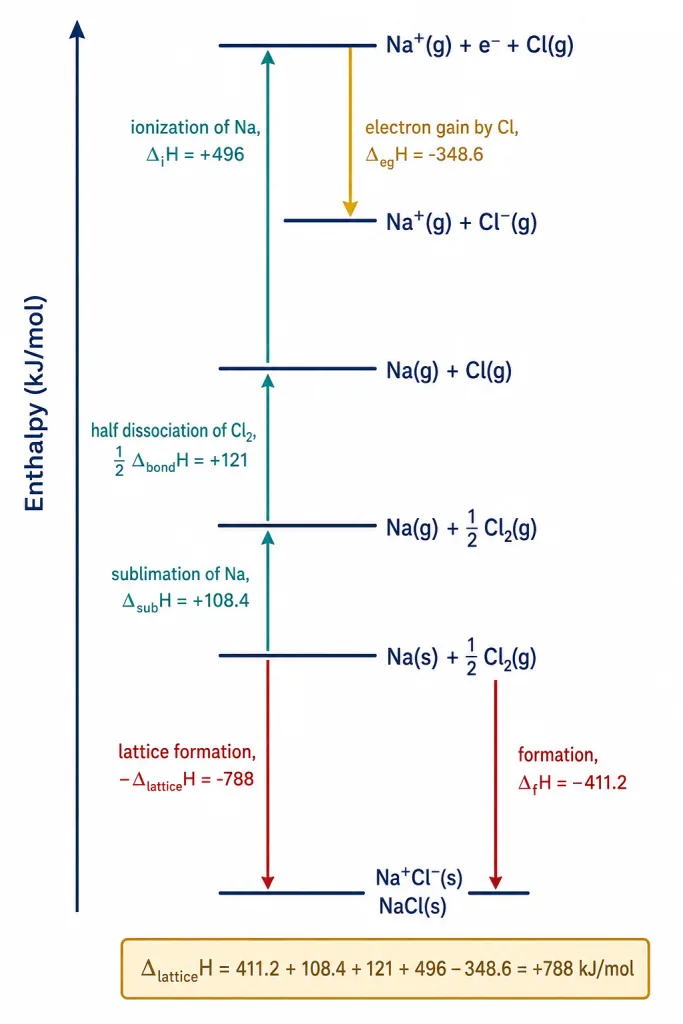
The five steps start at Na(s)+21Cl2(g) and end at NaCl(s), exactly where the direct route ends. Hess's law equates the two:
ΔfH∘=ΔsubH∘+ΔiH∘+21ΔbondH∘+ΔegH∘−ΔlatticeH∘
Rearranging for the unknown:
ΔlatticeH∘=−ΔfH∘+ΔsubH∘+ΔiH∘+21ΔbondH∘+ΔegH∘
ΔlatticeH∘=411.2+108.4+121+496−348.6=+788 kJmol−1
The internal energy change is smaller. Two moles of gas come from a solid, so Δng=2:
ΔlatticeU=ΔlatticeH−ΔngRT=788−2(8.314)(298)/1000=+783 kJmol−1
[JEE/NEET] Every Born-Haber question hides the same two sign traps: ΔfH∘ enters reversed because the cycle runs formation backwards, and ΔegH∘ is already negative. Write each step as an equation before adding anything.
Enthalpy of Solution and Enthalpy of Dilution
Key Point (Definition): The enthalpy of solution ΔsolH∘ is the enthalpy change when one mole of a substance dissolves in a specified amount of solvent at constant temperature and pressure.
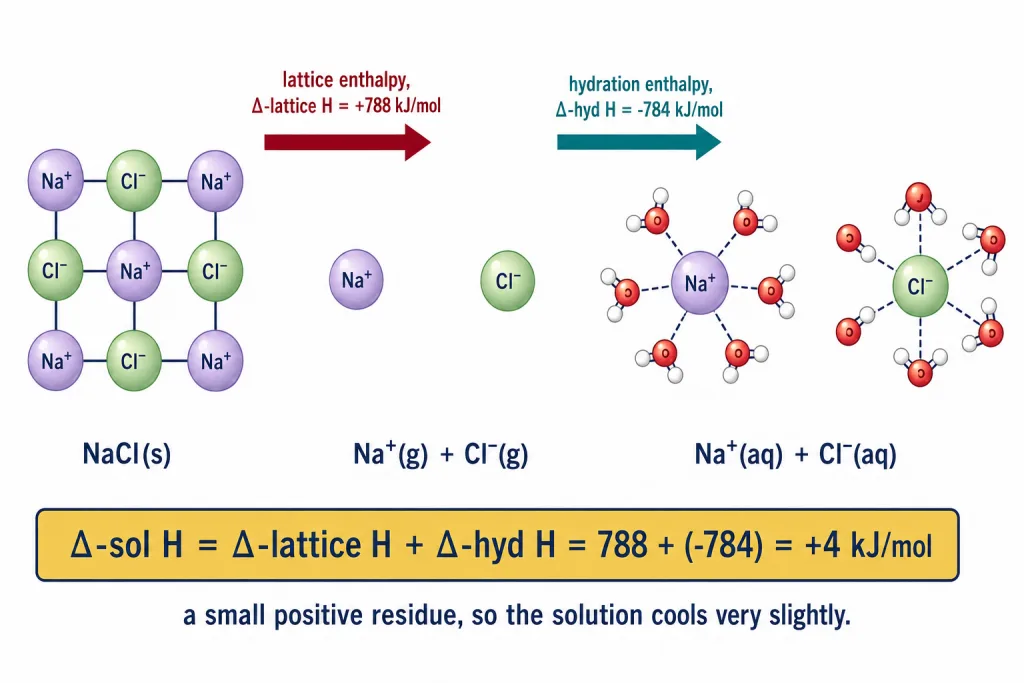
Dissolving an ionic solid is two competing changes at once. The lattice comes apart, costing the lattice enthalpy. The freed ions are then surrounded by solvent molecules, releasing the enthalpy of hydration ΔhydH∘ (the general word is solvation; hydration is the case where the solvent is water).
ΔsolH∘=ΔlatticeH∘+ΔhydH∘
The first term is large and positive, the second large and negative, so the enthalpy of solution is a small difference between two big numbers. Sodium chloride shows this sharply:
ΔsolH∘=788+(−784)=+4 kJmol−1
Two quantities near 800 kJmol−1 leave a residue of 4, so dissolving salt produces almost no measurable temperature change, cooling the water very slightly.
For most ionic compounds ΔsolH∘ is positive, so dissolution is endothermic and solubility rises with temperature. Where the lattice enthalpy is very large and hydration cannot repay it, the solid barely dissolves. Many fluorides are less soluble than the matching chlorides for this reason: the small fluoride ion packs into a tighter, higher-enthalpy lattice, and the gain in hydration enthalpy does not keep pace.
Why the amount of solvent is in the definition
The phrase "a specified amount of solvent" matters, because the heat released changes as more solvent is used. Dissolving gaseous hydrogen chloride in water, with aq standing for one mole of water:
| Process |
ΔH / kJ mol−1 |
| HCl(g)+10 aq→HCl⋅10aq |
−69.01 |
| HCl(g)+25 aq→HCl⋅25aq |
−72.03 |
| HCl(g)+40 aq→HCl⋅40aq |
−72.79 |
| HCl(g)+∞ aq→HCl⋅∞aq |
−74.85 |
The values grow more negative as solvent is added, but by less each time: 3.02 from 10 to 25 moles of water, only 0.76 from 25 to 40. Beyond a point the ions are so far apart that more water changes nothing, and the enthalpy of solution settles at a limiting value.
Key Point (Definition): The enthalpy of solution at infinite dilution is the enthalpy change on dissolving one mole of the substance in so much solvent that further dilution produces no further enthalpy change, and interactions between the dissolved particles are negligible. For hydrogen chloride this limit is −74.85 kJmol−1.
Key Point (Definition): The enthalpy of dilution is the enthalpy change on diluting an existing solution from one concentration to another. It is the difference between two enthalpies of solution, so diluting HCl⋅10aq to HCl⋅25aq has ΔH=−72.03−(−69.01)=−3.02 kJmol−1.
Extensive and Intensive Properties
Every enthalpy in this chapter is quoted per mole, and the reason runs through the whole subject.
Key Point (Definition): An extensive property depends on the amount of matter in the system. An intensive property does not.
| Extensive |
Intensive |
| mass |
temperature |
| volume |
pressure |
| internal energy U |
density |
| enthalpy H |
molar heat capacity Cm |
| entropy S |
concentration |
| Gibbs energy G |
specific heat capacity |
| heat capacity C |
refractive index, viscosity |
| number of moles |
boiling point, melting point |
The test is a partition. Take a container of gas at temperature T holding volume V, and slide in a wall splitting it into equal halves. Each half has volume V/2, so volume is extensive; each half is still at T, so temperature is intensive. Heat capacity is extensive, since twice the water needs twice the heat for the same rise. Dividing an extensive property by the amount of substance produces an intensive one:
Cm=nC,Vm=nV,ρ=Vm
Molar heat capacity, molar volume and density are intensive because the amount cancels. Any molar property is intensive.
This is why every thermochemical quantity in this chapter is written per mole. ΔH for a reaction is extensive, so burning two moles of methane releases twice the heat of one. Quoting ΔcH∘ per mole strips out the dependence on amount and leaves a number belonging to the substance.
[Board] Concentration is the one students misplace: taking half a beaker of 1 M solution leaves it 1 M. The ratio of any two extensive properties is intensive, which is what makes density and molar volume behave as they do.
Question 1: Mean C-H bond enthalpy in methane
The enthalpy of atomisation of methane is 1665 kJmol−1. Find the mean C−H bond enthalpy, and state what the successive dissociation values 427, 439, 452 and 347 kJmol−1 have to do with it.
Answer:
Atomisation of methane means CH4(g)→C(g)+4H(g). That breaks all four C−H bonds, so the 1665 is the cost of four bonds.
I divide by four.
ΔC−HH∘=41665=416.25≈416 kJmol−1
The four listed values are the individual bond dissociation enthalpies of the four successive steps. I check that they add up: 427+439+452+347=1665. They do, which is exactly why the mean is their average. Not one of the four equals 416.
Ans: ΔC−HH∘=416 kJmol−1; the four step values sum to the atomisation enthalpy and average to the mean.
Watch out: 416 is not the enthalpy of any real step. It is a table value for estimating reaction enthalpies, not for predicting how much energy pulls the first hydrogen off methane.
Question 2: The two O-H bonds in water
Breaking the first O−H bond in gaseous water takes 502 kJmol−1 and breaking the second takes 427 kJmol−1. Find the enthalpy of atomisation of water and the mean O−H bond enthalpy, and explain why the two steps differ.
Answer:
The two steps are H2O(g)→H(g)+OH(g) at 502 and OH(g)→H(g)+O(g) at 427 kJmol−1. Adding them cancels OH(g) and gives the atomisation:
H2O(g)→2H(g)+O(g);ΔaH∘=502+427=929 kJmol−1
There are two O−H bonds, so the mean is
ΔO−HH∘=2929=464.5 kJmol−1
The steps differ because the second bond broken is not a bond in water at all. It is the bond in the hydroxyl radical, a species with one unpaired electron and its own electron distribution. Identical bonds stop being identical once one of them is gone.
Ans: ΔaH∘=929 kJmol−1, ΔO−HH∘=464.5 kJmol−1.
Question 3: Ionization enthalpy from ionization energy
The ionization energy of an element is E0=738 kJmol−1. Find its ionization enthalpy at 298 K. Take R=8.314 JK−1mol−1.
Answer:
Ionization energy is defined at absolute zero, so going to 298 K needs the heat-capacity correction ΔiH∘=E0+25RT. I work that out first.
25RT=2.5×8.314×298=6194 Jmol−1=6.19 kJmol−1
ΔiH∘=738+6.19=744.2 kJmol−1
Ans: ΔiH∘=744.2 kJmol−1, larger than E0 by about 6.2 kJmol−1.
Watch out: For electron gain the sign of the correction flips, because one particle is destroyed: ΔegH∘=−A−25RT.
Question 4: Hydrogen chloride from the elements
Estimate ΔrH∘ for H2(g)+Cl2(g)→2HCl(g) using ΔH−HH∘=435.8, ΔCl−ClH∘=242 and ΔH−ClH∘=431 kJmol−1.
Answer:
I list the bonds on each side. Reactants: one H−H, one Cl−Cl. Products: two molecules of HCl, so two H−Cl bonds.
Bonds broken:
435.8+242=677.8 kJ
Bonds formed:
2×431=862 kJ
ΔrH∘=677.8−862=−184.2 kJmol−1
Ans: ΔrH∘≈−184 kJmol−1, exothermic.
Question 5: Chlorination of methane
Estimate ΔrH∘ for CH4(g)+Cl2(g)→CH3Cl(g)+HCl(g). Use C−H=414, Cl−Cl=242, C−Cl=330 and H−Cl=431 kJmol−1.
Answer:
Methane has four C−H bonds and chloromethane three, so only one C−H is really broken; the other three appear on both sides and cancel. I count only what changes.
Broken: one C−H and one Cl−Cl.
414+242=656 kJ
Formed: one C−Cl and one H−Cl.
330+431=761 kJ
ΔrH∘=656−761=−105 kJmol−1
Ans: ΔrH∘≈−105 kJmol−1.
Watch out: Listing all four C−H bonds as broken and three as formed gives the same answer only if both sides are done consistently. Cancelling the spectator bonds first is faster and leaves less room for an arithmetic slip.
Question 6: Hydrogenation of ethene
Estimate ΔrH∘ for C2H4(g)+H2(g)→C2H6(g) from C=C=611, H−H=435.8, C−C=347 and C−H=414 kJmol−1.
Answer:
Ethene has one C=C and four C−H; ethane has one C−C and six C−H. Four C−H bonds cancel, so what changes is the C=C becoming a C−C, the H−H disappearing and two new C−H bonds appearing.
Broken:
611+435.8=1046.8 kJ
Formed:
347+2×414=347+828=1175 kJ
ΔrH∘=1046.8−1175=−128.2 kJmol−1
Ans: ΔrH∘≈−128 kJmol−1.
Watch out: The measured value is about −137 kJmol−1. A gap of a few percent is normal for a bond-enthalpy estimate and is not an arithmetic error.
Question 7: Where the bond-enthalpy estimate goes wrong
Estimate ΔrH∘ for CH4(g)+2O2(g)→CO2(g)+2H2O(g) from mean bond enthalpies C−H=414, O=O=498, C=O=741 and O−H=464 kJmol−1. The measured value is −802 kJmol−1. Account for the difference.
Answer:
Bonds broken: four C−H and two O=O.
4×414+2×498=1656+996=2652 kJ
Bonds formed: two C=O in carbon dioxide and four O−H in the two water molecules.
2×741+4×464=1482+1856=3338 kJ
ΔrH∘=2652−3338=−686 kJmol−1
The estimate falls 116 kJmol−1 short of the measured −802. The culprit is the C=O value. The tabulated 741 is a mean drawn largely from aldehydes and ketones. In carbon dioxide the two C=O bonds are far stronger, near 803 kJmol−1 each, because the molecule is linear and its electrons are delocalised over both bonds. Using 803:
ΔrH∘=2652−(1606+1856)=2652−3462=−810 kJmol−1
which lands close to the measured figure.
Ans: Estimate −686 kJmol−1 against a measured −802 kJmol−1; the general-purpose mean C=O value badly understates the bonds in CO2.
Watch out: Water must be taken as gaseous here. Using H2O(l) would need the enthalpy of vaporisation added separately, since bond enthalpies say nothing about intermolecular forces.
Question 8: Bond enthalpy of C-Cl in carbon tetrachloride
Calculate ΔH for CCl4(g)→C(g)+4Cl(g) and the mean C−Cl bond enthalpy, given ΔvapH∘(CCl4)=30.5, ΔfH∘(CCl4, l)=−135.5, ΔaH∘(C)=715.0 and ΔaH∘(Cl2)=242 kJmol−1.
Answer:
The formation enthalpy given is for the liquid, but my atomisation starts from the gas, so I convert first by adding the vaporisation step:
ΔfH∘(CCl4, g)=−135.5+30.5=−105.0 kJmol−1
Now I reverse the gas-phase formation to get back to the elements, then atomise them.
CCl4(g)→C(graphite,s)+2Cl2(g);ΔH=+105.0
C(graphite,s)→C(g);ΔH=+715.0
2Cl2(g)→4Cl(g);ΔH=2×242=+484.0
Adding all three:
ΔH=105.0+715.0+484.0=+1304 kJmol−1
That breaks four C−Cl bonds, so ΔC−ClH∘=1304/4=326 kJmol−1.
Ans: ΔH=+1304 kJmol−1 and the mean C−Cl bond enthalpy is 326 kJmol−1.
Watch out: ΔaH∘(Cl2)=242 is for one mole of Cl2 giving two moles of atoms. Two moles of Cl2 need 484, not 242 and not 968.
Question 9: The full Born-Haber cycle for sodium chloride
Calculate the lattice enthalpy of NaCl(s) from ΔfH∘(NaCl, s)=−411.2, ΔsubH∘(Na)=108.4, ΔiH∘(Na)=496, ΔbondH∘(Cl2)=242 and ΔegH∘(Cl)=−348.6 kJmol−1. Then find the corresponding ΔU at 298 K.
Answer:
The unknown step is NaCl(s)→Na+(g)+Cl−(g). I build a route from NaCl(s) to those gaseous ions using only steps I have data for.
Reverse formation: NaCl(s)→Na(s)+21Cl2(g), so ΔH=+411.2 (sign flipped).
Sublimation: Na(s)→Na(g), ΔH=+108.4.
Half dissociation: 21Cl2(g)→Cl(g), ΔH=21(242)=+121.
Ionization: Na(g)→Na+(g)+e−, ΔH=+496.
Electron gain: Cl(g)+e−→Cl−(g), ΔH=−348.6.
Adding the five equations cancels the electron along with Na(s), Na(g), Cl2(g) and Cl(g), leaving exactly the target step. By Hess's law:
ΔlatticeH∘=411.2+108.4+121+496−348.6
ΔlatticeH∘=+788 kJmol−1
For the internal energy I use ΔH=ΔU+ΔngRT with Δng=2−0=2, since solids do not count.
ΔU=788−10002×8.314×298=788−4.96=+783 kJmol−1
Ans: ΔlatticeH∘=+788 kJmol−1 and ΔlatticeU=+783 kJmol−1.
Watch out: Only half a mole of Cl2 appears in the formation equation of NaCl, so half the bond dissociation enthalpy is used. Putting in the full 242 inflates the answer by 121.
Question 10: Lattice enthalpy of calcium chloride
Find ΔlatticeH∘ for CaCl2(s) given ΔfH∘=−795, ΔsubH∘(Ca)=178, first and second ionization enthalpies of calcium 590 and 1145, ΔbondH∘(Cl2)=242 and ΔegH∘(Cl)=−349 kJmol−1.
Answer:
The formation equation is Ca(s)+Cl2(g)→CaCl2(s): a whole mole of Cl2 this time, two chloride ions so the electron gain step is doubled, and two electrons lost by calcium so both ionization enthalpies are needed.
ΔlatticeH∘=−ΔfH∘+ΔsubH∘+ΔiH1∘+ΔiH2∘+ΔbondH∘+2ΔegH∘
ΔlatticeH∘=795+178+590+1145+242+2(−349)=+2252 kJmol−1
Ans: ΔlatticeH∘(CaCl2)≈+2252 kJmol−1.
Watch out: Roughly three times the NaCl value, as expected: lattice enthalpy climbs steeply with ionic charge, since the attraction goes as the product of the charges.
Question 11: Enthalpy of solution and enthalpy of dilution
(a) Sodium chloride has ΔlatticeH∘=+788 and ΔhydH∘=−784 kJmol−1. Find its enthalpy of solution and say what happens to the temperature of the water. (b) From the data HCl(g)+25 aq giving −72.03 and HCl(g)+∞ aq giving −74.85 kJmol−1, find the enthalpy of dilution from HCl⋅25aq to infinite dilution.
Answer:
(a) Dissolving is the lattice coming apart followed by hydration of the ions, so I add the two.
ΔsolH∘=788+(−784)=+4 kJmol−1
A positive value means the system absorbs heat, so the water cools very slightly. The effect is barely detectable, since 4 is a tiny residue from two numbers near 800.
(b) Dilution of HCl⋅25aq to infinite dilution is a Hess's law difference of two solution enthalpies:
ΔdilH=−74.85−(−72.03)=−2.82 kJmol−1
Ans: (a) ΔsolH∘=+4 kJmol−1, the solution cools slightly. (b) ΔdilH=−2.82 kJmol−1, exothermic.
Watch out: Enthalpy of hydration is always negative and lattice enthalpy always positive in the dissociation convention. Adding them with matching signs, rather than subtracting, is the usual slip.
Question 12: Sorting extensive from intensive
Classify each as extensive or intensive: mass, temperature, internal energy, density, enthalpy, molar heat capacity, entropy, pressure, heat capacity, concentration. Then explain why a 2 mol sample of a gas at 300 K with U=7.5 kJ has U=3.75 kJ and T=300 K in each half after a partition is inserted.
Answer:
I ask of each property whether its value would change if I took half the sample.
Extensive (value halves): mass, internal energy, enthalpy, entropy, heat capacity.
Intensive (value unchanged): temperature, density, molar heat capacity, pressure, concentration.
Internal energy is the total energy of all the molecules present, and half the molecules carry half the total, so U falls to 3.75 kJ. Temperature measures the average kinetic energy per molecule, and an average does not change when fewer molecules are counted, so it stays at 300 K.
Ans: Extensive: mass, U, H, S, C. Intensive: T, density, Cm, p, concentration.
Watch out: Heat capacity C is extensive but molar heat capacity Cm=C/n is intensive. Dividing any extensive property by the amount of substance produces an intensive one, which is why every enthalpy in this chapter is quoted per mole.
