The Enthalpy Change of a Reaction
Every substance carries a certain enthalpy. When a reaction runs, one set of substances disappears and another appears, and the enthalpy of the contents of the flask changes. That change is what a chemist measures as heat at constant pressure.
Key Point (Definition): The reaction enthalpy ΔrH is the enthalpy of the products minus the enthalpy of the reactants, each substance counted with its stoichiometric coefficient:
ΔrH=i∑aiHproducts−i∑biHreactants
Here ai and bi are the coefficients of the products and the reactants in the balanced equation, and H is the molar enthalpy of each species. The subscript r marks it as a reaction quantity.
For the combustion of methane,
CH4(g)+2O2(g)→CO2(g)+2H2O(l)
ΔrH=[Hm(CO2,g)+2Hm(H2O,l)]−[Hm(CH4,g)+2Hm(O2,g)]
where Hm is the molar enthalpy of each species. The coefficient 2 appears twice because two moles of oxygen are consumed and two moles of water are made.
The sign carries the physics
If the products sit lower in enthalpy than the reactants, ΔrH is negative and the flask gives out heat: the reaction is exothermic. If the products sit higher, ΔrH is positive and heat must be supplied: the reaction is endothermic.
Methane burning releases 890.3kJ for every mole of methane, so ΔrH=−890.3kJmol−1. Calcium carbonate decomposing absorbs 178.3kJ per mole, so for that change ΔrH=+178.3kJmol−1.
What "per mole" means here
The unit kJmol−1 on a reaction enthalpy is not per mole of any one substance. It is per mole of reaction as written — one full turn of the balanced equation, consuming a moles of this and b moles of that.
Balance the same chemistry a different way and the number changes:
Fe2O3(s)+3H2(g)→2Fe(s)+3H2O(l);ΔrH=−33.2kJmol−1
21Fe2O3(s)+23H2(g)→Fe(s)+23H2O(l);ΔrH=−16.6kJmol−1
Both statements describe the same reduction. The second processes half as much material and releases half as much heat. Enthalpy change is an extensive quantity, and the equation you write fixes how much "one mole of reaction" is.
Key Point: A value of ΔrH means nothing until the balanced equation it belongs to is written down beside it.
Thermochemical Equations and the Rules for Handling Them
Key Point (Definition): A thermochemical equation is a balanced chemical equation written together with the value of its ΔrH and the physical state of every substance in it.
C2H5OH(l)+3O2(g)→2CO2(g)+3H2O(l);ΔrH=−1367kJmol−1
That single line says: burning one mole of liquid ethanol in oxygen gas, at constant temperature and pressure, to give carbon dioxide gas and liquid water, releases 1367kJ.
Three rules govern what you may do to such an equation. Each one follows from enthalpy being a state function and an extensive property.
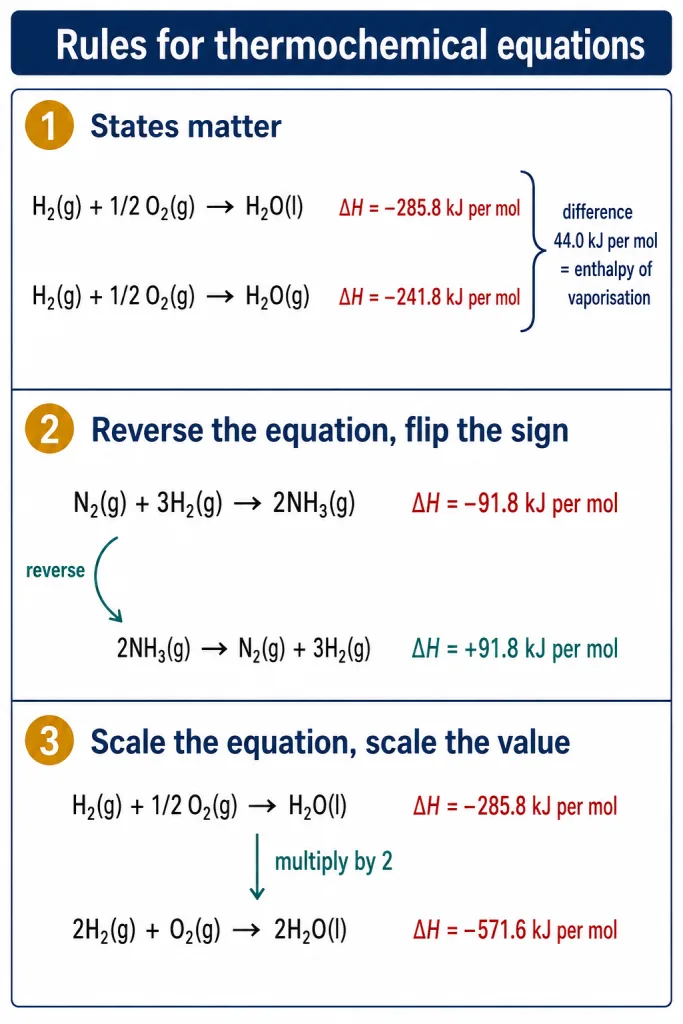
Rule 1: physical states must always be shown
Enthalpy depends on the state of aggregation, so ΔrH does too. Compare the two ways of writing the combustion of hydrogen:
H2(g)+21O2(g)→H2O(l);ΔrH=−285.8kJmol−1
H2(g)+21O2(g)→H2O(g);ΔrH=−241.8kJmol−1
The chemistry is identical; only the state of the product differs. The gap of 44.0kJmol−1 is exactly the enthalpy needed to vaporise one mole of water at 298K. Leaving off the (l) or (g) turns a precise statement into a vague one, and where allotropes exist the allotrope must be named too: C(graphite) and C(diamond) give different numbers.
Rule 2: reversing the equation reverses the sign
Running a reaction backwards takes the system from the old products to the old reactants. The enthalpy difference is the same size with the opposite sense.
N2(g)+3H2(g)→2NH3(g);ΔrH=−92.4kJmol−1
2NH3(g)→N2(g)+3H2(g);ΔrH=+92.4kJmol−1
What is released on the way out must be supplied on the way back, otherwise energy could be manufactured by cycling round and back.
Rule 3: multiplying the equation multiplies ΔrH
Multiply every coefficient by n and the enthalpy change is multiplied by n as well, fractions included.
H2(g)+21O2(g)→H2O(l);ΔrH=−285.8kJmol−1
2H2(g)+O2(g)→2H2O(l);ΔrH=−571.6kJmol−1
The coefficients in a thermochemical equation stand for moles, never molecules, which is why writing 21O2 is perfectly legal — half a mole of oxygen is an ordinary quantity.
Key Point: Reverse it, flip the sign. Scale it, scale the number. Add two of them, add their ΔrH values. These three moves are the whole toolkit for the calculations in this section.
[Board] A thermochemical equation loses marks for a missing state symbol even when the arithmetic is right. Write (s), (l), (g) or (aq) on every species, every time.
Standard States and the Standard Reaction Enthalpy
Enthalpy changes shift with pressure and temperature, so tabulated values have to be quoted under an agreed set of conditions. That agreed set is the standard state.
Key Point (Definition): The standard state of a substance at a specified temperature is its pure form at a pressure of 1bar. Data are usually tabulated at 298K.
The standard state of ethanol at 298K is pure liquid ethanol at 1bar. The standard state of iron at 500K is pure solid iron at 1bar. Temperature is not part of the definition — it must be stated separately — but pressure is fixed at 1bar and the substance must be pure.
Standard conditions are marked with a superscript circle on the symbol.
Key Point (Definition): The standard reaction enthalpy ΔrH∘ is the enthalpy change of a reaction in which all reactants and all products are in their standard states.
The reference state of an element
Formation data need one more agreement, because there is no absolute zero of enthalpy to measure from.
Key Point (Definition): The reference state of an element is its most stable state of aggregation at 298K and 1bar. By convention, an element in its reference state is assigned ΔfH∘=0.
The reference state of hydrogen is H2(g), of oxygen O2(g), of carbon C(graphite), of sulphur S(rhombic), of bromine Br2(l), of mercury Hg(l). Diamond, ozone and S(monoclinic) are elements but not reference states, and their formation enthalpies are not zero — ΔfH∘ for C(diamond) is +1.90kJmol−1.
Key Point (Definition): The standard enthalpy of formation ΔfH∘ is the enthalpy change when one mole of a compound is formed in its standard state from its elements in their reference states.
H2(g)+21O2(g)→H2O(l);ΔfH∘=−285.8kJmol−1
C(graphite,s)+2H2(g)→CH4(g);ΔfH∘=−74.8kJmol−1
2C(graphite,s)+3H2(g)+21O2(g)→C2H5OH(l);ΔfH∘=−277.7kJmol−1
Two conditions must hold together. Exactly one mole of the compound is produced, and the starting materials are elements in their reference states. Both of these fail the test:
CaO(s)+CO2(g)→CaCO3(s);ΔrH∘=−178.3kJmol−1
H2(g)+Br2(l)→2HBr(g);ΔrH∘=−72.8kJmol−1
The first builds calcium carbonate from two compounds, not from calcium, carbon and oxygen. The second starts from elements correctly but makes two moles of product; dividing every coefficient by two repairs it:
21H2(g)+21Br2(l)→HBr(g);ΔfH∘=−36.4kJmol−1
ΔfH∘ is a special case of ΔrH∘ — the case where the reaction happens to be a formation reaction.
Absolute enthalpies cannot be measured, but the definition of ΔfH∘ supplies a fixed floor: the elements in their reference states, all at zero. Every compound is then quoted by how far it sits above or below that floor.
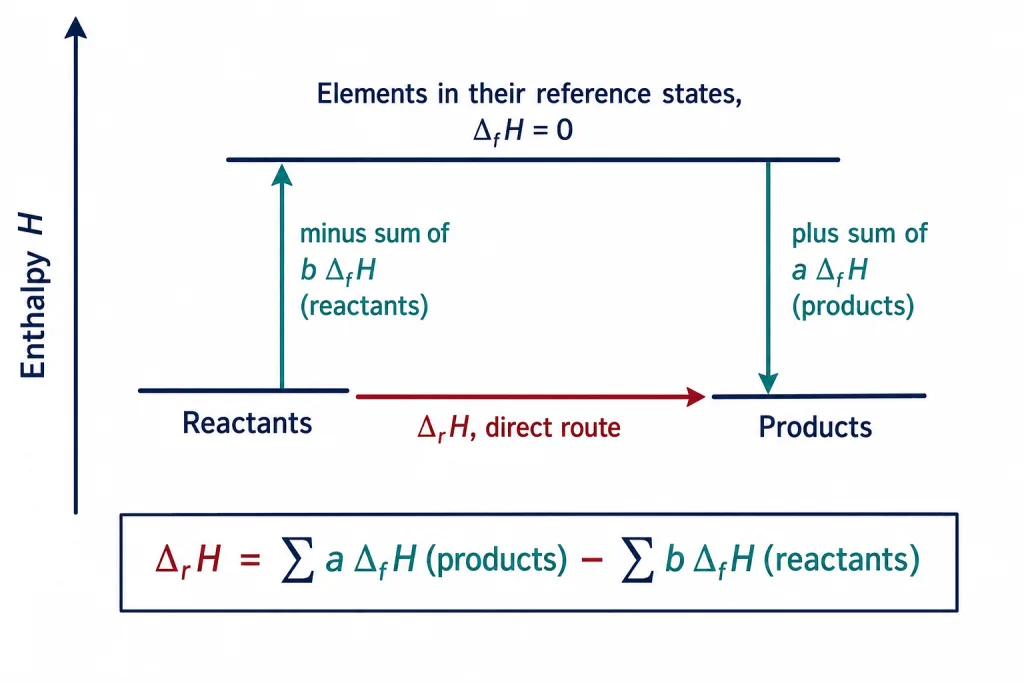
Take any reaction from reactants to products by a detour: pull the reactants apart into their elements, then assemble the products from those elements. Pulling the reactants apart costs the negative of their formation enthalpies; building the products releases theirs. The detour and the direct route must give the same total.
Key Point: ΔrH∘=∑iaiΔfH∘(products)−∑ibiΔfH∘(reactants), with ai and bi the stoichiometric coefficients in the balanced equation.
Worked through: decomposing limestone
CaCO3(s)→CaO(s)+CO2(g)
Every coefficient is 1, so
ΔrH∘=[ΔfH∘(CaO,s)+ΔfH∘(CO2,g)]−ΔfH∘(CaCO3,s)
=[(−635.1)+(−393.5)]−(−1206.9)=−1028.6+1206.9=+178.3kJmol−1
The positive sign says the kiln must be heated, which matches how lime is actually made.
Worked through: reducing iron(III) oxide
Fe2O3(s)+3H2(g)→2Fe(s)+3H2O(l)
Iron and hydrogen are elements in their reference states, so both contribute zero:
ΔrH∘=3(−285.8)−(−824.2)=−857.4+824.2=−33.2kJmol−1
Some values worth carrying
| Substance |
ΔfH∘ / kJmol−1 |
Substance |
ΔfH∘ / kJmol−1 |
| CO2(g) |
−393.5 |
CaCO3(s) |
−1206.9 |
| CO(g) |
−110.5 |
CaO(s) |
−635.1 |
| H2O(l) |
−285.8 |
Fe2O3(s) |
−824.2 |
| H2O(g) |
−241.8 |
Al2O3(s) |
−1675.7 |
| CH4(g) |
−74.8 |
SO2(g) |
−296.8 |
| C2H6(g) |
−84.7 |
NO(g) |
+90.3 |
| C2H2(g) |
+226.8 |
HCl(g) |
−92.3 |
| C2H5OH(l) |
−277.7 |
C(graphite), O2(g), H2(g) |
0 |
A negative ΔfH∘ marks a compound that lies below its elements in enthalpy, which is one reason such compounds are common and stable. A positive value, as for ethyne, marks a compound that stores energy relative to its elements.
[NEET] The commonest slip in this calculation is dropping the coefficient. In 3H2O(l) the formation enthalpy is used three times. The second commonest is forgetting that the elements are zero and hunting for a value that is not in the table.
Hess's Law of Constant Heat Summation
Some reaction enthalpies cannot be measured directly. Burning graphite in a limited supply of oxygen is meant to give carbon monoxide, but some carbon dioxide always forms alongside it, so the heat measured belongs to a mixture and not to the clean reaction
C(graphite,s)+21O2(g)→CO(g);ΔrH∘=?
Enthalpy is a state function, and its change depends only on the initial and final states. The route taken between them is irrelevant. That single fact rescues the calculation.
Key Point (Hess's Law): If a reaction takes place in several steps, its standard reaction enthalpy is the sum of the standard enthalpies of the intermediate steps into which the overall reaction may be divided, at the same temperature.
For a change from A to B carried out directly with enthalpy change ΔrH, or through intermediates with steps ΔrH1, ΔrH2, ΔrH3:
ΔrH=ΔrH1+ΔrH2+ΔrH3+⋯
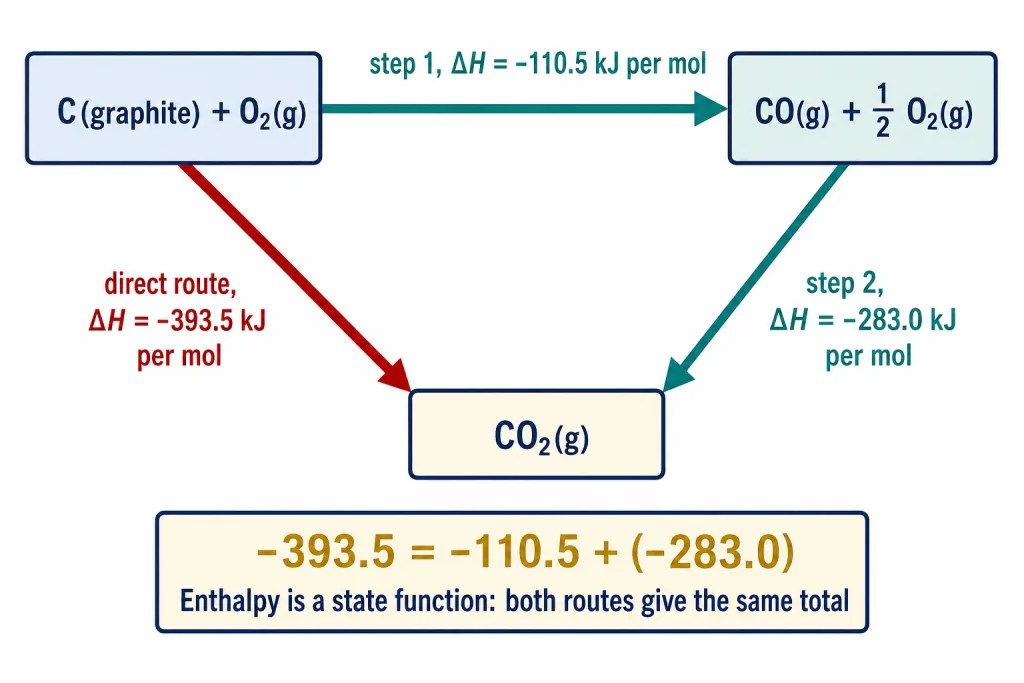
The carbon monoxide problem solved
Two reactions that can be measured cleanly:
C(graphite,s)+O2(g)→CO2(g);ΔrH∘=−393.5kJmol−1(i)
CO(g)+21O2(g)→CO2(g);ΔrH∘=−283.0kJmol−1(ii)
The target has CO on the right, while equation (ii) has it on the left. Reversing (ii) moves it across and flips the sign:
CO2(g)→CO(g)+21O2(g);ΔrH∘=+283.0kJmol−1(iii)
Adding (i) and (iii), the CO2 appearing on the right of one and the left of the other cancels, and one O2 on the left is partly cancelled by the 21O2 on the right:
C(graphite,s)+21O2(g)→CO(g)
ΔrH∘=(−393.5)+(+283.0)=−110.5kJmol−1
That number appears in every table as ΔfH∘(CO,g), and it was never measured directly.
Why the law cannot fail
Suppose the two routes from graphite to carbon dioxide gave different totals. Go up by the larger route and come back down by the smaller, and the cycle would return the system to exactly its starting state while leaving a surplus of energy behind. Energy would have been created out of nothing. Hess's law is the first law of thermodynamics wearing a chemical uniform.
Key Point: Hess's law holds because H is a state function. Any quantity that is a state function obeys the same summation rule, which is why the identical arithmetic works later for entropy and Gibbs energy.
Assembling a Target Equation from Given Equations
Most Hess's law questions hand you two or three thermochemical equations and one target. The work is bookkeeping, and it goes faster with a fixed routine.
Step 1. Write the target equation and mark which species must end up on the left and which on the right.
Step 2. Take each given equation in turn. Find a species in it that appears in the target and only there. Reverse the equation if that species is on the wrong side; multiply it if the coefficient is wrong.
Step 3. Add the adjusted equations. Everything not in the target must cancel between the two sides.
Step 4. Add the adjusted ΔrH values, reversing signs where you reversed an equation and scaling where you scaled one.
A three-equation build
Find ΔrH∘ for 2C(graphite,s)+H2(g)→C2H2(g), given
C2H2(g)+25O2(g)→2CO2(g)+H2O(l);ΔrH∘=−1299.6kJmol−1(i)
C(graphite,s)+O2(g)→CO2(g);ΔrH∘=−393.5kJmol−1(ii)
H2(g)+21O2(g)→H2O(l);ΔrH∘=−285.8kJmol−1(iii)
Ethyne is a product in the target but a reactant in (i), so (i) is reversed. Graphite is needed as 2 moles on the left, so (ii) is doubled. Hydrogen is needed as 1 mole on the left, so (iii) is used unchanged.
2×(ii):2C(graphite,s)+2O2(g)→2CO2(g);ΔH=2(−393.5)=−787.0
(iii):H2(g)+21O2(g)→H2O(l);ΔH=−285.8
reverse (i):2CO2(g)+H2O(l)→C2H2(g)+25O2(g);ΔH=+1299.6
Adding the three: the 2CO2 cancels, the H2O cancels, and the oxygen tallies as 2+21−25=0. What survives is the target.
ΔrH∘=−787.0−285.8+1299.6=+226.8kJmol−1
Ethyne lies well above its elements in enthalpy, which is why it burns so fiercely in an oxyacetylene torch.
That build is exactly the formation formula in disguise. Combustion equations are formation equations for CO2 and H2O turned round, so whenever every given equation is a combustion, the shortcut is
ΔrH∘=∑biΔcH∘(reactants)−∑aiΔcH∘(products)
with the reactants and products the other way round compared with the formation version, because combustion enthalpies point down from a substance while formation enthalpies point up to it.
Key Point: Two checks catch nearly every error. Confirm that the adjusted equations really add to the target with everything else cancelling, and confirm that the sign of the answer matches the chemistry you expect.
[JEE Main] When the given data are combustion enthalpies, the two routines conflict if you mix them. Use the cancellation method or the combustion formula, not half of each.
Solved Examples
Question 1: Combustion enthalpy of methane from formation data
Calculate ΔrH∘ for CH4(g)+2O2(g)→CO2(g)+2H2O(l). Take ΔfH∘ values of −74.8, −393.5 and −285.8kJmol−1 for CH4(g), CO2(g) and H2O(l).
Answer:
I use products minus reactants, each with its coefficient. Oxygen is an element in its reference state, so it contributes zero.
ΔrH∘=[(−393.5)+2(−285.8)]−[(−74.8)+2(0)]
=(−393.5−571.6)+74.8=−965.1+74.8=−890.3kJmol−1
Ans: ΔrH∘=−890.3kJmol−1
Watch out: The 2 in front of H2O multiplies its formation enthalpy. Using −285.8 once gives −604.5, which is a long way out.
Question 2: The same reaction with water as vapour
Repeat the previous calculation with the water produced as H2O(g), for which ΔfH∘=−241.8kJmol−1, and account for the difference.
Answer:
ΔrH∘=[(−393.5)+2(−241.8)]−(−74.8)=−877.1+74.8=−802.3kJmol−1
The value is less negative than before by 890.3−802.3=88.0kJmol−1.
Two moles of water are left as vapour instead of liquid. Vaporising a mole of water at 298K costs 44.0kJ, so two moles cost 88.0kJ — energy that stays locked in the vapour instead of being released.
Ans: ΔrH∘=−802.3kJmol−1; the 88.0kJmol−1 gap is 2×ΔvapH of water
Watch out: This is the reason state symbols are compulsory. A combustion value quoted without them could be either number.
Question 3: Reversing and scaling a thermochemical equation
For N2(g)+3H2(g)→2NH3(g), ΔrH∘=−92.4kJmol−1. Write ΔrH∘ for (a) the decomposition of 2 moles of ammonia into its elements, and (b) the formation of one mole of ammonia.
Answer:
(a) Decomposition is the given equation run backwards, so the magnitude is unchanged and the sign flips.
2NH3(g)→N2(g)+3H2(g);ΔrH∘=+92.4kJmol−1
(b) One mole of ammonia means halving every coefficient, so I halve the enthalpy change as well.
21N2(g)+23H2(g)→NH3(g);ΔrH∘=21(−92.4)=−46.2kJmol−1
Since this makes exactly one mole of the compound from elements in their reference states, it is also ΔfH∘(NH3,g).
Ans: (a) +92.4kJmol−1; (b) −46.2kJmol−1
Question 4: Which equation defines a formation enthalpy
Three equations are given below. Identify the one whose ΔrH∘ is a standard enthalpy of formation, and repair the others where possible.
(a) CaO(s)+CO2(g)→CaCO3(s)
(b) H2(g)+Br2(l)→2HBr(g); ΔrH∘=−72.8kJmol−1
(c) C(graphite,s)+2H2(g)→CH4(g)
Answer:
A formation equation needs two things at once: exactly one mole of the compound as the only product, and elements in their reference states as the only reactants.
(a) fails on the reactants. Calcium carbonate is being built from two compounds, so this is an ordinary ΔrH∘. It cannot be repaired by rescaling; the reactants would have to be Ca(s), C(graphite) and O2(g).
(b) has the right reactants but makes two moles of product. Dividing every coefficient by 2 fixes it, and the enthalpy change halves:
21H2(g)+21Br2(l)→HBr(g);ΔfH∘=−36.4kJmol−1
(c) passes both tests. Graphite and H2(g) are reference states and one mole of methane is formed.
Ans: (c) is a formation equation; (b) becomes one on halving, giving ΔfH∘(HBr,g)=−36.4kJmol−1; (a) cannot be rewritten as one
Watch out: Br2 must be written as a liquid. Bromine vapour is not the reference state, and ΔfH∘ measured from Br2(g) would be smaller by the enthalpy of vaporisation.
Question 5: The thermite reaction
Calculate ΔrH∘ for 2Al(s)+Fe2O3(s)→Al2O3(s)+2Fe(s), given ΔfH∘(Al2O3,s)=−1675.7 and ΔfH∘(Fe2O3,s)=−824.2kJmol−1.
Answer:
Aluminium and iron are elements in their reference states, so only the two oxides carry a value.
ΔrH∘=[(−1675.7)+2(0)]−[2(0)+(−824.2)]
=−1675.7+824.2=−851.5kJmol−1
The strongly negative value is why the thermite mixture melts the iron it produces.
Ans: ΔrH∘=−851.5kJmol−1
Question 6: Formation enthalpy of benzene from its combustion
One mole of benzene is burned completely at 298K to CO2(g) and H2O(l), liberating 3267.6kJ. Find ΔfH∘ of benzene, given ΔfH∘ of CO2(g) and H2O(l) as −393.5 and −285.8kJmol−1.
Answer:
The combustion equation, balanced for one mole of benzene, is
C6H6(l)+215O2(g)→6CO2(g)+3H2O(l);ΔcH∘=−3267.6kJmol−1
Applying the formation formula to this equation, with x standing for ΔfH∘(C6H6,l):
−3267.6=[6(−393.5)+3(−285.8)]−x
−3267.6=(−2361.0−857.4)−x=−3218.4−x
x=−3218.4+3267.6=+49.2kJmol−1
Ans: ΔfH∘(C6H6,l)=+49.2kJmol−1, against a tabulated +49.0kJmol−1 — the small gap is rounding in the formation data used
Watch out: The unknown is a reactant, so it enters with a minus sign. Writing −3267.6=−3218.4+x delivers −49.2, the right size with the wrong sign.
Question 7: Carbon monoxide by Hess's law
Find ΔrH∘ for C(graphite,s)+21O2(g)→CO(g) from
(i) C(graphite,s)+O2(g)→CO2(g); ΔrH∘=−393.5kJmol−1
(ii) CO(g)+21O2(g)→CO2(g); ΔrH∘=−283.0kJmol−1
Answer:
The target needs CO on the right, and equation (ii) has it on the left. I reverse (ii) and flip its sign.
CO2(g)→CO(g)+21O2(g);ΔrH∘=+283.0kJmol−1
Adding this to (i): CO2 cancels completely, and on the oxygen side 1 mole on the left against 21 mole on the right leaves 21 mole on the left. The sum is the target equation.
ΔrH∘=(−393.5)+(+283.0)=−110.5kJmol−1
Ans: ΔrH∘=−110.5kJmol−1, which is ΔfH∘(CO,g)
Watch out: Subtracting the two given values as −393.5−(−283.0) happens to give the same −110.5 here only because the reversal and the subtraction are the same operation. Doing it by inspection stops working the moment scaling is involved.
Question 8: Methane formation from combustion data
Calculate ΔfH∘ of methane from
(i) C(graphite,s)+O2(g)→CO2(g); ΔrH∘=−393.5
(ii) H2(g)+21O2(g)→H2O(l); ΔrH∘=−285.8
(iii) CH4(g)+2O2(g)→CO2(g)+2H2O(l); ΔrH∘=−890.3
All values in kJmol−1.
Answer:
The target is C(graphite,s)+2H2(g)→CH4(g).
Graphite is on the left in (i) and in the target, so (i) is used as it is. Hydrogen is needed as 2 moles, so (ii) is doubled. Methane must end on the right, so (iii) is reversed.
(i):ΔH=−393.5
2×(ii):2H2(g)+O2(g)→2H2O(l);ΔH=−571.6
reverse (iii):CO2(g)+2H2O(l)→CH4(g)+2O2(g);ΔH=+890.3
Adding: CO2 cancels, 2H2O cancels, and oxygen tallies as 1+1−2=0. The target survives.
ΔfH∘=−393.5−571.6+890.3=−74.8kJmol−1
Ans: ΔfH∘(CH4,g)=−74.8kJmol−1
Watch out: Doubling (ii) must double its enthalpy too. Carrying −285.8 forward while writing 2H2O in the equation gives +211.0, an answer with the wrong sign entirely.
Question 9: A cycle with three steps
For a change A→B carried out through the intermediates C and D, the measured step enthalpies are A→C, +56kJ; C→D, −118kJ; D→B, +21kJ. Find ΔH for the direct change A→B and for B→A.
Answer:
The three steps chain head to tail from A to B, so by Hess's law I add them.
ΔH(A→B)=56−118+21=−41kJ
The reverse change has the same magnitude and the opposite sign.
ΔH(B→A)=+41kJ
Ans: −41kJ forward, +41kJ reverse
Question 10: Ethyne from its elements
Find ΔrH∘ for 2C(graphite,s)+H2(g)→C2H2(g) given the combustion enthalpies ΔcH∘(C2H2,g)=−1299.6, ΔcH∘(C,graphite)=−393.5 and ΔcH∘(H2,g)=−285.8kJmol−1, with water produced as a liquid.
Answer:
Burning graphite gives CO2 and burning hydrogen gives H2O(l), so those two combustion enthalpies are also formation enthalpies. The ethyne equation has to be reversed to put ethyne on the right.
2×(graphite burning):ΔH=2(−393.5)=−787.0
1×(hydrogen burning):ΔH=−285.8
reverse (ethyne burning):2CO2(g)+H2O(l)→C2H2(g)+25O2(g);ΔH=+1299.6
Adding the three, 2CO2 and H2O cancel and the oxygen balances as 2+21−25=0.
ΔrH∘=−787.0−285.8+1299.6=+226.8kJmol−1
Ans: ΔrH∘=+226.8kJmol−1
Watch out: A positive answer here is correct, not a slip. Ethyne is an endothermic compound sitting above graphite and hydrogen in enthalpy.
Question 11: Formation enthalpy of ethane
The standard enthalpy of combustion of ethane is −1559.7kJmol−1, with water formed as a liquid. Using ΔfH∘(CO2,g)=−393.5 and ΔfH∘(H2O,l)=−285.8kJmol−1, find ΔfH∘ of ethane.
Answer:
The balanced combustion of one mole of ethane is
C2H6(g)+27O2(g)→2CO2(g)+3H2O(l)
Applying the formation formula with x=ΔfH∘(C2H6,g):
−1559.7=[2(−393.5)+3(−285.8)]−x=(−787.0−857.4)−x=−1644.4−x
x=−1644.4+1559.7=−84.7kJmol−1
Ans: ΔfH∘(C2H6,g)=−84.7kJmol−1
Watch out: The 27 in front of oxygen tempts people to clear the fraction by doubling the equation. Doubling it also doubles the combustion enthalpy, and forgetting that gives half the right answer for x.
Question 12: How much heat from a given mass
How much heat is released when 11.5g of ethanol is burned completely at 298K and 1bar? For C2H5OH(l)+3O2(g)→2CO2(g)+3H2O(l), ΔrH∘=−1367kJmol−1. Molar mass of ethanol =46.0gmol−1.
Answer:
The equation is written for one mole of ethanol, so the tabulated value applies to one mole.
n=46.011.5=0.250mol
qp=n×ΔrH∘=0.250×(−1367)=−341.8kJ
The negative sign means the system loses this energy, so 341.8kJ of heat is given out to the surroundings.
Ans: 341.8kJ released, and ΔH=−341.8kJ for the system
Question 13: From ΔrH∘ to ΔrU∘
For CH4(g)+2O2(g)→CO2(g)+2H2O(l), ΔrH∘=−890.3kJmol−1 at 298K. Find ΔrU∘. Take R=8.314JK−1mol−1.
Answer:
I count only gaseous moles. On the right there is 1 mole of gas, since the water is liquid. On the left there are 1+2=3 moles.
Δng=1−3=−2
From ΔH=ΔU+ΔngRT:
ΔrU∘=ΔrH∘−ΔngRT=−890.3−(−2)(8.314×10⁻³)(298)
=−890.3+4.955=−885.3kJmol−1
Ans: ΔrU∘=−885.3kJmol−1
Watch out: The two moles of liquid water are not counted in Δng. Counting them would give Δng=0 and hide the correction altogether.
Question 14: Building sulphur trioxide in two steps
Calculate ΔfH∘ of SO3(g) from
(i) S(rhombic,s)+O2(g)→SO2(g); ΔrH∘=−296.8kJmol−1
(ii) 2SO2(g)+O2(g)→2SO3(g); ΔrH∘=−198.4kJmol−1
Answer:
The target is S(rhombic,s)+23O2(g)→SO3(g), making exactly one mole of SO3.
Equation (i) already gives one mole of SO2 from sulphur, so I keep it. Equation (ii) makes two moles of SO3, so I halve it.
21×(ii):SO2(g)+21O2(g)→SO3(g);ΔH=21(−198.4)=−99.2
Adding this to (i), the SO2 cancels and the oxygen adds to 23 moles on the left.
ΔfH∘=−296.8+(−99.2)=−396.0kJmol−1
Ans: ΔfH∘(SO3,g)=−396.0kJmol−1
Watch out: Adding −296.8 and −198.4 without halving gives −495.2, which belongs to S(rhombic,s)+SO2(g)+2O2(g)→2SO3(g) — two moles of SO3, and a mole of SO2 consumed that the target never mentions.
