
Card 1 — Thermodynamic Terms
The vocabulary the whole chapter runs on. Everything below is definition-level recall.
| Term | Meaning |
|---|---|
| System | The part of the universe under observation |
| Surroundings | Everything else that can interact with the system |
| Boundary | The real or imaginary wall separating the two |
| Universe | System surroundings |
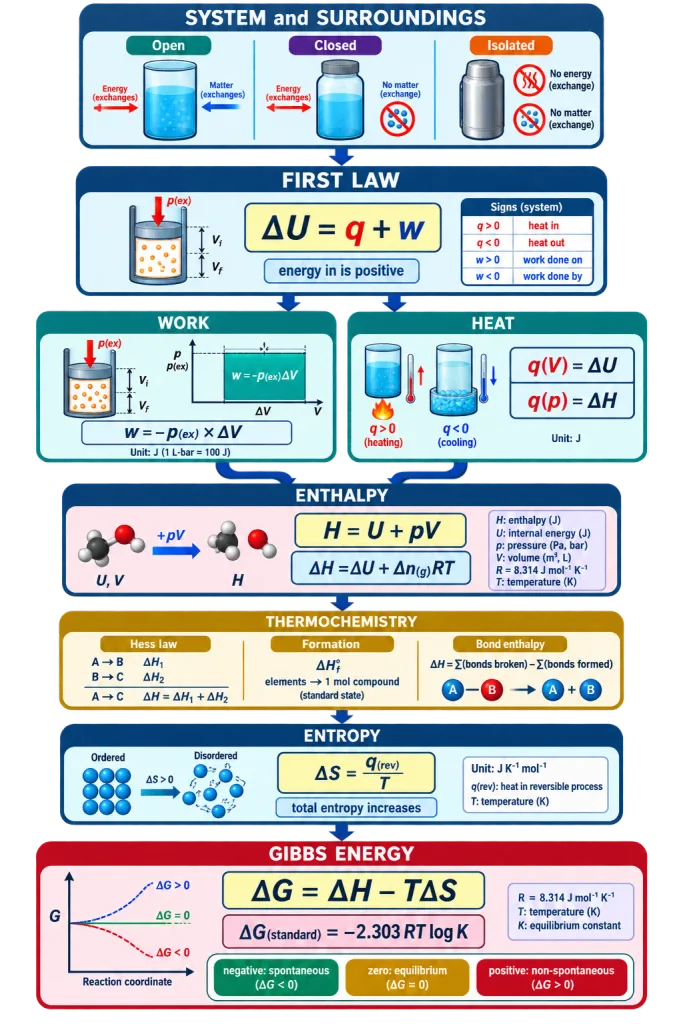
Types of system
| Type | Matter exchanged | Energy exchanged | Standard example |
|---|---|---|---|
| Open | yes | yes | Reactants in an open beaker |
| Closed | no | yes | Reactants in a sealed copper or steel vessel |
| Isolated | no | no | Hot tea in a stoppered thermos flask |
Key Point: Every system exchanging matter also exchanges energy, so there is no fourth type. A sealed but conducting vessel is closed; a sealed and insulated vessel is isolated.
Walls
| Wall | Heat passes | Consequence |
|---|---|---|
| Adiabatic | no | , so |
| Diathermic | yes | Thermal equilibrium with surroundings; |
State of a system and state variables
The state of a system is fixed by its state variables: , , and . For a fixed amount of an ideal gas, any two of , , fix the third through . Thermodynamics applies only to systems at equilibrium or moving between equilibrium states.
State functions against path functions
Key Point (Definition): A state function depends only on the present state of the system, not on how the system reached it. Its change is (final initial). A path function depends on the route taken and has no "change" of its own.
| State functions | Path functions |
|---|---|
| , , , , , , , , density, , | (heat), (work) |
- Written , , , — never or .
- and are individually path-dependent, yet the sum is not: is a state function. That is the content of the first law.
- Over any complete cycle, every state function returns to its starting value: for a cyclic process, while and need not be zero.
Extensive against intensive
Key Point (Definition): An extensive property depends on the amount of matter present. An intensive property does not; it is the same for a part of the system as for the whole.
| Extensive | Intensive |
|---|---|
| mass, volume, , , , , , (heat capacity), total charge | temperature, pressure, density, viscosity, refractive index, molar mass, molarity, specific heat , molar heat capacity , per mole, surface tension |
Test: halve the system. An extensive property halves; an intensive one does not change. Any extensive property divided by amount of substance becomes intensive — heat capacity is extensive, molar heat capacity is intensive.
Types of process
| Process | Condition held fixed | Immediate consequence |
|---|---|---|
| Isothermal | constant | and for an ideal gas |
| Isobaric | constant | |
| Isochoric | constant | , |
| Adiabatic | no heat exchange | , |
| Cyclic | returns to initial state | , so |
[NEET] Statement-type questions almost always test one of three things: which properties are intensive, which quantities are state functions, and which system type a described container is. All three are in the tables above.
Card 2 — Internal Energy, Work, Heat and the First Law
Key Point (Definition): Internal energy is the total energy stored in a system — translational, rotational, vibrational, electronic, nuclear and the energy of interaction between particles. It is a state function and an extensive property. Only can be measured, never the absolute value of .
Two and only two ways exist to change in a closed system: transfer of work and transfer of heat.
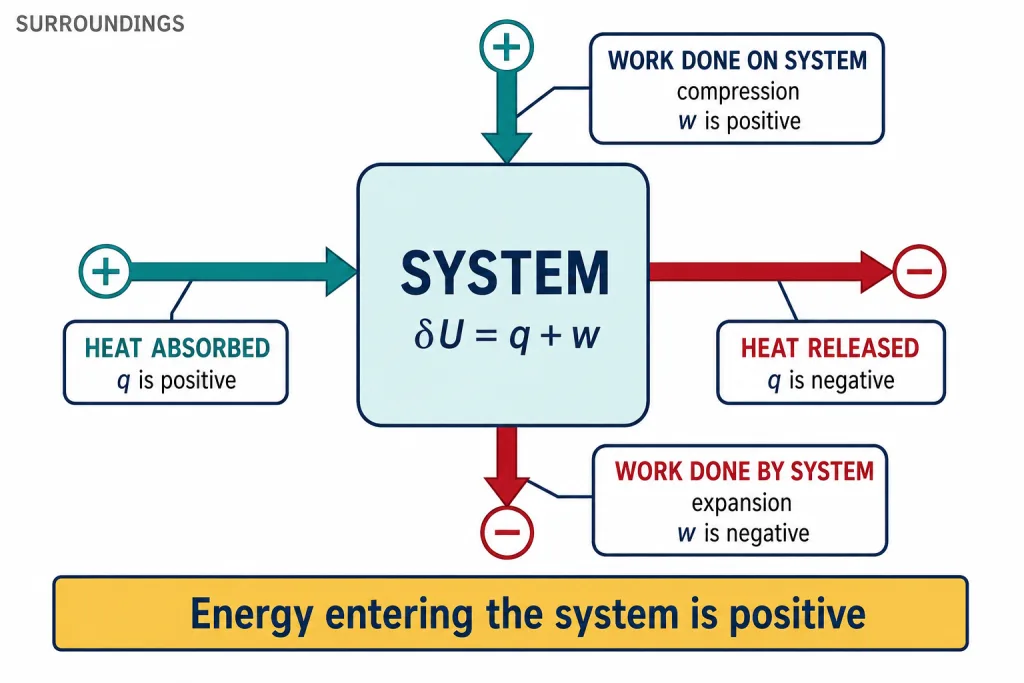
The IUPAC sign convention
| Quantity | Positive when | Negative when |
|---|---|---|
| heat is absorbed by the system (endothermic) | heat is released by the system (exothermic) | |
| work is done on the system (compression) | work is done by the system (expansion) | |
| the internal energy of the system rises | the internal energy of the system falls |
Key Point: Energy entering the system is positive; energy leaving the system is negative. That one sentence generates the whole table. Some physics texts define with the opposite sign and write ; every equation in this chapter uses the IUPAC form.
The first law
Key Point: The energy of an isolated system is constant. Energy can be converted from one form to another but can neither be created nor destroyed.
for a chemical change is , and for a general change .
Every special case in one table
| Condition | What it forces | First law becomes |
|---|---|---|
| Isolated system | and | |
| Adiabatic | ||
| Constant volume (rigid vessel) | ||
| Constant pressure | , so | |
| Cyclic process | ||
| Isothermal, ideal gas | ||
| Free expansion into vacuum | , insulated | , , |
Sign readings worth memorising
| Observation | Effect on | ||
|---|---|---|---|
| Gas expands against the atmosphere | — | negative | lowers |
| Gas is compressed by a piston | — | positive | raises |
| Exothermic reaction | negative | — | lowers |
| Endothermic reaction | positive | — | raises |
| Adiabatic compression | positive | rises, so rises | |
| Adiabatic expansion | negative | falls, so falls |
Adiabatic compression heats a gas and adiabatic expansion cools it, with no heat crossing the boundary at all. Both follow from .
Units
[JEE/NEET] When a question reports "work done by the gas ", the value to substitute is . Reading the direction from the wording before writing the sign is the single highest-yield habit in this chapter.
Card 3 — Work of Expansion
All of the work in this chapter is pressure-volume work. The pressure in every expression is the external pressure, not the pressure of the gas inside.
| Process | Work expression | - area |
|---|---|---|
| Free expansion into vacuum | (since ) | no area at all |
| Single step against constant | one low rectangle | |
| Several steps of falling | a staircase, larger area | |
| Reversible isothermal, ideal gas | full area under the smooth isotherm | |
| Constant volume (rigid vessel) | a vertical line, zero area | |
| General variable pressure | area under the actual curve |
Reversible isothermal expansion of an ideal gas
Boyle's law at fixed gives , so either ratio may be used. Since for an isothermal ideal gas,
Key Point: A reversible process runs through a continuous sequence of equilibrium states, driven by an infinitesimal pressure difference. It delivers the maximum work an expansion between two given states can give, and requires the minimum work for a compression between the same two states.
Signs, checked
| Change | Sign of | Meaning | |
|---|---|---|---|
| Expansion | positive | the system does work on the surroundings, losing energy | |
| Compression | negative | the surroundings do work on the system, adding energy | |
| No volume change | zero | nothing to push |
Free expansion
into an evacuated space, so whatever the volume change. If the container is also insulated, and , and for an ideal gas the temperature does not change either.
Key Point: "Expands into vacuum" is an instruction to write before reading any numbers. The volumes quoted in such a question do not enter the answer.
Unit conversion
Pressure in atm times volume in litres gives L atm; multiply by to reach joules. A work value of a few L atm should land in the hundreds of joules.
Reading a - diagram
- The magnitude of the work is the area under the curve between and .
- Moving rightwards (expansion) makes negative; leftwards (compression) makes positive.
- A closed cycle traced clockwise gives ; anticlockwise gives . For any cycle , so .
[JEE Main] Choose to match the units in the options: gives joules, gives L atm. is always in kelvin.
Card 4 — Enthalpy
Most reactions are run in open vessels at atmospheric pressure, where the system may change volume and do work. Enthalpy is the state function built to handle that case.
is a state function because , and all are, and it is extensive. Absolute cannot be measured; only can.
Key Point: is the heat exchanged at constant pressure and the heat exchanged at constant volume. Both are state functions; the heats they equal are path functions that happen to be fixed once the path condition is stated.
| Reaction type | Sign of | Heat | Surroundings |
|---|---|---|---|
| Exothermic | released by the system | get warmer | |
| Endothermic | absorbed by the system | get cooler |
, so a negative value means the products lie lower in enthalpy than the reactants.
Relating the two
For a reaction involving gases treated as ideal, , giving
Key Point (Definition): , counted from the balanced equation. Solids, liquids and species in solution are not counted.
At , , so each unit of shifts from by about .
Worked values
| Reaction | Relation | |
|---|---|---|
| water is liquid, not counted | ||
| graphite not counted | ||
| fractions are allowed | ||
| large negative correction | ||
| phase changes have too | ||
When the two are equal
exactly when . Two situations produce it:
- Equal moles of gas on both sides, as in .
- No gases at all — reactions entirely among solids, liquids or solutions, where the volume change is negligible.
Note what does not qualify: a sealed rigid vessel. Fixing the volume makes equal , but still differs from by , because at constant volume , which for a reaction quoted at a fixed temperature is the same as always.
Key Point: The two differ by at most a few kilojoules per mole while reaction enthalpies run to hundreds. The correction is small but it is not optional, and its sign follows the sign of .
[Board] Convert to kilojoules before adding it to a quoted in . Mixing into a kilojoule equation is the commonest arithmetic slip here.
Card 5 — Heat Capacity and Calorimetry
| Symbol | Name | Definition | Unit |
|---|---|---|---|
| Heat capacity | heat needed to raise the temperature of the whole sample by | ||
| Specific heat capacity | heat needed per gram per kelvin | ||
| Molar heat capacity | heat needed per mole per kelvin |
is extensive; and are intensive. For water, and .
Two heat capacities, two conditions
| At constant volume | At constant pressure |
|---|---|
| , so all the heat raises | some heat is spent doing expansion work |
Heating at constant pressure requires more heat for the same temperature rise, because part of the energy leaves as work pushing the surroundings back. So always.
Key Point: For one mole of an ideal gas, . The proof is two lines: , so for one mole , and dividing by gives .
| Gas type | |||
|---|---|---|---|
| Monatomic | |||
| Diatomic |
(Values in .)
Calorimetry: the instrument decides the quantity
| Bomb calorimeter | Coffee-cup calorimeter | |
|---|---|---|
| Vessel | thick sealed steel bomb in a water bath | insulated polystyrene cup, open to air |
| Condition | constant volume | constant pressure |
| Work done | expansion work possible | |
| Measures | directly | directly |
| Heat counted as | ||
| Typical use | enthalpies of combustion | neutralisation, dissolution, dilution |
is the calorimeter constant, the combined heat capacity of bomb, water and fittings, in . Working rule for both instruments: heat gained by the calorimeter equals heat lost by the reaction, so the reaction quantity carries the opposite sign to the temperature rise.
with the moles of the limiting substance, so that the answer comes out per mole.
Converting a bomb result
A bomb hands you ; tables quote . The correction is a couple of kilojoules per mole of gas, and its sign follows .
[NEET] Match instrument to quantity before starting any arithmetic. "Bomb calorimeter" plus "find " means a correction is coming; "polystyrene cup" plus "find " means none is needed.
Card 6 — Reaction Enthalpy, Standard States and Hess's Law
Key Point (Definition): The reaction enthalpy is the enthalpy change for the reaction exactly as written, with the stoichiometric coefficients read as moles. Its unit is , meaning per mole of reaction as the equation stands.
Standard state
Key Point (Definition): The standard state of a substance at a specified temperature is its pure form at . The superscript circle marks it: . Data are almost always quoted at , but the standard state fixes pressure, not temperature.
At and water is a liquid, so standard equations end in .
Thermochemical equation rules
| Operation on the equation | Effect on |
|---|---|
| Reverse the equation | reverse the sign, same magnitude |
| Multiply every coefficient by | multiply by |
| Divide every coefficient by | divide by |
| Add two equations | add the two values |
| Change the physical state of any species | changes; the equation is a different one |
Physical state labels are part of the equation:
The gap of is exactly the enthalpy of vaporisation of water at .
Hess's law
Key Point: Hess's law of constant heat summation — the enthalpy change of a reaction is the same whether it takes place in one step or in several, provided the initial and final states are the same. It is a direct consequence of being a state function.
Practical form: if a target equation can be built by reversing, scaling and adding known equations, then combining their values in exactly the same way gives the target .
A worked chain in three lines. Given
Reverse the second and add: .
The formation-enthalpy formula
with and the coefficients in the balanced equation.
Key Point: of any element in its reference state is exactly zero: , , , , , , , . Non-reference forms are not zero: and .
Formation data worth carrying in
| Substance | / kJ mol | Substance | / kJ mol |
|---|---|---|---|
Sample use: for ,
[Board] Write "products minus reactants" at the top of the page before substituting. Reversing that order is the single commonest source of a sign error in a Hess's law question.
Card 7 — The Named Enthalpies
Every enthalpy the chapter names, with its symbol, its definition, its invariable sign and a value to anchor it.
| Enthalpy | Symbol | Defined as the enthalpy change when | Sign | Anchor value |
|---|---|---|---|---|
| Combustion | one mole of a substance burns completely in excess oxygen | always | : | |
| Formation | one mole of a compound forms from its elements in their reference states | either | : | |
| Fusion | one mole of solid melts at its melting point | always | ice: | |
| Vaporisation | one mole of liquid becomes vapour at its boiling point | always | water at : | |
| Sublimation | one mole of solid becomes vapour directly | always | at : | |
| Atomisation | one mole of a substance is broken into free gaseous atoms | always | : | |
| Bond dissociation | one mole of a named bond breaks in the gas phase | always | : | |
| Ionization | one mole of gaseous atoms loses one electron each | always | : | |
| Electron gain | one mole of gaseous atoms gains one electron each | usually | : | |
| Solution | one mole of solute dissolves in a large excess of solvent | either | : about | |
| Dilution | a solution is diluted further, per mole of solute | either | small | |
| Lattice | one mole of an ionic solid separates into gaseous ions | always | : | |
| Hydration | one mole of gaseous ions is hydrated by water | always | large negative |
Phase-transition relation
For every substance : melting only loosens the arrangement, vaporising removes the attractions entirely. Reverse changes — freezing, condensation, deposition — carry the same magnitude with the opposite sign.
Bond dissociation against mean bond enthalpy
| Bond dissociation enthalpy | Mean bond enthalpy |
|---|---|
| A specific bond in a specific molecule | The average over all bonds of that type in a molecule, or across many molecules |
| : | in water: |
| : | Tabulated values are means |
| Exact, but only for that one step | Approximate, so bond-enthalpy estimates of are approximate |
For a diatomic molecule the two are the same number, and both equal the enthalpy of atomisation.
Estimating a reaction enthalpy from bond enthalpies
Key Point: This is the one formula in the chapter that reads reactants minus products, because bond breaking absorbs energy and bond forming releases it. It is valid only when every species is gaseous.
Useful mean values in : , , , , , , , , .
Enthalpy of solution and the Born-Haber cycle
The lattice enthalpy is positive and the hydration enthalpy negative; whichever is larger in magnitude decides whether dissolving warms or cools the solution. A salt whose lattice enthalpy far exceeds its hydration enthalpy is sparingly soluble.
Lattice enthalpy cannot be measured directly. It comes from a Born-Haber cycle, Hess's law applied to the formation of an ionic solid:
[JEE Main] In a Born-Haber question, check first whether the given lattice enthalpy refers to the solid breaking into gaseous ions (positive) or to ions coming together to form the solid (negative). The two differ only in sign, and the whole answer turns on it.
Card 8 — Entropy and the Second Law
Key Point (Definition): Entropy is a measure of the degree of randomness or disorder of a system, counting both the arrangement of the particles and the spread of energy among them. It is a state function and an extensive property, quoted in .
Reading the sign of without data
| Change | |
|---|---|
| Solid liquid gas | positive |
| Gas liquid solid | negative |
| (more moles of gas produced) | positive |
| (moles of gas consumed) | negative |
| small; decided by the non-gaseous species | |
| Dissolving a solid in water | usually positive |
| Mixing two gases | positive |
| Raising the temperature | positive |
| Expanding a gas into a larger volume | positive |
| A perfect crystal at |
Gases dominate the entropy account, so counting settles most sign questions in one step.
| Reaction | Sign of | |
|---|---|---|
| positive | ||
| negative | ||
| negative | ||
| positive | ||
| near zero |
The quantitative definition
is the heat absorbed along a reversible path at temperature . Since is a state function, between two states is the same for any path; the reversible path is simply the one that lets you compute it. A phase change at its own transition temperature is reversible as it stands:
Ice at : . Water at : .
The surroundings
An exothermic reaction has , which makes positive. The heat dumped into the surroundings raises their entropy, and that is how an exothermic reaction drives itself.
The second law
| Verdict | |
|---|---|
| spontaneous | |
| equilibrium | |
| non-spontaneous; the reverse change is the spontaneous one |
Key Point: For a spontaneous process the total entropy of system plus surroundings increases. The entropy of the system alone may fall — water freezes, plants build sugar, iron rusts — provided the surroundings gain more than the system loses.
For an isolated system there are no surroundings to exchange heat with, so and the criterion reduces to .
Standard entropy change of a reaction
Unlike formation enthalpies, standard entropies of elements are not zero. Every pure substance has a positive at .
| Substance | / J K mol | Substance | / J K mol |
|---|---|---|---|
[JEE/NEET] Convert from to before dividing by in , and keep the sign of inside the expression.
Card 9 — Gibbs Energy
The second law needs the surroundings. Gibbs energy removes them, leaving a criterion written entirely in system properties.
is a state function and an extensive property, with units of energy. Substituting into the second law gives the identity
so a negative and a positive always say the same thing.
| Verdict | What it means physically | |
|---|---|---|
| spontaneous | the forward change proceeds on its own | |
| equilibrium | forward and reverse balance; is at its minimum | |
| non-spontaneous | the reverse change is spontaneous; the forward one needs work from outside |
Key Point: The criterion holds at constant temperature and constant pressure. A positive never means "impossible" — electrolysis of water has and runs perfectly well while the power supply is on.
The four cases
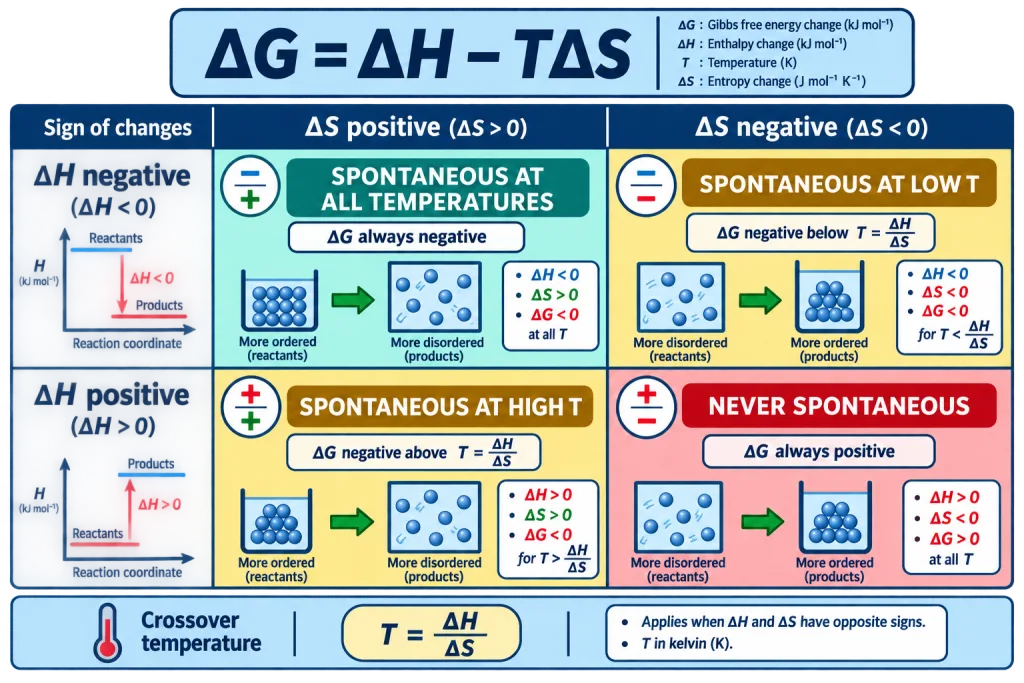
| Spontaneity | Example | |||
|---|---|---|---|---|
| negative at every | spontaneous at all temperatures | |||
| positive at every | non-spontaneous at all temperatures | |||
| negative at low , positive at high | spontaneous only below the crossover | |||
| positive at low , negative at high | spontaneous only above the crossover |
multiplies only, so raising strengthens the entropy term and leaves the enthalpy term where it is. Both terms favourable, nothing can spoil it; both unfavourable, nothing can rescue it. When is favourable and is not, cooling helps because shrinks; when is favourable and is not, heating helps because grows.
The crossover temperature
Setting ,
Key Point: is the temperature at which changes sign. It is meaningful only when and share a sign; opposite signs give a negative kelvin value, which is the arithmetic reporting that the sign never changes.
Limestone: , , so
Above the decomposition is spontaneous, which is why lime kilns run near .
Key Point: is tabulated in and in . Convert before subtracting or dividing. Dividing by gives — wrong by a factor of a thousand and absurd on its face.
as maximum useful work
is the part dispersed as heat to satisfy the entropy requirement; is the part that can be harvested.
Key Point: At constant and , is the maximum non-expansion (useful) work obtainable from a change, which is why was long called the free energy. Expansion work against the atmosphere is not included.
For , : one mole of hydrogen in a fuel cell can deliver at most of electrical work, and any real cell delivers less.
[Board] Work in joules throughout and convert to kilojoules only at the end. One conversion is easier to remember than two.
Card 10 — Gibbs Energy and Equilibrium; the Third Law
At equilibrium the forward and reverse changes balance and sits at its minimum, so no further change in either direction can lower it.
Combined with the Gibbs equation, that gives the equilibrium condition in terms of enthalpy and entropy:
This is the same expression as the crossover temperature, arrived at from the equilibrium side.
The equilibrium relation
At ,
so with in ,
is dimensionless, because every pressure or concentration inside it is measured against the standard state, and a number with units cannot go inside a logarithm.
| / kJ mol | at 298 K | Position of equilibrium | |
|---|---|---|---|
| essentially complete | |||
| products dominate | |||
| products favoured | |||
| comparable amounts | |||
| reactants favoured | |||
| very little product | |||
| negligible product |
Every extra of negative multiplies by ten.
| Sign of | Reading | |
|---|---|---|
| large negative | mostly products; reaction goes nearly to completion | |
| slightly negative | products favoured | |
| zero | reactants and products in comparable amounts | |
| positive | mostly reactants; only a trace of product |
Key Point: and are different quantities. refers to all species in their standard states and is a fixed number for a given reaction at a given temperature; refers to the actual mixture in front of you. means , not "no reaction"; means the mixture has reached equilibrium.
A positive does not forbid the reaction; it makes small, so only a trace of product forms. For ozone from oxygen at room temperature, written as , , and that trace genuinely exists.
Strongly exothermic reactions tend to have large , but the entropy term can overturn that, and the enthalpy term weakens as rises while the entropy term does not.
The third law
Key Point: Third law of thermodynamics — the entropy of a perfectly crystalline pure substance is zero at absolute zero: at .
Every particle is fixed at a lattice site and every motion is frozen out, so exactly one arrangement exists and no disorder is left to count. The wording is narrow on purpose: glasses, solutions and supercooled liquids freeze their disorder in place as they cool and keep a residual entropy at .
What the third law buys is an absolute entropy scale. Warming a sample from near in small steps and summing , with a jump of at each phase change, gives the standard molar entropy .
| Enthalpy | Entropy |
|---|---|
| No absolute value; only is measurable | Absolute values exist, fixed by the third law |
| of an element in its reference state by convention | of an element is a real positive number, never zero |
| Quoted in | Quoted in |
[JEE Main] If a question gives in atmospheres, feed the bare number into the logarithm. Carrying the unit through is what produces impossible answers here.
Card 11 — The Mistakes That Cost the Most Marks
Twelve errors, each with the fix. Most marks lost in this chapter come from this list rather than from not knowing the theory.
1. Getting the sign of backwards. Expansion means the system loses energy, so is negative. Compression means the system gains energy, so is positive. Fix: before writing any number, decide whether energy is entering or leaving the system. Entering is positive.
2. Using from a physics book. That convention defines as work done by the system. Fix: use with positive for work done on the system, consistently, and never mix the two in one paper.
3. Counting solids and liquids in . In , the water is liquid, so , not . Fix: strike out every species that is not labelled before counting.
4. Mixing joules and kilojoules between and . is tabulated in , in . Subtracting them as they stand throws the answer out by . Fix: convert everything to joules, do the arithmetic, convert the final answer back.
5. Assuming exothermic means spontaneous. Melting ice, dissolving and mixing two gases are all spontaneous with . Fix: spontaneity is decided by , or equivalently by , never by alone.
6. Assuming spontaneous means fast. Diamond turning into graphite has and takes geological time; hydrogen and oxygen sit mixed in a flask for years. Fix: thermodynamics gives tendency, kinetics gives rate. A catalyst changes the rate and leaves untouched.
7. Forgetting that depends on physical state. gives ; the same equation ending in gives . Fix: copy the state labels into every line of working, and check that a standard-state equation at ends in .
8. Reversing "products minus reactants". . The one exception is the bond-enthalpy estimate, which is bonds broken minus bonds formed, that is, reactants minus products. Fix: write the correct order at the top of the page before substituting, and remember that bond enthalpies are the odd one out.
9. Ignoring stoichiometric coefficients in a Hess or formation sum. For , the contribution is , not . Fix: multiply each or by its coefficient as you write it down, not afterwards.
10. Taking of every element as zero. Only the reference state is zero. is and is . And of an element is never zero at . Fix: check the state label before assigning a zero.
11. Confusing with . uses the standard value. is the equilibrium condition for the actual mixture. Fix: if the sentence mentions , the quantity is ; if it says "at equilibrium", the quantity is .
12. Treating a bomb calorimeter result as . A bomb is rigid, so and it measures . Fix: apply whenever a question moves from a bomb to a tabulated enthalpy, and keep the sign of .
60-second revision
- System types: open (matter and energy), closed (energy only), isolated (neither).
- State functions , , , , , , ; path functions and .
- Sign rule: energy into the system is positive. .
- ; reversible isothermal ; free expansion .
- ; .
- (bomb, rigid). (cup, open).
- ; ; counts gases only; at .
- per mole of ideal gas; ; water .
- Hess's law: reverse flips the sign, scaling scales the value, adding adds.
- ; elements in reference states are zero.
- Bond enthalpies only: reactants minus products, all species gaseous.
- ; all three positive.
- .
- in ; ; spontaneous when .
- ; spontaneous when ; equilibrium at .
- Four cases: always, never, low , high ; crossover at .
- is the maximum non-expansion work.
- ; at ; negative means .
- Third law: for a perfect crystal at .