
Why Internal Energy Alone Is Not Enough
The first law gives a clean result at constant volume. With there is no expansion work, so and
The heat measured in a rigid sealed vessel is exactly the change in internal energy. That is a genuinely useful result, and it is how a bomb calorimeter works.
The trouble is that almost no chemistry is done that way. A reaction in a test tube, a beaker, a round-bottom flask or a conical flask is open to the room. Gas evolved during the reaction does not stay put — it pushes the atmosphere back and escapes. The volume of the system changes freely while the pressure stays pinned at whatever the atmosphere happens to be, roughly .
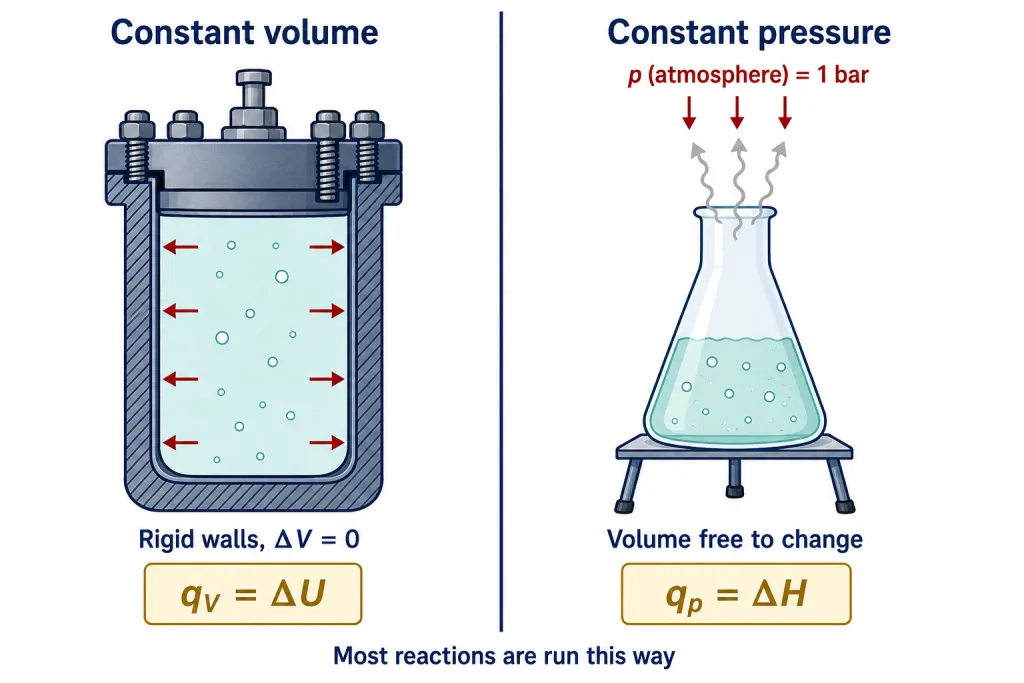
So a laboratory reaction runs at constant pressure, not constant volume. Under that condition part of the energy released by the reaction is spent pushing the atmosphere out of the way, and only the rest shows up as heat in the thermometer. The heat measured is no longer .
Start from the first law at constant pressure. The only work is expansion work, , so
The measured heat is therefore , and that quantity — not by itself — is what a chemist actually measures in a flask. Chemistry needs a state function whose change equals , in the same way that equals . That function is enthalpy.
How much energy is lost to the atmosphere
The size of the effect is easy to estimate. Suppose a reaction releases one mole of gas at against an atmospheric pressure of . The gas produced occupies about , so the system pushes the atmosphere back through that volume:
Two and a half kilojoules per mole of gas released never reaches the thermometer. Against a combustion enthalpy of several hundred kilojoules that is a small slice, but it is not zero, and it is exactly the gap between the two quantities this section is about.
Key Point: At constant volume the heat exchanged is . At constant pressure it is not, because some energy goes into pushing the surroundings. A second state function is defined to handle the constant-pressure case.
Enthalpy, H = U + pV
Rearrange the constant-pressure first law with initial state 1 and final state 2:
Collecting the state-2 terms on one side and the state-1 terms on the other,
Both brackets have the same form, . That combination is given a name.
Key Point (Definition): Enthalpy is defined as . Its SI unit is the joule; chemists usually quote it in .
With that definition the two brackets are and , so
Key Point: At constant pressure, . The heat absorbed by a system at constant pressure is its enthalpy change.
Why H is a state function
is a state function, is a state variable and is a state variable. is built only from these three, so its value depends only on the present state of the system and not on how the system got there. between two given states is fixed, whatever the route.
This has a consequence worth pausing on. Heat is a path function — the heat exchanged between two states depends on the route taken. But once the pressure is held constant, is forced to equal , and is route-independent. Pinning the pressure removes the freedom that made path-dependent. The same thing happened at constant volume, where was forced to equal .
The finite-change form
Written for a finite change,
When the pressure is constant this collapses to
Read the three terms physically. is the energy actually stored inside the system. is the energy the system spent shoving the atmosphere aside to make room for itself. is the sum, and it is the quantity a thermometer in an open flask reports.
Only changes in enthalpy can be measured
The absolute enthalpy of a substance is unknown, because the absolute internal energy is unknown — nobody can count the total kinetic and potential energy of every particle in a mole of a substance. What can be measured is the difference between two states, and that is all chemistry ever needs:
For a reaction, "final" means the products and "initial" means the reactants, so
The old name "heat content" for enthalpy survives in some books and is misleading. A system does not contain a stock of heat that it hands out; heat is energy in transit across the boundary. Enthalpy is a property of the state, and it happens to change by exactly the amount of heat transferred when, and only when, the pressure is held constant.
[Board] State the condition with the result. is true at constant pressure only, and needs constant pressure as well. A bare "" loses the mark.
The Sign of Delta H
An exothermic change gives out heat. Heat leaves the system, so is negative, and
An endothermic change takes in heat. Heat enters the system, is positive, and
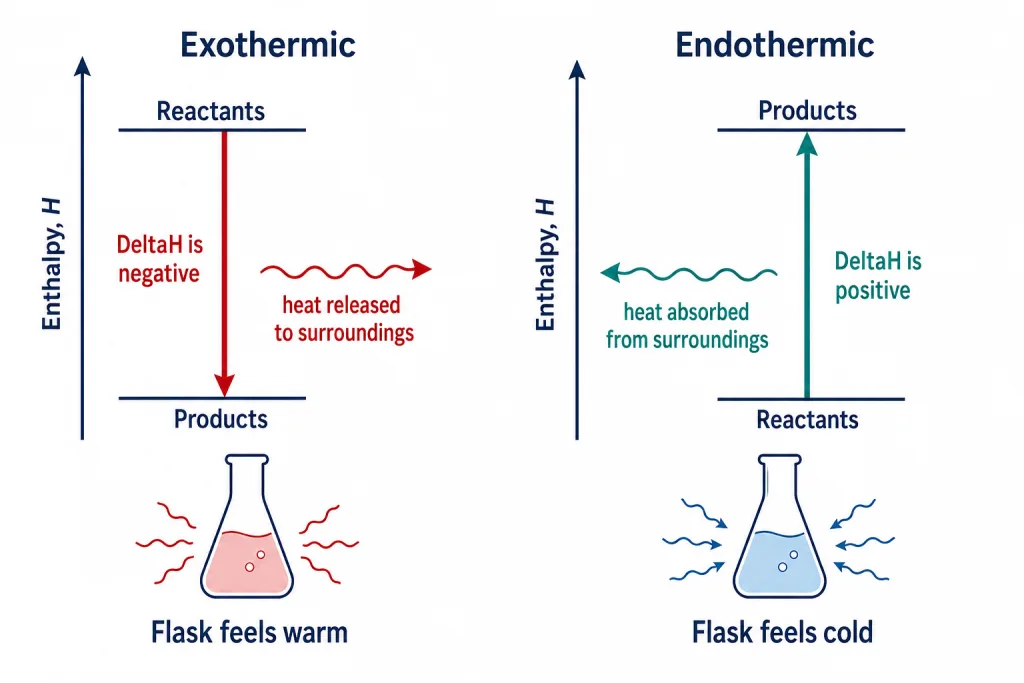
An enthalpy level diagram makes this visual. Enthalpy is plotted upward. For an exothermic reaction the products sit lower than the reactants: the system has shed enthalpy into the surroundings and comes out negative. Combustion of methane, neutralisation of an acid by an alkali and the setting of cement are all of this kind, and all warm their surroundings.
For an endothermic reaction the products sit higher. The system has drawn enthalpy in from the surroundings, so is positive and the flask feels cold. Dissolving ammonium chloride in water and decomposing limestone both behave this way.
| Change | Heat flow | Sign of | Sign of | Flask feels |
|---|---|---|---|---|
| Exothermic | out of the system | negative | negative | warm |
| Endothermic | into the system | positive | positive | cold |
One caution about the word "system". The flask feels warm in an exothermic reaction because the heat has gone into the surroundings — your hand is part of the surroundings, not part of the system. The system itself has lost enthalpy. Students who reason from the temperature they feel often get the sign backwards.
Key Point: negative means heat released, products lower in enthalpy. positive means heat absorbed, products higher in enthalpy.
Writing the value with the equation
A balanced equation carrying its enthalpy change is a thermochemical equation:
Two conventions travel with it. Every species carries its physical state, because the value depends on it. And the value belongs to the equation exactly as written — for the amounts shown by the coefficients, not per mole of any one species picked at random.
Reversing the equation reverses the sign. Condensation of water gives out the same that vaporisation at absorbed:
This follows from being a state function: swapping the initial and final states can only flip the sign of the difference.
Relating Delta H to Delta U for Reactions Involving Gases
is correct but awkward, because for a reaction is not something anyone measures. For gases the ideal gas equation converts it into something countable.
Take a reaction run at constant temperature and constant pressure . Let be the total moles of gaseous reactants occupying total volume , and the total moles of gaseous products occupying . Applying to each side,
Subtracting,
The volume difference is the volume change of the reaction, and is given the symbol :
Substituting into gives the working relation of this section.
Key Point: , where is the number of moles of gaseous products minus the number of moles of gaseous reactants.
Rearranged the other way, . Bomb calorimetry delivers and the relation converts it to ; an open-flask measurement delivers and the relation converts it back. Both directions appear in exams.
Counting Delta n_g
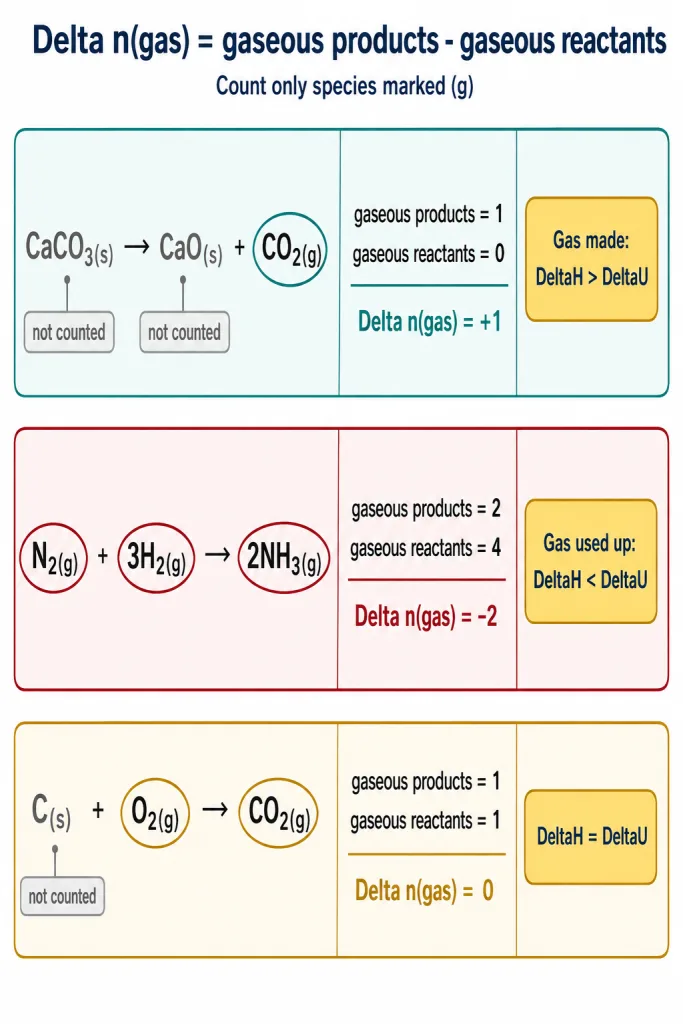
Only species labelled are counted. Solids, liquids and aqueous species contribute nothing, because their volumes are thousands of times smaller than the volume of a gas and are treated as negligible.
The moles are the stoichiometric coefficients of the balanced equation as it is written, so belongs to that equation, not to the reaction in the abstract. Doubling every coefficient doubles , and it doubles and with it.
Fractional coefficients give fractional values, and that is fine. has .
What the derivation assumed
Three assumptions went into , and each one is worth knowing.
The gases were treated as ideal, so that could be applied to both sides. Real gases at ordinary pressures are close enough for the correction term, which is small anyway.
The temperature was the same before and after. If a reaction heats itself up, the relation applies to the reactants and products compared at the same temperature.
The volumes of solids, liquids and solutions were taken as negligible against the volumes of gases. At a mole of gas occupies about and a mole of water about , a ratio of roughly to , so the approximation is a safe one.
Working Through Delta n_g, and When the Two Are Equal
Three reactions, one of each kind.
Positive . Limestone decomposing:
Gaseous products: . Gaseous reactants: — the solids are not counted. So . Gas is created, the system expands, it spends energy pushing the atmosphere back, and is larger than .
Negative . Ammonia synthesis:
. Gas is consumed, the system shrinks, the atmosphere does work on it, and is smaller than — more negative, in this exothermic case.
Zero . Burning graphite:
One mole of gas in, one mole of gas out. The solid carbon is not counted at all, so , and exactly.
The two cases where Delta H equals Delta U
The first is , as above. The gas volume created equals the gas volume destroyed, no net expansion work is done, and the two quantities coincide.
The second is a reaction involving only solids and liquids. Condensed phases barely change volume on reacting or on heating, so is tiny compared with the energies of chemical change, and
A number makes the size of the neglect clear. One mole of a gas at and occupies about ; one mole of a liquid or solid occupies tens of millilitres. Expanding by one mole of gas costs , while the volume changes of condensed phases cost a few joules at most.
Key Point: when , and when no gases take part at all.
The mistakes that cost marks
- Counting a solid or a liquid in . has , not .
- Counting an aqueous species. has .
- Missing the phase label on water. has , but writing instead makes it . The phase in the equation decides it.
- Reversing the subtraction. It is products minus reactants, in that order.
[JEE/NEET] When a question offers "" as an option, count before dismissing it. Combustion of graphite, and the esterification of ethanoic acid by ethanol all qualify.
Using the Relation Without Slipping on Units
Three habits keep from going wrong.
Match the energy units. produces in joules, while and are almost always quoted in . Divide the correction by before adding it. At ,
That single number handles most room-temperature problems: the correction is kilojoules.
Use kelvin. in the relation is absolute temperature. A question quoting means , and means .
Fix the direction of the conversion. Going from to , add . Going from to , subtract it. Writing the equation down before substituting prevents the sign flip.
A physical check catches most sign errors without any arithmetic. If gas is created, is positive, the system had to spend energy pushing the atmosphere back, and comes out greater than . If gas is consumed, the atmosphere pushed inward and did work on the system, so is less than . An answer that violates that pattern has a sign error somewhere.
The other value, , is for work in litre-atmospheres and has no business in this relation unless the enthalpies themselves are quoted in litre-atmospheres.
A size check
For most reactions the correction is small. Combustion of methane has and a correction of about — under one per cent. This is why the difference between and can be ignored in rough work but never in an exam answer that asks for both.
The correction matters most for phase changes and for reactions with a large . Vaporising water at has and a correction of , which is nearly eight per cent of the answer.
| Reaction | Correction at | |
|---|---|---|
Key Point: The correction term is kilojoules at . Its sign follows the sign of .
Solved Examples
Question 1: Vaporising one mole of water
Treating water vapour as an ideal gas, the molar enthalpy change for vaporisation of of water at and () is . Calculate the internal energy change for the same process.
Answer:
The change is . Liquid water is not counted, so the gaseous moles go from to :
The temperature is . I want , so I subtract the correction:
is smaller because part of the supplied was spent making room for the vapour, not on separating the molecules.
Ans:
Watch out: , not and not . Using in place of gives a correction of and a wrong answer.
Question 2: Counting the gaseous moles
Find for each reaction.
(a) (b) (c) (d)
Answer:
Each time I list only the species carrying a label and subtract reactants from products.
(a) Products: liquid water, so moles of gas. Reactants: . .
(b) Products: . Reactants: the solid contributes nothing, so . .
(c) Products: . Reactants: hydrogen only, since iodine is a solid here, so . .
(d) Products: . Reactants: . The two solids drop out. .
Ans: (a) (b) (c) (d)
Watch out: In (c) the temptation is to write by counting . It is a solid, and solids never enter .
Question 3: Combustion of graphite
For the combustion of of graphite at , . Find .
Answer:
The equation is .
Gaseous products , gaseous reactants , and graphite is not counted.
Ans:
Question 4: Ammonia synthesis
For , at . Calculate .
Answer:
Gaseous products ; gaseous reactants .
The system contracted, so the surroundings did of work on it. That energy stayed inside, which is why is less negative than .
Ans:
Watch out: Subtracting a negative correction adds. Writing is the commonest slip in this question.
Question 5: Cyanamide burnt in a bomb
The reaction
has at . Calculate .
Answer:
Gaseous products: nitrogen and carbon dioxide, . Liquid water is not counted. Gaseous reactants: oxygen only, ; the solid cyanamide is not counted.
Ans:
Watch out: A fractional is perfectly legal. The half comes from the in front of oxygen and must not be rounded to or .
Question 6: Combustion of benzene
Liquid benzene burns according to
with at . Find .
Answer:
Gaseous products . Gaseous reactants . Both benzene and water are liquids and are ignored.
Ans:
Question 7: Decomposing limestone
has at . Calculate and say whether the reaction is exothermic or endothermic.
Answer:
Only carbon dioxide is a gas, and there are no gaseous reactants.
is positive, so the reaction absorbs heat and is endothermic.
Ans: ; the reaction is endothermic.
Question 8: The phase of the water changes the answer
Methane burns as
with at .
(a) Find . (b) What would have been if the water had been produced as vapour?
Answer:
(a) Gaseous products: carbon dioxide only, , because the water is liquid. Gaseous reactants: .
(b) With the gaseous products become , and
so and would have been equal.
Ans: (a) (b)
Watch out: The same reaction gives two different values depending on the state of the water. Read the phase labels before counting anything.
Question 9: Heat measured in an open beaker
Burning of a compound in an open vessel at releases of heat. What is per mole of the compound?
Answer:
The vessel is open, so the pressure is constant and the heat measured is .
Heat is released, so is negative: for .
Ans:
Watch out: Had the same reaction been run in a sealed rigid bomb, the measured heat would have been instead, and the two answers would differ by .
Question 10: Working backwards to Delta n_g
For a certain reaction at , . Find and suggest a reaction that fits.
Answer:
From the working relation, .
Two moles of gas disappear. Ammonia synthesis, , has exactly this .
Ans:
Watch out: Convert to before dividing, because carries joules.
Question 11: Zinc dissolving in acid
releases per mole of zinc when carried out in an open flask at . Find and .
Answer:
Open flask means constant pressure, so the measured heat is , and it is released:
For , the only gas anywhere in the equation is hydrogen. Zinc is a solid; the acid and the zinc chloride are aqueous.
Ans: ,
Watch out: Aqueous species carry no entry in . Counting as gas would give and reverse the sign of the correction.
Question 12: A reaction with no gases at all
The neutralisation has . What is , and why?
Answer:
No species in the equation carries a label, so and the correction term vanishes:
Beyond that, everything present is a liquid or a solution, and condensed phases change volume by only a few millilitres during a reaction. The term is a few joules against an enthalpy change of , which is negligible.
Ans: ; with no gases involved, and are equal to the accuracy quoted.