Standard Enthalpy of Combustion
Burning is the reaction chemistry measures most often. It runs to completion, it is easy to start, and it dumps a large amount of heat into a calorimeter where that heat can be counted.
Key Point (Definition): The standard enthalpy of combustion ΔcH∘ is the enthalpy change when one mole of a substance is burned completely in excess oxygen, with every reactant and product in its standard state at the stated temperature.
Four phrases in that definition carry weight.
One mole of the substance. The equation is written for one mole of the fuel, never for one mole of oxygen and never for two moles of fuel. Balancing then often forces a fraction in front of O2. A fraction there is correct, not sloppy.
Completely. Every carbon atom must finish as CO2, every hydrogen as H2O, every sulphur as SO2. If any CO or soot appears among the products the combustion was incomplete, and the heat measured is smaller in magnitude than ΔcH∘.
In excess oxygen. Oxygen is never the limiting reagent, so the fuel decides how much heat comes out.
Standard states. At 298K and 1bar water is a liquid, so combustion equations at 298K end in H2O(l), not H2O(g). Writing H2O(g) instead makes the released heat smaller by the enthalpy of vaporisation of the water formed.
Two examples, both written for exactly one mole of fuel:
C4H10(g)+213O2(g)→4CO2(g)+5H2O(l);ΔcH∘=−2877.5kJmol−1
C6H12O6(s)+6O2(g)→6CO2(g)+6H2O(l);ΔcH∘=−2802.0kJmol−1
The butane equation shows the fraction: 213 moles of oxygen are needed per mole of butane. Clearing the fraction by doubling everything would give a valid balanced equation, but its enthalpy change would be −5755kJ for two moles of butane, and that number is no longer ΔcH∘.
Combustion breaks weak bonds in the fuel and forms very strong bonds in CO2 and H2O. More energy comes out of bond formation than goes into bond breaking, so combustion is exothermic without exception.
Key Point: ΔcH∘ is negative for every substance that burns. A positive value quoted for an enthalpy of combustion is a sign error.
| Fuel |
ΔcH∘ / kJ mol−1 |
| H2(g) |
−285.8 |
| C(graphite,s) |
−393.5 |
| CH4(g) |
−890.3 |
| C2H5OH(l) |
−1367 |
| C6H6(l) |
−3267.6 |
| C4H10(g) |
−2877.5 |
| C6H12O6(s) |
−2802.0 |
[NEET] A question that says "heat released on burning x grams" is asking you to convert grams to moles first and to multiply by the magnitude of ΔcH∘. The sign then goes back in at the end: heat released is positive, ΔH is negative.
Calorific Value and Comparing Fuels
A rocket engineer and a cook both want the most heat from the least fuel, but they measure fuel in kilograms, not in moles. Enthalpy of combustion is quoted per mole, so it needs converting before two fuels can be compared fairly.
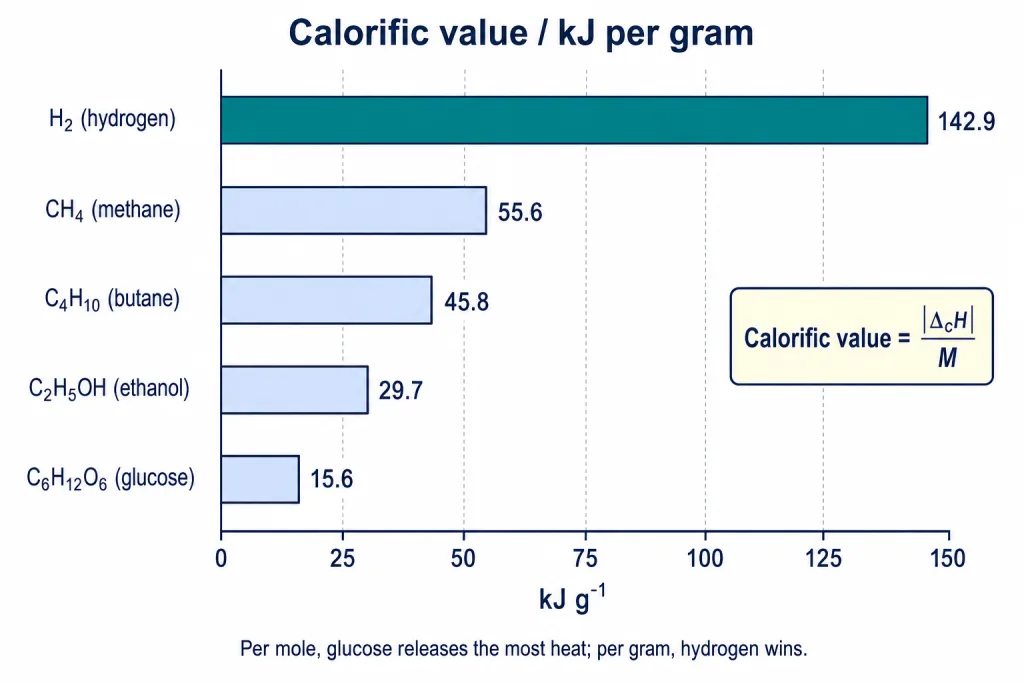
Key Point (Definition): The calorific value of a fuel is the heat released when one gram of it burns completely in oxygen. Numerically it is ∣ΔcH∘∣/M, where M is the molar mass in gmol−1, and it is quoted as a positive number in kJg−1.
Per mole, benzene (−3267.6kJmol−1) beats methane (−890.3kJmol−1) by a factor of nearly four. Per gram the ranking reverses, because one mole of benzene weighs 78g while one mole of methane weighs only 16g.
| Fuel |
M / g mol−1 |
ΔcH∘ / kJ mol−1 |
Calorific value / kJ g−1 |
| H2(g) |
2 |
−285.8 |
142.9 |
| CH4(g) |
16 |
−890.3 |
55.6 |
| C4H10(g) |
58 |
−2877.5 |
49.6 |
| C6H6(l) |
78 |
−3267.6 |
41.9 |
| C2H5OH(l) |
46 |
−1367 |
29.7 |
| C6H12O6(s) |
180 |
−2802.0 |
15.6 |
Hydrogen sits far above everything else, which is why it is the fuel of choice where mass matters more than anything and the exhaust is only water. It loses on volume rather than on mass, since a gas of molar mass 2 occupies a great deal of space.
The same arithmetic runs through nutrition. The body oxidises glucose to carbon dioxide and water by a long chain of enzyme-controlled steps, but enthalpy is a state function, so the total enthalpy change is the same as for burning glucose in a flame: −2802kJ per mole, or about 15.6kJ per gram. Food labels usually print this as roughly 4 kilocalories per gram of carbohydrate.
Fats give more than twice as much per gram as carbohydrates because their carbon atoms start in a more reduced, more hydrogen-rich state and therefore have further to fall on the way to CO2.
Absolute enthalpies cannot be measured. What can be tabulated is the enthalpy of every compound relative to an agreed zero, and the elements supply that zero.
Key Point (Definition): The standard enthalpy of formation ΔfH∘ is the enthalpy change when one mole of a compound is formed in its standard state from its constituent elements, each in its reference state.
Key Point (Definition): The reference state of an element is its most stable state of aggregation at 298K and 1bar. Dihydrogen is H2(g), dioxygen is O2(g), carbon is graphite, sulphur is the rhombic form, bromine is Br2(l), mercury is Hg(l), sodium is Na(s).
Three worked formation equations:
H2(g)+21O2(g)→H2O(l);ΔfH∘=−285.8kJmol−1
C(graphite,s)+2H2(g)→CH4(g);ΔfH∘=−74.8kJmol−1
2C(graphite,s)+3H2(g)+21O2(g)→C2H5OH(l);ΔfH∘=−277.7kJmol−1
The convention that fixes the zero is the whole point of the scheme.
Key Point: By convention, ΔfH∘ of an element in its reference state is exactly zero. ΔfH∘[O2(g)]=0, ΔfH∘[C(graphite,s)]=0, ΔfH∘[Na(s)]=0.
This is a choice of origin, not a claim that elements have no energy. Choosing the elements as the floor means every compound is quoted by how far it sits above or below that floor, and the floor cancels out of any reaction enthalpy calculation.
The reference state qualification matters. Graphite is the reference state of carbon, so ΔfH∘[C(graphite,s)]=0. Diamond is carbon too, but it is not the most stable form at 298K and 1bar, so it carries a real value, ΔfH∘[C(diamond,s)]=+1.90kJmol−1. The same applies to ozone: O2(g) is zero, while ΔfH∘[O3(g)]=+142.7kJmol−1.
| Substance |
ΔfH∘ / kJ mol−1 |
Substance |
ΔfH∘ / kJ mol−1 |
| H2O(l) |
−285.8 |
CaO(s) |
−635.09 |
| H2O(g) |
−241.82 |
CaCO3(s) |
−1206.92 |
| CO2(g) |
−393.5 |
NaCl(s) |
−411.15 |
| CO(g) |
−110.5 |
Fe2O3(s) |
−824.2 |
| CH4(g) |
−74.8 |
HBr(g) |
−36.4 |
| NH3(g) |
−46.2 |
C6H6(l) |
+49.0 |
| HCl(g) |
−92.3 |
C(diamond,s) |
+1.90 |
A negative ΔfH∘ means the compound lies below its elements in enthalpy and heat was released when it formed. Most stable compounds are in that group. A positive value, as for benzene and for ozone, means the compound sits above its elements; such compounds are called endothermic compounds and are often reactive.
One Mole, and Only One Mole
The commonest error with ΔfH∘ is writing a balanced equation that is chemically correct but makes the wrong amount of product. A formation equation must satisfy three conditions at once.
- The only product is the compound, and there is exactly one mole of it.
- The only reactants are elements, each in its reference state.
- Every substance is in its standard state at the stated temperature.
Consider
H2(g)+Br2(l)→2HBr(g);ΔrH∘=−72.8kJmol−1
The reactants are elements in their reference states, so conditions 2 and 3 are met. Condition 1 is not: two moles of HBr are produced, so this ΔrH∘ is 2ΔfH∘. Dividing every coefficient by two repairs it:
21H2(g)+21Br2(l)→HBr(g);ΔfH∘=−36.4kJmol−1
Half a mole of H2 and half a mole of Br2 appear on the left. Fractional coefficients on the element side are not just permitted, they are usually unavoidable, because the compound side is locked at one mole and the elements have to bend to fit.
A different failure is
CaO(s)+CO2(g)→CaCO3(s);ΔrH∘=−178.3kJmol−1
Exactly one mole of calcium carbonate is produced, so condition 1 holds. Condition 2 fails: the reactants are compounds, not elements. The formation equation for calcium carbonate has to start from calcium metal, graphite and dioxygen:
Ca(s)+C(graphite,s)+23O2(g)→CaCO3(s);ΔfH∘=−1206.92kJmol−1
A useful habit when writing one from scratch: put one mole of the compound on the right first, list the elements it contains on the left in their reference states, and only then balance, allowing whatever fractions appear.
Key Point: ΔfH∘ is a special case of ΔrH∘ — the case where the reaction happens to be the formation of one mole of a compound from its elements. Every rule that applies to ΔrH∘ applies to it, including that reversing the equation reverses the sign and that scaling the equation scales the value.
[Board] When a question hands you ΔrH∘ for an equation making n moles of the compound, divide by n before calling the answer a formation enthalpy. For N2(g)+3H2(g)→2NH3(g) with ΔrH∘=−92.4kJmol−1, the formation enthalpy of ammonia is −46.2kJmol−1, not −92.4.
Both quantities are enthalpy changes for one mole of a named substance, and students routinely swap them. The distinction is which side of the equation the named substance sits on.
- In a formation reaction the named substance is the product. It is being built from elements.
- In a combustion reaction the named substance is the reactant. It is being destroyed by oxygen.
For methane the two numbers are nowhere near each other:
C(graphite,s)+2H2(g)→CH4(g);ΔfH∘=−74.8kJmol−1
CH4(g)+2O2(g)→CO2(g)+2H2O(l);ΔcH∘=−890.3kJmol−1
Different reactions, different numbers, no relation to look for between them beyond what Hess's law supplies.
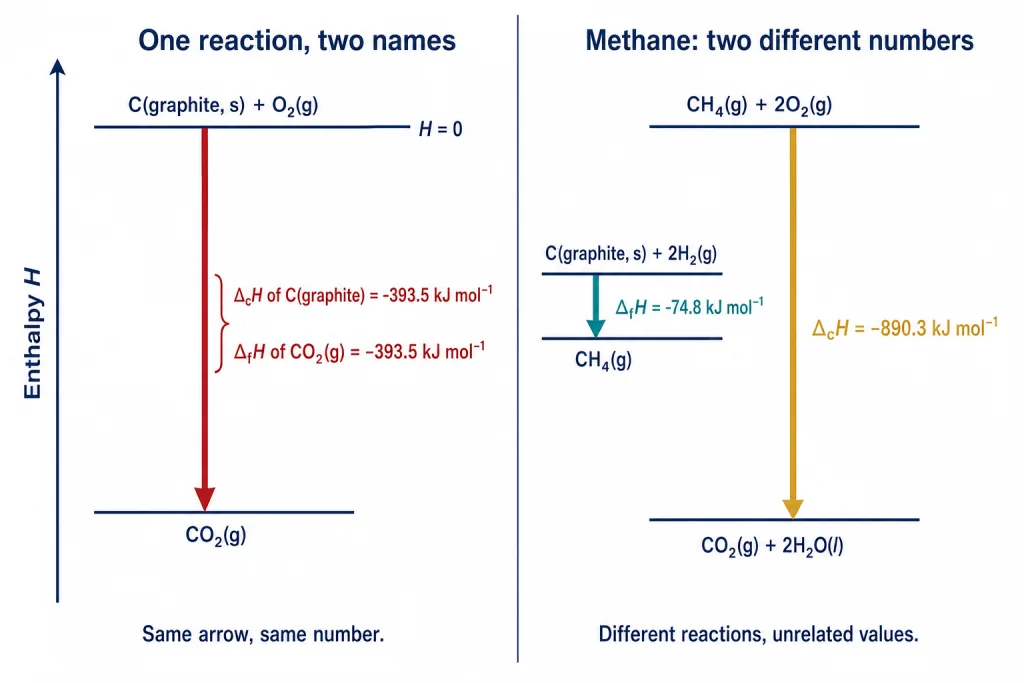
There is a family of substances for which the two coincide exactly, and the reason is worth pinning down. Take graphite. Burning it gives
C(graphite,s)+O2(g)→CO2(g);ΔcH∘[C,graphite]=−393.5kJmol−1
That very equation is also the formation equation of carbon dioxide: one mole of CO2 as the only product, elements in their reference states as the only reactants. The same physical process is being described twice, so
ΔcH∘[C,graphite]=ΔfH∘[CO2,g]=−393.5kJmol−1
The value belongs to the reaction. The two names simply record which substance you were watching: chemists tracking the graphite call it a combustion enthalpy, chemists tracking the CO2 call it a formation enthalpy.
Key Point: ΔcH∘ of an element equals ΔfH∘ of its combustion product whenever burning one mole of the element yields exactly one mole of a single oxide.
Three cases where this holds:
| Element burned |
Equation |
Shared value / kJ mol−1 |
| C(graphite,s) |
C+O2→CO2(g) |
−393.5 |
| H2(g) |
H2+21O2→H2O(l) |
−285.8 |
| S(rhombic,s) |
S+O2→SO2(g) |
−296.8 |
The coincidence fails as soon as the combustion makes more than one product or more than one mole of product. Burning methane makes CO2 and water, so ΔcH∘[CH4] is not the formation enthalpy of anything. Burning one mole of ethane makes two moles of CO2, which breaks the one-mole rule.
This equality is what lets combustion data stand in for formation data. Any table of combustion enthalpies contains, hidden inside it, ΔfH∘ for CO2(g) and H2O(l), and those two values unlock the formation enthalpy of any hydrocarbon whose combustion enthalpy is known.
Enthalpies of Phase Transition
Melting ice and boiling water are not chemical reactions, but they absorb heat at constant pressure, so each has an enthalpy change of its own. During a phase change the temperature stays fixed; the heat supplied goes into separating particles rather than into speeding them up.
Key Point (Definition): The standard enthalpy of fusion ΔfusH∘ is the enthalpy change on melting one mole of a solid at its melting point under standard pressure.
H2O(s)→H2O(l);ΔfusH∘=+6.00kJmol−1
Key Point (Definition): The standard enthalpy of vaporisation ΔvapH∘ is the enthalpy change on converting one mole of a liquid to vapour at its boiling point under standard pressure.
H2O(l)→H2O(g);ΔvapH∘=+40.79kJmol−1 at 373K
Key Point (Definition): The standard enthalpy of sublimation ΔsubH∘ is the enthalpy change when one mole of a solid passes directly into vapour at constant temperature under standard pressure.
CO2(s)→CO2(g);ΔsubH∘=+25.2kJmol−1 at 195K
All three are endothermic, always. Particles in a solid attract each other; pulling them apart to make a liquid, and then dragging them entirely out of range of one another to make a gas, costs energy in both cases. Every ΔfusH∘, ΔvapH∘ and ΔsubH∘ is positive. The reverse changes — freezing, condensing, deposition — release exactly the same magnitude of heat and carry the opposite sign.
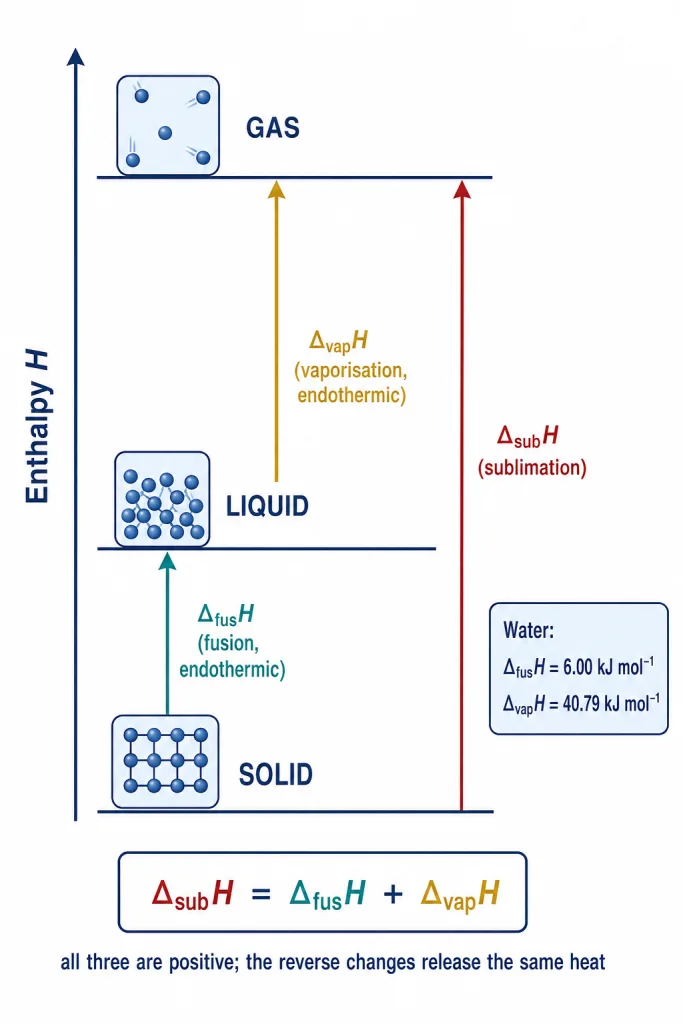
Sublimation reaches the same final state as melting followed by boiling. Enthalpy is a state function, so the route makes no difference:
ΔsubH∘=ΔfusH∘+ΔvapH∘
The one condition is that all three refer to the same temperature. Textbook tables list ΔfusH∘ at the melting point and ΔvapH∘ at the boiling point, and adding those two straight off gives only an approximation.
For every substance ΔvapH∘ is much larger than ΔfusH∘. Melting only loosens the arrangement — the particles stay in contact. Vaporising has to break the attractions completely and push the vapour out against the atmosphere.
| Substance |
Tf / K |
ΔfusH∘ / kJ mol−1 |
Tb / K |
ΔvapH∘ / kJ mol−1 |
| Ar |
83.8 |
1.2 |
87.3 |
6.5 |
| NH3 |
195.2 |
5.65 |
239.7 |
23.4 |
| CH3COCH3 |
177.8 |
5.72 |
329.4 |
29.1 |
| C6H6 |
278.6 |
9.83 |
353.2 |
30.8 |
| H2O |
273.15 |
6.00 |
373.15 |
40.79 |
The size of these numbers tracks the strength of the intermolecular forces. Argon has only weak dispersion forces and vaporises for 6.5kJmol−1. Acetone has dipole-dipole attractions and needs 29.1. Water has hydrogen bonds and needs 40.79kJmol−1 at 373K, which is why a swimmer coming out of a pool feels so cold: evaporating the film of water draws that heat out of the skin.
[JEE/NEET] Vaporisation creates gas from a condensed phase, so Δng=+1 per mole and ΔvapU=ΔvapH−RT. Fusion involves no gas, Δng=0, and ΔfusU≈ΔfusH.
Solved Examples
Question 1: Enthalpy of combustion from a measured heat
Burning 2.9g of butane, C4H10, completely in excess oxygen at 298K and 1bar releases 143.9kJ of heat. Find ΔcH∘ for butane.
Answer:
I first turn the mass into moles. The molar mass of C4H10 is 4(12)+10(1)=58gmol−1.
n=58gmol−12.9g=0.050mol
The heat quoted belongs to 0.050mol. Per mole it is
0.050mol143.9kJ=2878kJmol−1
Heat was released, so the enthalpy change is negative. This matches the tabulated ΔcH∘=−2877.5kJmol−1 to the precision of the data.
Ans: ΔcH∘=−2878kJmol−1
Watch out: The measured heat is a positive quantity of energy leaving the system. The sign is put in only at the last step, when the number is renamed an enthalpy change.
Question 2: Which fuel gives more heat per gram
Given ΔcH∘ values of −890.3, −2877.5 and −1367kJmol−1 for methane, butane and ethanol, decide which is the best fuel per unit mass.
Answer:
Per mole butane wins easily, but a cylinder is sold by mass, so I divide each magnitude by the molar mass.
Methane, M=16gmol−1: 890.3/16=55.6kJg−1
Butane, M=58gmol−1: 2877.5/58=49.6kJg−1
Ethanol, M=46gmol−1: 1367/46=29.7kJg−1
Methane has the highest calorific value. Ethanol is worst because a third of its mass is oxygen, which is already partly oxidised and contributes nothing further on burning.
Ans: Methane, 55.6kJg−1
Watch out: Ranking fuels by ΔcH∘ alone reverses the answer. The comparison is only fair after dividing by molar mass.
Question 3: Writing formation equations
Write the equation whose enthalpy change is ΔfH∘ for (a) ethanol, C2H5OH(l), (b) sodium chloride, NaCl(s), (c) nitrogen dioxide, NO2(g).
Answer:
For each one I put a single mole of the compound on the right, list its elements on the left in their reference states, then balance.
(a) Ethanol contains C, H and O. Reference states are graphite, H2(g), O2(g). Two carbons, six hydrogens and one oxygen are needed.
2C(graphite,s)+3H2(g)+21O2(g)→C2H5OH(l)
(b) Sodium is a solid metal, chlorine is Cl2(g).
Na(s)+21Cl2(g)→NaCl(s)
(c) Nitrogen is N2(g).
21N2(g)+O2(g)→NO2(g)
Ans: The three equations above, with ΔfH∘=−277.7, −411.2 and +33.2kJmol−1 respectively
Watch out: Doubling any of these to remove the fraction destroys the formation equation. The fraction stays.
Question 4: Formation enthalpy of benzene from its combustion
One mole of benzene burns completely at 298K to give CO2(g) and H2O(l), liberating 3267.6kJ. Given ΔfH∘[CO2,g]=−393.5 and ΔfH∘[H2O,l]=−285.8kJmol−1, find ΔfH∘ of benzene.
Answer:
The combustion equation, written for one mole of benzene, is
C6H6(l)+215O2(g)→6CO2(g)+3H2O(l);ΔcH∘=−3267.6kJmol−1
I apply products minus reactants, with oxygen contributing zero.
ΔcH∘=[6(−393.5)+3(−285.8)]−ΔfH∘[C6H6,l]
−3267.6=(−2361.0−857.4)−ΔfH∘[C6H6,l]=−3218.4−ΔfH∘[C6H6,l]
ΔfH∘[C6H6,l]=−3218.4+3267.6=+49.2kJmol−1
Ans: ΔfH∘[C6H6,l]=+49.2kJmol−1, against a tabulated +49.0kJmol−1; the small gap is rounding in the data used as input.
Watch out: The positive sign is real. Benzene lies above its elements in enthalpy, so its formation from graphite and hydrogen absorbs heat even though burning it releases a great deal.
Question 5: Formation enthalpy of methanol
Calculate ΔfH∘ for CH3OH(l) from
(i) CH3OH(l)+23O2(g)→CO2(g)+2H2O(l); ΔrH∘=−726kJmol−1
(ii) C(graphite,s)+O2(g)→CO2(g); ΔcH∘=−393.5kJmol−1
(iii) H2(g)+21O2(g)→H2O(l); ΔfH∘=−285.8kJmol−1
Answer:
Equation (ii) is both the combustion of graphite and the formation of CO2, so −393.5 serves as ΔfH∘[CO2,g]. Equation (iii) gives ΔfH∘[H2O,l]=−285.8.
Applying products minus reactants to equation (i):
−726=[(−393.5)+2(−285.8)]−ΔfH∘[CH3OH,l]
−726=−965.1−ΔfH∘[CH3OH,l]
ΔfH∘[CH3OH,l]=−965.1+726=−239.1kJmol−1
Ans: ΔfH∘[CH3OH,l]=−239.1kJmol−1
Question 6: Two different numbers for methane
The standard enthalpies of combustion of methane, graphite and dihydrogen at 298K are −890.3, −393.5 and −285.8kJmol−1. Find ΔfH∘ of methane, and state why it differs so much from ΔcH∘ of methane.
Answer:
The target is C(graphite,s)+2H2(g)→CH4(g).
Burning graphite gives CO2, so its combustion enthalpy is ΔfH∘[CO2,g]=−393.5. Burning hydrogen gives liquid water, so its combustion enthalpy is ΔfH∘[H2O,l]=−285.8. The combustion equation of methane produces one CO2 and two H2O:
ΔcH∘[CH4]=[ΔfH∘(CO2)+2ΔfH∘(H2O,l)]−ΔfH∘[CH4]
−890.3=[−393.5+2(−285.8)]−ΔfH∘[CH4]=−965.1−ΔfH∘[CH4]
ΔfH∘[CH4]=−965.1+890.3=−74.8kJmol−1
The two numbers describe different reactions. ΔfH∘ measures the small drop from graphite plus hydrogen down to methane. ΔcH∘ measures the far larger drop from methane plus oxygen down to carbon dioxide plus water.
Ans: ΔfH∘[CH4,g]=−74.8kJmol−1
Watch out: Methane is a substance where formation and combustion enthalpies are entirely unrelated numbers. They coincide only for an element whose combustion makes exactly one mole of one oxide, such as graphite or dihydrogen.
Question 7: Heat released on forming a given mass of carbon dioxide
The enthalpy of combustion of carbon to carbon dioxide is −393.5kJmol−1. Calculate the heat released when 35.2g of CO2 forms from carbon and dioxygen.
Answer:
The reaction is C(graphite,s)+O2(g)→CO2(g), and it produces one mole of CO2 per 393.5kJ released.
The molar mass of CO2 is 12+2(16)=44gmol−1.
n(CO2)=44gmol−135.2g=0.80mol
q=0.80×393.5=314.8kJ
Ans: 314.8kJ of heat released, so ΔH=−314.8kJ
Watch out: This combustion enthalpy of graphite is at the same time the formation enthalpy of CO2, which is why the question can phrase itself either way.
Question 8: Sublimation, fusion and vaporisation of naphthalene
Naphthalene sublimes with ΔsubH∘=73.0kJmol−1. Its enthalpy of fusion is 19.0kJmol−1 at the same temperature. Find its enthalpy of vaporisation there.
Answer:
Solid going straight to vapour reaches the same final state as solid melting and the liquid then boiling. Enthalpy is a state function, so the two routes must add to the same total.
ΔsubH∘=ΔfusH∘+ΔvapH∘
73.0=19.0+ΔvapH∘
ΔvapH∘=73.0−19.0=54.0kJmol−1
The result is positive and much larger than the fusion value, as it should be.
Ans: ΔvapH∘=54.0kJmol−1
Watch out: The addition is only valid when all three quantities refer to one temperature. Combining a fusion enthalpy at the melting point with a vaporisation enthalpy at the boiling point gives an estimate, not an exact answer.
Question 9: Evaporating the film of water on a swimmer
A swimmer leaving a pool carries a film of water weighing about 18g. How much heat must be supplied to evaporate it at 298K, given ΔvapH∘=44.0kJmol−1 at that temperature? Also find ΔvapU∘. Take R=8.314JK−1mol−1.
Answer:
The process is H2O(l)→H2O(g), one mole to one mole.
n=18gmol−118g=1mol
qp=n×ΔvapH∘=(1mol)(44.0kJmol−1)=44.0kJ
For the internal energy I use ΔH=ΔU+ΔngRT. One mole of gas appears from a liquid, so Δng=+1.
ΔvapU∘=ΔvapH∘−ΔngRT=44.0−(1)(8.314)(298)(10−3)
=44.0−2.48=41.52kJmol−1
Ans: q=44.0kJ supplied; ΔvapU∘=41.52kJmol−1
Watch out: The 2.48kJ difference is the work the expanding vapour does pushing back the atmosphere. The skin still gives up the full 44.0kJ, because that is the heat absorbed at constant pressure; only 41.52kJ of it ends up stored inside the vapour.
Question 10: Water at 100 degrees Celsius to ice at 0 degrees Celsius
Calculate ΔU when 1mol of water at 100∘C and 1bar is converted to ice at 0∘C. Take ΔfusH=6.00kJmol−1 and the specific heat capacity of water as 4.18Jg−1∘C−1. Treat the vapour phase as absent.
Answer:
I split the change into two steps and add the enthalpy changes, since enthalpy is a state function.
Step 1, cooling liquid water from 100∘C to 0∘C. One mole is 18g.
ΔH1=−(18)(4.18)(100)Jmol−1=−7524Jmol−1=−7.52kJmol−1
Step 2, freezing the water at 0∘C. Freezing is the reverse of fusion, so the sign flips.
ΔH2=−6.00kJmol−1
ΔH=ΔH1+ΔH2=−7.52−6.00=−13.52kJmol−1
No gas is involved anywhere, so Δng=0 and pΔV is negligible for the small liquid-to-solid volume change.
ΔU=ΔH−ΔngRT=ΔH=−13.52kJmol−1
Ans: ΔH=ΔU=−13.52kJmol−1
Watch out: The fusion enthalpy is tabulated for melting. Using +6.00 here would report the water as absorbing heat while it froze.
Question 11: Freezing water below zero
Calculate the enthalpy change on freezing 1.0mol of water at 10.0∘C to ice at −10.0∘C. Take ΔfusH=6.00kJmol−1 at 0∘C, Cp[H2O,l]=75.3Jmol−1K−1 and Cp[H2O,s]=36.8Jmol−1K−1.
Answer:
The fusion enthalpy is only valid at 0∘C, so I route the change through that temperature in three steps.
Step 1, cool liquid water from 10.0∘C to 0∘C:
ΔH1=(1.0)(75.3)(−10.0)=−753J
Step 2, freeze at 0∘C. Freezing reverses fusion:
ΔH2=−6000J
Step 3, cool ice from 0∘C to −10.0∘C, now with the heat capacity of ice:
ΔH3=(1.0)(36.8)(−10.0)=−368J
ΔH=−753−6000−368=−7121J=−7.121kJ
Ans: ΔH=−7.121kJmol−1
Watch out: Steps 1 and 3 use different heat capacities. Using the liquid value throughout inflates the answer by about 0.4kJ.
Question 12: Internal energy of combustion of benzene
For C6H6(l)+215O2(g)→6CO2(g)+3H2O(l), ΔcH∘=−3267.6kJmol−1 at 298K. Find ΔcU∘.
Answer:
Only gases count in Δng. On the right there are 6mol of gas; liquid water contributes nothing. On the left there is 215=7.5mol of gas; liquid benzene contributes nothing.
Δng=6−7.5=−1.5
ΔcU∘=ΔcH∘−ΔngRT=−3267.6−(−1.5)(8.314)(298)(10−3)
=−3267.6+3.72=−3263.9kJmol−1
Ans: ΔcU∘=−3263.9kJmol−1
Watch out: Counting liquid benzene or liquid water in Δng is the usual slip. A negative Δng makes ΔcU∘ slightly less negative than ΔcH∘, not more.
