
Heat Capacity: Linking Heat to Temperature Rise
Pour heat into a body and its temperature climbs. The size of the climb is not the same for every body: the same electric heater run for the same time raises a cup of water by a few degrees and an identical mass of copper by tens of degrees.
Experiment shows the rise is proportional to the heat supplied:
Key Point (Definition): The heat capacity of a body is the heat needed to raise its temperature by one kelvin, . Its SI unit is .
A large means a given amount of heat produces only a small temperature rise. Water has an unusually large heat capacity, which is why a lake warms slowly on a hot day and why water is the working fluid in radiators and calorimeters.
Because a kelvin and a celsius degree are the same size, has the same numerical value in both, and and are interchangeable for heat capacities.
Specific and molar heat capacity
depends on how much substance is present — double the mass and you double the heat needed. Heat capacity is an extensive property, so it is quoted per unit of substance to make it usable.
Key Point (Definition): The specific heat capacity is the heat needed to raise the temperature of one gram of a substance by one kelvin, , in . The molar heat capacity is the heat needed for one mole, , in .
Both are intensive: they belong to the substance, not to the lump of it in front of you. The two working equations follow at once:
They are the same statement counted in different units, and they are linked through the molar mass :
Some real values
| Substance | / | / | / |
|---|---|---|---|
| Water (l) | 4.18 | 18.02 | 75.3 |
| Ethanol (l) | 2.44 | 46.0 | 112 |
| Aluminium (s) | 0.897 | 27.0 | 24.2 |
| Iron (s) | 0.449 | 55.8 | 25.1 |
| Copper (s) | 0.385 | 63.5 | 24.4 |
| Lead (s) | 0.129 | 207 | 26.7 |
Two things stand out. Water beats every common liquid on a per-gram basis. And the four metals, wildly different per gram, all land near per mole — an old empirical result that a mole of any heavy solid element stores heat in much the same way.
The value for water is worth memorising. Nearly every calorimetry calculation in this chapter uses it.
One caution on the values
A specific heat capacity is not a true constant. It drifts slowly with temperature, and it changes sharply at a phase change: ice, liquid water and steam have quite different values. Over the small temperature ranges a calorimeter covers — a few kelvin — treating as fixed is safe, and every problem in this chapter does so. Across a phase boundary it is not, and the phase-transition enthalpy has to be added separately.
Why Heat Capacity Depends on the Conditions
A single number for the heat capacity of a gas is not enough, because the answer depends on what you hold fixed while heating it.
Heat one mole of a gas in a rigid sealed steel cylinder. The volume cannot change, so and no expansion work is done. Every joule supplied stays inside the gas as internal energy.
Heat the same mole in a cylinder closed by a light piston free to slide. The gas expands as it warms, pushing the atmosphere back. Part of the heat supplied leaves again as work, so a larger heat input is needed to reach the same temperature.
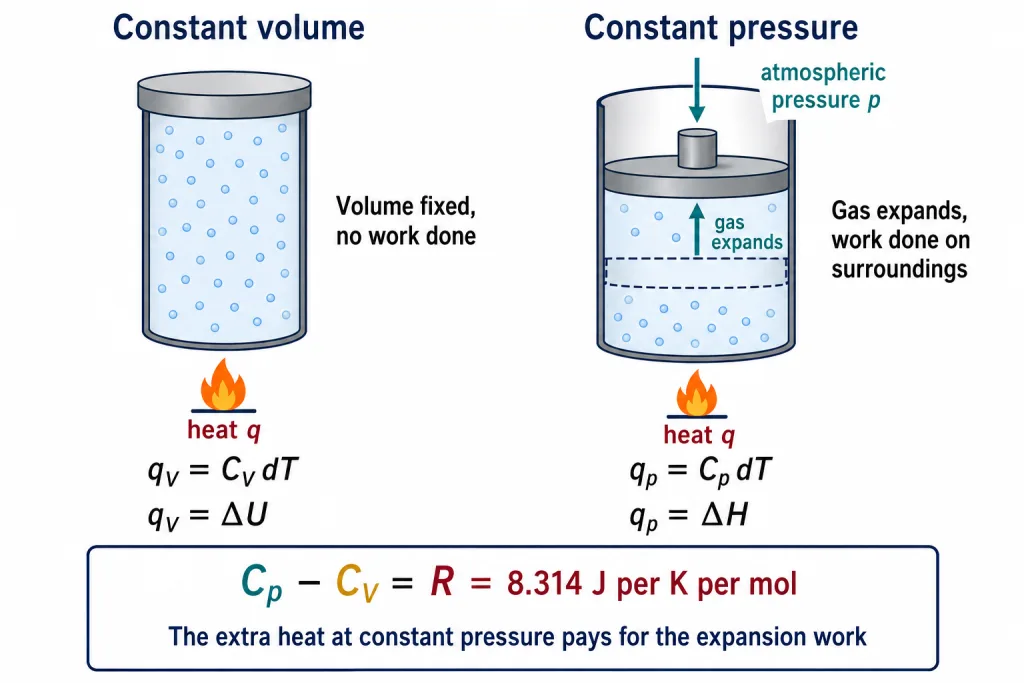
The two conditions get their own symbols.
At constant volume. With , the first law gives , and the heat is written through the constant-volume heat capacity :
At constant pressure. The heat exchanged is the enthalpy change, and the constant-pressure heat capacity carries it:
Key Point: measures heat that all goes into internal energy; measures heat of which part is spent on expansion work. For a gas, always.
Why solids and liquids need only one value
The table in the previous block quoted a single for water, aluminium and lead without saying which condition applied. Heating a solid or a liquid changes its volume by a fraction of a percent, so is negligible beside the heat supplied. and for a condensed phase differ by well under one per cent, and the distinction is dropped.
For gases the gap is large and cannot be dropped. A mole of an ideal gas at heated by one kelvin at constant pressure expands by about against , and the work involved is exactly the size of the gap — the next block puts a number on it.
Key Point: and are the two doorways into calorimetry. A rigid container measures ; an open container measures .
The Relation C_p - C_V = R
For one mole of an ideal gas the gap between the two heat capacities has a fixed value, and the derivation is three lines.
Start from the definition of enthalpy applied to one mole:
For one mole of an ideal gas , so
Take the change on heating through at constant composition:
Now substitute and :
Cancelling leaves the result.
Key Point: For one mole of an ideal gas, . For moles the total heat capacities differ by .
The physical reading is direct: per mole per kelvin is precisely the extra energy the gas must be given at constant pressure to pay for pushing the atmosphere aside, since for one mole.
Values worth carrying
| Gas type | |||
|---|---|---|---|
| Monatomic (He, Ar) | 1.67 | ||
| Diatomic (, ) | 1.40 |
Values in . Whatever the gas, the difference between the two columns is .
A result that gets used constantly
For an ideal gas the internal energy depends only on temperature. Whatever path the gas takes between two temperatures — constant volume, constant pressure, or anything else — the internal energy change is the same:
[JEE Main] The subscript on does not restrict to constant-volume paths. It holds for any process of an ideal gas, including isobaric and adiabatic ones. The same freedom applies to .
Calorimetry and the Bomb Calorimeter
Calorimetry is the measurement of the heat exchanged in a chemical or physical change. The change is carried out inside a vessel called a calorimeter, immersed in a known quantity of liquid, and the heat is worked out from the temperature change the liquid records.
Everything rests on the two results of the previous block. Run the change at constant volume and the heat measured is ; run it at constant pressure and it is . Two instruments, one for each.
The bomb calorimeter
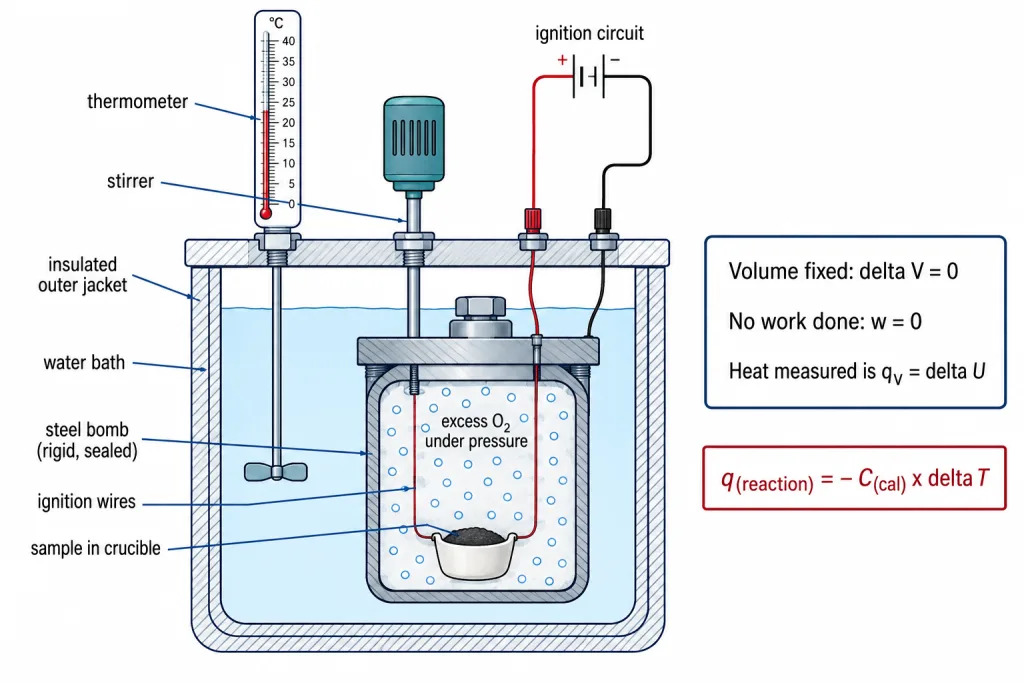
A weighed sample sits in a small crucible inside a thick steel vessel — the bomb — which is then charged with pure dioxygen at high pressure and sealed. The bomb is lowered into a measured mass of water in an insulated jacket, fitted with a stirrer and a sensitive thermometer. The sample is ignited electrically through a fine wire.
The heat released by the combustion warms the bomb, the water and the fittings. The thermometer records the rise .
The steel bomb is rigid and sealed, so its volume is fixed. even when the reaction consumes and produces gases, so no work is done and
Key Point: A bomb calorimeter operates at constant volume and therefore measures directly, never .
Combustions are put in a bomb for practical reasons as well. Pure oxygen at high pressure drives the burning to completion, so no partly oxidised products are left to spoil the figure, and the sealed steel keeps every product inside where its heat is counted. An open flame would let hot gases escape with energy still in them.
The calorimeter constant
The bomb, the water and the fittings warm up together, so they are treated as one body with a single heat capacity , in or . Heat absorbed by that body is
The calorimeter is the surroundings of the reaction. Heat gained by it was lost by the reaction mixture, equal in magnitude and opposite in sign:
For an exothermic combustion is positive, so comes out negative, as it should.
is not calculated from the parts; it is measured by burning a substance of accurately known combustion energy, usually benzoic acid, and dividing the heat released by the observed rise. That calibration step is worked through in the examples.
Watch the bookkeeping: already includes the water in the jacket. Adding a separate term for that water double-counts it.
The Constant-Pressure (Coffee-Cup) Calorimeter
Reactions in solution — neutralisation, dissolution, dilution, metal displacement — are run in a far simpler instrument.
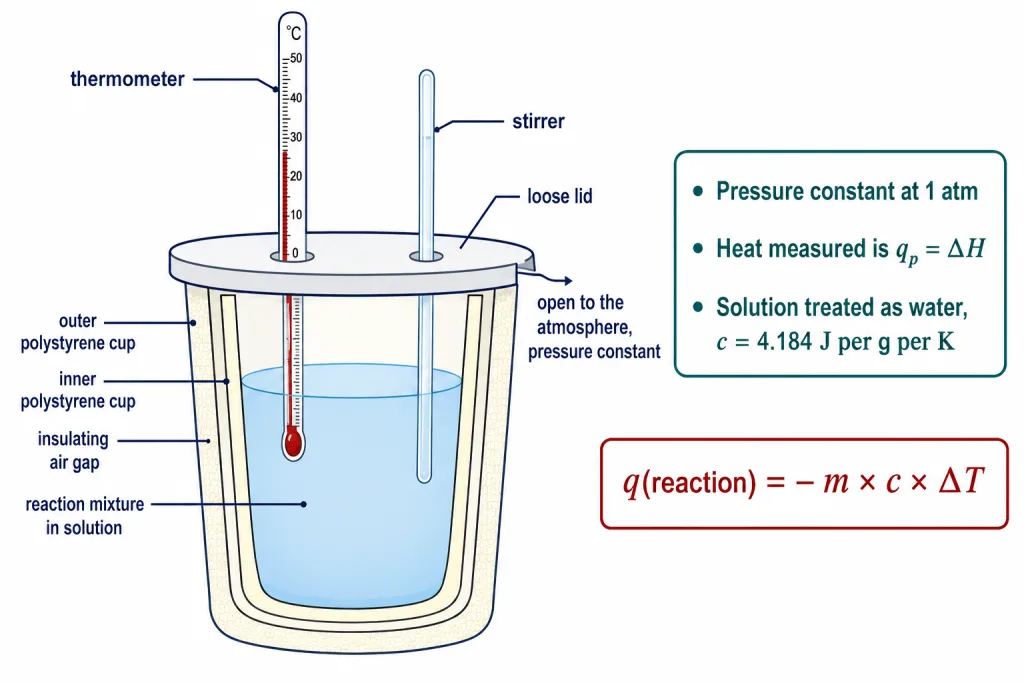
Two nested polystyrene cups hold the solution. A lid carries a thermometer and a stirrer. The polystyrene insulates well enough that little heat escapes over the seconds the reaction takes, and the cup is open to the room, so the pressure stays at atmospheric throughout.
Constant pressure means the heat measured is the enthalpy change:
Key Point: A coffee-cup calorimeter operates at constant pressure and measures directly. A bomb calorimeter measures . The instrument decides which quantity you get.
Getting a number out of it
The solution is dilute, so it is treated as water: specific heat capacity and density . Heat absorbed by the solution is
with the total mass of the mixed solutions. The reaction supplied that heat, so
Dividing by the moles of the limiting reactant gives the molar enthalpy change:
An exothermic reaction warms the solution, is positive and comes out negative. An endothermic dissolution cools it, is negative and comes out positive. The thermometer reading carries the sign; nothing has to be inserted by hand.
If the cup and thermometer have a measured heat capacity of their own, the heat they absorb is added:
In school-level work for a polystyrene cup is usually taken as negligible.
What the cup is good for
The instrument suits reactions that finish in seconds in dilute solution: neutralisation, dissolution, dilution, precipitation and metal displacement. It cannot handle a combustion, which needs oxygen under pressure and would melt the cup, and it cannot handle a slow reaction, because heat leaks to the room over minutes and the peak temperature is never reached. Even in a fast reaction a little heat escapes, so the measured is slightly small and the magnitude of comes out slightly low.
[NEET] Match the instrument to the quantity before doing any arithmetic. A question that says "bomb calorimeter" and then asks for is asking for a correction; a question that says "polystyrene cup" and asks for is not.
From a Bomb Result to Delta H
A bomb calorimeter hands you . Reactions are tabulated as . The bridge is the relation from the previous section:
where counts moles of gaseous species, products minus reactants, and when the energies are in kilojoules.
The route in order
- Find the heat: .
- Scale it from the sample burnt to one mole, using the molar mass. This gives in .
- Write the balanced equation and count , with every phase label correct.
- Add .
Delta n_g for common combustions
| Combustion (products and ) | at | |
|---|---|---|
| 0 | 0 | |
The correction is a couple of kilojoules per mole of gas against combustion energies in the hundreds or thousands. It is small, but a bomb calorimeter is precise enough that ignoring it is a real error, and examiners test it because the sign trips people.
Where marks are lost
- Liquid water is the product at . Counting as a gas flips badly.
- Solids and liquids never enter .
- in with in produces an answer wrong by a thousand.
- The sign flip belongs to the heat, not to . There is one temperature change, read off the thermometer once; put it into and let the minus sign do the rest.
- When , exactly, and no correction is needed at any temperature.
[Board] A full-marks answer states the condition (, so , so ), shows the scaling to one mole, and shows counted from a balanced equation with phase labels.
Solved Examples
Question 1: Warming water
How much heat is needed to raise the temperature of of water from to ? Specific heat capacity of water .
Answer:
I use .
The temperature change is , which is , since a celsius degree and a kelvin are the same size.
That is , and it is positive because heat goes into the water.
Ans:
Question 2: Heating an aluminium block
Calculate the heat, in kilojoules, needed to raise the temperature of of aluminium from to . Molar heat capacity of aluminium , .
Answer:
The heat capacity here is given per mole, so I use and need the moles first.
Ans:
Watch out: A molar heat capacity multiplies moles, a specific heat capacity multiplies grams. Feeding straight into gives an answer times too large — the molar mass over again.
Question 3: Finding a specific heat capacity by mixing
A block of a metal at is dropped into of water at in an insulated cup. The mixture settles at . Find the specific heat capacity of the metal and its approximate molar mass, given that metals have molar heat capacities near .
Answer:
The cup is insulated, so all the heat lost by the metal is gained by the water.
Water gains: ,
The metal loses the same amount. Its temperature falls by , so
Using with ,
which points to copper.
Ans: , (copper)
Question 4: Heating a gas two ways
of an ideal monatomic gas is heated through , once at constant volume and once at constant pressure. Calculate the heat needed in each case, and identify and . Take .
Answer:
For a monatomic ideal gas,
At constant volume,
and this heat equals .
At constant pressure,
and this heat equals .
The gap, , is the expansion work , the last digit differing only through rounding of the two heat capacities.
Ans: ;
Watch out: is in both experiments, because the temperature change is the same and of an ideal gas depends only on . Only the heat differs, because the constant-pressure run also does work.
Question 5: Working from C_p to C_v
The molar heat capacity at constant pressure of nitrogen is . Find , and calculate and when of nitrogen is heated from to .
Answer:
For an ideal gas per mole, so
With ,
A check: , and . They agree.
Ans: , ,
Question 6: Graphite in a bomb calorimeter
of graphite is burnt in a bomb calorimeter in excess of oxygen at and :
The temperature rises from to . The heat capacity of the bomb calorimeter is . Find the enthalpy change for the reaction at .
Answer:
Heat absorbed by the calorimeter is , with .
The reaction mixture lost that heat, so
The negative sign says the combustion is exothermic. The bomb is rigid, so , , and this heat is for burning of graphite.
Scaling to one mole, :
For , count the gases: one mole of out, one mole of in, so .
Ans: , which is the tabulated to the precision of the data
Question 7: Calibrating a bomb calorimeter
Burning of benzoic acid in a bomb calorimeter releases and raises the temperature by . Find the calorimeter constant.
Answer:
All the heat released goes into the calorimeter assembly.
Ans:
Watch out: covers the steel bomb, the water jacket, the stirrer and the thermometer together. It is never worked out by adding up masses and specific heats; it is always measured with a standard substance.
Question 8: Using the calibrated calorimeter
of glucose, (), is burnt in the calorimeter of Question 7. The temperature rises by . Find and of combustion per mole at .
Answer:
for . Per mole,
The balanced combustion is
Gaseous moles: out, in, so .
Ans: , which is the tabulated to the precision of the calorimeter data
Question 9: Cyanamide, from Delta U to Delta H
The reaction of cyanamide with dioxygen was carried out in a bomb calorimeter and was found to be at . Calculate the enthalpy change at .
Answer:
I count only gases. Products: of and of , so . Reactants: of . Solid cyanamide and liquid water do not count.
Now apply with :
Ans:
Watch out: is positive here, so is less negative than . Water is a liquid at ; counting it as a gas would give and an answer wrong by .
Question 10: Benzene in a bomb
The combustion of benzene in a bomb calorimeter at gives for
Find .
Answer:
Gaseous products: of . Gaseous reactants: of . Liquid benzene and liquid water are ignored.
Here is more negative than : the reaction consumes more gas than it makes, so the atmosphere does work on the system as it contracts.
Ans:
Question 11: Neutralisation in a coffee-cup calorimeter
of and of , both at , are mixed in a polystyrene cup. The temperature rises to . Taking the density of the solution as and its specific heat capacity as , find the enthalpy of neutralisation per mole of water formed.
Answer:
Total mass of solution: , so .
Heat absorbed by the solution:
The reaction gave up that heat, so . The cup is open to the atmosphere, so this is for the amount that reacted.
Moles reacting: of each, giving of water.
Ans:
Watch out: The mass in is the mass of the whole mixed solution, , not . Halving it doubles the answer.
Question 12: An endothermic dissolution
of () is dissolved in of water in a coffee-cup calorimeter. The temperature falls from to . Find the enthalpy of solution per mole. Take for the solution and ignore the heat capacity of the cup.
Answer:
Mass of solution: .
The solution lost heat, so the dissolving salt absorbed it:
Moles dissolved:
The positive sign matches the observation: the cup felt cold.
Ans: