
What a Spontaneous Process Means
The first law connects heat, work and internal energy, and it holds just as well for a change as for its exact reverse. It places no restriction on direction. Direction, though, is what chemistry keeps running into. Heat flows from a hot block to a cold one and never back on its own. A gas released into an evacuated bulb spreads through it and never gathers itself back into one corner. Iron left in damp air rusts, and rust never reassembles into iron and oxygen.
Key Point (Definition): A spontaneous process is one that has a natural tendency to occur by itself, without being driven by any external agency. A non-spontaneous process is one that will not happen unless something outside keeps pushing it.
A spontaneous change is irreversible in a precise sense: it can be undone, but only by spending work from outside. Electrolysis will pull iron back out of its oxide, and the electric supply is that external agency.
The word says nothing at all about speed. This single point costs more marks than any other idea in the chapter.
| Process at 298 K, 1 bar | Spontaneous | How fast |
|---|---|---|
| Rusting of iron in moist air | yes | months |
| yes | far too slow to detect | |
| and standing mixed in a flask | yes | no visible change in years |
| Melting of ice | yes | minutes |
| Freezing of water | no | — |
Diamond is the less stable form of carbon at ordinary pressure, so its conversion to graphite has a natural tendency to occur. Nobody watches a diamond turn grey, because the carbon atoms are locked in place and the rate is effectively zero. The same holds for the flask of hydrogen and oxygen: the reaction to give water is spontaneous, and left alone at room temperature the mixture sits unchanged for years. A spark changes the rate, not the spontaneity.
Key Point: Spontaneity is about tendency; rate is a separate question answered by chemical kinetics. A slow process can be spontaneous and a fast process can be non-spontaneous once you supply the driving agency.
[NEET] A statement pairing "the reaction is spontaneous" with "so it must be fast" is false, and assertion-reason items are built on exactly that pairing.
Enthalpy Alone Cannot Decide Direction
A stone falls; water runs downhill. In both the potential energy drops, and the change stops when it can drop no further. Carrying that picture into chemistry suggests a reaction runs in whichever direction lowers the energy, which at constant pressure means the direction with a negative . A good deal of evidence supports the guess:
All three are exothermic and all three are spontaneous, so the rule looks safe. Now put two endothermic reactions beside them.
Both of these absorb heat, and at ordinary temperature neither of them really goes. That is exactly why nitrogen and oxygen sit together in the air without turning into . So far the rule survives, but three endothermic changes from everyday life break it at once, because every one of them absorbs heat and still happens on its own. Heat taken in or given out cannot by itself decide the direction.
Ammonium chloride dissolving. Stir into water and the test tube goes cold in your hand. The enthalpy of solution is about , energy drawn from the surroundings, and the solid dissolves regardless.
Ice melting above . Fusion is endothermic, , and an ice cube left on a warm table melts without any help.
Two gases mixing. Put nitrogen on one side of a partition and oxygen on the other, both at the same pressure and temperature, and pull the partition out. The gases diffuse into each other completely. For ideal gases there is no enthalpy change at all, , and the mixing still happens every single time. The reverse, in which the two gases sort themselves back onto their own sides, has never been seen.
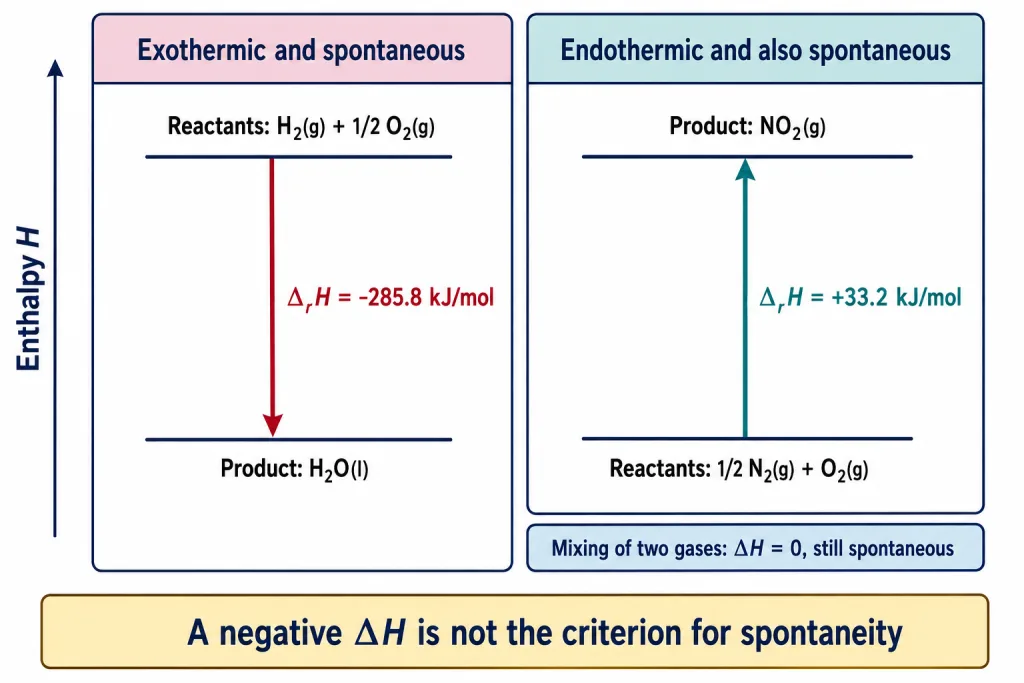
Key Point: A negative favours a change but does not decide it. Endothermic changes can be spontaneous, and a change with can be spontaneous. Something besides enthalpy must be driving these processes.
[Board] A full-mark answer to the standard question on whether a decrease in enthalpy is the criterion for spontaneity says No, then supports it with one endothermic spontaneous reaction quoted with its data and with the mixing of two gases at .
Entropy as a Measure of Disorder
The mixing of two gases is worth staying with, because it isolates the missing factor. Before the partition is pulled out, picking a molecule from the left bulb is certain to give gas A and picking one from the right is certain to give gas B. After mixing, a molecule taken from anywhere in the container could be either. The system has lost order and become less predictable. No energy was released to make that happen; the container is isolated and . What increased was disorder.
Key Point (Definition): Entropy, , is a measure of the degree of randomness or disorder of a system. The more disordered the arrangement of particles and the distribution of energy among them, the higher the entropy.
Solids hold their particles at fixed lattice sites, so a crystalline solid is the most ordered state and has the lowest entropy. In a liquid the particles keep contact but slide past one another. In a gas they are far apart and move at random through the whole volume, which is the most disordered arrangement available.
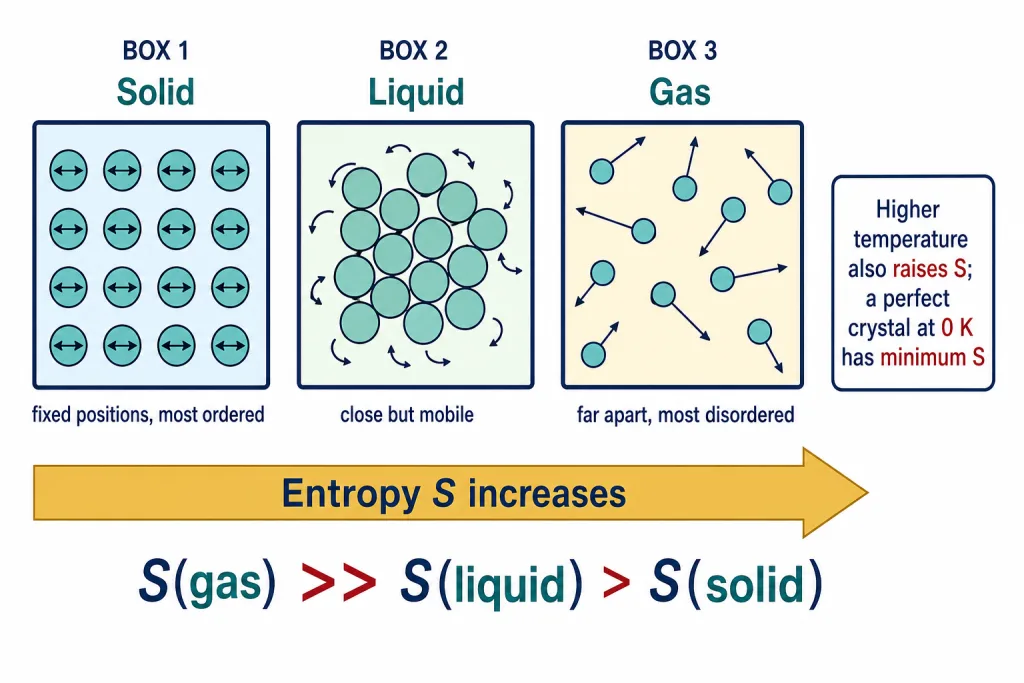
Within the same physical state, entropy rises when the number of particles rises, when a solid dissolves to give ions free to wander, and when the temperature is raised so that particles move and vibrate more vigorously. A perfect crystal at has its particles static and its entropy at a minimum.
For a chemical reaction, the sign of can usually be read off without any data, because gases dominate the entropy account. Count the moles of gas on each side and take the difference:
| Sign of | Reaction | |
|---|---|---|
| positive | , | |
| negative | , | |
| zero | small, sign decided by the other species | , |
Only gaseous moles enter ; solids and liquids are counted only when no gas appears at all, and then the ordering of the states settles the sign. Melting, vaporisation and sublimation all have ; freezing, condensation and crystallisation all have .
Entropy as a State Function and the Meaning of q Divided by T
Disorder is a picture. To use entropy in calculations it has to be tied to a measurable quantity, and heat is the obvious candidate: adding heat to a system speeds its particles up and increases the randomness of their motion.
Heat alone will not do, because the same quantity of heat does not produce the same amount of extra disorder everywhere. Pour into a cold system, whose particles are already sluggish and orderly, and the disruption is large. Pour the same into a system already hot and chaotic and the extra disorder barely registers. The entropy change must fall as the temperature rises, which fixes the form of the definition.
Key Point (Definition): For a change carried out reversibly at a constant temperature , the entropy change is , where is the heat absorbed by the system along the reversible path.
Entropy is a state function, exactly like and . Its value depends only on the state of the system, so between two given states is the same whichever path is taken. The word "reversible" in the definition does not restrict which processes have an entropy change; it tells you which path to use for the arithmetic. For an irreversible change between the same two states, is unchanged, and it is still computed on an imagined reversible path joining those states.
The units follow from the definition: joules divided by kelvin, per mole of substance.
Key Point: Entropy is quoted in while enthalpy is quoted in . Any expression that combines the two needs one of them converted first. Forgetting the factor of throws every answer out by three orders of magnitude.
A phase change at its own transition temperature is the cleanest reversible process available, because solid and liquid, or liquid and vapour, sit in equilibrium there and the smallest nudge tips it either way. All the heat supplied goes into the transition at constant temperature, so
[JEE/NEET] For ice at , ; for water at , . Vaporisation gains far more entropy than melting because the gas state is the large jump.
The Second Law of Thermodynamics
The mixing of gases and the melting of ice both increased the disorder of the system. Not every spontaneous reaction does. Iron rusting, water freezing at and ammonia synthesis all run with the system becoming more ordered, so an increase in the entropy of the system by itself cannot be the criterion either. The account has to be taken over system and surroundings together.
Key Point: The second law of thermodynamics states that for a spontaneous process . At equilibrium , and a process with is non-spontaneous, its reverse being the spontaneous one.
Read as a statement about the universe, the second law says the entropy of the universe is always increasing. The system and its surroundings together make up the universe, so is often written .
Three consequences are worth holding onto.
The entropy of a system is allowed to fall. Water freezes, a plant builds sugar out of carbon dioxide, ions crystallise out of solution. Each of these is a fall in , and each is spontaneous only because the surroundings gain more entropy than the system loses.
For an isolated system there are no surroundings to exchange heat with, so and the criterion collapses to . The two mixing gases in a sealed insulated box are exactly this case, which is why that experiment showed the entropy criterion so plainly.
At equilibrium the entropy of the system plus surroundings has climbed as far as it can go. Entropy is at a maximum and ; ice and water coexisting at is the standard example.
Entropy also separates the reversible path from the irreversible one where the first law cannot. For the isothermal expansion of an ideal gas, whether the expansion is reversible or a free expansion into vacuum. is the same for both, being a state function, but is zero for the reversible path and positive for the irreversible one. does not distinguish the two; does.
The Entropy Change of the Surroundings
Using the second law needs a number for , and that number is easy to get. The surroundings are enormous compared with the system, so heat entering or leaving them changes their temperature not at all, and the exchange behaves as a reversible transfer at the fixed temperature .
Whatever heat the system releases, the surroundings absorb. At constant pressure the heat released by the system is , so
Key Point: . An exothermic reaction has , which makes positive: the heat dumped into the surroundings stirs them up and raises their entropy.
That single relation explains why exothermic reactions are so often spontaneous. The enthalpy released is not a driving force in itself; it becomes one by generating entropy in the surroundings. Rusting is the clearest illustration.
Three moles of gas disappear into a solid, so the system becomes markedly more ordered. The surroundings more than make up for it:
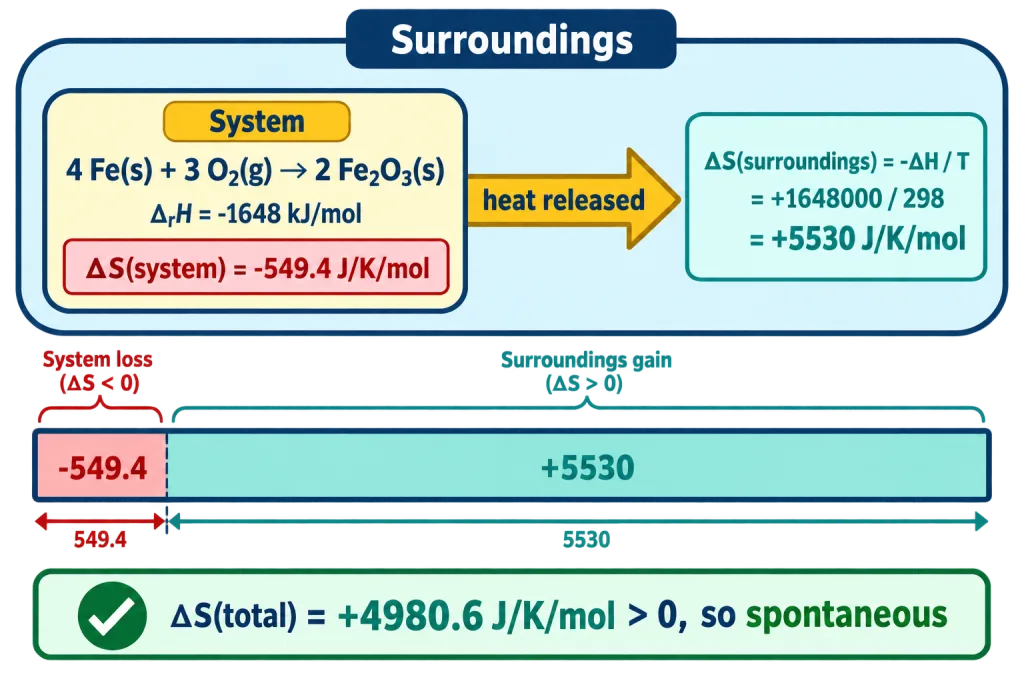
The in the expression matters as much as the minus sign. The same released heat produces a bigger entropy gain in cold surroundings than in hot ones, so lowering the temperature strengthens the contribution of an exothermic reaction to and weakens the contribution of an endothermic one. That temperature dependence is what decides why some reactions turn spontaneous only on heating, and it is handled compactly by Gibbs energy in the next section.
[JEE Main] In every calculation, convert from to before dividing by , and keep the sign of inside the bracket.
Question 1: Spontaneous or not, fast or not
For each of the following at and , state whether the change is spontaneous, and whether spontaneity tells you anything about its rate: (i) diamond converting to graphite, (ii) a sealed flask of hydrogen and oxygen forming water, (iii) water freezing, (iv) carbon dioxide splitting into carbon and oxygen.
Answer:
I take spontaneity to mean a natural tendency to occur without outside help, and I keep it separate from speed.
(i) Graphite is the stable form of carbon at ordinary pressure, so the conversion is spontaneous. The atoms are locked in a rigid lattice and the rate is far too small to measure, which is why diamonds survive.
(ii) The formation of water from its elements is strongly exothermic and spontaneous. The mixture still shows no perceptible change for years at room temperature because the rate is negligible until it is sparked.
(iii) At water freezing is not spontaneous. The reverse, ice melting, is the spontaneous direction at this temperature.
(iv) Splitting into its elements is not spontaneous; it needs a continuous supply of energy from outside.
Ans: (i) spontaneous, immeasurably slow; (ii) spontaneous, extremely slow without a spark; (iii) non-spontaneous; (iv) non-spontaneous.
Watch out: "Slow" is never a reason to call something non-spontaneous, and "explosive" is never a reason to call something spontaneous by itself.
Question 2: Entropy increase or decrease
Predict whether the entropy increases or decreases in each: (i) a liquid crystallises into a solid, (ii) a crystalline solid is warmed from to , (iii) , (iv) .
Answer:
(i) On freezing, molecules that were sliding past each other take up fixed lattice positions. Order goes up, so entropy decreases.
(ii) At the particles are static and the entropy is at its minimum. Warming sets them oscillating about their lattice sites, so the system becomes more disordered and entropy increases.
(iii) The reactant is a single solid, low in entropy. The products are one solid plus two gases, with . Entropy increases sharply.
(iv) One mole of molecules becomes two moles of free atoms. More independent particles moving at random means entropy increases.
Ans: (i) decreases; (ii) increases; (iii) increases; (iv) increases.
Question 3: Sign of Delta S from the gas count
Predict the sign of for each reaction: (i) , (ii) , (iii) , (iv) .
Answer:
I count only gaseous moles, products minus reactants.
(i) . A gas is created out of a solid, so .
(ii) . Four moles of gas collapse into two, so .
(iii) . No change in the number of gas moles, so is small. It is not exactly zero, because the individual molecules differ, and the measured value is only about against hundreds for the others.
(iv) , and the product is a liquid on top of that. Strongly negative.
Ans: (i) ; (ii) ; (iii) close to zero; (iv) strongly .
Watch out: Water in (iv) is liquid, so it contributes nothing to . Writing by mistake would give and a much smaller magnitude.
Question 4: Entropy of fusion of ice
The enthalpy of fusion of ice is and it melts at . Find .
Answer:
At its melting point, ice and water are in equilibrium, so melting there is a reversible change at constant temperature. I can use directly with .
Before dividing I convert the enthalpy into joules, because entropy is quoted per kelvin in joules.
The sign is positive, which matches the picture: a rigid lattice turning into a mobile liquid is a gain in disorder.
Ans:
Watch out: Skipping the kJ to J conversion gives , and the units alone should catch it. Entropy values for ordinary processes sit in the tens or hundreds of .
Question 5: Entropy of vaporisation of water
Water boils at with . Find and compare it with the entropy of fusion.
Answer:
Boiling at the normal boiling point is again an equilibrium between two phases, so the transfer is reversible at .
That is about five times the of fusion. The comparison is sensible. Melting only loosens molecules that stay in contact, while vaporisation scatters them through a volume more than a thousand times larger, which is the far bigger jump in disorder.
Ans: , roughly five times .
Question 6: Entropy change of the surroundings
The combustion of one mole of hydrogen at , , has . Find the entropy change of the surroundings.
Answer:
The surroundings are vast, so they take in the heat released without their temperature shifting, and the transfer counts as reversible at .
The system is exothermic and the surroundings gain entropy, which is the expected direction.
Ans:
Watch out: Two minus signs sit in this calculation, one in the formula and one in . Dropping either gives and reverses the conclusion about the surroundings.
Question 7: Why rusting is spontaneous despite a negative Delta S
For at , the entropy change of the system is and . Show that the reaction is spontaneous.
Answer:
The system loses entropy here, since three moles of gas are consumed and only solids remain. Spontaneity is decided by the total, not by the system alone, so I need as well.
is positive by a wide margin, so the second law is satisfied and rusting is spontaneous. The huge heat release generates far more entropy in the surroundings than the system loses by locking gas into solid oxide.
Ans: , so the reaction is spontaneous.
Watch out: Rust forms slowly over months. The size of says nothing about that.
Question 8: Ammonia synthesis, entropy of both halves
For at , and . Decide whether the reaction is spontaneous at .
Answer:
, so a negative is exactly what I expect. The surroundings decide the outcome.
The total is positive, so the reaction is spontaneous at .
The margin is thin compared with rusting. Raising the temperature shrinks , because it carries a , while stays near . Somewhere above room temperature the total turns negative and the synthesis stops being spontaneous, which is why industrial ammonia plants fight a yield problem at high temperature.
Ans: ; spontaneous at .
Question 9: Melting of ice at three temperatures
Take and , both roughly constant near the melting point. Decide whether ice melts spontaneously at , and .
Answer:
Melting is endothermic for the system and the surroundings pay for it, so is negative at every temperature. Only its size changes.
At : , and .
At : , and .
At : , and .
Below the melting point the total is negative, so melting is not spontaneous and the reverse, freezing, is. At the total is zero, the definition of equilibrium, and ice and water coexist. Above it the total is positive and ice melts on its own.
Ans: Not spontaneous at ; equilibrium at ; spontaneous at .
Watch out: The system term here barely moves while the surroundings term does all the switching. Temperature enters spontaneity mainly through .
Question 10: How much entropy the dissolving salt must generate
Dissolving in water at absorbs and happens on its own. Find the smallest value of consistent with that observation.
Answer:
The process is endothermic, , so the surroundings lose heat and lose entropy.
For the dissolution to be spontaneous the second law needs :
The system does clear that bar. An ordered ionic lattice breaks up into and ions free to move anywhere in the solution, and the entropy gained by that scattering outweighs the ordering of water molecules around the ions.
Ans: must exceed .
Question 11: Heat absorbed reversibly
A system absorbs of heat reversibly at a constant . Find , and .
Answer:
The heat enters the system, so for the system.
The same leaves the surroundings at the same temperature, so their entropy change is equal and opposite.
A total of zero is the signature of a reversible process. It is the borderline case of the second law, the one at equilibrium at every stage.
Ans: , , .
Watch out: does not mean nothing changed. Both halves changed; they cancelled.
Question 12: Reversible expansion against free expansion
One mole of an ideal gas doubles its volume at a constant , first reversibly and then by free expansion into a vacuum. Find , and for each, and say what the comparison shows. Take .
Answer:
The initial and final states are the same in both cases, and entropy is a state function, so has one value that serves for both. I get it from the reversible path, where for an isothermal ideal gas and so .
Reversible path: the surroundings supply that at , so and .
Free expansion: the gas pushes against nothing, so , and with that forces . The surroundings exchange nothing, , and .
is zero for both expansions and cannot tell them apart. is zero for one and positive for the other, so entropy does exactly what internal energy cannot.
Ans: for both; reversibly and for the free expansion.
Watch out: for the free expansion is not . The actual heat is used only for the surroundings; the system's entropy change always comes from a reversible path between the same two states.