
Internal Energy, U
A thermodynamic system stores energy in many forms at once. Its molecules translate, rotate and vibrate. Its atoms are held together by bonds that store chemical energy. Its electrons occupy energy levels, its nuclei have their own energy, and the molecules attract one another across space. Thermodynamics does not try to separate these contributions. It adds them all into one quantity.
Key Point (Definition): The internal energy of a system is the total energy stored in it — kinetic, chemical, electrical, nuclear and every other form — measured with the system as a whole at rest and outside any external field.
is an extensive property. Two moles of a gas at a given and hold twice the internal energy of one mole at the same and . Its unit is the joule.
There is one honest limitation to state at the start. We cannot measure the absolute value of for any real system, because that would mean counting every bond, every electron and every nucleus. What we can measure, and all that chemistry ever needs, is the change in internal energy:
Contrast this with volume. A system in a given state has a definite, measurable volume — you can quote it as . It also has a definite internal energy, but you cannot quote a number for it. Only differences are accessible.
Three ways the internal energy can change
The internal energy of a system changes when
- heat passes into or out of the system,
- work is done on the system or by the system,
- matter enters or leaves the system.
The third route matters only for an open system. Through the whole of this chapter we work with closed systems, where matter is fixed and only two channels remain: heat and work. Those two channels are the entire subject of the first law.
[Board] is a property of the system in its present state. It is not a store of "heat" and not a store of "work" — those two words describe energy while it is crossing the boundary, never energy sitting inside.
Joule's Adiabatic Experiments — Why U is a State Function
Calling a state function is a claim about experiment, not a definition we are free to make. The experiment is Joule's.
First fix the wall. A wall that permits no heat to pass is an adiabatic wall, and a change carried out through such a wall is an adiabatic process. Water in a well-insulated thermos flask is the standard picture: whatever happens inside, no heat leaks across the boundary.
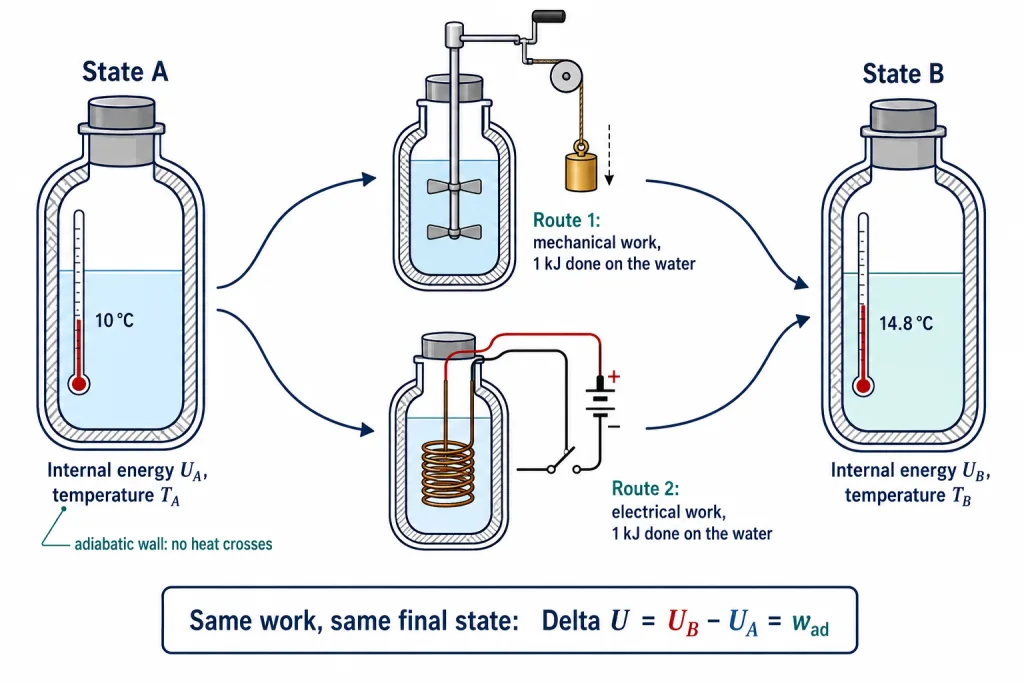
Take water in such a flask at temperature . Call this state A, with internal energy . Now change the state in two completely different ways.
Route one — mechanical work. Rotate a set of small paddles inside the water and churn it, doing of work on the water. The temperature rises to . Call the new state state B, with internal energy , so and .
Route two — electrical work. Start again from state A. This time pass a current through an immersion coil dipped in the water and do the same , now as electrical work. Measure the temperature.
The temperature rise is the same. The final state is the same state B.
J. P. Joule carried out experiments of exactly this kind between 1840 and 1850 and established the general result: a given amount of work done adiabatically on a system produces the same change of state, whatever the mechanism by which the work is done.
That result is what licenses the definition. If adiabatic work depends only on the two end states, it can be used to label those states. So define by
where is the work done adiabatically on the system.
Key Point: Adiabatic work between two given states has one fixed value however the work is done. That is the experimental fact; internal energy being a state function is its statement in thermodynamic language.
Two consequences worth holding on to.
Work in general is a path function — stir a gas, compress it, expand it slowly or fast, and the work differs. It is only when the path is adiabatic that the work is pinned down. Joule's experiment does not make a state function; it makes one.
And carries no memory of the route. Pressure, volume, temperature and amount behave the same way. Raising a system from to gives whether you heat straight up or cool first and then heat; the change in a state function is fixed by the endpoints alone.
The Second Route — Heat
The same change of state can be produced with no work at all.
Replace the adiabatic wall by a thermally conducting wall — copper, say. Such a wall is called diathermic. Put water at inside the copper container and immerse the whole thing in a large heat reservoir held at . Energy now flows across the boundary purely because the two sides are at different temperatures, and the water warms from to .
Key Point (Definition): Heat, , is energy transferred across the boundary of a system as a result of a temperature difference between the system and its surroundings.
The system began in state A and ended in state B — the same two states as in Joule's flask. No paddle turned and no coil ran, so no work was done. If the volume is held constant so that the system cannot push on its surroundings,
The amount of heat absorbed can be measured from the temperature difference and the heat capacity of the water.
Heat, like work, is energy in transit. It exists only while it is crossing the boundary. Once it has arrived, it has become part of the internal energy and there is nothing left to call heat. A hot body does not "contain heat"; it has a high internal energy and a high temperature.
is a path function. Between one pair of states you can transfer a lot of heat and little work, or the reverse, or any combination in between — the split is decided by the path. This is why the chapter never writes or : those symbols would suggest a change in a stored quantity, and neither quantity is stored.
The IUPAC Sign Convention
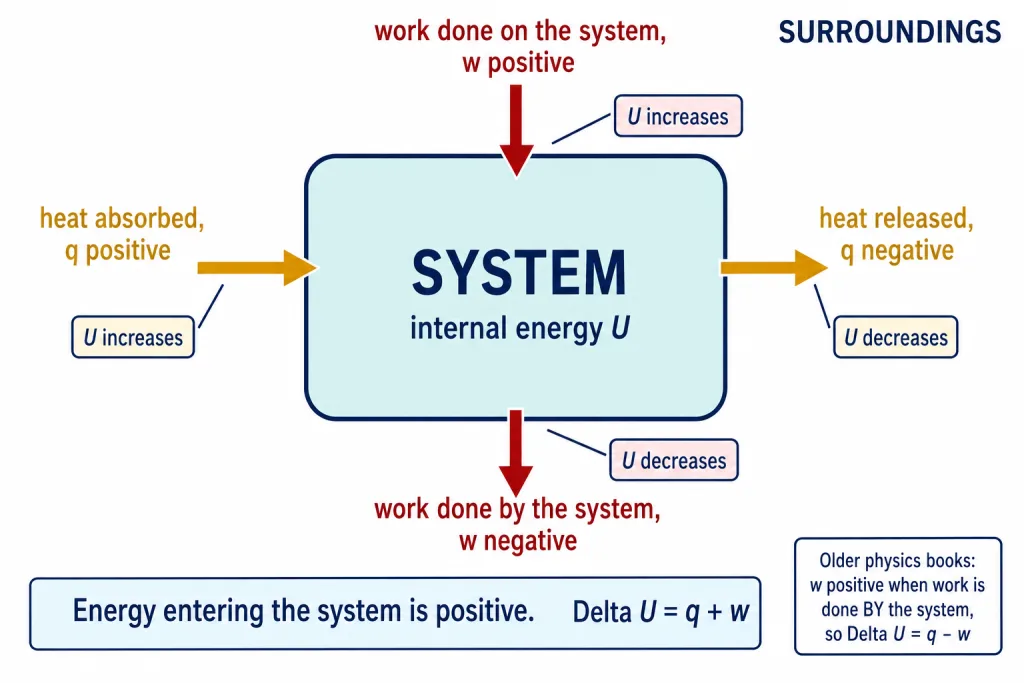
Heat and work can each flow in two directions, so each needs a sign. Chemistry fixes the signs by one simple rule: energy entering the system is positive.
| Quantity | What happens | Sign | Effect on |
|---|---|---|---|
| Work done on the system (gas compressed, water stirred) | increases | ||
| Work done by the system (gas expands, pushes the piston out) | decreases | ||
| Heat absorbed by the system from the surroundings | increases | ||
| Heat released by the system to the surroundings | decreases |
Key Point: is positive when work is done on the system; is positive when heat flows into the system. Both signs are read from the system's point of view, never the surroundings'.
Read the convention against Joule's experiment and it makes sense at once. Churning the water is work done on the system, the temperature rises, so rises — and came out positive in . Had the gas instead expanded and pushed a piston outward, it would have spent some of its own energy, would fall, and would be negative.
The older physics convention
Older physics texts assign the opposite sign to work: there is counted positive when work is done by the system, and the first law is written . Both conventions describe the same physics, and both give the same — the two sign changes cancel. What they do not share is the meaning of the symbol .
This chapter, and every chemistry paper you will sit, uses the IUPAC convention: positive when work is done on the system, and
[JEE/NEET] When a question supplies a number in words — "the gas does of work" — convert it to the IUPAC sign yourself before substituting. Work done by the gas is . A large share of lost marks in this chapter are sign errors made at exactly this step.
The First Law of Thermodynamics
Now take the general case, where the state changes by heat transfer and by work together. The two contributions simply add:
This is the first law of thermodynamics. For a given change of state, and can each take many values depending on how the change is carried out — but their sum cannot. It is fixed by the initial and final states alone, because is the change in a state function.
Key Point: The first law: . The energy of an isolated system is constant. Equivalently, energy can neither be created nor destroyed, only converted from one form to another or transferred between system and surroundings.
Three readings of the same equation are worth separating.
As bookkeeping. Whatever energy enters the system as heat or as work must show up as an increase in its internal energy. Nothing is lost and nothing appears from nowhere.
As a constraint on paths. Two different paths from state A to state B may have wildly different and wildly different . Their sums are identical. If a problem gives you and for one path and asks for on a second path with a known , the first law is the bridge.
As a definition of heat. Rearranged, : heat is whatever energy transfer is left over once the work has been accounted for.
Reading the sign of
A positive means the system finished with more internal energy than it started with. A negative means it finished with less — it gave energy out, as heat or as work or both. For an ideal gas, where depends only on temperature, also means the temperature rose.
A closing caution on units. Mixing with , or with , is the second most common error here after sign errors. Convert everything to joules before adding: .
Special Cases of the First Law
Most problems are one of five standard situations. Each is with one term switched off.
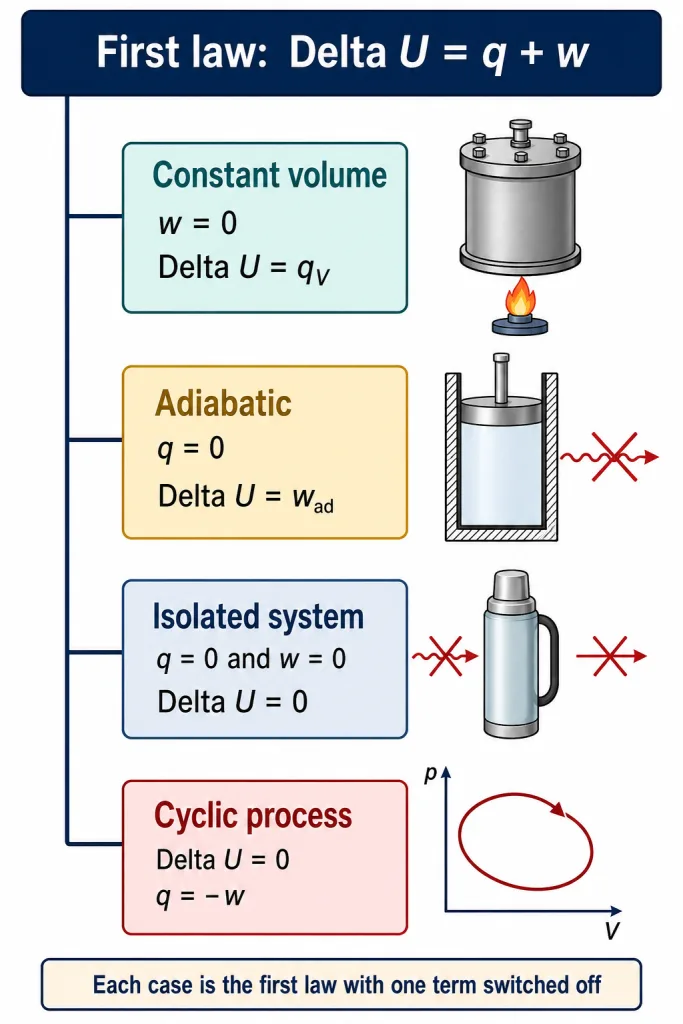
Constant volume. A rigid sealed vessel cannot change its volume, so it does no expansion work and :
The subscript records that the heat was supplied at constant volume. This single line is what makes the bomb calorimeter useful: heat measured in a rigid steel bomb is for the reaction inside it.
Adiabatic. An insulated boundary passes no heat, so :
Compress a gas adiabatically and all the work you put in becomes internal energy, so the gas heats up. Let it expand adiabatically and it cools, having spent its own internal energy pushing the surroundings back.
Isolated system. Neither matter nor energy crosses the boundary, so and :
The internal energy of an isolated system is constant no matter what happens inside it — a reaction may run to completion, but the total energy is unchanged. The universe as a whole is the largest isolated system, which is why the first law is often stated as: the energy of the universe is constant.
Cyclic process. The system runs through any sequence of changes and returns to its starting state. Every state function comes back to its original value, so over the complete cycle, and
The net heat absorbed over a cycle equals the net work done by the system. An engine that produced work without absorbing heat over a cycle would be creating energy, and the first law forbids it.
Free expansion into a vacuum. A gas expands into an evacuated space with nothing to push against, so no work is done, . Joule found by experiment that for an ideal gas no heat flows either, , and so and the temperature does not change.
| Condition | What is zero | First law becomes |
|---|---|---|
| Constant volume, no other work | ||
| Adiabatic | ||
| Isolated system | and | |
| Cyclic process | ||
| Free expansion, ideal gas | and |
[JEE Main] For a cyclic process, and always, whatever the shape of the cycle — but and are not zero, and are equal in magnitude with opposite signs.
Solved Examples
Question 1: Reading the signs
Give the sign of and of , in the IUPAC convention, for each change. (i) A gas is compressed by a piston pushed inward. (ii) Ice melts in a beaker kept in a warm room, the system being the ice. (iii) A gas in a cylinder expands and lifts the piston. (iv) A hot metal block cools in air, the block being the system.
Answer:
I ask one question each time: is energy going into the system or out of it? In means positive.
(i) The surroundings push the piston in, so work is done on the gas. is positive. No heat information is given.
(ii) The ice absorbs heat from the warm room, so is positive.
(iii) The gas pushes the piston out, spending its own energy. Work is done by the system, so is negative.
(iv) The block gives heat out to the air, so is negative.
Ans: (i) (ii) (iii) (iv)
Watch out: In (iii) the gas still does real, positive work in everyday language. The minus sign is bookkeeping about the system's energy, not a claim that no work happened.
Question 2: First law, both terms positive
A system absorbs of heat and of work is done on it. Find .
Answer:
Heat flows into the system, so . Work is done on the system, so .
Both channels feed energy in, so the internal energy rises by the total.
Ans:
Question 3: First law with a sign flip
A gas absorbs of heat and does of work on its surroundings. Calculate the change in internal energy.
Answer:
Heat is absorbed, so . The gas does the work, so in the IUPAC convention .
The gas took in and spent of it pushing the surroundings back, keeping the remaining .
Ans:
Watch out: Writing here gives , which is a favourite distractor. The phrase "does work" always means is negative.
Question 4: Which wall does the system have?
Express for each case and name the kind of wall or system. (i) No heat is absorbed by the system, but work is done on it. (ii) No work is done on the system, but amount of heat is taken out of it. (iii) Work is done by the system and heat is supplied to it.
Answer:
(i) , so . Heat cannot cross the boundary, so the wall is adiabatic.
(ii) and heat leaves the system, so the heat absorbed is and . Heat does cross the boundary, so the walls are thermally conducting.
(iii) Both channels are active. Work done by the system enters as , so , where is the magnitude quoted. Energy crosses but matter does not, so it is a closed system.
Ans: (i) , adiabatic wall (ii) , thermally conducting wall (iii) , closed system
Question 5: Heating in a rigid vessel
of heat is supplied to a gas sealed in a rigid steel vessel. What is , and how much work is done?
Answer:
The vessel is rigid, so and no expansion work is possible. That makes .
Every joule supplied stays in the system as internal energy, so the gas gets hotter.
Ans: ,
Question 6: An adiabatic compression
A gas in a perfectly insulated cylinder is compressed, of work being done on it. Find , , and state whether the gas warms or cools.
Answer:
Perfect insulation means no heat crosses the boundary, so . Work is done on the gas, so .
The internal energy has risen with no heat coming in, so the rise must show as temperature. The gas warms.
Ans: , , the gas warms up
Question 7: A complete cycle
A system is taken round a cycle. It absorbs of heat in one part of the cycle and rejects in another, returning to its starting state. Find for the cycle and the net work.
Answer:
The system returns to the state it started in, so every state function returns to its original value. That gives for the whole cycle.
Net heat is .
From with ,
A negative means the system did of work on the surroundings.
Ans: ; the system does of net work on the surroundings
Watch out: over a cycle does not make and zero. It only forces them to be equal in size and opposite in sign.
Question 8: A reaction in a thermos flask
A reaction is carried out inside a sealed, perfectly insulated flask of fixed volume. The temperature inside rises sharply. What is for the contents of the flask?
Answer:
Nothing crosses the boundary: the flask is insulated so , and it is rigid and sealed so and no matter moves. That is an isolated system.
The temperature rise is real, but it comes from chemical energy being converted into thermal energy inside the system. The total internal energy of the contents is unchanged.
Ans:
Watch out: A temperature rise usually signals a rise in , but only when the system can exchange energy. In an isolated system the energy is redistributed, not added to.
Question 9: Heat found from the first law
The internal energy of a gas falls by while of work is done on it. How much heat is exchanged, and in which direction?
Answer:
I put in and and solve for .
The negative sign says the heat left the system.
Ans: ; the system gives out of heat to the surroundings
Question 10: Converting from the physics convention
A physics book records a process as absorbed and , with its own convention in which is the work done by the system and the first law reads . Rewrite the data in the IUPAC convention and find both ways.
Answer:
In their convention, .
To move to IUPAC I keep as it is, because both conventions treat heat the same way, and flip the sign of the work: the system does of work, so .
Same answer, as it must be. The two conventions differ only in what the symbol names.
Ans: ; in both conventions
Question 11: Two paths, one state function
A system goes from state A to state B along path 1, absorbing of heat while of work is done on it. The same change is then carried out along path 2, in which the system does of work on the surroundings. Find the heat absorbed along path 2.
Answer:
Path 1 gives me :
depends only on states A and B, so it is along path 2 as well. On path 2 the system does the work, so .
Ans: absorbed along path 2
Watch out: changed from to between the two paths, and changed too. Only the sum stayed put — that is exactly what makes a state function and , path functions.
Question 12: Expansion into a vacuum
Two litres of an ideal gas at and expands isothermally into an evacuated space until the total volume is ten litres. Find the work done and the heat absorbed.
Answer:
The gas expands into a vacuum, so the external pressure it pushes against is . With ,
Joule's experiment showed that an ideal gas expanding freely in this way exchanges no heat either, so . From the first law,
Nothing pushes back, so the gas spends no energy expanding, and its temperature is unchanged.
Ans: , ,
Watch out: The volume really does increase eightfold. Work is zero not because the volume is fixed but because there is nothing to push against.
Question 13: Same expansion against a real pressure
Repeat the previous expansion, this time against a constant external pressure of , the temperature staying constant. Find and .
Answer:
Now and .
Converting, to three figures.
The temperature is constant and the gas is ideal, so . From the first law .
Ans: ;
Watch out: All the heat absorbed leaves again as work, so the internal energy is unchanged even though and are both large.