
What Reversible Means in Thermodynamics
In everyday chemistry talk a "reversible reaction" is one that runs both ways. Thermodynamics uses the word in a much stricter sense, and the whole of this section rests on that stricter meaning.
Key Point (Definition): A reversible process is one carried out in such a way that the system stays in perfect equilibrium with its surroundings at every instant. Each step is infinitesimal, and an infinitesimal change in the driving condition sends the process the other way.
Nothing real is reversible in this sense, because a finite push is needed to make anything move at a finite rate. A reversible path is an idealised limit that a slow, gently driven process approaches.
Applied to a chemical reaction, the same demand appears in a different dress. Take a general reaction
carried out in a closed vessel. Reactants begin to form products. As products build up, they begin to react back. After some time the forward rate and the backward rate become equal, and the amounts of A, B, C and D stop changing. Both reactions are still running, molecule by molecule, at identical rates. This is dynamic equilibrium.
A puzzle sits inside this picture. A spontaneous change at constant temperature and pressure must have . At equilibrium both the forward and the backward reaction are proceeding. If each of them had to run downhill in free energy, the mixture would need
which is impossible, because reversing a reaction reverses the sign of every state-function change:
Two numbers that are exact negatives of each other cannot both be negative. The only escape is that both are zero.
That single line is the criterion this section builds on, and it is worth seeing why it is forced rather than assumed.
The Free Energy Minimum
Follow the Gibbs energy of the whole reaction mixture, not of one substance, as the reaction proceeds. Start with pure reactants and let the reaction move forward step by step until only products remain. The horizontal axis is the extent of reaction: 0 for pure reactants, 1 for complete conversion.
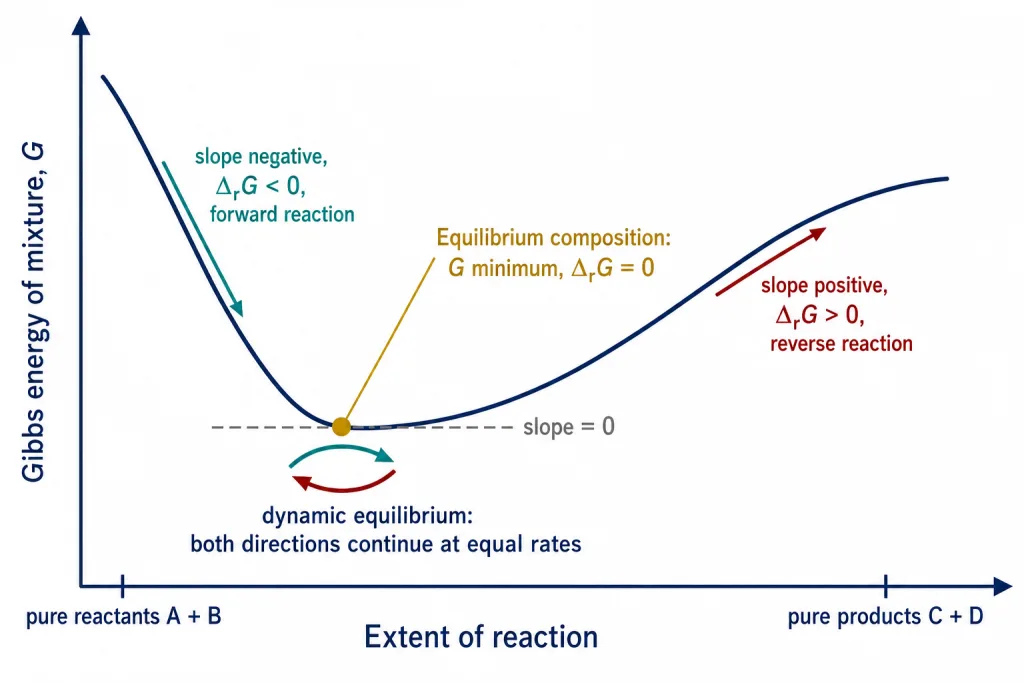
The curve dips. It has to. Mixing reactants and products always lowers below the value either pure state would have on its own, so the graph sags in the middle and passes through a minimum at some composition.
The reaction free energy is the slope of this curve at the composition the mixture currently has. Reading the graph gives the whole story:
- On the left of the minimum the slope is negative. , and the mixture runs forward.
- On the right of the minimum the slope is positive. Going forward would raise , so the mixture runs backward instead.
- At the minimum the slope is zero. , and neither direction lowers . The composition stops changing.
Key Point: A reacting mixture at constant temperature and pressure settles at the composition where its Gibbs energy is a minimum. The condition for that point is . If the mixture were anywhere else on the curve, it would spontaneously slide towards the minimum.
Two symbols now have to be kept apart, and mixing them up is the single most expensive error in this topic.
| Symbol | What it is | Value at equilibrium |
|---|---|---|
| slope of the curve at the composition present right now; changes as the reaction proceeds | zero | |
| a fixed number for the reaction with every reactant and product in its standard state (1 bar for a gas, unit concentration for a solute), quoted at a stated temperature | not zero, except in the special case |
is a variable. is a constant belonging to the balanced equation at a given temperature.
The shape of the curve also explains why no reaction ever runs fully to completion in a closed vessel. The two ends of the curve represent pure reactants and pure products, neither of which contains any mixing. Every intermediate composition is a mixture, and mixing raises entropy, which lowers by . A composition part-way along therefore has a Gibbs energy below what a straight line joining the two ends would give, and the sag guarantees a minimum somewhere strictly inside. Even a reaction with an enormous leaves a trace of reactant behind, because the minimum can never sit exactly at the right-hand edge.
Relating the Standard Gibbs Energy to K
The reaction free energy at any composition is connected to the standard value by
where is the reaction quotient, built from the amounts present at that moment exactly as the equilibrium constant is built from the amounts at equilibrium.
At equilibrium two things are true together: , and has reached its equilibrium value . Putting both in,
Key Point:
The degree sign is not decoration. The quantity fixed by is the standard reaction Gibbs energy, the one for reactants and products all in their standard states. The standard state fixes the pressure and the concentration, at 1 bar and unit concentration, and says nothing about the temperature: and both have a value at every temperature, and the numbers in tables are simply the ones measured at 298 K. The plain is zero at equilibrium and carries no information about at all. Writing without the degree sign says , which forces for every reaction in existence.
Rearranged for use in the other direction:
Units decide whether the arithmetic works. With the product comes out in , so must also be in . Standard Gibbs energies are almost always quoted in , so multiply by 1000 before dividing. Going the other way, a value computed from comes out in joules per mole and is divided by 1000 for the usual kilojoule answer.
At 298 K the combination that keeps appearing has a value worth memorising:
so at 298 K, with in kilojoules per mole,
here is dimensionless, because each pressure or concentration in it is measured against the standard state. A logarithm of a quantity with units would be meaningless.
[JEE/NEET] Questions that hand you in atmospheres and ask for expect you to feed the bare number into the logarithm. Do not try to carry the unit through.
Reading the Sign and the Size of the Standard Gibbs Energy
Because sits inside a logarithm, small changes in it produce enormous changes in . At 298 K:
| / | Position of equilibrium | ||
|---|---|---|---|
| essentially complete | |||
| products dominate | |||
| products favoured | |||
| comparable amounts | |||
| reactants favoured | |||
| very little product | |||
| negligible product |
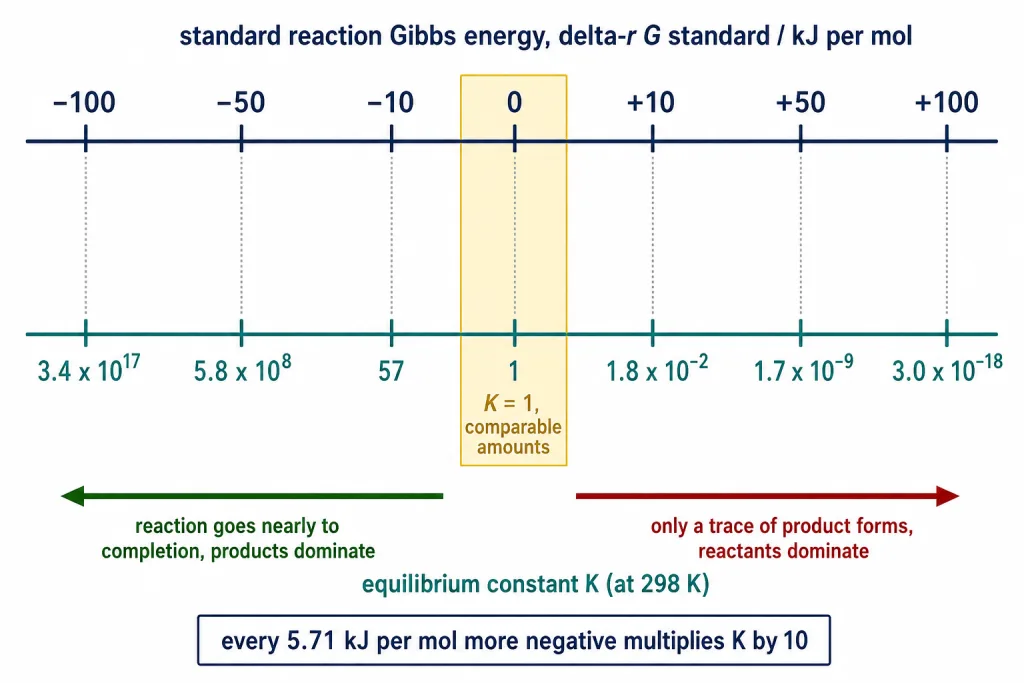
Every extra of negative multiplies by ten. A gap of 30 kJ between two reactions is a factor of about in their equilibrium constants.
Three readings to hold on to:
- large and negative gives . At equilibrium the mixture is mostly products, and the reaction is described as going nearly to completion.
- positive gives . The equilibrium mixture is mostly reactants.
- gives , an equilibrium with reactants and products in comparable amounts.
Three traps sit alongside them.
A positive does not mean the reaction cannot happen. It means is small, so only a trace of product forms before equilibrium is reached. Ozone from oxygen at room temperature has , and a tiny equilibrium amount of ozone does exist.
does not mean "no reaction". It means the equilibrium constant is exactly 1.
A negative says the standard mixture would run forward. Whether a particular mixture in front of you runs forward depends on , which needs as well: the mixture moves forward while and backward while .
Exothermic Reactions, Entropy and the Size of K
Substituting into the equilibrium relation splits into an enthalpy part and an entropy part:
A strongly exothermic reaction has large and negative, which makes the first term large and positive, so is likely to be large and negative and large. Strongly exothermic reactions are expected to have big equilibrium constants and to go nearly to completion. A strongly endothermic reaction usually has the opposite: large and positive, far below 1, and very little product.
"Likely" is doing real work in that sentence. The second term, , can pull the result the other way, and the first term shrinks as rises while the second does not.
Ammonia synthesis, , is exothermic () but four moles of gas become two, so . At 298 K the enthalpy term wins and . Raise the temperature and grows more negative in the combination , so climbs towards zero and collapses. Above about 465 K the standard Gibbs energy turns positive.
Limestone decomposition, , is the mirror image. It is endothermic (), yet a gas is produced from a solid, so . At 298 K, . Above the entropy term takes over, turns negative and exceeds 1, which is why lime kilns are run near 1200 K.
Key Point: The sign of is a good first guess at the size of , never a proof. and the temperature settle the matter through .
This relation also makes two practical routes available. Measuring by calorimetry and getting from tabulated entropies gives , and hence a prediction of at any temperature before the reaction is ever run. Measuring in the laboratory runs the calculation backwards and yields .
One more consequence is worth extracting from the same equation. Since and change only slowly with temperature, is very nearly a straight line when plotted against , with slope and intercept . Measuring at several temperatures and drawing that line is the standard way of extracting a reaction enthalpy without ever using a calorimeter. For an exothermic reaction the slope is positive, so falls as the temperature is raised; for an endothermic reaction the slope is negative and climbs with temperature. That is the quantitative version of the familiar statement that heating shifts an endothermic equilibrium towards products.
The Third Law and Absolute Entropies
Molecules in a substance move in three ways: they travel (translation), they spin (rotation), and their bonds stretch and bend (vibration). Cooling drains all three. Entropy falls with temperature, and the natural question is how far it can fall.
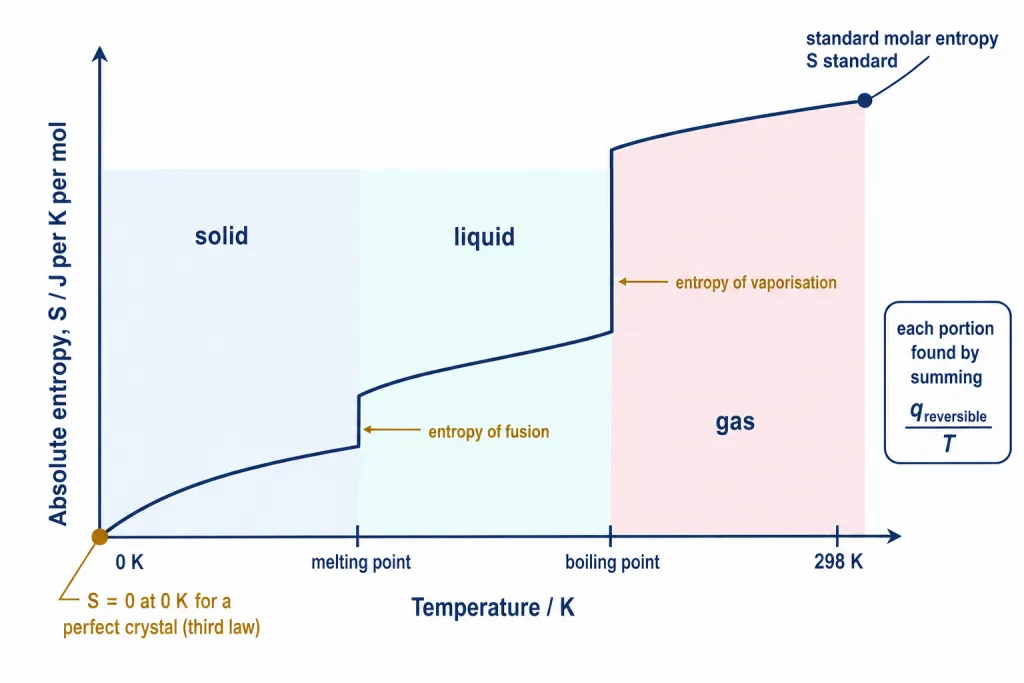
For a pure substance built into a perfect crystal, every particle is fixed at a lattice site and every motion is frozen out at absolute zero. Exactly one arrangement of the whole crystal is available, so there is no disorder left to count.
Key Point: Third law of thermodynamics — the entropy of a perfectly crystalline pure substance is zero at absolute zero, at .
The wording is deliberately narrow. Glasses, solutions and supercooled liquids freeze their disorder in place as they are cooled: the particles stop moving, but they stop in a jumbled arrangement rather than an ordered one. Both theory and measurement show that such substances keep a residual entropy at 0 K, and the third law does not claim otherwise.
Why a true zero is useful
With a genuine zero fixed, entropy can be measured on an absolute scale rather than as a difference. Cool a sample to near 0 K, warm it in small steps, and add up the contributions:
with a jump of added at each phase change. The result is the standard molar entropy , quoted in at 298 K and 1 bar. Values for pure substances are all positive.
| Substance | / |
|---|---|
| (graphite, s) | 5.7 |
| 39.7 | |
| 70.0 | |
| 92.9 | |
| 130.7 | |
| 188.8 | |
| 191.6 | |
| 192.5 | |
| 205.0 | |
| 213.8 |
A standard entropy change then follows by a Hess-type sum:
The contrast with enthalpy
No experiment measures the absolute enthalpy of a substance. A calorimeter reports the heat exchanged during a change, which is a difference in , and there is no third law for enthalpy to supply a zero. The gap is filled by a convention: an element in its reference state is assigned , and every other enthalpy of formation is quoted relative to that choice.
The two situations look similar on the page and are completely different underneath. is a bookkeeping decision. is a measured quantity, and it is nowhere near zero.
Three patterns in the table are worth carrying into an exam hall. Gases have far larger than liquids, which in turn beat solids: compare at 188.8 with at 70.0. Hard, tightly bonded solids sit at the bottom, which is why graphite manages only 5.7. And within a phase, the more atoms a molecule carries, the more ways it has of vibrating and the higher its entropy, so at 213.8 outranks at 205.0.
[Board] A question that asks for of a reaction between elements is testing exactly this. The elements contribute their full values; only their values vanish.
Question 1: Equilibrium constant from a standard Gibbs energy
For a reaction at 298 K the standard Gibbs energy change is . Find the equilibrium constant.
Answer:
I use and solve for .
The Gibbs energy is in kilojoules and is in joules, so I convert first: .
Ans: Watch out: Forgetting the factor of 1000 gives and , which looks harmless and is completely wrong.
Question 2: Standard Gibbs energy from a very small K
Calculate for at 298 K, given .
Answer:
I need the logarithm of a number smaller than 1, so it will be negative.
Ans: Watch out: Two minus signs multiply to a plus. A tiny must give a large positive , so a negative answer here is a signal to recheck.
Question 3: An equilibrium constant of exactly 10
The equilibrium constant for a reaction at 298 K is 10. Find .
Answer:
, which makes the arithmetic almost nothing.
Ans: Watch out: This is the number behind the shortcut at 298 K, with in .
Question 4: What a zero standard Gibbs energy means
A reaction has at 500 K. State what this says about the equilibrium mixture, and say whether it means the reaction does not occur.
Answer:
I put the value into the relation.
An equilibrium constant of 1 means reactants and products are present in comparable amounts once equilibrium is reached. The reaction certainly occurs; it just does not go far in either direction. The quantity that is zero at equilibrium is , not , and here the two happen to coincide only because .
Ans: ; reactants and products in comparable amounts, and the reaction does occur. Watch out: and "no reaction" are unrelated statements.
Question 5: Standard Gibbs energy from a dissociation percentage
At 333 K, is 50 per cent dissociated at a total pressure of 1 bar. Calculate for at this temperature.
Answer:
I start from 1 mol of and let half of it dissociate.
At equilibrium: , , total .
Mole fractions: and .
With a total pressure of 1 bar the partial pressures in bar are the same numbers, so
Ans: Watch out: Each mole of that dissociates gives two moles of . Using 0.5 mol of instead of 1.0 mol wrecks both and the sign of the answer.
Question 6: K for ammonia synthesis at 298 K
For , and . Find at 298 K.
Answer:
I find first, working entirely in joules.
Ans: , Watch out: is negative, so is a positive addition. Subtracting it instead gives and an absurdly large .
Question 7: How much a change in standard Gibbs energy changes K
Reaction A has at 298 K and reaction B has at the same temperature. Compare their equilibrium constants.
Answer:
Doubling the magnitude of doubles , which squares . Checking: .
Ans: , ; Watch out: is not proportional to . Doubling does not double .
Question 8: The temperature at which K becomes 1
For , and . Find the temperature at which , and state what happens above it.
Answer:
makes , so at that temperature.
Above 1110 K the term exceeds , so becomes negative and rises above 1. Decomposition then produces at a useful pressure.
Ans: ; above it and Watch out: in kJ and in J must be brought to the same unit before dividing, or the answer comes out 1000 times too small.
Question 9: Standard entropy change from absolute entropies
Using values of for , for and for , find for .
Answer:
I take products minus reactants, weighting each by its coefficient.
Four moles of gas become two, so a negative value is what the equation leads me to expect.
Ans: Watch out: The elements and contribute their full entropies. Setting them to zero, the way of an element is set to zero, gives and the wrong sign.
Question 10: Two zeros that are not the same kind
Explain why of graphite is zero at 298 K while of graphite is and not zero.
Answer:
No experiment gives the absolute enthalpy of a substance. A calorimeter measures heat exchanged during a change, which is a difference in , and nothing supplies a natural zero. Chemists therefore choose one: every element in its reference state is assigned at 298 K, and all other formation enthalpies are quoted against that choice. It is a convention.
Entropy is different, because the third law supplies a real zero. A perfect crystal of graphite has at 0 K. Warming it to 298 K adds entropy in measurable amounts, obtained by summing from the heat capacity data. The figure is that accumulated total, a measured quantity rather than an agreed one.
Ans: is a chosen reference; is an absolute value measured from the third-law zero at 0 K. Watch out: Graphite is chosen as the reference form of carbon; diamond has , not zero.
Question 11: Standard Gibbs energy from K at a temperature other than 298 K
An equilibrium constant is at 500 K. Calculate .
Answer:
The temperature is not 298 K, so the shortcut value 5705.8 does not apply and I recompute the factor.
Ans: Watch out: always gives a positive , at any temperature. Use that as a check before writing the answer down.
Question 12: A large positive standard Gibbs energy
At 298 K a reaction has . Find and comment on how far the reaction goes.
Answer:
An equilibrium constant of means the equilibrium mixture is reactants with a barely detectable trace of product. The reaction is not forbidden; it simply stops almost at once.
Ans: ; a negligible amount of product at equilibrium. Watch out: Handling needs the logarithm split as . Reading it as and rounding to is off by a factor of ten.