
What thermodynamics is about
Burn a spoon of sugar and the beaker gets hot. Drop ammonium chloride into water and the beaker gets cold. Thermodynamics is the branch of chemistry that keeps account of these energy changes: how much energy a change releases or absorbs, in what form it leaves or enters, and whether the change will happen on its own at all.
It answers three questions about any chemical or physical change:
- How much energy is exchanged with the surroundings, as heat and as work?
- Will the change occur by itself, or must it be driven?
- If it is an equilibrium, how far does it go before it stops?
What thermodynamics refuses to answer matters just as much. It says nothing about rate. It says nothing about mechanism.
The conversion of diamond into graphite releases energy and is a change thermodynamics calls favourable. Diamonds do not visibly turn to graphite, because the rate of that conversion is unimaginably slow. Thermodynamics has no clock in it. A calculation that says a reaction "can happen" is not a promise that it will happen in your lifetime. Rates belong to chemical kinetics; the step-by-step route the atoms take belongs to reaction mechanism. Thermodynamics looks only at the starting point and the finishing point.
Key Point: Thermodynamics deals with the energy changes between an initial state and a final state. It does not deal with how fast the change occurs or by what mechanism.
Macroscopic, and at equilibrium
Two more restrictions define the subject.
First, thermodynamics is macroscopic. Its variables are bulk properties — pressure, volume, temperature, amount of substance — that belong to a large collection of molecules, not to any one of them. Temperature is meaningless for a single molecule. A sample of of gas contains about molecules, and the pressure it exerts is the smoothed-out effect of all of them. Because the numbers are so large, the fluctuations average away and the bulk properties have steady, measurable values.
Second, the laws of thermodynamics apply to a system in equilibrium, or moving from one equilibrium state to another. A system is in equilibrium when its macroscopic properties stop changing with time. Water in a sealed flask at a fixed is at equilibrium; the same flask two seconds after you put it on a burner is not, because its temperature is still climbing and different parts of it are at different temperatures. In that in-between condition a single value of for the whole system does not exist, so equations written in terms of have nothing to work with.
[JEE/NEET] "Thermodynamics predicts feasibility, not rate" is a one-mark statement that appears in some form almost every session. Pair it with the diamond-to-graphite example and you will never mix it up with kinetics.
The system, the surroundings and the boundary
To keep account of energy you must first fence off the part of the world you are accounting for.
Key Point (Definition): The system is the part of the universe chosen for study and observation. The surroundings are everything else. Together, system + surroundings = universe.
If you are studying the reaction between two solutions A and B in a beaker, the beaker and its contents are the system, and the room in which the beaker stands is the surroundings.
Strictly, the surroundings are the whole of the rest of the universe. In practice a reaction in a beaker in Delhi has no effect on a star in Andromeda, so we take the surroundings to mean the region near the system that can actually interact with it — the air, the bench, the water bath.
The two are separated by a boundary: the wall across which we track every movement of matter and energy. The boundary can be real or imaginary.
- Real boundary: the glass wall of a test tube, the steel shell of a pressure cooker, the silvered wall of a thermos flask.
- Imaginary boundary: a cube of air one metre on a side inside a room, defined only by a set of coordinates. Nothing physical separates it from the rest of the room, but you can still count what crosses its faces.
The choice of boundary is yours, and it changes the answer, so it must be stated before any calculation. Take zinc granules dropped into hydrochloric acid in an open beaker.
- If you call the beaker and everything in it the system, the boundary is an imaginary surface just outside the beaker, and hydrogen gas escaping into the room is matter leaving the system.
- If you call only the reaction mixture the system, the boundary is the inner glass surface, and the beaker walls are now part of the surroundings.
Neither choice is wrong. But heat absorbed by the glass counts as "staying inside" in the first choice and as "lost to the surroundings" in the second, and the two calculations give different numbers for the heat exchanged. Fix the system first, then calculate.
Key Point: Whatever the system gives out, the surroundings take in. Heat leaving the system is heat entering the surroundings, with the same magnitude and the opposite sign.
Open, closed and isolated systems
Systems are classified by what the boundary lets through — matter, energy, both or neither.
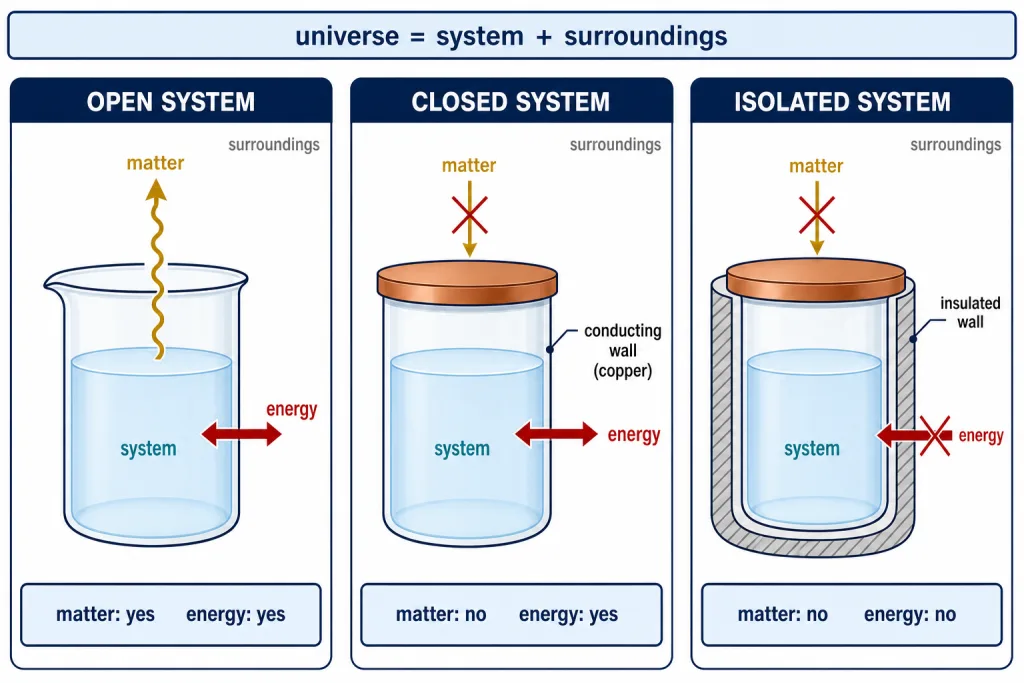
Open system. Both matter and energy cross the boundary. Reactants in an open beaker form an open system: vapour and gases leave, air enters, heat flows through the glass. A pan of milk boiling on a stove is open — steam leaves as matter, heat enters as energy. So is a burning candle, a running car engine, and your own body, which takes in food and oxygen and gives out carbon dioxide, water and heat.
Closed system. Energy crosses the boundary but matter does not. Reactants sealed in a rigid copper or steel vessel form a closed system: nothing can get in or out, but the metal conducts heat freely, so the contents warm up or cool down with the room. A sealed glass ampoule of liquid, a sealed pressure cooker on a flame, and a filled hot-water bottle are all closed systems. The pressure cooker needs care — it is closed only while the weight stays down; the moment steam whistles out, matter is leaving and it has become open.
Isolated system. Neither matter nor energy crosses the boundary. Hot coffee sealed in a perfect thermos flask is the standard example: the stopper stops matter, the vacuum jacket and silvering stop heat. No real container is perfectly isolating — leave the flask overnight and the coffee is cold — but over a short experiment the approximation is good enough to calculate with.
| System | Matter exchange | Energy exchange | Example |
|---|---|---|---|
| Open | Yes | Yes | Reactants in an open beaker; boiling milk |
| Closed | No | Yes | Reactants sealed in a steel vessel |
| Isolated | No | No | Hot coffee in a sealed thermos flask |
The universe as a whole, taken together, is the one system that is genuinely isolated: there is nothing outside it for matter or energy to move to.
Key Point: Matter can cross the boundary only in an open system. Energy can cross in both open and closed systems. Neither crosses in an isolated system.
[NEET] The trap is a sealed vessel described as "insulated" or "adiabatic" — that is isolated, not closed. A sealed vessel described as "made of copper" or "conducting" is closed. Read the wall material, not just the lid.
The state of a system and its state variables
To calculate an energy change you must be able to say precisely where the system started and where it finished. That description is the state of the system.
Key Point (Definition): The state of a system is its condition as fixed by the values of its measurable macroscopic properties — pressure , volume , temperature and amount of substance — together with its composition.
The quantities , , and are called state variables, because once you know them the system is described, no matter what history brought it there. Two samples of oxygen at , and are in the same state, and every other property they have — density, internal energy per mole, refractive index — is the same for both. It makes no difference that one was compressed from a larger volume and the other expanded from a smaller one.
In mechanics you would have to specify the position and velocity of every particle — an impossible bookkeeping job for molecules. Thermodynamics gets away with four numbers because it deals only in averages.
You do not even need all four. The state variables are linked by an equation of state, so only some of them can be varied independently. For a fixed amount of an ideal gas, ties the three together: fix any two and the third follows. Take of an ideal gas at and , with ; the volume is not something you get to choose:
For a fixed amount of a pure gas, then, two independent variables fix the state. How many are needed in general depends on the nature of the system, but the pattern is the same: once a certain minimum set is fixed, everything else takes definite values automatically.
One useful asymmetry: the state of the surroundings can never be fully specified — you cannot list the pressure and temperature of the whole rest of the universe — and fortunately you never need to. Only the changes in the surroundings that show up at the boundary matter.
State functions and path functions
This is the distinction the whole chapter rests on.
Key Point (Definition): A state function is a property whose value depends only on the present state of the system, so its change depends only on the initial and final states and not on the route taken. A path function depends on how the change was carried out, and has a value only for a route, not for a state.
, , , and internal energy are state functions. Heat and work are path functions.
Take the temperature of a beaker of water from to . Heat it straight up, or cool it to first and then warm it to . Either way . The change in a state function is fixed by the two end points. The heat you had to supply is not the same for the two routes — the second route wastes heat cooling the water and then putting it back — so is a path function.
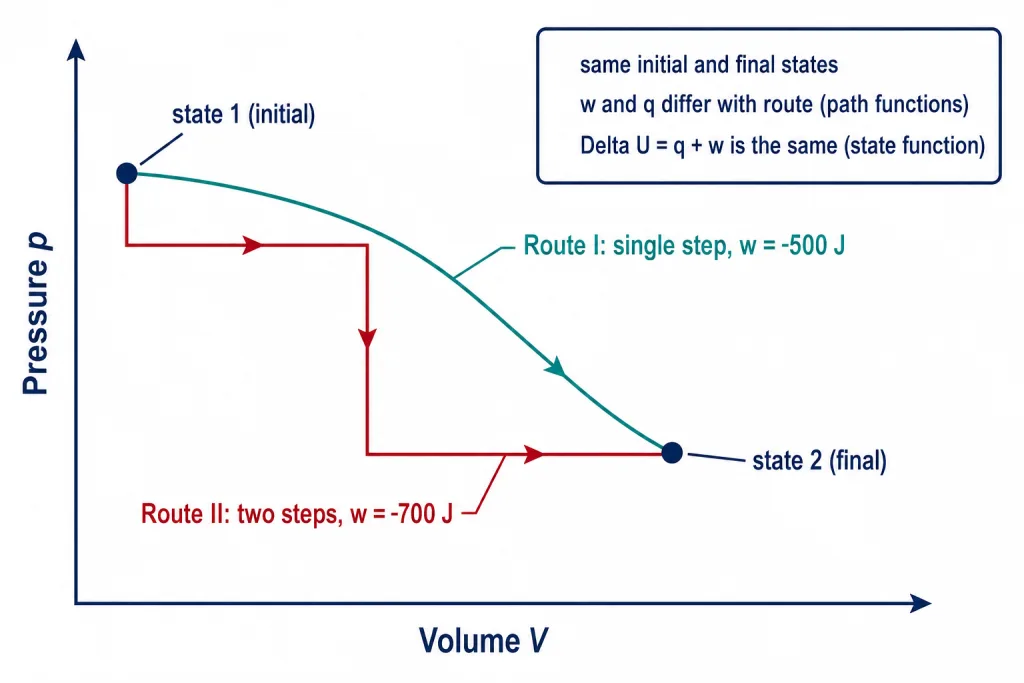
The numerical contrast is worth doing once. Let a gas go from state 1 () to state 2 () by two routes. Work done on a gas expanding against a constant external pressure is , and .
- Route I, one step against : .
- Route II, two steps — first against up to , then against up to : .
Same initial state, same final state, two different values of . That is what "path function" means, in numbers. The heat comes out different on the two routes too. But their sum is identical for both, because that sum is the change in the state function — which is exactly what makes the first law worth writing down.
A quick test for a path function: ask whether the phrase "the system has of it" makes sense. A system has a pressure, a volume, a temperature, an internal energy. It does not have heat or work. Heat and work exist only while energy is crossing the boundary; when the change is over they are gone, and only the new state remains.
Key Point: For any cyclic process, the system returns to its starting state, so the change in every state function is zero: , , . But and over the cycle are generally not zero — that is how an engine works.
Adiabatic and diathermic walls
Walls are classified by what they do to heat.
Key Point (Definition): An adiabatic wall does not allow heat to pass through it. A diathermic (thermally conducting) wall does allow heat to pass.
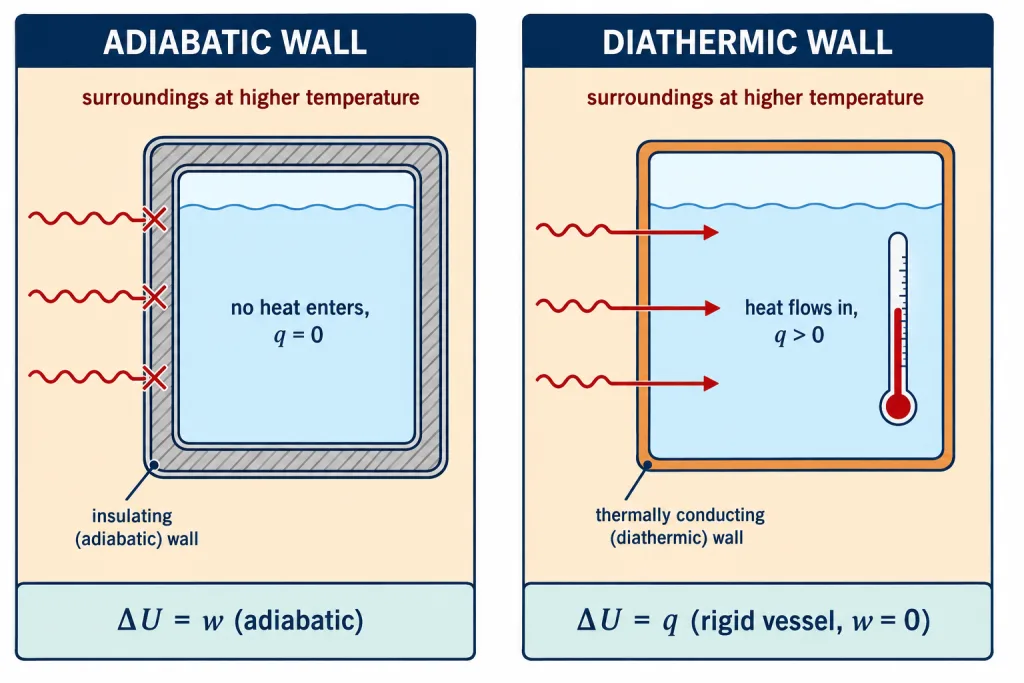
Water in a thermos flask sits behind adiabatic walls; water in a thin copper can sits behind diathermic walls. Put both in a hot room and only the copper can warms up. A process carried out inside adiabatic walls is an adiabatic process, and for it by definition.
This distinction is what lets the internal energy be pinned down experimentally. Joule, working between 1840 and 1850, took water inside adiabatic walls and did a measured amount of work on it — once by churning it with paddles, once by passing current through an immersion coil. For the same amount of work done, the temperature rose by the same amount both times. The route did not matter; only the total work did.
That result defines a state function. Inside adiabatic walls, the work needed to go from one state to another is fixed by the two states alone:
Now swap the wall for copper and put the same water in a large heat bath, letting no work be done on it (a rigid vessel, no stirring). Energy still enters, but now as heat, driven by the temperature difference. Here
and in the general case, when heat and work both cross the boundary,
That last equation is the first law, taken up in the next section. Everything in it follows from what this section has set up: a fenced-off system, a stated boundary, two path-dependent ways of moving energy across it, and one state function that does not care which way was used.
Key Point: IUPAC sign convention — is positive when heat flows into the system, is positive when work is done on the system. Both signs are written from the system's point of view.
Question 1: Sorting three containers
Classify each as open, closed or isolated: (i) tea in an open cup, (ii) a sealed rigid steel cylinder of nitrogen gas, (iii) hot soup in a stoppered vacuum flask.
Answer:
I ask two questions of each container: can matter get across the boundary, and can energy get across.
For the open cup, steam leaves and air enters, so matter crosses. Heat also leaves through the walls and the surface. Both cross, so it is open.
For the steel cylinder, it is sealed, so no matter crosses. Steel is a good conductor, so heat crosses freely. Matter no, energy yes — closed.
For the vacuum flask, the stopper blocks matter and the vacuum jacket blocks heat. Neither crosses, so it is isolated over the time of an experiment.
Ans: (i) open, (ii) closed, (iii) isolated
Watch out: "Sealed" alone only rules out matter. You still have to look at the wall to decide between closed and isolated.
Question 2: The boundary changes the answer
Magnesium ribbon is burnt in an open china dish standing on a bench. Give one sensible choice of system, the boundary that goes with it, and say what crosses it.
Answer:
I will take the magnesium and the oxygen that reacts with it as the system. The boundary is then an imaginary surface wrapped around the burning ribbon, and the china dish, the bench and the air are all surroundings.
Oxygen enters through that boundary and magnesium oxide smoke leaves, so matter crosses. Heat pours out into the dish and the air, so energy crosses. It is an open system.
If instead I take the dish plus its contents as the system, the boundary is the imaginary surface just outside the dish. It is still open — oxygen still enters, smoke still leaves — but now the heat absorbed by the china counts as staying inside the system rather than being lost to the surroundings.
Ans: Either choice is valid; both give an open system, but they book the heat taken up by the dish differently
Watch out: State the system before you calculate. Marks are lost when the boundary is silently switched halfway through a solution.
Question 3: Which ones are state functions
From the list , , , , , , , pick out the state functions and the path functions, and give the reason in one line each.
Answer:
I use the test: does the quantity have a value for a state, or only for a route?
Pressure, volume, temperature and amount of substance are things a system possesses at a given instant, so they are state functions. Internal energy is also a property the system possesses — Joule's adiabatic experiments showed its change depends only on the end states — so is a state function.
Heat and work are not possessed by anything. They are energy in transit across the boundary, and their values depend on the route, so they are path functions.
Ans: State functions: , , , , . Path functions: ,
Question 4: Two routes to the same temperature
Water at is brought to in two ways: (a) heated directly, (b) first cooled to , then heated to . Compare for the two routes, and comment on the heat supplied.
Answer:
Temperature is a state function, so its change is final minus initial and nothing else enters.
Route (a): .
Route (b): as well. The dip to cancels out — I lose going down and gain coming back up.
The heat is a different story. On route (b) I first have to remove heat to cool the water by , then supply heat for a rise. The heat supplied in the heating stage is larger than on route (a), and heat was also removed on the way. So is not the same for the two routes.
Ans: for both; the heat exchanged differs, because is a state function and is not
Question 5: Work along two routes
A gas expands from to at constant temperature. Route I: one step against a constant external pressure of . Route II: first against until the volume is , then against up to . Find for each route in joules. Take .
Answer:
Work done on the gas against a constant external pressure is . The minus sign is there because the gas is expanding, so it does work on the surroundings and its own energy falls.
Route I is a single step:
Route II has two steps, and I add the work of each.
The two routes start at the same state and finish at the same state, yet the work differs by .
Ans: , ; work is a path function
Watch out: In each step is measured for that step only, and is the pressure the gas pushes against, never the gas's own pressure.
Question 6: Making the sum come out right
For the gas in Question 5, the process is isothermal and the gas is ideal, so for both routes. Find for each route.
Answer:
The first law is , so .
Route I: .
Route II: .
Both and change when I change the route, but they change together, so that their sum stays at zero. That is the point of the first law: two path functions add up to a state function.
Ans: , ; on both routes
Question 7: Writing the energy change for three walls
Express for each: (i) work is done on a system enclosed by adiabatic walls, (ii) heat leaves a system through thermally conducting walls while its volume is fixed, (iii) a closed system in which heat enters and the system does work of magnitude on the surroundings.
Answer:
I start from every time and then knock out whichever term is zero, keeping the IUPAC signs.
(i) Adiabatic walls mean no heat passes, so and . Work done on the system is positive, so the internal energy rises.
(ii) The volume is fixed, so no expansion work is done and . Heat leaves the system, so is negative and I write it as for a magnitude . Then .
(iii) Both terms survive. Heat enters, so that term is . Work is done by the system, so the work term is negative: .
Ans: (i) , (ii) , (iii)
Watch out: The symbols and already carry their own signs. Write only when the question has already told you is a magnitude of heat lost.
Question 8: The perfect thermos
Hot coffee is sealed in an ideal thermos flask and left for an hour. Taking the coffee as the system, state , and , and say what this means for its temperature.
Answer:
The flask is ideal, so no heat crosses the walls: . Nothing moves the boundary and no shaft work is done, so .
From the first law, .
The internal energy is unchanged, so for a fixed amount of liquid the temperature is unchanged too. The coffee is as hot after an hour as it was at the start.
Ans: , , ; the temperature stays constant
Watch out: This holds for an ideal isolated system. Real flasks leak heat slowly, which is why the coffee is lukewarm by evening — the isolation is an approximation, not a fact.
Question 9: How many numbers fix the state
For of an ideal gas, how many of , and may be chosen independently? If and , find . Take .
Answer:
The three variables are tied together by , so only two of them are free. Once I fix any two, the equation hands me the third.
Ans: Two are independent;
Question 10: Around a cycle and back
A gas is taken from state A to state B and then back to A along a different route. State the value of , and for the whole cycle. If the gas absorbs of heat over the cycle, find .
Answer:
At the end of the cycle the system is back in state A, so every state function has returned to the value it had at the start. Their changes are all zero: , , .
For I use the first law over the whole cycle:
The negative sign says work is done by the gas on the surroundings. Over the cycle the gas took in of heat and handed out of work, ending exactly where it began.
Ans: ;
Watch out: and are not zero over a cycle even though is. If they were, no heat engine could run.
Question 11: What the calculation cannot tell you
Thermodynamics shows that the change releases energy and is favourable at room temperature. Explain why diamonds do not turn into graphite on a shelf.
Answer:
The thermodynamic result says only that graphite is the lower-energy, more stable form — that the change is allowed in the direction diamond to graphite.
It says nothing about how fast the change goes. To rearrange the rigid three-dimensional network of a diamond into layers of graphite, a very large number of strong C-C bonds must break at once, and at room temperature almost no atoms have enough energy to start. The rate is effectively zero.
So the change is thermodynamically favourable but kinetically blocked. Speed is a question for chemical kinetics, and no thermodynamic quantity contains time.
Ans: The conversion is favourable but immeasurably slow; thermodynamics predicts direction and extent, never rate
Question 12: Reading the wall, not the lid
Classify: (i) a sealed glass ampoule of bromine placed in a water bath, (ii) a plant growing in a pot, (iii) the whole universe, (iv) a pressure cooker whistling on a flame.
Answer:
(i) The ampoule is sealed, so no bromine gets out. Glass conducts heat, so the water bath warms or cools the contents. Matter no, energy yes — closed.
(ii) The plant takes in water, carbon dioxide and minerals, and gives out oxygen; it also absorbs sunlight and loses heat. Both matter and energy cross — open.
(iii) There is nothing outside the universe, so neither matter nor energy can leave it — isolated.
(iv) While the whistle blows, steam is escaping, so matter crosses the boundary, and heat is entering from the flame. Both cross — open. Before the weight lifts, with the lid sealed, it was closed.
Ans: (i) closed, (ii) open, (iii) isolated, (iv) open while whistling (closed before that)
Watch out: The same physical object can change category during a process. Decide from what is crossing the boundary at the moment in question.