
How to Use This Section
The theory is finished. What follows is one long problem set: 35 questions worked out in full, arranged from the simplest to the hardest, covering the in-text problems and the end-of-chapter exercises that boards, JEE Main and NEET keep recycling.
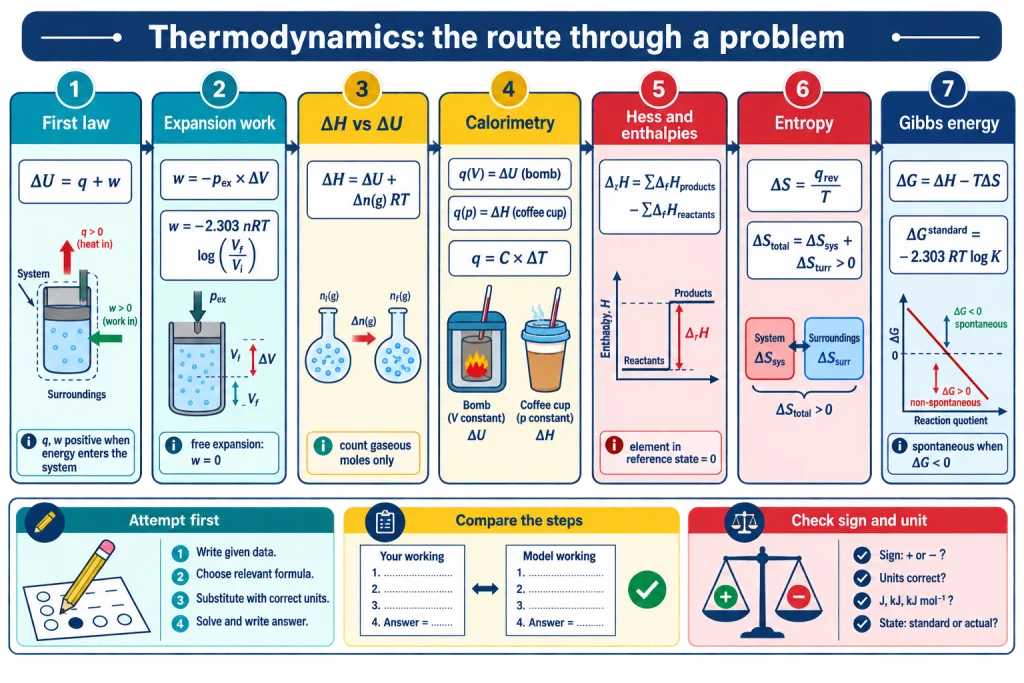
Every solution is written the way an answer script should be written: the relation first, the substitution second, the number with its unit last. Where a question hides a trap, a Watch out line names it.
The working method
- Cover the answer and attempt the question on paper. Reading a solution feels like learning and is not.
- Compare your steps with mine, not only your final number. A right answer reached by a wrong route collapses the moment the data change.
- Before pressing a calculator key, check that every energy term in the equation carries the same unit. Half the lost marks in this chapter are a stray factor of 1000.
- Read the Watch out line even when your answer matched.
- Two days later, redo from a blank page any question you could not finish.
The errors that cost the most marks in this chapter
| Error | Where it bites | The fix |
|---|---|---|
| Writing | Every expansion question; the sign of and then of flips | The IUPAC form is . Expansion means , so comes out negative |
| Counting solids and liquids in | Converting a bomb-calorimeter into | counts gaseous moles only, products minus reactants. Water written as contributes nothing |
| Leaving work in L atm when joules were asked | Expansion-work numericals | and |
| Mixing J and kJ in | Crossover-temperature and spontaneity questions | almost always arrives in and in . Convert one of them first |
| Flipping a thermochemical equation but not its sign | Hess cycles, Born-Haber, formation-from-combustion problems | Reverse the arrow, reverse the sign. Multiply the equation, multiply the value |
| Using the system's own sign for | Second-law questions | . An exothermic reaction raises the entropy of the surroundings |
A last piece of advice about presentation. In a board answer script, a numerical earns marks in three places: the relation quoted, the substitution shown with units, and the final value with its sign and unit. An answer that jumps from the data straight to a boxed number forfeits two of those three even when the number is right. Every solution below is laid out in that order deliberately, so that copying the layout costs nothing extra.
[JEE/NEET] In a numerical, the marks sit on the sign and the unit far more often than on the arithmetic. Write , , and with their signs explicitly before substituting.
Question 1: Reading the first law off the wall
Express the change in internal energy of a system when
(i) no heat is absorbed by the system from the surroundings, but work is done on the system. What kind of wall does the system have? (ii) no work is done on the system, but amount of heat is taken out of the system and given to the surroundings. What kind of wall does the system have? (iii) amount of work is done by the system and amount of heat is supplied to the system. What kind of system is this?
Answer:
I start from the first law in the IUPAC convention, , where both and are positive when energy enters the system.
In (i) no heat crosses the boundary, so and
A boundary that blocks heat but still lets the piston move is an adiabatic wall. The change is an adiabatic compression, and every joule of work done on the gas stays in it as internal energy.
In (ii) no work is done, so . Heat leaves the system, so carries a negative sign: the heat entering it is , and
Heat can cross the boundary, so the wall is thermally conducting, a diathermic wall.
In (iii) the symbol is the magnitude of the work done by the system, so the work done on it is , while heat enters, so is positive:
Both heat and work cross the boundary but matter does not, so this is a closed system with a diathermic wall.
A fourth case is worth naming even though it was not asked. If the walls block both heat and work, nothing at all crosses the boundary, and , and . That is an isolated system. The first law then has nothing left to say about which way a change inside it will run, which is precisely the gap entropy is invented to fill later in the chapter.
The pattern to carry forward is that the first law never needs memorising in three versions. There is one equation, , and the wall decides which term survives.
Ans: (i) , adiabatic wall; (ii) , diathermic wall; (iii) , closed system with a diathermic wall. Watch out: In part (iii) the symbol in the question already means the magnitude of work done by the system. Feeding into would give the wrong sign. Decide the direction first, then attach the sign.
Question 2: Heat in, work out
In a process, 701 J of heat is absorbed by a system and 394 J of work is done by the system. What is the change in internal energy for the process?
Answer:
Heat is absorbed by the system, so .
Work is done by the system on the surroundings, so energy leaves the system as work and .
The internal energy rises by 307 J: the system took in more energy as heat than it gave out as work.
A physical check confirms the sign. The system collected 701 J and paid out 394 J, so it must end 307 J richer than it started. Whenever the heat absorbed exceeds the work done by the system, comes out positive.
One more remark, because it causes confusion between subjects. Many physics texts define as the work done by the system and write the first law as . The physics is identical and the final number is identical; only the bookkeeping differs. Chemistry uses the IUPAC convention throughout, in which energy entering the system is positive, so keep and let the direction of flow supply the sign.
Ans: Watch out: "394 J of work is done by the system" is not . Writing it as positive gives , which is the commonest wrong answer to this question.
Question 3: Three one-line checks
(a) A thermodynamic state function is a quantity of what kind? (b) For a process to occur under adiabatic conditions, what must be true? (c) What are the standard enthalpies of all elements in their standard states?
Answer:
(a) A state function is fixed by the present state of the system alone. Its change between two states depends only on the initial and final states and not on the route taken. Internal energy, enthalpy, entropy, Gibbs energy, pressure, volume and temperature are state functions; heat and work are not, because they are quantities of energy in transit and their values depend on the path. Questions 4 to 6 make the distinction concrete: the same pair of initial and final states there gives three completely different values of and of , and the same value of every time.
(b) Adiabatic means no heat is exchanged with the surroundings, so . Temperature is not fixed in an adiabatic change; in fact an adiabatic expansion cools the gas, so is wrong. Nor is : an adiabatic process usually does work, and with the first law reduces to .
(c) By convention the standard enthalpy of formation of an element in its reference state is taken as zero. That fixes the zero of the enthalpy scale, so of , , and are all zero. It applies only to the reference form: , diamond and have non-zero values.
Ans: (a) a quantity whose value is independent of the path; (b) ; (c) zero. Watch out: is the isothermal condition, not the adiabatic one. A great many students tick it here.
Question 4: An expansion into a vacuum
Two litres of an ideal gas at a pressure of 12.2 atm expands isothermally at into a vacuum until its total volume is 10 litres. How much heat is absorbed and how much work is done in the expansion?
Answer:
Expansion into a vacuum means there is nothing outside pushing back, so the external pressure is zero:
Work of expansion is , and with ,
The gas is ideal and the temperature is constant, so the internal energy does not change, . The reason is worth stating once: the internal energy of an ideal gas depends on temperature alone, because its molecules exert no forces on one another, so moving them further apart costs no energy. From the first law,
No work is done and no heat is absorbed. The gas simply spreads out, and because the molecules of an ideal gas do not attract one another, spreading out costs no energy.
Ans: and . Watch out: The initial pressure of 12.2 atm plays no part in the calculation. Only appears in , and here it is zero. Students who substitute 12.2 atm get , which is the work of a completely different process.
Question 5: The same expansion against 1 atm
Consider the same expansion, but this time against a constant external pressure of 1 atm.
Answer:
Now the gas has to push the surroundings back at a steady 1 atm.
The negative sign says energy has left the system as work, which is right for an expansion.
The process is isothermal and the gas is ideal, so and
Converting to joules with :
The gas absorbs 810 J of heat from the surroundings and hands out exactly the same energy as work, so its internal energy is unchanged.
Compare this with Question 4. The gas started at the same 2 L and finished at the same 10 L, at the same temperature, and yet this time it did 810 J of work and drew 810 J of heat. Nothing about the two end states changed. Only the route did.
Ans: ; . Watch out: is the pressure the gas pushes against, not the pressure of the gas. In an irreversible expansion the two are different at every instant, and only the external one belongs in .
Question 6: The same expansion carried out reversibly
Consider the expansion of Question 4 again, this time for 1 mol of an ideal gas conducted reversibly.
Answer:
For an isothermal reversible expansion of an ideal gas the external pressure is kept infinitesimally below the gas pressure at every instant, and the work is
With , , , , so and .
Taking :
In joules, using :
Since for the isothermal change,
Why the reversible number is the largest is worth seeing rather than memorising. In the irreversible run the gas pushed against a fixed 1 atm the whole way, even at the start when its own pressure was 12.2 atm and it could have pushed against nearly 12.2 atm. In the reversible run the external pressure is lowered in step with the gas pressure, so at every instant the gas is doing the most work the surroundings will let it do. Add up all those instants and the total is the maximum any path can deliver between these two states.
Ans: ; . Watch out: Line up the three answers. The same initial and final states give into a vacuum, against 1 atm and reversibly. Work is a path function, and the reversible path extracts the maximum. is zero in all three, because is a state function.
Question 7: Compressing a gas in one step
One mole of an ideal gas held at 300 K is compressed from 20.0 L to 5.0 L in a single step against a constant external pressure of 5.0 bar. Calculate , and in joules.
Answer:
Positive work means work has been done on the gas, which is what compression should give.
Converting with :
The temperature is held at 300 K throughout and the gas is ideal, so . From the first law,
The 7.5 kJ pushed in as work leaves again as heat into the thermostat bath.
It is worth asking how this compares with a reversible compression between the same two volumes. That would need , less than half the single-step figure. The rule for expansion inverts for compression: the reversible path takes the least work out of you, because the external pressure is never more than a whisker above the gas pressure. Slamming a piston down in one step against a fixed 5 bar wastes energy as heat.
One more check on the signs, because they are the whole difficulty in this question. Compression means is negative. A negative multiplied by the minus sign in leaves positive, and positive means energy has gone into the system. Every one of those three statements agrees with the physical picture of someone pushing a piston in. If your answer for a compression comes out negative, the error is almost always that was written as instead of .
Ans: , , . Watch out: exactly, while . Read which unit the external pressure came in before choosing the factor.
Question 8: Two paths and a closed cycle
A system is taken from state A to state B along path I, absorbing 60 J of heat and doing 30 J of work on the surroundings. It is then returned from B to A along a different path II, along which 40 J of work is done on the system. Find for path II, and the totals of and for the complete cycle.
Answer:
For path I, and because the system does the work.
Internal energy is a state function, so the return trip must undo exactly this change no matter which route it takes:
Along path II work is done on the system, so , and
The system gives out 70 J of heat on the way back.
Over the whole cycle the system returns to its starting state, so
and their sum is zero, as it must be.
Every step of this problem rests on one idea. I was never told what happens between A and B on either path, and I did not need to know. is fixed by the two end states, so once path I gave me , path II was forced to give whatever it did in between. The individual and values, by contrast, are different on the two paths and could have taken any pair of values summing correctly.
The cycle result is also the reason a heat engine can exist at all. Over one complete cycle the working substance ends where it began, so its internal energy is unchanged, and every joule of net heat it takes in must leave as net work. Nothing accumulates inside the engine. What the second law adds later is that the heat cannot all be taken from one source; some must be dumped at a lower temperature.
Ans: ; over the cycle , , . Watch out: round a cycle does not mean and round a cycle. It means they are equal and opposite. That single line is the whole idea behind every heat engine.
Question 9: Internal energy of vaporisation of water
Assuming water vapour to be a perfect gas, the molar enthalpy change for vaporisation of 1 mol of water at 1 bar and is . Calculate the internal energy change when 1 mol of water is vaporised at 1 bar and .
Answer:
The change is
Gaseous moles: one on the right, none on the left, so .
Of the 40.79 kJ supplied, about 3.1 kJ is spent pushing the atmosphere back to make room for the vapour, and only 37.7 kJ goes into the molecules themselves. One mole of liquid water occupies about 18 mL; as vapour at 373 K and 1 bar it occupies about 31 L. Something has to move the air out of the way, and that something is paid for out of the heat supplied.
For any process in which gas is created, is positive and is therefore larger than . Vaporisation, sublimation and the decomposition of a carbonate all sit in that family.
Ans:
Question 10: The bomb-calorimeter value for cyanamide
The reaction of cyanamide, , with dioxygen was carried out in a bomb calorimeter and was found to be at 298 K. Calculate the enthalpy change for the reaction at 298 K.
Answer:
A bomb calorimeter runs at constant volume, so what it measures is . The vessel is sealed steel, , no expansion work is possible, and the first law collapses to . Converting that measurement into the a chemist actually wants is the whole point of this question.
I count gaseous moles only. On the product side: and , that is 2 mol of gas. Water is liquid, so it contributes nothing. On the reactant side: mol of , since cyanamide is a solid.
Ans: Watch out: here is a fraction, and fractions are allowed. Rounding to 2 makes and hands back , which is wrong.
Question 11: Counting gaseous moles, and the sign it forces
(a) Write for each reaction below and state which ones have .
(i) (ii) (iii) (iv) (v)
(b) of combustion of methane is . What can be said about ?
Answer:
(a) Counting gases only, products minus reactants:
| Reaction | Gaseous products | Gaseous reactants | |
|---|---|---|---|
| (i) | 1 | 3 | |
| (ii) | 1 | 1 | |
| (iii) | 1 | 0 | |
| (iv) | 2 | 2 | |
| (v) | 2 | 4 |
whenever , so in (ii) and (iv).
(b) Methane combustion is reaction (i), with .
Subtracting a positive quantity from makes the result more negative, so .
Numerically at 298 K, , so .
Notice how small that correction is. At room temperature is only about , so unless is large the gap between and is a few kilojoules on a reaction enthalpy of several hundred. That is why the two are often quoted as though they were interchangeable, and also why an exam question that asks for the difference is really asking whether you can count gaseous moles.
Ans: (a) ; for (ii) and (iv). (b) . Watch out: "More negative" means smaller, not larger. With negative the answer is always , whichever way the arithmetic feels.
Question 12: Heating a block of aluminium
Calculate the number of kJ of heat necessary to raise the temperature of 60.0 g of aluminium from to . Molar heat capacity of Al is .
Answer:
The capacity given is molar, so I need moles, not grams. The molar mass of aluminium is .
A temperature difference is the same number in celsius and in kelvin:
Three forms of the same relation are worth keeping straight, because the data decide which one to use. With a molar heat capacity, . With a specific heat, . With the heat capacity of a whole object such as a calorimeter, with nothing else attached. Reading which of the three has been handed to you takes five seconds and saves the question.
It is instructive to convert the given value into a specific heat: for aluminium, against for water. Gram for gram, water needs almost five times as much heat for the same rise in temperature. That is why a metal spoon in a hot drink burns the fingers within seconds while the drink itself cools slowly, and why water is the standard coolant in radiators and calorimeters alike.
Ans: Watch out: Do not convert and to kelvin separately and then subtract in a panic. The difference is unchanged; converting only wastes time.
Question 13: Heating the same gas two different ways
Two moles of an ideal gas whose molar heat capacity at constant pressure is are warmed from 300 K to 350 K. Find the heat required (a) at constant pressure and (b) at constant volume, and account for the difference. Take .
Answer:
For an ideal gas the two molar capacities differ by :
(a) At constant pressure, :
and since , the enthalpy rises by 2910 J.
(b) At constant volume, :
and since , the internal energy rises by 2079 J.
The difference is
which is , rounded to the above. That extra energy is the expansion work the gas does on the atmosphere while it warms at constant pressure. At constant volume it does no work, so all the heat stays inside as internal energy.
This is the whole content of , and it is the same idea as seen from a different angle. Heat a gas in a sealed box and every joule raises the internal energy. Heat it under a free piston and part of every joule is spent shoving the atmosphere aside, so more heat is needed for the same rise in temperature. The extra, per mole per kelvin, is exactly .
The value of given here, close to , is worth recognising. For a monatomic ideal gas and ; for a diatomic gas at ordinary temperatures the figures are and . The gas in this question is therefore behaving as a diatomic one. The difference holds for both, because the expansion work per mole per kelvin does not care how many atoms are in the molecule.
Ans: (a) ; (b) ; the difference , which is rounded, is expansion work. Watch out: is 2079 J in both cases, because for an ideal gas depends only on the temperature change. Only in the constant-volume run does it happen to equal the heat supplied.
Question 14: Burning graphite in a bomb calorimeter
1 g of graphite is burnt in a bomb calorimeter in excess of oxygen at 298 K and 1 atmospheric pressure according to the equation
During the reaction the temperature rises from 298 K to 299 K. If the heat capacity of the bomb calorimeter is , what is the enthalpy change for the reaction at 298 K and 1 atm?
Answer:
Heat gained by the calorimeter:
Whatever the calorimeter gained, the reaction mixture lost. Same magnitude, opposite sign:
The negative sign says the reaction is exothermic. The bomb is sealed, so the volume is fixed and no work is done; this heat is therefore for the burning of 1 g of graphite.
For one mole I scale by the molar mass, :
One mole of gas is consumed and one mole is produced, so and
Two sanity checks are worth running. First, the sign: the water bath got hotter, so the reaction gave out heat, so and must be negative. Second, the magnitude: the accepted enthalpy of combustion of graphite is , and this calorimeter gives , which is the tabulated value to the precision of the data.
Ans: Watch out: The heat capacity quoted is that of the whole calorimeter assembly, already in , so no mass and no specific heat is needed. Multiplying by 1 g or by 1000 is a common slip.
Question 15: A neutralisation in a coffee-cup calorimeter
50.0 mL of 1.00 M HCl and 50.0 mL of 1.00 M NaOH, both at , are mixed in a coffee-cup calorimeter. The temperature rises to . Take the density of the mixture as , its specific heat as , and the heat capacity of the cup as negligible. Find the enthalpy of neutralisation per mole of water formed.
Answer:
The cup is open to the atmosphere, so the pressure is constant and the heat measured is .
Mass of solution:
Heat taken up by the solution:
The solution gained it, so the reaction released it:
Moles of water formed. HCl supplies of , NaOH the same amount of , so 0.0500 mol of water forms and neither reagent is left over.
The accepted value for a strong acid neutralised by a strong base is close to , and it barely changes whichever strong acid and strong base are used. Both are fully dissociated in solution, so the only chemistry happening is . That constancy is itself an experimental argument for complete dissociation.
Note the contrast with Question 14. The bomb is sealed, so it delivers . The cup is open to the air at atmospheric pressure, so it delivers directly, with no correction needed.
One approximation has been swallowed here and is worth naming. The specific heat and density used are those of water, not of a salt solution, and the heat absorbed by the polystyrene cup and the thermometer has been ignored. Both approximations push the answer slightly low, which is part of why falls a little short of . A more careful experiment measures the heat capacity of the calorimeter itself first, by mixing hot and cold water in it, and adds to the heat account.
Ans: Watch out: The heat is absorbed by the whole 100 g of mixed solution, not by 50 g. And the moles used in the last step are the moles of water formed, not the total moles of acid plus base.
Question 16: Heat released in making a fixed mass of carbon dioxide
Enthalpy of combustion of carbon to is . Calculate the heat released upon formation of 35.2 g of from carbon and dioxygen gas.
Answer:
The thermochemical equation is
so 393.5 kJ comes out for every mole of made.
Molar mass of .
A reaction enthalpy is an extensive quantity once the amount is fixed: double the amount of substance and you double the heat. What stays fixed is the value per mole, which is why thermochemical data are always tabulated with attached. Reading the units of the given value tells you at once whether to multiply by moles.
For this reaction of carbon and of happen to be the same number, because burning graphite in oxygen is also the formation reaction of carbon dioxide. That coincidence holds only when the combustion product is the compound being formed.
The same figure can be reached from the carbon side, which is a useful cross-check when the question gives the mass of the fuel rather than of the product. 0.800 mol of requires 0.800 mol of carbon, that is 9.6 g of graphite, and burning 9.6 g of graphite releases the same 314.8 kJ. Both routes must agree because the equation has a one-to-one stoichiometry.
Ans: 314.8 kJ of heat is released, that is . Watch out: The question asks for "heat released", so the number quoted is 314.8 kJ, but if the answer is written as it must carry the minus sign. State which one you are giving.
Question 17: Formation enthalpy of ammonia from a reaction enthalpy
Given , . What is the standard enthalpy of formation of ammonia gas?
Answer:
A formation reaction makes exactly one mole of the compound from its elements in their reference states. The equation given makes two moles of , so I halve it:
Halving the equation halves the enthalpy change:
Both and are elements in their reference states, so their formation enthalpies are zero and nothing else has to be subtracted.
The general statement behind this one-line calculation is worth writing out, because the next two questions lean on it:
Key Point: , with each value multiplied by its stoichiometric coefficient and every element in its reference state contributing zero.
Applied here, , which rearranges to the same .
Ans: Watch out: Fractional coefficients are compulsory here. Writing and calling the formation enthalpy is the standard error.
Question 18: A reaction enthalpy from a table of formation enthalpies
Enthalpies of formation of , , and are , , and respectively. Find for
Answer:
Products:
Reactants:
The large negative value makes chemical sense. Carbon monoxide is a good reducing agent with a fairly weak hold on its oxygen, while carbon dioxide is a very stable molecule, so moving three oxygen atoms from a nitrogen oxide onto CO releases a great deal of energy.
Watch the two positive entries in the data. of and of are both positive, meaning those oxides sit above their elements in enthalpy. Positive formation enthalpies are perfectly legal and must be carried into the sum with their own signs, not turned negative on the way in.
Ans: Watch out: Every formation enthalpy must be multiplied by its stoichiometric coefficient before the sum. Dropping the 3 in front of CO and gives , a favourite distractor.
Question 19: Formation enthalpy of methanol by Hess's law
Calculate the standard enthalpy of formation of from the following data:
Answer:
The equation I want is the formation of one mole of liquid methanol from its elements:
I build it from the three given equations.
Carbon appears on the left of (ii), which is where I want it, so I keep (ii) as it is.
Two moles of are needed on the left, so I take (iii).
Methanol must end up on the right, but in (i) it is on the left, so I reverse (i) and reverse the sign of its enthalpy.
A quick check on the oxygen bookkeeping: (ii) plus twice (iii) uses mol of , and reversing (i) releases mol, leaving mol on the left. That is exactly the target equation.
The routine here is worth fixing as a habit, because every Hess's law question yields to it:
- Write the target equation first, with the correct states and one mole of the substance being formed.
- Decide for each given equation whether it must be reversed, and whether it must be multiplied.
- Apply the same operation to the enthalpy value: reversing flips the sign, multiplying by multiplies the value by .
- Add the equations and check that every species not in the target has cancelled.
Step 4 is the one students skip, and it is the only step that catches a mistake made in step 2.
Ans:
Question 20: Formation enthalpy of methane from combustion data
The enthalpies of combustion of methane, graphite and dihydrogen at 298 K are , and respectively. Calculate the enthalpy of formation of .
Answer:
The three combustion equations are
Target:
Take (ii) (iii) (i):
Note the shape of the result: for a compound whose elements and whose own combustion all end at the same products,
The reason it works is that all three combustions end at the same place, and . Burning the elements and burning the compound are two routes from the same starting materials to the same products, so the difference between them is the enthalpy of turning the elements into the compound. Drawing that as a triangle, with the elements at the top left, methane at the top right and the combustion products at the bottom, makes the subtraction obvious and takes about ten seconds.
Methane's is negative, so methane is more stable than the carbon and hydrogen it is made from. That is the usual situation for a stable compound, and it contrasts sharply with the benzene result in the next question.
Ans: Watch out: The compound's own combustion enthalpy is subtracted, the elements' are added. Reversing that gives , which is offered in every version of this question.
Question 21: A positive formation enthalpy, and what it says about stability
(a) The combustion of one mole of benzene takes place at 298 K and 1 atm. After combustion, and are produced and 3267.6 kJ of heat is liberated. Calculate the standard enthalpy of formation of benzene. Standard enthalpies of formation of and are and .
(b) Comment on the thermodynamic stability of , given
Answer:
(a) The combustion equation is
and the target is
Using :
The value is positive: benzene sits above its elements on the enthalpy scale. The tabulated figure is , and the small gap is rounding in the formation data used as input. A minus sign appears in front of this number in some printings, and it is a slip rather than a different convention: the products come to and the combustion term contributes , and adding two numbers of those magnitudes can only give a small positive result.
(b) , also positive, so NO is higher in enthalpy than the dinitrogen and dioxygen it came from. On enthalpy grounds it is unstable with respect to its own elements.
The second equation makes it worse. Converting NO to releases 74 kJ per mole, so there is a still lower enthalpy state available to it. NO is therefore unstable both with respect to decomposing into and and with respect to being oxidised further to . This is why nitric oxide made in an engine cylinder does not stay as NO in the open air: it browns into within minutes.
The general reading of a formation enthalpy is short. A negative places the compound below its elements, so it will not fall apart into them on enthalpy grounds. A positive places it above them, and the compound is described as endothermic and thermodynamically unstable with respect to its elements.
Ans: (a) , against a tabulated ; (b) NO is thermodynamically unstable, both towards its elements and towards oxidation to . Watch out: "Unstable" here is a thermodynamic statement only. Benzene and NO both survive on the shelf because their decompositions are slow, and thermodynamics says nothing about rate.
Question 22: The swimmer and the film of water
A swimmer coming out of a pool is covered with a film of water weighing about 18 g. How much heat must be supplied to evaporate this water at 298 K? Calculate the internal energy of vaporisation at 298 K. for water at 298 K is .
Answer:
That heat comes out of the swimmer's skin, which is why standing wet in a breeze feels cold.
For the internal energy, the change is , so :
Compare this with Question 9, where the same substance vaporising at 373 K needed . Vaporisation enthalpy falls as the temperature rises, because the liquid at the higher temperature already has more energy in it and there is less of a gap to close. The two numbers, at 298 K and at 373 K, show that fall directly.
The cooling effect is real and large. Evaporating that thin film draws 44 kJ from the swimmer's body, roughly the energy released by burning a gram of fat, and it is drawn from the skin faster than the body can replace it. Sweating works on exactly the same principle, and so does the earthen water pot that keeps water cool by letting a little seep through and evaporate.
Ans: ; Watch out: The temperature in is 298 K, the temperature stated in the question, not 373 K. Vaporisation does not have to happen at the boiling point.
Question 23: Freezing water below its freezing point
Calculate the enthalpy change on freezing of 1.0 mol of water at to ice at . at ; ; .
Answer:
Water does not freeze at , so I cannot use directly. Enthalpy is a state function, so I route the change through , where the phase change data apply, in three steps.
Step 1, cool the liquid from to :
Step 2, freeze at . Freezing is the reverse of fusion, so the sign flips:
Step 3, cool the ice from to :
Adding:
Look at the relative sizes. The phase change alone accounts for 6000 J of the 7121 J, while cooling twenty degrees in total contributes barely a thousand. Breaking or making the hydrogen-bonded network costs far more than nudging the temperature, which is the general reason phase-change enthalpies dominate this kind of multi-step calculation.
The structure of the answer is the important part, not the arithmetic. Whenever a process starts or ends at a temperature where the tabulated phase-change data do not apply, build a route through the temperature where they do. Enthalpy is a state function, so the detour costs nothing.
Ans: Watch out: Two things flip sign here and both are easy to miss: the cooling steps have negative , and freezing carries , not . Also use the liquid capacity above and the solid capacity below it.
Question 24: Steam to ice, and its internal energy change
Assuming water vapour to be a perfect gas, calculate the internal energy change when 1 mol of water at and 1 bar pressure is converted to ice at . Enthalpy of fusion of ice is ; heat capacity of water is .
Answer:
Two steps take liquid water at to ice at .
Step 1, cool 1 mol (18 g) of liquid water from to :
Step 2, freeze it at :
For the internal energy: only a liquid and a solid are involved and neither changes volume appreciably, so and .
That last line states a rule worth keeping. For processes involving only solids and liquids, and are equal for all practical purposes, because condensed phases hardly change volume and is negligible. The two quantities part company only when gases appear or disappear.
The negative sign carries a physical meaning too. Going from hot water to ice releases 13.52 kJ per mole into the surroundings, which is exactly the heat a freezer has to pump out to make a mole of ice from water at .
Ans: Watch out: The capacity given is per gram, so it multiplies the 18 g mass, not the 1 mol amount. Compare Question 12, where the capacity was molar and the mass had to be turned into moles first.
Question 25: A reaction enthalpy from bond enthalpies
Estimate the standard enthalpy of the gas-phase reaction
from the mean bond enthalpies , and . Compare with the value from .
Answer:
Bonds broken cost energy, bonds made release it:
Reactants: one H-H bond and one Cl-Cl bond.
Products: two molecules of HCl, so two H-Cl bonds.
From formation enthalpies, the same reaction makes 2 mol of HCl:
The two agree to well under a kilojoule, which is as close as mean bond enthalpies ever get.
They agree so well here for a specific reason: every bond involved is in a simple diatomic molecule, so the tabulated values are true bond dissociation enthalpies rather than averages taken over many different compounds. For a polyatomic species such as or the tabulated C-H figure is a mean, the real bonds differ from it by ten or twenty kilojoules each, and a bond-enthalpy estimate can be out by that much overall.
Key Point: A bond-enthalpy calculation gives an estimate of . Where formation enthalpies are available they are the better source; bond enthalpies earn their place when they are not.
Ans: , against from formation data. Watch out: The order is reactants minus products, the opposite of the formation-enthalpy rule. Bond enthalpies are always positive numbers, so the sign of comes entirely from which side has the stronger total bonding. And the method is only valid when every species is a gas.
Question 26: Atomising carbon tetrachloride
Calculate the enthalpy change for the process
and calculate the bond enthalpy of C-Cl in . Given , , and .
Answer:
The formation enthalpy given is for the liquid, so I must condense the gaseous first, then take it apart through the elements.
Step 1, condense the vapour. This is the reverse of vaporisation:
Step 2, decompose the liquid into its elements. This is the reverse of formation:
Step 3, atomise the carbon:
Step 4, atomise both moles of chlorine:
Adding the four steps gives exactly the required process:
Four identical C-Cl bonds are broken, so the mean bond enthalpy is
Two features of this question are worth naming because they recur. The first is that a phase change was buried in the data: the process asked about starts from , while the formation enthalpy supplied is for , so the vaporisation enthalpy has to be used to bridge them. Scanning the given data for a mismatch of physical states before starting is a five-second check that saves the whole question.
The second is the difference between an atomisation enthalpy and a bond enthalpy. is the enthalpy of atomisation of , the cost of pulling one mole of it completely apart. Dividing by four gives the mean bond enthalpy, since the four bonds are equivalent by symmetry. The individual bonds break one at a time with different values, and only their average is 326.
Ans: ; Watch out: already produces 2 mol of Cl atoms from 1 mol of . Two moles of are needed, so the factor is 2, not 4.
Question 27: Lattice enthalpy of sodium chloride by a Born-Haber cycle
Calculate the lattice enthalpy of from: , , ionization enthalpy of Na , and . Also find for the lattice dissociation at 298 K.
Answer:
The cycle runs from the elements to solid NaCl by two routes, and Hess's law makes them equal.
Route 1, direct:
Route 2, through gaseous ions:
Setting the two routes equal:
For the internal energy: lattice enthalpy is defined for
which makes 2 mol of gaseous particles from a solid, so .
The cycle exists because lattice enthalpy cannot be measured. There is no experiment that pulls a crystal apart into a gas of free ions, so the value is reached indirectly, from five quantities that can each be measured, held together by Hess's law.
The number is also useful straight away. Enthalpy of solution is built from it:
for sodium chloride, using the literature hydration enthalpy. That near cancellation of two enormous numbers is why dissolving table salt in water produces almost no temperature change at all, and why the solubility of most ionic solids is a fine balance rather than an obvious outcome.
Ans: ; Watch out: The electron gain enthalpy is already negative, so it is added as and not subtracted again. Doubling that minus sign is what turns 788 into 1485.2.
[Board] The Born-Haber cycle is a three-mark question in its own right. Draw the cycle with arrows labelled by name and number, then write the single Hess equation. Marks are given for the labelled cycle even before the arithmetic.
Question 28: Reading which way the entropy goes
Predict whether entropy increases or decreases in each of the following:
(i) A liquid crystallises into a solid. (ii) The temperature of a crystalline solid is raised from 0 K to 115 K. (iii) (iv)
Answer:
Entropy measures how many ways the particles and their energy can be arranged. Two questions settle almost every case: has the substance become more gas-like, and are there more particles at the end than at the start.
(i) In the liquid the molecules move past one another freely; in the solid they are locked into lattice sites. The arrangement becomes ordered, so entropy decreases.
(ii) At 0 K a perfect crystal has just one arrangement and its entropy is the minimum possible. Raising the temperature to 115 K sets the particles oscillating about their lattice positions, and their energy can now be distributed in many ways, so entropy increases.
(iii) The reactant is a single solid. The products are one solid plus two moles of gas. Gas is the state of highest entropy, and the mole count rises as well, so entropy increases, and by a large amount.
(iv) One mole of molecules becomes two moles of atoms in the same phase. More particles means more ways of sharing the energy, so entropy increases. Two moles of H atoms have a higher entropy than one mole of molecules, even though the mass and the element are unchanged.
Ranking the three states settles most questions of this kind on sight:
A crystalline solid at 0 K is the state of lowest entropy, with every particle fixed and only one way to arrange them. Melting loosens the positions, vaporising removes them entirely, and each step raises the entropy sharply. Part (ii) adds a fourth rule to the list: for a given substance in a given phase, raising the temperature always raises the entropy.
Ans: (i) decreases; (ii) increases; (iii) increases; (iv) increases. Watch out: The gas count outranks everything else. Any reaction that turns a solid or liquid into a gas has , and any reaction that consumes gas has , whatever the mole totals of the condensed phases do.
Question 29: Two short entropy questions
(a) For the reaction , what are the signs of and ? (b) For an isolated system with , what can be said about ?
Answer:
(a) A Cl-Cl bond is being formed from two free atoms. Bond formation releases energy, so the enthalpy of the system falls and is negative. (Numerically it is the negative of the bond dissociation enthalpy, about .)
Two moles of gaseous particles become one mole of gaseous particles. Fewer independent particles means fewer ways of arranging them and their energy, so is negative.
(b) An isolated system exchanges neither matter nor energy, so automatically and the first law can say nothing about the direction of change. Direction is decided by entropy instead. Any spontaneous change inside an isolated system must raise its entropy:
If the system has already reached equilibrium, nothing further happens and . So in general , with the strict inequality for a real spontaneous change.
That single line is the second law in its most compact form, and it explains why the chapter needs entropy at all. The first law says energy is conserved in every change, forwards or backwards, so it can never rule out the reverse of a process we know does not happen. A cup of hot tea cooling on the table and a cup of cool tea spontaneously heating itself while the room cools both conserve energy perfectly. Only the entropy criterion separates them.
Ans: (a) and ; (b) for a spontaneous change, at equilibrium. Watch out: Part (a) is a reaction with a negative and a negative . That combination is spontaneous only at low temperature, which is exactly why free chlorine atoms recombine readily at room temperature but survive in a hot flame.
Question 30: Entropy change of the surroundings
Calculate the entropy change in the surroundings when 1.00 mol of is formed under standard conditions. .
Answer:
The reaction is
The system releases 285.8 kJ, and the surroundings take in exactly that much:
Standard conditions here mean 298 K, and the surroundings are so large that their temperature does not change, so the heat enters reversibly as far as they are concerned:
Notice how large this is. The system's own entropy change for this reaction is strongly negative, since 1.5 mol of gas condenses into a liquid, but a value near is nowhere near enough to cancel . The total stays firmly positive and the reaction is spontaneous.
That is the general reason exothermic reactions are so often spontaneous. They may order the system, but the heat they pour into the surroundings disorders those far more, and it is the total that decides.
The temperature in the denominator also explains a common observation: the same quantity of heat raises the entropy of cold surroundings more than of hot ones, because there is less thermal chaos already present for it to be added to.
Ans: Watch out: The minus sign in is not optional. An exothermic reaction always raises the entropy of the surroundings, so a negative must give a positive .
Question 31: A spontaneous reaction with negative entropy change
For the oxidation of iron,
the entropy change is at 298 K. In spite of this negative entropy change, why is the reaction spontaneous? for this reaction is .
Answer:
Spontaneity is decided by the entropy change of the universe, not of the system alone:
The system loses 1648 kJ as heat and the surroundings gain it:
Adding the two:
The total is strongly positive, so the reaction is spontaneous. The system does become more ordered, since 3 mol of gas disappear into a solid, but the heat it dumps into the surroundings disorders them ten times more than the system was ordered.
There is a second route to the same verdict, and it is faster. Multiply through by and the inequality becomes , which is . Checking here:
which is strongly negative and agrees. The Gibbs criterion is the same second law rewritten so that only quantities belonging to the system appear in it, which is why it is the version chemists use.
Rust on iron is the everyday consequence. The reaction is enormously favourable, and nothing but slow kinetics and a protective layer stands between a bridge and its oxide.
Ans: , , so the reaction is spontaneous. Watch out: never by itself rules a reaction out. Every rusting nail, every freezing pond and every crystal that grows from solution has .
Question 32: The temperature at which a reaction switches on
For the reaction at 298 K,
and . At what temperature will the reaction become spontaneous, taking and to be constant over the temperature range?
Answer:
Both and are positive here. The reaction becomes spontaneous when turns negative:
At exactly 2000 K, and the system sits at equilibrium. Above 2000 K the term outgrows and the reaction runs forward.
This reaction belongs to the third row of the four sign combinations:
| Verdict | ||
|---|---|---|
| Spontaneous at all temperatures | ||
| Spontaneous at low temperature only | ||
| Spontaneous at high temperature only | ||
| Never spontaneous |
Only the two middle rows have a crossover temperature, and in both of them it is found the same way, by setting and solving . The difference is which side of that temperature is the spontaneous side: with and both positive the reaction switches on above it, and with both negative it switches off above it.
Note also the quiet warning in the question. and do drift with temperature, and taking them as constant from 298 K up to 2000 K is a large approximation. The question says to do it, so do it, but the calculated 2000 K is an estimate rather than a measured switch-on point.
Ans: The reaction is spontaneous above 2000 K; at 2000 K it is at equilibrium. Watch out: Both quantities are already in kJ here, which is unusual. When arrives in , convert before dividing, or the crossover temperature comes out a thousand times too small.
Question 33: Gibbs energy from an internal energy change
For the reaction
and at 298 K. Calculate for the reaction and predict whether it may occur spontaneously.
Answer:
The Gibbs equation needs , and what I have is , so the first job is the conversion.
Gaseous moles: 2 on the right, on the left.
Now the Gibbs equation, with converted to kJ:
is positive, though only just, so the reaction is not spontaneous under standard conditions at 298 K.
Reading the two competing terms explains the near tie. The reaction is exothermic, which pushes down by 13.0 kJ. It also consumes a mole of gas, which is an ordering change, and pushes back up by 13.1 kJ. The two almost exactly cancel, and the entropy term wins by 164 J.
Since both and are negative, this sits in the second row of the temperature table: spontaneous at low temperature, non-spontaneous at high. The crossover is at , only four kelvin below the temperature asked about. Cool the reaction by a few degrees and it would turn spontaneous.
Ans: , ; the reaction is non-spontaneous at 298 K. Watch out: Skipping the to step gives , still positive, so the verdict survives but the number is wrong. The sign here turns on a difference of 0.16 kJ, so carry three decimals to the end.
[JEE Main] A near-zero like this one is a favourite setup. It means is close to 1, so neither reactants nor products dominate at equilibrium.
Question 34: Moving between the standard Gibbs energy and the equilibrium constant
(a) The equilibrium constant for a reaction is 10 at 300 K. What is ? Take . (b) Find the equilibrium constant at 298 K for a reaction whose standard Gibbs energy change is . (c) Calculate for the conversion of oxygen to ozone, , at 298 K if for this conversion is .
Answer:
The single relation behind all three parts is
(a) .
A greater than 1 gives a negative , as it must: products are favoured.
(b) Rearranging for :
(c) .
The huge positive value matches the tiny : at ordinary temperature oxygen has essentially no tendency to turn into ozone. The ozone in the upper atmosphere is not made by this reaction running downhill; it is made by ultraviolet photons supplying the energy from outside.
The three parts share one structure, and it pays to see it as a single fact read in three directions:
Key Point: . forces ; forces ; gives .
The sign check is free and catches most errors. Before doing any arithmetic, look at : if it is bigger than 1 the answer must be negative, and if it is a tiny power of ten the answer must be positive and large.
Ans: (a) ; (b) ; (c) Watch out: is in , so the raw answer is always in joules. Part (b) also needs pushed into joules before dividing. Mixing the two units is the single biggest source of wrong answers in this topic.
Question 35: From a percentage dissociation to a standard Gibbs energy
At , dinitrogen tetroxide is 50 per cent dissociated. Calculate the standard free energy change at this temperature and at one atmosphere.
Answer:
I start with 1 mol of and let half of it dissociate.
Dissociated: 0.5 mol of , producing of . Left over: of . Total at equilibrium: .
Mole fractions:
The total pressure is 1 atm, so each partial pressure is its mole fraction times 1 atm:
Now the Gibbs relation at :
The value is small and negative, which fits a reaction sitting almost exactly halfway: is a little above 1, so the products are favoured, but only slightly.
The general form is worth extracting, since the same setup appears with any degree of dissociation rather than the convenient 0.5. Starting from 1 mol of at total pressure :
Putting and gives , the same answer with less counting. One subtlety: here carries units of pressure because ; strictly the in the Gibbs equation is dimensionless, being referred to the standard pressure of 1 bar, and with the total pressure at 1 atm the numerical value is unaffected.
Ans: ; Watch out: Three traps sit in this one question. The total number of moles at equilibrium is 1.5, not 1, so the mole fractions are not 0.5 and 0.5. The temperature is 333 K, not 60 K or 298 K. And the answer is in joules per mole: exactly, , and , so , about . A value near appears in some printings and is wrong in both its unit and its digits, since a so close to 1 could never give a Gibbs energy of that size.
[JEE/NEET] Use as a sanity check on every you compute. means of a few kJ at most; means tens of kJ; only beyond about gives hundreds of kJ.