
Pressure-Volume Work
A chemical system does mechanical work in one main way: it pushes its boundary outward against whatever is holding it in. A gas evolved in a test tube pushes the atmosphere back. Petrol burning in an engine pushes a piston down. This is pressure-volume work, and it is the only kind of work this chapter counts.
Take a cylinder holding a gas, closed by a frictionless piston of cross-sectional area . The gas inside is at pressure and occupies volume . Outside the piston, the surroundings press down with a constant external pressure .
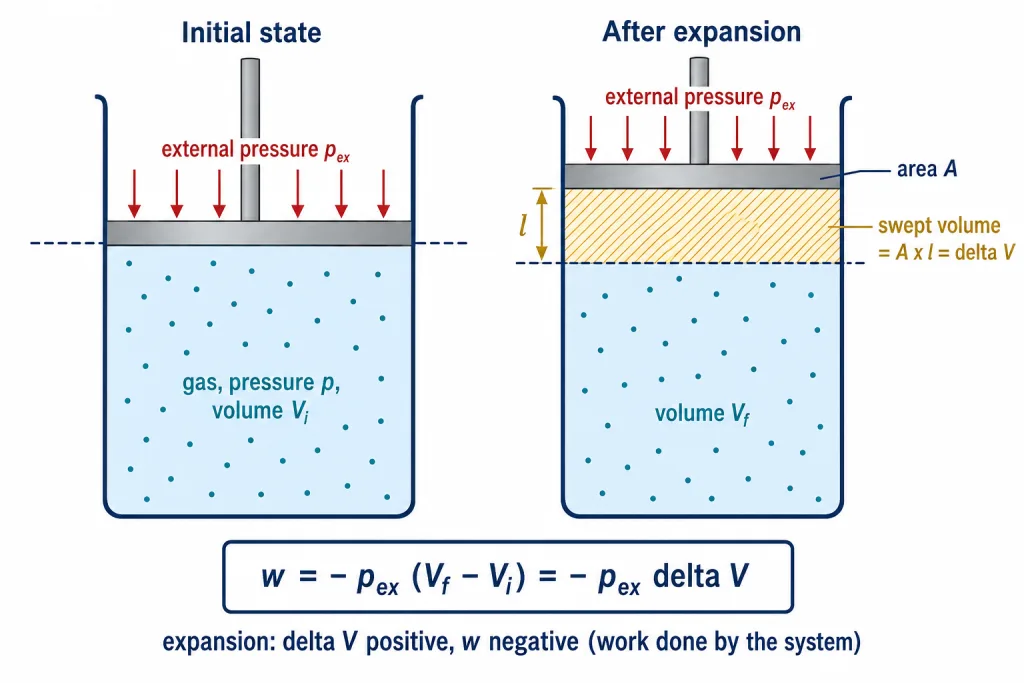
Two idealisations are built into that picture and both are deliberate. The piston is frictionless, so no energy is lost rubbing against the cylinder wall and every joule the gas spends goes into pushing the surroundings. The piston is also weightless, so the whole opposing force comes from and none from gravity. Real pistons fail both tests, which is why real engines deliver less work than the calculation predicts.
Suppose is greater than . The gas wins, the piston slides out through a distance , and the gas ends at volume .
The force the piston has to push against is
The distance moved is , so the energy the gas spends is
because the swept volume is exactly the volume increase .
That energy left the system. In the IUPAC convention energy leaving the system carries a minus sign, so
Key Point: For a change against a constant external pressure, .
Checking the sign both ways
The single formula handles expansion and compression. Only changes sign.
Expansion. , so is positive and comes out negative. The gas has spent its own energy pushing the surroundings back — work done by the system.
Compression. Now exceeds , the piston is driven inward, and . is negative, and is positive. Work has been done on the system and its internal energy rises.
| Change | Sign of | Meaning | |
|---|---|---|---|
| Expansion | system does work on surroundings | ||
| Compression | surroundings do work on system | ||
| No volume change | no pressure-volume work at all |
The last row is worth holding on to. A reaction sealed in a rigid steel vessel cannot change its volume, so there no matter how violent the reaction.
One symbol causes more errors than any other in this section. The pressure in is the external pressure, the one the system pushes against. It is not the pressure of the gas inside. During a fast expansion the gas may be at while it expands against an atmosphere at ; the work is set by the .
Units
Multiplying a pressure in atm by a volume in litres gives work in litre-atmosphere. Converting to the SI unit,
Both units appear in exam papers, and a question that gives pressure in atm and volume in litres is asking for L atm unless it says otherwise. The value comes from and , whose product is , and a pascal-cubic-metre is a joule. A rough check that saves time: a litre-atmosphere is about a hundred joules, so an answer of a few L atm should land in the hundreds of joules.
Work Is a Path Function — Reading a p-V Diagram
Fix the initial state at and the final state at . The value of between them is fixed. The value of is not — it depends on how the expansion was managed.
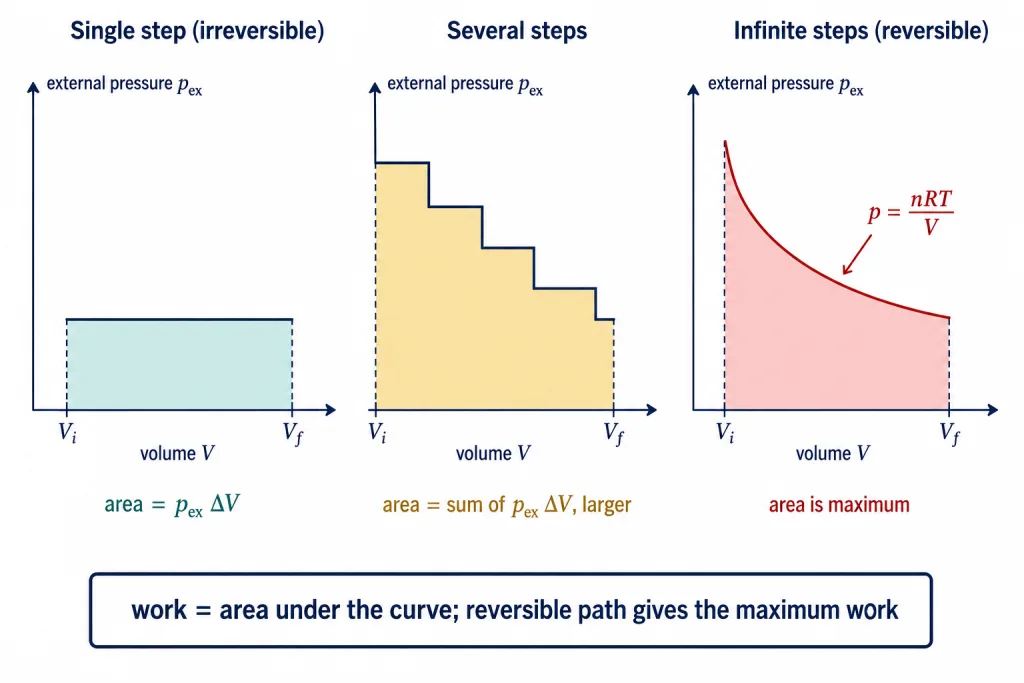
Plot external pressure on the vertical axis against volume on the horizontal axis. For an expansion in one step against a constant , the graph is a horizontal line from to , and the rectangle beneath it has area .
Key Point: On a - diagram the magnitude of the pressure-volume work is the area under the curve between and . The sign is supplied separately: negative for expansion, positive for compression.
Expanding in stages
Now drop the external pressure in stages instead of all at once. Let the gas expand a little against a high , then drop and let it expand again, and so on. The plot becomes a staircase, and the work is summed over the steps:
Each step is a taller rectangle than the single low-pressure rectangle it replaces, so the staircase encloses more area. Staging the expansion extracts more work from the same change of state.
If the pressure is not constant at all but varies continuously, the sum becomes an integral:
This is the general expression; is only its constant-pressure special case.
Two states, three different answers for depending on the route — that is exactly what makes work a path function. behaves the same way, and their sum does not.
One caution about reading these plots. The pressure plotted is the external pressure, the pressure the system pushes against, not the pressure of the gas. During a fast single-step expansion the gas has no single pressure at all, so a curve for the gas cannot be drawn. Only in the reversible case do the two pressures coincide to within , and only then does the graph double as a plot of the gas's own state.
Free Expansion into a Vacuum
Remove the opposition entirely. Connect a bulb of gas to an evacuated bulb through a stopcock and open it. The gas rushes into the empty space with nothing to push against.
Key Point (Definition): Free expansion is the expansion of a gas into a vacuum, where .
Put into either expression for the work:
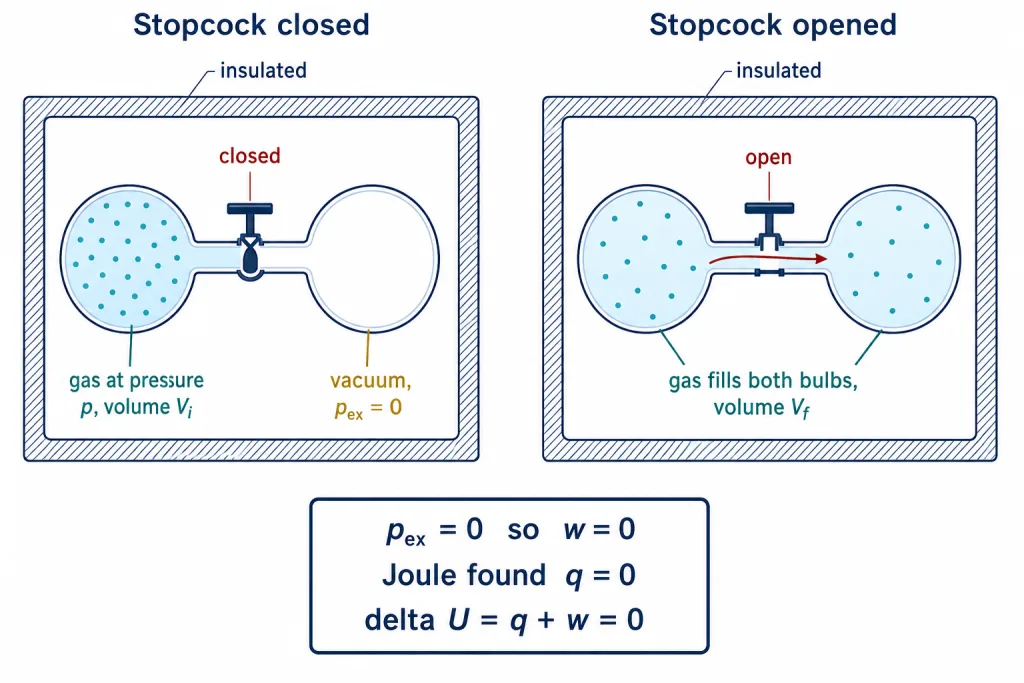
No work is done in a free expansion, whether the process is run reversibly or irreversibly. The volume change may be large, the gas may travel fast, but the force it pushes against is zero and so the energy transferred as work is zero.
The isothermal free expansion of an ideal gas
Joule measured the heat exchanged when a gas expands into a vacuum at constant temperature and found it to be zero as well. For an ideal gas expanding isothermally into a vacuum,
Both channels for changing the internal energy are shut, so does not change. This is consistent with what the kinetic theory says about an ideal gas: its internal energy depends only on temperature, and the temperature has not changed. Spreading the same molecules over a bigger volume costs nothing, because an ideal gas has no intermolecular attractions to stretch.
[JEE/NEET] A question that says "expands into vacuum" is telling you before you read the volumes. If it also says isothermal and ideal, then and are zero too, and the litres given in the question are decoration.
Reversible and Irreversible Processes
Everything so far has been a shove: the external pressure was suddenly dropped and the gas lurched outward. During such a change the gas is not at a single well-defined pressure — it is turbulent, denser near the walls, not in equilibrium with anything. A pressure inside the cylinder cannot even be quoted while it happens.
There is an idealised alternative. Lower the external pressure not in finite drops but by an infinitesimal amount at a time, so that at every instant
The gas expands by an infinitesimal , comes to equilibrium, and the process repeats. For a compression the same idea runs the other way, with .
Key Point (Definition): A reversible process is one carried out infinitesimally slowly, through a continuous series of equilibrium states, such that the system and its surroundings differ only infinitesimally and the direction of the change can be reversed at any moment by an infinitesimal change in a variable.
Two features define it, and both matter.
It is infinitely slow. An infinite number of infinitesimal steps takes infinite time. No real process is reversible; it is a limit that real processes can be made to approach but never reach.
The system is always in equilibrium with its surroundings. Because the internal pressure is defined at every instant, the gas laws apply throughout, and can be replaced by in the work integral. That single substitution is what makes the reversible case calculable.
Key Point (Definition): Any process that is not reversible is an irreversible process. Every spontaneous, real, finite-rate change is irreversible.
A gas bursting into a vacuum, a hot block cooling in cold air, a rock rolling downhill — each is irreversible, since reversing it needs a finite push, not an infinitesimal one.
| Feature | Reversible | Irreversible |
|---|---|---|
| Driving force | infinitesimal, | finite |
| Speed | infinitely slow | finite, often fast |
| State of the system | equilibrium throughout | non-equilibrium during the change |
| Pressure of the gas | defined at every instant | not defined |
| Work in expansion | maximum | less than the maximum |
| Occurrence in practice | never exactly attained | every real change |
An idealisation this extreme earns its place because it gives a limit. Whatever route a real expansion takes, its work is bounded above by the reversible value, and that bound can be computed from the gas laws alone. The same reasoning returns later in the chapter, when reversible heat defines the entropy change through , and when Gibbs energy is read as the maximum useful work a reaction can deliver.
Isothermal Reversible Expansion of an Ideal Gas
Under reversible conditions the external pressure differs from the internal pressure only by :
The product is a product of two vanishingly small quantities and is dropped, leaving
Now the ideal gas equation can be used, because the gas has a definite pressure at every stage. Writing as , for moles
Hold the temperature constant — an isothermal change — so comes out of the integral:
Converting the natural logarithm to base ten,
Key Point: For the isothermal reversible expansion of an ideal gas, .
The same result in terms of pressures
At constant temperature Boyle's law gives , so
Use whichever pair the question hands you. The volume ratio is final over initial; the pressure ratio is initial over final. Getting them the wrong way round flips the sign of the answer, which is the single commonest slip in this formula.
Heat in the isothermal reversible case
An ideal gas held at constant temperature keeps its internal energy unchanged, so and the first law gives
Every joule the gas spends pushing the piston out is drawn in from the surroundings as heat. The gas acts as a pass-through, converting heat into work with its own energy store untouched.
[JEE Main] With the answer is in joules; with it is in L atm. Choose to match the unit the options are written in, and remember is always in kelvin.
Why the Reversible Path Gives the Maximum Work
Take one mole of an ideal gas from the same initial state to the same final state by three routes and compare the work.
| Route | Work expression | Area on the - plot |
|---|---|---|
| Free expansion into vacuum | no area at all | |
| One step against constant | a single low rectangle | |
| Several steps of falling | a staircase, larger | |
| Reversible, infinitely many steps | the full area under the smooth isotherm |
In an irreversible expansion the external pressure is always noticeably below the gas pressure. The gas pushes against a weak opposition and gets little back for the volume it gives up. Making the opposition stronger — closer to the gas's own pressure — extracts more work per litre swept. The strongest opposition an expansion can have and still proceed is , which is the reversible path.
Key Point: For a given change of state, the reversible path delivers the maximum work done by the system on expansion, and requires the minimum work done on the system for compression. is the largest possible for expansion.
The same argument run backwards explains compression. Compressing irreversibly means pushing with an external pressure well above the gas pressure and wasting effort; compressing reversibly means pushing with only to spare, which costs least.
The first law on each path
Collecting the special cases for an ideal gas:
- Isothermal irreversible change: , so .
- Isothermal reversible change: , so .
- Isothermal free expansion: , , .
- Adiabatic change: , so and the temperature must change.
- Constant volume: , so .
Reading down that list, the adiabatic case is the one that breaks the isothermal pattern. With no heat allowed in, an expanding gas can only pay for the work out of its own internal energy, so is negative and the gas cools.
A caution about the word "maximum"
Maximum work does not mean the gas ends up with less energy than on another route. For an isothermal ideal gas is zero on every route, so the extra work delivered on the reversible path is matched joule for joule by extra heat drawn in from the surroundings. The reversible path is not more energetic; it is more efficient at converting heat into work, wasting nothing on turbulence.
[Board] A three-mark question on this section usually asks for the derivation of from force times distance, or the integration of with to reach the logarithmic result. Write the substitution step explicitly; the marks sit there rather than on the final line.
Solved Examples
Question 1: Expansion against a constant pressure
A gas expands from to against a constant external pressure of . Calculate the work done, in L atm and in joules.
Answer:
The external pressure is constant, so I use .
To convert I multiply by :
The gas expanded, so the minus sign is the answer checking itself.
Ans:
Question 2: Compression
A gas is compressed from to by a constant external pressure of . Find the work done.
Answer:
The formula is the same one; only changes sign.
Positive, as it must be — the surroundings did work on the gas.
Ans:
Watch out: Do not put because "the volume changed by 6 litres". is always final minus initial, and for a compression that is negative.
Question 3: Expansion into a vacuum
Two litres of an ideal gas at a pressure of expands isothermally at into a vacuum until its total volume is . How much work is done and how much heat is absorbed?
Answer:
The gas expands into a vacuum, so .
The change is isothermal and the gas is ideal, so , and the first law gives
Ans: and ; no work is done and no heat is absorbed.
Watch out: The is the pressure of the gas inside, not the pressure it expands against. It plays no part in the work.
Question 4: The same expansion against 1 atm
The same gas, at , now expands isothermally to against a constant external pressure of . Find , and .
Answer:
The gas is ideal and the temperature is unchanged, so and
The gas absorbed of heat and spent all of it on the piston.
Ans: , ,
Question 5: The same expansion, done reversibly
One mole of the same ideal gas expands isothermally and reversibly at from to . Find the work done, in L atm and in joules.
Answer:
Reversible and isothermal, so I use the logarithmic expression. Since the answer is wanted in L atm first, I take .
, and .
Ans:
Question 6: Ranking the three routes
For the same isothermal change of one mole of an ideal gas at , arrange the three routes of Questions 3, 4 and 5 in order of work done by the gas, and say what the ordering shows.
Answer:
I collect the three magnitudes.
Free expansion: . Single step against : . Reversible: .
The order of work done by the gas is free expansion single-step irreversible reversible. The three routes share the same initial and final states but give three different values of , which shows work is a path function. The largest of the three is the reversible one.
Ans: ; the reversible path yields the maximum work.
Question 7: Reversible expansion in joules
Two moles of an ideal gas expand isothermally and reversibly at from to . Calculate and .
Answer:
First I convert the temperature: . The answer is wanted in joules, so .
, and .
Isothermal and ideal means , so .
Ans: ,
Question 8: Using the pressure ratio
Five moles of an ideal gas at expand isothermally and reversibly from to . Find the work done.
Answer:
Volumes are not given, so I use the pressure form, with the ratio initial over final.
, and .
Ans:
Watch out: Writing gives , which claims the surroundings compressed an expanding gas. The pressure ratio is upside down relative to the volume ratio for a reason.
Question 9: First law with expansion work
A gas absorbs of heat while expanding from to against a constant external pressure of . Calculate .
Answer:
Heat flows in, so .
The gas spent more on the piston than it took in as heat, so its internal energy fell.
Ans:
Watch out: The two terms must be in the same unit before they are added. Adding to gives nonsense.
Question 10: Converting between L atm and joules
(i) Express of work in kilojoules. (ii) A gas does of work on its surroundings; express in L atm.
Answer:
(i) I multiply by :
(ii) The gas does the work, so . To go from joules to L atm I divide by :
Ans: (i) (ii)
Question 11: Two steps against one
An ideal gas at is expanded to in two ways: (a) in one step against a constant of ; (b) in two steps, first to against , then to against . Compare the work done by the gas.
Answer:
(a) One step:
(b) Two steps, summed:
The staircase of two rectangles encloses more area than the single flat rectangle, so the two-step route does more work. Adding more steps would push the total towards the reversible value.
Ans: (a) ; (b) ; the two-step route does more work.
Question 12: Reversible compression
One mole of an ideal gas is compressed isothermally and reversibly at from to . Find and .
Answer:
The same formula covers compression; the volume ratio is now less than one.
, and .
The sign is positive, which is right — work has been done on the gas. Since for an isothermal ideal gas,
The gas releases that much heat to the surroundings while being squeezed.
Ans: ,
Watch out: A reversible compression is the cheapest compression. Any irreversible route from to would need more than of work put in.
Question 13: Work from a pressure change
Half a mole of an ideal gas at expands isothermally and reversibly until its pressure falls from to . Find the work done and the final volume.
Answer:
No volumes are given, so I use the pressure form.
, and .
For the final volume I use the ideal gas equation with in L atm units.
As a check, , so the volume ratio is , matching the pressure ratio.
Ans: ,
Question 14: Work done by a reaction in an open beaker
Zinc reacts with dilute hydrochloric acid in an open beaker at and produces of hydrogen gas against a constant atmospheric pressure of . Calculate the work done by the system.
Answer:
The volume increase comes from the hydrogen released; the solids and the solution contribute almost nothing. I get the volume it occupies from the ideal gas equation:
Ans: , about half a kilojoule done by the system on the atmosphere
Watch out: Only gaseous moles enter . Counting the aqueous or the solid zinc here would inflate the answer.