
What This Chapter Is Asked To Do
Thermodynamics sits in the physical-chemistry part of the paper, and in a typical paper it supplies one or two questions. Those questions are short by design. They are meant to be finished in under a minute each, which fixes what they can contain: no calculus, no three-stage reversible-adiabatic chains, no algebra that runs past four lines. What they contain instead is a definition, a sign, one substitution into a single formula, or a comparison of two signs.
The table below is the shape of the demand.
| Theme | How heavily it is drawn on | The usual form | What you must have ready |
|---|---|---|---|
| Sign conventions and vocabulary | Very heavy | "which statement is correct" | and are positive when energy enters the system; |
| State function against path function | Very heavy | pick the odd one out of four quantities | the two lists, memorised |
| Simple first-law numericals | Heavy | one substitution, answer in J or kJ | , , |
| against | Heavy | given one, find the other; or "for which reaction are they equal" | and how to count |
| Hess's law and formation enthalpies | Heavy | three equations to combine, or a sum | reverse changes the sign, multiply scales the value |
| Entropy and the second law | Moderate | sign of for a stated change | gas count rises means positive; |
| Spontaneity from the signs of and | Heavy | four sign pairs, one temperature statement | the spontaneity grid |
| Gibbs energy and equilibrium | Moderate | at equilibrium, or from | |
| Heat capacity and calorimetry | Lighter | one substitution | of water |
| Bond, lattice and solution enthalpies | Lighter | a definition, or one bond-enthalpy sum | bond enthalpies: reactant bonds minus product bonds |
Two of those rows carry more marks than their size suggests. The sign-convention row and the state-function row are pure recall; a student who has the lists is never going to lose those marks, and a student who has not cannot reason them out in the time available.
The rows that look like calculation are not really calculation either. A question is decided by whether you counted correctly, and the arithmetic after that is one multiplication. A Hess's law question is decided by whether you flipped the right equation. The number-crunching is deliberately small.
What the paper does not do here
It does not ask you to derive . It does not set adiabatic problems, Kirchhoff's equation, or Born-Haber cycles with six unknown steps. It does not ask for the Carnot efficiency. Those live in the harder engineering-entrance syllabus. What it does do is take a small idea and test whether you hold it exactly: not roughly, exactly.
That word "exactly" is the difference between this chapter and most of organic chemistry. In organic you can often reason your way to an answer you half-remember. Here a half-remembered sign convention gives you a confident wrong answer, and a confident wrong answer costs you the negative mark as well as the mark you missed.
Key Point: The whole chapter runs on one convention. is positive when heat flows into the system, is positive when work is done on the system, and . Some physics texts write the first law as with meaning work done by the gas. Both are self-consistent; mixing them is what produces wrong signs. Use the convention above and nothing else.
The formats it comes in
Four wrappings account for nearly everything set from this chapter. A plain single-correct question with four numerical or symbolic options. A "which of the following statements is correct" list, where three statements carry a planted error and one is exact. An assertion-reason pair, where the assertion and the reason are each true or false and you must also judge whether the reason explains the assertion. And a match-the-column, usually pairing four processes with four sign patterns or four formulae. The chemistry is identical across all four; only the reading changes, and the statement and assertion-reason formats reward the precise wording of a definition far more than the numerical ones do.
How to spend the minute
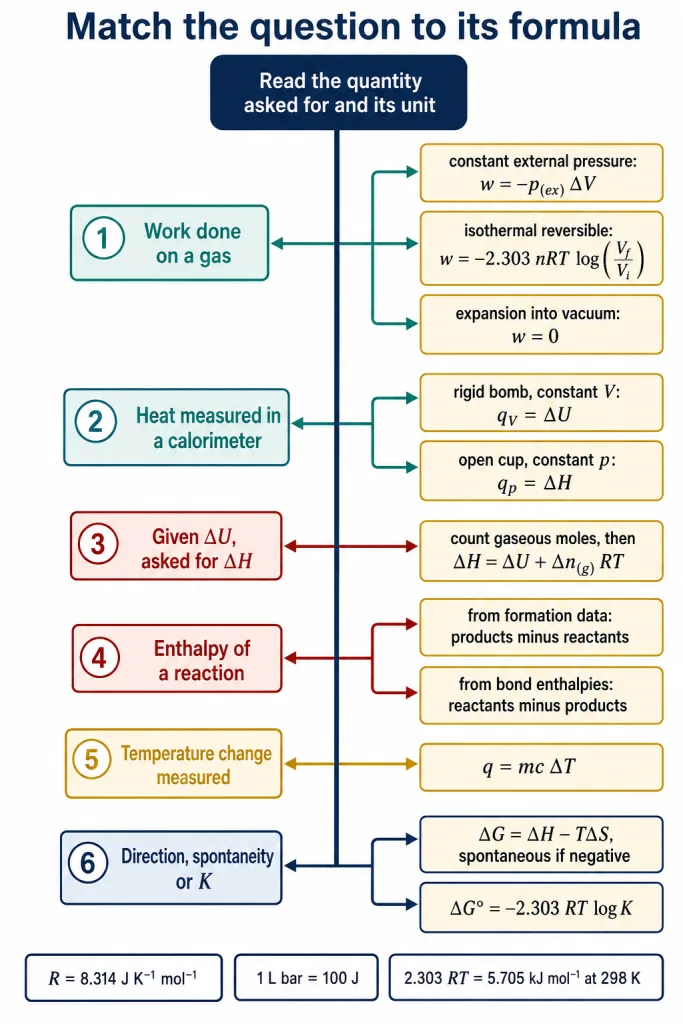
Read the quantity being asked for and its unit before reading the data. If the options are in the question wants an entropy, and any option quoted in is dead on arrival. If the options split two positive and two negative, the sign alone removes half the paper before you have touched a calculator.
[NEET] A large share of the questions from this chapter are settled by a sign, a unit or a definition rather than by arithmetic. Train the sign check as a reflex: decide whether the answer must be positive or negative first, then compute only if two options survive.
The Definitions You Must Have Word-Perfect
Recall questions are free marks or lost marks; there is no middle ground. The tables below are the ones worth committing exactly.
Systems and their boundaries
| Type of system | Exchanges matter? | Exchanges energy? | Everyday example |
|---|---|---|---|
| Open | Yes | Yes | hot tea in an open cup; a reaction in an open beaker |
| Closed | No | Yes | tea in a sealed steel flask that still feels warm outside |
| Isolated | No | No | tea in a stoppered vacuum flask (an idealisation) |
The system is the part of the universe under study; the surroundings are everything else that can exchange energy or matter with it; the boundary is the real or imagined surface separating them. A boundary that allows heat through is diathermic; one that does not is adiabatic.
Key Point (Definition): A system is isolated only if it exchanges neither matter nor energy. A thermos flask is the standard example, and it is only an approximation, because no real wall is perfectly adiabatic.
State functions and path functions
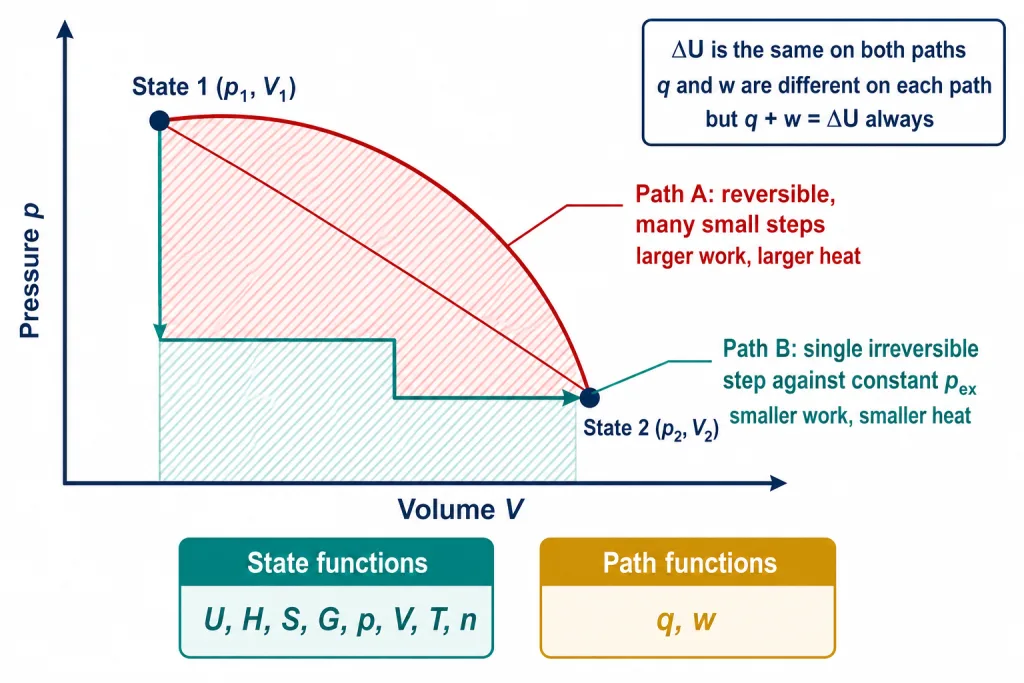
A state function is a property whose value depends only on the present state of the system, fixed by the state variables , , and , and not at all on how the system reached that state. A path function depends on the route taken between the same two end states.
Key Point (Definition): Internal energy , enthalpy , entropy and Gibbs energy are state functions. Heat and work are path functions. The sum is a state function change even though neither term separately is.
Extensive and intensive
An extensive property depends on the amount of substance present; an intensive property does not.
| Extensive | Intensive |
|---|---|
| mass, volume, number of moles | temperature, pressure, density |
| internal energy , enthalpy | molar internal energy, molar enthalpy |
| entropy , Gibbs energy | molar entropy, molar Gibbs energy |
| heat capacity of an object | specific heat , molar heat capacity |
Dividing one extensive property by another gives an intensive one: mass over volume is density, enthalpy over moles is molar enthalpy. That single trick answers most questions in this row.
The named enthalpies
| Name | Symbol | Definition (per mole, in the standard state) | Sign |
|---|---|---|---|
| Standard enthalpy of formation | for forming 1 mol of the compound from its elements in their reference states | either | |
| Standard enthalpy of combustion | for the complete combustion of 1 mol of a substance in excess oxygen | always negative | |
| Enthalpy of fusion | for melting 1 mol of a solid at its melting point | positive | |
| Enthalpy of vaporisation | for vaporising 1 mol of a liquid at its boiling point | positive | |
| Enthalpy of sublimation | solid straight to vapour; equals | positive | |
| Bond dissociation enthalpy | to break 1 mol of a particular bond in the gas phase | positive | |
| Lattice enthalpy | to separate 1 mol of an ionic solid into gaseous ions | positive | |
| Enthalpy of solution | for dissolving 1 mol of solute in a very large amount of solvent | either | |
| Ionization enthalpy | to remove an electron from 1 mol of gaseous atoms | positive | |
| Electron gain enthalpy | for 1 mol of gaseous atoms gaining an electron | usually negative |
Key Point: An element in its most stable form at 1 bar and the stated temperature is its reference state, and for that form is exactly zero. Graphite has and diamond does not. has zero and does not. has zero and does not.
The processes, by what is held fixed
| Process | What stays constant | The immediate consequence |
|---|---|---|
| Isothermal | temperature | and for an ideal gas, so |
| Isobaric | pressure | , and |
| Isochoric | volume | , so |
| Adiabatic | no heat exchanged, | , so a gas cools as it expands |
| Cyclic | system returns to its starting state | every state function change is zero, so and |
| Reversible | driven by an infinitesimal imbalance, at equilibrium throughout | the slowest route, and the one that delivers the most work |
| Irreversible | a finite imbalance, everything real | less work delivered than the reversible route between the same states |
The isothermal and adiabatic rows are the two most often confused. Isothermal fixes the temperature and lets heat flow in or out to keep it fixed; adiabatic forbids the heat flow and lets the temperature move. Both cannot hold at once for a change of volume in an ideal gas.
Entropy and Gibbs energy
Entropy is a state function that measures the degree of dispersal or randomness of a system. For a reversible change at temperature ,
with units . Gibbs energy is defined as , and at constant temperature its change is
with units . equals the maximum non-expansion work the change can deliver.
One Formula Card for the Whole Chapter
Everything the paper can ask of you from this chapter is on this card. The third column is the one students skip and then lose marks on: a formula used outside its conditions gives a wrong answer that looks right.
| Formula | Reads as | Valid when | The trap |
|---|---|---|---|
| first law | always | is work done on the system | |
| heat at constant volume | rigid container, no other work | a bomb calorimeter measures , not | |
| heat at constant pressure | open vessel or fixed external pressure | a coffee-cup calorimeter measures | |
| no change in internal energy | isothermal change of an ideal gas | needs the gas to be ideal | |
| adiabatic | insulated walls | here, so the gas cools on expanding | |
| definition of enthalpy | always | not | |
| expansion work | external pressure constant | ; expansion gives negative | |
| free expansion | expansion into a vacuum, | volume changes but no work is done | |
| isothermal reversible work | ideal gas, temperature constant | use with the , or without it, never both | |
| linking the two | constant temperature, gases ideal | counts gaseous moles only | |
| molar heat capacities | 1 mol of an ideal gas | per mole; for mol the difference is | |
| heat from a temperature rise | no phase change during the rise | in g when is in | |
| same, with a heat capacity | is for the whole object | ||
| reaction enthalpy from formation data | all species in standard states | multiply each by its stoichiometric coefficient | |
| reaction enthalpy from bond enthalpies | all species gaseous | this one is reactants minus products, the opposite way round | |
| entropy change | reversible path, constant | at a phase change is the transition temperature in kelvin | |
| second law | spontaneous change | the universe, not the system, must gain entropy | |
| surroundings' share | constant and | the minus sign is the whole content of it | |
| Gibbs energy change | constant and | in kJ, in J: convert one of them | |
| equilibrium constant | standard states, equilibrium | , not |
The constants and conversions
Two derived numbers save real time. At any temperature . At 298 K,
so at room temperature in . A of means ; means ; means . Recognising those three pairs converts a calculation question into a recall question.
Counting
is the number of moles of gaseous products minus the number of moles of gaseous reactants, read straight off the balanced equation. Solids, liquids and species in solution contribute nothing.
The third line is the one that catches people: the water is liquid, so it is not counted, and is rather than .
[NEET] When , exactly. Scanning four reactions for the one with equal gas moles on both sides is a five-second job and it is a whole question.
The Spontaneity Grid
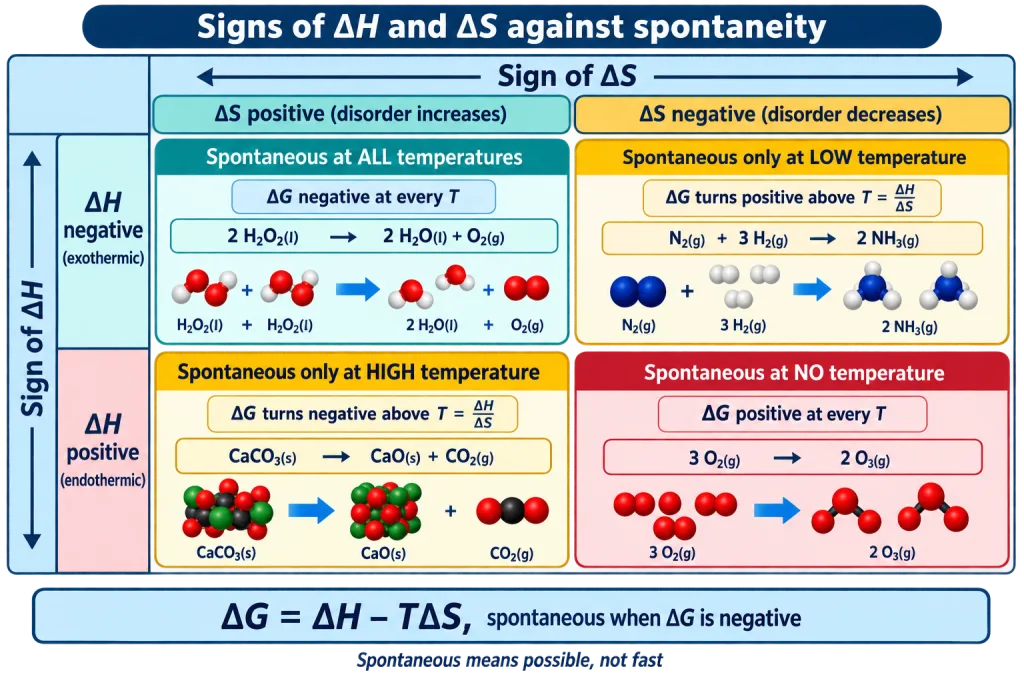
A spontaneous process is one that can take place on its own, without continuous outside help. The test is the sign of the Gibbs energy change at constant temperature and pressure:
with the change spontaneous when , at equilibrium when , and non-spontaneous in the direction written when .
Because is always positive on the kelvin scale, the signs of and decide almost everything, and temperature settles the two cases where they disagree.
| Spontaneous | Typical case | ||||
|---|---|---|---|---|---|
| Negative | Positive | negative | negative at every | Yes, at all temperatures | |
| Negative | Negative | positive | negative only while is small | Yes at low , no at high | ; water freezing below 273 K |
| Positive | Positive | negative | negative only once is large | No at low , yes at high | ; ice melting above 273 K |
| Positive | Negative | positive | positive at every | Never |
Reading the grid takes one habit: look at , not at . A positive makes negative, which pushes down, which favours the change.
The crossover temperature
In the two middle rows the two terms fight, and the winner changes at the temperature where they balance. Setting ,
Above that temperature the term is the bigger of the two; below it the term is. For the endothermic, entropy-increasing row (row three) the reaction turns spontaneous above . For the exothermic, entropy-decreasing row (row two) it turns non-spontaneous above that temperature. Which way round it goes is not worth memorising separately, because substituting one large and one small into settles it in ten seconds.
The hedges that questions are built on
Three statements sound right and are wrong, and each of them has been the whole content of a question.
Spontaneous does not mean fast. Thermodynamics says nothing about rate. The conversion of diamond to graphite has negative at room temperature and takes geological time. A mixture of hydrogen and oxygen has an enormously negative for forming water and will sit unchanged in a flask for years until a spark arrives. Spontaneity is about direction, and rate belongs to kinetics.
A negative does not by itself mean spontaneous. Exothermic changes are usually spontaneous, which is why the idea is tempting, but the counter-examples are common. Water freezing at 283 K is exothermic and does not happen; the entropy loss beats the enthalpy release. A reaction with and has at 298 K, and does not go.
A positive does not by itself mean spontaneous either. The second law is about the total. What must increase is
An exothermic reaction dumps heat into the surroundings and raises by , and that term is often what makes the total positive even when the system itself becomes more ordered. The criterion is the same statement rearranged for the system alone: dividing by gives exactly .
Key Point: and are the same criterion written two ways. is more convenient because it uses only quantities belonging to the system, but it is valid only at constant temperature and pressure.
Sign of without any data
Most entropy questions give no numbers at all and ask only for a sign. Count the gas molecules.
| Change | Why | |
|---|---|---|
| Solid to liquid to gas | Positive | particles gain freedom at each step |
| Gaseous moles increase | Positive | more ways to arrange the same matter |
| Gaseous moles decrease | Negative | freedom is lost |
| Gaseous moles unchanged | Small, sign from the details | no dominant term |
| A solid dissolving in water | Usually positive | the ordered lattice breaks up |
| Two gases mixing | Positive | mixing always disperses |
| A gas being compressed | Negative | less volume, fewer arrangements |
goes from 3 mol of gas to 2 mol, so is negative without a single calculation.
Reading a spontaneity question in fifteen seconds
Take the ammonia synthesis, , with negative, and a question asking about its spontaneity.
Gaseous moles fall from 4 to 2, so is negative. is negative because the reaction is exothermic. Negative with negative places it in row two: spontaneous at low temperature, non-spontaneous once the temperature is high enough. Any option saying "spontaneous at all temperatures" or "spontaneous only at high temperature" is gone, and no arithmetic was needed.
The industrial detail sits neatly on top of that reading. The process is run hot even though heat works against the equilibrium, because at low temperature the rate is hopeless. That is spontaneity and speed pulling in opposite directions in a single real example, and it is why the two ideas have to be kept apart.
[NEET] When a spontaneity question gives a reaction rather than numbers, get from the change in gas moles and from whether the reaction is a combustion, a decomposition or a synthesis. Two signs, then the grid.
State Functions and Path Functions, as a List
This is the one-mark question the paper returns to most reliably, and it is answered from memory or not at all. Learn the two columns.
| State functions (depend only on the present state) | Path functions (depend on the route) |
|---|---|
| Internal energy | Heat |
| Enthalpy | Work |
| Entropy | |
| Gibbs energy | |
| Pressure , volume , temperature | |
| Number of moles , concentration | |
| Density, molar mass, refractive index | |
| Heat capacity, specific heat | |
| Free energy change of a stated reaction |
The right-hand column has two entries and that is the whole of it. Heat and work are the only path functions the chapter defines, and every other quantity in it is a state function.
Why those two are different is worth one sentence, because the reason is what a well-set question probes. A system in a given state has a definite internal energy, but it does not "contain" heat or work; and are names for energy in transit, and how much of the transfer arrives as heat and how much as work depends entirely on the route.
Same ends, different routes
Take one mole of an ideal gas from state 1 to state 2 by two routes: a single-step expansion against a constant external pressure, and a slow reversible expansion between the same two states. The reversible route does more work and absorbs more heat. Both routes give the same , because the initial and final states are the same and is a state function.
The sum comes out the same on both routes even though each term separately does not. That is the first law being useful rather than merely true.
The exception that questions are built on
Under a constraint, a path function can become as good as a state function.
At constant volume no expansion work is possible, so the whole of the energy transfer arrives as heat and has only one possible value. At constant pressure the same happens for enthalpy. Heat has not stopped being a path function; the constraint has removed the choice of path.
Key Point: and are path functions. and are still heats, but because they are pinned to a state-function change they take a single value for given end states. That is exactly why calorimetry works.
Round a closed cycle
Take a system through any sequence of changes that brings it back to its starting state. Every state function returns to its original value, so
for the cycle as a whole, whatever happened in between. The first law then gives : the net heat absorbed over the cycle equals the net work done by the system. Heat and work are not zero round a cycle, and that is the sharpest demonstration available that they are path functions while is not. An engine is exactly this arrangement.
Two lookalikes worth separating
Heat capacity appears in the state-function column, which surprises people, since it is defined through . It belongs there because it is a property of the material at a given state, measured under a stated condition, and quoting it as or already names the path. Specific heat and molar heat capacity are the same property expressed per gram and per mole.
Work is a path function, but the change in a state function is not made into a path function by being written with a . , , and are all differences of state functions and are all route-independent. There is no such thing as or , and an option that writes one is wrong on the notation alone.
[NEET] The commonest form of this question lists four quantities and asks which is not a state function. Scan for or ; if neither appears, look for a quantity written as heat absorbed or work done in disguise, such as "heat of a process carried out irreversibly".
Fast Elimination and the Traps That Cost Marks
Speed here is not fast arithmetic. It is knowing which questions do not need arithmetic.
Habit 1: decide the sign before you compute
Before touching the numbers, ask what sign the answer must carry. A gas expanding does work on its surroundings, so is negative. A combustion is exothermic, so is negative. A reaction that consumes gas has negative. Melting is endothermic, so and are both positive.
Options in this chapter are usually built as two signs times two magnitudes, so fixing the sign halves the paper immediately. If the surviving two differ only in magnitude, you now have a one-step calculation instead of a four-way comparison.
Habit 2: check before reaching for
Count gaseous moles on both sides first. If they match, , the correction term vanishes, and . Any option that makes them differ is wrong, and the question is over.
If they do not match, the correction at 298 K is , a number small enough to do in your head. A of shifts about below ; a of lifts it about above. Options separated by more than that are not testing this formula at all.
Habit 3: read the units on the options
Units eliminate faster than algebra.
| If the options carry | The quantity is | So reject any option in |
|---|---|---|
| entropy, or a molar heat capacity | ||
| an enthalpy or a Gibbs energy | ||
| or with no "per mol" | heat or work for a stated amount | anything per mole |
| no unit at all | an equilibrium constant or a ratio | anything with a unit |
| or | expansion work not yet converted | joule answers, unless you convert |
Entropies of common processes sit in the tens to low hundreds of ; enthalpies of reaction sit in the tens to thousands of . An "entropy" option of is off by a factor of a thousand and can be struck out on sight.
Habit 4: use "spontaneous means negative" to kill two options
Any question that says a process is spontaneous, or asks you to find the temperature at which it becomes spontaneous, has already told you the sign of . Options with the wrong sign go. Options that say the process is spontaneous because it is exothermic go too, since that reasoning is unsound even when the conclusion happens to be right.
The same trick works backwards. If then and is negative; if then is positive; if then . Any option pairing with a positive is wrong before you compute anything.
Habit 5: sanity-check the magnitude
of water at is and of ice at is , so vaporisation costs several times more than melting. Bond enthalpies run from about to about . Lattice enthalpies run to several hundred and beyond. Combustion enthalpies of small organic molecules run into the thousands. An answer three orders of magnitude off one of these is an arithmetic slip, usually a J-for-kJ conversion.
The traps table
| Trap | What actually goes wrong | The fix |
|---|---|---|
| Sign of | using from a physics book alongside | one convention only: positive when work is done on the system |
| Counting | including solids, liquids or aqueous species | gases only, products minus reactants |
| versus | assuming they are always equal | equal only when |
| Mixed units in | in kJ and in J, added directly | convert to , or to J |
| Temperature in | using 25 instead of 298 in or | every in thermodynamics is in kelvin |
| applying it to diamond, or | only the reference state of an element is zero | |
| Hess's law | forgetting to change the sign on a reversed equation | reverse means change sign; double means double the value |
| Bond enthalpy direction | using products minus reactants | bond enthalpies go reactants minus products |
| against | using or | pairs with ; nothing pairs with |
| against | putting into | only the standard value fixes ; at equilibrium, generally is not |
| "Exothermic so spontaneous" | treating as sufficient | and still get a vote |
| "Spontaneous so fast" | reading a rate into a | thermodynamics fixes direction, not speed |
| in a bomb calorimeter | calling it | constant volume gives ; convert with |
| applying it to moles as written | it is per mole; for moles the difference is |
The order to do things in
For a numerical question from this chapter, the sequence that wastes the least time is fixed.
Read the unit on the options and decide what quantity is wanted. Decide the sign the answer must carry, and strike out whatever contradicts it. Check whether any given temperature is in Celsius and convert it. Check whether and are in different energy units and fix that before adding them. Then, and only then, substitute into one formula. If two options survive and both look defensible, the difference between them is almost always a factor of , a factor of , or a sign, and each of those points at a specific slip you can check in five seconds.
For a recall question the sequence is shorter still. Find the word that carries the condition, which is usually "reversible", "at constant volume", "in its reference state", "gaseous" or "standard". Options in this chapter are made wrong by removing or altering exactly that word, and an option that has dropped the condition is the planted error.
Key Point: Read as a statement about the position of equilibrium, not about whether a reaction is possible. A positive means , so the reaction favours reactants at equilibrium; it does not mean nothing happens.
Question 1: Work in one line
A gas expands from to against a constant external pressure of . Find the work done on the gas.
Answer:
The external pressure is constant, so I use .
The gas expanded, so I already know the answer is negative. That kills any positive option.
Now I convert, using .
Ans: Watch out: Leaving the answer as is the trap here, because will usually be sitting there as an option. If the pressure had been given in atmospheres the factor would be , not .
Question 2: The first law, with the signs done properly
A system absorbs of heat and does of work on its surroundings. Calculate the change in internal energy.
Answer:
Heat flows into the system, so .
The system does work on the surroundings, which means work is done by the system. In the convention where is the work done on the system, that makes negative.
Ans: Watch out: is on the option list for everyone who adds the two magnitudes. The phrase to read carefully is "on the surroundings" against "on the system"; those two produce answers that differ by twice the work.
Question 3: Spotting
For which of these reactions is equal to ?
(i) (ii) (iii) (iv)
Answer:
, so the two are equal exactly when . I count gaseous moles on each side.
(i) . Not equal. (ii) . Equal. (iii) . Not equal. (iv) . Not equal.
Ans: Only reaction (ii) Watch out: The counting is of moles of gas, not of molecules or atoms. Everything here happens to be gaseous; had any species been a liquid or a solid it would have contributed nothing to the count.
Question 4: from
For the combustion of ethene,
the internal energy change at is . Find .
Answer:
First I count the gaseous moles. Products give mol of ; the water is liquid and is not counted. Reactants give mol.
Ans: Watch out: Counting the liquid water as gas would put mol of gas on each side, so and the answer would come out unchanged at , which will be one of the options. The state symbols are part of the data.
Question 5: Reaction enthalpy from formation data
Given values of for , for and for , find the standard enthalpy of combustion of methane.
Answer:
Oxygen is an element in its reference state, so its is zero and it drops out.
Ans: Watch out: The coefficient multiplies the water term, and the reactant sum is subtracted, so the negative of methane comes back as . Dropping the coefficient gives and dropping the gives , and both of those appear as options.
Question 6: Hess's law, two equations
Given
find the standard enthalpy of formation of .
Answer:
The target equation is the formation of one mole of from its elements.
I get there by keeping the first equation as written and reversing the second, which changes the sign of its enthalpy to . Adding them, cancels from both sides and half a mole of cancels from the left.
Ans: Watch out: Adding the two values instead of subtracting gives . Reversing an equation always reverses the sign of its enthalpy change.
Question 7: A coffee-cup calorimeter
of is mixed with of , both initially at . The temperature rises to . Take the density of the mixture as and its specific heat as . Find the enthalpy of neutralisation per mole of water formed.
Answer:
The solution is what warms up, so its mass is the total volume times the density.
The solution gained that heat, so the reaction released it, and the reaction enthalpy is negative.
Moles of water formed equal the moles of acid, since acid and base are present in equal amounts.
Ans: Watch out: A temperature difference is the same number in and in K, so is correct here. That is not a licence to use Celsius anywhere a temperature itself appears, such as in . The vessel is open, so this heat is and equals , not .
Question 8: Entropy of a phase change
The enthalpy of fusion of ice is at its melting point. Calculate the entropy change of the system when one mole of ice melts at , and state the total entropy change.
Answer:
Melting at the melting point is a reversible change, so with at constant pressure.
The temperature must be in kelvin.
The surroundings supplied that same heat at the same temperature, so
Ans: ; Watch out: A total entropy change of zero is the signature of equilibrium, and ice and water are indeed in equilibrium at . Above that temperature the same melting has and runs on its own. Using instead of gives , which is the same number with the kilo lost.
Question 9: The temperature at which it turns spontaneous
For , and . Above what temperature is the decomposition spontaneous?
Answer:
is positive and is positive, so this is the third row of the grid: non-spontaneous when cold, spontaneous once is large enough. The changeover is where .
The two quantities must be in the same energy unit, so I put into joules.
Ans: Spontaneous above about , roughly Watch out: Forgetting to convert to joules gives , which is absurd and is always one of the options. The result also matches practice: limestone is calcined in a kiln at well over , not at room temperature.
Question 10: From and to
A reaction has and at . Find , say whether the reaction is spontaneous, and calculate .
Answer:
The two terms disagree in sign, so I cannot read the answer off the grid; this is row two, spontaneous only while the temperature is low enough.
I convert the entropy into so both terms share a unit.
Negative, so the reaction is spontaneous at .
For the equilibrium constant I use , with at this temperature.
Ans: , spontaneous, Watch out: Adding and without noticing the double negative gives and a near . A negative must give , and here the value is only modestly above 1, matching a of a few . Spontaneous at says nothing about how quickly the reaction reaches that equilibrium.