
Why the Total Entropy Criterion Is Awkward to Use
The second law settles direction: a change is spontaneous when the total entropy of the universe increases.
The criterion is correct, and it is also inconvenient. Only the first term belongs to the reaction being studied. The second belongs to everything outside the flask, and a chemist working at a bench has no way of measuring the entropy of a laboratory, a water bath and the air above it. Every spontaneity question would need two calculations, one of them about a region with no fixed boundary.
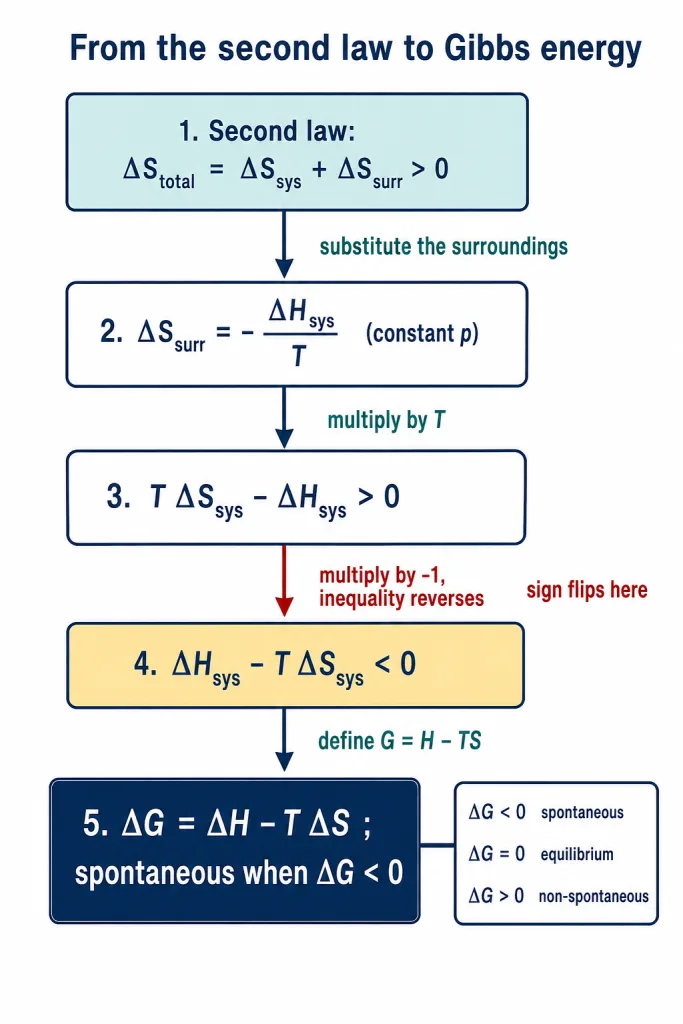
There is a way out, and it rests on a single observation. The surroundings receive whatever heat the system releases. At constant pressure that heat is the enthalpy change of the reaction, with its sign flipped:
The surroundings are large, so their temperature does not change while they take in that heat, and the exchange is effectively reversible for them. Their entropy change is then
That expression carries no property of the surroundings in it. It is written entirely in terms of of the system and the temperature. So the surroundings can be eliminated from the criterion altogether, and what is left is a test on the system alone. Carrying out that elimination is what produces the Gibbs energy.
Key Point: The entropy change of the surroundings at constant and is . This single substitution converts a criterion about the universe into a criterion about the system.
Deriving G = H - TS
Start from the second law and put the substitution in.
Multiply every term by , which is positive, so no inequality is disturbed:
For a spontaneous change , and therefore
Now multiply through by . Multiplying an inequality by a negative number reverses it, and this reversal is the reason the final criterion reads "less than zero" rather than "greater than zero":
The left-hand side is a combination of system properties only, and it deserves a name. Define a new function
is built from , and , all of which are state functions or state variables, so Gibbs energy is itself a state function. It has units of energy, and since and are extensive, is extensive too.
For a change at constant temperature,
and the inequality above becomes simply . The subscript "sys" is dropped from here on; every symbol in the Gibbs equation refers to the system.
Key Point (Definition): Gibbs energy is , an extensive state function. At constant temperature its change is , and .
That last identity is worth keeping. Since , the Gibbs energy change is nothing more than the total entropy change of the universe multiplied by . The two criteria are the same statement in different clothing: positive and negative always agree, because is positive.
The Sign of Delta G
The criterion applies at constant temperature and constant pressure, which is how almost every reaction in a school or college laboratory is run.
| Verdict | What is happening | |
|---|---|---|
| spontaneous | the change proceeds on its own in the forward direction | |
| equilibrium | forward and reverse changes balance; no net change | |
| non-spontaneous | the forward change needs work supplied from outside; the reverse direction is the spontaneous one |
A positive never means "nothing can happen". It means the reverse reaction is the spontaneous one, and that the forward reaction can only be driven by an outside agency. Electrolysis of water has and runs perfectly well as long as the power supply is on.
deserves care. It does not mean the system is dead. A beaker of ice and water at has ice melting and water freezing at matched rates, and for is zero at that temperature. Equilibrium is the state at which has reached its minimum, so no further change in either direction can lower it.
The sign of says nothing whatever about rate, exactly as the sign of said nothing about rate. Diamond turning into graphite has a negative at room temperature and takes geological time.
[JEE/NEET] If a question gives and asks for , or the reverse, use directly rather than rebuilding the whole calculation.
Delta G as the Maximum Useful Work
Read the Gibbs equation as a division of the energy released by a reaction.
is the total energy the reaction makes available at constant pressure. The term is the portion that has to be spent on the entropy requirement of the change; it is dispersed as heat and cannot be harnessed. What remains, , is the part that can be taken out as useful work.
Key Point: At constant and , equals the maximum non-expansion (useful) work obtainable from a change. This is why was long called the free energy: it is the energy free to do useful work.
"Non-expansion" is the operative word. A reaction that releases gas does pressure-volume work on the atmosphere simply by pushing it back, and that work is not available for anything else. Electrical work from a cell, the work of driving a motor, the work of pumping ions across a membrane are all non-expansion work, and is their ceiling.
The word maximum matters as well. The full is delivered only if the change is carried out reversibly, meaning through a continuous sequence of near-equilibrium states. A hydrogen fuel cell drawing a small current approaches it; burning the same hydrogen in air delivers none of it as useful work, because all of the energy leaves as heat.
For , . One mole of hydrogen consumed in a fuel cell can deliver at most of electrical work, whatever the design of the cell. Any real cell delivers less.
The Four Cases: How Temperature Enters
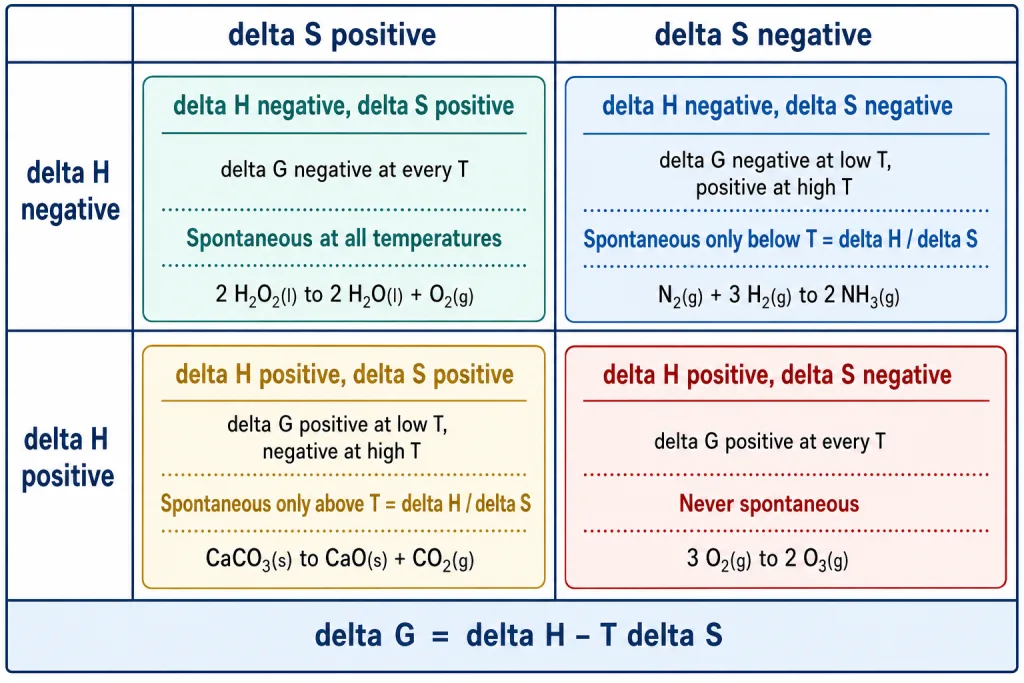
Temperature appears in the Gibbs equation only as a multiplier on . That single position is enough to make temperature decisive, because grows as rises while stays roughly fixed. Whether temperature helps or hurts depends on the signs of and , and there are four combinations.
| Spontaneity | |||
|---|---|---|---|
| negative at every | spontaneous at all temperatures | ||
| positive at every | non-spontaneous at all temperatures | ||
| negative at low , positive at high | spontaneous only below the crossover temperature | ||
| positive at low , negative at high | spontaneous only above the crossover temperature |
The first two rows need no arithmetic. If is negative and positive, then is also negative and both terms push down; the reaction goes at any temperature. The decomposition of hydrogen peroxide, , is of this kind. If is positive and negative, both terms push up and no temperature can rescue the reaction; ozone forming from oxygen with heat absorbed and gas moles falling is such a case.
The last two rows are where exam questions live, because there the two terms fight.
Both negative. The enthalpy term favours the reaction and the entropy term opposes it. At low temperature is small and wins, so the reaction goes. Raise the temperature and eventually exceeds , and the reaction stops. Ammonia synthesis, , has and : thermodynamically it prefers a cold reactor, which is precisely why the industrial process needs a catalyst to get any speed at a temperature low enough for a decent yield.
Both positive. The entropy term favours the reaction and the enthalpy term opposes it. Heating makes large enough to overcome . Limestone decomposing, , refuses to go at room temperature and runs in a lime kiln above about . Melting, boiling and sublimation all sit in this row too, which is why every solid has a temperature above which it melts.
There are two routes to a large enough in this row. Either is small and must be pushed very high, or is large and a modest temperature will do. Reactions that release a gas belong to the second kind.
One warning about reading the table. The words low and high are relative to the particular reaction, not to any fixed scale. For a reaction with a small and a large , the crossover may sit below room temperature, so ordinary laboratory conditions already count as high. For limestone the same word means above a thousand kelvin. Only the arithmetic fixes the boundary.
[JEE/NEET] Reading the signs off a balanced equation is usually enough to place a reaction in the table. A rise in the number of gaseous moles means is positive, a fall means negative, and whether heat is given out or taken in fixes .
The Crossover Temperature
In the two rows where the terms fight, there is one temperature at which they exactly cancel. Setting ,
Key Point: is the temperature at which changes sign. Below it one term dominates, above it the other does, and at it the system is at equilibrium.
Read the Gibbs equation as a straight line in : has intercept on the axis and slope . The crossover temperature is where that line cuts the axis. When is positive the line slopes down, so the reaction turns spontaneous above the crossing. When is negative the line slopes up, so the reaction turns non-spontaneous above the crossing.
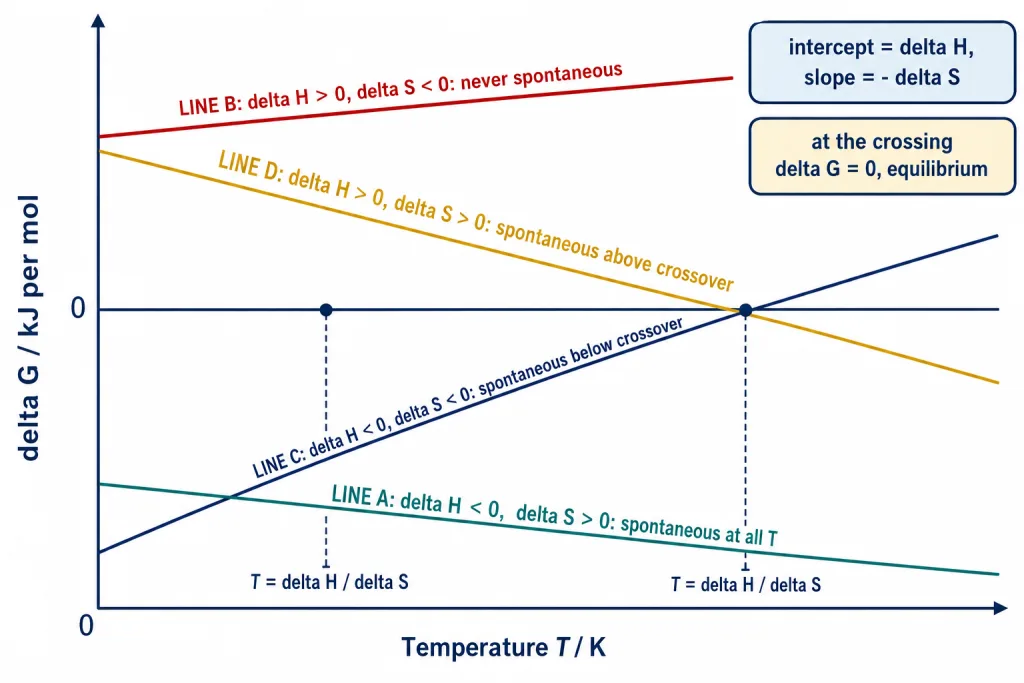
The formula only means something when and have the same sign; if they have opposite signs the quotient is negative, and a negative Kelvin temperature is the arithmetic telling you the sign never changes.
The unit trap. Tabulated is almost always in and tabulated in . These cannot be subtracted or divided as they stand. Convert first, every single time.
A student who divides by gets instead of , out by a factor of a thousand and absurd on its face. The same slip in a calculation gives a number in the tens of thousands of kilojoules. Two habits stop it: write the unit next to every number as you substitute, and glance at the size of the answer before moving on.
[Board] Working in joules throughout and converting the result to kilojoules at the end is safer than converting , because it leaves only one conversion to remember.
Question 1: Gibbs energy for ammonia synthesis
For , and . Find at and say whether the reaction is spontaneous.
Answer:
The two quantities are in different units, so I convert the enthalpy to joules first.
Now I substitute into the Gibbs equation.
The second term has two minus signs, so it comes back positive.
That is , which is negative, so the reaction is spontaneous at .
Ans: ; spontaneous at . Watch out: Both signs are negative here, so the entropy term works against the reaction. Dropping one minus sign gives , which is a common wrong answer.
Question 2: Rusting of iron, two ways
For at , and . Find , and confirm it against the total entropy change.
Answer:
Converting the enthalpy, .
So , strongly negative, and rust forms spontaneously even though the system loses entropy.
For the cross-check I work out the entropy change of the surroundings.
The two routes agree exactly, as they must.
Ans: ; the huge positive from the heat released is what makes the change spontaneous. Watch out: A negative for the system is not a reason to call a reaction non-spontaneous. Here the surroundings gain far more entropy than the system loses.
Question 3: Sorting reactions into the four cases
Classify each reaction by the signs of and and state its temperature behaviour: (i) , exothermic, gas produced; (ii) , endothermic, gas moles fall; (iii) ; (iv) , endothermic.
Answer:
(i) negative and positive, since one mole of gas appears where there was none. Both terms drive negative, so it is spontaneous at all temperatures.
(ii) positive and negative, since three moles of gas become two. Both terms drive positive, so it is non-spontaneous at all temperatures.
(iii) Freezing releases heat, so is negative, and a liquid becoming a solid loses disorder, so is negative. Both negative means spontaneous only at low temperature — below at .
(iv) positive, and one solid gives two moles of gas so is strongly positive. Both positive means spontaneous only at high temperature, which matches solid ammonium chloride subliming when heated.
Ans: (i) all ; (ii) no ; (iii) low only; (iv) high only.
Question 4: Crossover temperature for limestone
For , and , both taken as independent of temperature. Find at and the temperature above which the decomposition becomes spontaneous.
Answer:
First the value at room temperature, with the enthalpy converted to joules.
That is , positive, so limestone does not decompose at room temperature.
Both and are positive, so this is the case that turns spontaneous on heating. The crossover is where .
Above the term exceeds and turns negative. At itself the solid and its products are in equilibrium. A lime kiln is run above this temperature for exactly this reason.
Ans: at ; spontaneous above . Watch out: Dividing by without converting gives . Any crossover temperature that comes out near absolute zero, or in the millions, is a unit error.
Question 5: The temperature above which dinitrogen tetroxide dissociates
has and . Is it spontaneous at ? Find the temperature above which it is.
Answer:
So at , just positive, so the dissociation is not spontaneous under standard conditions, though only barely.
Above about , some , the entropy term takes over and dissociates spontaneously. This is why a sealed tube of the pale gas darkens when warmed in a water bath: more brown is formed.
Ans: not spontaneous at (); spontaneous above . Watch out: A small positive means the crossover temperature is close by. Do not read "non-spontaneous" as "impossible under any conditions".
Question 6: Ice and water at the melting point
The enthalpy of fusion of ice is and ice and water are in equilibrium at under . Find . Then say what happens to for melting at and at .
Answer:
Equilibrium means for at .
Melting has both and positive, so it is the high-temperature case and is its crossover.
At : , positive, so ice does not melt and water freezes instead.
At : , negative, so ice melts.
Ans: ; at and at .
Question 7: Entropy of vaporisation of water
Water boils at under with . Find , and explain why it is much larger than .
Answer:
At the boiling point liquid and vapour coexist, so for the vaporisation.
That is about five times . Melting only frees molecules from fixed lattice sites while keeping them in contact; boiling separates them completely and gives each one the whole volume of the vessel to move in. The jump in disorder from liquid to gas is far bigger than the jump from solid to liquid.
Ans: .
Question 8: Useful work from a fuel cell
has and at . What is the greatest electrical work obtainable per mole of hydrogen, and what happens to the rest of the energy?
Answer:
The maximum non-expansion work available at constant and is .
The difference between the two quantities is the part tied up by the entropy requirement.
is negative here, since three half-moles of gas become a liquid, so the reaction must dump into the surroundings as heat to satisfy the second law. That heat cannot be converted into electrical work.
Ans: at most of electrical work per mole of ; must leave as heat. Watch out: The ceiling is , not . Quoting as the available work ignores the entropy term entirely.
Question 9: Finding an entropy change from Delta G
A reaction at has and . Find and say whether raising the temperature helps the reaction.
Answer:
I rearrange the Gibbs equation for .
Both and are negative, so this is the low-temperature case. Heating makes more positive and pushes up, so raising the temperature hurts. The reaction stops being spontaneous above
Ans: ; heating hurts, and spontaneity is lost above about .
Question 10: A cold reaction that still happens
Solid dissolving in water absorbs heat, with and at . Show that it dissolves spontaneously and identify which term is responsible.
Answer:
So , negative, and the salt dissolves on its own even though the test tube goes cold.
The enthalpy term is working against dissolution; it is the entropy term that carries the process. An ordered ionic lattice breaks up into ions moving freely through the solvent, which is a large gain in disorder, and at the product is , comfortably larger than .
Ans: ; the positive term drives it. Watch out: The flask cooling is a sign that is positive, not that is.
Question 11: Spotting a unit error
For , and . A student writes . Find the error and the correct value at , then find the crossover temperature.
Answer:
The student subtracted a term in joules from a number in kilojoules. Every quantity has to be in the same unit before the subtraction, so I put the enthalpy into joules.
That is , spontaneous at . The student's answer of over fifty thousand kilojoules per mole is roughly a thousand times any ordinary reaction energy, which is the clue that a conversion was missed.
Both signs are negative, so the reaction is spontaneous only below its crossover.
Above about the oxidation of stops being spontaneous, which is why the contact process is run near with a catalyst rather than simply hotter.
Ans: ; spontaneous below .
Question 12: Minimum temperature for a reaction to run
A reaction has and , both effectively constant. Will it proceed at ? Find the lowest temperature at which it will.
Answer:
at , so it does not proceed there.
Both quantities are positive, so heating helps. Setting ,
At the system is at equilibrium; above it is negative and the reaction runs.
Ans: not spontaneous at ; spontaneous above . Watch out: "Lowest temperature at which it is spontaneous" and "temperature at which " give the same number, but at that exact temperature the system is at equilibrium, not proceeding.