
The Four Standard Processes in One Table
Almost every gas problem set at JEE level is one of four idealised processes, or a chain of them. Each process holds one variable fixed, and holding that variable fixed collapses the first law into a short expression you can write down without thinking.
Everything below uses the first law in the IUPAC form
where is the change in internal energy of the system, is the heat supplied to the system, and is the work done on the system. Expansion work against an external pressure is , with .
Two results for an ideal gas do most of the work in this section. The internal energy of an ideal gas depends only on its temperature, because the molecules have no intermolecular potential energy to store. Enthalpy then also depends only on temperature. So for moles of an ideal gas,
where and are the molar heat capacities at constant volume and constant pressure.
Key Point: For an ideal gas, and hold on every path, not only at constant volume and constant pressure. The subscripts name where the heat capacities were measured, not where the formulae may be used. All you need is the temperature change.
The two molar heat capacities are tied together by
for one mole of an ideal gas. Now the four processes, for a fixed amount of an ideal gas doing only pressure-volume work.
| Process | Held constant | (on the gas) | |||
|---|---|---|---|---|---|
| Isochoric | |||||
| Isobaric | |||||
| Isothermal, reversible | |||||
| Adiabatic, reversible |
Four things in that table are worth spelling out.
In the isochoric row , so no expansion work is possible and every joule of heat goes into internal energy. is still non-zero, because the temperature changed; here .
In the isobaric row, follows from writing at both states and subtracting, which is legitimate only because is the same at both ends.
In the isothermal row , so and are both zero and the first law reduces to . Whatever work the gas does on the surroundings is replaced exactly by heat drawn in. The logarithmic expression for is the reversible one; for a one-step expansion against a constant the work is the smaller instead, while and stay zero.
In the adiabatic row by definition, so exactly. Work done on the gas raises its temperature; work done by the gas cools it. This row is the one that carries most of the marks, and the next block takes it apart.
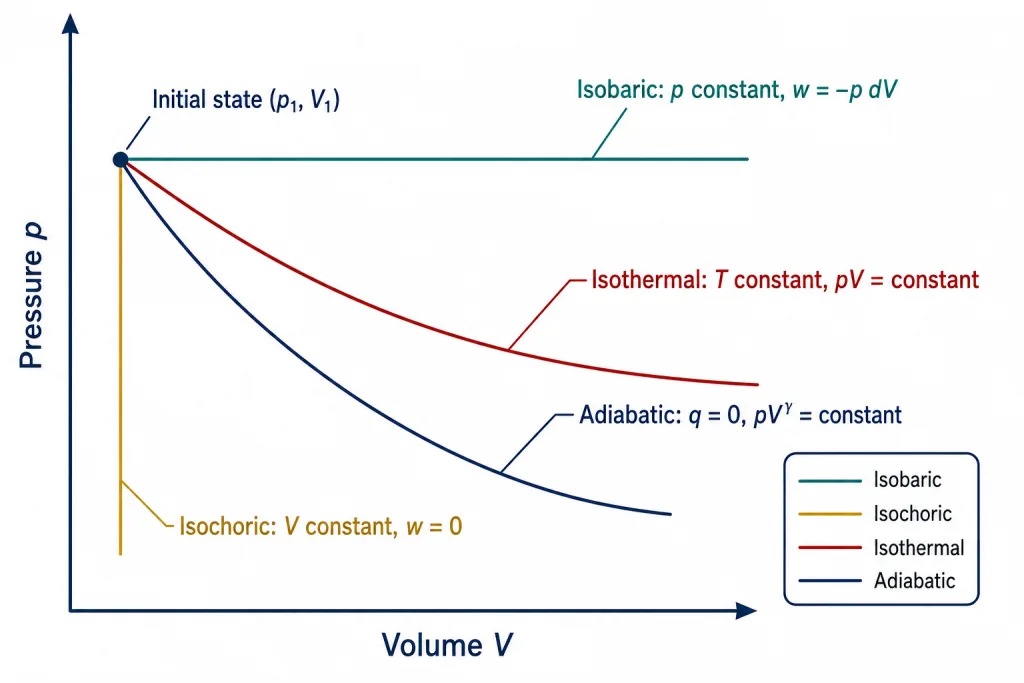
The four processes are one family
All four curves are special cases of a single reversible path called a polytropic process, defined by
for some fixed number called the polytropic index, written with a letter of its own so that it is never confused with the number of moles . Reading off the four values of makes the family obvious.
| The condition constant becomes | Process | |
|---|---|---|
| constant | isobaric | |
| constant, which for an ideal gas means constant | isothermal | |
| constant | reversible adiabatic | |
| constant, that is constant | isochoric |
For any the reversible work integrates to a single expression,
Putting gives the adiabatic work formula used later in this section. Putting gives , the isobaric result. The case has to be handled separately because the denominator vanishes, and integrating with constant gives the logarithm instead. Seeing the four processes as one family stops them feeling like four unrelated formulae to memorise.
[JEE Main] A question that gives you and asks for is answered in one line by , whatever the path was, provided the gas is ideal and no phase change or reaction occurs.
Adiabatic Change in an Ideal Gas
An adiabatic process is one in which no heat crosses the boundary: . It is achieved either by insulating the system or by running the change so fast that heat has no time to flow. The first law then gives
An adiabatic expansion cools the gas; an adiabatic compression heats it.
Deriving the relation between and
Take one infinitesimal step of a reversible adiabatic change, so that the gas pressure and the external pressure are equal throughout. For an infinitesimal step,
For moles of an ideal gas , and . Substituting both,
Divide through by to separate the variables:
Integrate from state 1 to state 2, treating as constant over the range:
Now define the adiabatic exponent
Since for an ideal gas, dividing that relation by gives . Divide the integrated equation by :
Removing the logarithms,
Replace by in that result. The constant factor cancels from both sides and leaves
Eliminating instead gives the third member of the family:
Key Point: For a reversible adiabatic change of an ideal gas with constant heat capacities, constant, constant and constant, where . Drop any one of those three conditions and the relations no longer hold.
Values of
For an ideal monatomic gas such as He, Ne or Ar, kinetic theory gives three translational degrees of freedom and
For an ideal diatomic gas such as , or at ordinary temperatures, two rotational degrees of freedom are also active and
Numerically, for a monatomic gas and for a diatomic one.
These values assume the vibrational modes are not excited. At high temperature the vibrations of a diatomic molecule start to absorb energy, rises above and falls below . For a linear triatomic or a bent triatomic molecule the count changes again. Exam problems say "monatomic" or "diatomic" precisely so that you may use and without worrying about this.
Work in an adiabatic process
Since , the work follows directly from the internal energy change:
Replacing gives the form most useful when temperatures are known,
and using at each end, and , gives the form most useful when pressures and volumes are known:
All three expressions are the same equation. In an expansion , so is negative: the gas does work on the surroundings and pays for it out of its own internal energy. In a compression and is positive.
One warning that costs marks every year is worth stating flatly. The three -type relations were derived for a reversible adiabatic path. An adiabatic expansion against a constant external pressure is irreversible, and those relations do not apply to it. What still applies is and
which is solved for directly. Question 6 below works through exactly this case.
The two adiabatic paths differ in every quantity except :
| Reversible adiabatic | Irreversible adiabatic (constant ) | |
|---|---|---|
| constant | applies | does not apply |
| Route to | solve | |
| , equal to | ||
| Cooling on expansion | larger | smaller |
| of the gas | greater than |
The last row is worth holding on to. Both processes have , but only the reversible one has . Adiabatic and isentropic mean the same thing only when the path is also reversible.
A third adiabatic case sits at the far end of the same scale. In a free expansion the gas expands into an evacuated space, so and . If the container is also insulated, as well, and the first law gives . For an ideal gas, zero means zero : a free expansion of an ideal gas is both adiabatic and isothermal, and neither nor the cooling of the ordinary adiabatic case occurs. The entropy still rises, by , because the final state is the same as that reached by an isothermal expansion.
Isothermal and Adiabatic Curves Compared
Draw both processes on a - diagram starting from the same state and let the gas expand to the same final volume . The two curves separate immediately, and the reason is temperature.
Along the isotherm the gas is held at by contact with a thermostat, so heat flows in to replace the energy spent as work. Along the adiabat no heat enters, so the energy spent as work comes out of the internal energy and the gas cools. A cooler gas at a given volume has a lower pressure. The adiabat therefore lies below the isotherm at every volume beyond the common starting point.
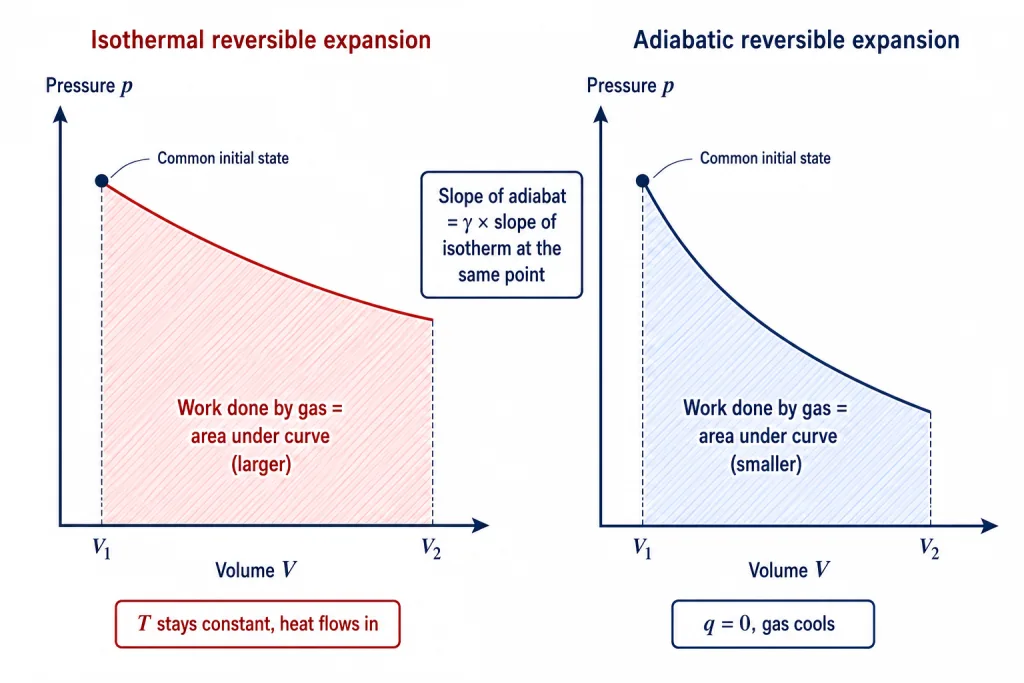
The slopes
Differentiate the isothermal condition constant:
Differentiate the adiabatic condition constant by the product rule:
Both slopes are negative, and at any common point they differ by exactly the factor .
Key Point: For an ideal gas, at any point on a - diagram the reversible adiabat is steeper than the isotherm through that point by the factor . Since always, the adiabat always falls away more sharply. The statement belongs to reversible paths only: an irreversible adiabatic expansion against a constant external pressure does not obey constant and is not a curve of this kind at all.
For a monatomic gas the adiabat is times as steep as the isotherm through the same point; for a diatomic gas, times as steep.
Numbers make the separation concrete. Take 1.0 mol of an ideal monatomic gas starting at 300 K in 10.0 L, where , and follow both paths outward.
| / L | on the isotherm / bar | on the adiabat / bar | Gas temperature on the adiabat / K |
|---|---|---|---|
| 10.0 | 2.49 | 2.49 | 300 |
| 15.0 | 1.66 | 1.27 | 229 |
| 20.0 | 1.25 | 0.79 | 189 |
| 30.0 | 0.83 | 0.40 | 144 |
The isothermal pressures come from and the adiabatic ones from . By the time the volume has tripled, the adiabatic pressure has fallen to less than half the isothermal one, and the gas has cooled to 144 K.
Which process does more work
Work done by the gas is the area under the curve on a - diagram. Between the same two volumes, starting from the same state, the isotherm lies above the adiabat everywhere, so the area under it is larger.
The physical reading is short: in the isothermal expansion the gas is being fed heat continuously, and that borrowed energy is delivered as extra work. In the adiabatic expansion the gas spends only what it already had.
The comparison flips for a compression. Compressing from the same initial state down to the same final volume, the adiabat rises more steeply, so the area under it is larger and more work must be done on the gas adiabatically than isothermally. An adiabatic compression also leaves the gas hotter, which is why a bicycle pump warms up.
A useful ordering for a single expansion between the same two volumes, from most work delivered to least:
- Isothermal reversible expansion — largest.
- Adiabatic reversible expansion — smaller, because the gas cools on the way.
- Any single-step irreversible expansion against a constant external pressure — smaller still, because the opposing pressure never falls.
- Free expansion into a vacuum — zero, because .
That ordering carries a condition worth stating plainly: all four paths must start from the same state and finish at the same volume. If instead the paths are made to finish at the same final pressure, the volumes reached differ, the areas are no longer being compared over the same interval, and the ranking can change. Any comparison of work has to fix what the two paths have in common before it means anything.
The same caution applies to the heat. The isothermal expansion absorbs of heat, the adiabatic one absorbs none, and the irreversible one absorbs whatever its smaller work demands. Only and are indifferent to the path, and even they are equal across these cases only when the final temperatures agree, which they do not here.
[JEE Main] A question that asks only "which is greater" can be answered from the diagram in seconds. Sketch the two curves from the common point and compare areas; no arithmetic is needed.
Cyclic Processes and Work as an Area
A cyclic process returns the system to its exact starting state. Every state function has the same value at the end as at the start, so for one complete cycle
Feeding into the first law leaves the single most useful statement about cycles:
Net heat absorbed over a cycle equals net work done by the gas. Neither nor is a state function, so neither is zero in general; only their sum is.
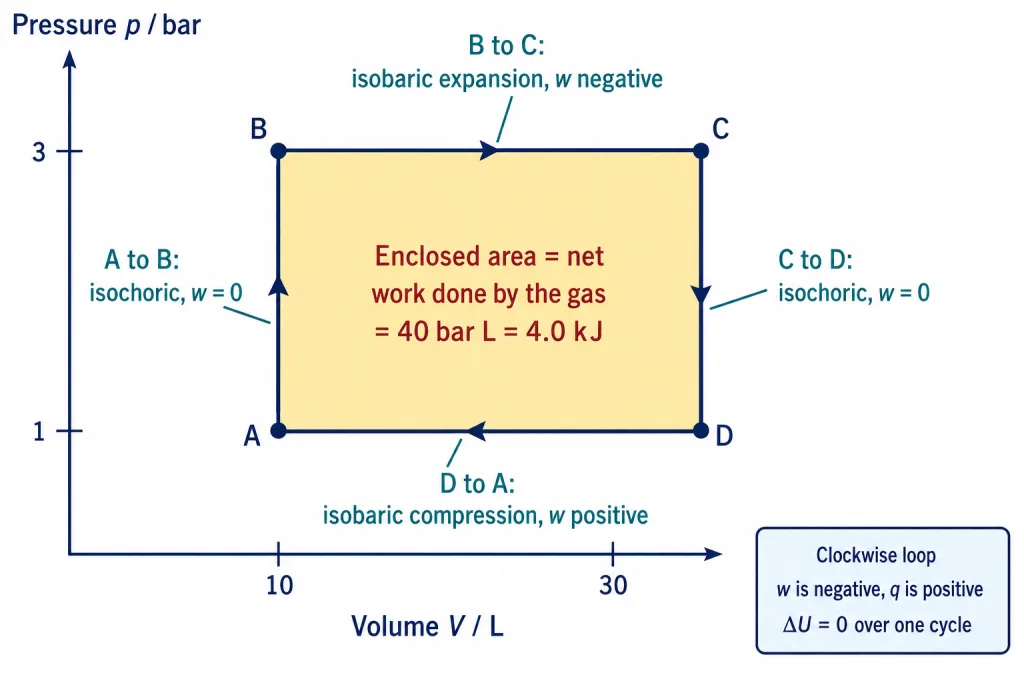
Reading the area
For any step, the work done on the gas is , and on a reversible path , so the magnitude of the work is the area under that step of the curve. Around a closed loop the areas under the outward and return paths partly cancel, and what survives is the area enclosed by the loop.
Key Point: For a cyclic process the magnitude of the net work equals the area enclosed by the loop on the - diagram. A clockwise loop means net work done by the gas, so and in the IUPAC convention. An anticlockwise loop means net work done on the gas, so and .
The sign rule follows from the geometry. In a clockwise loop the expansion half of the cycle happens along the upper, higher-pressure branch and the compression half along the lower branch. The gas therefore pushes out at high pressure and is pushed back in at low pressure, and it wins on the exchange. This is exactly what a heat engine does: absorb heat, deliver work, reject the rest. An anticlockwise loop is that engine run backwards, which is a refrigerator or a heat pump.
Working a cycle in practice
The reliable method is a small table. List the steps down the side and , , across the top, fill in whichever two entries each process makes easy, and get the third from . Then check that the column sums to zero. That check catches almost every sign error.
| Step type | Which entry is easiest first | Then |
|---|---|---|
| Isochoric | , and | |
| Isobaric | , and | |
| Isothermal reversible | , and | |
| Adiabatic |
Two conversions make the arithmetic painless when pressures are in bar and volumes in litres:
A rectangular cycle built from two isobars and two isochores has an area that is simply , which is the fastest area to evaluate. For a cycle containing an isothermal step the logarithmic work expression is needed for that step, and for one containing an adiabatic step the work is for that step.
One caution about efficiency. The net work of a cycle is not the whole heat absorbed, because some steps of the cycle reject heat. The efficiency is
where counts only the steps in which is positive, not the algebraic sum. Using the net heat in the denominator gives for every cycle, which is the giveaway that the wrong quantity was used.
The upper limit on is set by the second law. A cycle built from two reversible isotherms at and joined by two reversible adiabats — the Carnot cycle — has
with both temperatures in kelvin. No cycle working between the same two temperatures can beat it, and every real cycle falls short because its steps are irreversible. The efficiency depends only on the two temperatures, not on the gas or on how much of it there is.
Where the state functions help
The reason cycles are worth setting up carefully is that they turn hard questions into easy ones. Any quantity that is a state function can be obtained by whichever route through the cycle is simplest, because the answer does not depend on the route. If a problem asks for from A to C and the direct path is awkward, going A to B to C gives the same number. The same freedom is what Hess's law exploits for reaction enthalpies, and it is the same principle wearing different clothes.
What cannot be moved between routes is and . Each of those belongs to the particular path taken, which is exactly why the enclosed area of a cycle is not zero even though is.
Cycles drawn on other axes
A cycle is sometimes given on - or - axes instead, and the first job is to identify each step before any arithmetic starts. Reading the graph is a matter of knowing what each process looks like on those axes.
| Process | On - axes | On - axes | On - axes |
|---|---|---|---|
| Isochoric | vertical line | straight line through the origin | horizontal line |
| Isobaric | horizontal line | horizontal line | straight line through the origin |
| Isothermal | rectangular hyperbola | vertical line | vertical line |
The straight lines through the origin come from at fixed and at fixed , both direct readings of . Once each step is named, the work is computed on - thinking as usual, since the area rule belongs to those axes alone. An area enclosed on a - or - plot has no thermodynamic meaning at all.
Kirchhoff's Equation — How Changes with Temperature
Tables of standard enthalpies of formation are quoted at 298 K. Industrial reactions are run at 700 K or 1200 K, and the reaction enthalpy is not the same there. Kirchhoff's equation supplies the correction.
Start from the definition of heat capacity at constant pressure applied to a single substance. Warming a substance from to at constant pressure changes its enthalpy by
when is constant over the interval. Apply this to the products and to the reactants of a reaction separately, then subtract. The enthalpy difference between products and reactants is , and the heat capacity difference is
each term weighted by its stoichiometric coefficient. Subtracting gives
Key Point (Definition): Kirchhoff's equation is , where is the stoichiometric sum of the molar heat capacities of the products minus that of the reactants. It assumes is effectively constant across the temperature range and that no substance changes phase within that range.
Both conditions matter. Heat capacities themselves drift with temperature, so over a range of many hundreds of kelvin the constant- form is an approximation. The exact statement is a derivative,
whose integrated form is
and the linear equation above is what that integral becomes when is pulled out as a constant. If a reactant or product melts or boils between and , the latent heat of that transition has to be added separately, because the simple linear form cannot see it. For a reaction of water, for instance, a range that straddles 373 K needs the enthalpy of vaporisation inserted at that point and the heat capacity of steam used above it.
The sign of decides the direction of the drift.
- : the products absorb heat faster than the reactants, so becomes more positive (less exothermic) as rises.
- : becomes more negative (more exothermic) as rises.
- : the reaction enthalpy is independent of temperature over that range.
There is a matching statement for internal energy at constant volume,
with built the same way from constant-volume heat capacities. The two forms are consistent with each other. Differentiating with respect to temperature gives
which is just applied to every gaseous species and summed with its stoichiometric sign. Solids and liquids contribute nothing to , so only the gases matter in that correction.
A worked feel for the size of the effect: for the ammonia synthesis is about , so raising the temperature by 200 K shifts by about against a reaction enthalpy of . The correction is a tenth of the value — small enough to ignore in a rough estimate, far too large to ignore in a plant design.
[JEE Main] Watch the units. Reaction enthalpies come in and heat capacities in . The correction term lands in joules and must be divided by 1000 before it is added.
Entropy Changes for an Ideal Gas
Entropy is a state function defined through a reversible path by . For an ideal gas that definition can be turned into a formula in and that works for any change of state, reversible or not, because depends only on the endpoints.
For an infinitesimal reversible step, the first law gives . For an ideal gas and , so
Integrating between the two states, with taken as constant,
The same change expressed in and , obtained by substituting and using , is
Key Point: For moles of an ideal gas, . Because entropy is a state function, this holds for any process joining those two states, however irreversible the actual path was. The reversible path was used only to evaluate the integral.
Three special cases fall straight out.
Isothermal change. , so the first term vanishes:
Expansion raises entropy; compression lowers it. For an isothermal reversible expansion the surroundings lose exactly what the system gains, so , which is the signature of a reversible process. For an isothermal irreversible expansion is the same number, but the surroundings give up less heat, so .
Constant volume. . Heating raises entropy. At constant pressure the matching result is , larger for the same temperature rise because the gas also expands.
Reversible adiabatic change. Substituting into the general formula gives
using . A reversible adiabatic process is isentropic. An irreversible adiabatic expansion, by contrast, has but , so "adiabatic" and "constant entropy" are not synonyms.
The surroundings and the total
Entropy decides spontaneity only through the total, . The surroundings are treated as a reservoir so large that heat entering or leaving does not change its temperature, and any heat it exchanges is therefore exchanged reversibly:
Two isothermal expansions of the same gas between the same two states show what this buys. Take 1.0 mol expanding at 300 K from 10.0 L to 20.0 L. In both cases , because entropy is a state function.
Carried out reversibly, the gas absorbs , so and . Carried out against a constant external pressure equal to the final pressure, the gas does less work and absorbs only , so and
The system's entropy change is identical on the two paths; the surroundings' is not, because is a path function. That difference is the whole content of the second law for this process.
For a phase change at its transition temperature, where the change is reversible by construction,
with the melting or boiling point in kelvin.
Entropy of mixing
Two ideal gases at the same temperature and pressure, separated by a partition, mix spontaneously when the partition is removed. No heat is exchanged and no work is done, yet the process runs one way only. Entropy explains it.
Each gas expands from the volume it occupied alone into the whole container. For gas A, , where is its mole fraction. Its entropy rise is . Adding the contribution of every component,
Every mole fraction is less than 1, so every logarithm is negative and is always positive. For one mole each of two gases, .
Since mixing ideal gases has , the Gibbs energy of mixing is , which is negative at every temperature. Mixing of ideal gases is spontaneous and never reverses on its own.
Gibbs Energy Away from Standard Conditions
is a single fixed number for a balanced equation at a stated temperature, defined with every reactant and product in its standard state — pure, at 1 bar, and at unit concentration for solutions. A real reaction vessel almost never contains that mixture. The quantity that decides which way a real mixture will move is , and the two are connected by
Here is the reaction quotient: the same combination of partial pressures or concentrations that appears in the equilibrium constant, but evaluated with whatever amounts are present at that moment rather than with equilibrium amounts. For a gas reaction
with , which makes dimensionless so that its logarithm is defined. In practice the partial pressures are simply entered in bar and the divisions are silent.
Two checks confirm that the equation is sensible. If the mixture happens to be in standard states, every ratio is 1, , and . And at equilibrium the mixture has no tendency to move either way, so while has reached its equilibrium value . Putting both facts in,
Key Point: gives the driving force of a mixture at its actual composition. Setting and recovers . The first equation describes a particular vessel; the second is a property of the reaction alone.
Substituting back into the first equation collapses both into one statement:
which reads off the direction of change immediately.
| Condition | Sign of | What the mixture does |
|---|---|---|
| negative | runs forward, making more product | |
| zero | at equilibrium, composition fixed | |
| positive | runs backward, remaking reactant |
This settles a confusion that costs marks. A reaction with a large positive is not forbidden. It has a small , so it proceeds only a little way — but if the vessel starts with almost no product, is smaller still, is negative, and the reaction does run forward until climbs to . What fixes is the stopping point, not whether anything happens at all.
The temperature dependence sits inside . Combining it with and dividing by ,
A plot of against is a straight line of slope and intercept , provided and are roughly constant over the range. An exothermic reaction has a positive slope, so falls as rises — the quantitative form of the qualitative rule that heating shifts an exothermic equilibrium backwards.
Writing that line at two temperatures and subtracting eliminates the entropy term and gives the two-point form,
which converts a value of at one temperature into a value at another using only the reaction enthalpy. The same caution attaches: must be effectively constant across the interval, which is the assumption Kirchhoff's equation exists to correct when it is not.
What measures
At constant temperature and pressure, is the maximum work other than expansion work that a process can deliver:
in the IUPAC convention, where work done on the system is positive, so a negative corresponds to work delivered by the system. That maximum is reached only on a reversible path; any real process delivers less, with the shortfall appearing as entropy generated. This is the quantity a galvanic cell converts into electrical work, and the reason appears in electrochemistry rather than .
[JEE/NEET] A negative means , and a positive means . Neither says anything about how fast the reaction goes: thermodynamics fixes the destination, kinetics fixes the travelling time.
Question 1: The isochoric row, filled in
2.0 mol of an ideal monatomic gas is heated from 300 K to 500 K in a sealed rigid vessel. Find , , and . Take .
Answer:
The vessel is rigid, so and no expansion work is possible.
The gas is monatomic, so and . The temperature rise is .
From the first law with , the heat is the whole of the internal energy change.
For the enthalpy I use the ideal-gas result that works on any path.
Ans: , , Watch out: is not zero just because the volume is fixed. The temperature changed, and for an ideal gas that alone fixes . Here , and the pressure did rise.
Question 2: The isobaric row, filled in
3.0 mol of an ideal diatomic gas is heated from 300 K to 400 K at a constant pressure of 1.0 bar. Find , , and .
Answer:
For a diatomic gas and , and .
The pressure is constant at both ends, so I can convert into using the gas equation at each state.
The sign is negative because the gas expanded on heating and pushed the surroundings back.
I check with the first law: , which matches .
Ans: , ,
Question 3: The isothermal row, filled in
2.0 mol of an ideal gas expands reversibly and isothermally at 300 K from 5.0 L to 25.0 L. Find , , and .
Answer:
The temperature is constant, so for an ideal gas both and are zero straight away.
For the reversible isothermal work,
With the first law gives .
Suppose the same expansion is instead carried out in one step against a constant external pressure equal to the final pressure of the gas. The final pressure is
and are still zero, because the end states are the same, and is still , now .
Ans: Reversible: , . Irreversible one-step: , . In both, Watch out: does not mean nothing happened. It also does not fix : the same pair of end states gave two different amounts of work, because work is a path function while internal energy is not.
Question 4: Reversible adiabatic expansion of a monatomic gas
1.0 mol of an ideal monatomic gas at 300 K expands reversibly and adiabatically until its volume doubles. Find the final temperature, , and .
Answer:
The gas is monatomic, so and . The path is a reversible adiabatic one for an ideal gas, so is constant.
The gas cooled by 111 K, which is what an adiabatic expansion must do. With the work equals the internal energy change.
The same number from the other form, as a check:
Ans: , , , Watch out: The exponent in is , not . Using by mistake gives , which looks like a perfectly reasonable answer and is not one.
Question 5: Adiabatic compression using pressures and volumes
1.0 mol of an ideal diatomic gas at 1.00 bar occupying 20.0 L is compressed reversibly and adiabatically to 5.0 L. Find the final pressure and the work done. Take .
Answer:
For a diatomic gas . The path is reversible and adiabatic, so .
For the work I use the form built from pressures and volumes.
The positive sign is correct: this is a compression, so work is done on the gas.
The temperatures come from the gas equation at each end, with .
Checking the work by the temperature form, with for a diatomic gas:
which agrees with the pressure-volume form to the precision of the rounding.
Ans: , , , Watch out: in the denominator is 0.4, not 1.4. Dividing by 1.4 gives 1.06 kJ, and the answer is out by a factor of three and a half.
Question 6: Adiabatic expansion against a constant external pressure
1.0 mol of an ideal monatomic gas at 300 K and 5.0 bar expands adiabatically against a constant external pressure of 1.0 bar until mechanical equilibrium is reached. Find the final temperature and the work done.
Answer:
The path is adiabatic but irreversible, because the gas pressure is 5.0 bar while the opposing pressure is 1.0 bar. The relation constant was derived for a reversible path and cannot be used here. What survives is , so , together with .
The gas stops expanding when its pressure equals the external pressure, so .
Putting in , , , and dividing both sides by :
The entropy change is worth adding, because it shows what "irreversible" costs. Using the pressure form for an ideal gas,
No heat crossed the boundary, so and , which is positive as the second law requires for a change that happens on its own. A reversible adiabatic expansion between a different pair of end states would have given exactly zero.
Ans: , , , , Watch out: The reversible formula would give 158 K here. That number is wrong for this problem, and it is the single most common error in adiabatic questions: the word "adiabatic" alone does not license .
Question 7: Isothermal against adiabatic, same expansion
1.0 mol of an ideal monatomic gas at 300 K expands from 10.0 L to 20.0 L, once reversibly and isothermally, and once reversibly and adiabatically. Compare the work delivered to the surroundings.
Answer:
For the isothermal path the temperature stays at 300 K throughout.
The adiabatic path is the one worked in Question 4: the same gas, the same starting state, the same doubling of volume. There and
Work delivered to the surroundings is , so the isothermal expansion delivers 1729 J and the adiabatic one 1384 J. The ratio is 0.80.
The reason is visible in the two final temperatures. The isothermal gas is held at 300 K by heat flowing in, so its pressure stays high all the way and it pushes hard right to the end. The adiabatic gas cools to 189 K, its pressure sags faster, and the area under its curve is smaller.
The final pressures make the same point from the other side. The initial pressure is . The isothermal path ends at , while the adiabatic path ends at . The adiabatic gas finishes both colder and at a lower pressure, having spent its own internal energy on the work.
Ans: Isothermal 1729 J, adiabatic 1384 J; the isothermal expansion does more work Watch out: This ordering holds when both paths start from the same state and end at the same volume. If instead they end at the same pressure, the volumes differ and the comparison has to be redone.
Question 8: A rectangular cycle
An ideal gas is taken round the cycle . Find the net work and the net heat for one cycle.
Answer:
I take the steps one at a time, in bar L, and convert at the end.
: volume fixed at 10.0 L, so .
: expansion at a constant 3.0 bar, .
: volume fixed at 30.0 L, so .
: compression at a constant 1.0 bar, .
As a check, the loop is a rectangle of height and width , giving an enclosed area of 40.0 bar L. The sequence goes up the left side, right along the top, down the right side and back left along the bottom, which is clockwise, so the net work is done by the gas and is negative.
The cycle returns the gas to state A, so and
The step-by-step heats follow if the gas is specified. Taking it as monatomic and using to compare temperatures, the ratio at A, B, C, D is , so the gas is heated on and and cooled on the return steps.
| Step | / bar L | / bar L | / bar L |
|---|---|---|---|
| Cycle |
The internal energy entries use for a monatomic gas, which needs no value of at all. The column sums to zero and , so the table is consistent.
Heat is absorbed on the first two steps, , so
Ans: (4.0 kJ of work done by the gas), , , Watch out: The area gives only the magnitude. The direction of travel gives the sign, and reversing the cycle to would give instead.
Question 9: A cycle containing isothermal steps
1.0 mol of an ideal monatomic gas is taken round this cycle: (i) reversible isothermal expansion at 300 K from 10.0 L to 20.0 L; (ii) cooling at constant volume to 150 K; (iii) reversible isothermal compression at 150 K from 20.0 L to 10.0 L; (iv) heating at constant volume back to 300 K. Find and for each step and for the cycle.
Answer:
Step (i), isothermal at 300 K, :
Step (ii), constant volume, :
Step (iii), isothermal at 150 K, , and the volume ratio is now :
Step (iv), constant volume, :
Cycle totals:
The internal energy column sums to , as it must for a closed cycle, and .
Heat is absorbed in steps (i) and (iv), a total of , so the efficiency is
Ans: (865 J done by the gas), , Watch out: The denominator of the efficiency is the heat absorbed, 3600 J, not the net heat, 865 J. Using the net heat gives 100% efficiency for every cycle, which is impossible.
Question 10: Kirchhoff's equation for ammonia synthesis
For , at 298 K. The molar heat capacities at constant pressure are 29.1, 28.8 and 35.1, all in and taken as constant. Find at 500 K.
Answer:
First I build as products minus reactants, each weighted by its coefficient.
The temperature interval is .
is negative, so the reaction becomes more exothermic as the temperature rises, which is the direction the sign predicted.
The matching internal energy change at 500 K follows from . Counting gaseous moles, .
Ans: , Watch out: The correction comes out in joules while the reaction enthalpy is in kilojoules. Adding to without converting gives nonsense. The answer also rests on being constant from 298 K to 500 K, which is only an approximation.
Question 11: Entropy change of an ideal gas, three ways
(a) 2.0 mol of an ideal monatomic gas goes from 300 K and 10.0 L to 400 K and 40.0 L. Find . (b) Find if the same gas goes from 300 K and 10.0 L to 300 K and 40.0 L. (c) 1.0 mol of and 1.0 mol of , both at the same temperature and pressure, are allowed to mix. Find , treating both as ideal.
Answer:
(a) Entropy is a state function, so I use the general ideal-gas expression with .
(b) The temperature term vanishes, leaving only the volume term, which is the number already computed.
(c) Each gas ends up with a mole fraction of .
Ans: (a) (b) (c) Watch out: Part (a) never asked whether the path was reversible, and it did not need to. The formula was derived along a reversible path, but the answer depends only on the two end states.
Question 12: Direction of a reaction from and
For at 298 K, . A vessel holds at 1.0 bar, at 3.0 bar and at 0.020 bar. Find and say which way the reaction runs.
Answer:
First the reaction quotient, with all pressures in bar so that is a pure number.
is negative, so the mixture runs forward and makes more ammonia.
The same conclusion follows from comparing with . From ,
is far below , so the reaction must move forward, and is strongly negative.
Ans: ; the reaction runs forward Watch out: and are different quantities. The standard value belongs to the reaction with every gas at 1 bar; the actual driving force in this particular vessel is nearly twice as large because the ammonia is so dilute.