
The Angle of Contact
Pour water onto a clean sheet of glass and it spreads into a thin sheet. Pour mercury onto the same glass and it rolls into tight silver balls. Put a drop of water on a lotus leaf and it sits up like a bead; put the same drop on a clean plastic plate and it flattens out.
The liquid is the same. The solid decides.
The number that captures the whole difference is the angle of contact.
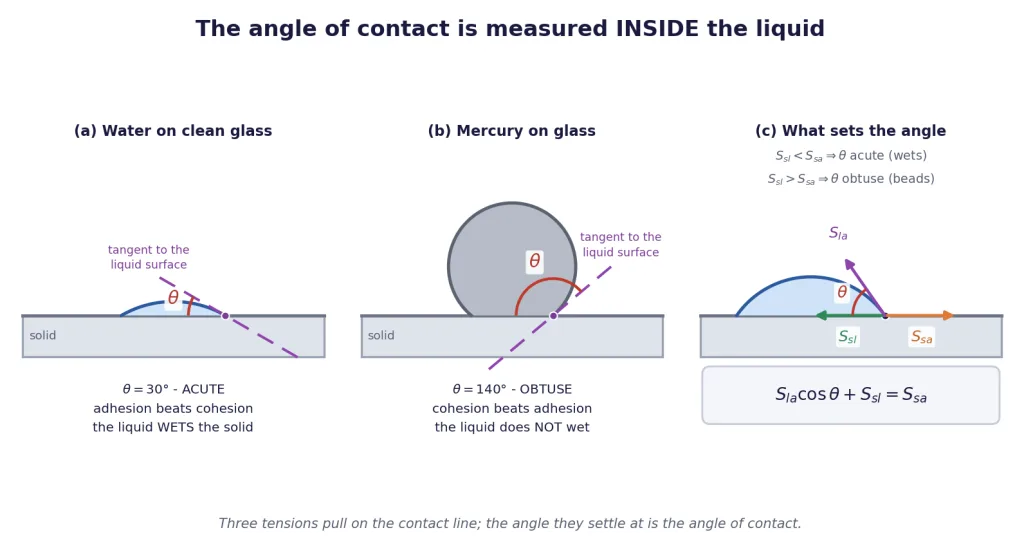
Key Point — the definition, and read the last four words twice:
The angle of contact is the angle between the tangent to the liquid surface at the point of contact and the solid surface, measured inside the liquid.
That phrase "inside the liquid" is the whole definition. Measure the same corner from outside and you get , and every sign in every formula from here to the end of the chapter flips. Whenever you draw a contact angle, shade the liquid first and then place the arc.
Acute or obtuse — and what each one means
| Acute, | Obtuse, | |
|---|---|---|
| Example | water on clean glass | mercury on glass |
| Meniscus in a tube | concave | convex |
| Behaviour of a drop on a plate | spreads out, flat | beads up, nearly spherical |
| Does it wet? | yes — a wetting liquid | no — a non-wetting liquid |
| In a capillary tube | rises | is depressed |
| Which force is winning | adhesion (liquid–solid) | cohesion (liquid–liquid) |
Some real values, all against a clean solid at room temperature:
| Liquid and solid | |
|---|---|
| Pure water on clean glass | close to |
| Ordinary water on ordinary glass | about to |
| Water on silver | |
| Water on paraffin wax | about |
| Water on a lotus leaf | about |
| Mercury on glass | about |
| Kerosene on almost anything | close to — it just spreads |
[Board Important] "Water on clean glass" is idealised to in almost every numerical, which makes and quietly disappears from the algebra. Do not assume it — read the question. If a value is given, use it.
Cohesion versus adhesion
Two kinds of attraction are competing at the contact line.
- Cohesive force — between molecules of the same substance, so liquid to liquid. It is what holds the drop together.
- Adhesive force — between molecules of different substances, so liquid to solid. It is what makes the liquid stick to the container.
Key Point:
- Adhesion stronger than cohesion the liquid prefers the solid's company it spreads is acute, meniscus concave.
- Cohesion stronger than adhesion the liquid prefers its own company it retracts into a ball is obtuse, meniscus convex.
Mercury has enormous cohesion, so it beads on almost everything. Kerosene has feeble cohesion, so it spreads on almost everything.
The equation behind the angle
There is a genuine force balance hiding here, and it is worth seeing once. Three interfaces meet along the contact line, and each has its own surface tension:
- — liquid–air
- — solid–air
- — solid–liquid
Resolving the three pulls along the solid surface at the contact line, in equilibrium:
Key Point:
Now read the consequences straight off:
- If , then and is acute. A liquid–solid interface is cheap compared with a solid–air one, so the liquid happily covers the solid. That is water on plastic or on glass.
- If , then and is obtuse. Creating liquid–solid interface is expensive, so the liquid pulls away. That is water on a waxy leaf, or mercury on anything.
- If ever exceeds , no angle can satisfy the equation at all: the liquid spreads without limit into a film. That is complete wetting, and it is what kerosene does.
What changes the angle of contact
depends on:
- the pair of substances — it is never a property of the liquid alone, exactly as surface tension is not;
- the temperature — generally decreases as temperature rises, so hot liquids wet better;
- impurities. Adding a wetting agent (soap, detergent, a dye) lowers sharply, which is precisely why detergents work. Adding a water-proofing agent (wax, silicone, the fluorocarbons in rain jackets) raises , so water cannot get a grip;
- the cleanliness of the solid — a fingerprint's worth of grease can move by tens of degrees.
[NEET Important] Two stock one-liners. "Why should water with detergent have a small angle of contact?" Because a detergent is a wetting agent: it lowers , which raises and drops , letting the water penetrate the fabric. "Why is the angle of contact of mercury with glass obtuse?" Because mercury's cohesion far exceeds its adhesion to glass, so and comes out negative.
The Meniscus, and What Curvature Costs
Dip a narrow glass tube into water and look at the surface inside it. It is not flat. It curves.
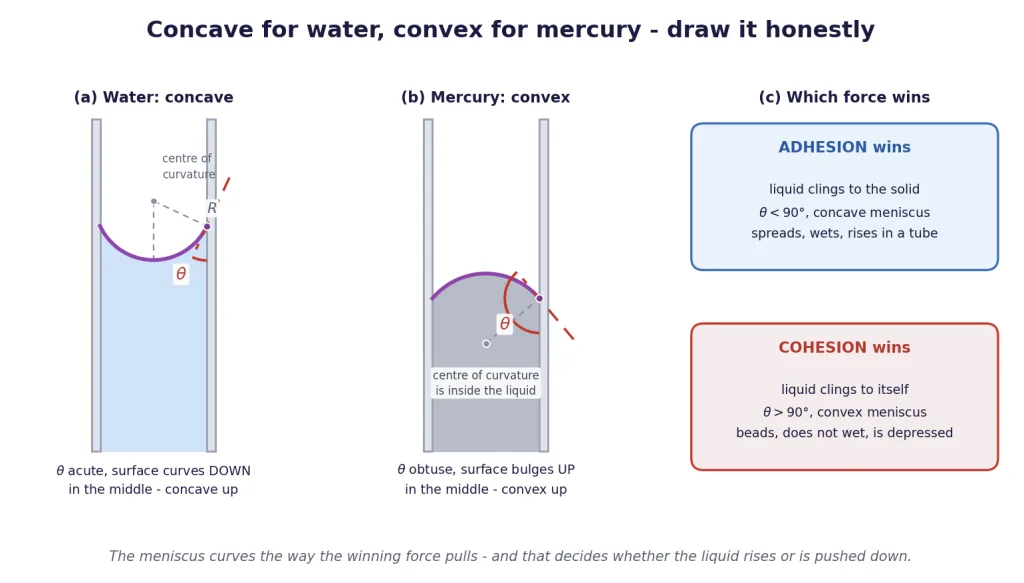
Key Point — get this the right way round:
- Water in glass: acute, the liquid climbs the wall, and the surface dips in the middle. The meniscus is concave (curving like the inside of a bowl, hollow side up).
- Mercury in glass: obtuse, the liquid retreats from the wall, and the surface humps up in the middle. The meniscus is convex (domed).
Read the volume of a liquid in a burette from the bottom of a water meniscus and the top of a mercury one — that is where the surface actually is at the centre.
The geometry you will use constantly
Take a tube of internal radius holding a liquid of contact angle . Very near the wall the surface must meet the glass at exactly , and if the tube is narrow enough the whole meniscus is a spherical cap of some radius of curvature .
Drop a perpendicular from the centre of curvature to the wall and the geometry gives, in one line,
Key Point — the meniscus radius: is the tube radius; is the meniscus radius of curvature. They are equal only when .
acute positive, centre of curvature above the liquid — concave.
obtuse the centre of curvature is inside the liquid — convex.
[JEE Tip] Mixing and here is the classic factor-of- error, and it is silent because both are lengths. Label them on your diagram before you write a formula. In this book is always the tube, always the meniscus.
Curvature means a pressure difference
Here is the physical idea that runs the rest of this section and all of Section 11.
Think of a curved liquid surface as a stretched membrane. A stretched membrane that is bent pushes towards the centre of its curvature — that is why a balloon's rubber squeezes the air inside. So the liquid surface presses on whatever lies on its concave side.
Key Point — the master rule, memorise it in these words:
The pressure is always greater on the concave side of a curved liquid surface.
A flat surface has no curvature and therefore no pressure difference across it.
Test it on the two menisci:
- Water in a tube. The meniscus is concave upward, so its concave side faces the air above. Therefore the pressure just below the meniscus, in the water, is less than atmospheric. Water is then pushed up the tube by the higher pressure outside — that is capillary rise, and Section 11 does the arithmetic.
- Mercury in a tube. The meniscus is convex upward, so its concave side faces down into the mercury. Therefore the pressure just below the meniscus is greater than atmospheric, and the mercury is pushed down. That is capillary depression.
Wetting, non-wetting and what people do about it
Because the angle of contact is a property of the pair, engineering it is easy and lucrative.
- Wetting agents — soaps, detergents, dyes, the agents in insecticide sprays — lower so the liquid penetrates cloth, soil or leaf rather than beading on the outside.
- Water-proofing agents — wax on a car, silicone on a windscreen, the fluorocarbon finish on a rain jacket, the natural wax on a lotus leaf — raise so water cannot spread and rolls off instead, carrying dust with it.
- Soldering flux does the same job for molten solder on copper: it drives down so the solder flows into the joint instead of balling up on it.
- A duck's feathers carry an oily secretion that keeps large. Wash it off with detergent and the bird gets waterlogged, which is why detergent spills are lethal to waterfowl.
[Board Important] "Water on a clean glass surface tends to spread out while mercury on the same surface tends to form drops. Explain." Full-mark answer: for water on glass the adhesive force exceeds the cohesive force, so , is positive, the angle of contact is acute and the water spreads to wet the glass; for mercury the cohesive force dominates, , is negative, the angle of contact is obtuse and the mercury retracts into drops.
Why Drops Are Spherical, and the Pressure That Follows
The shape first
A free liquid drop, with gravity and air resistance out of the way, is a sphere — and the argument is one sentence long. The surface carries energy proportional to its area, the volume is fixed, and of all shapes of a given volume the sphere has the least area. So the sphere is the minimum-energy shape, and the drop finds it.
You can check the claim against the only competitor most people can compute. A cube of side has volume and area . A sphere of the same volume has , hence , and area . That is 19% less area than the cube, for exactly the same amount of liquid. The sphere wins, and it wins against every other shape too.
That is also why a soap bubble is a sphere, why a jet of water breaks into round beads rather than sausages, and why the shot tower — dropping molten lead from a height so it solidifies in flight — has been making round lead shot since the eighteenth century.
The pressure inside must be higher
Now the consequence. Every element of that curved surface is pulling inwards, so the liquid inside is being squeezed. It follows that
and the difference is what we call the excess pressure . Let us get it exactly.
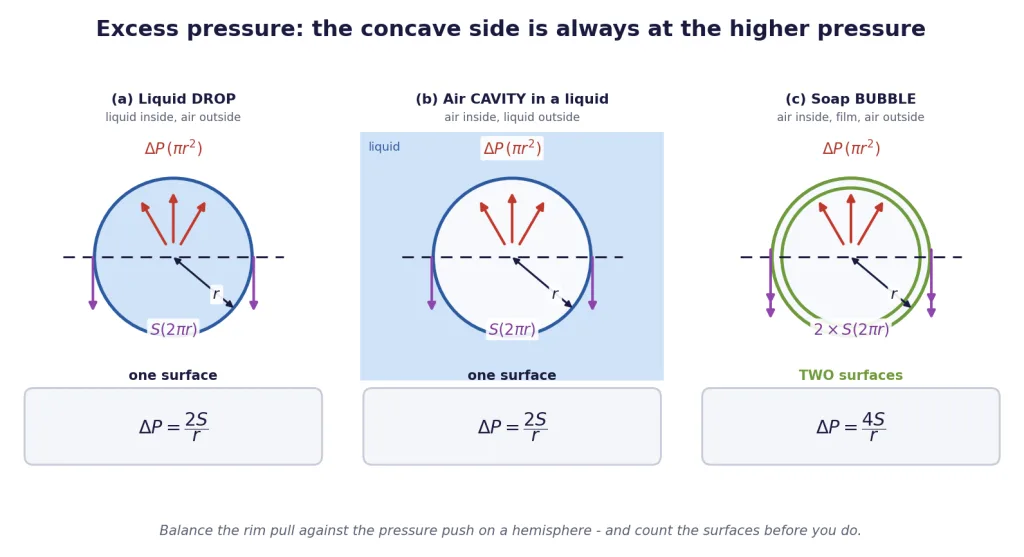
Derivation 1: cut the drop in half
Take a spherical drop of radius and imagine slicing it through a diameter. Consider the equilibrium of one hemisphere.
Pulling the two halves together, all round the circular rim of length , is the surface tension:
Pushing them apart is the excess pressure, acting on the flat circular face of area — and it is the projected flat area that matters, because only the component along the axis survives when you resolve the pressure over the curved surface:
In equilibrium these are equal:
Derivation 2: the work–energy route
Let the drop grow by a tiny amount , slowly.
Energy stored in the new surface: dropping as second order.
Work done by the excess pressure, pushing the surface out through over an area :
Equate, and cancels:
Two independent routes, one answer. That is how you know it is right.
Key Point — a liquid drop: One liquid–air surface. Higher pressure on the concave side, which for a drop is the inside.
The air cavity: the same answer, and the reason
Now take a bubble of air inside a body of liquid — a cavity, not a bubble in the soap-film sense. How many liquid surfaces does it have?
One. There is liquid outside and air inside, and exactly one boundary between them. So the derivation is word for word the same:
Key Point — an air cavity in a liquid: Same as a drop, because a cavity also has only one liquid–air interface. Only the labels "inside" and "outside" have swapped.
And the pressure is still higher on the concave side, which is again the air inside — the liquid surface curves round the air with its hollow facing in.
[JEE Tip] A cavity is not a bubble. The word "bubble" in an exam means a soap bubble — a film with air on both sides — unless the problem says "air bubble in a liquid", which is a cavity. Read the preposition. It is worth a factor of 2.
The Soap Bubble, and the Factor of Two
A soap bubble is a thin shell of liquid with air inside and air outside. So it has:
- an outer surface, liquid against the outside air, and
- an inner surface, liquid against the enclosed air.
Two surfaces — the same 2 that turned into in Section 9. Both of them squeeze the enclosed air.
The film is only a few micrometres thick, so the two radii are equal to any accuracy you could measure. Redoing the hemisphere balance with two rims pulling on the cut:
Key Point — the three results, memorise them together:
Object Surfaces Excess pressure Liquid drop 1 Air cavity in a liquid 1 Soap bubble 2 In every case is the amount by which the pressure on the concave side exceeds that on the convex side, and it is inversely proportional to the radius.
That is why you have to blow reasonably hard to start a soap bubble and then hardly at all to keep it growing. When the bubble is a millimetre across it needs a hundred pascal; when it is ten centimetres across it needs one.
Where the atmosphere goes
is a difference, so it is a gauge-type quantity and the atmosphere cancels out of it. To get an absolute pressure you must add the outside pressure back explicitly.
Key Point — always say which pressure you are quoting:
- Soap bubble in open air: (absolute), and the gauge pressure inside is just .
- Air cavity at a depth below the surface of a liquid: the pressure in the liquid right next to it is already , so
- A soap bubble blown under water would have two surfaces and ; an air bubble in water has one and . Count first.
Get into the habit of writing "gauge" or "absolute" beside every pressure the moment you write it down. In this chapter that single habit is worth more marks than any formula.
A sense of scale
For water, N/m. The excess pressure inside a drop:
| Radius of the drop | |
|---|---|
| 1 cm | 14.6 Pa |
| 1 mm | 146 Pa |
| 0.1 mm | 1460 Pa |
| 1 micrometre | Pa — about 1.4 atmospheres |
| 10 nanometre | Pa — about 144 atmospheres |
Look at what happens as things get small. On the scale of a raindrop, surface tension is a rounding error next to atmospheric pressure. On the scale of a mist droplet it is comparable to the atmosphere. On the scale of a cell it is dominant. Surface effects do not scale like volume effects, and that single fact is why the physics of the very small feels so alien.
[NEET Important] A favourite pair of one-liners. "Excess pressure inside a soap bubble of radius is…" . "Excess pressure inside an air bubble of radius inside a liquid is…" . The words look almost identical; the answers differ by a factor of 2.
The general case, in one line
For a surface curved differently in two perpendicular directions, with radii and , the result is which is beyond the syllabus, but it explains everything above in one stroke. For a sphere and you recover ; for a flat surface both radii are infinite and ; for a cylindrical jet of radius one radius is and the other infinite, giving — exactly half the drop's value. That last one is why a cylindrical stream of water is unstable and breaks up into drops.
Two Bubbles, One Tube — and What Everyone Gets Wrong
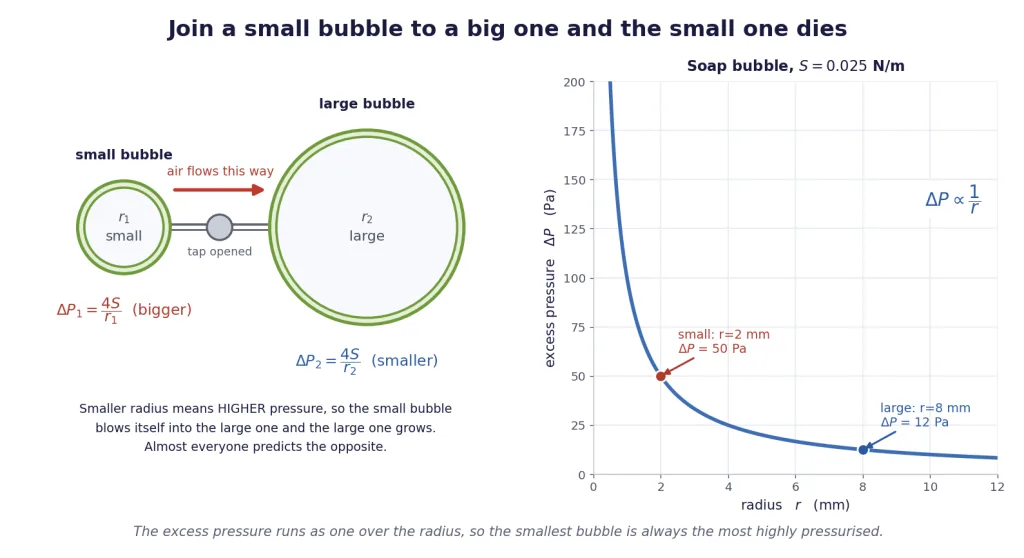
Blow a small soap bubble on one end of a tube and a large one on the other. Now open the tap between them. What happens?
Almost everybody says the big one feeds the small one until they are equal. The opposite happens. The small bubble shrinks, empties itself into the large one, and disappears; the large one grows.
Why
The smaller the bubble, the greater the pressure inside it. Air flows from high pressure to low, so it flows from the small bubble into the big one. That makes the small one smaller still, which makes its pressure higher still, which drives the flow harder. The process runs away, and the small bubble collapses to a flat film across the tube mouth.
Key Point:
When two soap bubbles of unequal size are connected, the smaller one collapses into the larger one, because the excess pressure goes as and is therefore greater in the smaller bubble. The system ends up with one big bubble, which has less total surface area — exactly what a surface always wants.
[JEE Tip] The follow-up question is: what is the radius of curvature of the common film where the two bubbles meet? The film separating them must supply the pressure difference across itself, and it is a single soap film with two surfaces like any other, so with . The common film bulges into the larger bubble, because the smaller one is pushing harder. Note that is always bigger than , so the interface is gently curved, not sharply.
When two bubbles merge into one
Two bubbles of radii and coalesce into a single bubble of radius , at constant temperature. The enclosed air obeys Boyle's law, so with the ambient pressure:
Cancelling and separating the two kinds of term:
Key Point — the exact isothermal condition: which can be turned round to measure the surface tension:
Two limiting cases hide inside that one equation, and knowing which one a question wants is the whole skill.
If the problem tells you to neglect the atmospheric pressure — which effectively means , true only for extremely small bubbles — the left side vanishes and This is the standard exam answer, and you should know it. It says the total surface area is unchanged.
If instead dominates, which is the case for any bubble you can actually see, the right side is negligible and that is, the volume is conserved, which is what your intuition expects at ordinary pressures.
[JEE Tip] Say out loud which case you are in before you write anything. "Neglect the atmosphere" add the squares. "Ordinary conditions, isothermal" add the cubes. Example 4 works a case both ways so you can see the difference numerically.
The trap list for this section
| Trap | What to do |
|---|---|
| "Bubble" vs "air bubble in a liquid" | Read the preposition. Film ; cavity |
| Quoting a pressure without saying gauge or absolute | Write the word next to the number, every time |
| Using the tube radius as the meniscus radius | ; they are equal only at |
| Measuring from outside the liquid | Shade the liquid, then draw the arc inside it |
| Assuming the big bubble feeds the small one | : the small one always loses |
| Forgetting for a bubble at depth | The outside pressure is before you add |
| Using diameter where the formula wants radius | Halve it first. A factor of 2 is always on the option list |
Solved Examples
Constants used throughout, unless a problem states otherwise: m/s², Pa, kg/m³, N/m, N/m. Every pressure below is labelled gauge or absolute.
Example 1: Inside a mercury drop
What is the pressure inside a drop of mercury of radius 3.00 mm at room temperature? The surface tension of mercury at that temperature is N/m and the atmospheric pressure is Pa. Also give the excess pressure.
Solution:
Count the surfaces. A drop of liquid in air has exactly one liquid–air surface, so the excess pressure is , not .
The excess pressure, with mm m: This is a gauge pressure — the amount by which the inside exceeds the outside.
The absolute pressure inside, adding the atmosphere back:
Final Answer: Excess pressure 310 Pa (gauge); absolute pressure inside Pa to three significant figures, or Pa if you keep more.
Takeaway: Excess pressure is a gauge quantity and it is tiny next to the atmosphere. 310 Pa is 0.3% of an atmosphere, which is why rounding to three figures makes the surface tension vanish entirely from the absolute answer. Quote the excess separately so it does not get lost.
Example 2: A soap bubble, and an air bubble at depth
(a) What is the excess pressure inside a bubble of soap solution of radius 5.00 mm, given that the surface tension of the solution at that temperature is N/m? (b) If an air bubble of the same size were formed at a depth of 40.0 cm inside a container of the same soap solution, of relative density 1.20, what would the pressure inside it be? Take Pa.
Solution:
(a) A soap bubble is a film — TWO surfaces:
(b) An air bubble inside the liquid is a cavity — ONE surface:
What is the pressure just outside it? Not the atmosphere — the bubble is 40.0 cm down in a liquid of density kg/m³:
Add the excess:
Final Answer: (a) 20.0 Pa excess (gauge); (b) Pa absolute inside the air bubble, of which the surface-tension contribution is only 10.0 Pa.
Takeaway: Same liquid, same radius, half the excess pressure — because part (a) is a film with two surfaces and part (b) is a cavity with one. And notice that the term, at 4704 Pa, is nearly five hundred times the surface-tension term. At depth, surface tension barely matters.
Example 3: Blowing a bubble at the end of a tube
The lower end of a capillary tube of diameter 2.00 mm is dipped 8.00 cm below the surface of water in a beaker. What pressure is required in the tube to blow a hemispherical bubble at its end in the water? Take N/m, Pa, kg/m³ and m/s². Also find the excess pressure.
Solution:
Get the radius right. The tube's diameter is 2.00 mm, so its radius is 1.00 mm. The bubble is hemispherical at the tube mouth, so its radius equals the tube radius:
Count the surfaces. This is a bubble of gas in a liquid — a cavity — so there is only one water–air surface:
The pressure just outside the bubble, 8.00 cm below the free surface:
The pressure needed in the tube:
Quote it as a gauge pressure too, since that is what a real gauge on the tube would read:
Final Answer: Pa absolute in the tube, which is 930 Pa gauge; the excess pressure across the bubble surface itself is 146 Pa.
Takeaway: Three separate pressures live in this problem — the atmosphere, the 784 Pa of water above the tube mouth, and the 146 Pa of surface tension. Name each one and add them in order, and say which of the two conventions your final number is in.
Example 4: Two bubbles merge — the exam answer and the honest one
Two soap bubbles of radii 3.0 cm and 4.0 cm coalesce isothermally into a single bubble. Find the radius of the new bubble (a) on the usual examination assumption that the atmospheric pressure may be neglected, and (b) keeping Pa with N/m. Comment.
Solution:
The exact isothermal condition, from Boyle's law applied to the enclosed air:
(a) Neglecting kills the left-hand side, so A tidy 3-4-5. This is the answer an exam wants.
(b) Keeping . Put the numbers in: Solving numerically gives
Compare with pure volume conservation: Identical to three figures.
Read the physics. The excess pressures here are Pa and Pa, against an atmosphere of Pa — smaller by a factor of thirty thousand. So overwhelmingly dominates and the real bubble simply conserves volume. The 5.0 cm answer is a legitimate consequence of a stated idealisation, not a physical prediction for bubbles you can see.
Final Answer: (a) 5.0 cm with neglected; (b) 4.50 cm in reality, which is what volume conservation gives.
Takeaway: Know both, and say which assumption you used. "Add the squares" belongs to the idealisation; "add the cubes" is what real bubbles at ordinary pressure do. Stating the assumption out loud is what separates a full-mark answer from a lucky one.
Example 5: The small bubble empties into the big one
A soap bubble of radius 2.0 mm and one of radius 6.0 mm, both blown from a solution of surface tension 0.025 N/m, are connected by a tube and the tap is opened. (a) Which way does the air flow? (b) What are the two excess pressures? (c) At the instant the tap is opened, what is the radius of curvature of the common film between them, and which way does it bulge?
Solution:
(b) first, since it settles (a). Both are soap bubbles, so two surfaces each:
(a) Air flows from high pressure to low, so from the small bubble into the large one. The small bubble shrinks, its radius falls, its excess pressure rises further, and the process runs away until the small bubble is gone.
(c) The common film. It must support the difference in pressure across it, and it is an ordinary soap film with two surfaces: Check with the compact formula: mm. Agreed.
Which way? The pressure is higher on the concave side, and the higher pressure is in the small bubble. So the small bubble's air is on the concave side, meaning the film bulges into the larger bubble.
Final Answer: (a) from the small bubble into the large one; (b) 50.0 Pa and 16.7 Pa gauge; (c) mm, bulging into the larger bubble.
Takeaway: Smaller means tighter means higher pressure. Everything in this problem, including which way the interface curves, follows from and the rule that pressure is higher on the concave side.
Example 6: Reading the angle of contact off the interfacial tensions
For a certain liquid on a certain solid, N/m, N/m and N/m. (a) Find the angle of contact. (b) Repeat for a second solid on which N/m, the other two unchanged. (c) Which surface would you make a raincoat out of?
Solution:
The equilibrium condition along the solid surface:
(a) First solid: Acute, so this liquid wets this solid.
(b) Second solid: Obtuse, so the liquid beads up and does not wet.
(c) A raincoat wants water thrown off, not soaked up, so it wants the large angle of contact — the second surface, with . It is expensive in energy to create liquid–solid interface there ( is large), so the water refuses to spread.
Final Answer: (a) , wetting; (b) , non-wetting; (c) the second surface.
Takeaway: The sign of decides everything. Positive gives an acute angle and wetting; negative gives an obtuse angle and beading. A wetting agent works by pushing down; a water-proofing agent works by pushing it up.
Example 7: The meniscus is not the tube
Water with an angle of contact of stands in a glass tube of internal radius 0.20 mm. Find (a) the radius of curvature of the meniscus, (b) the excess pressure across it, and (c) how the answers change if the water is pure enough that . Take N/m.
Solution:
(a) The meniscus radius, with mm m: That is 0.231 mm — larger than the tube, as it must be, because a tilted cap is flatter than a hemisphere.
(b) The excess pressure, using the meniscus radius: Equivalently Pa. Same thing.
Which side is higher? The meniscus is concave upward, so its concave side faces the air. The air above is therefore at the higher pressure, and the water just below the meniscus is 632 Pa below atmospheric — a gauge pressure of Pa.
(c) With : , so m and A 15% larger pressure difference, which will drive a 15% larger capillary rise.
Final Answer: (a) mm; (b) 632 Pa, with the water below atmospheric; (c) mm and Pa.
Takeaway: The formula wants the radius of the surface, not the radius of the tube. They differ by , and assuming when the question gave you an angle is an error that hides in plain sight.
Example 8: A soap bubble in the open air
A soap bubble of radius 1.0 cm is blown from a solution of surface tension 0.025 N/m into air at Pa. Find (a) the excess pressure, (b) the absolute pressure inside, and (c) the work done in blowing it.
Solution:
(a) Two surfaces, with m:
(b) Absolute: The bubble raises the pressure by one part in ten thousand.
(c) Work, from Section 9, again with the factor of two for the two surfaces:
Final Answer: (a) 10.0 Pa gauge; (b) Pa absolute; (c) J.
Takeaway: The same factor of two runs through both the pressure and the energy. and are the same physical fact — a film has two faces — showing up in two different questions.
Example 9: How much does surface tension matter at depth?
An air bubble of radius 1.0 mm sits at a depth of 10 m in a lake. Find the absolute pressure inside it, and state what fraction of that pressure the surface tension is responsible for. Take N/m, kg/m³, m/s² and Pa.
Solution:
The pressure in the water at that depth, measured downward from the free surface:
The excess across the bubble surface. One surface — it is a cavity:
Absolute pressure inside:
The fraction due to surface tension:
Final Answer: Pa absolute; surface tension supplies 0.073% of it.
Takeaway: Surface tension is a small-scale force. At the size of a visible bubble it is swamped by hydrostatic pressure. Shrink the bubble to a micrometre and the same becomes Pa — larger than the atmosphere — which is why gas dissolved in a liquid needs a nucleation site to come out at all.
Example 10: The tyranny of the small radius
For a water drop with N/m, tabulate the excess pressure for radii of 1 cm, 1 mm, 0.1 mm, 1 micrometre and 10 nanometre, and comment on what the pattern means.
Solution:
- One surface throughout, so with :
| in metres | ||
|---|---|---|
| 1 cm | 14.6 Pa | |
| 1 mm | 146 Pa | |
| 0.1 mm | 1460 Pa | |
| 1 micrometre | Pa | |
| 10 nanometre | Pa |
Compare with the atmosphere, Pa. At a centimetre, surface tension contributes one part in seven thousand. At a micrometre it exceeds the atmosphere. At ten nanometres it is 144 atmospheres.
Why it happens. The pressure comes from a force spread round a perimeter — a length — divided by an area. Length beats area as things shrink, so blows up like .
Final Answer: See the table; rises from 14.6 Pa at 1 cm to Pa at 10 nm.
Takeaway: Surface effects scale as while body effects such as weight scale as . That single mismatch is why an insect can stand on water, why a mist droplet will not evaporate the way a puddle does, and why a cell's mechanics has nothing in common with a bucket's.
Example 11: Drop, cavity and bubble side by side
A liquid drop, an air cavity in the same liquid and a soap bubble all have a radius of 2.0 mm. The liquid in the first two has N/m; the soap solution has N/m. Find the three excess pressures and put them in order.
Solution:
The drop — one surface:
The cavity — also one surface, same liquid, same radius, so identical:
The soap bubble — two surfaces, but a much weaker liquid:
Order: drop cavity bubble .
The lesson in the comparison. The bubble gets a factor of 2 from having two surfaces, but loses a factor of from the weaker liquid. Net effect , and indeed .
Final Answer: Drop 73.0 Pa, cavity 73.0 Pa, bubble 50.0 Pa — all gauge.
Takeaway: The two-surface factor does not automatically make a bubble the winner. Whenever two effects pull in opposite directions, compute both and multiply — never stop after the one you noticed first.