
Fluids That Move
Everything so far in this chapter has been about fluids at rest. Pressure, Pascal's law, the variation with depth, barometers, buoyancy — all of it assumed nothing was going anywhere. Now the fluid starts moving, and the subject is called fluid dynamics.
Here is the honest position. A moving fluid is genuinely complicated: every particle has its own velocity, and that velocity can change from place to place and from moment to moment. Solving that in general is beyond this course and, in most real cases, beyond anyone. So we do what physicists always do — we find the special case that is simple enough to handle and rich enough to be worth handling.
Steady flow
Key Point — steady flow:
A flow is steady if the velocity of the fluid at any given point in space does not change with time. Every particle that passes through a particular point does so with the same velocity as the particle before it.
Read that definition twice, because it is not saying what students usually think it says.
Steady does NOT mean the fluid moves at a constant speed. It certainly does not. A particle travelling from a wide part of a pipe into a narrow part speeds up enormously as it goes. What steady means is that if you nail your eye to one point and watch, the velocity you see there is always the same — because every particle arriving at that point arrives with the same velocity the last one had.
Think of it this way. Stand on a bridge over a river and stare at one spot where the water swirls round a rock. In steady flow, that swirl looks identical minute after minute, even though the water making it is completely different water every second. The pattern is frozen; the stuff is not.
Unsteady flow is everything else: the water when you first turn a tap on, the surge as a wave breaks, the gusting of wind. Turn a tap on slowly and the stream is smooth and unchanging — steady. Open it wide and it becomes noisy, churning and different from instant to instant — unsteady.
What this section will and will not do
This section is about the kinematics of flow: describing how the fluid moves, and what conservation of mass forces on that description. It covers steady and unsteady flow, streamlines, tubes of flow, the visual difference between laminar and turbulent flow, and the equation of continuity.
What it deliberately leaves alone:
- The energy of a moving fluid. That is Bernoulli's principle, and it is the whole of Section 5. Continuity tells you how the speed changes when a pipe narrows; Bernoulli tells you what happens to the pressure. Two different conservation laws, two different sections.
- The criterion that decides whether a flow is laminar or turbulent. That is the Reynolds number, and it belongs to Section 8. Here we only learn to recognise turbulence when we see it.
The assumptions the rest of the chapter leans on
From here to the end of the chapter, unless a problem says otherwise, we assume our fluid is:
| Assumption | What it means | Where it fails |
|---|---|---|
| steady | the velocity at each point is constant in time | a tap being opened, a breaking wave |
| incompressible | is the same everywhere and does not change | a gas at high speed; liquids are excellent here |
| non-viscous | no internal friction between layers | honey, glycerine, blood in fine vessels |
Liquids are very nearly incompressible — squeezing water to half its volume takes pressures of order Pa — so that assumption is close to free. The other two are real approximations, and Sections 5, 7 and 8 will say exactly where they break down.
[Board Important] "Distinguish between steady and unsteady flow" is a standard two-mark question. Give the definition in terms of the velocity at a point being constant in time, and then add the sentence that earns the second mark: a given particle may still speed up or slow down as it moves from place to place.
Streamlines and Tubes of Flow
Once the flow is steady, we can draw it — and the picture stays put.
Key Point — streamline:
A streamline is a curve whose tangent at every point gives the direction of the fluid velocity at that point. In steady flow it is also the actual path followed by a fluid particle.
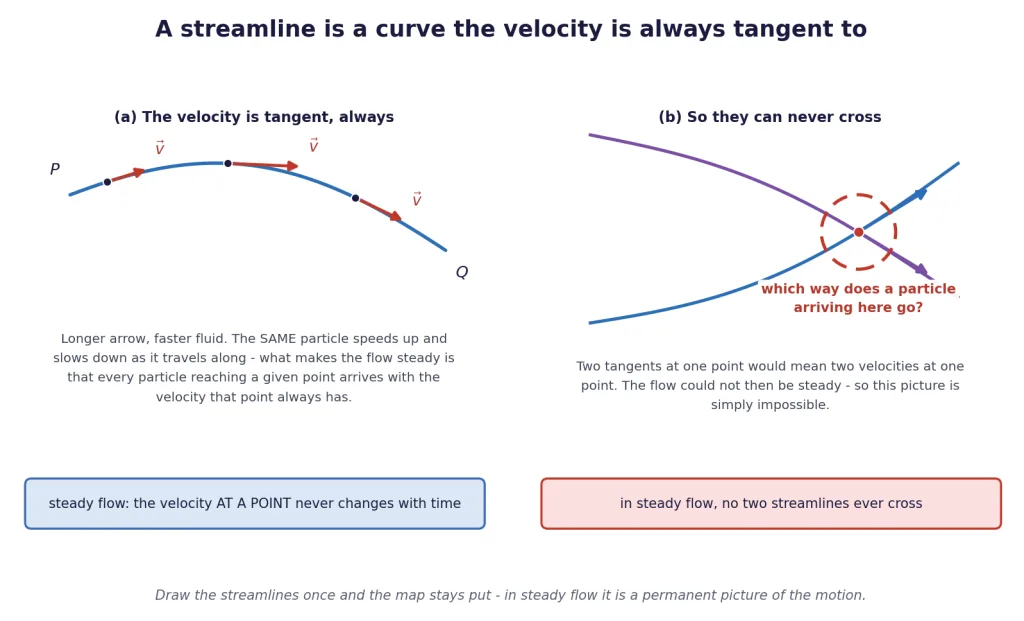
Take one particle and follow it from a point to a point . The curve it traces is a streamline. Its velocity is, at every instant, along the tangent to that curve — that is what "the path it follows" means. Its speed may change all the way along; only the direction is tied to the tangent.
And because the flow is steady, that curve is not just this particle's history. The next particle to pass through has the same velocity, so it turns the same way, so it traces the same curve. And the next. The map of streamlines is therefore a permanent picture of the flow — stationary in time, even though the fluid making it is streaming through.
Two streamlines can never cross
This is the single most asked conceptual point in the section, and the reason is a one-liner.
Suppose two streamlines did cross at some point . The tangent to the first line at gives one direction for the velocity there; the tangent to the second gives a different one. So a fluid particle arriving at would have to have two different velocities at once, which is impossible — or, more precisely, it would have to go one way sometimes and the other way at other times, and then the velocity at would not be constant in time, so the flow would not be steady.
Key Point: In steady flow, no two streamlines ever cross. If a diagram shows streamlines crossing, that diagram is wrong.
Streamlines that crowd together mean fast flow
Now a fact about how streamlines are drawn, which turns them from a direction map into a speed map as well.
The convention is to draw streamlines so that the same amount of fluid passes between any adjacent pair per second. Given that, where the streamlines run close together, the same flow is squeezed through a narrower gap, so it must be moving faster.
Key Point: Crowded streamlines mean fast flow; widely spaced streamlines mean slow flow. You can read the speed off a streamline diagram by eye, without a single number.
This will matter enormously in Sections 5 and 6, where the same picture also tells you where the pressure is low.
The tube of flow
Now bundle streamlines together.
Key Point — tube of flow:
Take a small closed curve in the fluid and draw the streamline through every point of it. The surface they sweep out is a tube of flow.The defining property: no fluid ever crosses the wall of a tube of flow. The velocity is everywhere tangent to the wall by construction, so there is no component pointing through it.
A tube of flow behaves exactly like a pipe with frictionless walls, except that its walls are made of nothing but the flow itself. Fluid that enters at one end must leave at the other, because there is nowhere else for it to go.
That is a strong statement, and the whole of the next block is what falls out of it.
[JEE Tip] A real pipe is a tube of flow, since no water goes through the pipe wall either. So every result about tubes of flow applies immediately to pipes, hoses, arteries and river channels. Draw the boundary, ask what crosses it — nothing does — and continuity follows.
Laminar and Turbulent Flow — as a Picture
Not every flow is orderly enough to draw. Watch the smoke rising from a stick of incense in still air and you see the whole story happen in a few centimetres.
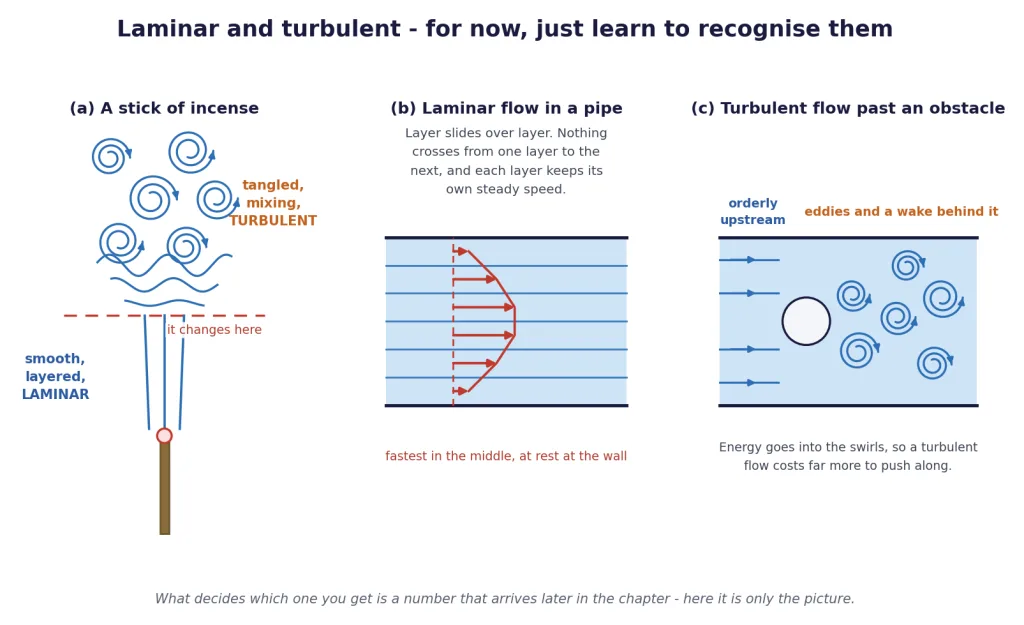
Just above the tip, the smoke rises as a smooth, steady, almost solid-looking column. Then, quite abruptly and at a fairly definite height, it breaks up — it wavers, curls, folds over on itself and disperses into a chaotic tangle. Two completely different kinds of flow, one above the other, with a visible boundary between them.
Key Point — laminar flow:
The fluid moves in layers (Latin lamina, a thin plate) that slide smoothly over one another. Adjacent layers may move at different speeds, but they do not mix. The flow is steady, the streamlines are smooth and parallel, and the whole thing is entirely predictable.Key Point — turbulent flow:
The orderly layers break down. The fluid develops eddies, whirls and irregular fluctuations; particles that started side by side end up far apart. The velocity at a point now fluctuates rapidly and irregularly, so the flow is not steady, and the streamline picture no longer applies.
Where you have already seen both
- A water tap opened slowly gives a clear, glassy, silent stream — laminar. Open it further and the stream becomes cloudy, ragged and noisy — turbulent. The change happens at a fairly definite setting of the tap.
- A river runs smoothly over a flat bed and churns white through a rapid.
- A jet of air striking a plate breaks up into eddies as soon as it hits.
- Behind any obstacle in a fast stream — a bridge pier, a rock, a cricket ball — there is a wake of swirling, disorganised fluid.
Why the difference matters
Three consequences, all of which will return later in the chapter.
- Turbulent flow costs far more energy. Energy that could have gone into pushing the fluid along goes into spinning up eddies instead, and is eventually lost as heat. Pumping a fluid through a pipe turbulently takes much more pressure than pumping it laminarly.
- Turbulent flow mixes; laminar flow does not. Put a drop of ink into laminar flow and it draws out into a thin thread that stays a thread. Put it into turbulent flow and it is stirred through the whole stream in seconds. That is why you stir your tea rather than waiting.
- The streamline picture, and everything built on it, applies only to laminar flow. The equation of continuity in the next block, and Bernoulli's principle in the next section, are results about steady flow. Turbulence is not steady, so they do not describe it.
What decides which one you get
That is a real question with a real answer — a single dimensionless number built from the fluid's density and viscosity, the speed, and the size of the pipe — and it is developed properly in Section 8, once viscosity has been defined in Section 7. It needs the idea of internal friction, which we have not met yet.
For now, know the qualitative version, because it is worth marks on its own: flow tends to turn turbulent when the speed is high, when the pipe is wide, when the fluid is dense, and when the fluid is thin and runny rather than sticky. Slow, narrow, light and syrupy keeps it laminar. There is a definite critical velocity above which the change happens, and Section 8 will tell you how to compute it.
[NEET Important] For recognition questions, the giveaways are these. Laminar: smooth, layered, steady, orderly, predictable, no mixing, streamlines apply. Turbulent: eddies, whirls, wake, chaotic, unsteady, noisy, strong mixing, high energy loss.
The Equation of Continuity
Here is the one quantitative result of this section, and it is nothing more mysterious than mass cannot appear or disappear.
Deriving it
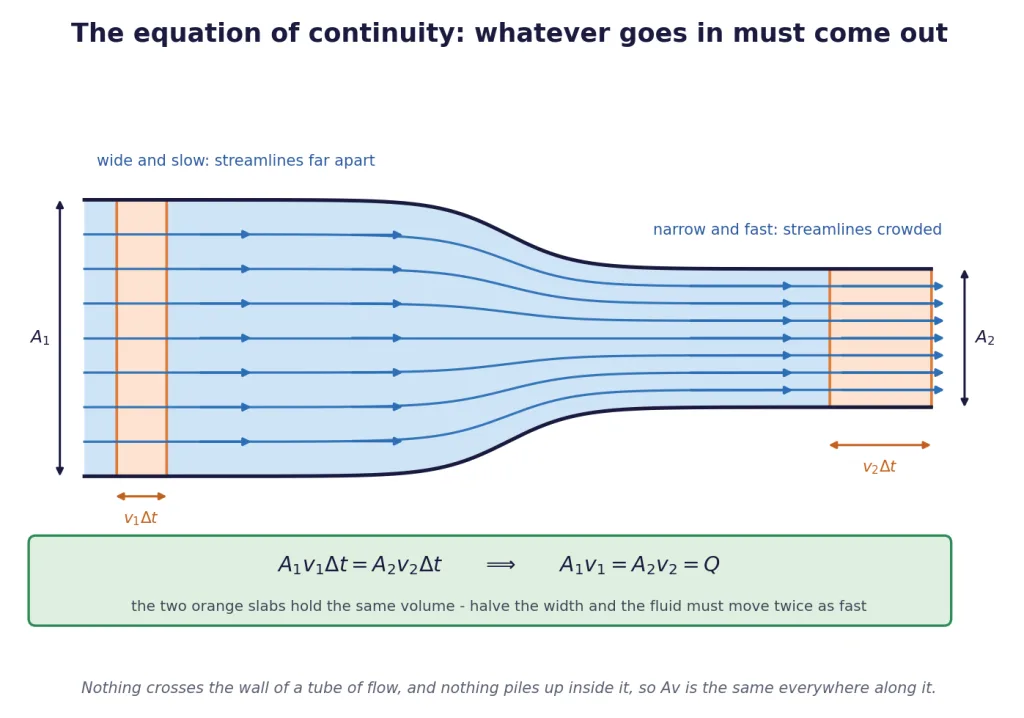
Take a tube of flow — a real pipe will do — with cross-sectional area at one place where the fluid speed is , and area further along where the speed is . Watch for a short time .
How much fluid crosses section 1 in time ? Every particle at section 1 moves a distance along the tube, so the fluid that crosses is a slab of cross-section and length :
Similarly at section 2:
Now apply conservation of mass. Nothing crosses the wall of the tube — that is the defining property of a tube of flow. And in steady flow nothing piles up inside it either, because the density and velocity at every point are fixed in time, so the mass contained between the two sections cannot be changing. So whatever goes in must come out:
Key Point — the general (compressible) equation of continuity: The quantity is the mass flow rate, in kg/s. This form holds for any fluid, gas or liquid.
For an incompressible fluid — which is what we assume for liquids throughout — is the same at both sections and cancels:
Key Point — the equation of continuity: is the volume flow rate, written , measured in m/s. It is the volume of fluid passing any cross-section per second.
Where the pipe narrows, the fluid must speed up, in exact inverse proportion to the area.
Reading it properly
Three things to be careful about, and each of them costs marks every year.
is an area, so it goes as the square of a linear size. For a circular pipe . Halve the radius and the area falls to a quarter, so the speed goes up four times. Halve the diameter and exactly the same thing happens, because the two are proportional. What you must never do is halve a diameter and treat it as a radius.
is what stays fixed, not . Squeezing the end of a hose does not push more water through it per second — the tap decides that. It makes the water that is coming through go faster. Getting this backwards is the commonest conceptual error in the topic.
It applies along one tube of flow. If a pipe branches into several, the total of over all the branches equals in the trunk. Nothing is lost, but it is now shared out.
The differential version, and streamline crowding
Write and take a small change along the pipe. Since the product is fixed, a fractional increase in one must be matched by a fractional decrease in the other:
Narrow the pipe by 1% and the speed rises by 1%. This is exactly the statement made in the previous block in pictures: streamlines drawn to carry equal flow between them are forced closer together where the area shrinks, and there the fluid is moving faster.
[JEE Tip] In an objective paper, never compute two speeds. Write the ratio and cancel: One line, no calculator, no units. The only trap left is the squaring — and it is a square, whether you feed it radii or diameters.
Where You Have Already Seen It
The equation of continuity is one of those results that, once you have it, you cannot stop noticing.
A thumb over the hose
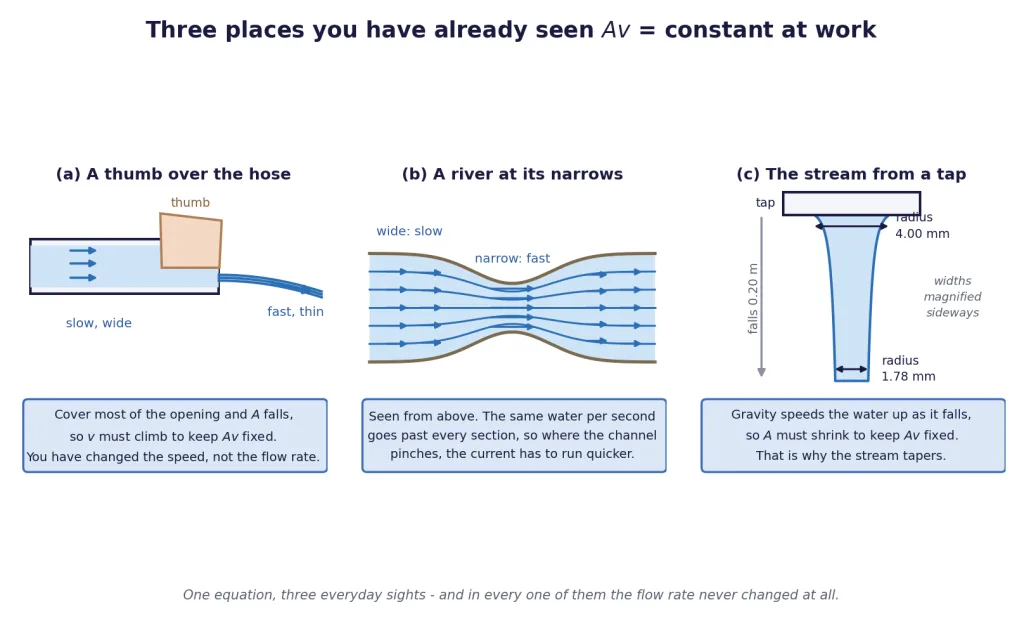
Put your thumb over most of the end of a garden hose and the dribble becomes a jet that will reach across the garden. The tap has not been touched, so is unchanged; you have cut down to a fraction, so has climbed by the reciprocal of that fraction. Cover nine tenths of the opening and the water leaves ten times as fast.
The same thing is why water gushes through the gaps between your fingers when you try to close a tap with your hand, and why the fine needle of a syringe controls the flow far better than the thumb pressure a doctor applies to the plunger.
A river at its narrows
A river running slowly across a wide flood plain becomes a fast, dangerous current where it squeezes between rocks. Same water per second, smaller cross-section, higher speed. The cross-section here is width multiplied by depth, so a channel that narrows and shallows speeds up twice over.
The tapering stream from a tap
Watch a smooth stream of water falling from a tap. It gets thinner as it falls. Gravity is accelerating the water, so increases as it goes down, and since is fixed the cross-section must shrink to compensate. The narrowing you see is the equation of continuity made visible.
(The speed after falling a height comes from ordinary kinematics, — no fluid dynamics needed. Section 5 will give the same result a proper energy footing.)
A shower rose, and every other multi-outlet fitting
A pipe of decent bore feeds a shower head pierced with a few dozen fine holes. The total hole area is far smaller than the pipe's cross-section, so the water leaves each hole much faster than it travelled down the pipe. Sprinklers, spray nozzles, watering-can roses and fuel injectors all work this way.
The circulation, which runs it backwards
Blood leaves the heart through the aorta at about 0.3 m/s. The aorta branches into arteries, then arterioles, then billions of capillaries. Each capillary is microscopically thin, but there are so many of them that their combined cross-sectional area is several hundred times that of the aorta. By continuity, the blood in them must therefore crawl — about 0.5 mm/s, roughly six hundred times slower.
And that is exactly what the body needs. A red cell spends a second or so crossing a capillary, and that second is what allows oxygen and nutrients to diffuse out and waste to diffuse in. Speed the blood up and the exchange fails.
[NEET Important] This is a favourite. The order to memorise is: aorta — fastest, smallest total area; capillaries — slowest, largest total area; veins — faster again as the total area falls. The speed at each stage is inversely proportional to the total cross-sectional area at that stage, and the total area is what matters, not the size of the individual vessel.
Pulling It Together
The whole section on one page
| Idea | Statement | Note |
|---|---|---|
| Steady flow | velocity at each point is constant in time | a particle may still speed up as it travels |
| Streamline | tangent gives at every point | the particle's path, in steady flow |
| No crossing | two streamlines never intersect | otherwise two velocities at one point |
| Crowding | close streamlines mean fast flow | drawn for equal flow between each pair |
| Tube of flow | bounded by streamlines | nothing crosses its wall |
| Laminar | smooth layers, no mixing | streamline picture applies |
| Turbulent | eddies, wake, unsteady | streamline picture fails |
| Continuity, general | mass flow rate, kg/s | |
| Continuity, incompressible | volume flow rate, m/s | |
| Ratio form | for circular pipes | |
| Branching | share it out, lose nothing | |
| Differential form | 1% narrower, 1% faster |
The five traps
Trap 1 — forgetting to square. The speed goes as the inverse of the area, not of the radius. Halve the radius and the speed goes up by four, not by two. This one trap accounts for more lost marks in this section than everything else combined.
Trap 2 — using a diameter as a radius. , and . In the ratio form it does not matter, because . In an absolute calculation of it matters by a factor of four. Halve it on the paper before anything else.
Trap 3 — thinking a narrower pipe carries less water per second. It carries exactly the same ; that is the whole content of the equation. What changes is the speed.
Trap 4 — using the area of one hole where the total is wanted. With outlets, the area in the equation is times the area of one. Missing the is worth a factor of thirty in a shower-head problem.
Trap 5 — applying continuity across a turbulent region. It is a statement about steady flow along a tube of flow. Once the flow breaks up, both of those go, and so does the result.
A checking habit
- Which way should the answer move? Narrower means faster. If your speed came out smaller in the narrow section, you have inverted the ratio.
- Is the flow rate the same at both ends? Compute and separately and confirm they match. It costs one line and catches almost every arithmetic slip in this section.
- Did I convert the areas? 1 cm is m, and 1 mm is m. Both squared, both easy to get wrong.
- Am I being asked for or for ? They have different units and behave in opposite ways along a pipe. Underline which one the question wants.
[Board Important] The standard long question is: define steady flow, define a streamline, explain why two streamlines cannot cross, and then derive from conservation of mass. Four separate marks. Do the derivation with the slab of length at each end, and state explicitly that nothing crosses the wall of a tube of flow and nothing accumulates inside it — those two sentences are the physics, and the algebra is only bookkeeping.
Solved Examples
Constants used throughout this section, unless a problem says otherwise: m/s, kg/m. Areas are converted to m before anything else: 1 cm m and 1 mm m.
Example 1: The basic pipe, start to finish
Water flows steadily through a horizontal pipe whose cross-section falls from 4.0 cm to 1.0 cm. In the wide part the water moves at 2.0 m/s. Find (a) the speed in the narrow part, (b) the volume flow rate in litres per second, (c) the mass flow rate, and (d) how long it takes to fill a 20 litre bucket.
Solution:
Convert the areas first, before anything else:
(a) Continuity: Note the areas were in the same units on both sides of that ratio, so the conversion cancelled — but do it anyway, because part (b) needs the SI values.
(b) The volume flow rate, from either section: Check it at the other end: m/s. Equal, as it must be. Since 1 m L,
(c) The mass flow rate is :
(d) Filling the bucket:
Final Answer: (a) 8.0 m/s; (b) m/s = 0.80 L/s; (c) 0.80 kg/s; (d) 25 s.
Takeaway: Always compute at both sections and check they agree. It is one extra line and it catches every unit slip and every inverted ratio before the answer leaves your pen.
Example 2: The nozzle on a hose
Water flows at 2.0 m/s along a garden hose of internal radius 1.0 cm. It leaves through a nozzle of radius 0.25 cm. Find the speed of the jet.
Solution:
Use the ratio form and skip the areas entirely. For circular sections,
Substitute:
So the jet speed is which is about 115 km/h. That is why a nozzle turns a hose into something that will reach the far end of a garden.
Confirm the flow rate is unchanged:
Final Answer: 32 m/s.
Takeaway: A factor of 4 in the radius is a factor of 16 in the speed. The squaring is where the drama is — and where the marks are lost.
Example 3: A river at its narrows
A river is 40 m wide and 2.5 m deep, and flows at 1.2 m/s. Downstream it passes through a gorge where it is only 15 m wide but 4.0 m deep. Find the discharge of the river and the speed in the gorge.
Solution:
The cross-section of a river is width multiplied by depth:
The discharge — the volume flow rate — is the same everywhere along the river:
The speed in the gorge:
Sense check. The area fell to 60% of its value, so the speed rose by the reciprocal, times: m/s. It also went the right way — narrower means faster.
Final Answer: Discharge 120 m/s; speed in the gorge 2.0 m/s.
Takeaway: The deepening partly offsets the narrowing. Whenever a channel changes in two dimensions at once, compute the actual areas rather than reasoning from the width alone.
Example 4: A shower rose
A pipe of internal radius 1.0 cm carries water at 1.5 m/s to a shower head pierced with 30 holes, each of radius 0.50 mm. Find the speed at which the water leaves the holes.
Solution:
The pipe's cross-section:
The combined area of the holes — and this is the step that gets dropped. It is times the area of one hole:
Apply continuity to the whole fitting. All the water arriving down the pipe leaves through the holes, so
Check the flow rate both ways:
Final Answer: 20 m/s.
Takeaway: With several outlets it is the TOTAL outlet area that goes into the equation. Forgetting the factor of 30 here would have given 600 m/s, which should set off every alarm you have — a sanity check on the size of the answer is free.
Example 5: Why the stream from a tap gets thinner
Water leaves a tap of radius 4.00 mm with a speed of 0.40 m/s and falls freely. Find the radius of the stream 0.20 m below the tap. Take m/s.
Solution:
First find the speed after the fall, using ordinary kinematics — this part is not fluid dynamics at all:
Now apply continuity to the stream, treating it as a tube of flow with no walls:
Substitute:
Confirm the flow rate is unchanged:
What you are looking at. The stream is a little over five times faster after 20 cm of fall, so its cross-section has shrunk to about a fifth and its radius to about 0.445 of what it was. That is the visible taper of every falling stream of water.
Final Answer: 1.78 mm — the radius has shrunk to about 45% of its value at the tap.
Takeaway: A free stream of liquid is a tube of flow with no pipe around it, and continuity applies to it just the same. Note the square root: the radius goes as , so a fivefold speed-up thins it by a factor of only about 2.2.
Example 6: A gas, where the density changes
Air flows steadily through a duct. At the inlet the cross-section is 0.50 m, the speed is 10 m/s and the density is 1.2 kg/m. Further along, the duct narrows to 0.40 m and the air has been compressed to a density of 1.5 kg/m. Find the speed there. What would the incompressible formula have given, and why is it wrong here?
Solution:
Use the general form, because the density is not constant:
The mass flow rate at the inlet:
Solve for :
Check: kg/s. The mass flow rate matches, which is the only thing that has to.
What the incompressible formula would have said. Using and ignoring the density: which is 25% too high. The error arose because the air was squeezed into a smaller volume as well as a smaller duct, so the volume flow rate genuinely fell — from 5.0 m/s to 4.0 m/s — even though the mass flow rate did not budge.
Final Answer: 10 m/s. The incompressible formula gives 12.5 m/s, which is wrong because changed.
Takeaway: What conservation of mass actually protects is , not . For liquids the two coincide because is fixed; for a gas being compressed they do not, and using the wrong one is a real error rather than an approximation.
Example 7: The aorta and the capillaries
Blood leaves the heart through the aorta, of radius 1.0 cm, at 0.30 m/s. It eventually reaches the capillaries, where the speed is only m/s. Find (a) the flow rate in litres per minute, (b) the total cross-sectional area of the capillary bed, and (c) roughly how many capillaries there are, if each has a radius of micrometres.
Solution:
(a) The flow rate at the aorta: Converting: L/min, which is about right for an adult at rest.
(b) The same passes through the capillary bed as a whole, since the circulation is a closed system with no leaks: about 1900 cm. Compare that with the aorta's own m: the capillary bed offers 600 times the cross-section.
(c) The number of capillaries. Each one has area some two thousand million of them.
The point of the calculation. Continuity forces the blood to crawl through the capillaries — 600 times slower than in the aorta — and that slowness is exactly what makes gas exchange possible. A red cell needs about a second in a capillary to unload its oxygen.
Final Answer: (a) 5.65 L/min; (b) about 0.19 m, some 600 times the aortic area; (c) roughly capillaries.
Takeaway: Individual capillaries are tiny, but their TOTAL area is enormous, and total area is what continuity cares about. The blood slows down going from the aorta into the capillaries precisely because the pipe, taken as a whole, got wider.
Example 8: Diameters, not radii
Water flows through a pipe that tapers from a diameter of 6.0 cm to a diameter of 2.0 cm. By what factor does the speed change? A student halves nothing and writes . What went wrong?
Solution:
Use the ratio form with diameters, which is perfectly legal because and the factor of 2 cancels in a ratio:
So the water speeds up nine times.
The student's error was not the diameter at all — using diameters in the ratio is fine. The error was forgetting to square. They found the linear ratio 3 and stopped there, instead of recognising that the area falls by .
When the diameter genuinely does matter. In a ratio the halving cancels. In an absolute calculation it does not: if you needed itself, and using 0.060 as the radius instead would have made that four times too big.
Final Answer: The speed increases by a factor of 9. The student forgot to square the ratio.
Takeaway: Diameters are safe inside a ratio and dangerous outside one. Whichever you use, the dependence is on the square.
Example 9: A pipe that branches
A horizontal main of cross-section 6.0 cm carries water at 3.0 m/s and divides into three identical branches, each of cross-section 1.5 cm. Find the speed in each branch.
Solution:
Continuity at a junction says the total flow out equals the flow in:
The flow rate in the main:
Shared equally among three identical branches, each carries m/s, so
Why it went up at all. The three branches together have cm of cross-section, which is less than the main's 6.0 cm. So even after splitting three ways, the total pipe available got narrower, and the water speeded up. Had the branches been 2.0 cm each, the total would have been exactly 6.0 cm and the speed would have stayed at 3.0 m/s.
Final Answer: 4.0 m/s in each branch.
Takeaway: At a junction, compare the TOTAL area of the branches with the area of the trunk. Branching does not automatically slow the fluid down — that depends entirely on whether the total cross-section grew or shrank.
Example 10: Reading a speed off a streamline diagram
In a two-dimensional steady flow, streamlines drawn to carry equal flow between adjacent pairs are 4.0 mm apart in one region and 1.0 mm apart in another. If the fluid moves at 1.5 m/s in the first region, how fast is it moving in the second?
Solution:
What "equal flow between adjacent pairs" means. The strip between two neighbouring streamlines is a tube of flow, and by construction every such strip carries the same . Nothing crosses a streamline, so the flow in one strip stays in that strip.
In two dimensions the "area" of that strip — per unit depth into the page — is just the spacing . So continuity reads
Substitute:
Note the difference from a pipe. Here the dependence is on the first power of the spacing, not the square, because this is a two-dimensional flow and the spacing is the area per unit depth. In a circular pipe the area goes as and you get the square.
Final Answer: 6.0 m/s — four times faster where the streamlines are four times closer.
Takeaway: Crowded streamlines are a speedometer. In two dimensions the speed is inversely proportional to the spacing; in a circular pipe it is inversely proportional to the square of the radius. Know which picture you are in.
Example 11: A gradual taper, and the differential form
Water flows along a pipe whose radius falls smoothly and linearly from 3.0 cm at one end to 2.0 cm at the other, over a length of 1.0 m. The speed at the wide end is 1.0 m/s. (a) Find the speed at the narrow end. (b) At the point where the radius is 2.5 cm, the pipe narrows by a further 1% over a short distance. By what percentage does the speed change there?
Solution:
(a) The ratio form, using radii:
Check the flow rate at both ends:
(b) Use the differential form. Since is constant, A 1% reduction in area gives a 1% increase in speed. But the question says the radius changes by 1%, and , so
Therefore The speed rises by about 2%, twice the fractional change in the radius.
Sense check against part (a). Over the whole pipe the radius fell by 33%, and means the speed rose by 125% — far more than , which is expected, because the small-change rule is only a first approximation and 33% is not a small change.
Final Answer: (a) 2.25 m/s; (b) the speed rises by about 2%.
Takeaway: The fractional rule carries a factor of 2 when you feed it a radius instead of an area, and it is only valid for genuinely small changes. For anything larger, go back to the exact ratio.