
What Makes Something a Fluid
The last chapter was about solids that resist being deformed. This one is about the stuff that gives up and flows.
Here is the clean dividing line. Push a solid sideways along its surface — apply a shear stress — and it deforms by a definite amount and then stops, held there by its own rigidity. Do the same to water or air and there is no stopping point. The layers just keep sliding over one another for as long as you keep pushing. That is what flowing is.
Key Point — the definition of a fluid:
A fluid is a substance that cannot sustain a shearing stress at rest. Any tangential force, however small, sets it flowing. Liquids and gases are both fluids; solids are not.
A fluid therefore has no shape of its own — it takes the shape of whatever holds it.
Notice how weak that requirement is. It does not say a fluid offers no resistance to shear — a thick oil clearly resists being stirred. It says the fluid cannot come to rest under shear. Resistance to the rate of shearing is called viscosity and it gets a whole section later. The shearing stresses fluids can support at rest are about a million times smaller than those a solid can support, which is close enough to zero for everything in this chapter.
Liquid or gas?
| Solid | Liquid | Gas | |
|---|---|---|---|
| Definite shape | yes | no | no |
| Definite volume | yes | yes | no — fills its container |
| Sustains shear at rest | yes | no | no |
| Compressibility | very small | small | large |
| Free surface of its own | — | yes | no |
The one property that separates the two fluids is compressibility. Squeeze a litre of water hard enough to double the pressure on it and its volume changes by about 0.005%; do the same to a litre of air and the volume halves. That is why we will treat every liquid in this chapter as incompressible — constant density, whatever the pressure — and treat gases as incompressible only when we say so.
[Board Important] When a question says "a liquid has a fixed volume", it means at ordinary pressures. Nothing is truly incompressible; liquids are just so close to it that the difference never shows up in a Class 11 numerical.
Notation for This Chapter
Fluids is the chapter where letters collide. Other books make different choices and both conventions are correct; what is fatal is mixing them inside one solution.
Key Point — notation for the whole chapter:
Quantity Symbol Also written density , surface tension or coefficient of viscosity pressure atmospheric pressure , area , angle of contact upthrust , terminal velocity is density. is surface tension. is viscosity. A or in another book's soap-bubble formula stands for ; a in its Stokes' law stands for .
Two more that matter just as much:
- is a radius and is a diameter, always. Never let them blur. Halving a diameter that was already a radius, or forgetting to halve one that was not, is the single most reliable way to be out by a factor of 2 — or by 4, once the area squares it.
- is a height or a depth — and you must say which, because they run in opposite directions. In this chapter is measured downwards from a free surface whenever it appears in , unless a problem says otherwise. State your reference level in every solution.
Pressure has two readings, and you must name yours
This is the trap that costs more marks in this chapter than any other single thing.
Key Point — the pressure convention:
- (absolute pressure) is the real, total pressure. It is never negative. Zero absolute pressure is a perfect vacuum.
- (gauge pressure) is the amount by which the pressure exceeds the atmosphere: . It can be negative, and then we call it a partial vacuum.
- is atmospheric pressure, Pa at sea level.
A bare in this chapter means absolute pressure unless the sentence says gauge. Every worked solution below states which one it is quoting.
Why does it matter so much? Because most instruments — the tyre gauge, the blood-pressure cuff, the manometer at the lab bench — have the atmosphere pushing on the other side of their sensing element, so what they show is the difference, not the total. Section 2 develops this properly. For now just make it a habit: the moment you write a pressure down, write "gauge" or "absolute" next to it.
Pressure: Force per Unit Area
A sharp needle pressed on your skin goes in. The back of a spoon pressed with exactly the same force does not. An elephant standing on a person's chest cracks ribs; a circus performer with a broad plank across the chest survives an elephant standing on the plank.
Every one of those is the same argument. The force is not what does the damage. The force divided by the area it is spread over is.
Two words that are not the same
- Thrust is the total normal force a fluid (or any body) exerts on a surface. It is a vector, measured in newtons.
- Pressure is that thrust per unit area. It is a scalar, measured in pascal.
Key Point — the definition: here is the component of the force normal to the area, not the whole force vector.
SI unit: pascal, Pa, where 1 Pa = 1 N/m. Dimensions — the same as stress, because pressure is a stress.
The pascal is a tiny unit. A sheet of A4 paper lying on a table presses down with about 1 Pa. That is why real pressures come out as large powers of ten, and why so many other units survive in practice.
| Unit | In pascal | Where you meet it |
|---|---|---|
| 1 Pa | 1 | the SI unit |
| 1 atmosphere (atm) | sea-level air pressure | |
| 1 bar | weather maps, engineering | |
| 1 millibar | weather reports | |
| 1 torr = 1 mm of Hg | 133 | medicine, physiology, vacuum work |
| 1 kgf/cm | old tyre gauges, workshops |
[NEET Important] 1 atm is very nearly 760 mm of mercury and very nearly 1 bar, but not exactly either. Blood pressure of "120 over 80" is in mm of mercury, gauge.
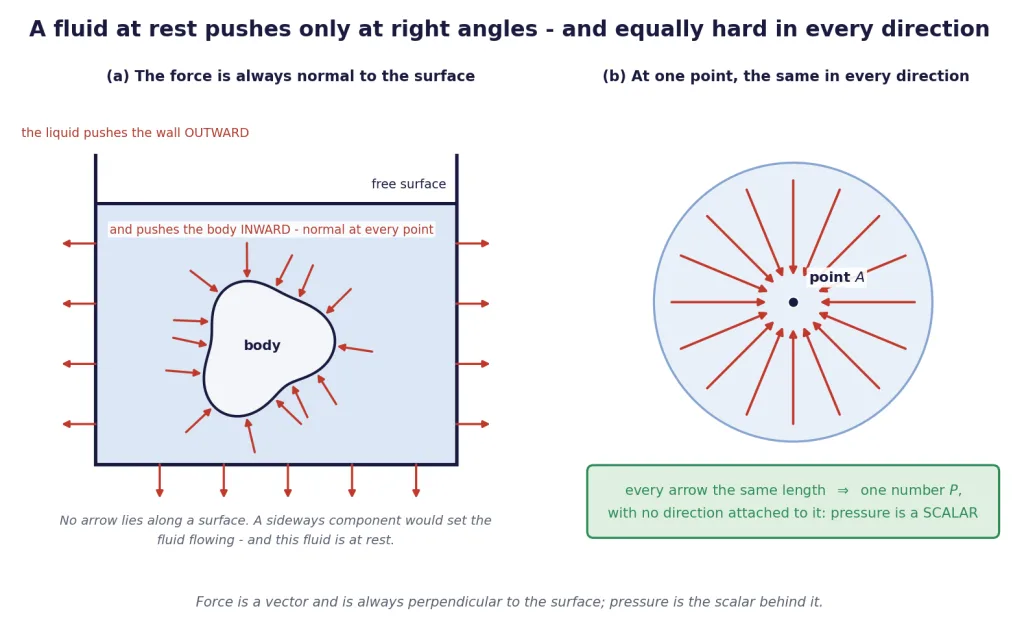
Why the force from a fluid at rest is always perpendicular
Look at any surface touching a fluid at rest — the wall of a beaker, the skin of a submerged stone. The force the fluid exerts there is always at right angles to the surface. Here is the one-line reason, and it is worth a mark.
Suppose the force had a component along the surface. By Newton's third law the surface would then push back along the fluid with an equal tangential force. A tangential force on a fluid is a shear stress, and a fluid cannot sustain shear at rest — it would start to flow. But we said the fluid is at rest. Contradiction. So the tangential component must be zero.
Pressure is a scalar — and here is the reason
This confuses almost everybody the first time, because has a vector on top. So say it carefully.
Key Point: Pressure is a scalar. At a point inside a fluid at rest, the pressure is the same in every direction — there is no direction you could possibly attach to it. What is a vector is the force on a particular surface, and its direction is fixed for you: normal to that surface, whichever way you tilt it.
Think of it this way. Take a tiny pressure gauge into the fluid, hold it at a point, and rotate it. Face it up, face it down, face it sideways, tilt it at — the reading never changes. One point, one number. That is exactly what "scalar" means. The proof that the reading cannot change is the wedge argument, and it is coming in a moment.
The vector-looking definition survives because the in it is not the full force vector — it is the component normal to the chosen area, which is a signed number, not a vector.
[JEE Tip] A favourite one-mark question: "Hydrostatic pressure is a scalar even though pressure is force divided by area. Explain." The full-mark answer has two halves — (i) the force in the numerator is the normal component, a scalar, and (ii) at a point in a fluid the pressure is the same in all directions, so no direction can be assigned to it.
The area argument, everywhere you look
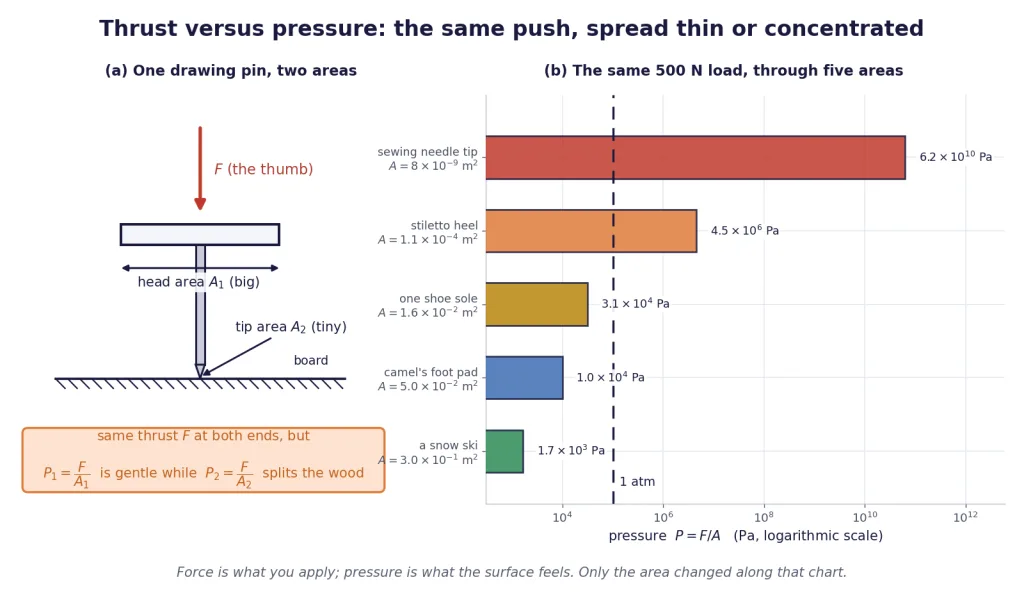
Same force, wildly different pressure, purely because of area:
- A drawing pin. Your thumb presses the broad head, which is comfortable; the same force comes out of a tip a few thousandths of a millimetre across, and the wood splits.
- A sharp knife. Sharpening does not make you stronger. It reduces the contact area, and the pressure goes up in exactly the same proportion.
- A stiletto heel versus a flat sole. The same person can dent a wooden floor on a heel and leave no mark at all in flat shoes.
- A camel's foot. Broad, splayed pads spread the animal's weight over a large area, so it does not sink into sand. Skis and snowshoes are the same idea.
- A tractor's fat tyres, a truck's many wheels, a rucksack's wide straps. All of them are arguments about area, not about force.
[Board Important] These are stock two-mark "explain why" questions. The answer is always the same skeleton: the force is the same, the area is smaller (or larger), and since the pressure is therefore larger (or smaller). Say the formula. Do not just say "because it is sharp".
Density and Relative Density
You cannot talk about the weight of a column of fluid without a number for how much matter each cubic metre of it carries. That number is the density.
Key Point: SI unit kg/m; dimensions . Density is a positive scalar.
Relative density (also called specific gravity) is It is a pure number, with no units at all.
Water is at its densest at 4°C, which is why that particular temperature is the reference. Take kg/m = 1 g/cm throughout this chapter.
The conversion worth memorising, because it turns up in every second numerical:
Numbers to know
This is our reference table for the chapter. Every worked example and question below uses these values unless the problem gives its own.
| Substance | (kg/m) | Relative density |
|---|---|---|
| Air (at 0°C, 1 atm) | 1.29 | 0.00129 |
| Petrol | 700 | 0.70 |
| Kerosene, light oil | 800 | 0.80 |
| Ice | 917 | 0.917 |
| Water (at 4°C) | 1000 | 1.00 |
| Sea water | 1030 | 1.03 |
| Blood | 1060 | 1.06 |
| Glycerine | 1260 | 1.26 |
| Aluminium | 2700 | 2.70 |
| Iron, steel | 7800 | 7.80 |
| Copper | 8900 | 8.90 |
| Mercury | 13600 | 13.6 |
| Gold | 19300 | 19.3 |
Two entries earn their bold type. Mercury is 13.6 times as dense as water — that one ratio explains why barometers use mercury and why a mercury manometer can read a big pressure in a short tube. And ice is less dense than water, which is why it floats, and why Section 3 exists.
[NEET Important] Relative density is dimensionless. A question asking for "the relative density of mercury" wants the answer 13.6, not 13600 kg/m. Losing the unit is the point, not a slip.
Mixing two liquids
Two standard results, and they are genuinely different from each other.
Equal volumes of two liquids, densities and . Total mass over total volume :
Equal masses of the two. Total mass over total volume :
[JEE Tip] The harmonic mean is always the smaller of the two answers, because equal masses means more volume of the lighter liquid gets into the mixture. Mix 800 and 1200: equal volumes gives 1000, equal masses gives 960. If your two answers come out the other way round, you have swapped the formulas.
Both derivations assume the volumes simply add. That is a very good approximation for ordinary liquids and it is what every exam expects.
Pascal's Law
Blaise Pascal noticed two things about a fluid at rest, and both go under his name. It is worth keeping them apart in your head, because questions test them separately.
Key Point — Pascal's law, in its two forms:
(1) The same-point form. At a point in a fluid at rest the pressure is the same in all directions; and all points at the same horizontal level in a connected fluid at rest are at the same pressure.
(2) The transmission form. A change of pressure applied to an enclosed fluid is transmitted undiminished to every point of the fluid and to the walls of the container.
Form (2) is the one the machines are built on. Notice the word enclosed: it does nothing for an open bucket of water. And notice undiminished — the pressure that arrives at the far end is not merely large, it is exactly the pressure you applied. Nothing is lost on the way.
Proving form (1): the wedge element
Take a very small wedge of fluid, a right-angled prism, sitting somewhere inside a fluid at rest. "Very small" is doing real work here: it means every part of the wedge is effectively at the same depth, so gravity acts equally on all of it, and the weight of the wedge is negligible beside the forces on its faces. (Weight goes as the volume, which is the cube of the size; the face forces go as the area, the square of it. Shrink the wedge and the weight loses.)
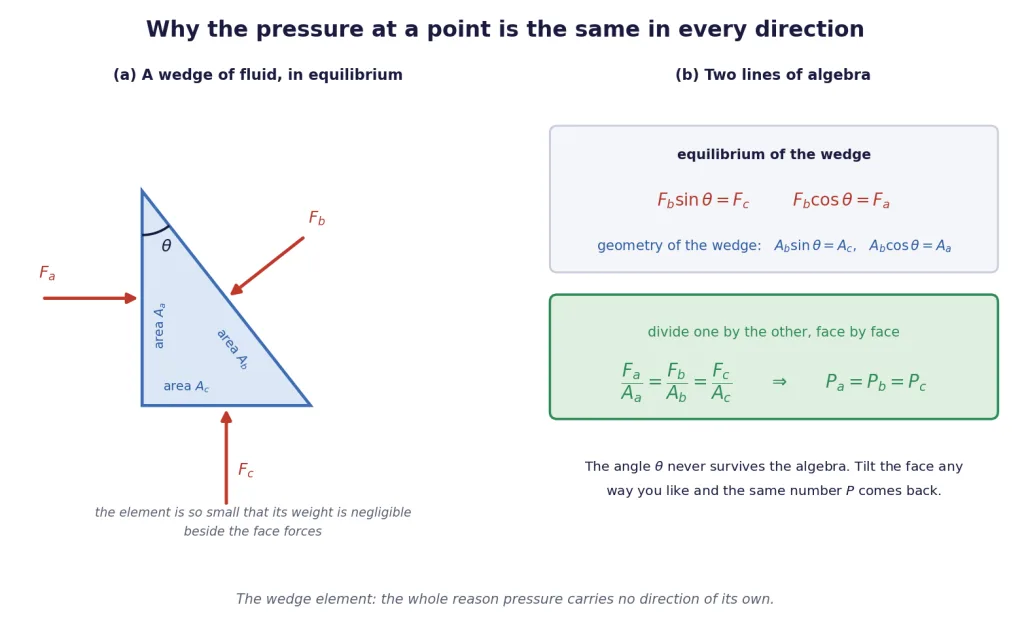
Call the three faces (vertical), (the slanted one) and (horizontal), with areas , , and normal forces , , . Every force is normal to its face, because that is what a fluid at rest does.
Step 1 — equilibrium. Resolve the slant force along the two axes:
Step 2 — geometry. The very same angle relates the three areas:
Step 3 — divide. Take the first pair and divide each by the matching member of the second pair:
And has vanished. The pressure came out the same on all three faces no matter how the slanted face was tilted, which is precisely the statement that pressure at a point has no direction. That is the proof that pressure is a scalar.
[Board Important] This derivation is a standard three-mark question. Marks go for: (i) drawing the wedge and marking all three forces normal to their faces, (ii) stating that the element is small enough for its weight to be neglected, (iii) the two force equations, (iv) the two area relations, and (v) cancelling to . Skipping step (ii) loses a mark on its own.
The horizontal-bar argument
The other half of form (1) is even quicker. Imagine a horizontal bar of fluid of uniform cross-section inside a fluid at rest. The only horizontal forces on it are the pressure forces on its two flat ends. It is not accelerating, so those must balance, so the pressures at the two ends are equal.
Key Point: In a connected body of the same fluid at rest, all points at the same horizontal level are at the same pressure. If they were not, there would be a net sideways force and the fluid would flow — and it is at rest.
Three warnings on that, all of them examined:
- "Connected" is essential. Two beakers standing side by side on a bench are at the same level but are not connected, so nothing follows.
- "Same fluid" is essential. If a layer of oil sits on top of the water in one arm of a tube, points at the same level in the two arms are not automatically at equal pressure — you have to cross the interface properly.
- It says nothing at all about points at different levels. Pressure at depth is Section 2's business.
Where the transmitted pressure actually comes from
One last conceptual point, because it catches people out. When you push the piston of a closed vessel and the pressure everywhere goes up by , that is added to whatever was already there. The pressure at the bottom of the vessel was already larger than at the top because of the weight of the fluid; Pascal's law does not flatten that out, it just raises every point by the same amount. The increase is uniform, not the pressure itself.
Hydraulic Machines: Pascal's Law Doing Work
Pascal's transmission law has one spectacular consequence. Enclose a liquid between two pistons of different area, push on the small one, and a much bigger force comes out of the big one.
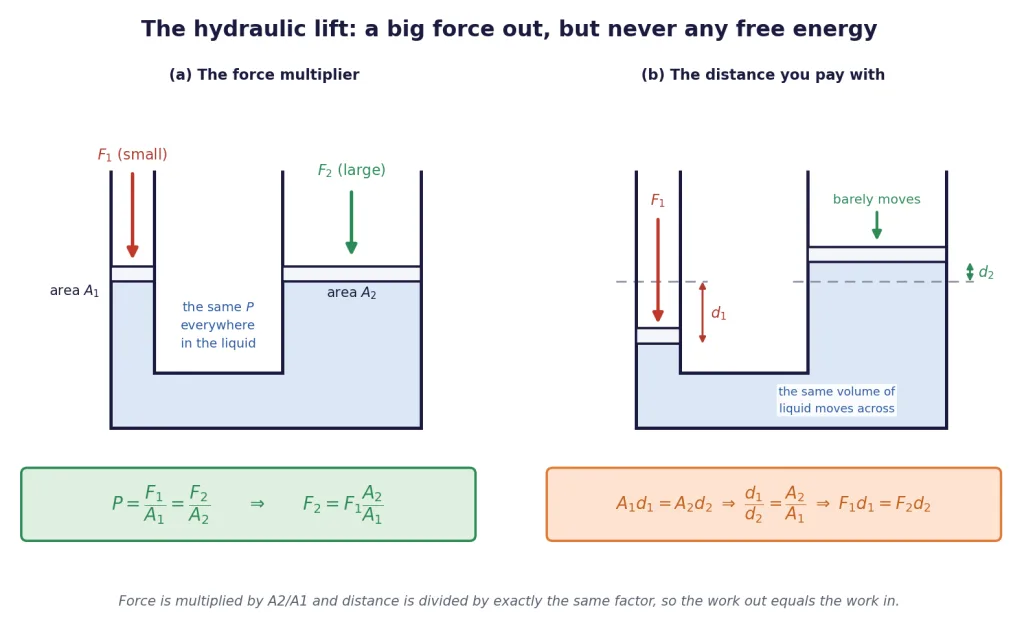
The hydraulic lift
Two cylinders, areas (small) and (large), joined by liquid. Press the small piston with a force . That creates a pressure
which Pascal's law delivers undiminished to the large piston, where it acts over the much bigger area :
Key Point — the hydraulic lift: The mechanical advantage is Because it is a ratio of areas, it goes as the square of the radius ratio. Pistons of radius 4 cm and 20 cm give an advantage of , not 5.
That squared factor is the whole reason a 470 N shove lifts a 1.2 tonne car.
[JEE Tip] In every hydraulic-lift problem, atmospheric pressure is pushing down on both pistons at once. It therefore cancels out of and plays no part in the force calculation. But if a question asks for the pressure in the liquid, you must say whether you are quoting the gauge value or the absolute value . The two differ by about Pa and both appear as options.
So where is the free energy? There isn't any
If a small force produces a big one, why is this not a perpetual motion machine? Because force is not energy. Work is force times distance, and the distances go the other way.
The liquid is incompressible, so whatever volume leaves the small cylinder must arrive in the large one:
Put the two boxed relations side by side. The force is multiplied by ; the distance is divided by exactly the same . So
Key Point: A hydraulic lift multiplies force and divides distance by the same factor. The work done is identical at the two ends — in an ideal machine no energy is created and none is destroyed. The small piston travels a long way; the large piston barely moves.
That is not a technicality, it is how these machines behave in the workshop. A garage lift with an advantage of 25 needs 25 cm of plunger stroke to raise a car by 1 cm, which is exactly why the operator pumps a lever over and over instead of pushing once. (A real lift is a little worse than ideal, because friction at the seals and a slight give in the pipes eat a few per cent — never more than ideal.)
Hydraulic brakes
Press the brake pedal of a car and you push a piston in the master cylinder. The pressure that creates is carried by brake fluid along pipes to a wheel cylinder at each of the four wheels, where a larger piston pushes the brake pads onto the disc.
Two things make this the right design, and both are exam answers:
- One pedal reaches four wheels at once, with the same pressure at each. Pascal's law guarantees the transmitted pressure is undiminished and identical everywhere, so the braking effort at the four wheels is equal. A car that braked harder on one side would spin.
- The force is multiplied twice over — once by the pedal lever, and again by the ratio of wheel-cylinder area to master-cylinder area. A 100 N push on the pedal can end up as thousands of newtons of clamping force.
And the same energy accounting applies: the pedal travels several centimetres while each wheel piston moves a fraction of a millimetre.
[NEET Important] Brake fluid, not water: it must not boil at the temperatures brakes reach, must not freeze in winter, and must not corrode the pipes. Air in the line is the classic fault — air is compressible, so part of the pedal travel goes into squashing the bubble instead of transmitting pressure, and the pedal feels spongy. This is why brakes are "bled".
The hydraulic press
The same machine, used to squash rather than lift: a small plunger, a large ram, and something in between them getting compressed. Cotton is baled, car bodies are pressed and scrap is crushed this way. The mechanical advantage is the same , and the same distance penalty applies — which is why a press moves so slowly.
The hydraulic jack, the barber's chair, the dentist's chair and the excavator arm are all the same idea wearing different clothes.
Putting It Together
A short block on the things that go wrong, because on this material the errors are extremely predictable.
The five standard mistakes
| The mistake | What it costs | The fix |
|---|---|---|
| Using the diameter where the radius belongs | area out by 4, so out by 4 | write on the page before anything else |
| Taking the mechanical advantage as | out by the square | MA is a ratio of areas |
| Quoting a pressure without saying gauge or absolute | a whole mark, every time | write the word next to the number |
| Calling pressure a vector | a mark, and a conceptual one | it is a scalar; the force is the vector |
| Forgetting to convert cm to m | a factor of | 1 cm = m, 1 mm = m |
That last one deserves its own line. 1 cm = m, not . Areas carry the conversion factor squared.
The order to work in
Almost every numerical in this section is the same four steps:
- Areas first. Halve any diameter. Convert to m.
- Forces next. A mass becomes a weight with — and use one value of for the whole problem, never 9.8 in one line and 10 in the next.
- Then the pressure. , or for a hydraulic machine.
- Then say which pressure it is. Gauge, or absolute? If the question could be read either way, give both.
What is coming next
Everything so far has treated the fluid as weightless — the wedge was small enough to ignore its weight, and the hydraulic lift ignored the head of liquid between the two pistons. Put the weight of the fluid back in and pressure starts to depend on depth. That is Section 2, and it brings the barometer, the manometer and the hydrostatic paradox with it.
Key Point — the four results to carry forward:
Solved Examples
Constants used throughout, unless a problem states otherwise: kg/m, kg/m, kg/m, kg/m, Pa. The value of is stated inside each problem and never changed part-way through one.
Example 1: The pressure your thigh bones carry
The two thigh bones of a person, each of cross-sectional area 10 cm, support the upper part of a body of mass 40 kg. Estimate the average pressure the femurs sustain. Take m/s.
Solution:
Total area, converted properly. Two bones, so
The force. The load is the weight of the upper body: It acts vertically down and therefore normally on the horizontal cross-section, which is what requires.
The pressure:
Which pressure is this? It is the extra pressure the bone material carries because of the load — a gauge-type figure. The atmosphere presses on the body from every side and does not enter the calculation. Quoting it as an absolute pressure would be wrong.
Final Answer: About Pa, roughly 2 atmospheres, over and above whatever the atmosphere is doing.
Takeaway: Convert cm to m before you do anything else, and remember there are two femurs. Both of those are single-mark traps sitting inside a three-mark question.
Example 2: Why a stiletto heel dents a floor
A person of mass 60 kg stands still. Compare the pressure on the floor when she balances on one circular stiletto heel of diameter 1.2 cm with the pressure when she stands on one flat sole of contact area 160 cm. Take m/s.
Solution:
Radius before area, always. cm so cm m.
The force is the same in both cases, since it is the same person:
On the heel:
On the flat sole, with m:
The ratio:
Put the heel figure in perspective. , so the heel presses about 51 times harder than the atmosphere does. Both figures are contact pressures over and above the atmosphere, that is, gauge-type.
Final Answer: Heel Pa, sole Pa — a factor of 141, with the same 588 N behind both.
Takeaway: The force never changed. Only the area did, and pressure went up by a factor of 141. That single sentence answers every "why does a sharp thing do more damage" question in the syllabus.
Example 3: Mixing two liquids two different ways
Two liquids have densities 800 kg/m and 1200 kg/m. Find the density of the mixture when they are mixed (a) in equal volumes, (b) in equal masses. Assume volumes add.
Solution:
(a) Equal volumes. Take of each.
(b) Equal masses. Take of each. Now the volumes differ:
Why (b) is smaller. Equal masses means you must pour in more volume of the lighter liquid to get the same mass, so the light liquid occupies more of the mixture, and the mixture comes out lighter.
Final Answer: (a) 1000 kg/m, the ordinary average. (b) 960 kg/m, the harmonic mean.
Takeaway: Equal volumes gives the arithmetic mean; equal masses gives the harmonic mean, which is always the smaller. Use that as your check: if your "equal masses" answer is the bigger of the two, you have used the wrong formula.
Example 4: What is the alloy made of?
An alloy of copper and aluminium has a mass of 1.0 kg and occupies 250 cm. Find the mass of copper in it. Take kg/m and kg/m, and assume the volumes add.
Solution:
Convert the volume: m.
Mean density of the alloy, which is worth writing down as a sanity anchor: That lies between 2700 and 8900, as it must, and closer to the aluminium end — so expect more than half the mass to be… careful, that reasoning is about volume, not mass. Do the algebra.
Two equations. Let be the mass of copper, so the aluminium mass is . Masses add and volumes add:
Solve:
Check by putting it back. m and m; the two add to m. Correct.
Final Answer: 0.4665 kg of copper (about 467 g) and 0.5335 kg of aluminium; relative density of the alloy 4.00.
Takeaway: Two conservation statements, two unknowns. Mass adds and volume adds; write both and the problem solves itself. Never average the two densities — that is only true for equal volumes.
Example 5: The car lift
In a car lift, compressed air pushes on a small piston of radius 4.0 cm. The pressure is transmitted through the liquid to a second piston of radius 20 cm, which carries a car of mass 1200 kg. Find (a) the mechanical advantage, (b) the force needed on the small piston, and (c) the pressure the compressed air must supply. Take m/s.
Solution:
The two areas.
(a) Mechanical advantage is a ratio of areas, so it is the ratio of radii squared:
The load to be supported:
(b) The effort: About the weight of a 48 kg person, holding up 1.2 tonnes.
(c) The pressure — and here you must say which one. The pressure the air adds to the liquid, above what the atmosphere already supplies, is The absolute pressure inside the liquid is then
Which one does the question want? "The pressure necessary to accomplish this" means the pressure the compressed air has to supply — the gauge value, Pa, because the atmosphere is already pressing on the car piston from above and cancels out of the force balance. If instead the question asked "the pressure in the liquid", quote the absolute value. Both numbers are worth writing down.
Final Answer: MA = 25; effort 470.4 N; gauge pressure Pa, absolute pressure Pa.
Takeaway: Mechanical advantage goes as the square of the radius ratio — 5 times the radius is 25 times the force. And always name your pressure: the same problem has two defensible numbers and only one of them answers the question asked.
Example 6: The distance you pay with
Two syringes without needles are connected by a tube full of water. The small piston has diameter 1.2 cm and the large one 4.8 cm. (a) What force appears on the large piston when 12 N is applied to the small one? (b) If the small piston is pushed in through 8.0 cm, how far does the large piston move out? (c) Compare the work done at the two ends.
Solution:
Areas, from radii. cm, cm. Note we never needed the areas themselves, only their ratio.
(a) The output force:
(b) The output travel. Water is incompressible, so the volume pushed out of the small syringe arrives in the large one:
(c) The work at each end: Identical, to the last digit.
Note on the atmosphere. It presses on both pistons and cancels, so it never entered the calculation. That is why we could work with the ratio alone.
Final Answer: 192 N out; the large piston moves 0.50 cm; and 0.96 J goes in and 0.96 J comes out.
Takeaway: Force 16, distance 16, work unchanged. A hydraulic machine is a lever made of liquid — it trades distance for force and creates nothing.
Example 7: One pedal, four wheels
A driver presses the brake pedal with 100 N. The pedal lever multiplies this by 4 before it reaches the master cylinder piston, of area 2.0 cm. Each of the four wheel cylinders has a piston of area 10 cm. Find (a) the pressure in the brake fluid, (b) the force at each wheel and the total, and (c) how far the pedal must move if each wheel piston is to advance 1.0 mm.
Solution:
Force on the master piston:
(a) The pressure in the fluid. With m, This is a gauge pressure: it is the amount by which the fluid is pushed above the atmosphere, and it is what does the work. The absolute pressure in the fluid is Pa.
(b) Force at each wheel. Pascal's law delivers the same Pa to every wheel cylinder, so with m:
(c) The pedal travel. All four wheel pistons advance 1.0 mm, so the fluid volume they swallow is The master piston must supply that volume: and the pedal, on the far side of a lever of ratio 4, moves
Energy check. At the pedal, J. At the wheels, J. Balanced.
Final Answer: Fluid at Pa gauge ( Pa absolute); 2000 N per wheel, 8000 N in all; pedal travel 8.0 cm.
Takeaway: The 100 N at the pedal becomes 8000 N at the wheels because the pedal moves 8 cm while each pad moves 1 mm. Equal pressure at all four wheels is the safety feature; the distance penalty is the price.
Example 8: The hydraulic press
A hydraulic press has a plunger of diameter 3.0 cm and a ram of diameter 30 cm. A force of 400 N is applied to the plunger. Find the force on the ram, and the pressure in the liquid. Take Pa.
Solution:
Ratio of areas — diameters this time, so square the ratio of diameters directly:
The force on the ram: about 4 tonnes of force from a 400 N push.
The pressure. cm, so m and
Check the same pressure at the ram. m, and Pa gauge. The same number, as Pascal's law demands.
Final Answer: N on the ram; liquid at Pa gauge, Pa absolute.
Takeaway: Ten times the diameter is a hundred times the force. And checking the pressure at both ends is a free way to catch an arithmetic slip: if the two do not match, something is wrong.
Example 9: Six faces, six forces, no net force
A sealed cubical box of side 20 cm contains gas at a gauge pressure of Pa. Find the force the gas exerts on each face, and the resultant force on the box. Neglect the weight of the gas.
Solution:
Area of one face:
Force on one face. The gas pushes outward, normal to the face. The net push on the wall is the gauge pressure, because the atmosphere is pushing inward on the outside of the same wall: The same 2000 N on every one of the six faces — because a gas is light enough that the pressure is effectively uniform throughout the box.
The resultant. Six forces of 2000 N each, but they come in three opposing pairs: left and right, front and back, top and bottom. Each pair cancels, so
The point of the question. The pressure is a single scalar, Pa, the same at every point of the gas. The six forces are six different vectors, all equal in magnitude and pointing six different ways. Scalar in, vectors out — and their sum is zero.
Final Answer: 2000 N on each face; resultant force zero.
Takeaway: A scalar pressure produces a vector force on every surface it touches, with the direction handed to you by the surface. That is exactly why pressure cannot itself be a vector: one number could not point six ways at once.
Example 10: Tilt the plate, keep the thrust
A small flat plate of area 50 cm is held inside a liquid at a place where the pressure is Pa (absolute). Find the thrust on one face of the plate when it is held (a) horizontal, (b) vertical, and (c) tilted at to the horizontal. The plate is small enough that the pressure over it may be taken as uniform.
Solution:
Convert the area: m.
The thrust, in every case:
All three answers are 1000 N. The magnitude does not depend on the orientation at all, because the pressure at the point is the same in every direction.
What does change is the direction of the force, which is always normal to the plate: vertically for the horizontal plate, horizontally for the vertical plate, and at to the horizontal for the plate tilted at .
A note on the pressure quoted. Pa was given as absolute, so 1000 N is the total thrust from the liquid on that face. If the other side of the plate is also in the liquid, the two thrusts cancel and the plate feels no net force — a plate in a liquid is not pushed anywhere.
Final Answer: 1000 N in all three cases; only the direction of the force changes.
Takeaway: Rotating a surface changes the direction of the thrust but never its magnitude. That is the experimental content of "pressure is a scalar", and it is exactly what the wedge proof predicts.
Example 11: One atmosphere, in five different currencies
Express Pa in (a) bar, (b) millimetres of mercury, (c) torr, (d) kgf/cm. Take kg/m and m/s.
Solution:
(a) In bar. By definition 1 bar Pa:
(b) In mm of mercury. " millimetres of mercury" means the pressure a mercury column of that height produces, . So There is the famous 76 cm, falling straight out of the arithmetic.
(c) In torr. 1 torr is defined as 1 mm of Hg, so torr.
(d) In kgf/cm. One kilogram-force is N, and one cm is m, so 1 kgf/cm Pa. Then
Final Answer: 1.013 bar = 760 mm of Hg = 760 torr = 1.03 kgf/cm, all of them the same absolute pressure.
Takeaway: 1 atm is about 1 bar, about 760 mm of Hg, and about 1 kgf/cm — three different near-coincidences that are worth carrying, and none of them exact. And notice how a "height of mercury" is really a pressure in disguise: Section 2 is built on that idea.
Example 12: What sharpening actually does
A cook presses a knife into a vegetable with 20 N. The blade is in contact along 3.0 cm of its edge. Find the pressure under the edge when the edge is 0.10 mm wide, and again after sharpening has reduced it to 0.010 mm.
Solution:
The contact area is a long thin rectangle: length of the edge in contact width of the edge.
The blunt blade:
After sharpening, the width falls by a factor of 10 and so does the area, m:
Read the result. The cook is pushing with exactly the same 20 N. Ten times narrower an edge is ten times the pressure — and Pa is roughly 660 atmospheres, comfortably enough to split a vegetable's cell walls.
Final Answer: Pa blunt, Pa sharp — ten times more, from the same force. Both are contact pressures over and above the atmosphere.
Takeaway: Sharpening a knife does not make you stronger; it makes the area smaller. Every question about needles, nails, tacks, blades, spikes and skates is this same one-line argument.