
How to Use This Problem Bank
Eleven sections of theory, and now the part that actually earns marks. What follows is 55 worked problems, arranged easy first and hard last, covering everything from "which formula is this?" up to the multi-step arrangements that decide ranks.
Work them with a pen and paper. Cover the solution, try it, then compare — including the check at the end of each one, because the check is where the marks usually leak away.
The four questions to ask before you write anything
Nearly every mistake in fluids is made in the first ten seconds, before any arithmetic starts. Ask these four, in this order:
- Is the fluid at rest or moving? At rest means and Archimedes. Moving means continuity and Bernoulli. Moving and sticky means Poiseuille and Stokes. Reaching for Bernoulli in a hydrostatics problem is the commonest wasted page in the chapter.
- Gauge or absolute? Say it out loud before you write the first line. A tyre gauge, a manometer and a blood-pressure cuff all read gauge. A barometer, a boiling point and anything involving a gas law need absolute. Half the wrong answers in this chapter are a missing .
- Radius or diameter? Areas go as and Poiseuille goes as , so one slip here is a factor of 4 or of 16. Circle the letter in the question before you start.
- One surface or two? A liquid drop has one surface, a soap bubble and a soap film have two. That factor of 2 is the entire content of a great many one-mark questions.
Key Point — the master formulas, all in one place:
A note on symbols, once
Throughout this chapter is density, is surface tension and is the coefficient of viscosity. Elsewhere or often stands for surface tension and for viscosity. In the terminal-velocity formula the density of the surrounding fluid is written rather than , because is doing other jobs elsewhere. is always a radius and always a diameter. And is a depth measured downwards from a free surface in every term, unless a solution says otherwise — each one states its reference level.
The data used below
Unless a problem states its own numbers, every solution here uses this table, and each problem also restates the constants it uses inside its own solution, so you never have to scroll back.
| Quantity | Value used |
|---|---|
| Density of water | 1000 kg/m |
| Density of sea water | 1030 kg/m |
| Density of mercury | 13600 kg/m |
| Density of air at 0°C, at sea level | 1.29 kg/m |
| Atmospheric pressure | Pa |
| Surface tension of water | 0.073 N/m |
| Surface tension of soap solution | 0.025 N/m |
| Surface tension of mercury at 20°C | 0.465 N/m |
| Viscosity of water at 20°C | Pa s |
| Viscosity of air | Pa s |
| Specific heat capacity of water | 4200 J/(kg K) |
On the value of : every problem states whether it uses m/s or m/s, and no problem mixes the two. Every problem here uses m/s unless it says otherwise.
[Board Important] Every solution below writes the formula on its own line before any number goes into it, and every pressure answer says the word gauge or the word absolute. Do both in the exam. A correct formula with an arithmetic slip still earns most of the marks; a pressure quoted without saying which kind it is can lose them all.
Solved Examples
Part 1: Warm-Ups — One Formula Each
Nine problems and two sets of one-liners whose whole content is picking the right relation. Get fast at these and the rest of the chapter is arithmetic.
Example 1: The tractor and the bicycle
A tractor of total mass 1800 kg rests on four tyres, each with a contact patch of area 0.055 m on the soil. A cyclist and bicycle together have a mass of 78 kg and two contact patches of area m each. Taking m/s, compare the pressure each puts on the ground.
Solution:
The load spreads over every patch. Pressure is the normal force per unit area:
The tractor.
The bicycle.
The ratio.
Both of these are gauge pressures — the extra push on top of the atmosphere, which is already pressing on the soil everywhere.
- Read the answer. A machine twenty-three times heavier presses on the ground with about one eighth of the pressure, because its tyres give it about 180 times the contact area. That is the entire reason a tractor has balloon tyres: it must not sink into a field.
Final Answer: tractor Pa gauge; bicycle Pa gauge — the bicycle presses about 8 times harder.
Takeaway: Weight decides the force; area decides the pressure. Whenever a question compares two things pressing on a surface, count the areas first — the masses almost never win the argument.
Example 2: How deep before the water doubles the pressure
At what depth in a fresh-water lake is the absolute pressure twice atmospheric? And in the sea, where the density is 1030 kg/m? Take Pa and m/s.
Solution:
Write the depth relation, with the free surface as the reference level. Measuring downwards from the surface,
The condition. "Twice atmospheric" means , so the water alone must supply one whole atmosphere:
Fresh water.
Sea water.
Store the number. Roughly every 10 m of water is worth one atmosphere. A diver at 30 m is at about 4 atmospheres absolute, or 3 atmospheres gauge. That single fact answers a surprising number of questions without a calculator.
Final Answer: about 10.3 m in fresh water and 10.0 m in the sea, at which depth the absolute pressure is Pa and the gauge pressure is Pa.
Takeaway: Ten metres of water is one atmosphere. Say it once and you will never again be surprised that a suction pump cannot lift water from a well more than about 10 m deep.
Example 3: What a cylinder gauge is not telling you
The gauge on a compressed-air cylinder reads 12.0 bar, where 1 bar Pa. (a) What is the absolute pressure of the air inside? (b) The cylinder is used until the gauge reads zero. Is it empty? Take Pa.
Solution:
What a gauge measures. Every ordinary pressure gauge compares the inside with the atmosphere outside it. It reads the difference:
(a) Add the atmosphere back on. which is about 12.85 atmospheres absolute.
(b) A zero reading is not an empty cylinder. Gauge zero means . The cylinder is still full of air at ordinary atmospheric pressure — it simply will not push any more of it out, because there is no longer a pressure difference to drive the flow.
Why this matters. Anything that uses the gas laws — a diver's air supply, a gas cylinder's contents, a bubble changing size — must use the absolute pressure, because constant is a statement about absolute pressure. Anything that measures a difference — the strength a tank wall needs, the reading on a blood-pressure cuff — is naturally gauge.
Final Answer: (a) Pa absolute; (b) no — the cylinder still holds air at Pa absolute, it just cannot deliver any of it.
Takeaway: Gauge pressure can be zero, and it can even be negative; absolute pressure cannot go below zero. Decide which one a problem needs before you start, and write the word down.
Example 4: Upthrust on a granite block
A block of granite of mass 25.0 kg and density 2700 kg/m is hung from a spring balance and lowered until it is completely submerged in water. Taking kg/m and m/s, find the upthrust on it and what the balance now reads.
Solution:
Find the volume, because the upthrust is about volume, not mass.
The upthrust is the weight of the water pushed aside. The block is fully under, so the displaced volume is the whole of :
The apparent weight.
What the balance shows in kilograms. The block appears to have lost 9.26 kg — which is exactly the mass of the water it displaced, as it must be.
A check that costs nothing. The fraction of weight lost is the ratio of the two densities. Any body loses the fraction of its weight when fully submerged.
Final Answer: upthrust N; the balance reads N, that is an apparent mass of kg.
Takeaway: Upthrust needs the volume of the body and the density of the fluid — never the density of the body. The body's density only enters when you have to work the volume out from a mass.
Example 5: From hose to nozzle
Water flows along a garden hose of internal diameter 2.0 cm at 1.2 m/s and leaves through a nozzle of diameter 0.60 cm. Find the speed of the jet and the volume flow rate in litres per minute.
Solution:
Continuity: what goes in must come out. Notice the square — the diameters enter through the areas.
Substitute the diameters directly, since only their ratio matters:
The flow rate, from the hose end.
Convert. One cubic metre is 1000 litres and one minute is 60 s:
The flow rate is the same everywhere. Check it at the nozzle: m, and m/s. The same number, as continuity demands.
Final Answer: the jet leaves at m/s; the flow rate is m/s, about litres per minute.
Takeaway: Narrowing the bore by a factor of multiplies the speed by , and leaves untouched. is the quantity that does not change along the pipe — always compute it once and re-use it.
Example 6: The pressure drop across a squeeze
Water flows steadily along a horizontal pipe. Where the cross-section is 6.0 cm the speed is 1.5 m/s; further along the pipe narrows to 2.0 cm. Taking kg/m, find the speed in the narrow part and the pressure drop between the two sections.
Solution:
Continuity first, always.
Bernoulli along the streamline. The pipe is horizontal, so the terms are equal on both sides and cancel:
Rearrange for the drop.
Gauge or absolute? It does not matter here, and that is worth understanding. Both sides of Bernoulli have a in them if you use absolute pressures, and it cancels in the difference. So a pressure difference is the same number either way. The moment a problem asks for a pressure value, you must choose and say which.
Feel the size. 9 kPa is about 9% of an atmosphere, or 92 cm of water. That is a real, easily measured drop — which is exactly why a constriction makes a usable flowmeter.
Final Answer: m/s and the pressure falls by Pa — a difference, identical in gauge and in absolute terms.
Takeaway: Continuity gives you the speeds, then Bernoulli gives you the pressures. Never try to do it the other way round, and never write Bernoulli before you have both speeds.
Example 7: Drag on a bead in oil
A small glass bead of radius 0.50 mm moves through oil of viscosity 0.20 Pa s at a steady 4.0 cm/s. Find the viscous drag on it.
Solution:
The sphere is small and the speed low, so Stokes' law applies:
Everything into SI first. mm m and cm/s m/s.
Substitute.
The direction. Viscous drag always opposes the relative motion of the sphere and the fluid. If the bead is falling, the drag points up; if it is being dragged sideways, the drag points backwards along its path.
A sanity check on Stokes' law itself. It is valid only while the flow around the sphere stays laminar, which needs to be well below about 1. For an oil of density around 900 kg/m, . Comfortably fine.
Final Answer: N, directed opposite to the bead's motion.
Takeaway: Stokes' law is linear in every one of , and — no squares anywhere. That is what makes it so different from the drag you meet on a cricket ball, and it is why it only works for small, slow spheres.
Example 8: A raindrop and a soap bubble, same size
A spherical water drop and a soap bubble both have radius 1.5 mm. Taking N/m and N/m, find the excess pressure inside each, and say which is greater.
Solution:
Count the surfaces. A liquid drop is solid liquid all the way through, so it has one surface — the outside. A soap bubble is a thin film with air inside and air outside, so it has two surfaces.
The drop.
The soap bubble — the two surfaces double it:
Which wins? The drop, at 97.3 Pa against 66.7 Pa — even though the bubble gets the factor of 4 and the drop only gets 2. Water's surface tension is nearly three times that of soap solution, and that beats the factor of two.
These are excess pressures, which are gauge quantities by construction — each is the amount by which the inside exceeds the immediate outside. To get an absolute pressure inside the drop you would add : Pa absolute.
Final Answer: drop Pa excess; soap bubble Pa excess. The drop has the higher excess pressure.
Takeaway: The factor of 4 belongs to a soap bubble, the factor of 2 to a drop and to a cavity — but only after you have checked whose you are using. A bigger factor multiplying a smaller does not automatically win.
Example 9: Five explanations worth having ready
Give the physical reason for each of the following, in one or two sentences.
(a) Blood pressure in a standing person is higher at the feet than in the brain. (b) Hydrostatic pressure is a scalar even though it is a force divided by an area. (c) The angle of contact of mercury with glass is obtuse, while that of water with glass is acute. (d) Water spreads out on clean glass while mercury beads up on the same glass. (e) A free liquid drop, with gravity and air resistance negligible, is always spherical.
Solution:
(a) Blood is a fluid, so the pressure in a connected column rises with depth exactly as says. Between a brain about 1.7 m above the feet and blood of density around 1060 kg/m, the extra pressure at the feet is which is about 133 mm of mercury — a large fraction of a normal reading. The heart has to work against exactly this, which is why standing up too fast makes you dizzy.
(b) Force is a vector, but pressure is not the ratio of a vector to a scalar. At a point in a fluid at rest, the fluid pushes with the same magnitude in every direction, and the direction of the resulting force is decided by the orientation of whatever surface you place there, not by the pressure. A quantity with a single value at each point and no direction of its own is a scalar.
(c) The angle of contact is set by the fight between adhesion — liquid to solid — and cohesion — liquid to liquid. For mercury on glass, cohesion is much the stronger, the liquid pulls itself away from the wall, and the angle measured inside the liquid comes out obtuse, about 140°. For water on clean glass, adhesion wins, the liquid climbs the wall, and the angle is acute, close to 0°.
(d) Same competition, seen from outside. Where adhesion wins the liquid maximises its contact with the solid and wets it, spreading into a film. Where cohesion wins the liquid minimises its contact with the solid and pulls itself into beads, whose shape is set by its own surface tension.
(e) Surface tension makes a liquid surface behave like a stretched skin that always tries to shrink, and shrinking the surface means minimising the area. Of all shapes enclosing a given volume, the sphere has the smallest surface area, so the drop settles there. Gravity spoils this for a drop resting on a table, which is why the statement carries the "no external forces" clause.
Final Answer: (a) the of a 1.7 m column of blood, about 17 kPa; (b) it has one value at a point with no direction of its own; (c) cohesion beats adhesion for mercury and loses for water; (d) the same competition decides wetting against beading; (e) a sphere minimises area for a given volume.
[Board Important] These five carry a mark each and take fifteen seconds if you have said them once before. Learn to name the mechanism — , cohesion against adhesion, minimum area — rather than describing what happens.
Takeaway: A one-mark "explain why" wants a mechanism, not a description. "Because the pressure is greater at the feet" earns nothing; "because over 1.7 m of blood is about 17 kPa" earns the mark.
Example 10: Filling in five blanks
Complete each statement with the right word from the pair given.
(a) The surface tension of a liquid generally _ as the temperature rises. (increases / decreases) (b) The viscosity of a gas with temperature, whereas the viscosity of a liquid with temperature. (increases / decreases) (c) For a solid, the shearing force is proportional to , while for a fluid it is proportional to . (shear strain / rate of shear strain) (d) For a fluid in steady flow, the increase in speed at a constriction follows from . (conservation of mass / Bernoulli's principle) (e) In a wind tunnel, turbulence sets in at a _ speed for a scale model than for the real aircraft. (greater / smaller)
Solution:
(a) decreases. Surface tension comes from the net inward pull on the surface molecules. Heat them and they move faster and hold each other less tightly, so falls, reaching zero at the critical temperature.
(b) increases; decreases. This is the one people get backwards. In a gas, viscosity is momentum carried across by molecules wandering between layers — heat them and they wander faster, so rises. In a liquid, viscosity is the intermolecular grip between layers — heat it and the grip weakens, so falls.
(c) shear strain; rate of shear strain. A solid under a shear stress deforms by a fixed angle and stops: . A fluid under a shear stress never stops, it deforms at a steady rate: . That difference is the definition of a fluid.
(d) conservation of mass. The speeding-up at a constriction is the equation of continuity , which is nothing but mass conservation. Bernoulli then tells you what the pressure does as a consequence of the speed change — it does not cause the speed change.
(e) greater. Turbulence sets in at a critical Reynolds number, . A model has a smaller , so in the same air it needs a larger to reach the same . That is exactly why a tunnel testing a one-tenth model in ordinary air would need ten times the real flight speed.
Final Answer: (a) decreases; (b) increases, decreases; (c) shear strain, rate of shear strain; (d) conservation of mass; (e) greater.
[NEET Important] (b) and (d) between them account for a remarkable share of the one-mark fluid questions asked each year. Both have a mechanism behind them; learn the mechanism and you can never write the wrong half.
Takeaway: Continuity is mass; Bernoulli is energy. Keep those two labels straight and part (d) — and a good deal of the rest of the chapter — answers itself.
Part 2: Pressure at Depth, Barometers, Manometers and Hydraulics
Everything here is and Pascal's law, and everything here needs the word gauge or the word absolute in the answer.
Key Point:
The depth is measured downwards from the free surface. The pressure depends on , on and on — and on nothing else: not on the shape of the vessel, not on how much liquid it holds, not on the area of its base.
Example 11: Will the offshore platform hold?
A vertical offshore structure is built to withstand a maximum stress of Pa. Is it suitable for standing on the seabed above an oil well, where the ocean is roughly 3.0 km deep? Take the density of sea water as 1030 kg/m, m/s and Pa, and ignore currents.
Solution:
What the structure actually has to resist is the pressure of the water column above the seabed, measured from the free surface downwards:
The absolute pressure down there adds the weight of the atmosphere sitting on the sea: The atmosphere contributes only — at this depth the distinction barely matters numerically, but you should still say which one you are quoting.
Compare with the design limit.
Verdict. The water loads the structure to about 3% of what it can take — a safety factor of roughly 33. It is comfortably suitable.
What the calculation leaves out. Ocean currents, wave slam, storm loading and the bending moments they produce are the things that actually govern an offshore design, and they are dynamic loads on a slender column. Standing pressure is the easy part.
Final Answer: the water exerts Pa gauge ( Pa absolute to two figures), only about of the design stress. The structure is suitable.
Takeaway: Answer the "is it safe?" question by taking a ratio, not by comparing two big numbers by eye. And when the numbers are this large, say explicitly how much of the total the atmosphere contributed — here it was one third of one per cent.
Example 12: A barometer ten metres tall
Torricelli's barometer used mercury. Suppose the same experiment is done with a wine of density 984 kg/m instead. How tall would the column be at normal atmospheric pressure? Take Pa and m/s.
Solution:
What a barometer balances. The column stands until its own weight per unit area equals the atmospheric pressure pushing down on the open reservoir:
Substitute.
Cross-check against mercury. For mercury at 13600 kg/m, and the ratio of the two heights is exactly the inverse ratio of the densities, as requires.
Why mercury won. A wine barometer would need a glass tube over ten and a half metres tall, taller than a three-storey house, and would have to be read from a ladder. Mercury does the same job in 76 cm because it is 13.6 times denser.
The pressure being measured is absolute, and this is the one instrument where that is unavoidable: the space above the column is a vacuum, so the column is balancing the full atmospheric pressure with nothing pushing back from above.
Final Answer: about m of wine, measuring an absolute pressure of Pa.
Takeaway: A barometer height is and nothing else — not the tube's diameter, not its shape, not how much liquid is in the reservoir. Only the density of the liquid changes the number.
Example 13: What the small piston of a car lift must bear
A hydraulic automobile lift is designed to raise cars of mass up to 3000 kg. The piston that carries the load has a cross-sectional area of 425 cm. (a) What is the greatest pressure the smaller piston has to bear? (b) If the smaller piston has an area of 12 cm, what force must be applied to it, and what is the lift's mechanical advantage? Take m/s.
Solution:
Pascal's law is the whole problem. A pressure applied to an enclosed fluid is transmitted undiminished, so the pressure at the small piston equals the pressure at the large one:
(a) Find that common pressure from the load side. This is the pressure in excess of atmospheric — that is, a gauge pressure, because the atmosphere is pushing down on the top of the load piston too and has already been accounted for. In absolute terms the oil is at Pa.
(b) The force on the small piston. about the weight of an 85 kg person.
Mechanical advantage.
And the price you pay. Energy is not created: to raise the car by 1.0 cm, the small piston must travel cm, because the same volume of oil has to move. Work in equals work out.
Final Answer: (a) Pa gauge ( Pa absolute); (b) a force of N, with a mechanical advantage of .
Takeaway: In a hydraulic machine the pressure is the shared quantity, not the force. Compute the pressure from whichever end you know, then use it on the other end.
Example 14: Oil floating on water in a road tanker
A tanker holds a 0.60 m layer of oil of density 820 kg/m floating on a 1.20 m layer of water. Taking m/s and Pa, find the gauge pressure at the oil-water interface and at the floor of the tank, and the absolute pressure at the floor.
Solution:
Layered liquids just add their terms, taking each layer's own density over its own thickness. Measure depths downwards from the free oil surface.
At the interface, 0.60 m down, only the oil is above:
At the floor, 1.80 m down, add the water layer's contribution:
The absolute pressure at the floor.
The mistake to avoid. Do not average the densities and use 1.80 m of the average. That would give and Pa — close, but wrong, and it is only close because the two layers happen to be of similar thickness. Add the layers, one at a time.
Final Answer: Pa gauge at the interface, Pa gauge at the floor, and Pa absolute at the floor.
Takeaway: Walk down the column layer by layer, using each layer's own over its own thickness. Never average densities, and never use the total depth with one density unless there really is only one liquid.
Example 15: The mercury bridge — reading a spirit's density
A U-tube contains water in one arm and methylated spirit in the other, the two kept apart by mercury sitting in the bend. The mercury stands at the same level in both arms, with 10.0 cm of water above it on one side and 12.5 cm of spirit above it on the other. What is the relative density of the spirit?
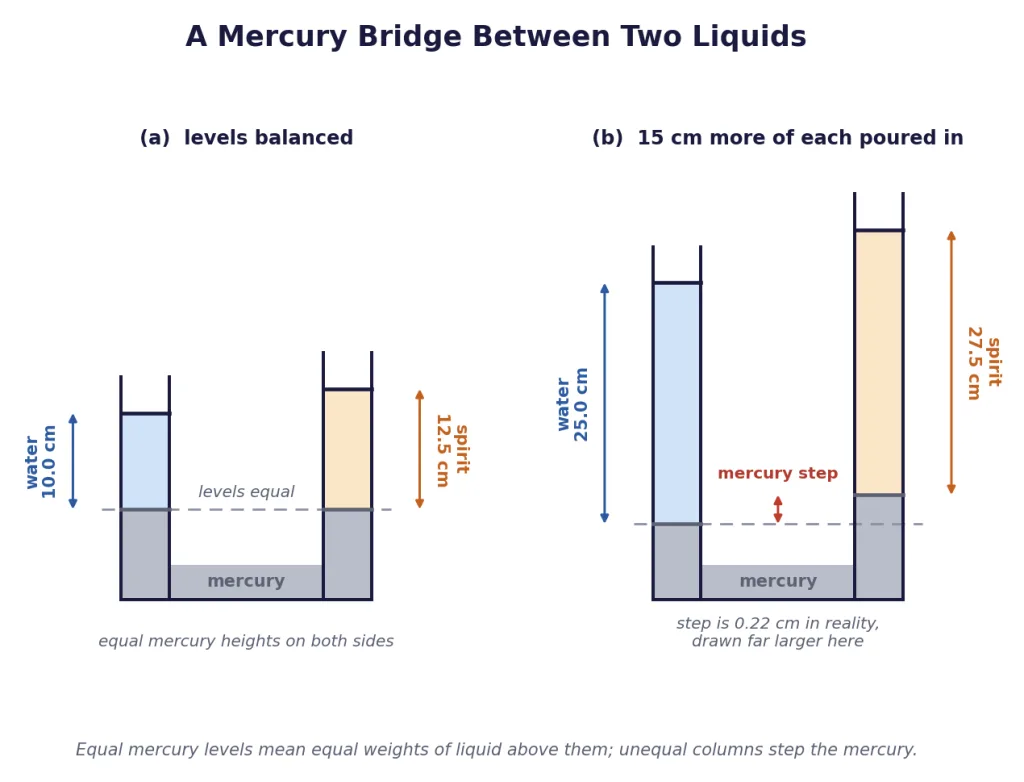
Solution:
Use "same level, same pressure". Points at the same horizontal level in the same connected body of fluid at rest are at the same pressure. The mercury is one connected body, and its two surfaces are at the same level, so those two surfaces are at the same pressure.
Write the pressure at each mercury surface, coming down from the open air above each arm:
The and the cancel — both arms are open to the same atmosphere:
Solve.
Read the answer physically. The lighter liquid needs the taller column to press down just as hard — 12.5 cm of spirit weighs the same, per unit area, as 10.0 cm of water. And notice that the density of the mercury never entered: it is only a bridge, and while its two surfaces are level it contributes nothing.
Final Answer: the spirit has density kg/m, a relative density of .
Takeaway: When the mercury levels are equal, the mercury cancels out completely. The whole problem reduces to "equal weights per unit area of the two liquids above", which is one line.
Example 16: Fifteen centimetres more of each
Starting from the arrangement of the previous problem, a further 15.0 cm of water and 15.0 cm of spirit are poured into the respective arms. What is the new difference in the mercury levels? Take the relative density of mercury as 13.6 and m/s.
Solution:
The columns are now unequal in weight. Water: cm. Spirit: cm. Their pressures at the old mercury level are (These are , kept in this form so nothing cancels by accident.) The water side now presses harder, so the mercury is pushed down under the water and up under the spirit.
Let be the difference in the mercury levels, with the mercury standing higher in the spirit arm. Balance the pressures at the lower of the two mercury surfaces, working down each arm:
Cancel and and solve for .
Sanity check the direction. The heavier column pushes its own mercury surface down, so the mercury must be higher in the spirit arm. It is, by about 2.2 mm.
Why so small? Because mercury is 13.6 times denser than water: a 3 cm imbalance of water column is worth only about 2 mm of mercury. That sensitivity ratio is exactly what makes mercury the right liquid for a manometer that must stay short.
Final Answer: the mercury levels differ by cm, about mm, standing higher in the spirit arm.
Takeaway: Set up a U-tube by balancing pressures at one chosen level, and choose the lowest interface as that level. Everything above it on each side contributes a ; everything below it is common and cancels.
Example 17: Reading a gas line off a mercury manometer
An open-tube mercury manometer is connected to a gas pipe. The mercury in the open arm stands 18.5 cm higher than in the arm connected to the gas. Taking kg/m, m/s and Pa, find the gauge and absolute pressures of the gas.
Solution:
Balance at a chosen level — take the lower mercury surface. The mercury is higher in the open arm, so the lower of the two mercury surfaces is the one in the gas arm. That surface is in direct contact with the gas, so the pressure there is simply .
Now reach the same level down the other arm. Starting at the open mercury surface, which sits at atmospheric pressure, you must descend 18.5 cm of mercury to get there: So the gas is at the higher pressure — the taller mercury column in the open arm is being held up by the gas pushing on the other side. (Had the open arm been the lower one, the sign would flip and the gas would be below atmospheric.)
Compute the gauge pressure.
And the absolute pressure.
Quote it as a height too, because that is how manometers are read in practice: the gas is at 18.5 cm of mercury gauge, or cm of mercury absolute.
Final Answer: Pa gauge, which is Pa absolute — equivalently 18.5 cm of mercury gauge.
Takeaway: Decide the direction by walking down each arm and adding a for every column you pass through, then set the two totals equal at a common level. Guessing from a picture is how signs get lost.
Example 18: Why the pressure halves after six kilometres
The atmosphere extends well over 100 km, yet atmospheric pressure at a height of about 6 km is only half its sea-level value. Explain, and estimate the height at which the pressure halves. Take Pa, the density of air at sea level as 1.29 kg/m, and m/s.
Solution:
Why will not do here. That formula assumes a constant density. Air is a gas: as you climb, the pressure falls, so the air expands, so its density falls too. Less dense air contributes less pressure per metre, so the pressure falls off ever more slowly rather than running out at a definite ceiling.
Set up the honest version. Over a thin slab of thickness , and for an isothermal atmosphere the density is proportional to the pressure, . Substituting,
The scale height . About 8 km. This is the height of a hypothetical atmosphere of uniform sea-level density that would give the same surface pressure.
Where does the pressure halve? Set : about 5.6 km — which is the observed "roughly 6 km", allowing for the fact that the real atmosphere is not isothermal.
Now answer the question as asked. The atmosphere is 100 km deep but the pressure halves in under 6 km because the density is not uniform: most of the mass sits in the bottom few kilometres, and everything above 30 km contributes barely one per cent of the total. The exponential never quite reaches zero, which is why "the top of the atmosphere" is a matter of definition rather than of measurement.
Final Answer: the pressure falls exponentially with a scale height of about km, halving at about km. All the pressures here are absolute.
Takeaway: is for liquids; gases need the exponential. The moment a problem spans kilometres of air, the constant-density formula is not an approximation, it is simply wrong.
Example 19: The cone that presses three times its own weight
A conical vessel stands on its circular base of radius 10.0 cm and tapers to a point 30.0 cm above it. It is filled to the brim with water. Taking kg/m and m/s, find the weight of the water and the force the water exerts on the base, and explain the difference.
Solution:
The weight of the water. A cone of base radius and height has volume :
The force on the base. The base is flat and horizontal at a depth of 0.300 m below the free surface, so the gauge pressure is the same everywhere on it:
Three times the weight. Exactly three, in fact:
Where does the extra force come from? From the walls. The cone slopes inwards as it rises, so the wall's normal reaction on the water has a downward component. Add that downward push from the walls to the weight of the water and you get exactly the 92.4 N pressing on the base. Nothing is created; the force balance on the water as a whole is perfectly satisfied.
This is the hydrostatic paradox, and it works the other way too. A vessel that flares outwards as it rises would press on its base with less than the weight of the water it holds, because the walls then hold part of the water up. In both cases the base feels , and only that.
Final Answer: the water weighs N but presses on the base with N gauge — three times as much. Adding over the same area would give the absolute force, N, but that is balanced by the atmosphere pushing up underneath the base.
Takeaway: The force on a horizontal base is , whatever the vessel is shaped like. If that disagrees with the weight of the liquid, the walls are making up the difference — and they always do, exactly.
Part 3: Upthrust, Apparent Weight and Floating
Key Point:
A floating body displaces its own weight of fluid, so the fraction of its volume under the surface is This fraction cannot exceed 1 — if the ratio comes out above 1, the body sinks and .
Example 20: The diver's lead belt
A diver's weight belt carries 6.0 kg of lead of density 11300 kg/m. Taking the density of sea water as 1030 kg/m and m/s, find the upthrust on the belt under water and the effective weight the diver actually has to carry.
Solution:
Volume of the lead. about half a litre.
Upthrust: the weight of the sea water displaced.
Weight in air.
Apparent weight under water. which is what a 5.45 kg mass would weigh in air.
The fraction lost. Lead is chosen for diving weights precisely because it is dense: a material of half the density would lose twice the fraction of its weight and you would need far more of it strapped to your waist to sink the same amount.
Final Answer: upthrust N; the belt weighs N under water instead of N in air, a loss of about .
Takeaway: A submerged body loses the fraction of its weight. Dense materials lose almost none of it, which is exactly why they are used for ballast.
Example 21: A pine log in a river and in the sea
A pine log of density 520 kg/m floats first in a fresh-water river ( kg/m) and then drifts out into the sea ( kg/m). What percentage of its volume stands above the surface in each case?
Solution:
Write the equilibrium condition. Floating means the upthrust exactly balances the weight:
The and the tidy up into a pure ratio:
In the river.
In the sea.
Read the change. The log rides of its volume higher in salt water. Denser fluid means more upthrust per unit of submerged volume, so less volume needs to be submerged. It is the same reason a ship rides higher when it leaves a river estuary, and the reason a swimmer floats more easily in the sea.
Final Answer: of the log stands above the water in the river, and in the sea.
Takeaway: The floating fraction is a ratio of densities and nothing else — the size of the log, the shape of the log and the value of all cancel. That is why the same wood floats identically in a bathtub and in the ocean.
Example 22: A balloon that just floats
A weather balloon of volume 8.0 m is filled with helium of density 0.18 kg/m in air of density 1.29 kg/m. (a) What is the greatest total mass — envelope, instruments and all — that it can just support? (b) If the envelope itself has a mass of 3.2 kg, what payload is left?
Solution:
The balloon floats in air exactly as a log floats in water. The upthrust is the weight of the air displaced:
What has to be lifted is the helium plus everything attached:
Set them equal for the "just floats" condition and cancel throughout:
(a) Substitute.
(b) Subtract the envelope.
What limits a real balloon. As it rises, the air thins out and falls, so the upthrust falls while the load does not. The balloon stops climbing at the height where has dropped to match the total weight — which is why weather balloons expand as they rise and eventually burst rather than floating forever.
Final Answer: (a) kg total; (b) about kg of payload.
Takeaway: The lifting capacity of a balloon is . The gas inside is not weightless — it is part of the load, and forgetting it is the standard slip in this problem.
Example 23: How many drums under the raft?
A raft is to be built from sealed empty drums, each of volume 0.21 m and mass 18 kg, in fresh water of density 1000 kg/m. It must carry a platform of mass 120 kg and six people averaging 70 kg each. How many drums are needed? Take m/s.
Solution:
What one drum can hold up. At best a drum is fully submerged and displaces its whole volume:
Take off the drum's own weight. The drum has to float itself before it floats anything else: which in mass terms is
The load to be carried.
Divide.
Round the right way. You cannot use 2.81 drums, and rounding down would sink the raft. Take 3 drums, which carry kg — a margin of 36 kg, or about . That is uncomfortably tight for a raft that will also meet waves, so a real builder would use four.
Final Answer: each drum supports 192 kg beyond its own weight, so 3 drums are the mathematical minimum; four would be sensible.
Takeaway: Always subtract the float's own weight before dividing, and always round a floatation count upward. A drum that can lift 210 kg of water can only lift 192 kg of passengers, because 18 kg of that capacity is spent on the drum itself.
Part 4: Continuity and Bernoulli Together
The pairing that runs the second half of the chapter. Continuity gives the speeds; Bernoulli then gives the pressures. In that order, every time.
Key Point:
Bernoulli holds along a single streamline, for steady, incompressible, non-viscous flow. All three terms have the units of pressure. You may use gauge pressures on both sides or absolute pressures on both sides, but never one of each.
Example 24: Forty fine holes in a spray pump
The cylindrical barrel of a spray pump has a cross-section of 8.0 cm, and one end of it carries 40 fine holes each of diameter 1.0 mm. If the liquid inside the barrel moves at 1.5 m per minute, what is the speed at which it is ejected through the holes?
Solution:
This is pure continuity. Whatever volume the plunger pushes along the barrel each second has to come out through the holes in the same second:
Convert everything to SI first. The holes have diameter 1.0 mm, so their radius is mm m:
Total hole area.
Solve for the ejection speed.
Notice how modest the speed-up is. The barrel is 25 times wider in area than all forty holes together, so the jet is 25 times faster than the plunger — but the plunger is crawling at 2.5 cm/s, so the jet only reaches 64 cm/s. To get a fine mist you would push far harder or use fewer holes.
Final Answer: the liquid leaves the holes at about m/s.
Takeaway: Add the hole areas up before you divide. Forty holes of 1 mm diameter are not a 1 mm problem — they are one m opening, and the number 40 is as important as the diameter.
Example 25: Which streamline picture cannot be real?
Two diagrams both claim to show the steady flow of a non-viscous liquid through a pipe that narrows. In one, the streamlines crowd together where the bore is narrow. In the other, the streamlines keep exactly the same spacing throughout, even where the pipe has narrowed. Which is impossible, and why?
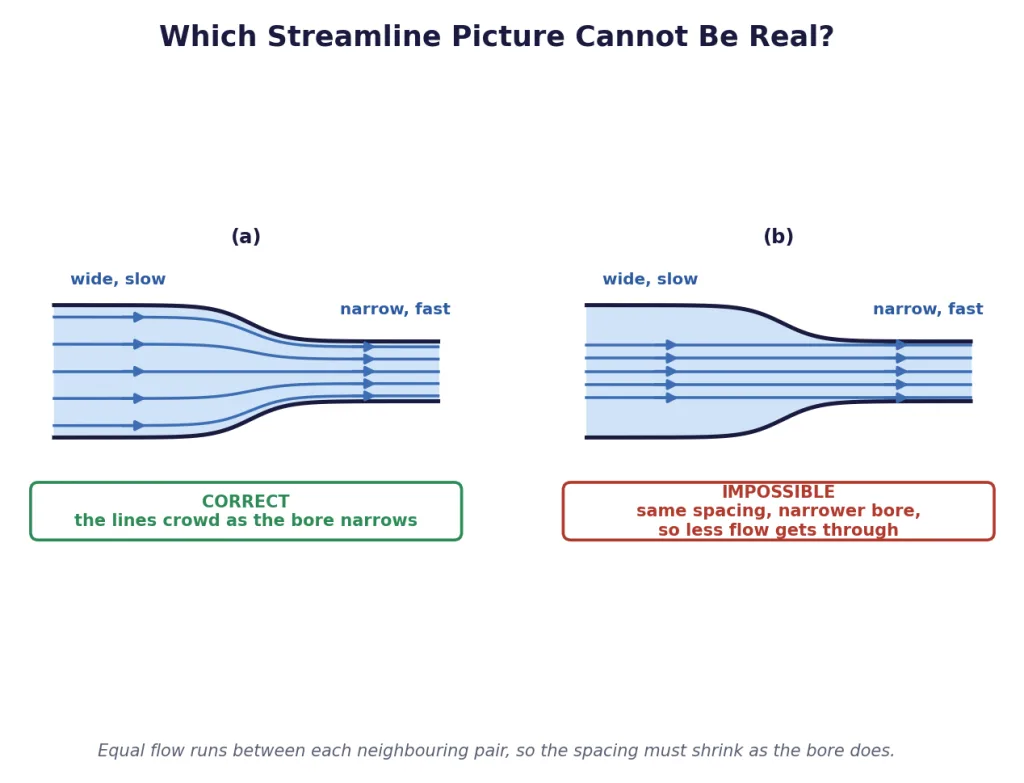
Solution:
What a streamline diagram means. These diagrams are drawn so that the same volume of fluid per second passes between each neighbouring pair of streamlines. The gaps between the lines are little tubes of flow, and no fluid ever crosses a streamline.
Apply continuity to one such gap. If the gap has cross-sectional area and the fluid there moves at speed , then is fixed for that gap all the way along. Narrower gap means faster flow — that is the entire content of the picture.
Now judge picture (b). It shows the same gap width in a narrower pipe. But the same gap width at the same spacing means the same — while the pipe has narrowed, so there is less total room. The only way to fit the same total flow through a smaller pipe with unchanged streamline spacing would be for some fluid to vanish, or for fluid to cross a streamline. Both are forbidden.
Say it as an equation. Between the two sections, so forces , and faster flow is crowded streamlines.
Verdict. Picture (a), with the lines crowding into the constriction, is the correct one. Picture (b) violates the equation of continuity, which is to say it violates conservation of mass.
Final Answer: the picture with unchanged streamline spacing in the narrowed section is impossible; it breaks the equation of continuity, and so conservation of mass.
Takeaway: Crowded streamlines mean fast flow, and by Bernoulli, low pressure. You can read speed and pressure straight off a well-drawn streamline diagram without a single calculation.
Example 26: What the water pays to speed up and to climb
Water flows through a pipe that is 8.0 cm in diameter at ground level, where the speed is 2.0 m/s and the gauge pressure is Pa. Further along, the pipe has narrowed to 4.0 cm in diameter and risen 6.0 m. Taking kg/m, m/s and Pa, find the speed and the pressure at the upper section.
Solution:
Continuity for the speed. Halving the diameter quarters the area:
Bernoulli, with the ground as the datum for height. with and m. Both pressures will be gauge, which is legitimate because would appear on both sides.
Evaluate the three terms at the lower section.
Now the known terms at the upper section.
Subtract to get . and the total at the top is Pa, matching the bottom exactly — the check that the arithmetic worked.
In absolute terms, Pa.
Where did the pressure go? kPa went into speeding the water up and kPa into lifting it. Climbing cost nearly twice as much as accelerating, which is typical: a few metres of height beats a few metres per second of speed almost every time.
Final Answer: m/s and Pa gauge, that is Pa absolute.
Takeaway: Write all three Bernoulli terms out separately at both ends and check the sums match. It costs one line and catches every sign error you are ever going to make in this chapter.
Example 27: The water tower and the tap
A water tower holds its free surface 18.0 m above a tap on the ground floor. The supply pipe is wide compared with the tap. Taking kg/m, m/s and Pa, find (a) the speed of the water leaving the fully open tap, and (b) the gauge pressure at the tap when it is closed.
Solution:
(a) Apply Bernoulli from the tower's free surface to the open tap. Both points are exposed to the atmosphere, so with gauge pressures both terms are zero. The tower's surface is enormous compared with the tap, so the water there is essentially at rest.
Everything cancels except the speed. which is the same speed the water would have reached by falling freely through 18 m — Torricelli's result, and a straight statement of energy conservation.
(b) The tap closed. Nothing is moving now, so every term vanishes and Bernoulli collapses back into hydrostatics:
Compare the two situations. Closed, the tap feels 176 kPa gauge. Open, it feels zero gauge and the whole of that pressure has turned into Pa of dynamic pressure. The energy did not go anywhere — it changed form.
Real taps are slower than this, typically by a factor of two or three, because a real pipe has viscous resistance which Bernoulli ignores. The 18.8 m/s is the ideal ceiling, not a prediction.
Final Answer: (a) m/s; (b) Pa gauge, that is Pa absolute.
Takeaway: Static head and dynamic pressure are the same wearing different clothes. Close the tap and it is all pressure; open it and it is all speed.
Example 28: A Venturi meter read in mercury
A Venturi meter in a horizontal water main has a bore of cross-section 20 cm narrowing to a throat of 8.0 cm. A mercury manometer connected across it shows a difference of 3.0 cm. Taking kg/m, kg/m and m/s, find the speed in the main and the volume flow rate.
Solution:
First convert the manometer reading into a pressure difference. The mercury column is pushed up on one side and down on the other, and the water sitting above it partly cancels the effect, so the effective density is the difference:
Continuity relates the two speeds.
Bernoulli, horizontal, so the height terms cancel.
Solve for . and hence m/s.
The flow rate. that is about litres per second, or 143 litres a minute.
Note what was measured and what was not. The manometer gives only the difference , which is the same number in gauge or in absolute terms. A Venturi meter never tells you the actual pressure in the main — only the drop across the throat, which is all it needs.
Final Answer: m/s in the main and m/s at the throat, giving m/s. The pressure drop is Pa, a difference and so identical in gauge and absolute.
Takeaway: Use , not alone. Forgetting to subtract the water overstates the pressure drop by about here, and by far more with a lighter manometer liquid.
Part 5: Efflux, Dynamic Lift and Reaction Thrust
Bernoulli put to work. Everything here follows from the single line constant.
Key Point — Torricelli's law:
where is the depth of the hole below the free surface, not the height of the hole above the ground. The speed of efflux is the speed a body would reach falling freely through — it does not depend on the density of the liquid at all.
Example 29: Where the jet from the drum lands
An open drum stands on level ground and is filled with water to a depth of 1.25 m. A small hole is opened in its side at a point 0.45 m below the water surface. Taking m/s, find the speed of the jet, how long it is in the air, and how far from the drum it lands.
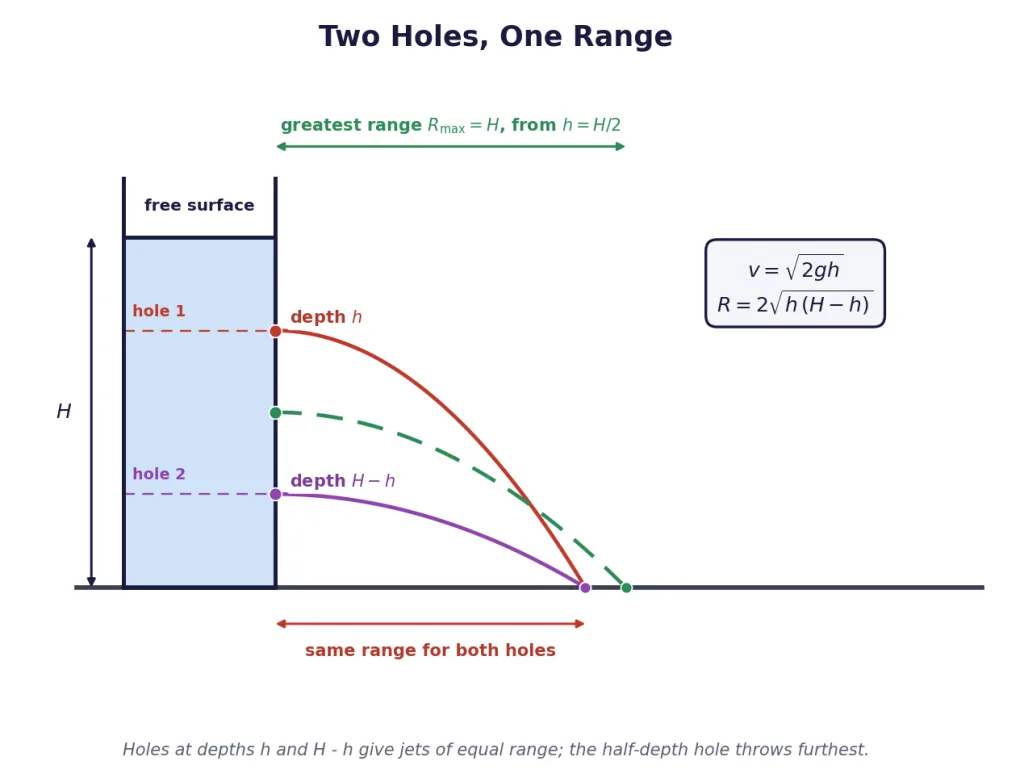
Solution:
The speed, from Torricelli. The depth below the free surface is m:
The height of the hole above the ground is what is left of the depth:
Now it is projectile motion. The jet leaves horizontally, so its vertical motion starts from rest:
The horizontal range.
The compact form, worth memorising. Substituting and , Check: m. The same answer, and notice that has vanished — the range of the jet is the same on the Moon.
A note on pressure. Just outside the hole the jet is a free stream open to the air, so its pressure is atmospheric — that is, zero gauge. Inside the drum at the same level the gauge pressure is Pa. That difference is exactly what accelerated the water.
Final Answer: the jet leaves at m/s, stays in the air for s and lands m from the base of the drum.
Takeaway: Two different heights appear in this problem and you must keep them apart. The depth below the surface sets the speed; the height above the ground sets the time of flight. Mixing them is the standard error.
Example 30: Two holes with the same range
A tank is filled with water to a depth of 1.80 m. A small hole is made 0.40 m below the surface. (a) Where must a second hole be made so that its jet has the same horizontal range? (b) What is that common range? (c) Where should a hole be to get the greatest possible range, and what is it?
Solution:
Start from the range formula derived above: with m.
(a) The symmetry is immediate. The expression is unchanged if you swap for . So the companion hole is at The first hole is 0.40 m down and 1.40 m up from the base; the second is 1.40 m down and 0.40 m up. They are mirror images about the mid-depth.
(b) The common range.
(c) The best hole. Maximise . For a fixed sum , the product is greatest when the two are equal, so
A result worth carrying. The greatest range a tank can throw equals its own depth of water, and it comes from a hole exactly halfway down. Neither the tank's width nor the liquid's density enters.
Final Answer: (a) 1.40 m below the surface; (b) a common range of m; (c) the mid-depth hole at 0.90 m gives m, equal to .
Takeaway: and always give the same range, and the mid-point always gives the maximum . Two facts, no calculation, and they answer a great many objective questions on sight.
Example 31: How long the drum takes to empty
A cylindrical drum of cross-sectional area 0.45 m has a hole of area 3.0 cm in its base and is filled with water to a depth of 1.6 m. Taking m/s, find how long it takes to empty, and what fraction of that time is spent draining the upper half of the water.
Solution:
The level falls slowly, so treat the flow as quasi-steady. When the water stands at depth , the efflux speed is , so the volume leaving per second is , and that must equal the rate at which the drum's contents shrink:
Separate and integrate from down to 0.
Substitute.
How good is the quasi-steady assumption? It ignores the fact that the surface itself is falling, which adds a term to Bernoulli. That term is smaller than the efflux term by the factor , about four parts in ten million. Integrating the falling level numerically, without the approximation, changes the answer by about one part in a million — so here the simple formula is not merely adequate, it is exact for every practical purpose. It would fail badly if the hole were comparable in size to the tank.
The upper half. Time to fall from to is evaluated between those limits:
So the top half drains in of the time and the bottom half takes . The drum starts fast and finishes slowly, because the head driving the flow is shrinking. In seconds: 251 s for the upper half, 606 s for the lower.
Final Answer: about s, or minutes, of which the upper half takes — about s.
Takeaway: — note the square root, so quadrupling the depth only doubles the time. And the emptying is front-loaded: the last half of the water takes more than twice as long as the first.
Example 32: Lift on a model wing in a tunnel
In a wind-tunnel test on a model aeroplane, the air flows over the upper surface of a wing at 70 m/s and along the lower surface at 63 m/s. The wing area is 2.5 m. Taking the density of the air as 1.3 kg/m, find the lift on the wing.
Solution:
Apply Bernoulli across the wing. The two surfaces are at essentially the same height, so the terms cancel and
Do the squares first, and note the difference of squares: (Or as , which is faster and less error-prone.)
The pressure difference.
The lift.
What that lift can hold up. comfortably enough for a model, and a useful sanity check that the answer is the right size.
Note the pressures involved. Pa is a difference, so gauge and absolute give the same number. It is only of an atmosphere — the whole of flight rests on a pressure difference smaller than the change you feel going up in a lift.
Final Answer: the pressure difference is Pa and the lift is N, enough to support about kg.
Takeaway: Lift is , and the difference of squares is where the arithmetic goes wrong. Factorise it as and the slip cannot happen.
Example 33: The kick a leaking tank feels
A tank of water sitting on a frictionless trolley springs a leak through a hole of area 2.5 cm in its vertical wall, 1.20 m below the water surface. Taking kg/m and m/s, find the backward thrust on the tank.
Solution:
Why there is a thrust at all. The tank is throwing water out one side. By Newton's third law, the water throws the tank the other way — exactly as a rocket works. The thrust is the rate at which the escaping water carries momentum away.
The efflux speed.
The mass leaving per second.
The thrust is the momentum carried off per second.
The elegant form. Since ,
Read that factor of 2, because it is the point of the problem. The gauge pressure at the hole is Pa, and would be only N. The thrust is twice that. The reason is that the pressure is not everywhere on the wall opposite the hole — the missing patch of wall unbalances the pressure distribution and the water accelerating towards the hole contributes as well. The momentum argument gets it right without needing any of that detail.
Final Answer: a backward thrust of N, which is — twice the naive .
Takeaway: Use momentum, not pressure, for a reaction thrust: . The pressure route needs the whole pressure distribution on the tank and is far harder to get right.
Example 34: Fingers over the tap
Water leaves a tap of cross-sectional area 1.8 cm at 0.90 m/s. You clamp your fingers over the mouth so that only of the opening is left clear, without touching the tap handle. Find the speed of the water now, and the dynamic pressure of the jet. Take kg/m.
Solution:
The tap setting has not changed, so to a good approximation the volume delivered per second is unchanged:
The remaining opening.
Continuity gives the new speed. That is times the original speed.
The dynamic pressure of the jet. about of an atmosphere, which is why the jet stings when it hits your hand.
Why this is the answer to "why does water gush between my fingers?" Continuity, not pressure. The same volume per second forced through a smaller opening must move faster, and the speed goes up as the reciprocal of the area. Bernoulli then tells you the pressure in the jet has fallen to atmospheric — the pressure energy has become kinetic energy.
The caveat worth stating. In reality the tap does not deliver quite the same once you block it, because the extra resistance slows the whole supply a little. The continuity answer is the ideal upper bound.
Final Answer: the jet speeds up to m/s, with a dynamic pressure of Pa.
Takeaway: The finger-over-the-hose effect is conservation of mass, not a pressure trick. Squeeze the area to a fraction and the speed multiplies by — nothing else changes.
Example 35: Three more explanations, all from one line of Bernoulli
Give the physical reason for each of the following.
(a) To hold a sheet of paper horizontal, you should blow over it, not under it. (b) A doctor controls the flow rate of an injection far better by choosing the needle's bore than by pushing harder on the plunger. (c) A spinning cricket ball does not follow a parabola.
Solution:
(a) Blowing over the top makes the air there move fast. Along a streamline, faster air means lower pressure: The still air underneath stays at atmospheric, so there is now a net upward pressure difference holding the sheet up. Blow underneath instead and you lower the pressure below it, and the atmosphere above pushes the paper down. Numerically, air blown at 12 m/s gives Pa — over a strip of area 0.015 m that is N, about a hundred times the strip's own weight of roughly 0.012 N.
(b) The flow through a fine tube is governed by Poiseuille's law: is only linear in the driving pressure but goes as the fourth power of the radius. Doubling the thumb pressure doubles the flow; halving the bore cuts it to a sixteenth. The needle gauge is a vastly stronger lever than the thumb, and it is also far more repeatable than a person's push.
(c) A spinning ball drags a thin layer of air around with it. On the side where the surface is moving with the airstream the relative speed is high; on the other side the surface moves against the stream and the relative speed is low. Bernoulli then puts a lower pressure on the fast side, so there is a sideways force perpendicular to the ball's velocity — the Magnus effect. A parabola requires a constant force (gravity alone); adding a lateral force that keeps turning with the ball's motion gives a curved, swerving path instead.
Final Answer: (a) fast air above means low pressure above, so the sheet is pushed up; (b) but only ; (c) the Magnus effect adds a lateral force, so the net force is no longer constant and the path is not parabolic.
[JEE Tip] Every one of these three is the same sentence in disguise: where a fluid moves faster, its pressure is lower. If you can say that sentence and name what is moving fast, you have the mark.
Takeaway: Name the mechanism and quote the relation. "Bernoulli" alone is worth little; "faster air above the paper, so lower pressure above, so a net upward push" is worth full marks.
Part 6: Real Fluids — Viscosity, Stokes' Law, Poiseuille and Reynolds
Bernoulli assumed no viscosity, which is why it predicts that a horizontal pipe needs no pressure difference to keep fluid moving through it. Real pipes do. Here is what changes.
Key Point: Poiseuille's law is valid only while the flow is laminar, so every Poiseuille answer deserves a Reynolds-number check. Below about the flow is laminar; above about 2000 it is turbulent.
Example 36: The oil film under a sliding block
A rectangular block with a base 0.15 m by 0.20 m rests on a film of oil 0.50 mm thick and is dragged sideways at a steady 6.0 cm/s. The oil has viscosity 0.85 Pa s. Find the force needed and the power it takes.
Solution:
The oil is being sheared. It sticks to the block on top and to the floor underneath, so its speed goes from 6.0 cm/s at the top of the film to zero at the bottom. Across a thin film the profile is linear, so the velocity gradient is uniform:
The area is the sheared face — the base of the block:
The viscous force.
The power. The block moves steadily, so the applied force exactly balances the viscous force and all the work goes into heating the oil:
Two levers to notice. Halving the film thickness doubles the force, and doubling the speed doubles it too. That is why bearing clearances are specified so tightly, and why a thicker oil film runs cooler but supports less load.
Final Answer: a force of N and a power of W.
Takeaway: The area in is the area being sheared, and the length underneath is the thickness of the film. Neither is the block's own dimension in the direction of motion.
Example 37: How long a fog droplet stays up
A fog droplet of radius 10 m falls through still air. Take kg/m, kg/m, Pa s and m/s. Find its terminal velocity and how long it would take to fall 100 m. Check that Stokes' law is entitled to be used.
Solution:
At terminal velocity three forces balance: weight down, upthrust up, viscous drag up.
Solve for .
Substitute, with m:
Time to fall 100 m. A fog does not settle out; it drifts away or evaporates.
Is Stokes' law allowed? It needs the flow around the droplet to be laminar, so check Far below 1, so Stokes' law is safely valid. This matters: for a full-sized raindrop it will not be.
How fast is terminal velocity reached? Integrating the equation of motion from rest gives an exponential approach with time constant ms, so the droplet is within of after about ms and less than 0.1 mm of fall. For all practical purposes it is at terminal velocity from the moment it forms.
Final Answer: cm/s; the droplet takes about s, roughly hours, to fall 100 m. With , Stokes' law is valid.
Takeaway: , so a droplet ten times smaller falls a hundred times slower. That single fact explains fog, mist, smoke, dust, cloud and why fine particulate pollution is so hard to get out of the air.
Example 38: A bubble rising through castor oil
An air bubble of radius 1.0 mm is released at the bottom of a tall column of castor oil of density 960 kg/m and viscosity 0.99 Pa s. Find the steady speed at which it rises, and how long it takes to travel 1.5 m. Take the density of air as 1.29 kg/m and m/s.
Solution:
Use the same three-force balance, but the bubble is lighter than the fluid, so the upthrust wins and the bubble rises. The drag now acts downwards, because drag always opposes the relative motion.
The general formula handles this automatically if you keep the sign: With this comes out negative, which is the formula's way of saying "upwards".
Substitute magnitudes.
Time to rise 1.5 m. nearly twelve minutes — castor oil is thick.
Reynolds check. Deeply laminar, so Stokes' law is fine.
A caution about the model. A real bubble is not a rigid sphere: its surface can circulate, which reduces the drag, and it deforms as it grows on the way up. Treating it as a rigid sphere is the Class 11 answer and is what a question of this kind wants.
Final Answer: the bubble rises steadily at mm/s and takes about s to climb 1.5 m.
Takeaway: The same formula covers falling and rising — just keep the sign of . A negative means the body goes up, and the drag turns round to point down.
Example 39: Driving glycerine along a two-metre tube
Glycerine flows steadily through a horizontal tube of length 2.0 m and radius 0.80 cm, and 6.0 g of it is collected each second at the far end. The density of glycerine is 1260 kg/m and its viscosity is 0.83 Pa s. (a) What pressure difference drives it? (b) Check whether the assumption of laminar flow is justified.
Solution:
Turn the mass rate into a volume rate, because Poiseuille's law is about volume:
Poiseuille's law, for steady laminar flow through a horizontal tube of uniform circular bore:
Substitute, with cm m so that m: This is a pressure difference between the two ends, so gauge and absolute give the same number. As a head of glycerine it is m — about 40 cm of glycerine, which is how you would set the experiment up.
(b) Now earn the laminar assumption. First the mean speed across the bore:
Then the Reynolds number, using the diameter m:
Verdict. is roughly two thousand times below the turbulent threshold. The flow is emphatically laminar, so Poiseuille's law was entitled to be used and the answer stands. Glycerine's enormous viscosity is what buys that margin — the same tube carrying water at the same speed would give , still laminar, and carrying water at 1 m/s would give , firmly turbulent.
Final Answer: (a) a pressure difference of Pa across the tube; (b) , so the flow is laminar and the assumption is fully justified.
Takeaway: Poiseuille's law is a conditional statement, and the condition is . Quote the flow rate, then quote the Reynolds number — an answer without the check is only half an answer.
Example 40: When does petrol in a fuel line go turbulent?
Petrol of density 720 kg/m and viscosity Pa s flows along a fuel line of internal diameter 8.0 mm. Taking the turbulent threshold as , find the critical velocity and the flow rate at which turbulence would set in. What is the speed below which the flow is certainly laminar?
Solution:
Rearrange the definition of the Reynolds number for the speed:
Substitute at the turbulent threshold.
The flow rate at that speed. which is about 38 litres per hour.
The certainly-laminar speed. Below the flow is reliably laminar, so Between 0.104 and 0.208 m/s the flow is in the unstable middle band and can be either — which is why engineers design well clear of it rather than close to it.
What this tells a designer. A real engine draws far more than 10 mL/s at full throttle, so the fuel in the line is turbulent, and Poiseuille's law does not describe it. Pressure drop then rises roughly as rather than as , and the pump has to be sized accordingly.
Final Answer: the critical velocity is m/s, corresponding to m/s, and the flow is certainly laminar below about m/s.
Takeaway: uses the diameter, not the radius. Using halves every Reynolds number you compute and will turn a turbulent flow into a laminar one on paper — the single most common slip in this topic.
Example 41: How long the saline drip takes
A saline drip delivers fluid of density 1000 kg/m and viscosity Pa s through a needle of length 3.2 cm and internal radius 0.20 mm. The bag hangs with its surface 1.10 m above the needle, and the pressure in the vein is Pa above atmospheric. Taking m/s, find the flow rate and the time to deliver 500 mL. Is the flow laminar?
Solution:
Find the net pressure difference across the needle. The bag's height provides the driving pressure and the vein pushes back: Both of these are gauge pressures — measured relative to the atmosphere, which acts on the open bag and (through the body) on the vein alike, so it cancels.
Poiseuille's law through the needle.
Substitute, with m so m:
Time for 500 mL. which is a realistic drip time, so the model is behaving.
The Reynolds check. Below 1000, so the flow is laminar and Poiseuille's law holds — but only just comfortably. Raise the bag to 2.0 m and roughly doubles, taking to about 1130 and into the uncertain band where the law can no longer be trusted.
The control the nurse actually has. but . Raising the bag from 1.1 m to 1.5 m increases by and by . Changing to a needle wider more than doubles it.
Final Answer: m/s, about mL/s, so 500 mL takes about minutes. With the flow is laminar.
Takeaway: Subtract the back pressure before you use Poiseuille. The driving quantity is the pressure difference across the tube, and a vein, a second tank or a downstream pump all push back.
Part 7: Surface Tension, Drops, Bubbles and Capillary Rise
The last family, and the one with the most traps. Count the surfaces, watch the radius, and decide before you start whether the answer wanted is an excess pressure or an absolute one.
Key Point: the same number carries two units, N/m and J/m: A film has two surfaces, so a slider of length feels . A drop and an air cavity in a liquid have one surface each, so they get ; only the soap bubble, with a film inside and out, gets .
Example 42: Weighing a soap film with a slider
A U-shaped wire is dipped in soap solution and withdrawn. The film formed between the wire and a light slider supports a total weight of N, which includes the small weight of the slider itself. The slider is 40 cm long. (a) Find the surface tension of the film. (b) How much work is needed to pull the slider down a further 5.0 cm?
Solution:
Count the surfaces. A soap film has liquid in the middle and air on both sides, so it has two surfaces. The slider is pulled up along its whole length by each of them:
(a) The film is in equilibrium, so that pull equals the weight hanging from it:
(b) Pulling the slider creates new surface. Moving down by adds of area on each of the two faces:
The work is the surface energy created.
Check it a second way. The slider moves at constant speed against a constant force N, so the work is force times distance: The same answer, which is exactly why surface tension in N/m and surface energy in J/m are the same number.
Final Answer: (a) N/m; (b) J of work.
Takeaway: The factor of 2 in is not the two ends of the slider — it is the two faces of the film. Use once for a single liquid surface and twice for a film.
Example 43: Three frames, one answer
A film of a certain soap solution on a wire frame with a 20 cm slider supports a weight of N. Two more frames are made from the same solution at the same temperature: one with a 40 cm slider and a film of the same height, and one with a 40 cm slider and a film of twice the height. What weight does each support?
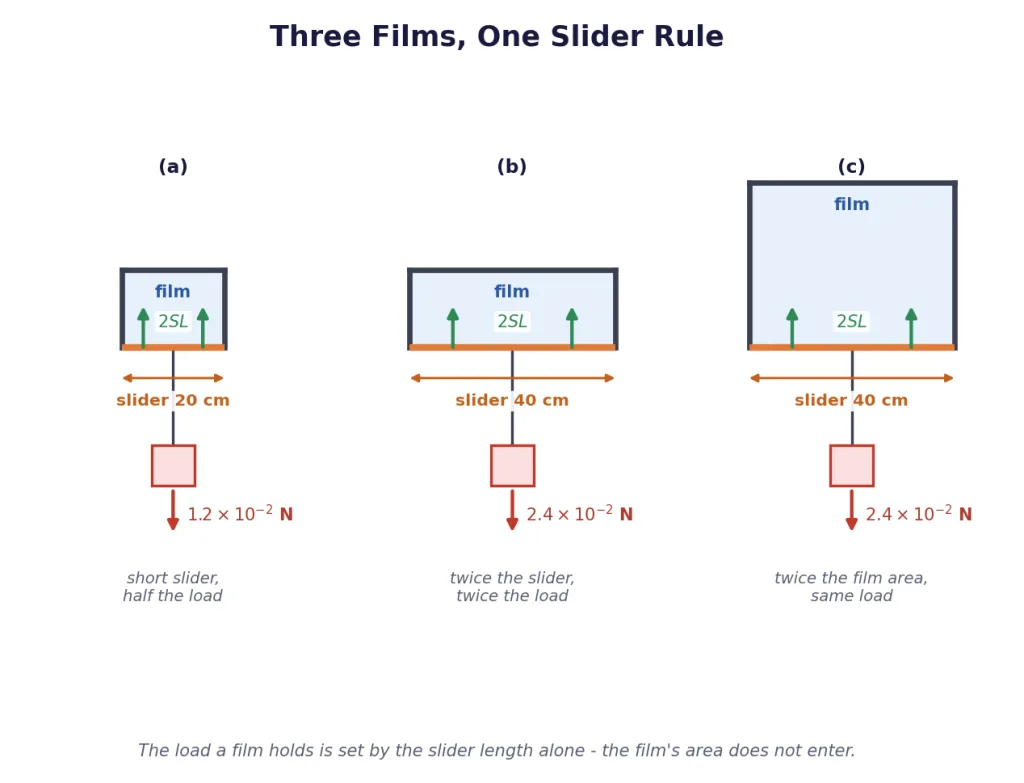
Solution:
Get from the first frame.
The second frame — twice the slider. Double the slider, double the load.
The third frame — twice the film height, same slider. Exactly the same as the second frame. The height of the film does not appear anywhere.
Why the area is irrelevant. Surface tension is a force per unit length of a line drawn in the surface, not a force per unit area. The only line that matters is the one along which the film meets the slider, and its length is the slider length. Doubling the film's height gives twice the area and twice the stored surface energy — but not one newton more of pull on the slider.
The contrast worth stating. A stretched rubber sheet is completely different: stretch it further and the tension rises. A liquid film's tension is a material constant, independent of how far it has been stretched, because pulling it simply brings more molecules up from the bulk into the surface rather than pulling the existing ones further apart.
Final Answer: the 40 cm slider supports N in both the second and the third case; the film's height makes no difference.
Takeaway: Surface tension is a force per unit length, not per unit area. If the film's area appears anywhere in your working for a slider problem, you have used the wrong relation.
Example 44: One drop into a hundred and twenty-five
A spherical water drop of radius 2.0 mm is broken up into 125 identical smaller drops. Taking N/m, find (a) the radius of each small drop, (b) the work that must be done, and (c) the resulting fall in temperature of the water, given its specific heat capacity 4200 J/(kg K) and density 1000 kg/m.
Solution:
(a) Volume is conserved — that is the only equation you need.
(b) Compute both surface areas explicitly. Before: After: Five times as much — because , and total area scales as when volume is fixed.
The new area created, and the work.
(c) Where the energy comes from if nobody supplies it. If the splitting happens with no external work, the energy is taken from the liquid's internal energy and it cools:
A tenth of a millikelvin. Real, in principle measurable, and utterly negligible in practice — which is the honest answer to give. The reverse process, coalescence, warms the liquid by the same amount.
Final Answer: (a) mm; (b) J; (c) a cooling of about K.
Takeaway: Conserve volume first, then compute the two areas separately and subtract. Never guess the radius ratio, and never try to shortcut with an "area ratio" you have not derived — the general result is .
Example 45: Two pressures for one mercury drop
What is the pressure inside a drop of mercury of radius 2.00 mm at room temperature? The surface tension of mercury at 20°C is 0.465 N/m and the atmospheric pressure is Pa. Give the excess pressure as well.
Solution:
A drop has one surface, so the excess pressure across it is
Substitute, with mm m:
The pressure inside is the pressure outside plus that excess. The outside is open air, so:
Which side is higher? The concave side always. Standing inside the drop, the surface curves away from you in every direction — the liquid is on the concave side — so the liquid is at the higher pressure. That rule settles every drop, cavity and bubble question without any memorised sign.
Feel the size. 465 Pa is of an atmosphere, so the answer barely moves the fourth significant figure of . That is normal for millimetre drops — but scale down to m and the same formula gives Pa, nearly five atmospheres. Surface tension only becomes a giant when the radius becomes tiny.
Final Answer: the excess pressure is Pa, and the pressure inside the drop is Pa absolute.
Takeaway: "Excess pressure" is a gauge quantity; "pressure inside" is an absolute one. Read which the question wants, because the two answers here differ by a factor of 218.
Example 46: A soap bubble, and a cavity half a metre down
(a) What is the excess pressure inside a bubble of soap solution of radius 4.00 mm, given that the surface tension of the solution at 20°C is N/m? (b) If an air bubble of the same radius were formed at a depth of 50.0 cm inside a container of the same soap solution, of relative density 1.20, what would the pressure inside it be? Take Pa and m/s.
Solution:
(a) A soap bubble blown in air has two surfaces, the inner and the outer face of the film:
(b) An air bubble inside a liquid is a completely different object. It is a cavity: there is only one liquid surface, the one separating the air from the surrounding solution. So it gets the factor of 2, not 4:
Now build the pressure up in layers. Start at the free surface of the solution and go down: with kg/m:
Add the excess for the curved surface.
Look at the three contributions. Atmosphere 101 300 Pa, depth 5880 Pa, surface tension 12.5 Pa. The surface-tension term is one part in eight thousand. For a millimetre-sized bubble at any appreciable depth, surface tension is a rounding error — but it is exactly what dominates for the micron-sized bubbles in a lung or a foam.
Final Answer: (a) Pa excess; (b) Pa absolute inside the submerged bubble, of which only Pa comes from surface tension.
Takeaway: Bubble in air ; cavity in liquid . The phrase "air bubble in a liquid" is the trigger for the factor of 2, and confusing it with a soap bubble is the single most-punished slip in this topic.
Example 47: Two bores, two rises, and the water they lift
Water is drawn up two clean vertical glass capillaries, of radii 0.30 mm and 0.15 mm, dipped in the same beaker. Take N/m, , kg/m and m/s, and ignore the meniscus correction. Find the rise in each tube and the mass of water raised in each.
Solution:
The ascent formula, obtained by balancing the weight of the raised column against the vertical component of the surface-tension pull around the circle of contact:
The wider tube, m and :
The narrower tube, m — half the radius, so twice the rise, by Jurin's law:
The mass raised in each.
The surprise. The narrow tube lifts the water twice as high but lifts half as much of it. That is because — the mass raised is directly proportional to the radius. That makes sense: the weight is held up by a force acting around the circumference, and the circumference is proportional to .
Would the meniscus correction matter? Adding to the wide tube's rise gives cm — a change of . It is explicitly excluded here, and for these radii it is negligible; for a tube of radius 1.0 mm it would be worth about .
Final Answer: rises of cm and cm; masses raised of mg and mg respectively. The meniscus correction is excluded.
Takeaway: but . Ranking the rises and ranking the masses give opposite orders, and questions love to ask for the one you did not compute.
Example 48: Why a mercury barometer reads a little low
A mercury barometer is made from a tube of internal diameter 4.0 mm. Taking N/m, the angle of contact of mercury with glass as 140°, kg/m and m/s, find the capillary depression and say how the true atmospheric pressure compares with the reading.
Solution:
Use the same ascent formula, and let the sign do the work. With obtuse, is negative and comes out negative — a depression:
The radius is half the diameter: mm m. And .
Read the sign. The mercury in the tube stands 2.67 mm lower than it would in a tube so wide that capillarity did not matter. The barometer therefore under-reads by 2.67 mm of mercury.
Convert that error into a pressure. about of an atmosphere. On a reading near 76 cm that is the difference between 760.0 mm and 762.7 mm.
Why the correction goes this way. Mercury does not wet glass, so its meniscus is convex upwards — it bulges up in the middle. The pressure is higher on the concave side, which here is the mercury below, so the mercury is pushed down. Water in a glass tube, with its concave meniscus, would be pulled up instead.
The practical fix. Use a wide tube. Since the depression goes as , a 20 mm bore reduces the error to mm, and precision barometers use bores of that size for exactly this reason.
Final Answer: a depression of mm, so the true atmospheric pressure is about mm of mercury — that is Pa — higher than the barometer reads.
Takeaway: An obtuse angle of contact makes negative and turns rise into depression, automatically. You never need a second formula for mercury; you only need to keep the sign.
Example 49: Tilting the capillary tube
A clean glass capillary of internal radius 0.25 mm is dipped vertically in water and the water climbs to a certain height. The tube is then tilted so that it makes 30° with the horizontal. Take N/m, , kg/m and m/s. Find the vertical rise in each case and the length of tube filled when tilted.
Solution:
The vertical tube.
Now tilt it, and think about what the formula actually balances. The capillary pull is set by the surface tension, the bore and the angle of contact — none of which the tilt changes. What it holds up is the weight of the raised liquid, and weight acts vertically. So the balance fixes the vertical height, not the length along the tube:
The length of tube filled is then simple trigonometry. If the tube makes an angle with the horizontal, a length along it corresponds to a vertical rise :
So tilting the tube makes the liquid travel further along it, but no higher. At 30° the liquid runs twice as far up the bore; at 10° it would run nearly six times as far.
The limiting case, which is the exam's favourite follow-up. If the tube is not long enough to accommodate , the liquid does not spill. It stops at the open end and the meniscus flattens — its radius of curvature increases until the reduced capillary pull matches the shorter column. Nothing ever runs out of the top of a capillary tube.
Final Answer: the vertical rise is cm whether the tube is vertical or tilted; at 30° to the horizontal the liquid fills cm of the tube's length.
Takeaway: Capillarity fixes the vertical height, not the length along the tube. Every tilted-tube question is that one sentence plus a .
Part 8: The Hard Finishers
Six multi-step problems. Each needs two or three ideas from different parts of the chapter, held together at once — which is exactly what separates a good score from a great one.
Example 50: From the roof tank to the shower head
A roof tank holds its free surface 22.0 m above a shower head. The supply pipe is 3.0 cm in diameter, and the shower head has holes of total area 1.2 cm. Assuming ideal flow, find (a) the speed of the water leaving the holes, (b) the volume flow rate, (c) the speed in the supply pipe, and (d) the gauge and absolute pressures in the pipe just before the head. Take kg/m, m/s and Pa.
Solution:
(a) Bernoulli from the tank surface to the open holes. Both points are at atmospheric pressure, so with gauge pressures both terms are zero, and the tank surface is effectively at rest:
(b) The flow rate, from the exit. about 2.5 litres per second, or 150 litres a minute — a very generous shower.
(c) Continuity back up the pipe.
(d) Bernoulli from the tank surface to a point in the pipe just before the head. Take the shower head as the height datum, so the tank surface is at m and the pipe point at :
Audit the three terms, which is the check that makes this problem safe:
| Point | (Pa) | (Pa) | (Pa) | sum (Pa) |
|---|---|---|---|---|
| tank surface | 0 | 0 | 215 600 | 215 600 |
| pipe before head | 209 386 | 6 214 | 0 | 215 600 |
| jet leaving the holes | 0 | 215 600 | 0 | 215 600 |
The constant is the same at all three points, as Bernoulli requires. The whole story is kPa of potential head turning first almost entirely into pressure and then entirely into speed.
- Why a real shower is nothing like this. Twenty metres per second would strip paint. Real pipes have viscous resistance, and the shower head is designed to throttle the flow — a real system loses most of that 215 kPa to friction and delivers perhaps 0.2 litres per second at 3 m/s. Bernoulli gives the ideal ceiling, and the gap between ceiling and reality is exactly what Poiseuille's law describes.
Final Answer: (a) m/s; (b) m/s; (c) m/s; (d) Pa gauge, that is Pa absolute.
Takeaway: Tabulate the three Bernoulli terms at every point you use and check the sums agree. In a four-part problem it costs one row per point and it will catch every mistake you are capable of making.
Example 51: A Venturi meter that climbs as it narrows
A Venturi meter carries water at m/s. Its inlet has cross-section 25 cm at ground level and its throat has cross-section 10 cm, positioned 1.5 m higher. A mercury manometer is connected between inlet and throat. Taking kg/m, kg/m and m/s, find (a) the two speeds, (b) the actual pressure difference , and (c) the manometer reading.
Solution:
(a) Both speeds straight from the flow rate.
(b) Bernoulli, now with the height terms alive.
Evaluate the two pieces separately, because they mean different things: Most of the drop is simply the cost of lifting the water 1.5 m; only of it is the constriction doing its job.
(c) Now the subtle part. The manometer does not read . Its two connecting limbs are themselves full of water, and the 1.5 m of water in the limb going up to the throat carries its own . Working the mercury balance through, that elevation term cancels exactly, leaving the manometer to respond only to the dynamic part:
Solve for the reading.
The moral. A Venturi meter can be tilted, stood on end or built into a rising main, and its manometer still measures the flow rate correctly — the geometry cancels. If it did not, every flowmeter would have to be recalibrated whenever it was installed at a different angle. All the pressures here are quoted as differences, so gauge and absolute are interchangeable throughout.
Final Answer: (a) m/s and m/s; (b) Pa, of which Pa is dynamic and Pa is elevation; (c) the manometer reads cm of mercury.
Takeaway: A Venturi manometer reads the dynamic part only — the elevation cancels between the meter and its own connecting limbs. That is what makes the instrument orientation-independent, and it is a favourite Advanced-level twist.
Example 52: Two raindrops, and where Stokes' law gives up
Two raindrops of radius 0.10 mm and 0.20 mm fall from a cloud 500 m up. Take kg/m, kg/m, Pa s and m/s. (a) Find each terminal velocity from Stokes' law and the time each takes to reach the ground. (b) Check whether Stokes' law is entitled to be used in each case.
Solution:
(a) Terminal velocity from the three-force balance.
The small drop, m:
The big drop is twice the radius, so four times the speed:
The times, assuming terminal velocity throughout (justified because the time constant is a few milliseconds):
(b) The Reynolds check, and this is the point of the problem.
Verdict. Stokes' law requires well below about 1. Both drops break that badly, and the larger one breaks it by more than two orders of magnitude. The wake behind a real raindrop of this size is not laminar at all, the drag grows more like than like , and the true terminal velocity of a 0.20 mm drop is roughly 1.5 m/s, not 4.8. The Stokes answers are numerically wrong, and the calculation's honest output is a warning rather than a speed.
What this saves you from. Applying all the way up to a 2 mm raindrop would predict about 480 m/s. Real raindrops arrive at 6 to 9 m/s. Stokes' law is a small-and-slow law, and the Reynolds number is the instrument that tells you when you have left its territory.
Final Answer: (a) Stokes gives m/s and m/s, so s and s; (b) and , both far above the limit — Stokes' law does not apply, and the real drops fall more slowly than it predicts.
Takeaway: A formula that gives a number is not the same as a formula that is valid. Compute the Reynolds number before you believe a Stokes answer, and be willing to write "this result cannot be trusted" as the final line.
Example 53: Four answers from one coalescence
Eight identical mercury droplets, each of radius 0.50 mm, coalesce into a single drop. Taking N/m, find (a) the radius of the big drop, (b) the energy released, (c) how the excess pressure changes, and (d) by what factor the terminal velocity in a viscous liquid would change.
Solution:
(a) Volume conservation.
(b) Compute both total areas and subtract. Exactly half the area has disappeared, because area scales as and .
The energy released. Surface area went down, so surface energy is given up, not required: It appears as heat, warming the mercury very slightly.
(c) Excess pressure. Halved, because the radius doubled.
(d) Terminal velocity. Since with everything else unchanged, The merged drop settles four times as fast.
All four answers come from one number. . Once you have that, the area halves, the excess pressure halves, the terminal velocity quadruples and the energy released is times the area lost. Get the radius ratio right and the rest is bookkeeping.
Final Answer: (a) mm; (b) J released; (c) the excess pressure falls from Pa to Pa; (d) the terminal velocity becomes times as large.
Takeaway: For drops merging, , the total area scales as and energy is released. Splitting reverses every one of those, and requires energy instead.
Example 54: A bubble that grows as it rises
An air bubble of radius 0.30 mm is released at the bottom of a lake 25.0 m deep and rises slowly to just below the surface, staying at the same temperature throughout. Taking kg/m, m/s, Pa and N/m, find its radius at the top, first ignoring surface tension and then checking whether that was fair.
Solution:
Isothermal, so Boyle's law applies to the air inside — using ABSOLUTE pressures, because that is what = constant means:
The pressure at the bottom, ignoring surface tension for now. At the top the bubble is just below the surface, so Pa absolute.
Volume goes as the cube of the radius, so about mm, so the bubble's volume has more than tripled.
Now check the assumption. Surface tension adds to the pressure inside a cavity. At the bottom: which is of Pa. At the top the term is Pa, or of .
Redo it honestly. With surface tension included, Boyle's law reads Solving this numerically gives m, against m without surface tension — a change of .
So ignoring surface tension was fair, and now you know it was, rather than merely hoping. Notice the direction, too: including surface tension makes the top radius very slightly smaller, because the extra at the top raises the pressure the air must push against. For a bubble a hundred times smaller the same term would be Pa and the answer would change completely.
Final Answer: the radius grows to about mm. Surface tension changes the answer by only , which is why it may be neglected here — but the check is what earns that claim.
Takeaway: Gas laws need absolute pressure, always. And when you drop a term because it is "small", put a number on how small before you drop it.
Example 55: The tube that is too short
A clean glass capillary of internal radius 0.20 mm would raise water to a certain height. It is dipped in water, but only 4.0 cm of the tube projects above the water surface. Take N/m, , kg/m and m/s. (a) What is the full rise the tube would give? (b) What happens with the short tube — does the water spill? (c) Find the new radius of curvature of the meniscus and the effective angle of contact.
Solution:
(a) The full rise. So the tube would need 7.45 cm above the water and it only has 4.0 cm.
(b) The water does not spill, and it does not fountain out. A liquid does not have a pump behind it — it rises because the pressure just under a curved meniscus is lower than atmospheric, and it rises only until the weight of the raised column has restored the balance. Reaching the top of the tube simply means the column can get no longer. So the water rises to the top and stops there, at 4.0 cm.
What adjusts instead is the curvature. The general balance is where is the radius of curvature of the meniscus. With forced down to 0.040 m, must rise: that is mm, against the bore radius of mm. The meniscus has flattened.
(c) The effective angle of contact follows from the geometry : The water still wets the glass, but the meniscus now meets the wall at instead of .
The invariant worth remembering. Rearranging, constant. Check it: Identical. So is fixed for a given liquid, and shortening the tube trades height for curvature.
Final Answer: (a) cm; (b) the water rises to the top and stops — no spilling; (c) the meniscus radius of curvature becomes mm and the effective angle of contact .
Takeaway: In a short tube the liquid keeps constant, flattening the meniscus rather than overflowing. A capillary is not a pump, and nothing that rises by capillarity can ever be made to run out of the top.