
Close the Notes. Start the Clock.
Sections 1 to 13 taught you this chapter — pressure and Pascal's law, pressure with depth, the barometer and the manometer, Archimedes and floatation, continuity, Bernoulli and everything it powers, viscosity and Stokes' law, Poiseuille and Reynolds, surface tension and capillarity, a full set of worked problems and an advanced toolkit on top. This section asks one different question: can you use any of it with a timer running?
There is no new theory below. There are 30 single-correct questions built to the exam pattern, and a marking scheme designed to punish the three habits this chapter rewards most cruelly — quoting a pressure without saying whether it is gauge or absolute, reading a diameter as though it were a radius, and forgetting that a soap film has two surfaces.
The rules of engagement
Key Point: This is not a reading exercise. Blank sheet, pen, timer. Attempt all 30 questions in one unbroken sitting, and do not open a single explanation until the last answer is written.
| The setup | What it is |
|---|---|
| Number of questions | 30, single correct option |
| Marking scheme | correct, incorrect, unattempted |
| Maximum score | marks |
| Minimum possible score | marks |
| Suggested time limit | 45 minutes (a shade under a minute and a half per question) |
| Take as | 9.8 m/s throughout. No question here uses 10 |
| Allowed | rough sheet, your own head |
| Not allowed | calculator, formula sheet, a glance back at the earlier sections |
The constants sheet
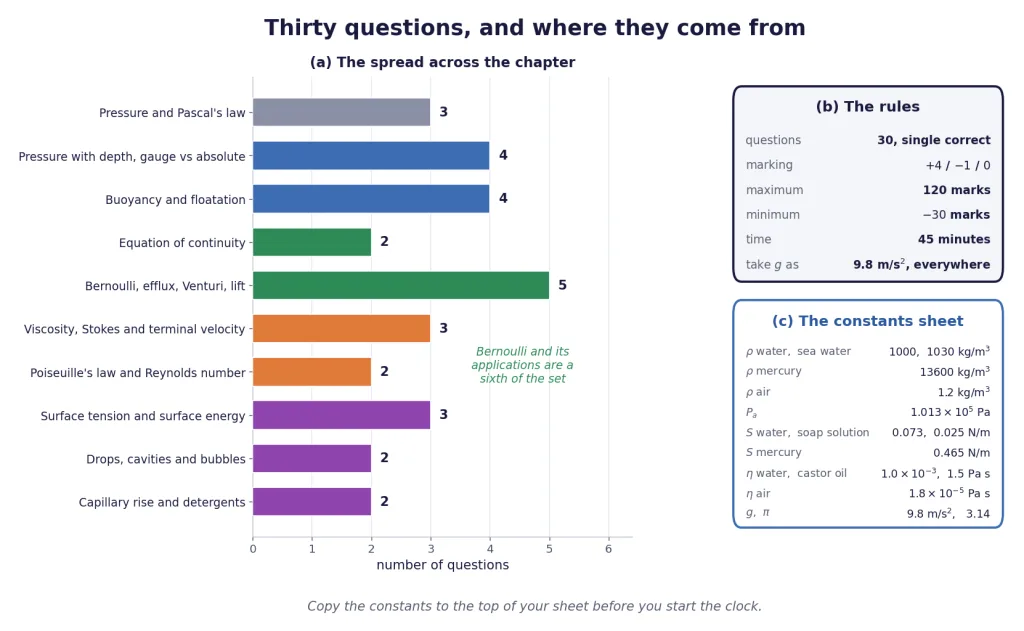
Every question that needs a number uses these and no others. Copy them to the top of your sheet before you start.
| Quantity | Value |
|---|---|
| Density of water | 1000 kg/m |
| Density of sea water | 1030 kg/m |
| Density of mercury | 13600 kg/m |
| Density of air | 1.2 kg/m |
| Atmospheric pressure | Pa |
| Surface tension of water | 0.073 N/m |
| Surface tension of a soap solution | 0.025 N/m |
| Surface tension of mercury | 0.465 N/m |
| Viscosity of water | Pa s |
| Viscosity of air | Pa s |
| Viscosity of castor oil | 1.5 Pa s |
| Acceleration due to gravity | 9.8 m/s |
| Useful values | , , |
The constants used throughout this drill. Nothing else is needed.
Symbols. is density, is surface tension and is the coefficient of viscosity; elsewhere the second is often written or and the third . is atmospheric pressure. is always a radius and always a diameter. Where a question says "gauge" or "absolute" it means it, and where it does not, the solution says which one it used and why.
What this set covers
| Topic | Questions | How many |
|---|---|---|
| Pressure, Pascal's law and hydraulic machines | Q1 | 1 |
| Pressure with depth, barometers, gauge versus absolute | Q2 to Q7 | 6 |
| Buoyancy and floatation | Q8 to Q11 | 4 |
| The equation of continuity | Q12 to Q13 | 2 |
| Bernoulli, efflux, the Venturi meter and lift | Q14 to Q18 | 5 |
| Viscosity, Stokes' law and terminal velocity | Q19 to Q21 | 3 |
| Poiseuille's law and Reynolds number | Q22 to Q23 | 2 |
| Surface tension and surface energy | Q24 to Q26 | 3 |
| Excess pressure in drops and bubbles | Q27 to Q28 | 2 |
| Capillary rise | Q29 to Q30 | 2 |
That spread mirrors how the paper actually samples this chapter. Bernoulli and its applications alone are 5 of the 30, because the moving-fluid questions carry the most steps and therefore the most marks, and they are where a slip on continuity ruins everything downstream.
The difficulty mix is roughly 25% easy, 45% medium and 30% hard. A handful will feel brutal. They are meant to.
[Exam Tip] That is not decoration. Four wild guesses that land one lucky hit earn mark for four minutes of work — a terrible trade. But a question narrowed to two options returns marks on average, which is a very good one. Narrow first, then commit. Leave blank only what you could not narrow at all.
[Exam Tip] Before you start, write five lines at the top of your sheet: gauge or absolute?, radius or diameter?, did I square the area ratio?, one surface or two?, are my units SI? Those five questions catch the overwhelming majority of the marks lost in this chapter.
Scoring Yourself Honestly
Mark your sheet with the real scheme — , , — and total it. No half marks for "I knew that one really". The number you get is the number that matters.
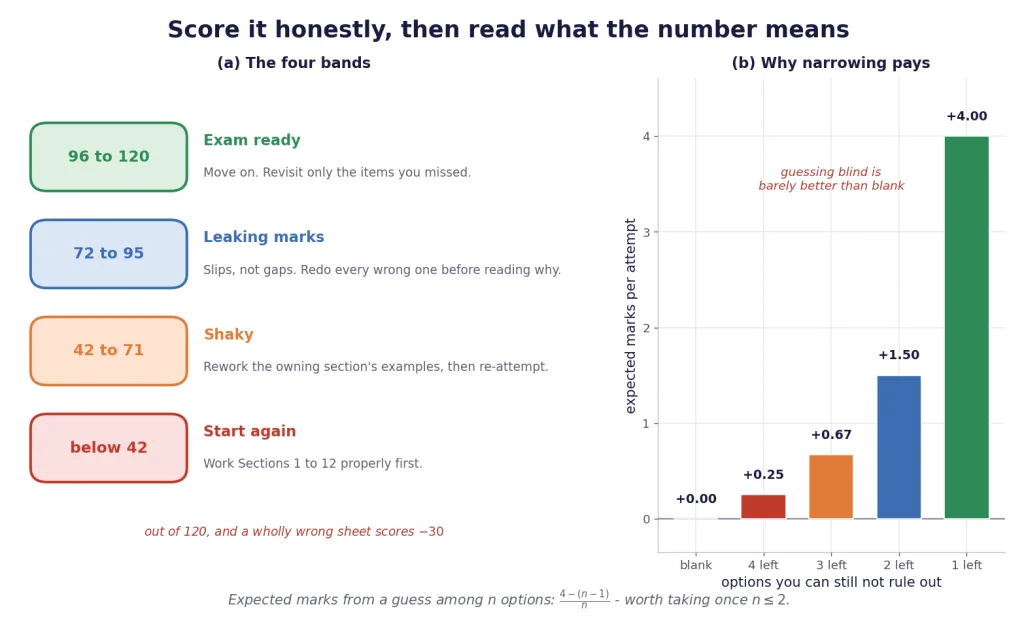
The bands
| Your score (out of 120) | Verdict | What to do next |
|---|---|---|
| 96 to 120 | Exam ready. 80% or more on a hard set, inside the time. | Move on. This chapter will not cost you marks. Revisit only the specific items you missed. |
| 72 to 95 | Solid, but leaking marks. | Almost always slips rather than gaps — a diameter used as a radius, an area ratio not squared, cm converted as instead of . Redo every wrong question without the explanation first. |
| 42 to 71 | Shaky. The ideas are there; the execution is not. | For each wrong answer go back to the section that owns it (use the topic map above) and rework its solved examples before re-attempting. |
| Below 42 | Start again. | Work Sections 1 to 11 properly, then Section 12's worked problems, then Section 13. Re-attempting this set now teaches you nothing but the answer key. |
Read your own answer sheet
Before you touch a single explanation, sort your mistakes into three piles. This is the most valuable ten minutes in the whole section.
- Method errors — you used Bernoulli where the flow was viscous, or Poiseuille where the question was about an ideal fluid. You applied across a liquid whose density changes. You connected two points by Bernoulli that no streamline joins. You used for a soap bubble. These are the expensive ones, because the whole solution is wrong from line one.
- Execution errors — right method, wrong arithmetic. The classic four in this chapter: a diameter substituted where the formula wanted a radius; an area ratio used where the square of a diameter ratio was needed; cm converted as m instead of m; and a gauge pressure fed into a calculation that needed the absolute one.
- Reading errors — the question asked for the pressure inside the bubble, not the excess pressure; for the speed at the throat, not in the bore; for the fraction above the surface, not below it; for the force on one wall, not on the whole tank.
Key Point: In this chapter pile 3 is unusually fat, because so many quantities in it come in near-identical pairs: gauge against absolute, above the surface against below it, drop against bubble, radius against diameter, along a streamline against across one. Underline the quantity the question actually wants before you start solving.
The eight habits this set is drilling
- Name the pressure. Write "gauge" or "absolute" beside every pressure you put on paper. Differences may use either; totals, boiling, cavitation and Boyle's law demand absolute.
- Pressure at depth depends on the depth, the density and — and on nothing else. Not on the shape of the vessel, not on how much liquid it holds, not on the area of the base.
- A floating body displaces its own weight; a submerged one displaces its own volume. Almost every buoyancy question is one of those two sentences.
- Continuity before Bernoulli, always on separate lines. Areas go as the square of the diameter, so halving a diameter quadruples the speed.
- Where a fluid moves faster, its pressure is lower, and the sign of that is worth checking before the arithmetic.
- Terminal velocity goes as , so coalescing drops give times the speed, not times.
- Poiseuille goes as . A 20% narrowing of a pipe more than halves the flow.
- Count the surfaces. A drop has one, an air cavity in a liquid has one, a soap film has two, a soap bubble has two. That single count is the difference between and , and between and .
[Exam Tip] Every explanation below is a full step-by-step solution, so this set doubles as revision. Read the explanation even for the questions you got right — several of these have a two-line route and a two-page route, and it is the two-line route you will need in the hall.