
The Skin That Isn't There
Drop a sewing needle flat onto still water and — if you are careful — it floats. Steel is about eight times denser than water, so Archimedes has nothing to do with it. Look closely and you can see the water surface dented under the needle, like a trampoline with a marble on it.
Watch a pond skater walk across a pond without getting its feet wet. Watch a drop of water hanging from a tap pull itself into a bead before it lets go. Watch the bristles of a wet paint brush cling into a fine point the moment you lift it out of the water — dry they splay apart, submerged they splay apart, and only on the way out do they draw together.
None of these is buoyancy. All of them are the same thing: the free surface of a liquid behaves as though a stretched elastic membrane were lying across it. That property is called surface tension.
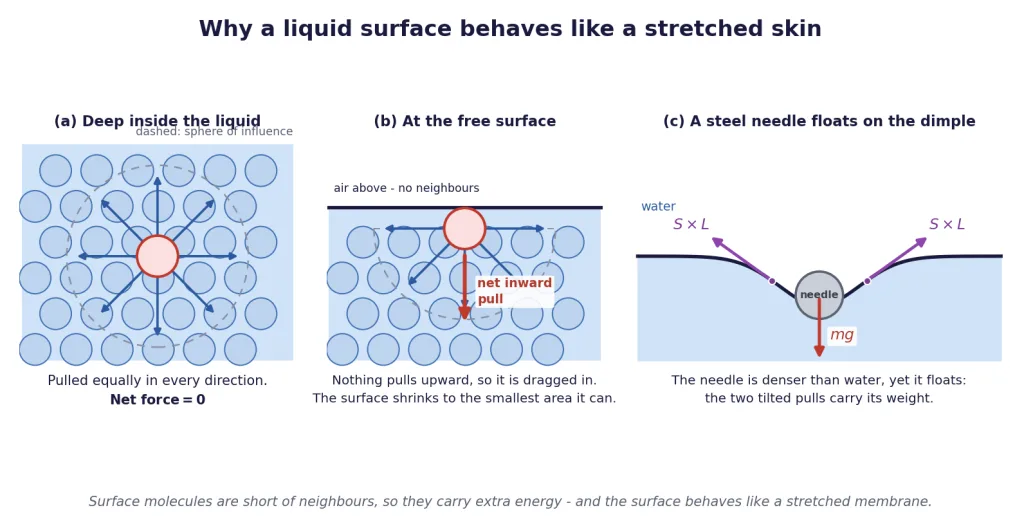
Where the membrane comes from
There is no actual skin. What there is, is an imbalance of molecular pulls.
Liquid molecules attract one another — that is cohesion, and it is the only reason a liquid holds together at all rather than flying apart like a gas. Each molecule reaches out to its neighbours within a sphere of influence, a range of a few molecular diameters, typically about m. Beyond that range the attraction is effectively zero.
Now compare two molecules.
- A molecule deep inside. Its sphere of influence is completely filled with other molecules. It is pulled left and right, up and down, forward and back, and every pull is matched by an equal and opposite one. Net force zero. It sits in a comfortable, low-energy hollow.
- A molecule at the surface. The upper half of its sphere of influence contains air — a few thousand times less dense than the liquid, so effectively empty. There is nothing above to pull it up. All the surviving pulls come from below and from the sides, and the sideways ones cancel. Net force: straight down, into the liquid.
Key Point — the molecular origin:
A surface molecule is short of neighbours, so it is pulled inward and it carries more potential energy than a molecule in the bulk — roughly half the energy needed to remove it from the liquid altogether. Since every system settles into its lowest energy state, the liquid shrinks its surface to the smallest area the circumstances allow.
Everything in this section and the next two follows from that one sentence. A liquid does not "want" to be curved or flat or spherical. It wants least area, and it will do whatever geometry achieves that.
The consequences, immediately
- A free drop is a sphere. Of all shapes enclosing a given volume, the sphere has the least surface area. A falling raindrop is squashed by air resistance and a resting one is flattened by gravity, but a drop in free fall inside a spacecraft is a perfect ball.
- Mercury beads up on a table. Mercury's cohesion is enormous, so it retracts into balls rather than spread.
- The needle floats. The surface, forced to stretch around the needle, pulls back along the tilted surface on both sides, and the upward components of those pulls carry the weight. Push the needle a millimetre under and it sinks like a stone, because once the surface is broken there is nothing left to pull.
- The wet paint brush. Water between the bristles has a surface, and pulling that surface small drags the bristles together. Dry there is no water and no surface; fully submerged there is water but no free surface. Only in between does the effect exist.
- Insects on ponds. A water strider's weight is a few milligrams. The surface pull along the perimeter of its dimpled feet is more than enough.
Two ideas, one quantity
Because the surface costs energy to make, we can talk about it in two equivalent languages:
- Surface tension — as a force per unit length pulling along the surface, in newton per metre.
- Surface energy — as an energy per unit area stored in the surface, in joule per square metre.
The next two blocks build each one properly and then show that they are the same number. And a warning that will save you marks: surface tension is throughout, and is reserved for temperature and for tension in a thread. A met elsewhere is .
[Board Important] "Why do small liquid drops assume a spherical shape?" is a two-mark stock question. The full answer is: a liquid surface has energy proportional to its area, the system minimises energy by minimising area, and for a fixed volume the sphere is the shape of least area. Say all three steps.
Surface Tension as a Force:
Imagine drawing an imaginary line, of length , anywhere on a liquid surface. The molecules on the left of the line pull the line towards them; those on the right pull it towards them. The line does not move, because those two pulls are equal and opposite — but they are real, and they are in the plane of the surface, perpendicular to the line.
Key Point — the definition: Surface tension is the force acting per unit length on either side of an imaginary line drawn in the surface, the force being tangential to the surface and perpendicular to the line.
SI unit: N/m. Dimensions: — note there is no length in the dimensional formula, which surprises people every time.
Check the dimensions yourself: . The same as a spring constant, and for the same reason — both are a force per unit stretch-related-length.
The experiment that defines it
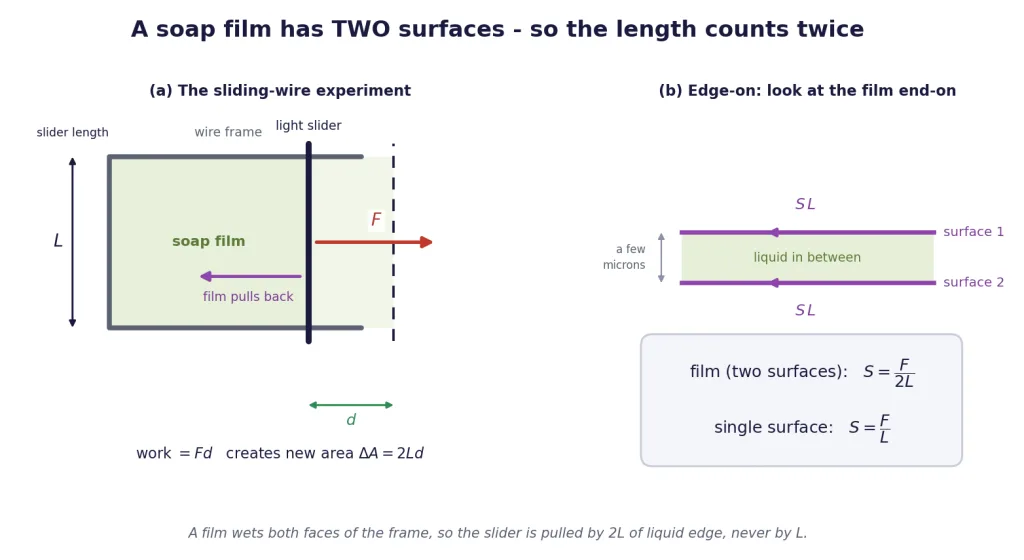
Bend a wire into a U and lay a light straight wire across the arms so it can slide freely. Dip the whole thing in soap solution and lift it out. A film spans the frame.
Left alone, the film pulls the slider inwards, shrinking its own area — exactly what the molecular picture predicted. To hold the slider still you must apply an outward force . Measure , measure the slider's length , and you have measured the surface tension.
The two-surfaces rule — the single biggest trap in this topic
Here is the thing that catches almost everybody.
A soap film is not a soap surface. It is a thin sheet of liquid — a few micrometres thick — with air on both sides. So it has a surface facing you and a surface facing away. Two surfaces. Both of them end on the slider, and both of them pull.
Key Point — count the surfaces before you write anything:
- A film (soap film, film on a frame, film on a ring) has TWO surfaces:
- A single free surface (water in a beaker, a liquid drop, the surface a plate is being pulled out of on one side) has ONE:
Getting this wrong changes your answer by exactly a factor of 2, and a factor of 2 is always available as a wrong option.
[JEE Tip] Before you touch the algebra, draw the thing edge-on and physically count the liquid–air boundaries that end on the object you are pulling. A rectangular plate being lifted out of water has two wetted edges — front and back — plus the two short ends, so the wetted perimeter is , but that is one surface wrapping round a perimeter, not two surfaces. A soap film on a frame is a genuinely different situation. Count boundaries, not habits.
What the force does and does not depend on
Key Point: For a given liquid at a given temperature against a given second medium, is a constant of the material. It does not depend on:
- the area of the surface — stretch a soap film to twice the area and the force on the slider is unchanged;
- the shape of the surface;
- the length of the line you drew (that is already divided out).
It does depend on the liquid, on the temperature, on what is on the other side of the surface, and on dissolved impurities.
That first point is worth dwelling on, because it is where the "stretched membrane" analogy breaks down. A rubber sheet pulls harder the more you stretch it — its tension rises with strain. A liquid film does not. Pull the slider out and more molecules simply come up from the bulk to occupy the new surface, each carrying the same energy as the ones already there, so the force per unit length stays put. That is why we say a liquid surface behaves like a membrane, not that it is one.
Some values to have a feel for
| Liquid (in contact with air) | Temperature | (N/m) |
|---|---|---|
| Mercury | 20 °C | 0.465 |
| Water | 0 °C | 0.0756 |
| Water | 20 °C | 0.0727 |
| Water | 100 °C | 0.0589 |
| Glycerine | 20 °C | 0.063 |
| Soap solution | 20 °C | about 0.025 |
| Ethanol | 20 °C | 0.0227 |
| Liquid oxygen | °C | 0.0132 |
| Liquid helium | °C | 0.000239 |
Surface tension of mercury is quoted between 0.4355 N/m for scrupulously clean mercury at 20 °C and the 0.465 N/m used in most problem sets; 0.465 N/m is used throughout, and a question will hand you the value it wants.
Two things jump out. Mercury is more than six times water, which is why it beads so aggressively. And soap solution is a third of water, which is the whole story of detergents and gets its own treatment in Section 11.
[NEET Important] For quick work, take N/m and N/m unless a question hands you a value. Always use the value the question gives you, even if it disagrees with the table.
Surface Energy: The Same Thing, Counted Differently
Go back to the sliding wire. Suppose you pull the slider out by a small distance , slowly, so nothing gains kinetic energy.
Work you do: the applied force is (two surfaces), moved through :
Area you created: the film got longer by , on both of its surfaces:
Divide one by the other and and both vanish:
Key Point — surface energy: The surface energy of a liquid is the work that must be done, at constant temperature, to create unit area of new surface. SI unit J/m.
Numerically and dimensionally it is the same quantity as the surface tension: N/m J/m, since .
So "surface tension of water is 0.073 N/m" and "surface energy of a water surface is 0.073 J/m²" are the same statement in two languages. Not two quantities that happen to be equal — one quantity with two units.
Why there are two names at all
Because two different kinds of question want two different pictures.
- Asked about a force — what holds the needle up, what pulls the slider in, what tension is in the thread — think and count the boundary lines.
- Asked about energy — how much work to blow this bubble, how much heat is released when these drops merge — think and count the areas before and after.
[JEE Tip] Every surface-tension numerical is one of those two. Decide which before you write a symbol. Mixing them mid-solution is how people end up multiplying an area by a length.
The work must be done isothermally
There is a small print clause: is the work at constant temperature.
When you stretch a film, molecules must be dragged from the comfortable interior to the uncomfortable surface. That costs energy. Some of it comes from the work you do; the rest is drawn from the liquid's own internal thermal energy, so stretching a surface cools the liquid slightly, and the liquid then absorbs heat from its surroundings to get back to room temperature. If you insist on doing the whole thing quickly, in a thermally isolated system, the liquid cools measurably instead.
Turn that round, and you have a result the exam loves:
Key Point:
- Increasing the surface area (splitting a drop, blowing a bubble, stretching a film) absorbs energy. If no heat can flow in, the liquid cools.
- Decreasing the surface area (drops coalescing, a film collapsing) releases energy. If no heat can flow out, the liquid warms — and any surplus appears as kinetic energy, which is why merging drops visibly jiggle.
The standard energy calculations
Blowing a soap bubble of radius from a flat blob: A bubble has two surfaces, inner and outer, of essentially equal radius, so
Growing a soap bubble from to :
Making a liquid drop of radius (one surface only):
Stretching a film in a frame — always (increase in the flat area).
Key Point — the film factor again:
Bubble: . Drop or cavity: .
Same radius, same liquid, twice the energy for the bubble. This is the same 2 that will turn into in Section 10.
[Board Important] A very common one-mark trap: "Does the surface energy of a liquid depend on the area of its surface?" The surface energy per unit area does not — it is , a material constant. The total surface energy obviously does, since it is times the area. Read which one is being asked.
Splitting and Coalescing Drops
This is the highest-yield calculation in the whole topic, and the good news is that it is always the same three lines.
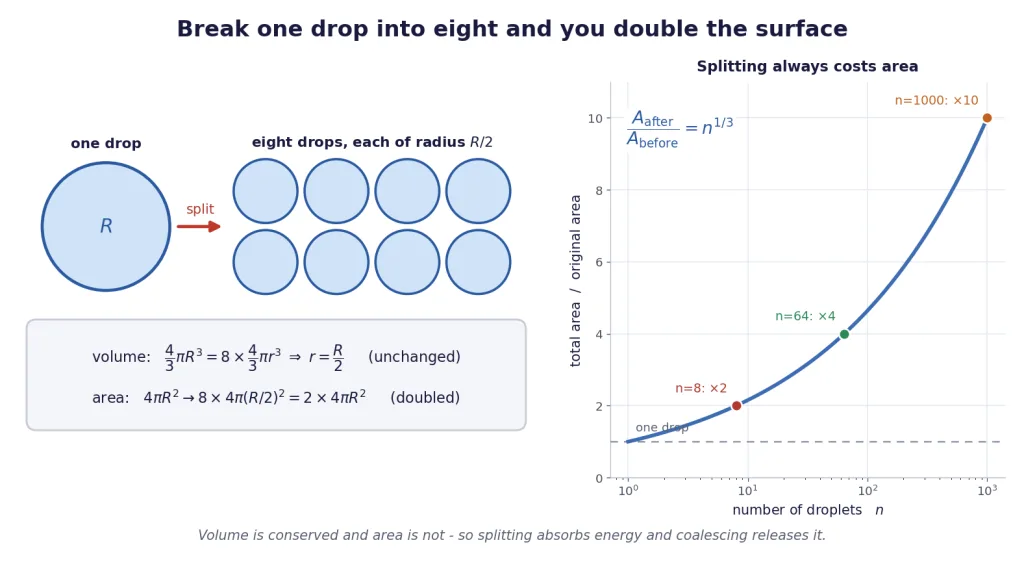
Step 1 — volume is conserved, so find the new radius
Liquid is incompressible and none of it is lost. If a single drop of radius becomes identical droplets of radius :
Never skip this step and never guess it. Ten small drops do not have one-tenth the radius; they have of it.
Step 2 — areas do not go the same way
Key Point — the area law: Split a drop into pieces and the total area is multiplied by , while the volume is untouched. Split into 8 and the area doubles; into 1000 and it goes up tenfold; into a million and it goes up a hundredfold.
That factor is why a spray, a mist or an aerosol is so chemically active: same amount of liquid, vastly more surface exposed.
Step 3 — energy is times the change in area
For splitting, , so — energy must be supplied. Running it backwards, when droplets of radius coalesce into one drop of radius , the energy released is
There is a second form of that expression which is far more useful, because it turns the awkward into two radii. Writing for the total volume, which is the same before and after,
Check it: , and . So it is , as required. Good.
The temperature change
If the merging happens fast, or in an insulated container, the released energy has nowhere to go but into the liquid's own thermal store. With mass and specific heat capacity :
cancels — a genuinely pleasing result, because it means the temperature rise does not care how much liquid you have.
Key Point — the temperature-change formula: Coalescing (): the bracket is positive, energy is released, the liquid warms.
Splitting: run the same formula with the sign reversed — the liquid cools.
is the liquid's density and its specific heat capacity. Use SI throughout and the answer comes out in kelvin.
Be warned that the numbers are small. Break a 1 mm water drop into a million droplets and the cooling is only about five thousandths of a degree, because for water is and surface energies are measured in microjoules. The formula is examined constantly; the effect is delicate.
[JEE Tip] For a soap bubble splitting or merging, every area in the calculation doubles, so every energy — and every — doubles too. And for bubbles you must also decide whether the enclosed air is being compressed, which a Class 11 problem will normally tell you to ignore.
A worked pattern to copy
| Step | What you write |
|---|---|
| 1 | |
| 2 | ; — put in numbers, do not simplify symbolically |
| 3 | (watch the sign) |
| 4 | ; if a temperature is wanted, |
Doing step 2 numerically, with actual metres, is the habit that stops sign errors and factor-of- errors dead.
What Changes the Surface Tension
is a material constant, but it is a constant of a situation, not just of a liquid. Four things move it.
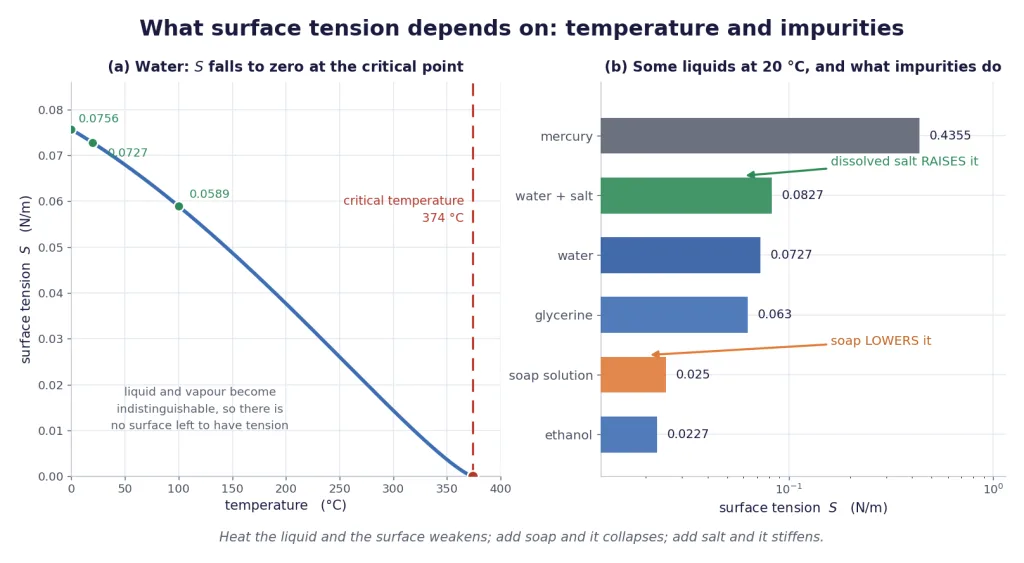
1. Temperature — it falls, and it vanishes
Heat a liquid and its molecules move faster and sit further apart. The cohesive attraction that creates the surface imbalance weakens, so the surface costs less energy to make.
Key Point:
Surface tension decreases as temperature rises, very nearly linearly over ordinary ranges, and becomes exactly zero at the critical temperature .
The vanishing at is not an approximation, it is a definition. At and above the critical temperature the liquid and its vapour become indistinguishable — there is no longer a boundary between two phases, so there is no surface, so there is nothing to have a tension. For water is 374 °C; the surface tension of water at 350 °C is already down to about a tenth of its room-temperature value.
A useful empirical form, worth recognising rather than memorising, is with in °C and a small positive constant for the liquid.
[NEET Important] Both viscosity and surface tension of a liquid fall as temperature rises. But the viscosity of a gas rises with temperature — that is the odd one out, and it is asked as a one-liner every year.
Two familiar consequences:
- Hot water cleans better than cold, partly because its lower surface tension lets it spread into fabric and soak into pores instead of beading on the outside.
- Hot soup spreads across the plate while cold soup sits in a dome.
2. Impurities — it can go either way, and which way matters
This is the part students get backwards, so learn it as two named cases.
Key Point — the impurity rule:
- A soluble impurity that dissolves fully and stays in the bulk — common salt, sugar, most inorganic salts — raises the surface tension of water. Ions are attracted into the bulk, so the surface is slightly depleted of them and cohesion at the surface is if anything strengthened.
- A sparingly soluble surface-active impurity — soap, detergent, phenol, alcohol, oil, camphor — collects at the surface and lowers the surface tension, often dramatically. Soap solution is about one-third of pure water.
One-line version: soap lowers, salt raises.
Substances of the second kind have a name — surfactants, short for surface-active agents. Their molecules are two-faced: one end likes water, the other end hates it. That structure forces them to sit in the surface, and by occupying it they weaken the very imbalance that created the tension. Section 11 spends this idea on how detergents actually lift grease.
Two demonstrations you can do at a sink:
- The camphor boat. A tiny scrap of camphor on still water skitters about erratically. Camphor dissolves unevenly, lowering locally and randomly, and the water pulls harder from wherever is still high.
- The pepper trick. Sprinkle pepper on water and touch the centre with a soapy finger. The pepper flees to the edges, because has collapsed in the middle and the untouched surface outside wins the tug of war.
3. The second medium — there is no such thing as "the" surface tension
Surface tension belongs to an interface, not to a liquid on its own. Water against air, water against oil and water against glass are three different interfaces with three different values. A liquid against its own vapour, against a different liquid, against a solid — all different. When a problem says "surface tension of water", it means water against air unless it says otherwise.
[Board Important] "Surface tension is a property of a single liquid." — False. It is a property of the interface between two media, at least one of which is a fluid.
4. Contamination — and why lab values disagree
Surface tension is notoriously sensitive. A trace of grease from a fingerprint on the inside of a beaker is enough to move a measurement by a few per cent, which is why real values for water range from 0.0727 to 0.073 to 0.0728 across different sources. Use whichever the question gives.
A quick summary of what does and does not matter
| Changing this… | …does what to |
|---|---|
| Raising the temperature | decreases it; zero at |
| Adding soap or detergent | decreases it, sharply |
| Dissolving common salt | increases it, slightly |
| Increasing the surface area | no change |
| Changing the shape of the surface | no change |
| Changing the second medium | changes it completely |
| Contaminating the surface | usually decreases it |
Solved Examples
Constants used throughout, unless a problem states otherwise: m/s², kg/m³, J/(kg·K), N/m, N/m, N/m, kg/m³.
Example 1: The sliding wire on a soap film
A U-shaped wire is dipped in soap solution and taken out. The thin soap film formed between the wire and a light slider supports a weight of N, including the small weight of the slider itself. The slider is 30 cm long. What is the surface tension of the film?
Solution:
Count the surfaces. The frame carries a film, so it has a front surface and a back surface. Both end on the slider, so the length of liquid edge pulling up on the slider is , not .
Equilibrium of the slider. The film pulls up, gravity pulls down:
Substitute, with m:
Final Answer: N/m, that is 0.025 N/m — a typical soap solution.
Takeaway: Divide by , not . Had you forgotten the second surface you would have got 0.05 N/m, which is not the surface tension of any soap solution on Earth. A quick sanity check against the table is free.
Example 2: Does the shape of the frame change the load?
A thin liquid film in one frame supports a small weight of N. A second and a third frame of the same liquid at the same temperature are made, one with a much larger enclosed area and one with a differently shaped boundary, but with sliders of the same length. What weight does each support?
Solution:
Write what the load depends on. For a film with a slider of length ,
Ask what changed. is fixed by the liquid and the temperature, both unchanged. is stated to be the same. The area of the film does not appear in the formula at all, and neither does the shape.
Therefore each film supports the same N.
The physical reason. Surface tension is a force per unit length of boundary, not per unit area of surface. Stretch the film and molecules simply migrate from the bulk into the new surface, each contributing the same as those already there. The pull per metre of edge never changes.
Final Answer: All three support N.
Takeaway: Surface tension is independent of surface area. This is exactly where the "stretched rubber sheet" picture fails — a rubber sheet gets harder to stretch, a liquid film does not.
Example 3: Work done in blowing a soap bubble
Calculate the work done in blowing a soap bubble of radius 5.0 cm from a soap solution of surface tension 0.025 N/m, and then the extra work needed to increase its radius to 7.0 cm. Ignore the work done against the air pressure.
Solution:
Count the surfaces. A bubble is a thin shell of liquid with air inside and air outside: two surfaces, both of radius essentially .
(a) Blowing it from nothing, with cm m:
(b) Growing it from 5.0 cm to 7.0 cm:
Final Answer: (a) J; (b) a further J.
Takeaway: Almost as much work to grow it by 2 cm as to make it in the first place, because the energy goes as . Notice too that the second answer used the difference of the squares, never the square of the difference.
Example 4: Splitting a water drop into a thousand
A water drop of radius 2.0 mm is broken into 1000 identical droplets. Find (a) the radius of each droplet, (b) the increase in total surface area, and (c) the work that must be done. Take N/m.
Solution:
(a) Conserve volume, with mm m: That is 0.20 mm.
(b) Areas, in numbers, not symbols: The ratio , exactly as the law says.
(c) Work:
Final Answer: (a) 0.20 mm; (b) m², a tenfold increase; (c) J, about 33 microjoules.
Takeaway: Volume first, area second, energy third — in that order, every time. And note how small the energy is: surface effects are feeble on the human scale and overwhelming on the millimetre scale, which is exactly why they run the world of droplets and capillaries.
Example 5: How much does the water cool?
The drop of Example 4 is broken into identical droplets instead, inside a thermally insulated chamber. By how much does the water's temperature change? Take J/(kg·K) and kg/m³.
Solution:
New radius, conserving volume with and m:
Energy required:
Where the energy comes from. Insulated, so it is drawn from the water's internal energy:
Cross-check with the compact formula: Agreed.
Final Answer: The water cools by K, about 2.6 millikelvin.
Takeaway: Splitting cools, merging warms — and the mass cancels, so the answer never depends on how much liquid you started with, only on the two radii.
Example 6: Eight mercury drops become one
Eight identical spherical drops of mercury, each of radius 1.0 mm, coalesce into a single drop. Find (a) the radius of the big drop, (b) the energy released, and (c) the rise in temperature if none of that energy escapes. For mercury take N/m, kg/m³ and J/(kg·K).
Solution:
(a) Volume is conserved, with m:
(b) Areas, numerically: The area halves, as demands, and the surplus energy is released:
(c) Temperature rise:
Final Answer: (a) 2.0 mm; (b) J released; (c) a rise of K.
Takeaway: Eight into one always halves the area, whatever the liquid, because . Memorise the three friendly cases: area , , .
Example 7: Lifting a glass plate off water
A rectangular glass plate of length 10.0 cm, breadth 4.00 cm and thickness 0.200 cm hangs from a balance with its lower edge just touching a water surface. What extra force must be applied to pull it clear, over and above its weight? Take N/m.
Solution:
Find the line along which the water pulls. The water clings to the plate all the way round its lower edge — along both long faces and both short ends. That closed line is the perimeter of the plate's rectangular cross-section: The breadth 4.00 cm is the height the plate is standing in — it never enters.
Count the surfaces. This is a single water–air surface wrapping right round the plate, not a film with two faces. So the factor is 1, not 2.
The extra force, with the angle of contact of water on clean glass taken as zero so the pull is vertically down:
Final Answer: An extra N, about 15 millinewton.
Takeaway: The wetted perimeter is a property of the cross-section that pierces the surface, and the thickness matters even when it looks negligible. Ignoring it here would give 0.0146 N — a 2% error that becomes 100% for a thick block.
Example 8: The thread loop on a soap film
A light thread is tied into a loop of total length 12.0 cm and laid gently on a horizontal soap film. The film inside the loop is then pricked. Find (a) the shape the thread takes and (b) the tension in it. Take N/m.
Solution:
(a) The shape. With the inside film gone, only the outside film survives, and it pulls the thread outward everywhere while trying to shrink its own area. The area outside the loop is smallest when the area inside is largest, and for a fixed perimeter the largest enclosed area is a circle. So the thread snaps taut into a circle.
Radius of that circle:
(b) Tension. Take half the loop as the body. The film pulls outward with force per unit length — the 2 because the film has two surfaces. Summing that pull over a semicircle, only the component along the diameter survives, and the total works out to times the projected width, which is the diameter : That is balanced by the thread tension acting at the two cut ends, :
Substitute:
Final Answer: (a) a circle of radius 1.91 cm; (b) N.
Takeaway: for a thread on a film, for a thread on a single surface. The two-surface factor follows you everywhere in this topic — into forces, into energies, and in Section 10 into pressures.
Example 9: How much weight can a vertical film hold?
A soap film is formed in a rectangular frame of width 8.0 cm held vertically, with a light horizontal wire resting on the film. What is the greatest mass the wire can carry before the film gives way? Take N/m and m/s².
Solution:
The upward pull, from both surfaces of the film along the wire of length m:
Set that equal to the weight:
In sensible units: kg is 0.408 g, about the mass of a grain of rice.
Final Answer: About kg, roughly 0.41 g.
Takeaway: Surface tension is a weak force in absolute terms and a mighty one per unit length. It cannot hold a coin, but along the perimeter of an insect's foot or inside a tube a fraction of a millimetre wide it is completely dominant.
Example 10: A drop, a bubble, and the same radius
Compare the surface energy of (a) a water drop of radius 3.0 cm and (b) a soap bubble of the same radius. Take N/m and N/m.
Solution:
(a) The drop has one surface:
(b) The bubble has two:
Compare. The bubble gets a factor of 2 from having two faces, but loses a factor of from the weaker liquid, so the drop wins overall:
Final Answer: Drop J; bubble J; the drop stores about 1.46 times as much.
Takeaway: Two effects, opposite directions — do not stop after the first one. The two-surface factor is not automatically decisive; the surface tensions matter just as much.
Example 11: Why the units agree
Show that the newton per metre and the joule per square metre are the same unit, and hence that a liquid whose surface tension is 0.073 N/m stores 0.073 J of energy for every square metre of new surface created.
Solution:
Start from the force definition and multiply top and bottom by a metre:
Confirm dimensionally. Force per length: Energy per area: The same. Note there is no in at all.
Read off the meaning. Creating one square metre of new water surface, isothermally, costs 0.073 J. Creating one square centimetre — a far more realistic amount — costs J.
Final Answer: N/m J/m; the two names describe one quantity, of dimensions .
Takeaway: If your answer to a surface-energy question comes out with the wrong power of ten, check the units before you check the algebra. Confusing cm² with m² is a factor of , and it is the commonest slip in this entire topic.
Example 12: Reading a temperature table
A student measures the surface tension of water at 0 °C and finds 0.0756 N/m, and at 100 °C finds 0.0589 N/m. (a) Estimate the constant in . (b) Use it to predict at 20 °C, and comment on the accuracy given that the measured value there is 0.0727 N/m. (c) What does the model predict for the temperature at which reaches zero, and why is that prediction wrong?
Solution:
(a) Fit the two end points. Putting into with :
(b) Predict at 20 °C: Measured: 0.0727 N/m. The error is — the linear model is very good over this range.
(c) Extrapolate to zero: The true critical temperature of water is 374 °C. The linear model overshoots by nearly 80 °C because the real curve is not a straight line near — it bends downward and meets the axis with zero slope. A straight line fitted over 0 °C to 100 °C simply has no information about that.
Final Answer: (a) per °C; (b) 0.0723 N/m, within 0.6% of the measured 0.0727; (c) it predicts 453 °C against a true 374 °C, because the linear law fails badly near the critical point.
Takeaway: Linear fits are for interpolating, not for extrapolating. The formula is perfectly good in the lab and completely wrong at the critical point — and knowing why a formula fails is worth more marks than knowing the formula.