
Real Fluids Fight Back
Everything from Section 4 to Section 6 rested on one convenient lie: that the fluid was ideal, that it slid past the walls of a pipe and past itself without any friction at all. That lie bought us the equation of continuity and Bernoulli's principle, and it was worth telling.
Now we take it back.
Pour water out of a jug and it comes out in a rush. Pour honey out of the same jug and it crawls. Stir water with a spoon and you feel almost nothing; stir a tin of thick paint and your wrist knows about it. Something inside the honey and the paint is resisting being sheared, and that something is viscosity.
Key Point — what viscosity is:
Viscosity is the internal friction of a fluid — the resistance one layer of fluid offers to another layer sliding past it. It appears only when there is relative motion between layers. A fluid sitting still has no viscous force anywhere in it.
Think of it this way. Friction between two solid surfaces needs the surfaces to be sliding, or trying to slide, over one another. Viscosity is the same idea moved inside the fluid: it is friction between one sheet of fluid and the next sheet along.
The experiment that defines it
Take a layer of oil of thickness trapped between two parallel glass plates. Hold the bottom plate fixed and drag the top one, of area , sideways at a steady speed .
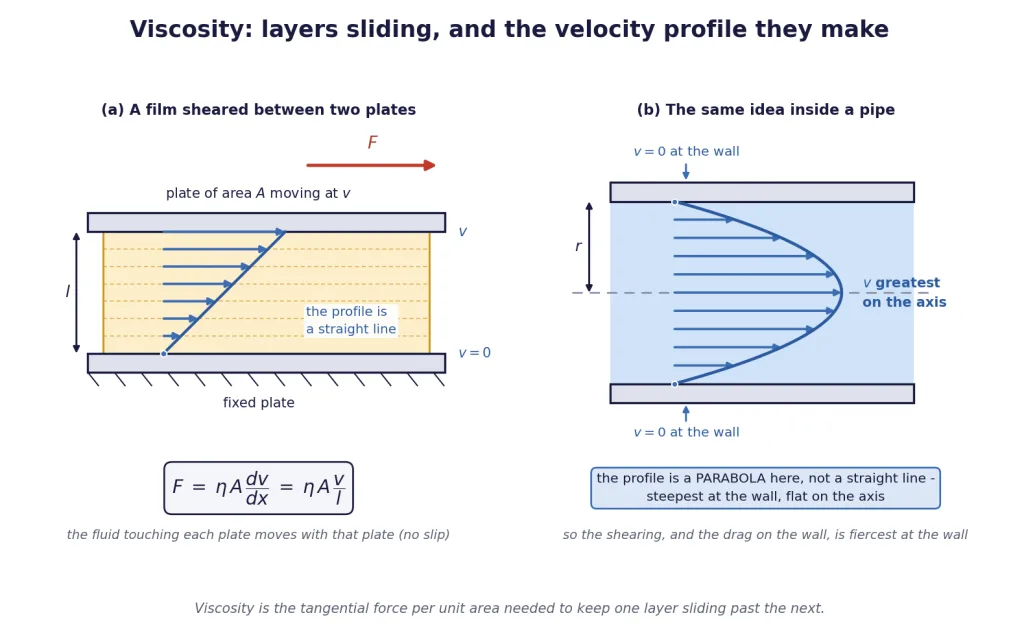
Three things happen, and each one matters.
First, the fluid sticks to both plates. The layer touching the moving plate moves with speed ; the layer touching the fixed plate does not move at all. This is the no-slip condition, and it is an experimental fact, not an assumption we chose for convenience.
Second, the layers in between share out the speed evenly. The speed climbs steadily from at the bottom to at the top, so the velocity gradient is where is measured across the film, perpendicular to the flow.
Third, keeping the top plate moving needs a steady force. Not to accelerate it — it is going at constant speed — but simply to overcome the drag of the layer below. Experiment shows that force is proportional to the area of the plate and to the velocity gradient:
Key Point — the defining equation: (say it "eta") is the coefficient of viscosity of the fluid. Rearranged, it says and that second form is the definition worth memorising: viscosity is shearing stress divided by the RATE of strain, not by the strain.
Its unit, and the one that keeps showing up in old questions
From , the top is a stress in pascal and the bottom is a velocity gradient in . So:
Key Point — unit and dimensions:
- SI unit: pascal second, written Pa s, which is the same thing as N s/m. This unit is also called the poiseuille (Pl).
- CGS unit: the poise (P), and Pa s. So 1 Pa s = 10 poise.
- Dimensions: .
Check the dimensions yourself, because it is a one-mark question in its own right:
[Board Important] The poise is small, so viscosities of thin liquids are often quoted in millipascal second (mPa s), and 1 mPa s Pa s poise. Water at C is almost exactly 1 mPa s, which is a very convenient number to remember.
Real numbers, so the symbol means something
This is our own reference table for the chapter. Every value below is used somewhere in this section or the next.
| Fluid | Temperature (C) | (mPa s) | (Pa s) |
|---|---|---|---|
| Air | 0 | 0.017 | |
| Air | 20 | 0.018 | |
| Air | 40 | 0.019 | |
| Water | 0 | 1.79 | |
| Water | 20 | 1.0 | |
| Water | 100 | 0.28 | |
| Blood | 37 | 2.7 | |
| Machine oil | 16 | 113 | 0.113 |
| Machine oil | 38 | 34 | 0.034 |
| Glycerine | 20 | 830 | 0.83 |
| Honey | room | about 200 | about 0.2 |
Read the table for the pattern, not for the digits. Gases are about a thousand times less viscous than water. Glycerine is about eight hundred times more viscous than water. And blood is nearly three times thicker than water, which is why the heart has to work as hard as it does — a fact Section 8 makes quantitative.
[NEET Important] Two biology-adjacent facts that come up: blood is more viscous than water, and its relative viscosity — its viscosity divided by that of water at the same temperature — stays very nearly constant from C right up to body temperature at C. So warming blood thins it, but it thins in step with water.
Notation
is the coefficient of viscosity throughout this chapter; elsewhere it is often written . They mean the same thing, and mixing the two inside one solution is the only way to get into trouble. Keep for density and for surface tension, exactly as Section 1 set out.
The Velocity Profile, and Why a Fluid Is Not a Solid
Inside a pipe the profile is a parabola
The straight-line profile between two plates is the simplest case. Push a liquid steadily through a pipe and the picture changes shape, though the underlying idea is identical.
The fluid touching the wall does not move — no-slip again. The fluid on the axis, as far from the wall as it can get, moves fastest. In between the speed rises smoothly, and the shape it takes is a parabola:
Key Point — the profile in a pipe: Zero at the wall (), greatest on the axis (). Section 8 derives this properly and shows that the average speed across the pipe is exactly half the axial speed.
Two consequences you can read straight off the picture, and both are examinable.
- The velocity gradient is steepest at the wall and zero on the axis. So the shearing, and therefore the viscous drag, is fiercest right at the wall. That is where a pipe loses its energy.
- Every point on a circle of radius drawn round the axis moves at the same speed. The flow is made of nested cylindrical shells sliding over each other, like the tubes of a collapsible telescope.
[JEE Tip] A question that says "the liquid velocity is maximum at the axis and zero at the walls" is describing laminar flow through a pipe. If the flow were turbulent this whole tidy picture would be gone — Section 8 tells you exactly when that happens.
Viscosity against the shear modulus of the last chapter
Chapter 8 defined the shear modulus for a solid:
Put that next to the definition of :
One word different. One enormous difference in behaviour.
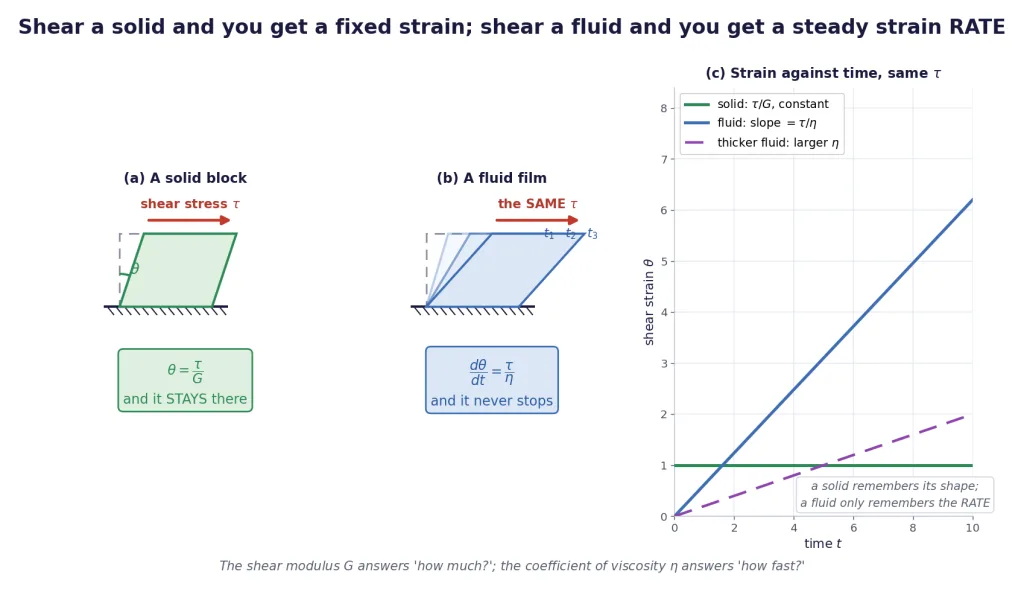
Key Point — the comparison that is worth full marks:
Solid (shear modulus ) Fluid (viscosity ) Apply a shear stress it deforms by a fixed angle it deforms without ever stopping What the modulus divides by the strain the strain rate Result , and it stays there , and it keeps going Remove the stress the solid springs back the fluid simply stops, where it happens to be Units pascal pascal second A solid answers the question "how much?". A fluid answers the question "how fast?".
Here is the same point in numbers. Apply a shear stress of 100 Pa to a rubber block with Pa. It shears by radian and then stops, and it will sit there all day. Apply the same 100 Pa to a film of glycerine with Pa s. It shears at a rate of radian per second, so after ten seconds it has been sheared through 1205 radian and it is still going.
That is the whole reason Section 1 could define a fluid as "a substance that cannot sustain a shearing stress at rest". Viscosity does not contradict that definition — it fills it in. A fluid does resist shear, but only while the shearing is actually happening, and the resistance is proportional to how fast you are doing it, never to how far you have got.
[Board Important] The classic two-mark version: "Distinguish between the shear modulus of a solid and the coefficient of viscosity of a fluid." The full-mark answer is one sentence: the shear modulus relates stress to strain, while viscosity relates stress to the rate of strain, so a solid takes up a definite deformation and a fluid deforms continuously. Say "rate" and you have the mark.
Heat It Up: Liquids Thin, Gases Thicken
This is the favourite one-mark question of the whole topic, and most students can quote the fact and not one of them can explain it. Do both.
Key Point — the two opposite rules:
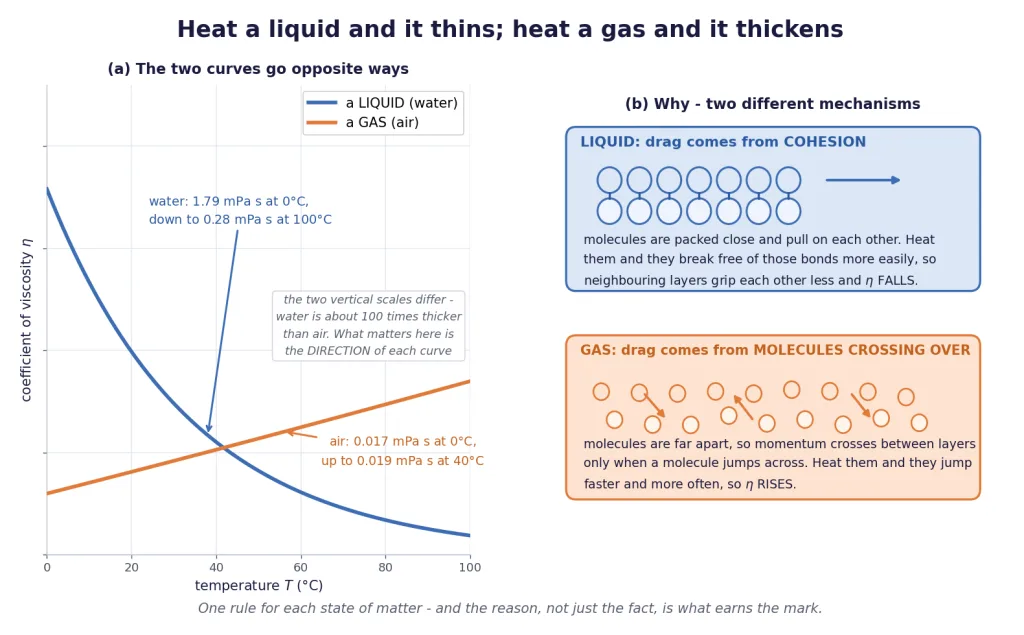
- As temperature rises, the viscosity of a LIQUID falls. Hot honey pours; cold honey does not.
- As temperature rises, the viscosity of a GAS rises. Hot air is stickier than cold air.
They genuinely go opposite ways, and it is because the drag is produced by two completely different mechanisms in the two states.
Why a liquid thins
In a liquid the molecules are packed almost as closely as in a solid, and there are real attractive forces — cohesive forces — between them. When one layer slides over the next, those bonds have to be repeatedly broken and remade, and it is the breaking and remaking that costs the force. Viscosity in a liquid is essentially the strength of that molecular grip.
Now heat the liquid. The molecules get more thermal energy, so they escape their neighbours' pull far more easily. The grip weakens. The layers slide past one another with less resistance, and falls.
And it falls hard, not gently. From the table in the first block, water goes from 1.79 mPa s at C to 0.28 mPa s at C — thinner by a factor of more than six. This is why engine oil is graded for the temperature range it will work over, and why a cold engine is harder to turn over than a warm one.
Why a gas thickens
In a gas the molecules are far apart and hardly attract each other at all, so cohesion cannot be the source of the drag. The drag comes from somewhere else entirely: molecules physically crossing from one layer to the next, carrying their momentum with them.
Picture two layers of gas, one moving faster than the other. A molecule from the fast layer wanders into the slow one and speeds it up a little. A molecule from the slow layer wanders into the fast one and slows it down a little. The net effect of all that wandering is exactly a drag between the layers — momentum is being carried across the boundary, and momentum carried across per second is a force.
Now heat the gas. The molecules move faster, so they cross between layers more often and carry more momentum each time they do. The transfer gets more efficient, so the drag increases, and rises.
Air goes from 0.017 mPa s at C to 0.019 mPa s at C — a real rise, though a gentle one. Kinetic theory predicts for an ideal gas, with in kelvin, which matches that gentle rise nicely.
Key Point — the one-sentence answers to memorise:
- Liquid: heating weakens the cohesive forces between molecules, so the layers grip each other less and falls.
- Gas: heating makes molecules cross between layers faster and more often, so more momentum is transferred and rises.
[JEE Tip] The trap version of this question gives you a mixture or asks about a liquid near its boiling point, where the vapour above it is a gas. Answer for whichever phase is actually being sheared. And watch for the assertion-reason form: "Assertion: the viscosity of a gas increases with temperature. Reason: the cohesive forces between gas molecules increase with temperature." The assertion is true, the reason is false, and the reason is not even the right mechanism.
One more dependence, briefly
Viscosity also depends on pressure, but for liquids the effect is tiny at ordinary pressures and for gases it is very nearly zero over a wide range — which is a genuinely surprising result of kinetic theory. In every problem in this chapter, treat as a function of temperature only, and take the value the question gives you at the temperature it states.
Stokes' Law: the Drag on a Sphere
So far viscosity has been a force between flat layers. Now let a solid object move through a fluid — a ball bearing dropping through oil, a raindrop falling through air, a bacterium swimming in water.
The object drags the layer of fluid touching it along with it (no-slip once more). That layer drags on the next one out, and so on. The result is a retarding force on the object, and unlike the drag you meet in projectile problems, this one is proportional to the speed itself, not to its square.
Getting the form by dimensions
Sir George Stokes worked out the exact answer in 1851 for a sphere moving slowly through a viscous fluid. We can get everything except the numerical factor by pure dimensional reasoning, which is a standard three-mark derivation.
The drag can sensibly depend on only three things: the viscosity of the fluid, the radius of the sphere, and the speed . So write with a dimensionless constant. Now put in dimensions:
Match the powers one at a time:
- Mass: , so .
- Time: , and with this gives .
- Length: , so .
Therefore . Experiment — and Stokes' full calculation — fixes .
Key Point — Stokes' law: The viscous drag on a sphere of radius moving with speed through a fluid of viscosity . It acts opposite to the relative motion, always.
Note what is not in it: the density of the fluid does not appear, and neither does the density of the sphere.
Three readings of that formula, all worth marks:
- . Double the speed, double the drag. This is what makes terminal velocity possible in the next block, and it is completely different from the drag of a cricket ball or a car.
- , not . The drag goes with the radius, not with the cross-sectional area. Students reach for out of habit; do not.
- . Thicker fluid, more drag, in direct proportion.
Where the law is honest, and where it is not
Stokes' law is not a universal truth. It is the answer for slow, steady, streamline flow around a small sphere, with no other walls or spheres nearby. Its own condition for validity is that the Reynolds number of the flow around the sphere — Section 8 defines it properly — should be around 1 or less.
That matters more than it sounds. For a speck of dust or a fog droplet, Stokes' law is superb. For a falling raindrop of ordinary size, it is off by a factor of nearly twenty, and the honest calculation needs a drag proportional to instead. The last block puts real numbers on that, and being able to say when the formula you were taught stops working is a genuinely valuable exam skill.
[NEET Important] Stokes' law holds for a sphere. If a question hands you a cube, a disc or a cylinder and expects , it is being sloppy — but you should still answer with the sphere formula unless the question gives you something else, since no other case is in the syllabus.
Terminal Velocity: When Everything Balances
Setting it up
Drop a small sphere into a deep tank of a viscous liquid and watch what happens.
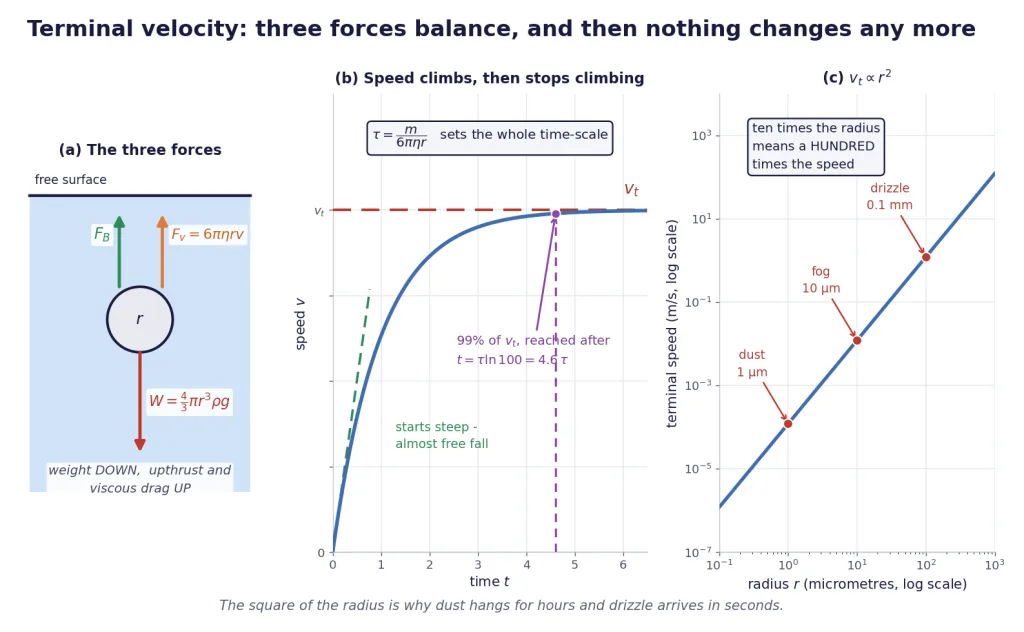
At the instant of release the sphere is at rest, so the viscous drag is zero. Only two forces act: its weight down, and the upthrust of the liquid up. Since the sphere is denser than the liquid, the weight wins and the sphere accelerates downwards.
As it speeds up, the drag grows — and it grows in direct proportion to the speed, because Stokes' law says so. So the net downward force shrinks, and the acceleration shrinks with it.
Eventually the drag has grown just enough to make the three forces add to zero. The acceleration is now zero, so the speed stops changing, so the drag stops growing. The sphere falls the rest of the way at a constant speed. That speed is the terminal velocity .
The derivation, line by line
Let the sphere have radius and density , and let the fluid have density and viscosity . Take downwards as positive.
Weight, acting down through the centre:
Upthrust, acting up, equal to the weight of fluid displaced — this is Archimedes' principle from Section 3, and it applies whether the body is moving or not:
Viscous drag, acting up because the motion is down:
At terminal velocity the net force is zero:
Collect the two volume terms on the left:
and solve for . The cancels, and one power of cancels out of the three:
Key Point — terminal velocity: is the density of the sphere, the density of the fluid. The fluid density is often written in this one formula; it is spelled out here because is badly overloaded elsewhere.
Reading the formula
— the square of the radius. This is the single most important fact in the section and the source of most of its questions. Double the radius and the terminal velocity goes up by four. Make the radius ten times smaller and the terminal velocity is a hundred times smaller.
. Only the difference of the densities matters. Three cases follow immediately:
| Case | What happens |
|---|---|
| positive: the body settles downwards at a steady speed | |
| negative: the body rises at a steady speed — this is a bubble | |
| : the body just hangs there, neutrally buoyant |
. Thicker fluid, slower fall. Drop the same ball bearing into water and into glycerine and it takes about eight hundred times longer in the glycerine.
is in there. On the Moon everything settles more slowly, in exact proportion to the local .
Why the explains the sky
Here is where the formula earns its keep. Take four small spheres falling through air and compute for each, using Pa s and kg/m. The bottom three rows are water drops at 1000 kg/m; the dust speck is a mineral grain, so it gets 2000 kg/m.
| Object | Radius | Stokes | Reynolds number | Is Stokes valid? |
|---|---|---|---|---|
| Fine dust | m | 0.24 mm/s | yes, comfortably | |
| Fog droplet | m | 1.2 cm/s | 0.016 | yes |
| Drizzle | 0.1 mm | 1.2 m/s | 16 | borderline |
| Raindrop | 1 mm | 121 m/s | 16000 | no |
The first three rows tell the story of the atmosphere. A speck of dust one micrometre across settles at a quarter of a millimetre per second, so it takes about three and a half hours to fall three metres. That is why a sunbeam through a window is full of dust that never seems to land, why smoke hangs in still air, and why fog is a cloud sitting on the ground rather than a shower.
The last row is the interesting one, because it is the formula telling you honestly that it has stopped working. Stokes' law predicts 121 m/s for a 1 mm raindrop, which would be lethal. The real answer is about 6.6 m/s — brisk, but survivable — because at that size the flow round the drop is nowhere near streamline and the drag goes as , not as . So the true reason raindrops are not lethal is that drag of some kind sets a terminal velocity; the reason it is 6.6 and not 121 is that the drag law itself changes.
[JEE Tip] If a question gives you a 1 mm raindrop and the viscosity of air and expects from the Stokes formula, give the Stokes answer — that is what is being tested. But if it asks you to comment, say that the Reynolds number is far too large for Stokes' law and the real terminal velocity is far smaller.
How quickly is actually reached?
Almost every problem says "the sphere attains terminal velocity" and moves on. It is worth knowing how good that assumption is.
Before terminal velocity is reached, Newton's second law reads
That is the equation of a quantity approaching a limit exponentially, with a time constant and the speed climbs as .
Because the approach is exponential, the sphere reaches 99% of after . For a 1 mm steel ball in glycerine, works out at 2.1 ms, so 99% of terminal velocity arrives after about 9.6 ms, in which time the ball has fallen about 0.13 mm.
Key Point: For a small sphere in a viscous liquid, terminal velocity is reached so fast — milliseconds, and a fraction of a millimetre of fall — that treating the whole descent as steady is an excellent approximation. That is why the standard experiment tells you to start timing a few centimetres below the surface.
Pulling It Together
Everything in this section, on one page
| Quantity | Formula | Watch out for |
|---|---|---|
| Coefficient of viscosity | stress over rate of strain | |
| Viscous force between layers | is the area of the sliding surface | |
| Unit of | Pa s (the poiseuille); poise Pa s | 1 mPa s = 0.01 poise |
| Dimensions of | not the same as pressure | |
| Profile in a pipe | zero at the wall, greatest on the axis | |
| Stokes' law | to the first power, sphere only | |
| Terminal velocity | squared, density difference | |
| Time constant of the approach | 99% of after | |
| Temperature | liquids: falls. Gases: rises | give the mechanism, not just the fact |
The six traps
Trap 1 — using in Stokes' law or in terminal velocity. Drag goes as ; terminal velocity goes as . Those are different formulas and they do different things. Write both down before you start.
Trap 2 — forgetting the upthrust. The terminal velocity formula contains , not . Dropping the fluid density is the commonest single error here, and it is always an over-estimate.
Trap 3 — reading a diameter as a radius. The formula is in . If the question gives 2 mm as a diameter, is 1 mm — and since , that slip costs you a factor of four.
Trap 4 — saying "viscosity of liquids increases with temperature". It decreases. And a gas is the other way. If you can only remember one, remember that hot honey pours easily and work the rest out from there.
Trap 5 — confusing viscosity with density. Mercury is thirteen times denser than water and yet is less viscous than water at room temperature. Thick and heavy are unrelated properties.
Trap 6 — quoting Stokes' law where it does not apply. Big, fast objects in thin fluids have drag. Say so when the question invites a comment.
The habit that saves marks
Before writing a final answer in this section, run three checks.
- Units. in Pa s. Velocity gradient in . Terminal velocity in m/s — and if you get something like 100 m/s for a small sphere in a liquid, you have almost certainly used a diameter as a radius or forgotten to convert mm to m.
- Direction. Is your positive or negative? Positive means it sinks, negative means it rises. A bubble giving you a negative is not an error — it is the answer.
- Size. Small spheres in thick liquids move at millimetres or centimetres per second. Anything in metres per second should make you check the arithmetic.
[Board Important] The commonest three-mark question in this section is: state Stokes' law, then derive the expression for terminal velocity from the balance of the three forces. Draw the three arrows, name them, write the balance equation, then solve. All four steps carry marks, and starting from the final formula loses three of them.
Solved Examples
Constants used throughout, unless a problem states otherwise: m/s, Pa s, Pa s, Pa s, kg/m, kg/m, kg/m, kg/m, kg/m.
Example 1: Measuring with a sliding block
A metal block of area 0.10 m rests on a table on a film of liquid 0.30 mm thick. A string from the block runs over a light frictionless pulley at the edge of the table and carries a hanging mass of 0.010 kg. When released the block moves at a constant speed of 0.085 m/s. Find the coefficient of viscosity of the liquid.
Solution:
Constant speed means zero net force, so the tension in the string equals the viscous drag on the block, and the tension equals the weight of the hanging mass:
The shearing stress on the film:
The rate of shear strain is the velocity gradient across the film. The block moves at 0.085 m/s and the table is fixed, so the whole speed is used up across 0.30 mm:
Divide:
Final Answer: Pa s, which is about three and a half times as viscous as water.
Takeaway: The pulley is not the physics; the constant speed is. The moment a question says "moves with constant speed" in a viscosity problem, write down "net force is zero" and equate the driving force to .
Example 2: The force needed to drag a plate over a water film
A flat plate of area 0.50 m is pulled horizontally over a layer of water 2.0 mm thick at a steady speed of 5.0 cm/s. Take Pa s. Find (a) the velocity gradient in the film and (b) the force required.
Solution:
(a) The velocity gradient, with the bottom of the film stationary:
(b) The force, straight from the defining equation:
Feel the size of that. Twelve and a half millinewton is the weight of about 1.3 grams. Water really is very slippery — which is exactly what a viscosity of one millipascal second means.
Final Answer: (a) 25 s; (b) N.
Takeaway: Convert the film thickness to metres before you divide. A thickness given in millimetres is where most of the lost marks in this type live: 2.0 mm is m, so the gradient is 25 per second and not 0.025.
Example 3: Units and dimensions, both ways
(a) Show that the dimensional formula of is . (b) The viscosity of glycerine at C is 0.83 Pa s. Express it in poise. (c) The viscosity of water at C is 1.0 mPa s. Express it in poise and in Pa s.
Solution:
(a) Start from the definition and put dimensions on every piece:
A useful cross-check. Pressure has dimensions , so is pressure multiplied by time — which is exactly what the unit "pascal second" says out loud.
(b) The conversion, since 1 poise Pa s:
(c) Water:
Final Answer: (a) ; (b) 8.30 poise; (c) 0.010 poise, or Pa s.
Takeaway: 1 Pa s = 10 poise, so the SI number is always the smaller one. If your conversion made the number smaller going from Pa s to poise, you divided the wrong way round.
Example 4: Terminal velocity of a copper ball, used to measure
A copper ball of radius 2.0 mm falls through a tall jar of oil at C and is observed to descend at a steady 6.5 cm/s. The density of copper is kg/m and that of the oil is kg/m. Find the viscosity of the oil.
Solution:
List what you have, in SI. m, m/s, kg/m, kg/m, m/s.
Rearrange the terminal-velocity formula for :
Substitute, doing the density difference first:
Sanity check against the reference table. Glycerine is 0.83 Pa s and machine oil at C is 0.113 Pa s, so 0.99 Pa s is a thoroughly plausible heavy oil.
Final Answer: Pa s.
Takeaway: This is how viscosity is actually measured in a school laboratory. Drop a ball of known size and density, time it over a measured distance well below the surface, and invert the terminal-velocity formula. The whole experiment is one rearrangement of one equation.
Example 5: Why dust hangs in the air
A speck of dust of radius 1.0 m and density kg/m is released in still air. Take Pa s and kg/m. Find (a) its terminal velocity and (b) how long it takes to settle through a room 3.0 m high.
Solution:
(a) Put the numbers in, with m:
Work the top and the bottom separately. Top: . Bottom: . that is, 0.24 mm per second.
Notice the density of air barely mattered. Subtracting 1.2 from 2000 changed the answer by 0.06%. For a solid falling through air you may drop the upthrust; for anything falling through a liquid you may never drop it.
(b) Terminal velocity is reached almost instantly at this size, so the whole fall is at a steady speed:
Final Answer: (a) 0.24 mm/s; (b) about 3.4 hours to fall 3 m.
Takeaway: This is the answer to "why is a sunbeam full of dust that never lands". It does land — it just takes most of an afternoon, and the least draught in the room sends it back up.
Example 6: How fast does terminal velocity actually arrive?
A steel ball of radius 1.0 mm is dropped from rest into a deep jar of glycerine. Take kg/m, kg/m, Pa s. Find (a) the terminal velocity, (b) the time constant of the approach, (c) the time to reach 99% of and (d) how far the ball has fallen by then.
Solution:
(a) Terminal velocity:
(b) The time constant is the mass divided by the drag coefficient:
(c) The speed climbs as , so 99% is reached when :
(d) The distance is a shade less than , because the ball was slower than for the whole of that interval. Integrating the motion numerically gives
Final Answer: (a) 1.72 cm/s; (b) 2.1 ms; (c) 9.6 ms; (d) about 0.13 mm.
Takeaway: "The ball attains terminal velocity" is not a lazy assumption, it is nearly exact. A tenth of a millimetre of fall and ten milliseconds is all it takes, which is why every falling-sphere experiment tells you to start timing well below the surface.
Example 7: Eight drops become one
Eight identical spherical raindrops, each falling at its terminal velocity, coalesce into a single large drop. Find the terminal velocity of the big drop as a multiple of the original.
Solution:
Conserve volume, not radius. Eight small drops of radius make one drop of radius :
Now use the law. Everything else — the two densities, , — is unchanged, so
The general rule, worth writing on your formula sheet: if identical drops coalesce, , so For that is ; for it is 9; for it is 100.
Final Answer: The big drop falls 4 times as fast.
Takeaway: Two steps, always in this order: cube-root the number to get the radius ratio, then square it to get the speed ratio. Doing it in one jump is how people end up answering 8 instead of 4.
Example 8: An air bubble rising in water
An air bubble of radius 0.050 mm rises through a tall column of water at C. Take kg/m, kg/m, Pa s. Find its terminal velocity, and check that Stokes' law is entitled to be used.
Solution:
Use the formula exactly as it stands, with the density of the body — which here is air — and the density of the water:
The density difference is negative, and that is the whole point:
Read the sign. We took downwards as positive, so a negative means the bubble moves upwards, steadily, at 5.44 mm/s. The viscous drag on it points downwards, because drag always opposes the motion.
Check Stokes' law is allowed. With m, which is comfortably around 1, so the calculation stands.
Final Answer: The bubble rises steadily at 5.4 mm/s.
Takeaway: Do not flip the formula round for a bubble — let the minus sign do the work. Put the body's density first, the fluid's second, and a negative answer is the formula telling you the thing rises.
Example 9: What fraction of the weight is the drag?
A small steel sphere falls at terminal velocity through water. Show that the viscous drag is a fixed fraction of the sphere's weight, and find that fraction. Take kg/m and kg/m.
Solution:
At terminal velocity the three forces balance, so the drag makes up whatever the upthrust does not:
Write both in terms of the volume :
Divide by the weight , and everything geometric cancels:
Put the numbers in:
Final Answer: The drag is 87.2% of the weight, and the upthrust carries the remaining 12.8%. It does not depend on the radius at all.
Takeaway: The radius vanished. Ratios like this one are always worth writing symbolically first — the cancellation tells you something real, namely that every steel sphere in water, whatever its size, shares its weight between drag and upthrust in exactly the same proportion.
Example 10: Solid or fluid, under the same push
A shear stress of 100 Pa is applied to (a) a rubber block of shear modulus Pa and (b) a film of glycerine of viscosity 0.83 Pa s. Describe what each one does, with numbers, over ten seconds.
Solution:
(a) The rubber block. For a solid, stress divided by the shear modulus gives the strain itself: It reaches that angle almost instantly and then stops. After ten seconds it is at rad. After ten hours it is at rad.
(b) The glycerine film. For a fluid, stress divided by the viscosity gives the strain rate:
Integrate over ten seconds: and it is still shearing at 120 rad/s at the end of the tenth second. Remove the stress and it does not spring back — it simply stops where it is.
Final Answer: The rubber takes up a fixed strain of rad; the glycerine shears without limit at 120 rad/s, reaching 1205 rad in ten seconds.
Takeaway: answers "how much"; answers "how fast". That one line is the whole difference between a solid and a fluid, and it is exactly what the definition of a fluid in Section 1 was pointing at.
Example 11: Would Stokes' law survive a raindrop?
A spherical raindrop of radius 1.0 mm falls through air. (a) What terminal velocity does Stokes' law predict? (b) Compute the Reynolds number of that flow and comment. (c) The observed terminal velocity of such a drop is about 6.6 m/s. Explain the discrepancy.
Solution:
(a) Apply the formula as given, with kg/m for water and kg/m for air:
(b) The Reynolds number, with m and the density and viscosity of the air, since air is the fluid being flowed through: Stokes' law needs of order 1. We are sixteen thousand times past that.
(c) So the answer in part (a) is meaningless as physics, though it is the right answer to the question asked. At of ten thousand the flow behind the drop is a turbulent wake, and the drag is no longer proportional to at all — it goes as . Balancing weight against a drag for the same drop gives about 6.6 m/s, which is what is actually measured.
The physics that survives. Whatever the drag law, drag grows with speed, so there is always a speed at which it balances the weight and a terminal velocity exists. That is why rain is survivable. What the drag law decides is the value of that speed.
Final Answer: (a) 121 m/s; (b) , far outside the range of Stokes' law; (c) the real drag goes as , giving about 6.6 m/s.
Takeaway: Every formula has a domain, and saying where a formula fails is worth marks. Quote the Stokes answer when asked for it, then say plainly that the Reynolds number rules it out for a real raindrop.
Example 12: Ranking four spheres
Four spheres are released in the same liquid. Sphere P has radius and density ; Q has radius and density ; R has radius and density ; S has radius and density . The liquid has density . Rank their terminal speeds and say which way each moves.
Solution:
Use the proportionality, since and are the same for all four:
Evaluate the product for each, in units of :
| Sphere | Product | ||
|---|---|---|---|
| P | |||
| Q | |||
| R | |||
| S |
Read off the ranking: , with speeds in the ratio .
Directions. P, Q and R are all denser than the liquid, so all three sink. S has exactly the density of the liquid, so it neither sinks nor rises — it stays where you put it, neutrally buoyant.
Final Answer: ; P, Q and R sink and S hangs motionless.
Takeaway: Never compute four terminal velocities when one product will rank them. Strip the formula down to the two things that are changing — here and the density difference — and multiply.