
Same Chapter, Half the Clock
Section 12 has already taken this chapter apart the long way, and Section 13 pushed it further still — force on a dam by integration, a U-tube oscillating in simple harmonic motion, a tank whose level falls while it drains. If you worked through those, you already know far more fluid mechanics than this section will ever ask of you.
So why a separate corner? Because the skill being tested is different.
One paper hands you a hard problem and the time to think about it. This one hands you a manageable problem and almost no time at all. Physics is 45 questions, and inside a 180-minute paper shared with Chemistry and Biology those 45 deserve roughly 45 minutes. One minute each — and Mechanical Properties of Fluids reliably supplies two or three of them, sometimes four in a year when surface tension and buoyancy both turn up. Every one of those has to be finished in well under a minute, correctly, so the time is banked for the questions that genuinely need it.
What is NOT asked from this chapter
This list matters as much as anything else here, because it tells you what to stop worrying about.
Key Point: Fluids at this level never leaves the core syllabus. No integration of pressure over the face of a dam. No accelerating or rotating container. No buoyancy in a non-inertial frame. No simple harmonic motion of a floating body or of liquid in a U-tube. No efflux from a tank whose cross-section is comparable with the hole. Everything on the paper is a statement you recall, one standard formula you substitute into, a set-up you have drilled, a diagram you read, or one of the two special formats.
Every item on that list belongs to Section 13. If you find yourself writing , you have wandered into the wrong section's version of the question.
The five types, and what each should cost you
| Type | What it looks like | Your budget | The right instinct |
|---|---|---|---|
| 1. Direct recall | "State Pascal's law." "Why is pressure a scalar?" "Unit of surface tension?" | 15-20 s | You either know it or you do not. Never derive a definition. |
| 2. One-step plug-in | , , , , | 25-35 s | Spot the picture, pick the card, substitute once. |
| 3. Standard template | The floating block, the tank with a hole, the capillary tube | 25-40 s | Recognise the set-up. You should already know the shape of the answer. |
| 4. Ranking or comparison | Four tubes, four spheres, four vessels — which is largest? | 20-30 s | Use the proportionality, not the formula. No calculator needed. |
| 5. Assertion-Reason / Column matching | Two special formats, both drilled below | 35-45 s | Judge each statement alone, then judge the link. |
[Important] A diagnostic worth internalising: if a fluids question needs a fifth line of working, you have misread it. You are handed two or three quantities and asked for one more. If your page is filling up, stop and reread the stem — you have almost certainly imported an assumption nobody made, most often that the tank's level is falling or that the atmosphere has to be included.
The / arithmetic
Four marks for a correct answer, minus one for a wrong one, zero for a blank. On a doubtful item the real question is not "can I get this?" but "can I get this in 40 seconds?" If two options survive elimination and 40 seconds have gone, take the better one and move on — a 50-50 guess is worth marks on average. What you must never do is spend three minutes rescuing one mark's worth of doubt in a chapter where the very next question might be a one-liner about whether a soap bubble has one surface or two.
The numbers and symbols this section fixes, now
Throughout this section m/s and Pa. No problem here mixes 10 with 9.8. Those are the round values a speed paper wants, and every question below is designed around them. The material constants used are these and no others:
| Quantity | Value |
|---|---|
| density of water / sea water | 1000 / 1030 kg/m |
| density of mercury | 13600 kg/m |
| density of blood / of air | 1060 / 1.2 kg/m |
| surface tension of water | N/m at 20°C |
| surface tension of soap solution | N/m |
| surface tension of mercury | N/m, angle of contact |
| viscosity of water | Pa s at 20°C |
Working values for this section; a question that supplies its own number always wins.
Key Point — symbol convention:
is density, is surface tension and is the coefficient of viscosity. Elsewhere or often stands for surface tension and for viscosity. is always a radius and always a diameter — never let them blur, because the area squares the error. And is a depth below a free surface wherever it appears in , unless a problem says otherwise.
Say gauge or absolute. Every single time.
This is the trap that costs more marks in this chapter than any other one thing, so it gets its own heading.
Key Point: is the absolute pressure at a depth . is the amount by which it exceeds the atmosphere. A tyre gauge, a manometer and a blood-pressure cuff all read gauge. A question that says "the pressure at the bottom of the tank" almost always wants absolute; a question that says "the pressure recorded by the gauge" wants gauge. Write the word next to your number before you look at the options.
What this section does, and what it does not repeat
We will not rebuild the definition of a fluid or reprove Pascal's law (Section 1), rederive (Section 2), rederive Archimedes' principle (Section 3), rebuild continuity (Section 4), rederive Bernoulli (Section 5) or its applications (Section 6), rederive Stokes' law and terminal velocity (Section 7), rebuild Poiseuille and Reynolds (Section 8), rederive surface tension and surface energy (Section 9), redo the excess-pressure results (Section 10) or rederive capillary rise (Section 11). What you get instead is the same material reorganised for recognition speed:
- The sentences that come back almost verbatim.
- Every formula in the chapter as a recognition table, with a hook for each.
- The biology-adjacent applications this paper reaches for every single year.
- The rankings on pressure, terminal velocity and capillary rise.
- Three ready-made templates, with clean numbers.
- Diagram reading, the two special formats, and the speed habits.
One housekeeping note. Archimedes' principle and floatation, the Venturi meter, Poiseuille's law and Reynolds number all sit outside the rationalised syllabus body text, yet all four are asked, so all four appear in the recognition table below and in the practice set that follows.
The Sentences That Come Back Almost Verbatim
This block is pure recall ammunition. Read it as flashcards, not as prose. Every item here has appeared as a complete question by itself.
Pressure, word for word
Key Point:
- Pressure is the normal force per unit area, . SI unit N/m, given the name pascal (Pa). Dimensional formula — the same as stress.
- Pressure is a scalar. Force is a vector, but at a point inside a fluid the pressure is the same in every direction — there is no direction attached to it. What has a direction is the thrust, , and its direction is set by the orientation of the surface, not by the pressure.
- A fluid at rest always pushes normally on any surface it touches. If it had a tangential component, that would be a shear stress, and a fluid cannot sustain one at rest — it would simply flow.
Say the scalar answer as one sentence: the pressure at a point is the same in all directions, so there is no unique direction to attach to it. Anything offering "because force and area are both scalars" is nonsense and is the standard distractor.
Pascal's law, word for word
Key Point: A change in the pressure applied to an enclosed fluid is transmitted undiminished to every point of the fluid and to the walls of the containing vessel. The two words that carry the marks are enclosed and undiminished. From it: a hydraulic lift has mechanical advantage , and it multiplies force, not work — the small piston travels far and the large piston barely moves, and .
Archimedes' principle, word for word
Key Point: A body wholly or partly immersed in a fluid is buoyed up by a force equal to the weight of the fluid it displaces. So , acting vertically upward through the centre of buoyancy, which is the centroid of the displaced volume — not the centre of gravity of the body. The law of floatation follows: a floating body displaces its own weight of fluid, so the submerged fraction is exactly .
Two one-line consequences asked directly. The upthrust does not depend on the depth (for a fully submerged body in a uniform fluid) — push it deeper and the pressure on the top and the bottom both rise by the same amount, so the difference is unchanged. And the upthrust does not depend on what the body is made of — only on the volume it displaces.
Why a fluid speeds up where a pipe narrows
This one is set almost every year, and the popular answer is wrong.
Key Point: The fluid speeds up because of conservation of mass, not because of Bernoulli. The same volume of an incompressible liquid must pass every cross-section in every second, so must stay constant and a smaller forces a larger . That is the equation of continuity, . Bernoulli then tells you the consequence — that the pressure at the narrow section is lower — and the falling pressure is what actually accelerates the fluid. Continuity says how fast; Bernoulli says at what pressure.
If an option says "it speeds up because the pressure there is lower", it has the causal chain backwards for the purpose of this question. Continuity is the answer.
Why viscosity falls for a liquid and rises for a gas
The single most-tested one-liner in the viscosity part of the chapter, and it has a real mechanism behind it.
Key Point:
- In a liquid, the resistance between layers comes from intermolecular cohesive forces. Heat the liquid and the molecules move further apart and shake free of one another more easily, so the cohesion weakens and falls. Honey off the shelf against honey out of a warm pan.
- In a gas, the molecules are already far apart and cohesion is irrelevant. The resistance comes from momentum transport — fast molecules wander from a fast layer into a slow one and speed it up, and slow ones wander the other way. Heat the gas and the molecules cross between layers more often, so more momentum is carried across and rises.
- Roughly, falls about like and rises about like .
Liquids: cohesion, so hotter means thinner. Gases: momentum exchange, so hotter means thicker.
Why a soap bubble has twice the excess pressure of a drop
Key Point: A soap bubble is a thin film of liquid with air on both sides, so it has two liquid-air surfaces, an inner one and an outer one, and each contributes . A liquid drop has only one surface. Hence An air cavity inside a liquid — a bubble of gas under water — also has just one liquid surface, so it goes with the drop, not with the soap bubble. And the excess pressure is always on the concave side of a curved surface.
The factor of two is a film effect, not a bubble effect. Whenever you see "soap", ask whether the thing described is a film with two faces or a droplet with one.
The rest of the recall list
Key Point:
- Pressure at a depth depends on the depth, the density and , and on nothing else — not on the shape of the vessel and not on how much liquid it holds. That is the hydrostatic paradox.
- Points at the same level in a connected fluid at rest are at the same pressure. This is the whole principle of a U-tube, a spirit level and a water-level pipe.
- One atmosphere is 76 cm of mercury, which is Pa. A water barometer would need a tube over 10 m tall, because water is 13.6 times lighter.
- Two streamlines can never cross. If they did, a particle arriving at the crossing would have two velocities at once.
- Bernoulli's equation holds along a single streamline, for steady, incompressible, non-viscous flow. Each of its three terms has the units of pressure.
- Torricelli: the speed of efflux from a small hole a depth below the surface is — exactly the speed of a body that has fallen freely through .
- Stokes' law is for a small sphere moving slowly through a fluid — the drag is proportional to the first power of the speed and of the radius.
- Terminal velocity goes as , and it can be negative, which just means the body rises — as an air bubble does in water.
- Poiseuille: , the fourth power of the radius. Halve the radius and the flow falls to a sixteenth.
- Reynolds number is dimensionless. Below about 1000 the flow is laminar; above about 2000 it is turbulent.
- Surface tension , in N/m, is numerically equal to the surface energy in J/m — they are one quantity with two names. For a film, counts twice.
- Surface tension falls as the temperature rises and vanishes at the critical temperature. Soap lowers it; dissolved salt raises it slightly.
- The angle of contact is measured inside the liquid, between the solid surface and the tangent to the liquid surface at the point of contact. Acute means wetting and a concave meniscus; obtuse means non-wetting and a convex one.
- Capillary rise — Jurin's law, . For mercury is negative and the liquid is depressed.
- In a tube too short for the calculated rise the liquid does not overflow. The meniscus flattens instead, its radius of curvature adjusts, and the product stays constant.
The always-true / never-true table
Speed comes from knowing which sentences are safe.
| Statement | Verdict |
|---|---|
| Pressure is a scalar | Always |
| A fluid at rest exerts a normal force on any surface it touches | Always |
| The pressure at the base of a vessel depends on its shape | Never |
| A hydraulic lift multiplies force but not work | Always |
| The upthrust on a fully submerged body grows with depth | Never |
| A floating body displaces its own weight of fluid | Always |
| A fluid speeds up in a narrow pipe because of continuity | Always |
| Bernoulli's equation may be applied between any two points in a flow | Never — one streamline only |
| The viscosity of a gas falls as the temperature rises | Never — it rises |
| Terminal velocity is proportional to the radius | Never — to its square |
| Reynolds number has the unit /s | Never — it is dimensionless |
| Surface energy and surface tension are numerically equal | Always |
| A soap bubble has twice the excess pressure of a drop of the same radius | Always |
| An air cavity in water has excess pressure | Never — it is |
| Water rises higher in a narrower capillary tube | Always |
| Capillary rise is independent of the length of the tube | Always |
[Important] The four most reused distractors in this chapter are "a fluid speeds up in a narrow pipe because the pressure is lower there", "the upthrust increases with depth", "the excess pressure inside an air bubble in water is " and "the viscosity of a gas falls as it is heated". Each appears somewhere almost every year, and each is worth four marks in under fifteen seconds.
The Recognition Table, With a Hook for Each
Sections 1 to 11 derived all of these. Your job here is different: see the situation, name the formula, substitute. No derivation, ever.
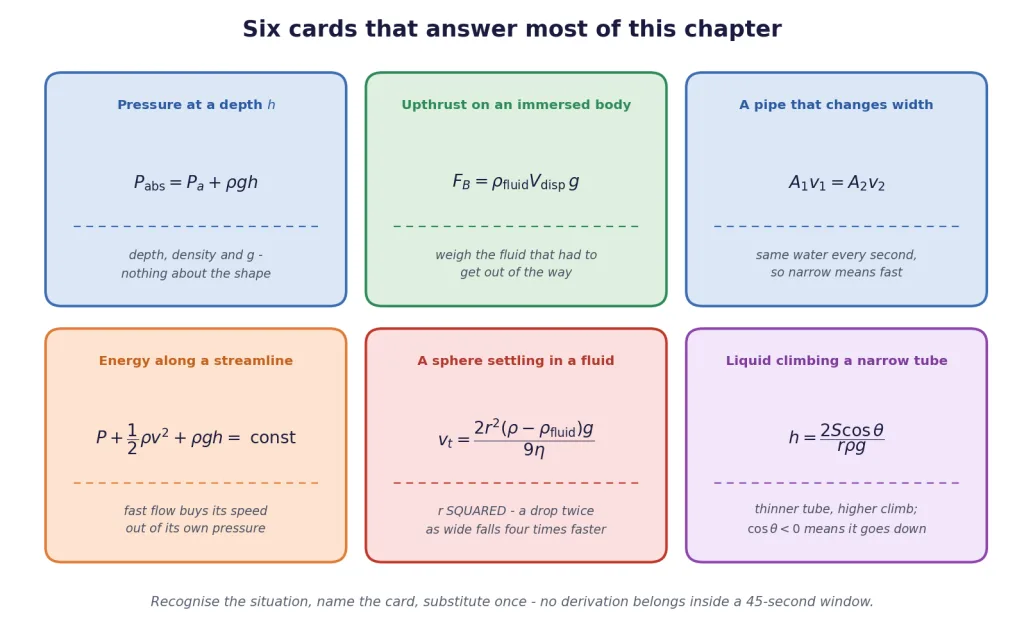
The twenty you must know cold
| # | Situation | Formula | Memory hook |
|---|---|---|---|
| 1 | pressure from a thrust | normal force over the area it is spread across | |
| 2 | pressure at a depth | depth, density and — shape is irrelevant | |
| 3 | gauge pressure | what the instrument actually shows | |
| 4 | hydraulic lift | force multiplied, work never | |
| 5 | upthrust | weigh the fluid that had to move aside | |
| 6 | apparent weight | the loss of weight is the upthrust | |
| 7 | floating fraction | denser body, deeper sit | |
| 8 | continuity | same litres per second everywhere | |
| 9 | volume flow rate | area times speed, m/s | |
| 10 | Bernoulli | const | three pressures that add to a constant |
| 11 | speed of efflux | as if it had simply fallen through | |
| 12 | range of the jet | largest at mid-depth, where | |
| 13 | Venturi meter | a pressure drop read as a speed; this is the shortcut form — the full one carries where stands, and dropping that is the commonest manometer error, worth 7.9% in and 3.9% in | |
| 14 | viscous force | area times velocity gradient | |
| 15 | Stokes drag | first power of , first power of | |
| 16 | terminal velocity | squared, and the sign tells you up or down | |
| 17 | Poiseuille's law | fourth power of the radius | |
| 18 | Reynolds number | pure number; 1000 laminar, 2000 turbulent | |
| 19 | surface tension | , and | force per length, energy per area, same number |
| 20 | capillary rise | thinner tube, higher climb |
Three more that carry most of the surface-tension marks, and are worth a card of their own:
| Situation | Formula | Note |
|---|---|---|
| excess pressure, drop or cavity | one surface | |
| excess pressure, soap bubble | two surfaces | |
| drops of radius merge into one of radius | , energy released | conserve volume, then compare areas |
Numbers 5, 6, 7, 13, 17 and 18 sit outside the rationalised syllabus body text, but they are asked, so they belong on this card.
Typical values worth carrying in your head
| Substance | Density (kg/m) | Viscosity (Pa s) | Surface tension (N/m) |
|---|---|---|---|
| Water at 20°C | 1000 | ||
| Sea water | 1030 | — | — |
| Blood | 1060 | about | — |
| Mercury | 13600 | ||
| Glycerine | 1260 | ||
| Soap solution | about 1000 | — | |
| Air at 20°C | — |
Working values at ordinary temperature; individual samples vary, and a question that supplies its own number always wins.
Three patterns hide in that table and all three are examined. Mercury is 13.6 times denser than water, which is why a mercury barometer is 76 cm tall and a water one would be over 10 m. Glycerine is roughly 800 times as viscous as water, which is why every terminal-velocity experiment in the book uses it. And air is about 800 times less dense than water but only about 55 times less viscous, which is why for air in a pipe is so much smaller than for water at the same speed.
The ratio shortcuts, which are faster than substituting
Most questions in this chapter compare two situations rather than asking for one absolute number. Learn the proportionalities and you never touch a calculator.
Worked in one line each.
- A pipe's diameter is halved: the area falls to a quarter, so the speed goes up four times.
- The depth of the hole is quadrupled: the efflux speed doubles, since .
- A drop's radius is doubled: its terminal velocity goes up four times.
- An artery's radius falls by 10%: the flow falls to , so a third of it is gone. This one shocks people every time, and it is exactly why it is set.
- A capillary tube's radius is halved: the rise doubles, but the mass raised — which goes as — halves.
- A bubble's radius is halved: the excess pressure inside it doubles.
Key Point: The single most examined confusion in this chapter is the radius against diameter slip. In continuity the answer changes by 4; in Poiseuille it changes by 16. Write , in numbers, as your very first line whenever a diameter is quoted. It costs two seconds.
[Important] Two units get asked directly and both are easy marks. Surface tension is in N/m, and surface energy is in J/m — and N/m J/m exactly, which is why one number serves both. And the coefficient of viscosity is in Pa s, with dimensional formula ; in the older system poise Pa s, so water at 20°C is poise, that is one centipoise.
Fluids in the Body and in the Plant
Here is the thing about this chapter: of every chapter in Class 11 Physics, this is the one that reaches furthest into biology — and a paper that spends two thirds of its length on living things is not going to let that pass. Blood is a viscous liquid pumped through branching elastic pipes; breathing is surface tension against ; a tree is a capillary problem with an evaporating top. Expect at least one of the questions this chapter gives you to be wearing a lab coat.
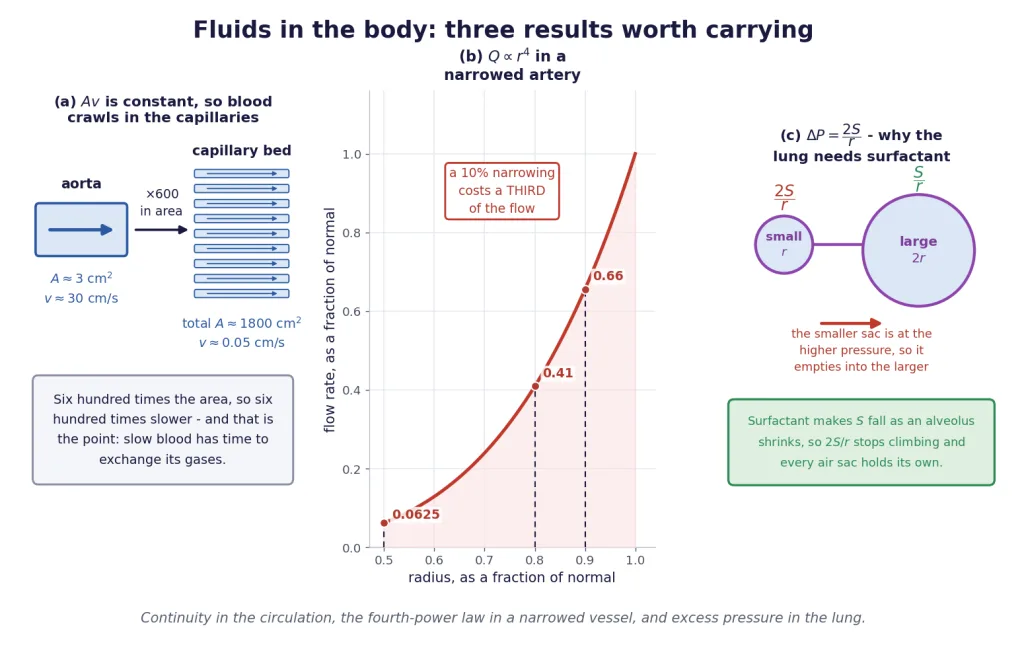
Blood flow and the equation of continuity
The aorta is a single tube of cross-section about 3 cm and blood leaves the heart along it at about 30 cm/s. By the time that blood reaches the capillaries it is crawling at about 0.05 cm/s — six hundred times slower.
Nothing mysterious has happened. Continuity says is the same at every stage, so if the speed has fallen by a factor of 600, the total cross-sectional area of all the capillaries taken together must be 600 times the area of the aorta, which is about 1800 cm. An individual capillary is microscopic; there are billions of them, and added up they dwarf the pipe that feeds them.
Key Point: In the circulation, is conserved and the capillary bed is slow because it is collectively enormous, not because it is individually narrow. The slowness is the whole point — blood has to linger long enough to hand over its oxygen. The commonest wrong answer is "because a capillary has a small radius", which would make the blood in it go faster, not slower, if the flow through one capillary were fixed.
The cardiac output falls straight out of the same line: cm/s, which is about 5.4 litres a minute. That is a real number for a resting adult, and it comes from one multiplication.
Blood pressure, and why it is quoted in millimetres of mercury
A blood pressure reading of "120 over 80" means the systolic pressure is the pressure exerted by a mercury column 120 mm tall and the diastolic by one 80 mm tall. Both are gauge pressures — the cuff is open to the atmosphere on its other side, so what it can possibly report is the excess over atmospheric.
so the absolute pressure in the artery at that moment is about Pa.
Why mercury? Because the instrument is a manometer, and what a manometer measures directly is a height. Use water and the same pressure would need a column m tall — you would need a two-metre tube strapped to the patient. Mercury is 13.6 times denser, so the same pressure is 13.6 times shorter, and 120 mm fits neatly on a desk instrument.
[Important] Two easy marks live here. A blood-pressure reading is a gauge pressure, and it is a height converted to a pressure by . And the same explains why blood pressure measured at the ankle of a standing person is much higher than at the heart, and why the reading is taken with the cuff level with the heart.
Arterial narrowing and the fourth power
Poiseuille's law is the reason a cardiologist worries about a small deposit.
Reduce the radius of a vessel by just 10%, to , and at the same driving pressure
A tenth off the radius takes a third of the flow. Take the radius down to half and the flow falls to — about 6% of normal. Turned round: to push the original flow through the narrowed vessel the heart must raise the pressure difference by the same factor, times for a 10% narrowing and 16 times for a halved radius. That is what "the heart is working against a stenosis" means arithmetically.
Key Point: Whenever a question narrows a vessel and asks about the flow, it is a fourth-power question. Whenever it narrows a vessel and asks about the speed at that point, it is a continuity question and the power is 2. Read which one is being asked — the two answers differ by a factor of .
Surfactant in the lungs, and why alveoli need it
The lung is roughly 300 million tiny spherical air sacs, the alveoli, each lined with a film of fluid. A curved liquid surface means an excess pressure, and for a fluid-lined air cavity that is — one surface, so a factor of 2, not 4.
Now put two alveoli of different sizes side by side, connected through the airways, with the same surface tension in the lining of each. A small one of radius sits at excess pressure ; a large one of radius sits at only . The small one is at the higher pressure, so air flows from small to large — the small alveoli would empty themselves into the big ones and collapse. That would be fatal, and in the disease of premature infants where surfactant is missing it very nearly is.
The escape is that the surface tension is not the same in each. The lung secretes a surfactant, a substance that lowers the surface tension of the lining fluid and, crucially, lowers it more when the film is compressed into a smaller area. So as an alveolus shrinks, its falls, and stops climbing. Every sac holds its own against its neighbours.
Two numbers for the record. With a clean water lining, N/m and an alveolus of radius mm would need an excess pressure of Pa to stay open. With surfactant bringing down to about N/m, that becomes 400 Pa. Surfactant reduces the work of breathing and stabilises the small sacs; both halves of that sentence are examinable.
Capillarity in plants, and the limits of it
Water reaches the top of a tree through the xylem, a bundle of very narrow tubes. Capillarity clearly plays a part — but do the arithmetic before you believe it does all the work. For a xylem vessel of radius 20 micrometres, with water wetting it completely,
Under a metre. Capillarity alone gets water to the height of a shrub. What carries it to the top of a hundred-metre tree is transpiration pull: water evaporating from the leaves leaves behind a concave meniscus in each tiny pore, the excess pressure across that curved surface puts the whole continuous column of water below it under tension, and the cohesion of water is strong enough to let that column be pulled up rather than pushed. Capillarity supplies the curved surface; evaporation supplies the driving force; cohesion supplies the rope.
Key Point: Capillary rise alone cannot explain a tall tree — the numbers are out by two orders of magnitude. The mechanism is transpiration pull acting through a continuous cohesive column, and the same curvature that gives capillary rise is what generates the tension. A question that offers "capillary action alone raises water to the top of the tallest trees" is offering a distractor.
Insects on the surface, and the rest of the everyday list
A water strider stands on the surface of a pond without breaking it. It is not floating in the Archimedes sense — it is supported by the vertical component of the surface-tension force along the contact line where its legs meet the water. Take six legs, each in contact along about 3.0 mm, with N/m:
which supports a mass of about 0.13 g — comfortably more than the insect weighs. Its legs are also waxy, which makes the angle of contact obtuse and pushes the meniscus the helpful way. Drop a little detergent in the pond and collapses; so does the insect.
The rest of the biology-adjacent list, one line each, because each has been a question:
| Observation | The physics |
|---|---|
| Blood in the capillaries crawls | continuity: the bed's total area is enormous |
| A blocked artery starves the tissue | Poiseuille: |
| Blood pressure is read in mm of mercury | a manometer measures a height; mercury keeps it short |
| Premature infants need surfactant | would collapse small alveoli |
| Water reaches the top of a tree | transpiration pull, with capillarity supplying the meniscus |
| An insect walks on water | along the contact line, plus a non-wetting waxy leg |
| A drip needs to be held above the patient | must exceed the venous pressure |
| A syringe injects when you press the plunger | Pascal's law, then Poiseuille through the needle |
The Rankings and Comparisons That Recur Every Year
Of all the fluids items on this paper, the ranking family is the most predictable. Three orderings answer nearly all of them, and none of them needs a calculator.
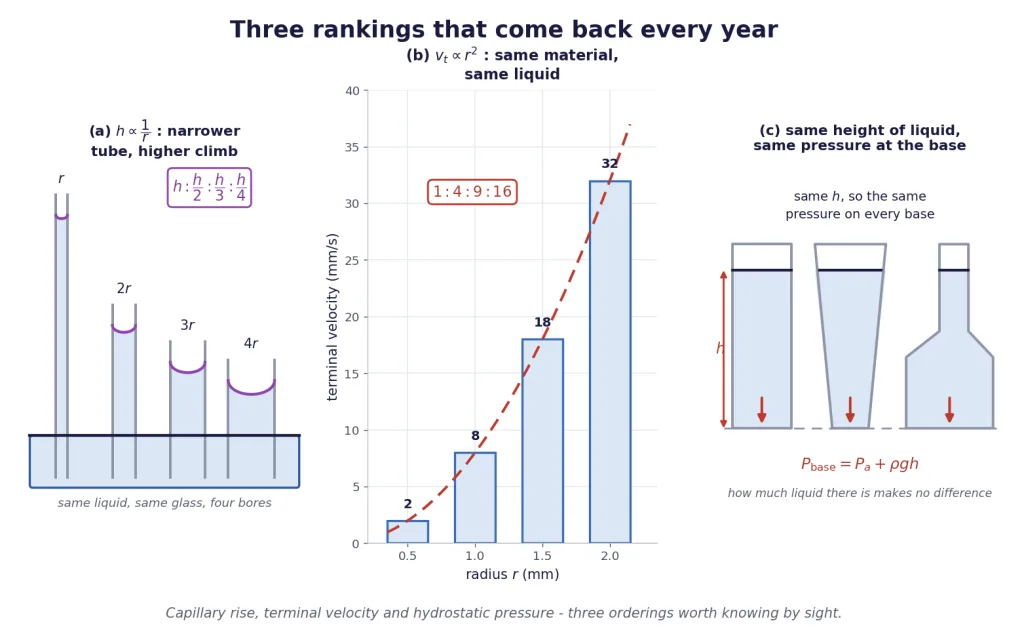
Ranking 1 — pressure, by depth alone
Take vessels of any shapes you like, fill them all with the same liquid to the same height, and ask which base is under the greatest pressure. Since and is common,
That is the hydrostatic paradox, and it is set as a question every couple of years. A conical vessel that flares outward, a cylinder, and a narrow-necked flask holding a tenth as much liquid all press equally hard on their bases, because pressure counts height, not volume.
Two follow-ups that separate the students who understand it from the ones who memorised it:
- The force on the base is not the same unless the base areas are equal, because .
- The force on the base need not equal the weight of the liquid. In a flaring vessel it is less; in a narrow-necked one it is more, sometimes far more. The rest is taken by the slanting walls.
And within one vessel: pressure grows with depth and does not vary sideways, so two points at the same level in a connected body of liquid at rest are at the same pressure whatever route the liquid takes between them.
Ranking 2 — terminal velocity, by
Four spheres of the same material are dropped into the same liquid. Since
everything except is common, so the biggest sphere is fastest, and by the square. Radii in the ratio give terminal velocities in the ratio .
| Radius | Terminal velocity, taking the smallest as 1 |
|---|---|
| 1 | |
| 4 | |
| 9 | |
| 16 |
Same material, same liquid, so simply tracks .
Three variants, all set:
- Same size, different materials. Now , so the denser body is faster. If the answer is negative, which means the body rises steadily — an air bubble in water is the standard example, and the "viscous force acts downward on it" follow-up catches people.
- Same body, different liquids. Now , and the viscosity usually dominates. A ball that takes a second to fall through water takes minutes through glycerine.
- small drops coalesce into one. Conserve volume: , so goes up by . Eight drops into one gives times the terminal velocity.
Ranking 3 — capillary rise, by
Four clean glass tubes of different bores stand in the same liquid. Since and everything but is common,
The narrowest tube gives the highest column — Jurin's law. Bores in the ratio give rises in the ratio .
But here is the twist that is the actual question about half the time. The mass of liquid raised does not follow the rise.
The narrow tube lifts the liquid higher but lifts less of it. Double the bore and the column is half as tall and twice as heavy. That is not a coincidence: the weight supported is just the surface-tension force round the rim, , and the rim gets longer as the tube widens.
| Quantity | How it scales with the bore |
|---|---|
| height of rise | |
| mass of liquid raised | |
| force supporting the column | |
| pressure just below the meniscus |
The three comparisons that actually get set
(a) Same tank, two different holes. Efflux speed goes as , so the deeper hole squirts faster. But the range goes as , which is symmetric about mid-depth: two holes equidistant from the middle give the same range, and the maximum range is itself, achieved by the hole at .
(b) Same liquid, drop against bubble against cavity. All three carry , but with different numerators.
| Object | Surfaces | Excess pressure |
|---|---|---|
| liquid drop | 1 | |
| air cavity in a liquid | 1 | |
| soap bubble in air | 2 |
Connect two soap bubbles of different sizes and the smaller one, at the higher pressure, empties into the larger. The radius of curvature of the film between two joined bubbles of radii and (with ) is , and it bulges into the larger bubble.
(c) Same pipe network, series against parallel. Viscous resistance is and combines exactly as electrical resistance does. In series the flow rate is the same through both tubes and the pressure drops add; in parallel the pressure drop is the same across both and the flows add. The narrow tube in a series pair takes almost the whole pressure drop, because .
Where the ranking questions go wrong
- Reading "which stretches highest" as "which lifts the most liquid". They are opposite orderings. Height goes as , mass as .
- Ranking terminal velocities when the spheres are not of the same material. Then is in play too, and a small dense sphere can beat a large light one.
- Assuming the base with the largest force is under the largest pressure. , and the areas may differ.
- Using the radius when a diameter was quoted. Half of every wrong ranking in this chapter traces back to this.
[Important] "Which is largest?" questions are answered by writing down the proportionality and nothing else. If you have started substituting numbers into a ranking question, you are spending forty seconds on something worth ten.
The Three Templates
Three set-ups cover the overwhelming majority of fluids numericals on this paper. Recognise which one you are looking at, write the boxed line, substitute.
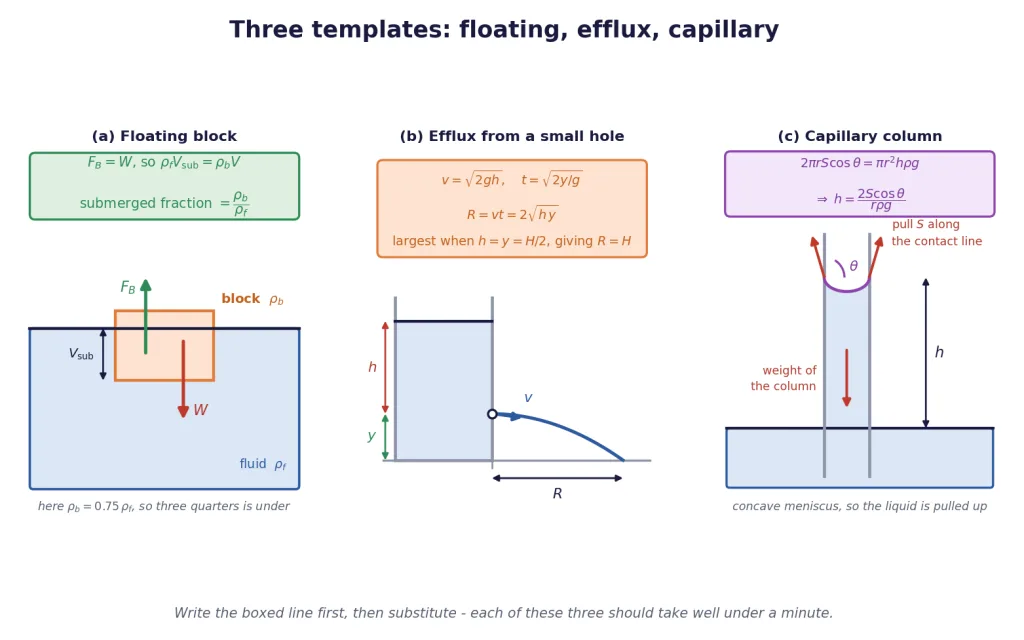
Template 1 — The floating body
Everything starts from one equation: for a body floating in equilibrium, the upthrust equals the weight.
The clean numbers. A rectangular wooden block cm by cm by cm, of density 750 kg/m, floats in water with the 20 cm dimension vertical.
So 15 cm of the block is under water and 5 cm stands proud. Two by-products come free once those lines are on the page. The extra load it can carry before it goes right under is the mass of the remaining displaceable water, kg. And in a denser liquid it rides higher: in brine of density 1250 kg/m the submerged fraction is , so only 12 cm is under.
Key Point: Write these three lines in this order every time: volume, then floating fraction, then whatever was asked. Doing them out of order is how people end up dividing the densities the wrong way up and reporting a fraction bigger than one — which is your own warning bell, because a floating body cannot displace more than its own volume.
Template 2 — The tank with a hole
with the depth of the hole below the free surface and its height above the ground. Note that , the total depth of liquid, whenever the tank stands on the ground it drains onto.
The clean numbers. An open tank holds water 5.0 m deep, and a small hole is opened in the side 1.8 m above the base.
Three by-products. The maximum range comes from the hole at mid-depth, m, and equals m. A second hole at a depth of 1.8 m (the mirror image of this one) gives m/s, s and the same range of 4.8 m. And the discharge through a hole of area 1.0 cm is m/s, that is 0.80 litres per second.
Three things to settle before you substitute, because each is worth a mark.
- is measured from the free surface, not from the top of the tank. If the tank is not full, they are different.
- The pressure at the hole is atmospheric, because the jet emerges into the air. That is why cancels and depends only on . If the tank is closed with compressed air above the liquid, it does not cancel and .
- This assumes the hole is small, so the level falls negligibly during the flight of the jet. Everything on this paper says "a small hole" for exactly that reason.
Template 3 — The capillary tube
read as: the surface-tension pull round the rim carries the weight of the raised column.
The clean numbers. A capillary tube of radius mm stands in a liquid of surface tension N/m and density 1000 kg/m that wets glass completely, so and .
Check it the other way round, which is what the marking scheme really wants to see: the upward pull is N, and the weight of the column is N. They agree, so the mass raised is about 14 mg.
Three by-products. In a tube of a third the radius the rise is three times as much, 15 cm. In mercury, with so , and kg/m, the same mm tube gives cm — a depression of 1.7 cm. And if the tube is only 3.0 cm long above the surface, the liquid does not spill: the meniscus flattens until matches, giving mm and a new angle of contact of about .
The template traps, priced
| The slip | What it does to your answer |
|---|---|
| using the diameter as the radius | continuity out by 4, Poiseuille out by 16, capillary rise out by 2 |
| leaving an area in cm | out by a factor of |
| measuring from the top of the tank rather than the free surface | wrong , wrong range |
| forgetting is negative for mercury | a depression reported as a rise |
| using for an air cavity in a liquid | out by a factor of 2 |
| adding to an efflux calculation | it cancels; the answer is unchanged, but the time is gone |
| quoting a gauge pressure where absolute was wanted | out by Pa |
[Important] The single most costly slip across all three templates is the radius against diameter one, and it is easy to defend against: write as your first line, in numbers, before you square anything or raise anything to the fourth. It costs two seconds and it is the difference between 8.0 m/s and 2.0 m/s.
Diagrams, the Two Special Formats, and Speed Habits
Four tasks live in this block. All four are mechanical once you know the drill, and none of them is really physics.
Reading the diagrams this chapter draws
Fluids is the most drawable chapter in the book, so a fair fraction of its questions arrive as a picture rather than a sentence. Five readings cover almost all of them.
| What you are shown | What it tells you |
|---|---|
| Streamlines crowding together | the flow is faster there, and by Bernoulli the pressure is lower |
| A converging pipe | continuity: the speed rises as ; Bernoulli: the pressure falls |
| A U-tube with two liquids | equate pressures at the lowest common level of the same liquid, never at the interface of two different ones unless that is the common level |
| A meniscus | concave means wetting, , the liquid rises; convex means non-wetting, , the liquid is depressed |
| A manometer limb standing higher on the open side | the gas is at a higher pressure than the atmosphere, so the gauge pressure is positive |
Four fast graph readings that follow, each set in its own right:
- Pressure against depth is a straight line of slope , with intercept if you are plotting absolute pressure and through the origin if you are plotting gauge. Two liquids in the same tube give a kink where the density changes, and the steeper section is the denser liquid.
- Speed against time for a body falling through a viscous fluid rises and flattens to the terminal velocity. It never overshoots. If a graph shows a maximum and then a fall, it is describing something else.
- The velocity profile in a pipe under laminar flow is a parabola — zero at the wall, maximum on the axis, and the mean speed is exactly half the maximum.
- Terminal velocity against radius is a parabola through the origin, not a straight line. A straight line would be Stokes' drag against speed, which is a different graph.
Key Point: When a diagram shows a floating body, the standard first move is to draw exactly two arrows: the weight down through the centre of gravity and the upthrust up through the centre of buoyancy, which is the centroid of the submerged part and generally sits lower. For a body in equilibrium they are equal and along the same vertical line.
Assertion-Reason: the four codes
You are given an Assertion (A) and a Reason (R), and asked to choose:
| Code | Meaning |
|---|---|
| (a) | Both A and R are true, and R is the correct explanation of A |
| (b) | Both A and R are true, but R is not the correct explanation of A |
| (c) | A is true but R is false |
| (d) | A is false but R is true |
Read the option list before you start — the order of these four is not fixed between papers, and picking "option (a)" from memory when the paper has shuffled them is a self-inflicted wound.
Key Point: Three separate judgements, in this order, and never let one influence the next:
- Cover R. Is A true, on its own?
- Cover A. Is R true, on its own?
- Only if both are true: does R actually explain A, or is it merely another true fact about the same topic?
Step 3 is where the marks are, and it is the step people rush. "Both true" is not enough. Ask yourself: if R were false, would A stop being true? If yes, R explains A. If A would survive without R, the answer is (b).
The trap this format is built around in this chapter is the pair of true statements about a narrowing pipe, because the popular reason and the correct reason are different true sentences.
Worked, four times.
Item 1. A: Water flows faster through the narrow part of a pipe. R: The pressure of a fluid is lower where it is moving faster. A alone: true. R alone: true — that is Bernoulli. But does R explain A? No. The speeding up is forced by conservation of mass, and Bernoulli then reports what the pressure does as a consequence. R is a true fact about the same situation, not the reason for A. Both true, R does not explain A.
Item 2. A: Water flows faster through the narrow part of a pipe. R: For an incompressible liquid in steady flow, the same volume must cross every section in every second. A alone: true. R alone: true. And this time R is exactly why A holds. Both true, R explains A. Items 1 and 2 have the same assertion and different reasons, and completely different answers. That is precisely how the format is built.
Item 3. A: The buoyant force on a fully submerged body does not change as it is pushed deeper into the same liquid. R: The upthrust equals the weight of fluid displaced, which depends only on the volume displaced and the density of the fluid. A alone: true. R alone: true. R explains A directly — nothing in it mentions depth. Both true, R explains A.
Item 4. A: The excess pressure inside an air bubble in water is . R: A soap bubble has two liquid surfaces. A alone: false — an air cavity in a liquid has one liquid surface, so . R alone: true. A false, R true — and notice how a perfectly correct R makes the false A feel plausible. That is the whole design.
Column matching: anchor and kill
You are given Column I (four entries, A to D) and Column II (four results, i to iv), and four codes that pair them up.
Key Point: Never work out all four pairings. Find the one you are surest of, use it to eliminate every code that contradicts it, then check whichever single pairing still separates the survivors. Two confident pairings almost always settle a four-option matching question.
The drill:
- Scan Column II for the odd one out — the only entry that is dimensionless, the only one with a fourth power, the only one carrying a square root, the only one with a .
- Anchor on that pairing and strike out every code that disagrees.
- Count the survivors. If one remains, stop. If two remain, find the single letter where they differ and settle just that one.
- Never check a pairing that all the surviving codes agree on. It cannot change the answer.
A worked anchor.
| Column I | Column II |
|---|---|
| (A) Speed of efflux | (i) |
| (B) Terminal velocity | (ii) |
| (C) Volume flow rate through a narrow tube | (iii) |
| (D) Reynolds number | (iv) |
Anchor on (A): (ii) is the only expression in Column II with a square root, and a speed of efflux is the only thing in Column I that famously carries one. A-ii is certain, and every code without it dies. Then anchor on (C): it is the only quantity that is a flow rate, and (i) is the only expression with a fourth power. C-i. Two anchors, and the matching is settled: B-iv and D-iii follow without any thought.
A second one, on units.
| Column I | Column II |
|---|---|
| (A) Surface tension | (i) dimensionless |
| (B) Coefficient of viscosity | (ii) Pa s |
| (C) Reynolds number | (iii) m/s |
| (D) Volume flow rate | (iv) N/m |
Here the odd one out in Column II is (i): it is the only entry that is not a unit at all, so it must belong to the only dimensionless quantity, C-i. Then (iii) is the only entry with a volume in it, so D-iii, and (ii) is the only one carrying a second, so B-ii. A-iv is what is left, and it is right.
The four-second triage
Read the stem once and put it in a box before writing anything:
| Signal in the stem | Box | First line you write |
|---|---|---|
| "define", "state", "unit of", "always/never" | recall | the answer |
| a depth, a diver, a dam, a barometer | hydrostatics | , and say gauge or absolute |
| two pistons, an area ratio, a car being lifted | Pascal | |
| floats, sinks, "fraction submerged", "weighs less in water" | Template 1 | |
| a pipe that changes width, a nozzle, "how fast" | continuity | |
| a pipe that changes width, "pressure difference" | Bernoulli | |
| a hole in a tank, a jet, "how far does it land" | Template 2 | |
| a small sphere in a liquid, "steady speed" | terminal velocity | |
| a tube, a viscosity, "rate of flow" | Poiseuille | |
| a film, a frame, a slider, work done | surface energy | for a film |
| a drop, a cavity or a bubble | excess pressure | count the surfaces first |
| a narrow tube dipped in a liquid | Template 3 | |
| two situations compared, "ratio", "which is largest" | proportionality | the scaling, not the formula |
| Assertion and Reason | AR | judge A alone first |
| two columns and four codes | matching | find the anchor |
Five ways to kill an option without solving anything
- Units. Pressure in Pa, surface tension in N/m, viscosity in Pa s, flow rate in m/s, Reynolds number in nothing at all. An option in the wrong units is dead on sight, and there is nearly always one.
- Orders of magnitude. Atmospheric pressure is Pa. A metre of water is Pa. Surface tensions are hundredths of a newton per metre. Terminal velocities of millimetre spheres in oil are centimetres per second. An option offering a capillary rise of 5 m is not worth checking.
- Signs and directions. The upthrust is up. Viscous drag opposes relative motion, so it acts downward on a rising bubble. Excess pressure is on the concave side. A capillary rise comes out negative only for a non-wetting liquid.
- Independence. Pressure at a depth does not depend on the shape of the vessel or on the volume. Upthrust on a submerged body does not depend on depth or on the body's material. Capillary rise does not depend on the length of the tube. If three options depend on something the answer cannot depend on, you have found it.
- Bounds. A floating body's submerged fraction is between 0 and 1. An angle of contact is between and . A Reynolds number for smooth laboratory flow through a narrow tube is not .
The stopwatch rule
Key Point: Give yourself 45 seconds. At 45 seconds, either you have an answer or you have two surviving options. If it is the second, choose the one your elimination rules favour and move on — the expected value of a 50-50 guess under is , and the two minutes you save are worth more than the mark you are chasing.
The four-question self-test before the exam
If you can answer these four in ten seconds each, this chapter is exam-ready.
- Why is pressure a scalar? — because at a point in a fluid it is the same in every direction, so no direction attaches to it. The thrust is the vector.
- Why does a fluid speed up in a narrow pipe? — conservation of mass, constant. Not Bernoulli.
- Why does a soap bubble have twice the excess pressure of a drop of the same radius? — a film has two surfaces and a drop has one.
- A capillary tube is replaced by one of half the bore. What happens to the height of the column and to the mass of liquid raised? — the height doubles, the mass halves.
[Important] If any of those four took you more than ten seconds, go back to the verbatim block and the recognition table. Those two blocks alone carry most of the marks this chapter is worth on the paper.
Solved Examples
Twelve problems at exam level and exam pace. Give yourself 45 seconds on each before reading the solution. Throughout, m/s and Pa, water has density 1000 kg/m and mercury 13600 kg/m; other constants are stated where they are used.
Example 1: Fifteen one-liners, from the statements alone
Answer each in a single sentence, with no calculation.
(a) State Pascal's law. (b) Why is pressure a scalar although force is a vector? (c) State Archimedes' principle. (d) Does the upthrust on a fully submerged body change with depth? (e) Why does a fluid speed up where a pipe narrows? (f) Between which two points may Bernoulli's equation be applied? (g) What is the speed of efflux from a small hole a depth below a free surface? (h) Why does the viscosity of a liquid fall, and that of a gas rise, as the temperature is raised? (i) On what power of the radius does the drag in Stokes' law depend, and on what power does the terminal velocity? (j) Is the Reynolds number a pure number? (k) What are the SI units of surface tension and of surface energy? (l) Why does a soap bubble have twice the excess pressure of a drop of the same radius? (m) Where is the angle of contact measured? (n) What happens if a capillary tube is shorter than the calculated rise? (o) What is a gauge pressure?
Solution:
(a) A change in the pressure applied to an enclosed fluid is transmitted undiminished to every point of the fluid and to the walls of the vessel.
(b) Because at a point in a fluid the pressure is the same in every direction, so there is no unique direction to attach to it. The thrust is the vector, and its direction comes from the surface.
(c) A body wholly or partly immersed in a fluid is buoyed up by a force equal to the weight of the fluid displaced, acting upward through the centre of buoyancy.
(d) No. The pressures on the top and the bottom both rise by the same amount, so their difference — and therefore the upthrust — is unchanged.
(e) Because of the equation of continuity, that is conservation of mass: the same volume must cross every section every second, so is constant. Bernoulli then says the pressure there is lower, which is a consequence, not the cause.
(f) Between two points on the same streamline, in steady, incompressible, non-viscous flow.
(g) — the speed of free fall through .
(h) A liquid's resistance comes from cohesion, which weakens as it is heated. A gas's comes from momentum transported between layers by wandering molecules, and that transport increases as it is heated.
(i) The drag goes as the first power of ; the terminal velocity goes as the square.
(j) Yes — it is dimensionless and has no unit.
(k) Surface tension in N/m; surface energy in J/m. They are numerically equal, because N/m J/m.
(l) A soap bubble is a film with two liquid surfaces; a drop has one.
(m) Inside the liquid, between the solid surface and the tangent to the liquid surface at the point of contact.
(n) The liquid does not overflow. The meniscus flattens, its radius of curvature increases, and stays constant.
(o) The amount by which a pressure exceeds atmospheric: . It is what a tyre gauge, a manometer or a blood-pressure cuff reports.
Final Answer: (a) transmitted undiminished through an enclosed fluid (b) same in all directions at a point (c) upthrust equals the weight of fluid displaced (d) no (e) continuity, conservation of mass (f) along one streamline (g) (h) cohesion versus momentum transport (i) first, then square (j) yes (k) N/m and J/m (l) two surfaces against one (m) inside the liquid (n) the meniscus flattens (o) the excess over atmospheric.
Takeaway: Fifteen questions, no arithmetic, well under two minutes in total. These are the sentences that come back year after year, and every second saved here is a second available for a numerical.
Example 2: The card gallery, as a recognition drill
Without deriving anything, write down: (a) The absolute pressure at a depth below the free surface of a liquid open to the air. (b) The mechanical advantage of a hydraulic lift. (c) The upthrust on a body of volume fully immersed in a fluid of density . (d) The fraction of a floating body that is submerged. (e) The equation of continuity, and the volume flow rate. (f) Bernoulli's equation. (g) The speed of efflux, and the range of the jet. (h) The viscous force between two layers, and Stokes' drag on a sphere. (i) The terminal velocity of a sphere in a fluid. (j) The volume flow rate through a narrow horizontal tube, and the Reynolds number. (k) Surface tension from a force, and from an energy. (l) The excess pressure inside a drop, an air cavity and a soap bubble. (m) The capillary rise.
Solution:
(a) , and the gauge pressure alone is .
(b) . Force multiplied, work not.
(c) .
(d) .
(e) , and in m/s.
(f) along a streamline.
(g) and , with the height of the hole above the ground.
(h) , and .
(i) .
(j) , and .
(k) (with counted twice for a film), and .
(l) , and respectively.
(m) .
Final Answer: as boxed in each step above.
Takeaway: Every one of these is a lookup. Recognise, do not derive — the derivations belong to Sections 1 to 11 and have no place inside a 45-second window.
Example 3: Three single-step numericals with clean numbers
(a) Find the gauge and the absolute pressure at a depth of 15 m in a freshwater lake. (b) Find the upthrust on a body of volume 250 cm held fully submerged in water. (c) Find the speed at which water emerges from a small hole 5.0 m below the free surface of an open tank.
Solution:
(a) Convert nothing, and name the pressure. Depth is already in metres. Two different correct answers to two different questions. Write which one you are quoting.
(b) Convert the volume before anything else. A cubic centimetre is m, not . Notice what did not appear: the depth, and what the body is made of. Neither matters.
(c) Torricelli, straight off the card. That is also the speed of anything dropped from rest through 5.0 m, which is the fastest way to check it.
Final Answer: (a) Pa gauge, Pa absolute; (b) 2.5 N; (c) 10 m/s.
Takeaway: Three questions, three single lines. The only two ways to lose marks here are leaving a volume in cm and failing to say whether a pressure is gauge or absolute.
Solved Examples (continued)
Example 4: The floating-body template, start to finish
A rectangular wooden block measuring cm by cm by cm, of density 750 kg/m, floats in water with the 20 cm dimension vertical. Find (a) its volume and mass, (b) the upthrust on it, (c) the fraction of its volume submerged and the depth to which it sinks, (d) the greatest extra mass that can be placed on it before water washes over the top, and (e) the depth to which it would sink in brine of density 1250 kg/m.
Solution:
(a) Volume and mass first, in SI.
(b) Upthrust. A floating body is in equilibrium, so the upthrust simply equals the weight.
(c) The floating fraction. The horizontal cross-section is constant, so the depth submerged is the same fraction of the height: with 5.0 cm standing above the surface.
(d) The extra load. When fully submerged, the block displaces its whole volume of water: Equivalently, kg. Both routes agree.
(e) In brine. Denser fluid, so the block rides higher:
Final Answer: (a) m and 18 kg; (b) 180 N; (c) , sinking to 15 cm; (d) 6.0 kg; (e) 12 cm.
Takeaway: One block, five questions, and every one of them comes off the single line . If your fraction comes out greater than 1, you have divided the wrong way up — a floating body cannot displace more than its own volume.
Example 5: The efflux template, start to finish
An open tank stands on level ground and holds water to a depth of 5.0 m. A small hole is opened in the side wall 1.8 m above the base. Find (a) the speed of efflux, (b) the time the jet takes to reach the ground and the horizontal distance from the tank at which it lands, (c) the depth of a second hole that would give the same range, (d) the position of the hole that gives the greatest range and what that range is, and (e) the volume flow rate through the original hole if its area is 1.0 cm.
Solution:
(a) Depth below the free surface, not height above the base. The atmosphere presses on both the free surface and the emerging jet, so cancels and never enters.
(b) The jet is a horizontal projectile. It leaves horizontally from a height m.
(c) The mirror hole. is symmetric under , so the second hole is at a depth of m. Check it: m/s, m so s, and m. It agrees.
(d) The best hole. is largest at m, and then The maximum range equals the depth of the liquid, which is worth carrying as a fact in itself.
(e) Discharge.
Final Answer: (a) 8.0 m/s; (b) 0.60 s and 4.8 m; (c) at a depth of 1.8 m; (d) at mid-depth, 2.5 m down, giving a range of 5.0 m; (e) m/s.
Takeaway: is measured down from the free surface; is measured up from the ground; and . Nearly every wrong answer to an efflux question is one of those two lengths used in place of the other.
Example 6: The capillary template, start to finish
A clean glass capillary tube of radius mm is dipped in a liquid of surface tension N/m and density 1000 kg/m that wets glass completely. Find (a) the height of the column, (b) the mass of liquid raised, checked two ways, (c) the rise in a tube of radius mm, (d) what happens if the tube projects only 3.0 cm above the liquid surface, and (e) the result for mercury in the original tube, with N/m, and kg/m.
Solution:
(a) The ascent formula, with .
(b) The mass raised, two ways. By volume: By force balance, which is the same statement read backwards: the upward pull round the rim is and the weight of the column is N. They match, as they must. (The small extra liquid held in the curve of the meniscus itself is being ignored here; the correction would add mm to a 5.0 cm column.)
(c) Jurin's law. A third of the radius, three times the rise:
(d) The short tube. The liquid does not spill. The vertical pull cannot exceed what the rim can supply, so the meniscus flattens until the product matches its old value. With and originally, mm, so and the new apparent angle of contact satisfies , so .
(e) Mercury goes down. With , : A depression of about 1.7 cm. Two things pushed it down and one pulled: the obtuse angle of contact flips the sign, and the enormous density shortens whatever is left.
Final Answer: (a) 5.0 cm; (b) about 14 mg, confirmed by both routes; (c) 15 cm; (d) no spilling — the meniscus flattens to a radius of curvature of mm, angle of contact about ; (e) a depression of about 1.7 cm.
Takeaway: Check before you divide. Positive means a rise, negative means a depression, and the arithmetic will not warn you if you drop the sign — it will just hand you a mercury column climbing up a glass tube.
Solved Examples (continued)
Example 7: Three rankings, answered without a calculator
(a) Four spheres of the same material, of radii , , and mm, are dropped into the same oil. The smallest settles at 2.0 mm/s. Give the other three terminal velocities. (b) Four clean glass capillary tubes of radii , , and stand in the same liquid. Rank them by the height of the column and by the mass of liquid raised. (c) Three vessels of very different shapes stand on a bench, each filled with water to the same height of 40 cm. Compare the pressures at their bases, and the forces on those bases.
Solution:
(a) Everything but is common, so .
Radius (mm) (mm/s) 1 2.0 4 8.0 9 18 16 32 The ratio is . Sixteen times, for four times the radius.
(b) Two opposite orderings. Height goes as : so the narrowest tube climbs highest. But the mass raised is so the masses are in the ratio and the widest tube lifts the most liquid. The two rankings run in opposite directions, which is exactly why both are asked.
(c) The hydrostatic paradox. the same at all three bases, whatever the shape and whatever the amount of water. Absolute pressure at each base is Pa. The forces on the bases, however, are and differ if the base areas differ — and none of them need equal the weight of the water in the vessel, because the sloping walls carry the difference.
Final Answer: (a) 2.0, 8.0, 18 and 32 mm/s; (b) heights in the ratio , masses in the ratio ; (c) equal gauge pressures of Pa, but forces in proportion to the base areas.
Takeaway: Ranking questions are answered by writing the proportionality and stopping. Pressure counts height. Terminal velocity counts . Capillary height counts and capillary mass counts .
Example 8: Continuity and Bernoulli, in one horizontal pipe
Water flows steadily through a horizontal pipe. At a wide section the cross-sectional area is cm and the speed is m/s; the pipe then narrows to cm. Find (a) the volume flow rate, (b) the speed at the narrow section, (c) the pressure difference between the two sections, and (d) the absolute pressure at the narrow section if the gauge pressure at the wide section is Pa.
Solution:
(a) Volume flow rate, from the wide section. Convert the area first: cm m.
(b) Continuity. The areas may stay in cm here, because only their ratio is used.
(c) Bernoulli, horizontal, so the terms cancel. The pressure is lower where the flow is faster.
(d) Name the pressure at every step. Because Bernoulli involves only a difference of pressures, gauge and absolute give the same Pa drop — but the question asked for an absolute value, so the atmosphere has to be put back.
Final Answer: (a) m/s; (b) 8.0 m/s; (c) Pa, lower at the narrow section; (d) Pa absolute.
Takeaway: Continuity gives the speed; Bernoulli then gives the pressure. In that order, always — and in a pressure difference it makes no difference whether you use gauge or absolute, but in a pressure value it makes all the difference.
Example 9: Counting the surfaces, five times over
Take water with N/m and soap solution with N/m, both of density 1000 kg/m. Find (a) the excess pressure inside a water drop of radius mm, (b) the excess pressure inside an air cavity of the same radius inside water, (c) the excess pressure inside a soap bubble of radius mm, (d) the absolute pressure inside a soap bubble of radius mm held 20 cm below the surface of a soap solution, and (e) the radius of curvature of the film between two joined soap bubbles of radii mm and mm, and which way it bulges.
Solution:
(a) A drop has one surface.
(b) An air cavity in a liquid also has one surface. The liquid-air boundary is a single sheet, exactly as for a drop — the geometry is inside out but the count is the same. The same answer as (a), and that is the point of asking both. Anyone who reaches for here has confused "bubble" the word with "film with two faces".
(c) A soap bubble has two surfaces.
(d) Three contributions, and you have to name each. The pressure just outside the bubble at that depth is the absolute pressure in the liquid there: and the film adds its excess on top: Look at the sizes: the atmosphere is a hundred thousand pascal, the 20 cm of liquid is two thousand, and the surface tension is a hundred. Surface tension is always the smallest term once a real depth is involved, which is worth knowing before you start rounding.
(e) The common film. Both bubbles push outward on the film between them, and the net excess across it is the difference of their excess pressures: The smaller bubble is at the higher pressure, so the film bulges into the larger bubble — and if the tap between them is left open the small one empties into the big one.
Final Answer: (a) 146 Pa; (b) 146 Pa; (c) 100 Pa; (d) about Pa absolute; (e) mm, bulging into the larger bubble.
Takeaway: Count the surfaces before you write the formula. One surface gives and that covers a drop and an air cavity alike; two surfaces give and that is a soap film. The word "bubble" is not the test — the number of liquid-air boundaries is.
Solved Examples (continued)
Example 10: The body, in five parts
(a) A blood pressure of "120 over 80" is quoted in millimetres of mercury. Convert the systolic figure to pascal and say whether it is gauge or absolute. (b) Why is mercury used rather than water? (c) The aorta has a cross-section of cm and blood leaves the heart along it at 30 cm/s. Find the cardiac output in litres per minute. (d) Deposits reduce an artery's radius by 10%. By what factor does the flow fall at the same pressure difference, and by what factor must the pressure rise to restore it? (e) A water strider has six legs, each in contact with the surface along about mm. With N/m, find the greatest mass the surface can support.
Solution:
(a) A column height converted by . This is a gauge pressure — the cuff has the atmosphere on its other side, so what it reports is the excess over atmospheric. The absolute pressure in the artery at that instant is about Pa.
(b) Because the instrument is a manometer and measures a height. The same pressure as a column of water would need Mercury is 13.6 times denser, so the column is 13.6 times shorter and fits on a desk instrument.
(c) Continuity, one multiplication. Work in SI: m, m/s. A real resting cardiac output, from a single product.
(d) Poiseuille, and the fourth power. so about 66% of the flow survives and a third of it is gone. To push the original flow through, since at fixed geometry, the pressure difference must rise by
(e) Surface tension along the contact line. Total contact length Comfortably more than a water strider weighs — which is why it walks and does not swim.
Final Answer: (a) about Pa, gauge; (b) a manometer reads a height, and mercury keeps that height to 120 mm rather than 1.63 m; (c) about 5.4 litres per minute; (d) to of the original, needing a pressure 1.5 times larger; (e) about g.
Takeaway: Every one of these five is a one-line application of a card you already have. A blood-pressure reading is and it is gauge. Cardiac output is . A narrowed vessel is a fourth power. An insect on water is times a length.
Example 11: Assertion-Reason, four items
For each pair choose: (a) both true and R explains A; (b) both true but R does not explain A; (c) A true, R false; (d) A false, R true.
Item 1. A: The pressure at the bottom of a vessel does not depend on the shape of the vessel. R: The pressure at a point in a fluid at rest is the same in all directions.
Item 2. A: An air bubble rising steadily through water has a viscous force acting vertically downward on it. R: The viscous force always opposes the relative motion between a body and the fluid.
Item 3. A: The viscosity of a gas decreases as its temperature rises. R: In a gas the resistance between layers comes from molecules carrying momentum across the boundary between them.
Item 4. A: Water rises higher in a capillary tube of smaller bore. R: The surface tension of a liquid is greater in a narrower tube.
Solution:
Item 1. A alone: true — the pressure at a depth is , which contains no reference to shape. R alone: true — that is exactly why pressure is a scalar. Does R explain A? No. The isotropy of pressure at a point is a different statement from its dependence on depth alone; the real explanation of A is that pressure varies only with vertical depth, since a horizontal layer of fluid in equilibrium has no net horizontal force on it. R is a true fact about the same topic that is not the reason. Answer (b).
Item 2. A alone: true — the bubble moves up, so the drag opposing it points down. R alone: true, and it is the definition of a viscous drag. Does R explain A? Yes, completely. Answer (a).
Item 3. A alone: false — the viscosity of a gas increases with temperature. R alone: true, and it is the correct mechanism. Notice that R, properly followed through, actually contradicts A: hotter molecules cross more often, carry more momentum, and stiffen the gas. Answer (d).
Item 4. A alone: true — Jurin's law, . R alone: false. Surface tension is a property of the liquid and its surface, not of the tube it happens to be sitting in. The rise is larger because the same rim force has to support a column of weight , and the weight falls off faster with than the force does. Answer (c).
Final Answer: Item 1 (b), Item 2 (a), Item 3 (d), Item 4 (c) — one of each, which is how a well-made set is built.
Takeaway: Judge A with R covered up, then R with A covered up, and only then ask whether one causes the other. Items 1 and 4 are the two shapes that cost the most marks: a true-but-irrelevant reason, and a reason that is simply a false statement wearing confident clothes.
Example 12: Column matching, two sets
Set 1. Match each situation with its formula.
| Column I | Column II |
|---|---|
| (A) Excess pressure inside a soap bubble | (i) |
| (B) Excess pressure inside an air cavity in a liquid | (ii) |
| (C) Height of capillary rise | (iii) |
| (D) Mass of liquid raised in a capillary tube | (iv) |
Codes: (a) A-iii, B-i, C-ii, D-iv (b) A-i, B-iii, C-ii, D-iv (c) A-iii, B-i, C-iv, D-ii (d) A-iv, B-i, C-ii, D-iii
Set 2. Match each quantity with its SI unit.
| Column I | Column II |
|---|---|
| (A) Surface tension | (i) dimensionless |
| (B) Coefficient of viscosity | (ii) Pa s |
| (C) Reynolds number | (iii) m/s |
| (D) Volume flow rate | (iv) N/m |
Codes: (a) A-iv, B-ii, C-i, D-iii (b) A-ii, B-iv, C-i, D-iii (c) A-iv, B-i, C-ii, D-iii (d) A-iii, B-ii, C-i, D-iv
Solution:
Set 1 — anchor on (D). It is the only entry in Column I that is a mass, and (iv) is the only expression in Column II carrying a in the denominator with an in the numerator — dimensionally the only one that can be a mass. D-iv. That kills code (a)? No — check: (a) has D-iv, (b) has D-iv, (c) has D-ii, (d) has D-iii. So (c) and (d) are dead.
Now separate (a) from (b) with a second anchor. They differ only in A and B. (A) is a soap bubble — two surfaces — so , which is (iii). Code (a) has A-iii; code (b) has A-i. Answer: (a).
The remaining pairings fall out with no work: B-i, because an air cavity has one surface; C-ii, the ascent formula.
Set 2 — anchor on (C). Reynolds number is the only dimensionless quantity in the chapter, and (i) is the only entry in Column II that is not a unit at all. C-i. That kills (c), which pairs C with Pa s.
Second anchor on (D). A volume flow rate is m/s, which is (iii). Codes (a), (b) and (d) all have D-iii except (d), which has D-iv. (d) is dead.
Separate (a) from (b). They differ only in A and B. Surface tension is force per length, N/m, which is (iv). Code (a) has A-iv. Answer: (a).
Final Answer: Set 1 — (a); Set 2 — (a).
Takeaway: Two anchors settle a four-code matching question, and neither of them needs any physics beyond a unit check or a count of surfaces. Never derive all four entries — that is thirty seconds you did not have.