
Why a Narrow Tube Pulls Water Up
Dip a fine glass tube in water and the water climbs it — several centimetres, against gravity, with nothing pushing it. The word comes from the Latin capilla, a hair: if the tube were as fine as a hair, the climb would be enormous.
Section 10 has already done all the physics. This section spends it.
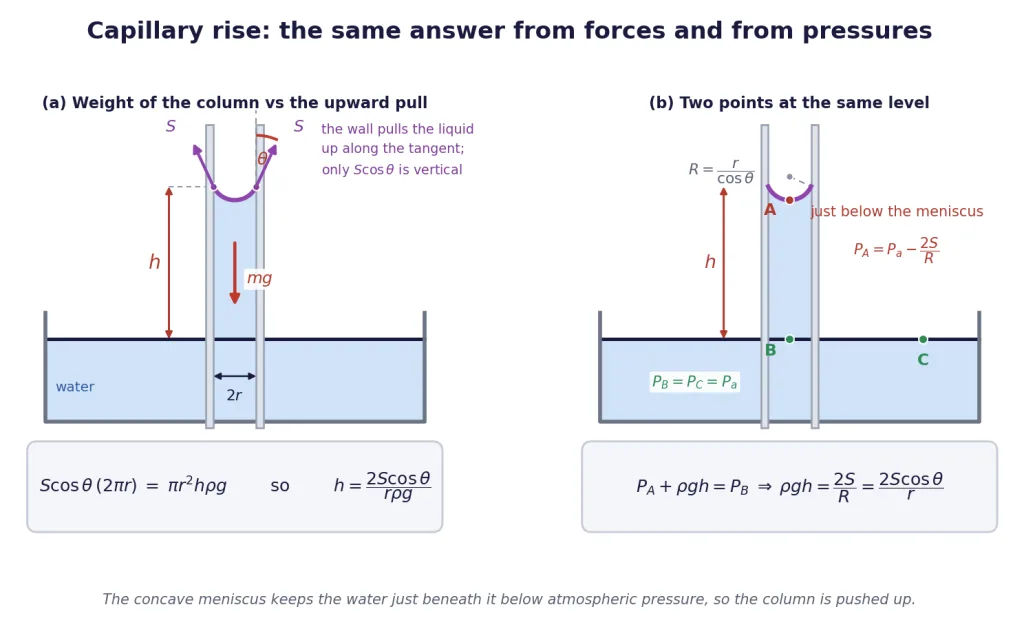
The pressure argument — the one that explains why
Water wets glass, so the angle of contact is acute and the meniscus inside the tube is concave.
A curved surface has a higher pressure on its concave side. Here the concave side faces upward, into the air. So:
- Just above the meniscus, the pressure is atmospheric, .
- Just below the meniscus, at the point marked A, the pressure is lower: where is the radius of curvature of the meniscus, not of the tube.
Now put point B in the tube at the level of the flat outside surface, and point C outside at the same level. B and C are in the same connected liquid at the same height, so they are at the same pressure, and C is right at the free surface, so
Travel down the column from A to B, a depth :
Substitute both known pressures:
Key Point — the ascent formula: is the height of the liquid inside the tube above the flat outside surface, measured to the bottom of the meniscus. is the internal radius of the tube, the angle of contact, the density of the liquid, its surface tension.
Read the mechanism once more, because it is what examiners want in words: the concave meniscus keeps the water immediately beneath it below atmospheric pressure, and the full atmospheric pressure outside pushes liquid up the tube until the weight of the raised column makes up the difference. The liquid is pushed up from below, not pulled up from above.
The force argument — the one that is quicker
Look at the ring where the liquid meets the glass, right at the top of the column. That contact line has length , and along every millimetre of it the glass pulls the liquid with a force per unit length, directed along the tangent to the liquid surface — that is, at the angle to the wall.
Vertical component of that pull:
Weight of the raised column, treating it as a cylinder of radius and height :
The column is in equilibrium, so
The same answer, and you should be able to produce either derivation on demand. The pressure route explains the mechanism; the force route is faster under time pressure.
[JEE Tip] Two things that get dropped. (i) , because so many problems set for water on clean glass that people forget it exists. (ii) the difference between and : is the tube, is the meniscus. Write both on your diagram before you start.
What is holding the column up, really?
A fair objection: surface tension acts at the top of the column, so how does it hold up water below it?
Because water is a liquid in tension throughout the column. The pull at the contact line is transmitted downward through the column by the liquid's own cohesion, exactly as a hanging rope transmits the ceiling's pull to its lowest fibre. That is also why the pressure in the raised column is below atmospheric everywhere above the outside surface level — the water there is genuinely being stretched.
Key Point: Inside the raised column the gauge pressure is negative. At the top, immediately under the meniscus, it is ; at the level of the outside surface it is zero. That is not a paradox — a liquid can sustain tension, and this one is.
Jurin's Law, and What Happens to Mercury
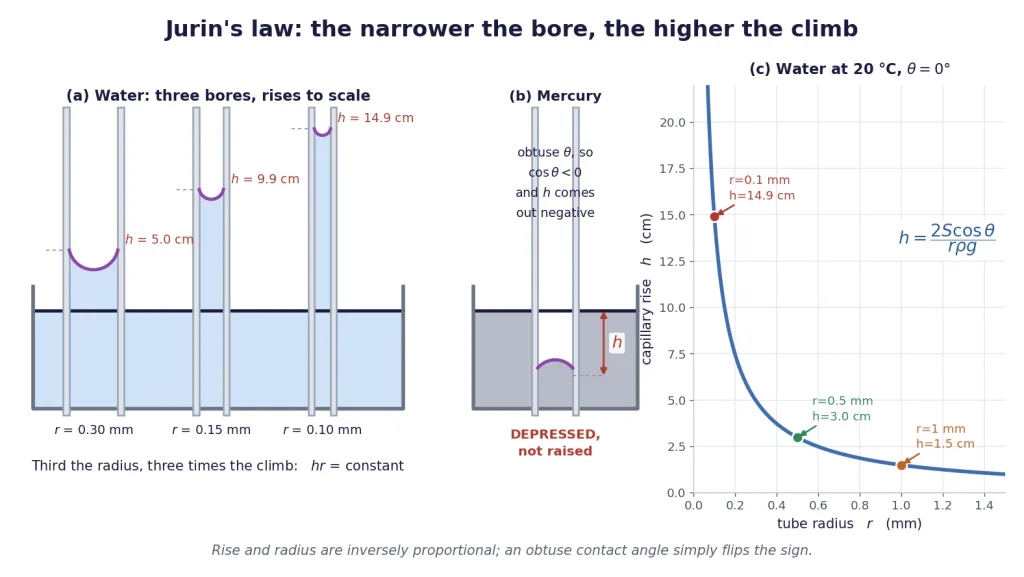
Look at the ascent formula again and notice which symbol is downstairs.
Key Point — Jurin's law: for a given liquid, a given angle of contact and a given . Halve the bore and the rise doubles. Take a tenth of the bore and the rise is ten times.
Some real numbers for water at 20 °C, taking N/m, , kg/m³ and m/s²:
| Internal radius | Rise |
|---|---|
| 1.0 mm | 1.49 cm |
| 0.50 mm | 2.98 cm |
| 0.30 mm | 4.97 cm |
| 0.10 mm | 14.9 cm |
| 0.020 mm | 74.5 cm |
| 1.0 micrometre | 14.9 m |
The last line is worth pausing over. A pore a micrometre across would lift water fifteen metres. That is what makes soil hold moisture, blotting paper drink ink, and a brick wall draw damp.
What the rise depends on, and what it does not
- up up. So anything that lowers — heating, or adding detergent — lowers the rise.
- up down down. Past the rise turns into a depression.
- up down. Jurin's law.
- up down. A heavier liquid is harder to lift.
- up down. On the Moon the same tube would lift water six times as far.
- The length of the tube does not appear, and neither does its shape below the surface, nor how deep it is dipped. Only the bore at the meniscus matters.
[NEET Important] The whole formula is worth memorising as a sentence: rise equals twice surface tension times cosine of the contact angle, over radius times density times g. The four things downstairs are the four things that fight the rise.
Mercury goes the other way
For mercury on glass, , so — negative. Put that straight into the same formula and comes out negative.
Key Point:
A negative means the liquid stands below the outside level. Mercury in a glass capillary is depressed, not raised, and the depression is The same law, the same formula, one sign. Do not invent a second formula for mercury.
For a tube of internal radius 1.0 mm with N/m, kg/m³ and , that gives a depression of 5.35 mm. Note that mercury loses twice over: its angle of contact is obtuse and its density is thirteen times water's.
Reading a meniscus, and why barometers lie a little
Because a mercury meniscus is convex, you read a mercury column from the top of the meniscus and a water column from the bottom. And because mercury in a narrow tube sits lower than it should, a mercury barometer with a fine bore under-reads the atmospheric pressure by exactly the capillary depression. Barometer tubes are made wide for precisely this reason.
[Board Important] "Water rises in a capillary tube but mercury is depressed in the same tube. Why?" The two-line answer: water has an acute angle of contact, so its meniscus is concave and the pressure just below it is less than atmospheric, and the liquid is pushed up; mercury has an obtuse angle of contact, so its meniscus is convex and the pressure just below it is greater than atmospheric, and the liquid is pushed down.
The Meniscus Correction, and Measuring
The force derivation quietly assumed the raised liquid was a cylinder of height . It is not. There is a little extra liquid sitting in the curved meniscus at the top, above the level of its own lowest point, and that liquid has weight too.
How much extra?
Take the simplest case, , where the meniscus is an exact hemisphere of radius .
The meniscus occupies the region between the flat disc at the level of the contact line and the hemispherical surface below it. Its volume is
So the total volume of liquid raised above the outside surface is
Balancing that against the surface-tension pull:
Key Point — the corrected ascent formula: Equivalently . The quantity is the rise measured to the bottom of the meniscus, and is the meniscus correction.
When does it matter?
Compare the two terms. The correction is against a rise of , so their ratio goes as : it matters for wide tubes and vanishes for narrow ones.
| Tube radius | Rise (to the meniscus bottom) | Correction as a share of | |
|---|---|---|---|
| 2.0 mm | 6.78 mm | 0.667 mm | 9.8% |
| 1.0 mm | 14.57 mm | 0.333 mm | 2.3% |
| 0.50 mm | 29.63 mm | 0.167 mm | 0.56% |
| 0.10 mm | 148.9 mm | 0.033 mm | 0.022% |
Key Point — say which you are using, every time:
A Class 11 problem usually intends the uncorrected formula unless it says otherwise, or unless it hands you the tube radius and asks for three-figure accuracy. Whichever you choose, write one sentence stating whether the meniscus correction is included. Both answers are defensible; an unstated assumption is not.
Every worked solution in this section states explicitly whether the correction is in or out.
Measuring surface tension with a capillary tube
This is the standard school-laboratory method and it is worth knowing as a procedure, not just as a formula.
- Clean the tube ferociously. Grease changes and destroys the measurement. Rinse with caustic soda, then with distilled water.
- Dip it vertically into the liquid in a wide beaker — wide, so that the outside surface really is flat.
- Measure the rise from the flat outside surface to the bottom of the meniscus, using a travelling microscope.
- Measure the internal radius at the position the meniscus settled at, again with a travelling microscope, or by weighing a known length of mercury thread.
- Compute , and take only if the liquid genuinely wets clean glass.
[JEE Tip] The dominant uncertainty is in , not , because is small and hard to measure and it appears to the first power in . A 2% error in the radius is a 2% error in the surface tension. If a question asks "which measurement limits the accuracy", the answer is the bore.
The Short Tube: The Question Everyone Gets Wrong
Here is the setup, and it appears in some form nearly every year.
A capillary tube of internal radius 0.10 mm is dipped in water. The rise should be 14.9 cm. But the tube is only 5.0 cm long above the water surface. What happens? Does the water spill out of the top? Does it fountain?
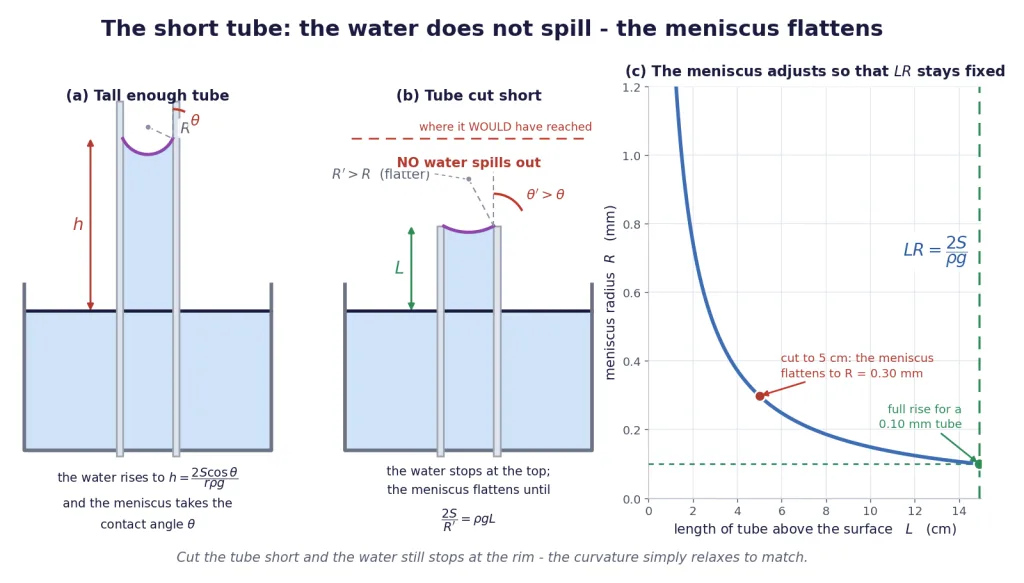
The answer
Nothing spills. Nothing fountains. The water rises to the top of the tube and stops there, and the meniscus flattens out.
Why
Watch what the two sides of the balance can do.
The left-hand side is set by how high the water is. The right-hand side is set by how curved the meniscus is. In a tall tube, is fixed at by the contact angle, and the water simply rises until matches.
In a short tube the water reaches the rim and can go no further, so is stuck at , the length of tube above the surface. Something has to give, and it is : the meniscus becomes less curved — flatter, with a larger radius of curvature — until the pressure difference it can supply is exactly and no more.
Key Point — the short-tube rule: and since the same relation held in the tall tube with and , Shorter tube, flatter meniscus, larger radius of curvature — and the product of height and meniscus radius never changes.
The new apparent angle of contact follows from the same geometry as before, : which is smaller than , so . The liquid meets the glass at a larger angle than it "wants" to, and it can, because the rim of a cut tube is an edge and a liquid surface can pin itself to an edge at any angle up to the point where it would spill over.
The two things to say in the exam
- The water does not overflow. There is no mechanism to make it: nothing is pumping, and the moment the column stops rising the surface tension stops doing work.
- The meniscus adjusts its curvature so that exactly.
[JEE Tip] The same logic answers the sister question, "what happens to the capillary rise in a freely falling lift?" There , so the required is infinite. The water therefore rises to the top of the tube and stops, and the meniscus flattens to a plane — an infinite radius of curvature, since a flat surface is exactly the surface that supports no pressure difference. Same rule, extreme case.
A worked feel for it
Take mm, N/m, kg/m³, m/s², .
| Length of tube above the surface | Meniscus radius needed | Apparent |
|---|---|---|
| 14.9 cm (or more) | 0.100 mm — the natural hemisphere | |
| 10.0 cm | 0.149 mm | |
| 5.0 cm | 0.298 mm | |
| 2.0 cm | 0.745 mm | |
| 1.0 cm | 1.49 mm |
Notice how the meniscus is almost flat by the time the tube is only a centimetre long — and still not one drop has left the tube.
Capillarity in the World, and How Detergents Work
Where you already meet it
- The oil lamp and the candle. Oil climbs the cotton wick through the capillaries between its fibres, faster than it burns away at the top. A candle does the same with molten wax. Squash the wick flat and the lamp goes out — the capillaries are gone.
- Blotting paper and kitchen towel. Paper is a mat of fine pores. Ink or water is drawn in by capillarity, and because the pores are of order ten micrometres, the potential climb is over a metre — far more than is ever needed.
- Tall trees. Water climbs from root to leaf partly by capillarity in the xylem vessels. But do the sum: a xylem vessel 20 micrometres across can lift water only about 75 cm. A hundred-metre tree needs something far stronger, and gets it from the evaporating menisci in the leaf, whose pores are a few nanometres wide. Capillarity is the mechanism; the leaf, not the trunk, is where it happens.
- Damp in a brick wall. Mortar and brick are full of fine pores, so ground water climbs. That is exactly what a damp-proof course — a layer of impermeable material near the base of the wall — is there to interrupt.
- A towel drying you. Cotton fibres wick water off skin by capillarity, which is why a synthetic towel with fewer, coarser capillaries works so badly.
- Ploughing a field. This one is the reverse. Soil is a mass of fine capillaries reaching the surface, and in dry weather they lift water up from below and let it evaporate away. Ploughing breaks those capillaries, so the water stays below, and the crop keeps it. The farmer is deliberately destroying a capillary network.
- The sponge, the paint brush, the wick of a marker pen, the fuel in a spirit stove — all the same physics.
[NEET Important] The ploughing question is asked constantly and is answered backwards just as often. Ploughing does not help water rise; it stops water rising, and it stops it because it breaks the soil capillaries.
Detergent action
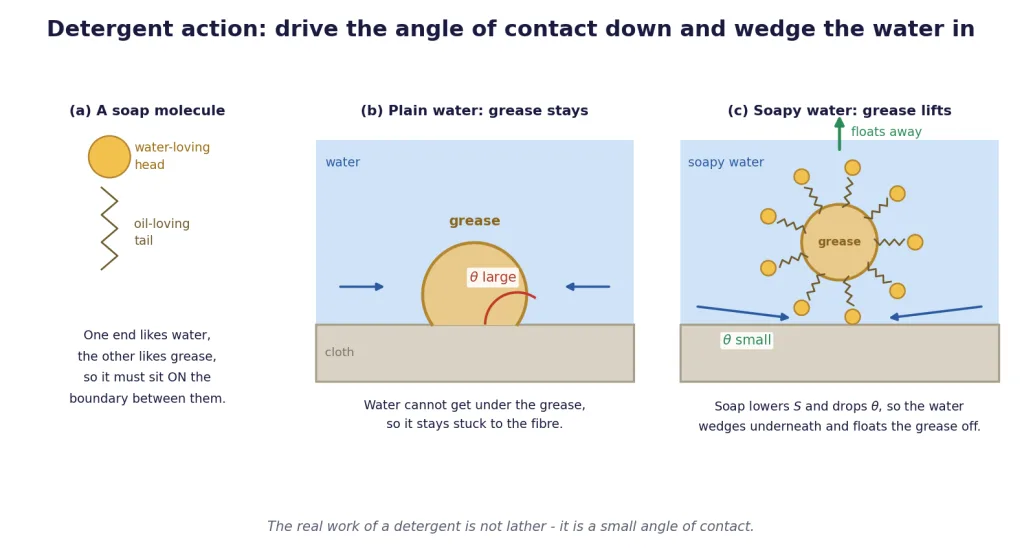
Now the everyday question this whole arc has been building to: why does soapy water clean and plain water not?
Dirt on cloth is almost always held there by grease, and grease and water refuse to mix. Drop water on a greasy fabric and it beads up: the angle of contact between water and grease is large, so the water cannot get underneath the grease to float it off. Scrub all you like.
Soap fixes this in two ways, and only one of them is the one people remember.
First, and less importantly: soap lowers the surface tension of water. From about 0.073 N/m to about 0.025 N/m. That is a big change, and it lets the water spread into the weave of the cloth instead of sitting on top of it. It also, incidentally, lowers the capillary rise — soapy water climbs a tube less far than pure water does, which surprises people who assume "better cleaning" means "more of everything".
Second, and this is the real mechanism: soap drives the angle of contact down. A soap molecule is two-faced. One end is a charged, water-loving head; the other is a long hydrocarbon, oil-loving tail. Such a molecule cannot be comfortable in water alone or in grease alone. It is only comfortable sitting in the boundary between them, tail buried in the grease, head out in the water.
Key Point — how a detergent actually works:
Soap molecules collect at the oil–water interface with the tail in the oil and the head in the water. This drops the oil–water interfacial tension and therefore drops the angle of contact between water and grease. Water can then wedge in underneath the grease, roll it up into a droplet, surround it with soap molecules — heads outward, so the whole bundle behaves like a water-loving particle — and float it away in the rinse.
The bundle has a name, a micelle, and it is the reason the grease never re-attaches.
Two consequences worth knowing:
- Hot water washes better than cold, partly because falls with temperature and partly because falls too, so the water penetrates further.
- Waterproofing is the same trick run backwards. Wax, silicone and the fluorocarbon finish on a rain jacket raise the angle of contact, so water cannot spread and rolls off instead.
[Board Important] "Water with detergent dissolved in it should have small angles of contact. Explain." The answer wanted is: a detergent molecule has one water-loving end and one oil-loving end, so it sits at the interface, reduces the solid–liquid interfacial tension , raises and therefore reduces ; a small angle of contact is exactly what is needed for the water to penetrate the fabric and lift the dirt.
The one-page recap of the whole surface-tension arc
| Idea | Result |
|---|---|
| Force per unit length | , or for a film |
| Energy per unit area | , numerically identical |
| Splitting into drops | area , |
| Excess pressure, drop or cavity | |
| Excess pressure, soap bubble | |
| Meniscus radius | |
| Capillary rise | |
| Short tube | constant; nothing spills |
Solved Examples
Every solution says explicitly whether the meniscus correction is included.
Constants used throughout, unless a problem states otherwise: m/s², kg/m³, kg/m³, N/m, N/m, N/m.
Example 1: The standard rise
A capillary tube of internal radius 0.050 cm is dipped vertically into water. Taking the angle of contact as zero, find how far the water rises, and check the answer by an independent force balance.
Solution: The meniscus correction is not included; the answer is the plain ascent formula.
Convert first, because this is where most marks are lost: cm m.
The ascent formula, with :
Independent check by forces. The vertical pull all round the contact ring: The weight of the column, treated as a cylinder: The two agree to four figures, so the height is right.
Final Answer: cm, without the meniscus correction.
Takeaway: Always convert the radius to metres before anything else, and check the direction of your answer: a smaller tube must give a bigger rise. If halving did not double your , you have made an algebra error.
Example 2: Measuring , with and without the correction
Water rises to a height of 14.6 mm, measured to the bottom of the meniscus, in a vertical glass tube of internal radius 1.00 mm. Find the surface tension of the water (a) ignoring the meniscus correction and (b) including it. Take .
Solution:
(a) Ignoring the correction, the raised liquid is treated as a pure cylinder:
(b) Including the correction. The liquid sitting in the hemispherical meniscus has volume , so the effective height is :
Compare. The corrected value is larger by and it is the corrected value, 0.0732 N/m, that matches the accepted room-temperature figure for water.
Final Answer: (a) N/m, correction excluded; (b) N/m, correction included. The second is the better measurement.
Takeaway: The correction is a 2% effect for a millimetre tube and negligible for a fine one — but it is never zero, and a full-mark answer states which convention it used rather than leaving the marker to guess.
Example 3: Jurin's law in action
Water rises 7.45 cm in a certain glass capillary. (a) What is the bore? (b) What radius would give twice the rise? (c) In a tube of radius 0.40 mm, how far would the same water rise? Take N/m, , no meniscus correction.
Solution:
(a) Rearrange the ascent formula for : That is 0.20 mm.
(b) Jurin's law: is constant. To double you halve : Check directly: m cm, which is indeed twice 7.45 cm.
(c) A wider tube, mm: Sanity check: the bore is twice that of part (a), so the rise should be half of 7.45 cm, which is 3.72 cm. Correct.
Final Answer: (a) 0.20 mm; (b) 0.10 mm; (c) 3.72 cm.
Takeaway: Use constant as a shortcut and the full formula as a check. Ratio problems in this topic are one line if you spot the proportionality, and three lines if you do not.
Example 4: Mercury goes down
A glass capillary of internal radius 1.00 mm is dipped in mercury. Taking the angle of contact as , the surface tension as 0.465 N/m and the density as 13600 kg/m³, find the capillary depression.
Solution: No meniscus correction; the same ascent formula is used with no change of sign convention.
Put the obtuse angle straight in. .
Numerator: , and . Denominator: .
Read the sign. Negative means the mercury stands below the level of the mercury in the dish. The depression is 5.35 mm.
Why so much smaller than water's rise? Mercury loses twice: is only instead of , and its density is 13.6 times water's. The two effects together beat its six-times-larger surface tension.
Final Answer: The mercury is depressed by 5.35 mm.
Takeaway: One formula covers both liquids. Do not memorise a separate depression formula — just let be negative and read the sign of the answer.
Example 5: The short tube
A capillary tube of internal radius 0.10 mm is dipped in water, but only 5.0 cm of it projects above the water surface. Take N/m, kg/m³, m/s² and for a full-length tube. (a) How high would the water rise in a long tube? (b) Does water overflow from the short tube? (c) What is the radius of curvature of the meniscus that actually forms, and (d) what apparent angle of contact does that correspond to?
Solution:
(a) The rise in a long tube: Three times the length available.
(b) No water overflows. Nothing is pumping the liquid. The water climbs to the rim, and there it stops. What changes instead is the curvature of the meniscus.
(c) The new radius of curvature. The meniscus must now supply exactly the pressure difference that holds up a column of height cm and no more: That is 0.298 mm, about three times the tube radius — a distinctly flatter meniscus.
Check the invariant: Equal, as demands.
(d) The apparent angle of contact, from :
Final Answer: (a) 14.9 cm; (b) no, nothing spills; (c) mm; (d) .
Takeaway: A capillary tube is not a fountain. When the tube runs out, the meniscus flattens until matches exactly, and stays constant throughout. Say those two sentences and the marks are yours.
Example 6: Two parallel plates
Two clean parallel glass plates are held vertically 0.10 mm apart and dipped into water. How far does the water rise between them? Take N/m, , kg/m³, m/s². Ignore any correction for the meniscus and for the finite width of the plates.
Solution:
Set up the force balance for a strip of width , measured along the plates. The water is held up by the contact line on both plates, so a length of liquid edge:
Weight of the raised sheet of water, of thickness mm, width and height :
Equate and cancel : Exactly the tube formula with the separation playing the role of the radius .
Substitute, with m:
Final Answer: The water rises 14.9 cm, the same as in a tube of radius 0.10 mm.
Takeaway: Plates a distance apart behave like a tube of radius , not of radius . The reason is geometric: a tube's meniscus curves in two directions and a slot's meniscus curves in only one, and that costs it a factor of two which exactly cancels the factor of two from having two plates.
Example 7: Heating the water
Water rises in a glass capillary of radius 0.20 mm. Its surface tension is 0.0727 N/m at 20 °C and 0.0662 N/m at 60 °C. Taking the density as 1000 kg/m³ at both temperatures and , find the rise at each temperature and the percentage change.
Solution: No meniscus correction, so both answers use the plain formula and the comparison is fair.
At 20 °C:
At 60 °C:
Percentage change: which is exactly the percentage by which itself fell, since everything else was held fixed:
A caveat worth a mark. Real water also gets less dense as it warms, from 998 to 983 kg/m³ over this range, which pushes the rise back up by about 1.5%. Holding fixed, as the question asks, isolates the surface-tension effect.
Final Answer: 7.42 cm at 20 °C, 6.76 cm at 60 °C, a fall of 8.9%.
Takeaway: With everything else fixed, is directly proportional to . So any question about how the rise changes with temperature is really a question about how changes with temperature — and always falls as things get hotter.
Example 8: Soapy water climbs less
The same glass capillary of radius 0.20 mm is dipped first in pure water ( N/m) and then in soap solution ( N/m), with in both cases and kg/m³ throughout. Find the two rises and comment on what this says about cleaning.
Solution: No meniscus correction in either case.
Pure water:
Soap solution:
Ratio: The soapy water climbs only about a third as far.
What this means. Detergent makes water climb less, not more — a surprise if you assumed that "cleans better" means "does everything better". Detergents do not clean by climbing. They clean by lowering the angle of contact between water and grease, so the water can spread over and wedge underneath the grease, and by wrapping the loosened grease in micelles so it cannot reattach. The lowered surface tension helps the water penetrate the weave; the lowered angle of contact does the actual work.
Final Answer: 7.45 cm for water, 2.55 cm for soap solution — the soapy water rises only 34% as far.
Takeaway: Lower surface tension means lower capillary rise, always. If a question tries to argue that detergent makes water rise higher in a tube, it is wrong; the cleaning power lives in , not in .
Example 9: How tall a tree can capillarity feed?
A xylem vessel in a tree trunk has an internal radius of 20 micrometres. (a) How high could capillarity alone lift sap through it, treating the sap as water with N/m and ? (b) The menisci in a leaf's cell walls have an effective radius of about 5 nanometres. What height do they correspond to? (c) What does the comparison tell you?
Solution:
(a) In the trunk vessel, micrometres m: Just 75 cm.
(b) In the leaf, nanometres m: Nearly three kilometres.
(c) The comparison. A giant sequoia is about 100 m tall. The trunk's vessels could account for less than one per cent of that; the leaf's nanometre-scale menisci could account for thirty times more than needed. So the lifting is done at the top, by the evaporating menisci in the leaves, which pull the whole continuous water column up behind them. The trunk is the pipe, not the pump.
Final Answer: (a) 0.745 m; (b) about 2980 m; (c) capillarity in the trunk is nowhere near enough — the pull comes from the nanometre menisci in the leaves.
Takeaway: Whenever an application of capillarity looks impressive, do the sum. tells you exactly what pore size a claimed height demands, and it is usually far smaller than people expect.
Example 10: Weighing the raised water
Water rises in a vertical capillary tube of internal radius 0.30 mm, with and N/m. Find (a) the rise, (b) the mass of water raised above the outside surface, and (c) verify the force balance independently.
Solution: Meniscus correction excluded throughout, so the raised liquid is treated as a cylinder.
(a) The rise:
(b) The volume and mass:
(c) The force balance. Weight of that water: Vertical surface-tension pull round the contact ring: Identical to four figures.
Final Answer: (a) 4.97 cm; (b) 14.0 mg; (c) both weight and pull are N.
Takeaway: Fourteen milligrams. Capillarity moves absurdly small masses, which is precisely why it is invisible on the human scale and decisive on the scale of a pore, a fibre or a cell.
Example 11: Reading a wall for damp
Mortar contains pores of effective radius 10 micrometres. (a) How high can ground water climb through it? (b) Blotting paper has pores of about the same size — comment. (c) A builder inserts a damp-proof course 15 cm above ground level. Is that enough? Take N/m, , kg/m³.
Solution:
(a) With micrometres m:
(b) Blotting paper. The same pore size gives the same potential climb, about 1.5 m — vastly more than the couple of millimetres a sheet of blotting paper ever needs. That is why blotting works instantly and completely: it is operating far below its ceiling, so the only limit is how fast the liquid can flow through, not how far it could go.
(c) A damp-proof course at 15 cm. The wall can lift water 1.49 m, which is nearly ten times higher. So an impermeable barrier is the only thing that will stop it, and 15 cm is a fine place to put it — the height does not matter, the interruption does. Without the barrier the damp would climb well above head height.
Final Answer: (a) 1.49 m; (b) the same, roughly 1.5 m, far more than blotting ever needs; (c) yes — the barrier works by breaking the capillaries, not by out-reaching them.
Takeaway: Capillarity is stopped by breaking the pore network, never by out-climbing it. That is the damp-proof course, and it is exactly the same idea as the farmer who ploughs a field to break the soil capillaries and keep the moisture down where the roots are.