
Why Pressure Grows as You Go Down
Section 1 kept its fluid elements small enough to ignore their weight. Put the weight back in and something new appears: the pressure inside a fluid at rest depends on how deep you are.
The reason is almost embarrassingly simple. Every layer of fluid has to hold up all the fluid above it, and the deeper you go, the more there is above you.
The derivation, in one free-body diagram
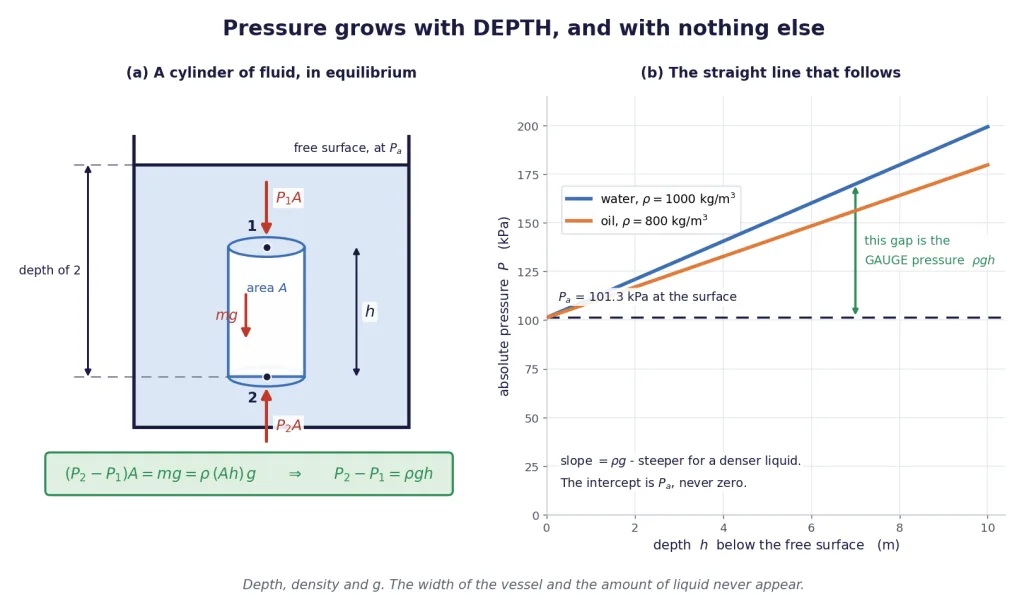
Take an imaginary cylinder of the fluid itself, of cross-sectional area , standing vertically with its top face at point 1 and its bottom face at point 2, a height lower. This cylinder is at rest, so the forces on it balance.
Horizontally, the pressures on the curved side push in from all around and cancel — nothing to do.
Vertically, three forces act:
- the fluid above pushes down on the top face with ,
- the fluid below pushes up on the bottom face with ,
- the cylinder's own weight pulls down.
Equilibrium:
Now the mass of the cylinder is its density times its volume, , so
and the area cancels off both sides:
Key Point — the central result of this section: and if point 1 is taken on a free surface open to the atmosphere, so that , then at a depth below that surface Here is the absolute pressure and is measured downwards from the free surface. The excess over atmospheric, is the gauge pressure at that depth.
Read the formula properly
Three quantities appear on the right: , and . Nothing else does. In particular:
- The area cancelled. It is nowhere in the answer.
- The shape of the vessel never entered the argument. We only ever used a vertical column of fluid.
- The total amount of liquid never entered either.
That is not a small observation. It is the whole content of the hydrostatic paradox, which gets its own block below.
The relation also says is a straight line in , of slope , with intercept at the surface. A denser liquid gives a steeper line. The intercept is , never zero — forgetting that is the most common wrong answer in the whole chapter.
[Board Important] The derivation assumes is constant with depth, so it holds for liquids, which are very nearly incompressible. It does not hold for a gas over any great height: the air near the ground is denser than the air higher up, so atmospheric pressure falls off far more gently than a straight line and the "height of the atmosphere" you get by pretending otherwise is badly wrong.
Same level, same pressure
The companion result comes from the horizontal-bar argument of Section 1. Take a horizontal bar of fluid inside a connected body of fluid at rest: the only horizontal forces on it are the pressures on its two ends, and it is not accelerating, so those pressures are equal.
Key Point: In a connected body of the same fluid at rest, all points at the same horizontal level have the same pressure. Points at different levels differ by exactly , where is the vertical separation — nothing else about the path between them matters.
Everyday machinery built on this one line:
- the spirit level and the transparent water-filled hose a mason uses to mark the same height on two walls of a building, which works round corners and through doorways because only the vertical difference matters;
- the U-tube, which is the whole of the manometer;
- an overhead water tank: the pressure at a tap depends only on how far the tap is below the water surface in the tank, not on the length or the twistiness of the pipe that gets there;
- why your blood pressure is higher at your feet than at your brain — you are a connected column of fluid about 1.7 m tall.
Two conditions carry the marks. Connected: two separate beakers on the same bench tell you nothing. Same fluid: if oil floats on the water in one arm, you cannot jump across at the same level; you have to cross the interface properly, which is exactly what the U-tube problems below make you do.
The Hydrostatic Paradox
Here is the result that students refuse to believe until they see the derivation, and it is examined every year.
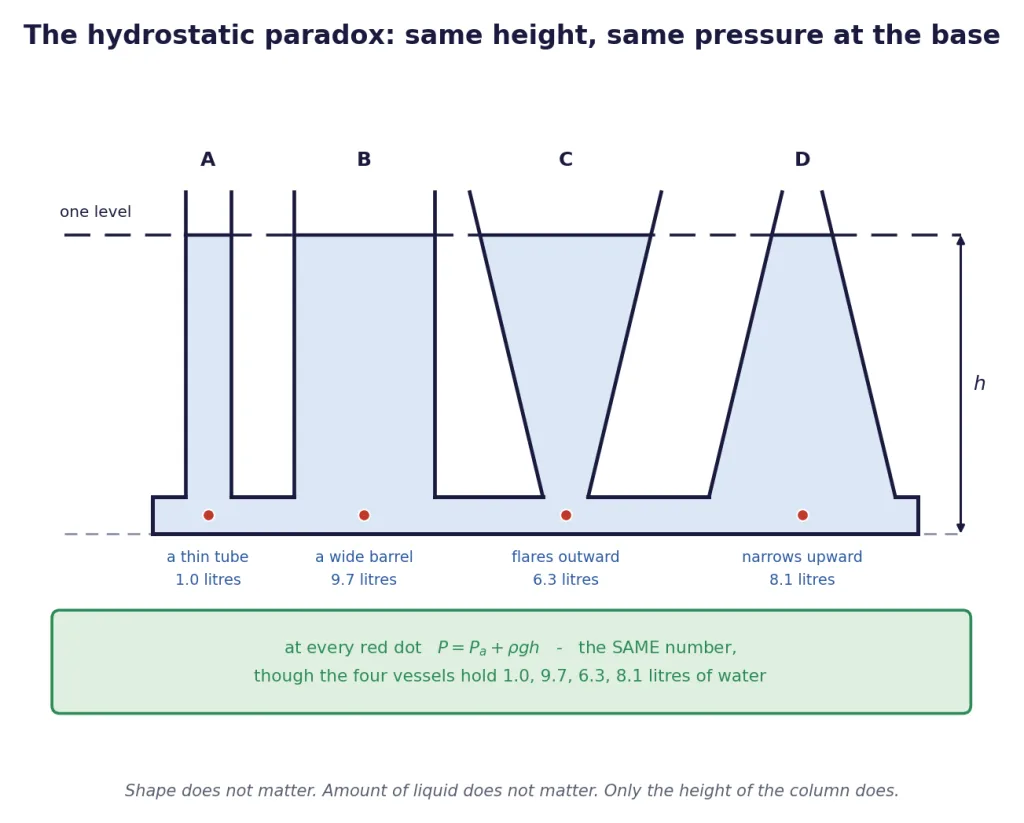
Four vessels stand on a bench, connected by a pipe along the bottom. One is a thin tube, one a fat barrel, one flares outward towards the top, one narrows to a neck. Pour water in and the level comes to rest at the same height in all four — even though the barrel holds ten times as much water as the thin tube.
Key Point — the hydrostatic paradox:
The pressure at the base of a vessel depends only on the vertical height of the liquid column above it (and on and ). It does not depend on the shape of the vessel, on the width of the vessel, or on the total amount of liquid it holds. A narrow tube of water 1 m tall and a swimming pool 1 m deep press equally hard on their floors.
It is called a paradox because it feels as though more liquid ought to press harder. It does not. Ten times the water spread over ten times the base area is the same pressure — the extra weight is carried by the extra area.
But what about a vessel that is NOT a straight cylinder?
This is the good question, and it is where the marks are.
For a straight-sided vessel, the force on the base is , and that is exactly the weight of the water in it. Fine.
For a vessel that flares outward going up, there is more water in it than a cylinder of the same base and height would hold — yet the force on the base is still only , which is less than the weight of the water. Where does the rest of the weight go? Into the sloping walls. The walls of such a vessel lean outward, so the liquid pushes them outward and downward; by Newton's third law they push back on the liquid inward and upward, and that upward wall force carries the missing weight.
For a vessel that narrows going up, like a conical flask, the argument runs the other way: the force on the base is greater than the weight of the liquid, and the sloping walls press down on the liquid to make up the difference.
Key Point: Force on the base , always.
The weight of the liquid equals that force only for a straight-sided vessel. For any other shape, the sloping walls take up or supply the difference.
[JEE Tip] The question is usually posed as "a vessel holds 12 kg of water; find the force on its base" with numbers chosen so that and come out different. Answering is the trap. Compute and then say, in one sentence, where the difference went. Example 3 below does exactly this and closes the books with an integration over the sloping wall.
The classic demonstrations
- Pascal's barrel. Fill a strong barrel with water, fit a long thin vertical pipe into its lid, and pour a few cupfuls of water into the pipe. A tall enough pipe bursts the barrel, though the water added weighs almost nothing — because it is the height, not the amount, that sets the pressure.
- The water tower. A town's water pressure is set by the height of the tank above the taps and not at all by how full the tank is horizontally.
- A dam. The thickness of a dam is decided by the depth of the reservoir behind it, not by how many kilometres the lake stretches back.
[NEET Important] One-liner to memorise: pressure at the bottom depends on the height of the liquid column, not on the shape of the vessel or the quantity of liquid.
Atmospheric Pressure and the Barometer
We live at the bottom of an ocean of air, and it presses on us.
Key Point: Atmospheric pressure at a point is the weight of the column of air of unit cross-section standing above that point, reaching to the top of the atmosphere. At sea level
That is about N on every square metre — ten tonnes of force on a door. You do not notice because the same pressure acts on both sides of you, inside and out, so nothing is left over to squash you.
Torricelli's barometer
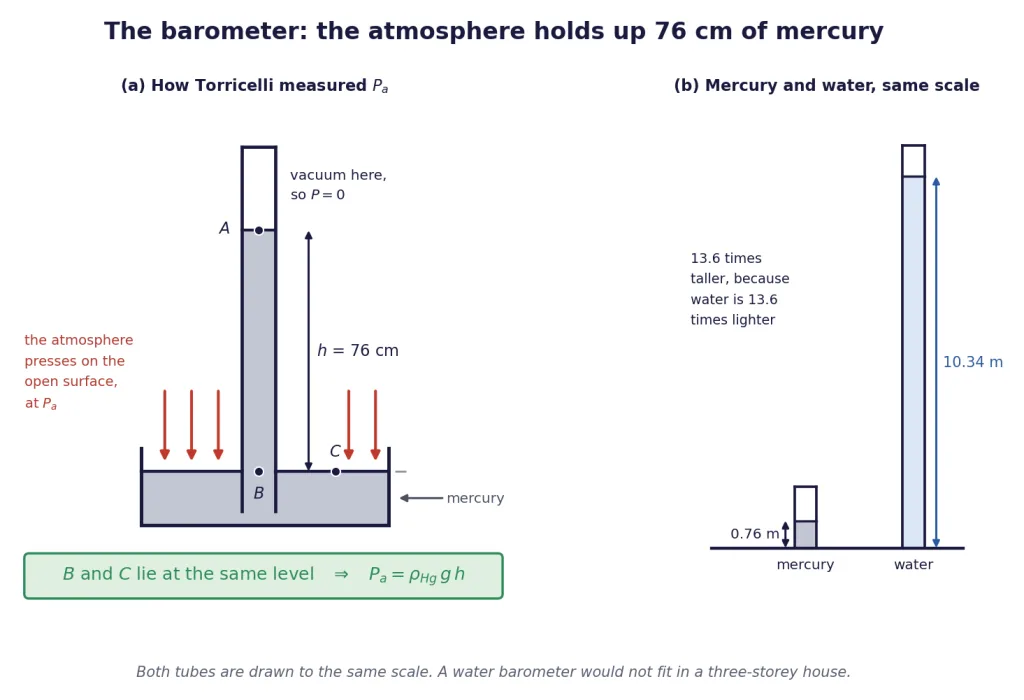
Fill a long glass tube, closed at one end, completely with mercury. Put your thumb over the open end, invert it into a trough of mercury, and let go. The mercury drops a little and then stops, leaving a column about 76 cm tall with an empty space above it.
That space is a near-perfect vacuum — only a trace of mercury vapour, at a pressure so small we take it as zero. Now use "same level, same pressure":
- At A, the top of the column, the pressure is .
- At B, inside the tube at the level of the trough surface, the pressure is — the weight of the column above it.
- At C, on the exposed trough surface at that same level, the pressure is , because the atmosphere is pushing there.
- B and C are at the same level in the same connected liquid, so their pressures are equal.
Key Point — the barometer equation: and putting in the numbers, m. The 76 cm is a prediction, not a definition.
Four things about the barometer that get asked:
- The cross-section of the tube does not matter. A tube twice as wide holds twice the weight of mercury over twice the area, and the height is unchanged. Same paradox as before.
- Tilting the tube does not change the reading. What is fixed is the vertical height of 76 cm; tilt the tube and the mercury simply runs further along it to keep that vertical height.
- The column height changes with the weather and with altitude, because does. A fall of 10 mm or more usually means a storm is on its way.
- If a bubble of air leaks into the space at the top, it pushes down on the column and the barometer reads too low.
Why nobody builds a water barometer
Run the same calculation for water:
Over ten metres — a tube taller than a three-storey house. Mercury, being 13.6 times denser, does the same job in a column 13.6 times shorter. That single ratio is the entire reason barometers are made of mercury.
The same 10 m limit explains something practical: a suction pump cannot lift water more than about 10 m, however good the pump. The pump does not pull the water up; it lowers the pressure at the top and lets the atmosphere push the water up. The atmosphere can only push so hard.
Reading pressures as heights
Because turns a pressure into a length, people quote pressures as heights of liquid and it is a genuinely useful habit.
| Pressure quoted as | Means | In pascal |
|---|---|---|
| 76 cm of Hg | ||
| 1 mm of Hg = 1 torr | 133 | |
| 120 mm of Hg (systolic, gauge) | ||
| 10 cm of water | 980 |
[NEET Important] Blood pressure "120 over 80" is in mm of mercury and is a gauge pressure. The absolute pressure in that artery at systole is Pa. A cuff reading of zero would mean atmospheric pressure inside the artery, not a vacuum.
Gauge Pressure, Absolute Pressure and the Manometer
This is the block that decides whether your numerical answers in this chapter are right.
Key Point — the two pressures, once more:
- is measured from a perfect vacuum. It can never be negative.
- is measured from atmospheric pressure. It is negative whenever the pressure is below atmospheric, and then it is called a partial vacuum or a suction.
- At a depth below a free surface, is the gauge pressure. Adding turns it into the absolute pressure.
Your tyre gauge is lying to you, on purpose
A tyre gauge reading 200 kPa does not mean the air in the tyre is at 200 kPa. It means the air inside is 200 kPa above the air outside. The absolute pressure inside the tyre is
roughly three atmospheres. The gauge reads a difference because the atmosphere is pushing on the other side of its sensing element. Every practical instrument of this sort behaves the same way: the tyre gauge, the blood-pressure cuff, the pressure dial on a gas cylinder, the manometer.
And note which of the two numbers actually does the work. The load on a tyre is carried by the gauge pressure, because the atmosphere pushes up on the outside of the contact patch just as hard as it pushes down elsewhere. A car of mass 1200 kg on four tyres inflated to 200 kPa gauge flattens each tyre until the contact patch is about 147 cm; using the absolute 301.3 kPa instead would predict about 98 cm and be wrong. Example 6 does the arithmetic.
Key Point: A completely flat tyre reads zero on a gauge. That is not a vacuum — it is one atmosphere absolute, the same as the air around it.
The open-tube manometer
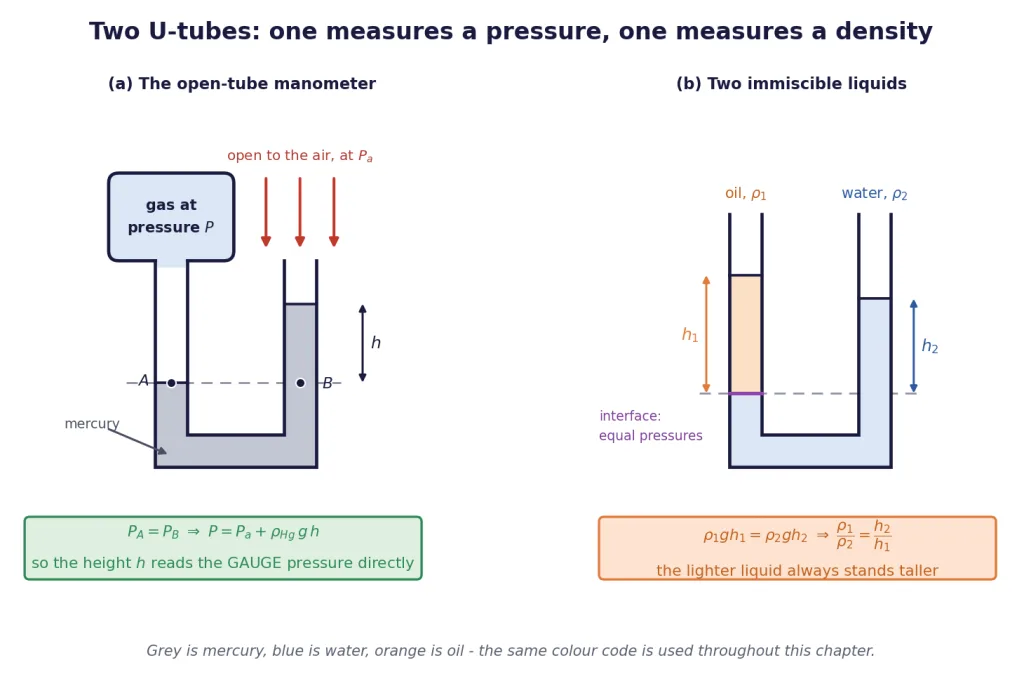
A U-tube part-filled with a liquid. One arm connects to the vessel whose pressure you want; the other is open to the air. The liquid settles with a difference in level, and that difference is the answer.
Take the point A at the liquid surface in the closed arm, and the point B in the open arm at exactly the same level. Same connected liquid, same level, so .
- Going down the closed arm: , the pressure of the gas (the gas column above it weighs nothing worth counting).
- Going down the open arm from the top: , where is the height of liquid above level B in the open arm.
Key Point — the manometer: The height difference reads the gauge pressure directly. If the open arm stands higher, the gas is above atmospheric and is positive. If the open arm stands lower, the gas is below atmospheric, is negative, and the gauge pressure is negative.
Choosing the liquid is a real design decision, and it is examinable. A low-density liquid such as oil or water gives a big, readable height difference for a small pressure difference, so it is used for delicate measurements. A high-density liquid such as mercury keeps the tube short when the pressure difference is large. It is the same trade-off that puts mercury in a barometer.
How to do any U-tube problem without thinking
Every U-tube question, however dressed up, yields to one mechanical procedure.
- Pick a level at which you know something — usually the lowest interface between two different liquids.
- Write the pressure at that level from the left arm, starting at whatever is on top (usually ) and adding for each layer you come down through.
- Write it again from the right arm, the same way.
- Set the two equal, and solve.
The only rules to obey are: add when you go down, subtract it when you go up, and use the density of the liquid you are actually passing through in each step.
Two immiscible liquids in a U-tube
Pour water into one arm of a U-tube and an oil that will not mix with it into the other. They meet at an interface. Take your level at that interface — a point on it in one arm, a point on it in the other, same level, same connected liquid below.
Left arm down to the interface: . Right arm down to the same level: . Equate:
Key Point: Measure the two column heights above the interface level and you have the ratio of the densities, and hence an unknown density, without ever weighing anything.
The lighter liquid always stands in the taller column — it needs more height to produce the same .
That last sentence is your sanity check. If your answer makes the denser liquid the taller one, you have inverted the ratio.
[JEE Tip] When mercury sits in the bottom of the U and two different light liquids are poured on top of it, the mercury levels themselves shift. The correct equation compares the pressures at the level of the lower mercury surface, and the mercury contributes a term for the offset between the two mercury surfaces. Example 9 works this all the way through.
Putting It Together
The decision tree for any depth problem
- Draw the vessel and mark the free surface. Write on it.
- Mark your point and measure vertically down from that surface. Not along the wall. Not along the pipe. Vertically.
- Write .
- Add if — and only if — the question wants the absolute pressure.
- Say which one you have quoted.
Step 5 is not decoration. Look at how often the same physical situation has two right answers:
| The question | Gauge | Absolute |
|---|---|---|
| pressure on a swimmer 10 m down | Pa | Pa |
| a tyre gauge reading 200 kPa | 200 kPa | 301.3 kPa |
| systolic blood pressure 120 mm Hg | Pa | Pa |
| a manometer showing 18 cm of Hg | Pa | Pa |
If a problem is genuinely ambiguous, compute both and say which one you are offering as the answer. That is a full-mark response; a bare number is a gamble.
When to use which
- Forces on submerged surfaces with the atmosphere on the other side — a submarine window, a dam face with air behind it, a tyre carrying a car — use the gauge pressure. The atmosphere is already pushing back on the far side and cancels.
- Anything involving a gas law, or an absolute reference such as a vacuum — use the absolute pressure.
- "What does the instrument read?" — almost always the gauge pressure.
The mistakes that recur
| The mistake | The fix |
|---|---|
| Forgetting when the question says "absolute" | write both numbers and label them |
| Measuring along a sloping wall or a bent pipe | is the vertical drop, always |
| Assuming the base force equals the weight of liquid | it equals ; the sloping walls make up the difference |
| Jumping across a U-tube at the same level, through two different liquids | the rule needs the same connected fluid |
| Using for air over kilometres | is not constant for a gas over any real height |
| Mixing and inside one problem | pick one at the start and stay with it |
Carrying forward
Key Point — the four results of this section:
Section 3 takes the very first of these and applies it to the top and bottom faces of a submerged body. The pressure underneath is larger than the pressure on top, the difference is over the body's height, and multiplying by the area gives a net upward push. That push is the upthrust, and it is where Archimedes' principle comes from.
Solved Examples
Constants used throughout, unless a problem states otherwise: kg/m, kg/m, kg/m, kg/m, kg/m, Pa and m/s. Every pressure quoted below is labelled gauge or absolute.
Example 1: The swimmer
What is the pressure on a swimmer 10 m below the surface of a lake?
Solution:
Set the reference level. is measured vertically down from the free surface of the lake, which is open to the air and therefore at .
The gauge pressure, that is, the excess over atmospheric:
The absolute pressure:
In atmospheres: atm, near enough 2 atm.
Which does the question want? "The pressure on a swimmer" with no further qualification means the absolute pressure, Pa. Note what the numbers say: ten metres of water roughly doubles the pressure, because 10 m of water is worth about one atmosphere. At 1 km down the increase would be 100 atm, which is why submarine hulls are built the way they are.
Final Answer: Gauge Pa; absolute Pa, about 2 atm. The answer quoted is the absolute value.
Takeaway: Ten metres of water is about one atmosphere. Carry that as a mental yardstick and you can check almost any depth answer in three seconds.
Example 2: The submarine window
At a depth of 1000 m in the ocean, find (a) the absolute pressure, (b) the gauge pressure, and (c) the net force on a window of area 20 cm 20 cm, given that the interior of the submarine is kept at sea-level atmospheric pressure. Take kg/m.
Solution:
(b) Gauge first — it is the simpler one: about 100 atmospheres.
(a) Absolute: which is 100.6 atm. Notice that at this depth the atmospheric term is only about 1% of the total — but it is still the difference between the two answers the examiner is offering you.
(c) The net force on the window. The sea pushes in with and the cabin air pushes out with , so what the glass has to withstand is the difference, which is exactly the gauge pressure: about 41 tonnes of force on a window the size of a dinner plate.
A refinement worth knowing. The pressure is not quite uniform over the window — its lower edge is 20 cm deeper than its upper edge. Integrating the real depth profile across the window gives N, which is the same to five figures as using the pressure at the centre. That is a general result for a flat surface, and it is why the shortcut is safe.
Final Answer: Absolute Pa; gauge Pa; net force on the window N.
Takeaway: Use the gauge pressure for the force whenever the atmosphere is acting on the other side. Using the absolute pressure would over-count by — here about 4000 N of force that simply is not there.
Example 3: The vessel that presses less hard than it weighs
A vessel with a flat circular base of area 200 cm is filled with water to a depth of 40 cm. The vessel flares outward towards the top and holds 12.0 kg of water. Find (a) the gauge and absolute pressure at the base, (b) the force the water exerts on the base, and (c) reconcile that with the weight of the water.
Solution:
(a) The pressure at the base depends only on the height of the column, so the flaring is irrelevant here:
(b) The force on the base. With m, and using the gauge pressure because the atmosphere presses up on the underside of the base as well:
(c) Now the weight of the water: The force on the base is less than the weight, by
Where did 39.2 N go? Into the sloping walls. The vessel widens as it rises, so the water pushes each piece of wall outward and downward; by Newton's third law the wall pushes the water inward and upward. Adding up that upward push over the whole sloping wall gives exactly 39.2 N, so the water's books balance:
The check. A straight cylinder of the same base and depth would hold only kg. This vessel holds 12.0 kg, so it must indeed flare outward, and it must indeed press on its base less hard than its contents weigh.
Final Answer: Base at 3920 Pa gauge, Pa absolute; force on the base 78.4 N; weight 117.6 N, with the missing 39.2 N carried by the sloping walls.
Takeaway: The force on a base is , never automatically . They agree only for a straight-sided vessel. This is the hydrostatic paradox with the numbers filled in, and it is a favourite trap.
Example 4: Barometers made of other liquids
Atmospheric pressure is Pa. Find the height of the column in a barometer filled with (a) mercury, (b) water, (c) a light oil of density 800 kg/m. Comment.
Solution:
The barometer equation comes from equating the pressure inside the tube at trough level to the atmospheric pressure outside at the same level:
(a) Mercury:
(b) Water:
(c) The oil:
Comment. The heights are in inverse proportion to the densities: , exactly the density ratio of mercury to water. A water barometer would need a tube taller than a three-storey house and an oil one taller still, which is why every practical barometer uses mercury.
Note on the pressure. here is an absolute pressure, because the space above the column is a vacuum and the reference is therefore zero, not atmospheric.
Final Answer: 0.760 m of mercury, 10.34 m of water, 12.92 m of oil.
Takeaway: The lighter the liquid, the taller the column — for a fixed pressure. Mercury wins because it is dense, not because there is anything special about mercury.
Example 5: The manometer, both ways round
An open-tube mercury manometer is connected to a gas cylinder. Find the gauge and absolute pressure of the gas when the mercury in the open arm stands (a) 18.0 cm higher than in the closed arm, and (b) 18.0 cm lower.
Solution:
(a) Open arm higher.
Set the level. Take the mercury surface in the closed arm as the reference level, and the point at the same height in the open arm.
From the gas side: the pressure at that level is just the gas pressure , since the gas column above weighs nothing worth counting.
From the open side: starting at the top of the open arm and coming down 18.0 cm of mercury,
The gauge pressure is the height term on its own: This is what the instrument is really telling you: the gas is 18 cm of mercury above atmospheric.
(b) Open arm lower. Now m, and everything flips sign:
The gauge pressure is negative — the gas is below atmospheric, a partial vacuum. The absolute pressure is of course still positive, as it must always be.
Final Answer: (a) Pa gauge, Pa absolute. (b) Pa gauge, Pa absolute.
Takeaway: A manometer reads the gauge pressure directly, sign and all. Open arm higher means above atmospheric; open arm lower means below. Only the absolute pressure is forbidden to go negative.
Example 6: What a tyre gauge means, and what carries the car
A tyre gauge reads 200 kPa. (a) What is the absolute pressure of the air in the tyre? (b) A car of mass 1200 kg rests on four such tyres. Estimate the contact area of each tyre with the road, and say which pressure you used and why.
Solution:
(a) Absolute pressure. A gauge reads the excess over the atmosphere, so about three atmospheres inside a tyre "at 200 kPa".
(b) Which pressure carries the load? Take the contact patch. The tyre air pushes down on it from inside at , and the atmosphere pushes up on it from outside at . The net downward push the road has to resist is the difference, which is the gauge pressure. So the gauge pressure is what carries the car.
The weight, shared between four tyres:
The contact area: which is a patch roughly 12 cm by 12 cm — about right for a car tyre.
What using the wrong pressure would cost. Putting the absolute Pa in instead gives cm, a third too small. That is the size of this chapter's commonest error, in one number.
Final Answer: Absolute pressure Pa; contact patch about 147 cm per tyre, calculated from the gauge pressure.
Takeaway: Gauge for forces where the atmosphere acts on the far side; absolute when you need a true total. A flat tyre reads zero on a gauge and one atmosphere absolute — not a vacuum.
Example 7: Levelling a building site with a hose
A mason checks whether two points on a building site are level using a long transparent hose filled with water and held open at both ends. He finds the water surface at end P stands 4.5 cm higher than the water surface at end Q. What pressure difference does this correspond to, and which point is higher?
Solution:
The principle. The two water surfaces are both open to the atmosphere, so both are at — whatever the hose does in between, however it loops and bends. Water surfaces open to the air in a connected liquid at rest always come to the same horizontal level.
Reading the result. If the water surface at P is 4.5 cm higher than the one at Q, then the end of the hose at P is 4.5 cm lower than the end at Q, since the water has more room to rise there. In building terms, Q is the higher point by 4.5 cm.
The pressure difference. Compare the pressures at the level of the lower surface. On the Q side that point is a surface, at . On the P side it lies 4.5 cm below the surface, so
Why it beats a spirit level over long distances. The result depends only on the vertical difference, so the hose can go round corners, through doorways and behind pillars without affecting the reading. And 441 Pa is only 0.4% of an atmosphere, which is why so small a height difference is easy to see and easy to trust.
Final Answer: 441 Pa, a gauge difference; and Q is the higher point, by 4.5 cm.
Takeaway: Open surfaces of a connected liquid at rest always settle to the same level, whatever the shape of the connection. That single fact is the spirit level, the water tower and the U-tube all at once.
Example 8: Weighing an oil without a balance
Water is poured into one arm of a U-tube and an oil that does not mix with it into the other, so that the two meet at an interface in the bend. Measured above the level of that interface, the water column is 12.0 cm and the oil column is 15.0 cm. Find the density and the relative density of the oil.
Solution:
Choose the level. Take the horizontal level of the interface. A point on it in the oil arm and a point on it in the water arm are at the same height in the same connected liquid below, so their pressures are equal.
Come down each arm from the open top:
Equate, and and cancel:
Solve:
Relative density is that divided by 1000, so , dimensionless.
Sanity check. The oil column is the taller one, so the oil must be the lighter liquid — and 800 is indeed less than 1000. Had the numbers come out the other way, the ratio was inverted.
Final Answer: kg/m; relative density 0.80.
Takeaway: measures a density with a ruler. Note that the heights are measured above the interface, not from the bottom of the tube and not from the bench.
Example 9: Mercury in the bend, two liquids on top
A U-tube contains mercury. Glycerine of density 1260 kg/m is poured into the left arm and water into the right. (a) With 20.0 cm of glycerine in the left arm, what height of water in the right arm leaves the two mercury surfaces exactly level? (b) A further 8.0 cm of each liquid is then poured into its own arm. Find the new difference between the mercury levels.
Solution:
(a) The level case.
Take the (common) level of the two mercury surfaces. Coming down the left arm gives ; coming down the right gives . The mercury contributes nothing yet, because the two surfaces are at the same height.
Equate:
(b) After adding 8.0 cm of each.
The new columns are 28.0 cm of glycerine on the left and 33.2 cm of water on the right. They no longer balance, so the mercury shifts. Let the right-hand mercury surface end up a height above the left-hand one.
Take the level of the LOWER mercury surface — the left one. Coming down the left arm: Coming down the right arm, through the water and then through of mercury:
Equate and cancel and :
Read the answer. mm, and it is positive, so the mercury stands higher in the water arm — which makes sense, because the glycerine side is now pressing down harder and pushes its own mercury surface down.
Final Answer: (a) 25.2 cm of water. (b) The mercury levels differ by 1.53 mm, higher on the water side.
Takeaway: Compare pressures at the level of the lower interface, and add for every layer you come down through. Mercury's huge density is why a 20.8 Pa-per-metre imbalance moves it only about a millimetre and a half.
Example 10: A column of three liquids
A tall vertical cylinder open at the top contains, from the bottom up, 20 cm of mercury, then 30 cm of water, then 25 cm of an oil of density 800 kg/m. The liquids do not mix. Find the gauge and absolute pressure (a) at the top of the mercury layer, and (b) at the bottom of the cylinder.
Solution:
Set the reference. The oil's free surface at the top is open to the air, so it is at . Come down through the layers one at a time, adding for each.
(a) At the top of the mercury layer, that is 25 cm of oil plus 30 cm of water below the surface:
(b) At the bottom, add the mercury layer as well:
Look at the arithmetic. The mercury layer is the shortest of the three at 20 cm, yet it contributes 2720 out of the 3220 units — about 85% of the whole gauge pressure. Density does the work, not height.
Note the shortcut and why it is safe. Because pressure differences simply add as you descend, you can treat a stack of liquids as a sum of terms. It works precisely because each term came from the same free-body argument applied to its own layer.
Final Answer: At the top of the mercury: 4900 Pa gauge, Pa absolute. At the bottom: Pa gauge, Pa absolute.
Takeaway: Stack the terms, one per layer, and keep the gauge and absolute answers separate. In any stack containing mercury, expect the mercury to dominate.
Example 11: How tall would the atmosphere be?
The density of air at sea level is 1.29 kg/m. Assuming this density did not change with altitude, how high would the atmosphere extend? Compare with reality.
Solution:
The model. Pretend the air is an incompressible liquid of density 1.29 kg/m sitting on the ground. Then the pressure at the ground would be the weight of that column, , and it must come to :
Solve:
Compare with the real atmosphere. Traces of atmosphere extend past 100 km — more than ten times this estimate. The model is wrong for a specific and important reason: air is compressible, so its density falls off steadily with altitude, and falls slightly too. A real atmosphere with thinning air needs far more height to supply the same total weight per unit area.
What the 8 km number is actually good for. It is a fair estimate of the "scale height" of the atmosphere — the height over which the pressure drops by a large factor. Roughly, atmospheric pressure halves for every 6 km you climb, which is why it is about half its sea-level value on top of the highest mountains and why aircraft cabins have to be pressurised.
Final Answer: About 8 km on the constant-density model, against a real atmosphere extending beyond 100 km.
Takeaway: needs a constant , so it is a liquid formula. Applying it to a gas over kilometres is exactly the mistake this problem is designed to expose.
Example 12: Why blood pressure is higher at your feet
A person stands upright. Their brain is about 1.7 m above their feet. Take the density of blood as 1060 kg/m. (a) Find the difference in blood pressure between the feet and the brain, and express it in mm of mercury. (b) If the systolic reading at heart level is 120 mm of Hg, what absolute pressure is that?
Solution:
(a) The blood in the arteries is a connected column of fluid at rest — near enough, for this estimate. So the pressure difference between two levels is simply : The feet are lower, so the pressure there is higher by this amount.
Convert to mm of mercury, since that is the unit medicine uses. One millimetre of mercury is Pa, so That is a very large number in clinical terms — comparable to the whole systolic reading. It is a gauge difference, and being a difference, it is the same whether you work in gauge or absolute values.
(b) 120 mm of Hg is a gauge reading:
The physiology this explains. Standing still for a long time lets blood pool in the legs under this extra pressure, which is why soldiers on parade faint and why compression stockings help. It is also why a giraffe, with several metres between heart and brain, needs an extraordinarily high heart pressure and a system of valves to survive lowering its head to drink.
Final Answer: (a) Pa, about 133 mm of Hg higher at the feet. (b) 120 mm of Hg gauge is Pa gauge, or Pa absolute.
Takeaway: A blood-pressure reading is a gauge pressure in millimetres of mercury, and the down your own body is comparable to the whole reading. Being tall is a real hydrostatic problem.