
How Much Actually Gets Through the Pipe?
This whole section develops material that sits outside the rationalised syllabus body text. Boards, JEE Main, JEE Advanced and NEET ask it every year, so it is built here from first principles. It is also not optional in practice: the standard glycerine-through-a-tube problem at the end of this chapter cannot be solved without Poiseuille's law, and it explicitly asks you to check whether the flow is laminar — which needs the Reynolds number. The exercise survived the cut; the theory that supports it did not. Here it is.
Section 7 gave us viscosity. Now put it to work on the question every engineer, every plumber and every cardiologist actually asks: for a given push, how much fluid gets through a given pipe per second?
The equation of continuity from Section 4 cannot answer this. It only says that whatever goes in must come out. Bernoulli cannot answer it either, because Bernoulli assumes no viscosity at all and therefore predicts that a horizontal pipe needs no pressure difference to keep fluid moving through it — which is plainly false, or your taps would not need a water tower.
What we are assuming
Poiseuille's result holds when all of these are true, and you should be able to list them:
- The flow is steady and laminar — no turbulence anywhere.
- The tube is horizontal, of uniform circular cross-section, and long compared with its radius.
- The liquid is incompressible and its viscosity is constant.
- The no-slip condition holds: the liquid touching the wall does not move.
Assumption 1 is the one that bites, and the Reynolds number later in this section is the tool for checking it.
Step one: the force balance gives the profile
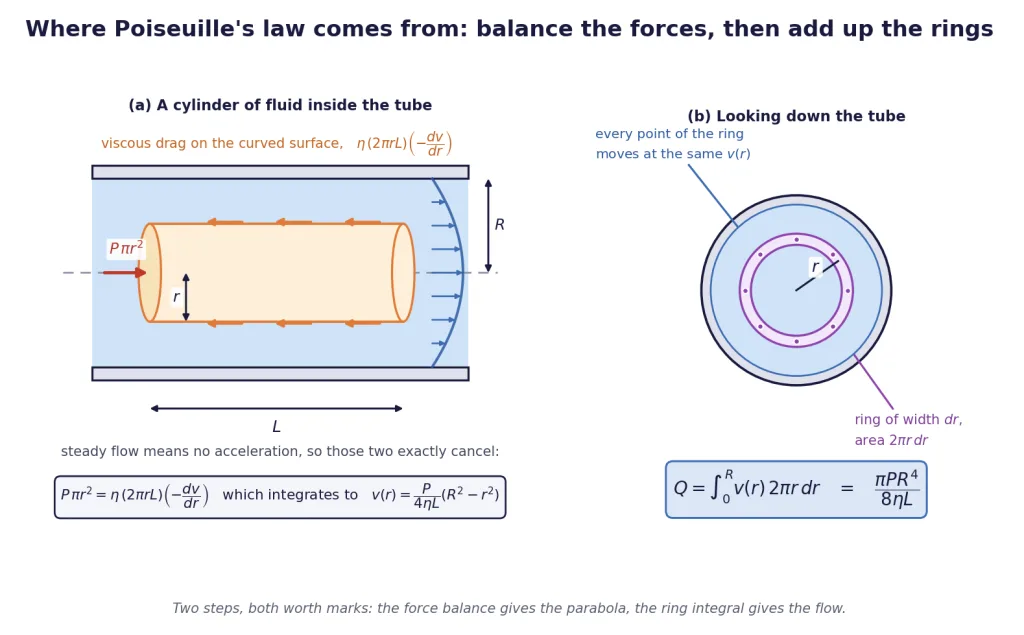
Take a tube of radius and length with a pressure difference between its ends. Inside it, imagine a coaxial cylinder of fluid of radius and the full length . Two horizontal forces act on it.
The pressure pushes it forwards. The pressure difference acts on its circular end face of area :
The fluid outside it drags it backwards. The cylinder's curved surface has area , and across that surface the outer fluid is moving more slowly, so it holds the cylinder back with the viscous force from Section 7: The minus sign is there because decreases as increases, so is negative and is the positive velocity gradient we want.
The flow is steady, so the cylinder is not accelerating, so those two are equal:
Integrate from a general out to the wall at , where the speed is zero:
Key Point — the velocity profile: A parabola. It is zero at the wall and greatest on the axis, where This is the formula Section 7 quoted and did not derive.
Step two: add up the rings
The speed is different at every radius, so we cannot just multiply one speed by the whole area. Instead, chop the cross-section into thin rings.
A ring at radius of width has area , and every point on it moves at the same speed . So the volume crossing that ring per second is , and the total is
Pull the constants out:
Key Point — Poiseuille's law: is the volume flow rate in m/s, the pressure difference between the ends, the radius of the tube, its length, the viscosity. Here means the tube's radius — the same thing the derivation called .
One free result worth remembering
The mean speed across the pipe is the flow rate divided by the area:
Compare that with and you get a clean fact:
Key Point: For laminar flow in a circular pipe, the average speed is exactly half the speed on the axis: .
[JEE Tip] Watch which speed a question is handing you. "The liquid flows at 2 m/s" almost always means the mean speed, the one you get from , and that is also the speed to use in the Reynolds number. If a question says "the maximum velocity" or "the velocity at the axis", halve it before you use it anywhere else.
The Fourth Power, and Why It Runs the World
Look again at what came out of that integral:
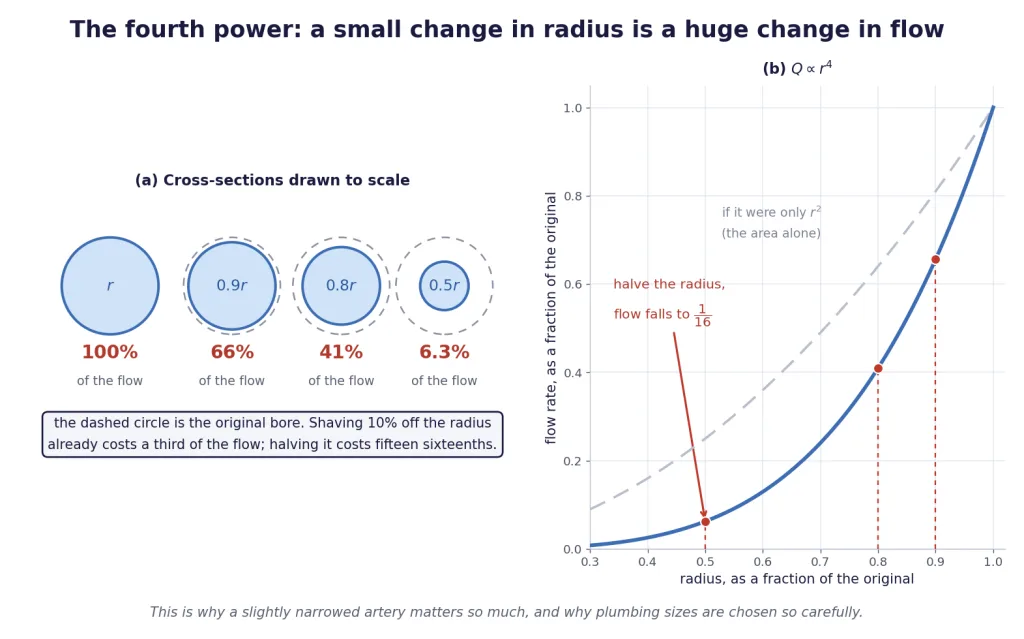
Not . Not , even though the area of the pipe goes as . The fourth power.
Where does the extra come from? A wider pipe carries more fluid for two separate reasons at once: there is more cross-section to flow through (that is the ), and the fluid in the middle is further from the wall so it is dragged less and moves faster (that is another ). Multiply the two effects and you get .
What the fourth power feels like
| Change to the radius | Flow rate becomes |
|---|---|
| radius | times |
| radius | , that is 6.3% |
| radius | , that is 1.2% |
| radius down by 10% (to ) | , that is 66% |
| radius down by 20% (to ) | , that is 41% |
| diameter doubled | 16 times, since doubling doubles |
Read the fourth row again. Shaving a mere tenth off the radius costs a third of the flow. That is not intuition-friendly, and it is why this result gets asked so often.
Arteries
An artery narrowed by fatty deposits is the standard application, and it is a fair one. Suppose the deposits reduce the effective radius by 20%. The flow falls to 41% of what it was — the tissue downstream now gets less than half its blood supply.
To push the original flow back through the narrowed artery, the pressure difference must rise by the reciprocal: The heart must work about two and a half times as hard across that section. A 20% narrowing you would barely see on a scan demands a 144% increase in driving pressure. That is the physics behind why arterial narrowing is dangerous out of all proportion to how small it looks.
[NEET Important] The body exploits the same law in reverse. Widening a vessel by only 19% doubles its flow, so very small changes in the muscle tone of an arteriole can redirect blood around the body with almost no change in the heart's output. That is what "vasodilation" means quantitatively.
Plumbing, needles and everything else
- Pipe sizing. Replacing a 15 mm pipe with a 22 mm one — barely a change you would notice by eye — multiplies the flow it can carry at the same pressure by .
- Hypodermic needles. Needle gauges are graded by bore, and a nurse choosing a wider needle is not being rough; a small increase in bore makes the injection enormously faster at the same push on the plunger.
- A blocked filter or a furred kettle element. Deposits reduce the bore a little and the flow collapses a lot.
- Blowing through a straw versus a drinking straw twice as wide. Try it. The wide one is not twice as easy; it is sixteen times as easy.
The other three dependences, briefly
The fourth power gets all the attention, but do not lose the rest of the formula:
- . Double the pressure difference, double the flow. This is exactly the linear relationship that makes the electrical analogy in the next block work.
- . Double the length of the pipe, halve the flow.
- . Thick liquids crawl. Glycerine, at 830 times the viscosity of water, flows 830 times slower through the same tube under the same pressure.
[Board Important] A stock question: "On what factors does the rate of flow of a liquid through a capillary tube depend?" The full-mark answer lists all four with their powers: directly on the pressure difference, directly on the fourth power of the radius, inversely on the length, and inversely on the coefficient of viscosity.
Viscous Resistance: Pipes Behave Like Resistors
Ohm's law, rewritten for fluids
Poiseuille's law says is directly proportional to . Any relationship of that shape can be written as "effort equals resistance times flow", so let us do exactly that:
Key Point — viscous resistance: is the viscous resistance of the tube. Its SI unit is Pa s/m. It depends on the tube (, ) and on the liquid () and on nothing else — not on how fast the liquid happens to be flowing.
Now line it up against the electricity you already know:
| Electricity | Fluid flow |
|---|---|
| potential difference | pressure difference |
| current | volume flow rate |
| resistance | viscous resistance |
| resistivity and geometry: | viscosity and geometry: |
The correspondence is not a loose analogy; the two equations have the same algebraic form, so every result you know about resistor networks transfers across unchanged.
Tubes in series
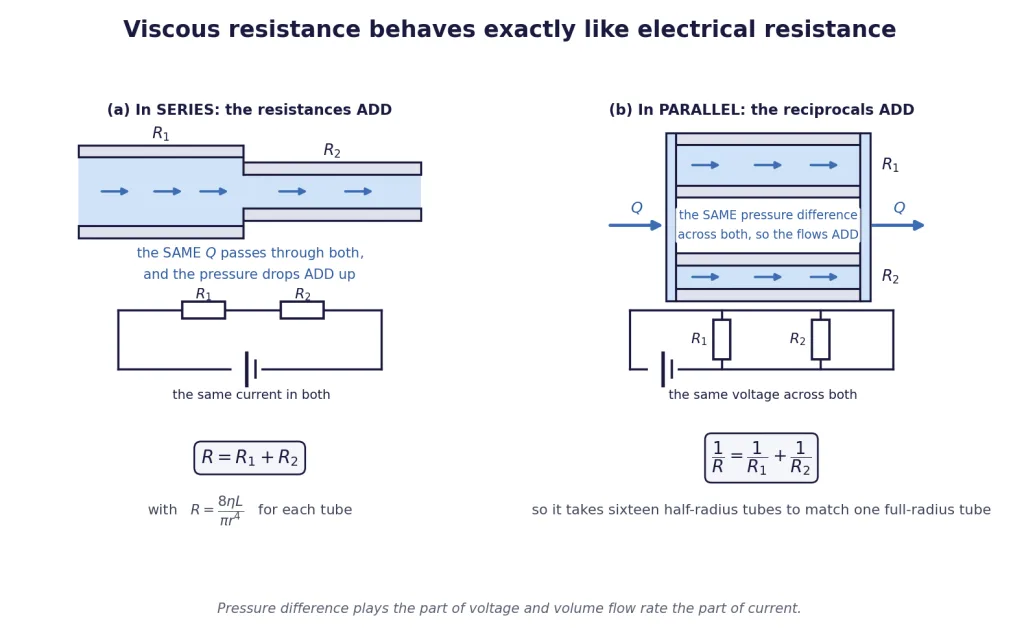
Join two tubes end to end and drive fluid through the pair.
The flow rate is the same in both — whatever goes into the first must come out of the second, or fluid would be piling up at the join. (This is just the equation of continuity from Section 4.)
The pressure drops add, because the total drop from one end of the assembly to the other is the drop across the first plus the drop across the second.
Key Point: In series: same , pressure drops add, resistances add. The narrower tube takes the larger share of the pressure drop — and because of the fourth power, that share can be overwhelming.
Here is what "overwhelming" means. Put a tube of radius in series with one of radius and the same length. Then , the total is , and the pressure drops split . The narrow tube, which is no longer than the wide one, eats 94% of the total pressure drop. The wide tube is very nearly irrelevant.
[JEE Tip] That is a general and very useful principle: in a series pipeline, the narrowest section dominates everything. If a question gives you three tubes in series with one much narrower than the others, you can usually get the answer to two significant figures by ignoring the wide ones entirely — and then check.
Tubes in parallel
Now put two tubes side by side between the same pair of junctions.
The pressure difference across each is the same, because both have the same pressure at each end.
The flow rates add, because the fluid that arrives at the junction has to go down one branch or the other.
Key Point: In parallel: same , flows add, reciprocals of the resistances add. The combination always carries more than either branch alone.
The fourth power makes this counting exercise vivid. How many tubes of radius , all the same length, do you need in parallel to carry as much as one tube of radius ? Each has 16 times the resistance, so you need sixteen of them. Sixteen half-width straws to replace one full-width straw.
Turn that round and it explains something real: many thin channels are a poor substitute for one wide one. The total cross-sectional area of sixteen half-radius tubes is , which is four times the area of the single tube — and yet they only just match it for flow. All that extra wall is what costs you.
[JEE Tip] For a network, do it exactly as you would a circuit: reduce parallel groups, then add the series chain, then get the total from , then work backwards for the individual flows and pressure drops. Never try to apply Poiseuille's law to a whole network in one go.
Reynolds Number: When Does the Whole Picture Collapse?
Everything in this section so far — the parabolic profile, Poiseuille's law, the resistance analogy — assumed laminar flow. Section 4 drew the difference between laminar and turbulent flow as a picture and promised a number that decides between them. Here it is.
The idea: which force is winning?
Two effects compete in any flow.
- Inertia wants to keep each parcel of fluid going the way it was going, and to amplify any wobble into a full swirl. Inertial effects scale like .
- Viscosity wants to damp any wobble out, dragging fast fluid back into step with its neighbours. Viscous effects scale like .
Take the ratio of those two and everything with units cancels:
Key Point — the Reynolds number: the density of the fluid, the mean speed of flow, the diameter of the pipe, the viscosity. is a pure number with no units at all — check it: cancels completely.
It measures inertial forces divided by viscous forces. Large means inertia is winning and the flow tears itself into eddies. Small means viscosity is winning and the flow stays in neat layers.
Read as one symbol, not as multiplied by .
The bands
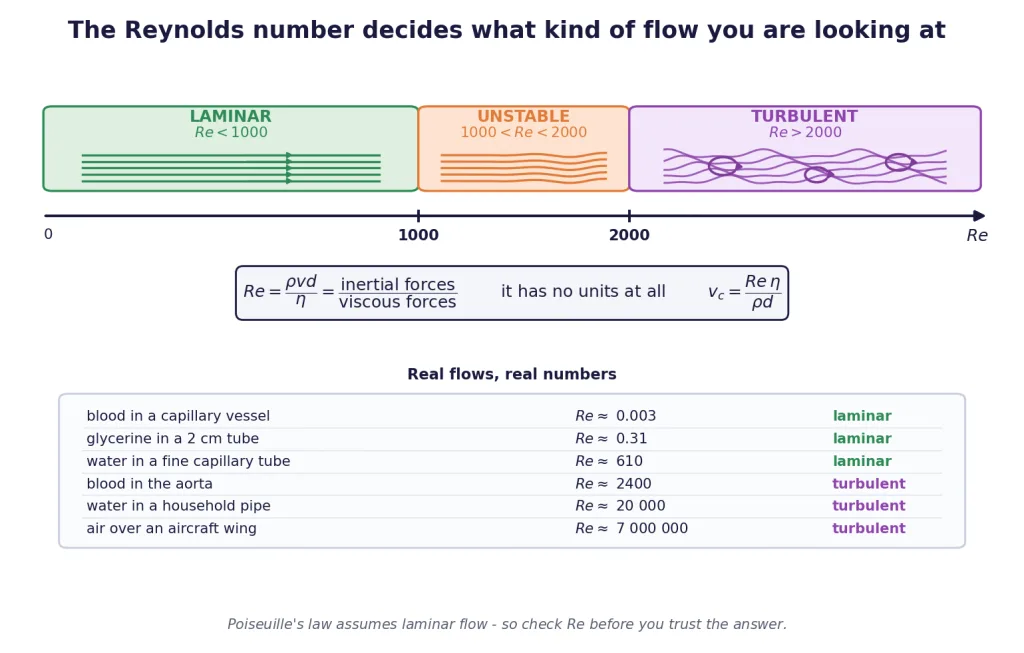
Key Point — what the number tells you:
Reynolds number Character of the flow laminar — steady, layered, Poiseuille's law applies unstable — it may be either, and small disturbances decide turbulent — eddies, mixing, and none of this section's formulas apply
Do not treat those boundaries as exact physical constants. They depend on how smooth the pipe is and how gently the fluid entered it; a very carefully prepared flow can stay laminar to a much higher . What they are is the working range every examination uses.
[JEE Tip] A single threshold near 2000 is sometimes quoted rather than the two-band picture, and is sometimes defined using the radius instead of the diameter, which halves every value. If a question gives you the threshold to use, use theirs. If it does not, use = diameter with the bands above, and say which convention you used.
Critical velocity
Turn the definition round and ask: at what speed does a given flow cross out of the laminar band?
Key Point — critical velocity: where is the threshold value being used, usually 1000 or 2000. Above the flow is turbulent.
Read the dependences: is large for a thick fluid (large ), a light fluid (small ) and a narrow tube (small ). Those three conditions are exactly the "slow, narrow, light and syrupy stays laminar" rule of thumb from Section 4, now made quantitative.
Two numbers make the point. Water in an ordinary 2 cm household pipe has Ten centimetres per second. Water coming out of a tap moves far faster than that, so the flow in your household plumbing is turbulent essentially all of the time — which is why you can hear it. Glycerine in the same pipe has so glycerine is laminar under any condition you will ever meet.
Where the same number governs a model and the real thing
There is one more reason matters, and it is the reason wind tunnels exist.
Because is dimensionless, two flows with the same Reynolds number behave in geometrically identical ways, whatever their actual sizes and speeds. A one-tenth-scale model of an aeroplane wing, tested at a Reynolds number matching the real wing's, produces a flow pattern that is a faithful scaled copy of the real one — same separation points, same wake, same lift coefficient. This is called dynamical similarity.
It also tells you how hard that is to arrange. A real wing with a 2 m chord at 50 m/s in air has To match that on a one-tenth model in ordinary air you would need m/s, which is faster than sound and therefore useless. In a water tunnel, where is about fifteen times larger, you would need 33 m/s — still fast, but possible. Real wind tunnels get round it by using pressurised air, which raises without touching .
[NEET Important] Blood in the aorta, with cm, m/s, kg/m and Pa s, has — just over the line. Aortic flow really is on the edge of turbulence, which is why a stethoscope picks up sounds there. In a capillary vessel, m and mm/s give : about a million times more laminar, and Poiseuille's law describes it beautifully.
Pulling It Together
The whole section on one page
| Quantity | Formula | The thing to remember |
|---|---|---|
| Velocity profile | a parabola, zero at the wall | |
| Maximum speed | on the axis | |
| Mean speed | exactly half the axial speed | |
| Poiseuille's law | the fourth power of | |
| Viscous resistance | , just like | |
| Series | same , pressure drops add | |
| Parallel | same , flows add | |
| Reynolds number | dimensionless; is the diameter | |
| Critical velocity | the speed at which laminar ends | |
| The bands | laminar, turbulent | in between it is unpredictable |
The six traps
Trap 1 — using the diameter as the radius in Poiseuille's law. The formula is in . Feeding a diameter in makes your answer sixteen times too big. Halve it on paper before anything else.
Trap 2 — treating the dependence as . It is . If a question about a narrowing pipe gives you an answer that seems too mild, you probably squared when you should have raised to the fourth.
Trap 3 — using the diameter in as though it were a radius, or the other way round. takes the diameter. Getting this wrong changes every answer by a factor of two, which is exactly enough to move a flow across a band boundary.
Trap 4 — putting the maximum speed into the Reynolds number. takes the mean speed. If you were given , halve it first.
Trap 5 — applying Poiseuille's law without checking . The formula assumes laminar flow. Water through a household pipe is turbulent, and Poiseuille's law is simply wrong there. Always compute when the question is about a real, fast flow — and say what you found.
Trap 6 — mixing up which quantity is common in series and in parallel. End to end, is common. Side by side, is common. Get that right and the rest is the resistor algebra you already know.
The three-line checking habit
- Units. in m/s (and 1 litre m, 1 mL m). in Pa s/m. has no units at all — if yours comes out with units attached, something has gone in wrong.
- Size. A capillary tube passes fractions of a millilitre per second. A household pipe passes litres per second. If a capillary calculation gives you litres, check the radius conversion.
- The laminar check. Before you trust any answer from , compute and then . If comes out below 1000, say so — it turns your answer from a number into an argument.
[Board Important] The commonest long question here is: derive Poiseuille's expression for the volume flow rate through a horizontal capillary tube. The marks are in the steps — the force balance on the coaxial cylinder, the integration that gives the parabolic profile, the ring of area , and the final integral. Quoting the answer earns almost nothing.
Solved Examples
Constants used throughout, unless a problem states otherwise: m/s, Pa s, kg/m, Pa s, kg/m, Pa s, kg/m, Pa s, kg/m. Every pressure quoted below is a pressure difference between the ends of a tube, so the gauge-or-absolute question does not arise — a difference is the same either way.
Example 1: Glycerine through a tube, and is it laminar?
Glycerine of density 1260 kg/m and viscosity 0.83 Pa s flows through a horizontal tube of length 1.5 m and radius 1.0 cm. If the mass flow rate is kg/s, find the pressure difference between the ends of the tube. Then check whether the flow is laminar, as Poiseuille's law requires.
Solution:
Convert the mass flow rate into a volume flow rate, because Poiseuille's law is about volume:
Rearrange Poiseuille's law for the pressure difference:
Substitute, with m so that m: about Pa, which is under 1% of atmospheric pressure.
Now the laminar check, which the question is really about. First get the mean speed:
Then the Reynolds number, with the diameter m:
Verdict. is not merely below 1000, it is three thousand times below it. The flow is deeply laminar and Poiseuille's law was entirely entitled to be used.
Final Answer: Pa, and with the flow is firmly laminar.
Takeaway: Always finish this type of question with the Reynolds number. The number itself takes one line, and it converts your answer from "here is what the formula says" into "here is why the formula applies".
Example 2: Water through a capillary under a head of water
A horizontal capillary tube of radius 0.50 mm and length 10 cm is fed from a reservoir that maintains a head of 20 cm of water above the tube. Find (a) the driving pressure difference, (b) the volume flow rate, (c) the mean speed in the tube, and (d) check whether the flow is laminar. Take Pa s and m/s.
Solution:
(a) The driving pressure is the hydrostatic pressure of the head, from Section 2. It is a pressure difference across the tube, so no atmospheric term is needed on either side:
(b) Poiseuille's law, with m so m: which is 0.481 mL per second, so it would take 20.8 s to collect 10 mL.
(c) The mean speed:
(d) The Reynolds number, with m:
Verdict. , comfortably below 1000, so the flow is laminar and the answer stands. Note how much closer to the boundary this is than the glycerine case — water is a thin liquid and this tube is not that narrow.
Final Answer: (a) 1960 Pa; (b) m/s, or 0.48 mL/s; (c) 0.61 m/s; (d) , laminar.
Takeaway: A head of liquid is just a pressure difference in disguise. Convert it with in the first line and the rest of the problem is ordinary Poiseuille.
Example 3: Halving the radius
A liquid flows through a horizontal tube at a certain rate. (a) The tube is replaced by one of the same length but half the radius, with the same pressure difference. What happens to the flow rate? (b) By what factor must the pressure difference be increased to restore the original flow through the narrow tube? (c) What if instead the length is doubled and the radius left alone?
Solution:
(a) Everything except is fixed, so : The flow falls to one sixteenth, that is to 6.3% of what it was.
(b) To restore the flow, the pressure must make up exactly what the radius lost. Since and is to be unchanged, Sixteen times the push, just to get back where you started.
(c) Now change instead. Since , The flow simply halves.
Compare the two changes. Halving the radius costs you a factor of 16. Doubling the length costs you a factor of 2. Geometry of the bore matters far more than the length of the pipe — which is why a long wide hose beats a short narrow one every time.
Final Answer: (a) one sixteenth, 6.3%; (b) sixteen times the pressure; (c) the flow halves.
Takeaway: Do these as ratios and never compute two flow rates. Write as a product of the four factors, put in the ones that changed, and read the answer off.
Example 4: The narrowed artery
Deposits on the wall of an artery reduce its effective radius by 20%. (a) What fraction of the original blood flow does it now carry, at the same pressure difference? (b) By what factor must the pressure difference rise to restore the original flow? (c) Repeat both parts for a 10% reduction in radius.
Solution:
(a) The new radius is , so The artery carries 41% of its former flow — less than half.
(b) The pressure must rise by the reciprocal: Two and a half times the driving pressure across that section.
(c) For a 10% reduction, the radius is : A tenth off the radius costs a third of the flow.
Why this is medically serious. A 20% narrowing is a small change in a picture and a catastrophic one in a flow. The heart cannot raise the pressure in one artery alone; it raises the pressure everywhere, so a local narrowing forces a global increase in blood pressure.
Final Answer: (a) 41% of the flow; (b) 2.44 times the pressure; (c) 66% of the flow, needing 1.52 times the pressure.
Takeaway: Percentages get amplified by the fourth power. A 20% reduction in radius is a 59% reduction in flow, and that mismatch between what you see and what you get is the whole point of the question.
Example 5: Viscous resistance, computed and used
A horizontal tube of radius 1.0 mm and length 20 cm carries water at C. (a) Find its viscous resistance. (b) What pressure difference drives a flow of m/s through it? (c) What is the resistance of an otherwise identical tube of radius 0.50 mm?
Solution:
(a) Straight from the definition, with m:
(b) Then use , exactly as you would use :
(c) Halving the radius multiplies the resistance by 16:
Check the direction of every effect. Longer tube, more resistance. Thicker liquid, more resistance. Narrower tube, enormously more resistance. All three agree with .
Final Answer: (a) Pa s/m; (b) 50.9 Pa; (c) Pa s/m.
Takeaway: Once you have , the pipe is a resistor and the problem is a circuit problem. Compute first in any question with more than one tube in it.
Example 6: Two tubes in series
A tube of radius and length is joined end to end to a tube of radius and the same length . A pressure difference of 1000 Pa is applied across the pair. Find (a) the ratio of the two resistances, (b) the pressure drop across each tube, and (c) the flow rate as a fraction of what the wide tube alone would carry.
Solution:
(a) Resistance goes as , and the lengths are equal:
(b) In series the same passes through both, so the pressure drops are in the ratio of the resistances, . The total resistance is , so The narrow tube, no longer than the wide one, takes 94% of the pressure drop.
(c) The flow through the pair: so the pair carries of what the wide tube would carry on its own. Adding the narrow tube has choked the line almost completely.
Final Answer: (a) ; (b) 58.8 Pa and 941 Pa; (c) , about 5.9%.
Takeaway: In a series pipeline the narrowest section decides everything. Estimating the whole line by its narrowest tube alone would have given instead of — an error of 6%, which is usually good enough for a first look.
Example 7: How many thin tubes replace one thick one?
(a) How many tubes of radius , each of length , must be connected in parallel to carry the same flow as a single tube of radius and length at the same pressure difference? (b) Compare the total cross-sectional area of the bundle with that of the single tube, and comment.
Solution:
(a) Each thin tube has 16 times the resistance, so each carries of the flow of the wide tube at the same pressure. Flows in parallel add, so you need Equivalently, in resistance language: equal resistances in parallel give , and setting that equal to gives .
(b) The areas. One thin tube has area , so sixteen of them have which is four times the area of the single wide tube.
Comment. You need four times the total bore area to move the same volume per second. All that extra area is extra wall, and the wall is where the fluid is held back. The lesson is a real engineering one: one wide pipe always beats a bundle of thin ones of the same total area.
Final Answer: (a) 16 tubes; (b) the bundle has four times the cross-sectional area, yet only matches the single tube.
Takeaway: Count in resistances, not in areas. Area reasoning would have told you four thin tubes were enough, and it would have been wrong by a factor of four.
Example 8: Where does the parabola put the speed?
For the glycerine flow of Example 1, find (a) the maximum speed, on the axis, and (b) the speed halfway between the axis and the wall. Take the mean speed as m/s.
Solution:
(a) The mean speed is exactly half the axial speed, so about 2.0 cm/s.
(b) Use the profile at :
Notice where the fluid actually is. At half the radius the speed is still three quarters of the maximum — the parabola is very flat near the axis. Nearly all of the shearing happens in the outer part of the pipe, and that is where the pressure drop is generated.
Final Answer: (a) 2.02 cm/s on the axis; (b) 1.52 cm/s at half the radius.
Takeaway: Mean speed and maximum speed differ by a factor of two, and questions use both. Use the mean speed in and in the Reynolds number; use the maximum only when the question asks about the axis.
Example 9: Is the water in your pipes laminar?
Water at C flows through a household pipe of diameter 2.0 cm at a mean speed of 1.0 m/s. (a) Find the Reynolds number. (b) Find the critical velocity for this pipe, taking the turbulent threshold as . (c) Comment.
Solution:
(a) Straight into the definition, with the diameter:
(b) Rearrange for the speed at which would equal 2000:
(c) Comment. The actual speed is ten times the critical velocity and is ten times the turbulent threshold, so the flow is firmly turbulent. Poiseuille's law does not apply to it at all, and neither does the parabolic profile. That is also why running water is audible: turbulence makes noise, laminar flow does not.
A useful sanity number. Ten centimetres per second is a crawl. Almost any flow of water in a pipe you can see is turbulent, and the neat laminar formulas of this section belong to capillaries, to thick liquids, and to the very slow.
Final Answer: (a) ; (b) m/s; (c) firmly turbulent, so Poiseuille's law is not valid.
Takeaway: Critical velocities for water in ordinary pipes are tiny. If a question about water in a centimetre-scale pipe expects laminar flow, check — the question may be testing whether you notice.
Example 10: Blood, from the aorta to a capillary
(a) Blood flows through the aorta, of diameter 2.0 cm, at a mean speed of 0.30 m/s. Find its Reynolds number. (b) In a capillary vessel of diameter 8.0 m the speed is 1.0 mm/s. Find there. (c) Comment on both. Take kg/m and Pa s.
Solution:
(a) The aorta:
(b) A capillary vessel, with m and m/s:
(c) Two very different regimes in one body. In the aorta sits just above the turbulent threshold, so the flow there is on the edge of turbulence — especially in the peaks of each heartbeat, when the speed is well above its mean. That is exactly what a stethoscope hears. In a capillary vessel , roughly a million times smaller, so that flow is as laminar as anything gets, and Poiseuille's law describes it very well indeed.
The critical velocity in the aorta, for completeness: which the mean speed of 0.30 m/s already exceeds.
Final Answer: (a) ; (b) ; (c) the aorta is marginally turbulent, a capillary vessel is deeply laminar.
Takeaway: The same fluid can be turbulent in one vessel and perfectly laminar in another, because contains the size and the speed as well as the fluid. Never call a liquid "laminar" or "turbulent" — call the flow one or the other.
Example 11: Matching a model to the real thing
An aircraft wing of chord 2.0 m moves through air at 50 m/s. (a) Find the Reynolds number. (b) A one-tenth scale model is to be tested. What speed is needed in a wind tunnel using ordinary air? (c) What speed would be needed in a water tunnel instead? Take kg/m, Pa s, kg/m, Pa s.
Solution:
(a) The full-size wing, using the chord as the characteristic length:
(b) For dynamical similarity the model must have the same . In air, with m: Ten times smaller means ten times faster — and 500 m/s is faster than sound, so the test would be measuring compressibility effects that the real wing never meets. Useless.
(c) In water, where is about fifteen times larger than in air: Fast, but achievable — which is why water tunnels are used for exactly this kind of test.
Final Answer: (a) ; (b) 500 m/s in air, which is impractical; (c) 33 m/s in water.
Takeaway: Matching the Reynolds number is what makes a scale model mean anything. Shrink the model by ten and you must either speed it up by ten, or switch to a fluid with a larger , or raise the density by pressurising the tunnel.
Example 12: A tube that splits in two
A horizontal tube of radius and length splits into two parallel branches, each of radius and length , which rejoin further on. Find the resistance of the parallel pair as a multiple of the single tube's resistance, and say what fraction of the original flow the pair carries at the same pressure difference.
Solution:
Each branch has resistance , where is the resistance of the wide tube.
Two equal resistances in parallel halve:
At the same pressure difference, flow is inversely proportional to resistance: The pair carries one eighth of what the single wide tube would carry.
Compare the areas once more. The two branches together have area , which is half the single tube's area — and yet they carry an eighth, not a half. Splitting a flow into narrower channels is expensive, every time.
Final Answer: , and the pair carries of the original flow.
Takeaway: Do the resistance arithmetic, then convert to flow at the very end. Every parallel-and-series pipe question in this chapter is one line of resistor algebra followed by one division.