
Bernoulli's Principle: Conservation of Energy, Written for a Fluid
Section 4 left us with a fact and a puzzle. The fact is the equation of continuity: , so a fluid must speed up when the pipe narrows. The puzzle is why. A fluid element does not accelerate because the pipe tells it to. Something has to push it. And in a fluid the only thing available to push is a difference in pressure.
That single thought — that the speed-up needs a pressure difference to cause it — is the whole of this section. Daniel Bernoulli wrote it down in 1738, and it is nothing more than the work-energy theorem you met in mechanics, applied to a lump of moving fluid.
Notation
| Symbol | Means | Watch out |
|---|---|---|
| density of the flowing fluid | denotes resistivity in other chapters | |
| pressure at a point | say every time whether it is gauge or absolute | |
| atmospheric pressure, Pa | ||
| speed of the fluid at that point | the velocity vector is , always tangent to the streamline | |
| height above a chosen datum, not depth | pick the datum once and write it down | |
| area of cross-section | ||
| volume flow rate |
On pressure specifically, keep to the convention Section 2 sets up and never let it drift: absolute pressure is the real, total pressure, and gauge pressure is the amount by which it exceeds atmospheric,
Every worked solution below says which one it is using. That single habit prevents more wrong answers in this chapter than any other.
Setting up the derivation
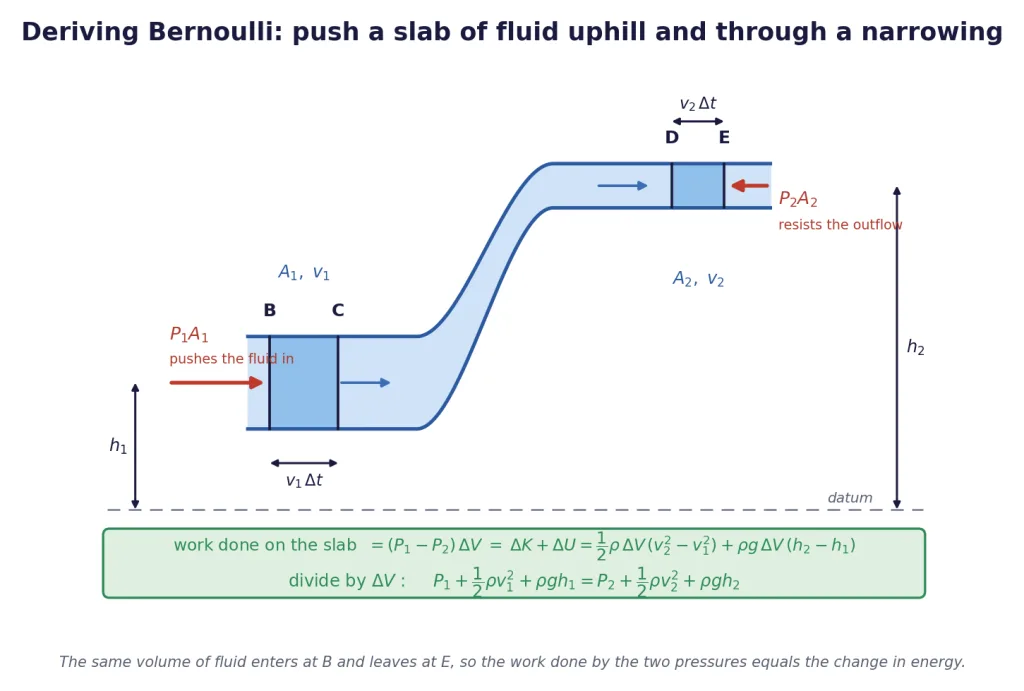
Take a pipe that both narrows and rises. Pick two stations along it:
- station 1, where the area is , the speed is , the pressure is and the height above our datum is ;
- station 2, where the same quantities are , , and .
Now watch the fluid that at some instant fills the region from B to D. A short time later, that same fluid fills the region from C to E. In effect, a slab of fluid has disappeared from BC and an identical volume has appeared at DE.
Two things make that "identical volume" claim exact:
- the flow is steady, so nothing in between changed;
- the fluid is incompressible, so by continuity the volume in equals the volume out:
The mass of that slab is .
The work done by the pressures
The fluid behind station 1 pushes the slab forward with a force , through a distance :
The fluid ahead of station 2 pushes back with a force , while the slab advances against it, so that work is negative:
Notice how neatly and have combined: pressure times area times distance is pressure times volume, and the volume is the same at both ends. So the total work done on the slab by the surrounding fluid is
Gravity's work is going to be counted as a change in potential energy instead, so it must not be counted again here. And the side walls do no work, because the force they exert is perpendicular to the wall while the fluid slides along it.
The energy the slab gained
Kinetic energy. The slab that vanished from BC had speed ; the one that appeared at DE has speed . So
Potential energy. The same mass moved from height to height :
Putting them together
The work-energy theorem says the work done on the slab equals the change in its total mechanical energy:
Every term carries , so divide it out — and with it goes the last trace of how big our slab was:
Collect the station-1 quantities on the left and the station-2 quantities on the right:
Key Point — Bernoulli's equation: and since stations 1 and 2 were any two points on the same streamline,
[Board Important] The derivation is a standard five-mark question. The five marks are: (i) the same volume passes both stations, by continuity; (ii) work done by pressure ; (iii) ; (iv) ; (v) work-energy theorem and divide by . Write those five steps in that order and you cannot lose a mark.
A first sanity check: switch the flow off
Set . Bernoulli collapses to
which is exactly the hydrostatic result of Section 2 — pressure rises by as you go down. A new law that reproduces the old one when the new ingredient is switched off is a law worth trusting.
Reading the Three Terms
Look hard at what we just derived:
Three things are being added. Whatever they are, they must all have the same units, and since the first one is a pressure, all three are pressures. Check it:
- has units kg/m³ times m²/s², which is kg/(m s²) — that is N/m², a pascal.
- has units kg/m³ times m/s² times m, which is again kg/(m s²).
Good. Three pressures that add to a constant. Each has a name and each means something physical.
| Term | Name | What it is | Zero when |
|---|---|---|---|
| static pressure | the pressure a gauge moving along with the fluid would read; the real, mechanical push the fluid exerts on its surroundings | never, in absolute terms | |
| dynamic pressure | the kinetic energy of the fluid per unit volume; the extra pressure you would get by bringing the fluid to rest | the fluid is at rest | |
| the potential term | the gravitational potential energy per unit volume | at the datum |
Key Point: The dynamic pressure is not a pressure you can measure with a gauge in the flow. It is an energy density that happens to have the units of pressure. It only turns into real pressure when the fluid is actually stopped.
Stagnation pressure, and what the dynamic term really buys you
Put a small obstacle in a stream and, right at the nose, one streamline runs straight into it and the fluid there is brought to rest. That point is called a stagnation point. Apply Bernoulli along that streamline, at the same height:
So the dynamic pressure is exactly the rise in pressure at a stagnation point. That is the honest physical meaning of , and it is why a Pitot tube — a tube with its open mouth facing into the flow — can measure a speed by measuring a pressure.
The head form: the same equation measured in metres
Divide the whole equation by . Every term then has the units of length, and lengths are far easier to picture than pascals.
Key Point — the head form: The three pieces are the pressure head, the velocity head and the elevation head, and their sum is the total head. All four are measured in metres of the flowing fluid itself.
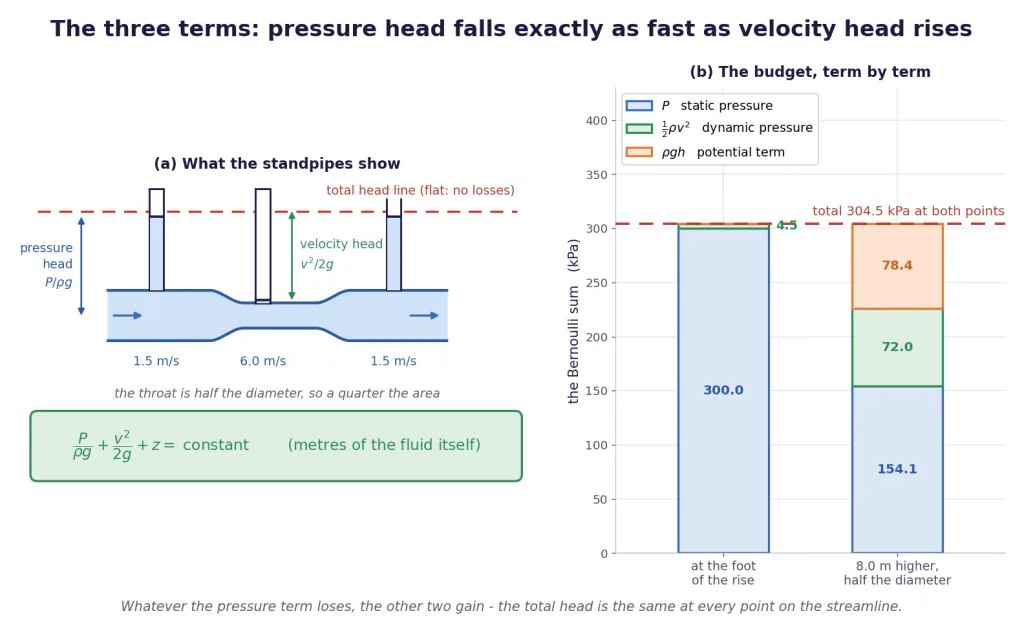
The picture above is the whole idea in one diagram. Solder thin vertical tubes — piezometers — into the wall of a horizontal pipe and let the water climb up them. The height it reaches in each tube is the pressure head at that point. Where the pipe narrows, the column falls; where it widens again, the column climbs back. Draw a line through the tops of all the columns plus the velocity head at each station, and for an ideal fluid that line is dead flat. It is called the total head line, and Section 6 will use it constantly.
A number worth carrying in your head: since m, one atmosphere is about 10.3 metres of water. That is why a suction pump cannot lift water more than about 10 m, and why a water barometer would need a tube three storeys tall.
The two special cases that cover most problems
Horizontal pipe. If , the elevation term is the same on both sides and simply cancels:
Roughly three quarters of every Bernoulli question you will ever be set is this one line plus continuity.
Fluid at rest. If , we are back to hydrostatics, as shown at the end of the last block.
A useful shortcut for small changes
When the speed changes only a little, write with small. Then
[JEE Tip] That last form, , is the fastest way to answer "by what percentage must the speed over the wing exceed the speed under it?" — and it is accurate to a few per cent whenever the speed difference is under about 10%.
Faster Means Lower Pressure — and Why That Is Not a Paradox
Here is the line that everyone quotes and almost nobody explains:
Key Point: Along a horizontal streamline, where the fluid is moving faster, its static pressure is lower.
Students find this genuinely strange, and they are right to. Fast-moving water from a hose feels like it is pushing harder, not less hard. So let us take the objection seriously.
The resolution: the pressure drop came first
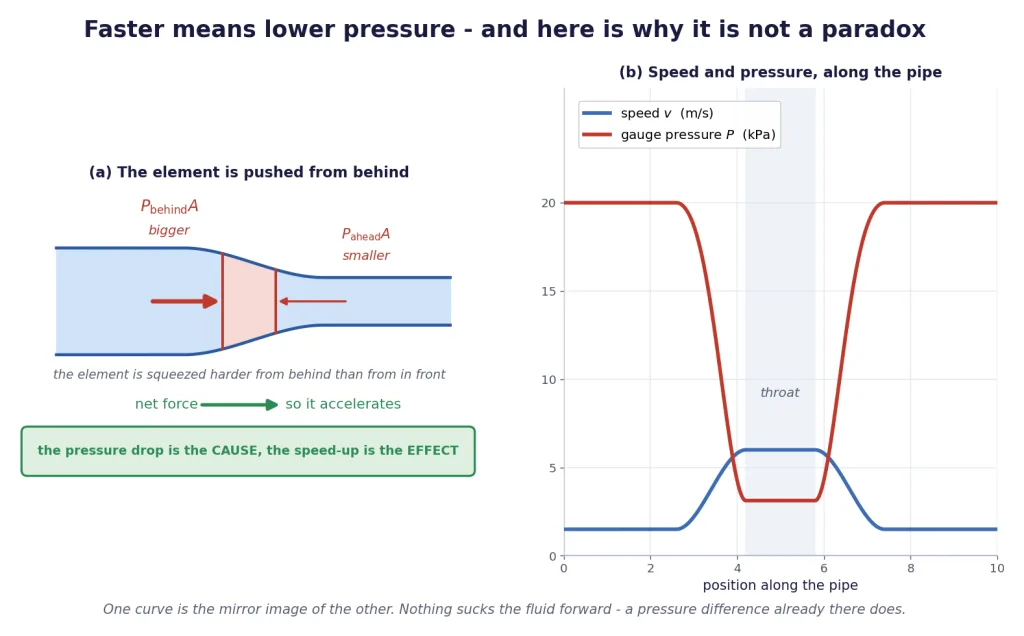
Forget energy for a moment and use Newton's second law instead. Follow one small element of fluid as it enters a narrowing section. Continuity says it is about to speed up. Speeding up means accelerating. Accelerating requires a net forward force.
The only forces on that element are the pressures on its two faces. For the net force to point forward, the pressure behind it must exceed the pressure ahead of it. So:
That is not a consequence of the element being fast. It is the reason the element becomes fast.
Key Point — read the causation in the right direction: The fluid does not lose pressure because it is moving quickly. A pressure difference was set up along the pipe, that difference pushed the fluid, and the pushing is what made it quick. Low pressure and high speed are the two ends of one and the same push.
Once you see it that way the strangeness evaporates. It is exactly the same as a ball rolling down a slope: the ball is fast at the bottom and its potential energy is low at the bottom, and nobody finds that paradoxical. Bernoulli's is playing the role of the potential energy and the role of the kinetic energy.
Three traps that this idea sets
Trap 1: the two points must lie on the same streamline. Bernoulli's constant is a constant along a streamline. Two points in different parts of a flow, connected by no streamline, need not share it. Comparing the pressure in one pipe with the pressure in an entirely separate pipe using Bernoulli is meaningless.
(There is a genuine special case in which the constant is the same everywhere: irrotational flow, in which the fluid elements do not spin about their own axes. Almost every flow drawn in a Class 11 problem is treated this way, which is why comparing points above and below a wing is allowed. But you should know that this is an extra assumption and not part of the derivation above.)
Trap 2: a free jet is not at low pressure. A jet of water leaving a nozzle into the open air travels fast, so students conclude the pressure inside the jet must be far below atmospheric. It is not. The static pressure inside a free jet, with straight parallel streamlines, is atmospheric — the air around it is at and there is no pressure gradient across straight streamlines, so the jet must match. The that the jet carries is dynamic pressure, and you only feel it when you put your hand in the way and stop the water. That sensation of the hose pushing hard is a stagnation pressure, not a static one.
Trap 3: the thumb over the hose is continuity, not Bernoulli. Covering most of the hose mouth makes the water shoot out faster. The reason is that must stay roughly constant, so shrinking raises . Bernoulli then tells you that the pressure at the constriction is lower than it was up the hose — but the speed-up itself is a continuity result. Get the order right: continuity gives you the speeds, Bernoulli then gives you the pressures.
The rule of thumb that follows
Since and trade off against each other along a horizontal streamline, and since streamlines crowd together wherever the flow is fast (Section 4), you can read a streamline picture straight off:
| In the picture | Speed | Static pressure |
|---|---|---|
| streamlines crowded close | high | low |
| streamlines spread wide apart | low | high |
| pipe narrows | rises | falls |
| pipe widens | falls | rises |
[NEET Important] Learn that table as a picture, not as words. A very large number of one-mark questions are answered by glancing at a diagram and asking "are the lines close together here?".
The Assumptions — and Exactly Where Each One Breaks
Bernoulli's equation is not a law of nature in the way that conservation of energy is. It is conservation of energy plus a list of simplifications, and every one of those simplifications fails somewhere. Knowing where is what separates a student who can quote the equation from one who can use it.
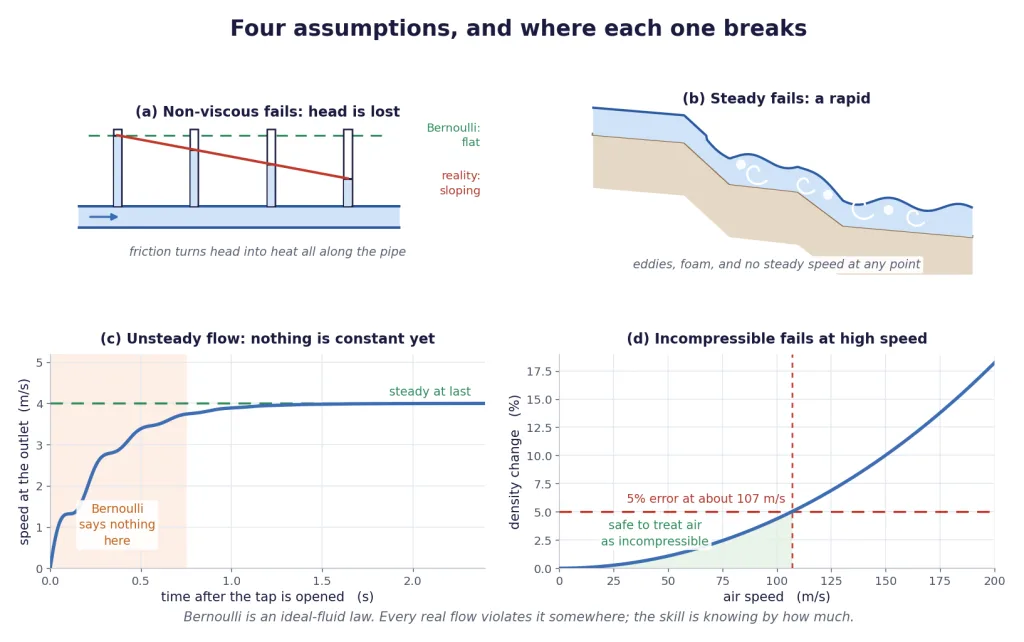
| Assumption | What it means | Where it fails | How badly |
|---|---|---|---|
| Steady flow | at each point the velocity does not change with time | a tap being opened, a valve slammed shut, a pump starting | completely, for the first fraction of a second |
| Incompressible | is the same at both stations | any gas moving fast | 0.4% of the density at 30 m/s, 4.4% at 100 m/s, 13% at 170 m/s |
| Non-viscous | no internal friction, so no energy turns into heat | every real pipe, and badly in narrow ones | the total head line slopes downward instead of running flat |
| Irrotational | elements do not spin about their own axes | wakes, eddies, the layer right against a wall | the constant differs from one streamline to the next |
| Along one streamline | the two points are joined by a path the fluid actually takes | comparing two unconnected regions | the comparison is simply not licensed |
| No shaft work | no pump or turbine sits between the two points | across a pump, a fan, a turbine | energy is added or taken out, so the sum is not constant |
Let us take the important ones properly.
Viscosity: the total head line always slopes down
Real fluids have internal friction. Layers slide past one another, rub, and turn ordered mechanical energy into disordered thermal energy. Section 7 makes this quantitative with the coefficient of viscosity ; here we only need the consequence.
Along a long, uniform, horizontal pipe, Bernoulli predicts something startling: since is constant, is constant, and since the pipe is horizontal, is constant — therefore is constant too. Bernoulli predicts no pressure drop at all along a long pipe. Anyone who has watched water dribble out of the far end of a long garden hose knows that is wrong. The pressure does drop, steadily, all the way along, and the drop is precisely what a pump has to work against.
So in engineering practice the equation is written with a loss term:
where is the head lost to friction between the two points, and it is never negative. That is why the red line in panel (a) of the figure slopes down while the ideal green one does not.
[JEE Tip] Bernoulli is a good approximation when the flow is fast, the distance is short and the passage is wide — a nozzle, a throat, a hole in a tank, air over a wing. It is a poor one when the flow is slow, the distance is long or the passage is narrow — a capillary, a long pipeline, a syringe needle. Section 8 gives you the criterion.
Turbulence: why the equation cannot describe a rapid
This one deserves its own paragraph, because it is the sharpest failure of the lot.
Picture a mountain stream tumbling over rocks. Water foams, boils, curls back on itself, throws up spray. Now try to apply Bernoulli to it and watch every assumption fall over at once:
- There is no steady velocity to put in. Stand at one point in the rapid and the velocity there changes wildly from instant to instant, in size and direction. The symbol has no single value to take.
- There are no clean streamlines. The paths cross, loop and break up. A "tube of flow" cannot be drawn, so there is no path along which the constant is constant.
- Energy is leaving the flow the whole way down. The eddies grind against one another, and their energy ends up as heat and as sound — the roar of the rapid is literally the mechanical energy of the water being radiated away.
The size of that last effect is not small. Take water entering a rapid at 1.0 m/s and dropping 3.0 m. Bernoulli, with the free surface at atmospheric pressure top and bottom, predicts an exit speed of
Real rapids deliver nothing like that; measure 3 m/s at the bottom and you would not be surprised. The energy budget then reads: 29.9 J per kilogram available, 4.5 J per kilogram present as kinetic energy at the bottom, and 25.4 J per kilogram — about 85% of the total — gone. It has become heat and noise. (Example 8 works the whole budget through, temperature rise included.)
Key Point: Bernoulli's equation applies to steady, streamline flow. Turbulent flow is not merely a harder case of it; it is outside the equation's domain altogether, because the quantities the equation is written in terms of do not exist.
Compressibility: when is a gas allowed to be a liquid?
Air is obviously compressible, yet we cheerfully apply Bernoulli to it whenever we talk about wings and spinning balls. The justification is quantitative. The fractional change in density that a flow of speed produces is roughly , where and the speed of sound in air is about 340 m/s. Working it out exactly:
| Air speed | Density change | Verdict |
|---|---|---|
| 30 m/s (a strong gale) | 0.39% | perfectly safe |
| 100 m/s (a light aircraft) | 4.4% | acceptable for estimates |
| 170 m/s (half the speed of sound) | 13.0% | Bernoulli is now the wrong tool |
The usual working rule is that a gas may be treated as incompressible below about a third of the speed of sound, which is roughly 110 m/s. Every air problem in this chapter sits comfortably under that.
Gauge or absolute? Settle it before you substitute
This is the single commonest source of wrong answers in the chapter, so here is the rule in full.
Bernoulli is an equation about a difference of pressures. If you subtract the same constant from both and , the equation is unchanged, because the terms cancel:
Key Point: You may use gauge pressure at every point, or absolute pressure at every point. Both give the same answer. What you must never do is mix them — read a gauge value at one station and an absolute value at the other. That error puts you out by Pa, which usually swamps everything else in the problem.
There are two situations where the choice stops being free:
- When the question asks for an absolute pressure, or gives you one — a barometric reading, a vacuum, a sealed tank quoted in absolute terms. Then convert everything to absolute and answer in absolute.
- When zero pressure matters physically. Ask "how fast can the water go before the pressure at the throat falls to nothing?" and the answer depends entirely on how far the pressure has to fall — which is the absolute pressure, not the gauge one. Doing that problem in gauge units gives an answer that is wrong by a factor of about 1.7. Example 5 shows this happening.
[Board Important] State, in one short line at the top of every numerical solution, which convention you are using: "All pressures below are gauge pressures." It costs you five seconds and it is worth full marks.
Using It: a Method, and the Traps
The five-step method
Almost every Bernoulli problem yields to the same routine.
- Draw the streamline and mark two points on it. One point should be where you know the most. Label them 1 and 2, and make sure a fluid particle really can travel from one to the other.
- Choose a datum and write it down. Anywhere convenient — usually the lower of the two points, which then has . Heights are measured upward from it.
- Choose gauge or absolute, and say so.
- Use continuity first to get whatever speeds you can: , or if a flow rate is given.
- Write Bernoulli in full, then strike out what is zero, and only then substitute numbers.
The reduced forms, ready to use
| Situation | What survives | Use it for |
|---|---|---|
| horizontal pipe | constrictions, Venturi meters, wings | |
| fluid at rest | hydrostatics, manometers | |
| both surfaces open to the air | efflux from a tank, siphons | |
| very wide tank feeding a small hole | Torricelli's law | |
| gas, over a small height change | drop entirely | aerofoils, spinning balls, chimneys |
That last row deserves justifying rather than asserting. For air, over a 2 m height difference is only Pa, while the dynamic pressure at aircraft speeds is tens of thousands of pascals — the height term is under a tenth of a per cent, and dropping it is honest. For water the comparison flips completely: over the same 2 m, is 19600 Pa, which at a typical pipe speed of 2 m/s is nearly ten times the dynamic pressure. Never drop for a liquid unless the problem is genuinely horizontal.
The six traps
Trap 1 — mixing gauge and absolute. Covered above, and worth repeating because it is the biggest one. Pick one convention per problem.
Trap 2 — using Bernoulli where continuity was wanted, or the reverse. Continuity is about areas and speeds and comes from conservation of mass. Bernoulli is about speeds and pressures and comes from conservation of energy. Nearly every problem needs both, in that order.
Trap 3 — comparing points not on the same streamline. Ask yourself: could a fluid particle actually get from point 1 to point 2? If not, do not write the equation.
Trap 4 — measuring downward. In , the symbol is a height above the datum, so it increases upward. If you set the datum at the top and measure depths downward, you must write . Half the sign errors in this chapter are this.
Trap 5 — forgetting that the answer does not depend on the datum. If you find yourself worrying about where to put the datum, relax: only differences of appear, so any datum gives the same answer. Example 9 checks this explicitly.
Trap 6 — applying it across a pump or a fan. A pump does work on the fluid, so the sum genuinely increases across it. Bernoulli holds on each side of the pump, not through it.
A checking habit
Before writing a final answer, run these three checks.
- Direction. Did the pressure fall where the pipe narrowed and rise where it widened? Did it fall as the pipe climbed? If not, you have a sign wrong.
- Size. A dynamic pressure of for water at a few m/s is a few kilopascals. For air at a few tens of m/s it is a few hundred pascals. If you are getting megapascals from a garden hose, something has slipped by a factor of a thousand — usually cm² read as m².
- The absolute pressure must be positive. If your working gives a negative absolute pressure, the flow you have described cannot happen; in reality the liquid would boil into vapour first. That is a real phenomenon, called cavitation, and it is what destroys badly designed pump impellers and ship propellers.
Everything on one page
| Quantity | Formula | Units |
|---|---|---|
| Bernoulli's equation | constant | Pa |
| head form | m | |
| horizontal case | Pa | |
| dynamic pressure | Pa | |
| stagnation pressure | Pa | |
| small-change shortcut | Pa | |
| gauge and absolute | Pa | |
| 1 atmosphere as head of water | 10.34 m | m |
Solved Examples
Constants used throughout this section, unless a problem states otherwise: m/s², kg/m³, kg/m³, Pa. Every solution states whether its pressures are gauge or absolute.
Example 1: The standard constriction, start to finish
Water flows steadily through a horizontal pipe that narrows from an internal diameter of 6.0 cm to 3.0 cm. At the wide section the speed is 1.5 m/s and the gauge pressure is Pa. Find (a) the speed at the narrow section, (b) the gauge pressure there, and (c) the volume flow rate.
Solution: All pressures in this solution are gauge pressures.
Areas first, halving each diameter before anything else.
(a) Continuity gives the speed — this step never involves pressure: Note the 4: the diameter halved, so the area went down by four, so the speed went up by four.
(b) Now Bernoulli, horizontal, so the terms cancel:
Check the three terms add to the same total at both stations.
| Station | (Pa) | (Pa) | (Pa) | Sum (Pa) |
|---|---|---|---|---|
| wide | 20000 | 1125 | 0 | 21125 |
| narrow | 3125 | 18000 | 0 | 21125 |
Identical, as they must be. The pressure gave up 16875 Pa and the dynamic term picked up exactly the same 16875 Pa.
- (c) The flow rate:
Final Answer: (a) 6.0 m/s; (b) 3125 Pa gauge (equivalently Pa absolute); (c) 4.24 L/s.
Takeaway: Continuity first, Bernoulli second, and never in the other order. Continuity hands you the speeds free of charge, and only then does Bernoulli have enough information to give you a pressure.
Example 2: A pipe that narrows and climbs at the same time
A water main at ground level has an internal diameter of 4.0 cm, carries water at 3.0 m/s and is at a gauge pressure of Pa. On the second floor, 8.0 m higher, the pipe has narrowed to 2.0 cm. Find the speed and the pressure there, in both gauge and absolute terms.
Solution: Datum at ground level, so and m. Working in gauge pressure and converting at the end.
Continuity. The diameter halved, so the area quartered:
Bernoulli in full, since neither the height nor the speed is unchanged:
The two losses, separately, because each is worth seeing:
Add them to the starting pressure:
In absolute terms:
Final Answer: 12 m/s, at Pa gauge, which is Pa absolute.
Takeaway: Compute the height cost and the speed cost separately and then add. Here they are comparable — 78 kPa for the lift and 68 kPa for the acceleration — and seeing them side by side tells you at once that neither may be neglected.
Example 3: The same problem in metres of water
Redo Example 2 in the head form, and confirm that the total head is the same at both points.
Solution: Datum at ground level; pressures gauge, so heads are gauge heads.
At the ground station:
At the second-floor station:
Identical. Set out as a ledger, the trade is completely transparent:
| Head | at the ground | on the second floor | change |
|---|---|---|---|
| pressure head | 30.612 m | 15.724 m | m |
| velocity head | 0.459 m | 7.347 m | m |
| elevation head | 0 | 8.000 m | m |
| total head | 31.071 m | 31.071 m | 0 |
The pressure head lost 14.888 m; the other two gained 6.888 m and 8.000 m, which add to exactly 14.888 m.
Final Answer: Total head 31.07 m at both points; the pressure head falls by 14.89 m and the other two heads take up precisely that amount.
Takeaway: The head form turns a Bernoulli problem into a bookkeeping exercise. Three columns, one total, and a mistake shows up instantly as a total that fails to match.
Example 4: What the dynamic term is worth
(a) Air at 1.2 kg/m³ flows past a strut at 50 m/s. Find the pressure rise at the stagnation point, and express it as a fraction of atmospheric pressure. (b) Repeat for water at 5.0 m/s, and express the answer as a head of water.
Solution:
(a) The stagnation rise is the dynamic pressure:
As a fraction of atmospheric: So even a stiff 180 km/h wind changes the pressure by under 2%. This is exactly why air can be treated as incompressible in these problems.
(b) For water at 5.0 m/s:
As a head:
Final Answer: (a) 1500 Pa, 1.48% of atmospheric; (b) 12500 Pa, which is 1.28 m of water.
Takeaway: Water is 833 times denser than air, so at the same speed its dynamic pressure is 833 times larger. That one ratio explains why a 5 m/s current will knock you over while a 5 m/s breeze goes unnoticed.
Example 5: The problem where gauge and absolute are not interchangeable
Water flows through a horizontal pipe. At the wide section the absolute pressure is Pa and the speed is 2.0 m/s. (a) How fast could the water be made to travel at a constriction before the absolute pressure there fell to zero? (b) What answer would you get if you carelessly fed the gauge pressure into the same equation? (c) Taking the vapour pressure of water at 20°C as 2340 Pa, what is the realistic limit?
Solution: This problem is about how far the pressure can fall, so it must be done in absolute pressure.
(a) Bernoulli, horizontal, with absolute:
(b) The careless route. The gauge pressure at the wide section is Feeding that in instead: That is wrong by a factor of 1.73, and the physical reason is easy to state: the pressure has Pa to give up, not Pa. Setting a gauge pressure to zero only means the pressure has fallen to atmospheric, which is nothing special at all.
(c) The realistic limit. Water does not survive down to zero pressure; it boils at its vapour pressure. Putting Pa absolute: Beyond this the water flashes into vapour and the flow cavitates.
Final Answer: (a) 17.4 m/s; (b) 10.1 m/s, wrong by a factor of 1.73; (c) 17.3 m/s, at which point the water starts to boil.
Takeaway: Whenever the question is about how far the pressure can fall, you must use absolute pressure. Gauge pressure hides the Pa of headroom that the atmosphere is quietly providing.
Example 6: The pressure it takes to hurry water along
Water flows at 4.0 m/s along a horizontal pipe. What pressure drop is needed to bring it to 4.4 m/s — a 10% increase? Compare the exact answer with the small-change shortcut .
Solution: Gauge or absolute makes no difference here, because only a difference of pressures is asked for.
Exact, from Bernoulli:
The shortcut, with m/s and m/s — but note the shortcut is usually quoted with the initial speed, so take :
The error: Under 5%, for a 10% change in speed. Using the average speed 4.2 instead reproduces the exact answer to every digit, since Pa exactly.
Final Answer: 1680 Pa exactly; the shortcut with the initial speed gives 1600 Pa, low by 4.8%, and the shortcut with the mean speed gives 1680 Pa exactly.
Takeaway: factorises as with no approximation at all, because is the mean. The only approximation lies in replacing the mean speed by the initial one.
Example 7: The pressure inside a free jet
Water leaves a nozzle horizontally into the open air at 10 m/s. A student argues that since the water is fast, its pressure must be Pa below atmospheric. (a) Is that right? (b) What is the dynamic pressure of the jet, as a head of water? (c) What depth of still water would produce this jet, if the nozzle were a hole in the side of a tank?
Solution:
(a) No, and the reason matters. The jet is a free stream surrounded by air at atmospheric pressure. Its streamlines are straight and parallel, and across straight parallel streamlines there is no pressure gradient. So the static pressure everywhere inside the jet is atmospheric, that is, zero gauge.
What the student has computed is the dynamic pressure, and that is not a pressure the water is exerting sideways on anything. It is the pressure you would measure if you stopped the jet: Put your palm in the way and you feel that 50 kPa. Slide a pressure gauge along with the jet and it reads atmospheric.
(b) As a head:
(c) The depth that would produce it. Along a streamline from the still surface to the hole, both ends at atmospheric pressure: The same 5.10 m, which is no coincidence: the velocity head is the depth of water needed to generate that speed.
Final Answer: (a) No — the static pressure in a free jet is atmospheric; (b) Pa, or 5.10 m of water; (c) a depth of 5.10 m.
Takeaway: Static pressure and dynamic pressure are different animals. The one you feel when you block a jet is the stagnation pressure, which is the sum of the two — and it is the stopping, not the speed, that produces the shove.
Example 8: Where the energy goes in a rapid
Water enters a rapid at 1.0 m/s and falls 3.0 m to the bottom, where it is measured to be moving at 3.0 m/s. (a) What speed does Bernoulli predict? (b) Draw up the energy budget per kilogram. (c) Estimate the temperature rise of the water, taking its specific heat capacity as 4200 J/(kg K).
Solution: Both the top and the bottom of the rapid are free surfaces at atmospheric pressure, so the terms cancel and the equation reduces to per unit mass.
(a) What Bernoulli predicts. Taking the bottom as the datum:
(b) The budget, per kilogram of water:
| Item | Energy (J/kg) |
|---|---|
| kinetic energy at the top | 0.5 |
| potential energy released in falling 3.0 m | 29.4 |
| total available | 29.9 |
| kinetic energy actually present at the bottom | 4.5 |
| dissipated | 25.4 |
That is of the energy gone — into eddies, then into heat, and a little into the sound you can hear from the bank.
- (c) The temperature rise, if all the lost energy stayed in the water: About six thousandths of a degree — far too small to feel, which is precisely why the energy seems to have vanished.
Final Answer: (a) 7.73 m/s; (b) 25.4 J/kg dissipated out of 29.9 J/kg available, that is 85%; (c) about 0.006 K.
Takeaway: When Bernoulli overpredicts a speed badly, the flow is turbulent and the missing energy has become heat. The temperature rise is minute, which is exactly why dissipated mechanical energy is so easy to overlook and so hard to get back.
Example 9: Does the datum matter?
Redo Example 2 with the datum placed at the upper station instead of the ground, and confirm the answer is unchanged.
Solution: Datum now at the second floor, so and m. Gauge pressures throughout.
Write Bernoulli with the new heights:
Rearrange for :
The same answer. It has to be: only the difference m ever appears, and shifting the datum shifts both heights by the same amount, which cancels.
Final Answer: Pa gauge — identical to Example 2.
Takeaway: Put the datum wherever it makes the arithmetic easiest, usually at the lower point. What you must not do is change it halfway through a problem.
Example 10: When may the term be thrown away?
An aircraft wing is about 2.0 m from its lowest to its highest point, and air flows over it at about 250 m/s. A horizontal water pipe rises 2.0 m and carries water at 2.0 m/s. In each case, compare the potential term with the dynamic term and decide whether the term may be dropped.
Solution:
Air.
Water.
The verdicts are opposite. For the wing the height term is six hundredths of one per cent of the dynamic term, and dropping it changes nothing. For the pipe the height term is nearly ten times larger than the dynamic term, and dropping it would ruin the answer.
Final Answer: Drop for the air (0.063% of the dynamic term); keep it for the water (9.8 times the dynamic term).
Takeaway: Air is a thousand times less dense than water, so its weight barely matters but its speed does; for water it is the other way round. Never carry a habit from a gas problem into a liquid problem.
Example 11: When does air stop being incompressible?
Bernoulli assumes constant density. For air, the fractional change in density produced by a flow of speed is about , where . Evaluate this at 30 m/s, 100 m/s and 170 m/s and decide where the limit should be drawn.
Solution:
At 30 m/s — a severe gale, or a fast cricket delivery:
At 100 m/s — a light aircraft, 360 km/h: (The exact compressible-flow calculation gives 4.4%, so the shortcut is trustworthy here.)
At 170 m/s — half the speed of sound: (Exactly, 13.0%.)
Where to draw the line. Below about a third of the speed of sound, roughly 110 m/s, the density change stays under 5% and treating air as incompressible is defensible. Above that it is not, and a compressible treatment is needed.
Final Answer: 0.39% at 30 m/s, 4.3% at 100 m/s and 12.5% at 170 m/s; the practical limit is about 110 m/s.
Takeaway: Every assumption in physics should come with a number attached. "Air is incompressible" is not a fact about air — it is a statement that below about 110 m/s the error from pretending so is under 5%.