
How to Use This Section
This is the last section of the chapter, and it has exactly one job: to be read the night before the paper, and again in the queue outside the hall.
Nothing new is taught here. Every card below compresses something an earlier section worked through properly, in the same notation and with the same numbers. So if a line here surprises you, that is not a line to memorise — it is a signal to go back and reread the section that owns it.
Six cards, two figures, three reference tables, one decision chart, one mistake checklist, one 60-second list and one fast self-test. Screenshot the two figures.
Six Notation Reminders
Fluids is the chapter where letters collide. Hold to these and you can read anybody's book without stumbling.
- is density, is surface tension, is the coefficient of viscosity. Elsewhere surface tension is often or and viscosity — same quantities, different letters. A in another book's soap-bubble formula is ; a in its Stokes' law is .
- A pressure is meaningless until you say which kind. is the real total pressure and is never negative; is the amount by which it beats the atmosphere and can be negative; Pa. A bare in this chapter means absolute unless the sentence says gauge. Write "gauge" or "absolute" next to every pressure you write down.
- is a radius and is a diameter, always. Reynolds number uses the diameter; Poiseuille's law and Stokes' law use the radius. Confusing them costs a factor of 2, or of 16 once the fourth power gets hold of it.
- is a height or a depth, and you must say which, because they run in opposite directions. In , is measured downwards from the free surface. State your reference level.
- In the terminal-velocity formula the fluid's density is written , not , because is badly overloaded elsewhere.
- is the angle of contact, measured inside the liquid, between the solid surface and the tangent to the liquid surface at the point of contact.
The constants sheet
Every number on these cards uses one of these. Never mix and inside one problem — pick one, write it at the top of your working, and use it everywhere.
| Constant | Value |
|---|---|
| Atmospheric pressure | Pa, which is 76 cm of mercury or 10.3 m of water |
| Density of water | 1000 kg/m |
| Density of mercury | 13600 kg/m |
| Density of sea water | 1030 kg/m |
| Surface tension of water at 20°C | 0.073 N/m |
| Surface tension of soap solution | 0.025 N/m |
| Viscosity of water at 20°C | Pa s |
| Viscosity of air at 20°C | Pa s |
The comparison table — learn the pattern, not the digits
| Substance | (kg/m) | (Pa s) | (N/m) |
|---|---|---|---|
| Air (0°C, 1 atm) | 1.29 | — | |
| Kerosene, light oil | 800 | about | about 0.026 |
| Ice | 917 | — | — |
| Water (20°C) | 1000 | 0.073 | |
| Sea water | 1030 | about | about 0.075 |
| Blood (37°C) | 1060 | — | |
| Glycerine (20°C) | 1260 | 0.83 | 0.063 |
| Machine oil (16°C) | about 900 | 0.113 | — |
| Mercury (20°C) | 13600 | 0.465 |
Typical values. Air appears here at 0°C, where is about Pa s; the constants sheet above quotes Pa s at 20°C, and the two agree because a gas gets more viscous as it warms. Surface tension of mercury is quoted between 0.4355 N/m for scrupulously clean mercury at 20°C and the 0.465 N/m used in most problem sets; a question will hand you the value it wants.
Five readings off it, all of which have been examination questions:
- Density spans four orders of magnitude from air to mercury, but every common liquid sits within a factor of about 14 of water. Mercury is the outlier.
- Viscosity spans five orders — air, water, blood, machine oil, glycerine — and that spread is why one fluid is "thin" and another "thick". Mercury is dense but not viscous: 13.6 times the density of water and only 1.55 times its viscosity. Density and viscosity are unrelated properties.
- Surface tension varies far less than either. Every ordinary liquid sits between about 0.02 and 0.08 N/m; mercury alone is six times higher, and that is why mercury beads while water spreads.
- Soap lowers the surface tension of water from 0.073 to about 0.025 N/m — a factor of three. Salt raises it slightly.
- Blood is denser and about 2.7 times more viscous than water. Both facts matter in the biology-flavoured questions.
Four topics on these cards that the body text does not carry
Archimedes' principle and the laws of floatation, the Venturi meter, Poiseuille's law and the Reynolds number all sit outside the rationalised syllabus. Boards, JEE Main, JEE Advanced and NEET ask them every year, so they are on these cards in full.
Card 1 — Fluids at Rest: Pressure, Pascal, Depth and Floatation
Pressure
Key Point: with the component of the force normal to the area. SI unit pascal (Pa), Pa N/m, dimensions — the same as stress.
Pressure is a scalar. At a point in a fluid at rest it is the same in every direction, so it has no direction of its own. Thrust is the total normal force, a vector, in newton.
A fluid at rest always pushes perpendicular to any surface it touches. If it pushed sideways it would be applying a shear stress to itself, and a fluid cannot sustain shear at rest — it would flow.
Pascal's law and the hydraulic machines
Key Point: A change of pressure applied to an enclosed fluid is transmitted undiminished to every part of the fluid and to the walls of the vessel. The mechanical advantage is the area ratio , which is the square of the radius ratio.
No energy is created. The volume of liquid pushed out of the narrow cylinder arrives in the wide one, so The small piston travels far, the large one barely moves, and . Force is multiplied; work is not.
Pressure with depth
Key Point: measured downwards from the free surface. The pressure depends on the depth, the density and — and on nothing else. Not on the shape of the vessel, not on how much liquid it holds, not on the area of the base.
Three consequences that get asked directly:
- The hydrostatic paradox. A narrow tube and a wide barrel filled to the same height press equally hard on their bases. A few cupfuls poured into a tall thin tube fitted to a sealed barrel can burst it.
- Same level, same pressure, provided the two points are in the same connected body of the same fluid at rest. That is the whole principle of the spirit level, the water-level pipe and the U-tube.
- For two immiscible liquids in a U-tube, equate the pressures at the level of the interface: . That measures a density without ever weighing anything.
The barometer and the manometer
Key Point — the barometer: the atmosphere supports a mercury column of height given by , so The same barometer filled with water would need m — which is exactly why a suction pump cannot lift water from a well deeper than about 10 m, however powerful it is.
The height of the column depends only on the density of the liquid and the atmospheric pressure. Widening the tube, tilting it, or lengthening it changes nothing about the vertical height.
The open-tube manometer reads a gauge pressure directly: , where is the difference in levels between the two arms. The gas arm standing lower means the gas is at more than atmospheric pressure.
Gauge or absolute? Decide it before you substitute
| The question says | What it is giving or asking for |
|---|---|
| "a tyre gauge reads 250 kPa" | gauge; the absolute pressure inside is kPa |
| "blood pressure 120 over 80" | gauge, and in millimetres of mercury |
| "the pressure at a depth of 20 m in a lake" | usually absolute: |
| "the pressure exerted by the water" | gauge: just |
| "the net force on a submerged window" | the gauge pressure — the atmosphere pushes on both sides and cancels |
| "the total thrust on the base of a vessel" | the gauge pressure, — the atmosphere presses up on the underside of the base too, so it cancels |
| "the thrust on a base with vacuum beneath it, or on the wall of a closed vessel with vacuum outside" | absolute — nothing pushes back on the far side, so nothing cancels |
Worked in one line, both ways. At a depth of 5.0 m in fresh water, with kg/m, m/s and Pa: the gauge pressure is Pa and the absolute pressure is Pa. Both are correct answers to different questions. Write down which one you have computed.
Archimedes' principle and floatation
Key Point: The upthrust equals the weight of fluid displaced, and acts upward through the centre of buoyancy, the centroid of the displaced volume. It depends on the volume displaced, the density of the fluid and — not on the density of the body, nor on the depth, as long as the body stays fully submerged.
Apparent weight , which gives a density from nothing but a spring balance:
The three cases, decided entirely by comparing with :
| Condition | What happens |
|---|---|
| it sinks; the apparent weight is what a balance reads | |
| it floats fully submerged, in neutral equilibrium anywhere | |
| it floats partly submerged, and settles until it displaces its own weight |
Key Point — the law of floatation: a floating body displaces its own weight of fluid, so
Ice at 917 kg/m floats with of its volume under fresh water, and under sea water — so an iceberg shows about a ninth of itself, and a ship rides higher when it leaves a river for the sea. A steel ship floats and a steel nail sinks because the ship's average density, hull plus enclosed air, is far below that of water.
[Board Important] "State Archimedes' principle and use it to explain why an iron ship floats" is a standard three-marker. The marks are for weight of fluid displaced, for average density of the whole ship, and for the floating condition itself.
Card 2 — Fluids in Motion: Continuity, Bernoulli, Efflux and the Venturi
The picture the equations assume
Steady flow: the velocity at a given point does not change with time, even though a given particle speeds up and slows down as it travels. Streamlines are the paths particles follow, with the velocity always tangent to the line, so two streamlines can never cross. A tube of flow is a bundle of them, and no fluid crosses its walls.
Everything on this card assumes the flow is steady, incompressible and non-viscous.
The equation of continuity — conservation of mass
Key Point: is the volume flow rate, in m/s. For a compressible fluid the correct form is .
Read it as: narrow means fast. Since , halving a pipe's diameter quarters its area and so quadruples the speed. Where the streamlines crowd together, the flow is fast. That is the thumb over the garden hose, the river running quickest at its narrowest, and the falling stream from a tap that thins as it accelerates.
Bernoulli's principle — conservation of energy
Key Point — the pressure form: Three terms, all with the units of pressure: the static pressure, the dynamic pressure and the potential term.
Key Point — the head form. Divide throughout by : Three terms, all with the units of length: the pressure head, the velocity head and the elevation head.
The horizontal special case covers most exam questions:
Key Point — the counter-intuitive line: where a fluid moves faster, its pressure is lower. It is not a paradox: the fluid had to be accelerated into the narrow section, and only a pressure difference could have done that, so the pressure behind must exceed the pressure ahead.
The four assumptions, and they all matter: steady, incompressible, non-viscous, and the two points must lie on the same streamline. Water tumbling through a rapid breaks the first and the last; honey in a narrow tube breaks the third; a shock wave breaks the second.
Gauge or absolute? Either, provided you use the same one at both points — the atmospheric term is a constant that cancels from the difference. It stops being a free choice the moment the problem involves a vacuum, a cavitating pump or an absolute-pressure reading.
Torricelli's law of efflux
Key Point: for a small hole at a depth below the free surface of an open tank, the same speed a body would reach falling freely through . It depends on the depth alone — not on the density of the liquid, not on the size of the hole, not on the shape of the tank.
Three standard extensions:
| Quantity | Result |
|---|---|
| Horizontal range from a hole at depth in a tank filled to | |
| Depth giving the greatest range | , and then |
| Time for a tank of area to empty through a hole of area |
Two holes at depths and give equal ranges — a favourite one-liner.
The Venturi meter
A constriction converts pressure into speed, and the pressure drop read on a manometer gives the flow rate.
Key Point: with the density of the manometer liquid, that of the flowing fluid, the bore area and the throat area.
The same idea drives a filter pump, a carburettor, a spray gun, an atomiser and a Bunsen burner: fast air past an opening lowers the pressure there and liquid is pushed up into the stream by the atmosphere.
Dynamic lift in one line
A spinning ball drags a boundary layer round with it, so the air moves faster on one side than the other; the pressure is lower on the fast side and the ball swerves — the Magnus effect. An aerofoil at a small angle of attack does the same thing deliberately, and the lift is
[JEE Tip] Almost every pipe problem is continuity first, Bernoulli second. Get the speeds from the areas, then feed them into Bernoulli for the pressures. Trying to do it the other way round leaves you with two unknowns and one equation.
Card 3 — Real Fluids: Viscosity, Stokes, Poiseuille and Reynolds
The coefficient of viscosity
Key Point: is the area of the sliding surface and the velocity gradient. SI unit Pa s, dimensions . In the older system poise Pa s.
Viscosity is stress over rate of strain — that is the difference from the shear modulus of the last chapter, where stress was proportional to the strain itself. A solid gives a fixed deformation; a fluid gives a steady rate of deformation.
In a pipe the speed is zero at the wall and greatest on the axis, with a parabolic profile.
Key Point — the temperature question: as the temperature rises, the viscosity of a liquid falls and the viscosity of a gas rises. In a liquid, viscosity comes from intermolecular cohesion, which heat weakens. In a gas it comes from molecules carrying momentum between layers, and heat makes them cross faster. The mechanism is the mark, not the fact.
Stokes' law, and its limits
Key Point: for a small sphere moving slowly through a fluid, to the first power, to the first power, sphere only. The drag opposes the relative motion, so it acts upward on a falling ball and downward on a rising bubble.
Key Point — when it is allowed: Stokes' law is a low-Reynolds-number result. It is trustworthy only while is well below about 1, and it degrades badly beyond that. It is not a universally valid drag law.
The honest illustration is a raindrop. For a 1 mm drop falling in air, the Stokes formula predicts a terminal velocity of about 121 m/s, which would be lethal. The real answer is about 6.6 m/s. The Reynolds number even at the true speed is around 900 — hundreds of times too large for Stokes' law — and at that scale the drag goes as , not as . So raindrops are survivable because drag of some kind sets a terminal velocity; the reason the number is 6.6 and not 121 is that the drag law itself has changed.
Terminal velocity
Key Point: weight down, upthrust up, drag up; set the three to balance and is the density of the sphere, that of the fluid.
Read the formula:
- — the SQUARE of the radius. Ten times the radius means a hundred times the speed. This is why a speck of dust hangs in a sunbeam for hours and a hailstone arrives in seconds.
- Only the density difference matters. If , comes out negative and the body rises steadily — that is a bubble. If they are equal it hangs, neutrally buoyant.
- . Thicker fluid, slower fall.
- When identical drops coalesce, volume conservation gives , so the new terminal velocity is times the old one.
Poiseuille's law
Key Point: for steady laminar flow of a viscous liquid through a horizontal tube of radius and length under a pressure difference , the volume flow rate depending on the FOURTH power of the radius.
That fourth power is the whole point of the formula. Halve the radius and the flow falls to . Narrow an artery to 80% of its radius and the flow at the same driving pressure falls to , that is 41% — a 20% narrowing costs nearly 60% of the blood supply.
Viscous resistance , so that and tubes combine exactly as electrical resistances do: in series with the same through both, in parallel with the same across both.
Reynolds number and critical velocity
Key Point: the mean speed, the diameter of the pipe. is the ratio of inertial to viscous forces and is a pure number — no unit, no dimensions.
| Reynolds number | Character of the flow |
|---|---|
| laminar — steady, layered, Poiseuille's law applies | |
| unstable — it may be either, and small disturbances decide | |
| turbulent — eddies and mixing, and none of this card's formulas apply |
Critical velocity is the speed at which the change happens, with the threshold being used.
Key Point — the two exponents, side by side. They are the most confusable pair in the chapter: Square for a sphere settling, fourth power for a tube carrying. Different physics, different geometry, different exponent.
[NEET Important] Every Poiseuille answer is provisional until you have computed and confirmed the flow is laminar. A question that gives you a viscosity, a diameter and a speed and then asks "is the flow laminar?" is asking for exactly that one substitution.
Card 4 — Surface Tension, Excess Pressure and Capillarity
Surface tension and surface energy
Key Point: the force per unit length acting along a line drawn in the surface, in N/m, dimensions .
A film has TWO surfaces. For a soap film on a frame with a slider of length , the film pulls with , so . A single liquid surface, and a drop, count once.Key Point — surface energy: the work needed to create new surface, in J/m — numerically equal to the surface tension in N/m, because J/m N/m. They are one quantity with two names.
Splitting and coalescing. Volume is conserved, so breaking a drop of radius into identical droplets gives each a radius , and the total area goes up by a factor . The work required is Run it backwards and the same energy is released when droplets coalesce, warming the liquid slightly.
What changes : it falls as the temperature rises and vanishes at the critical temperature; soap and detergent lower it sharply; dissolved salt raises it slightly.
Angle of contact
Key Point: is measured inside the liquid, between the solid surface and the tangent to the liquid surface at the point of contact.
- — adhesion beats cohesion. The liquid wets the solid, the meniscus is concave, and the liquid rises in a capillary. Water on clean glass has .
- — cohesion beats adhesion. The liquid does not wet, the meniscus is convex, and the liquid is depressed. Mercury on glass has .
Detergent works by driving down, so water can wedge under the grease and lift it away; lowering is the smaller half of the story.
The excess-pressure table — settle it once
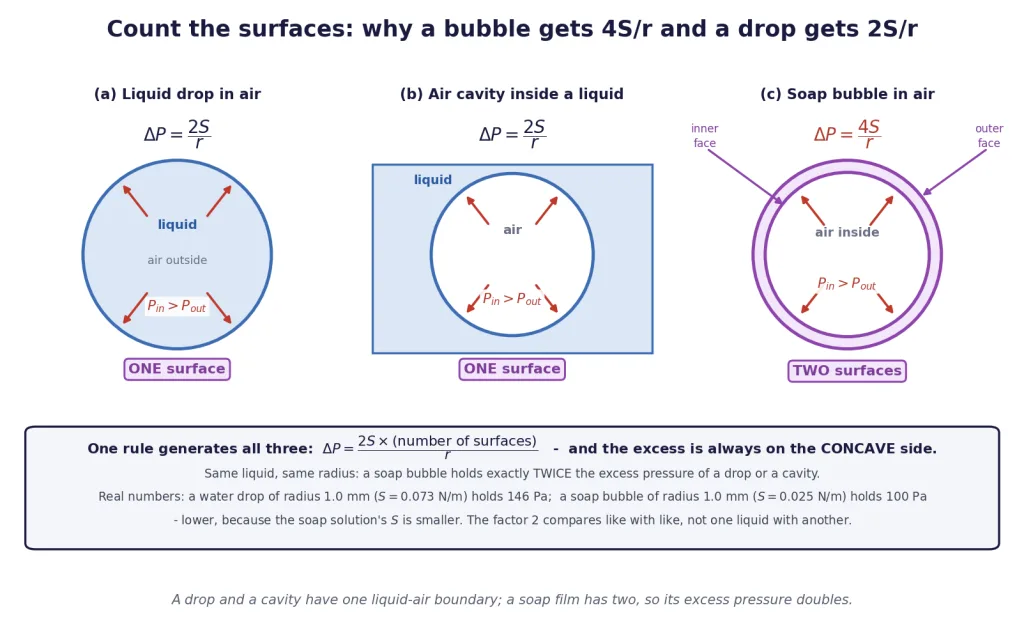
Key Point: a curved liquid surface always has the higher pressure on its CONCAVE side, and one rule generates all three results:
| Object | Surfaces | Excess pressure | Why |
|---|---|---|---|
| Liquid drop in air | one (liquid-air) | one boundary to stretch | |
| Air cavity or bubble inside a liquid | one (liquid-air) | still just one boundary | |
| Soap bubble in air | two (inner and outer faces of the film) | the film is stretched on both faces |
So the 4 has nothing to do with soap and everything to do with counting. For the same liquid and the same radius, a bubble holds exactly twice the excess pressure of a drop or a cavity. A drop and a cavity of the same radius in the same liquid hold exactly the same excess pressure.
Two standard consequences of :
- Connect a small bubble to a large one and the small one collapses into the large one, because the smaller radius holds the greater pressure. Air flows from small to large.
- The film separating two joined bubbles of radii curves towards the larger one with radius .
Capillary rise
Key Point: with the radius of the tube, not of the meniscus. The meniscus radius is .
- Jurin's law: . Halve the bore and the liquid climbs twice as high. Tubes of radii 0.10, 0.20 and 0.40 mm give rises in the ratio 4 : 2 : 1.
- carries the sign. For mercury, makes negative and comes out negative — a depression, which is the formula telling you the truth, not an error.
- The mass raised, , is proportional to , not to : the narrow tube lifts liquid higher but lifts less of it.
- The short-tube question. If the tube is shorter than the calculated rise, the liquid does not spill and does not fountain. The meniscus flattens instead: its radius of curvature grows until stays constant, and the liquid stops at the top.
- The meniscus correction. Measuring to the bottom of the meniscus leaves out the liquid in the meniscus itself; including it gives . Say explicitly whether you have included it.
- Capillarity in the world: oil up a lamp wick, water to the top of a tall tree, ink through blotting paper, damp rising in a wall, and the reason a farmer ploughs a field — to break the soil capillaries and stop the moisture climbing away.
[NEET Important] In a freely falling lift, , so the ascent formula gives an infinite : the liquid rises to the top of the tube and simply stays there, with the meniscus flattening. It does not spurt out.
Card 5 — Choosing Between Continuity, Bernoulli and Poiseuille
This is the most valuable card in the section, because reaching for Bernoulli when the problem is viscous — or grinding through Bernoulli when continuity alone would have answered it — is how the most marks are lost in this chapter. It is never a calculation error. It is a reading error, made in the first five seconds.
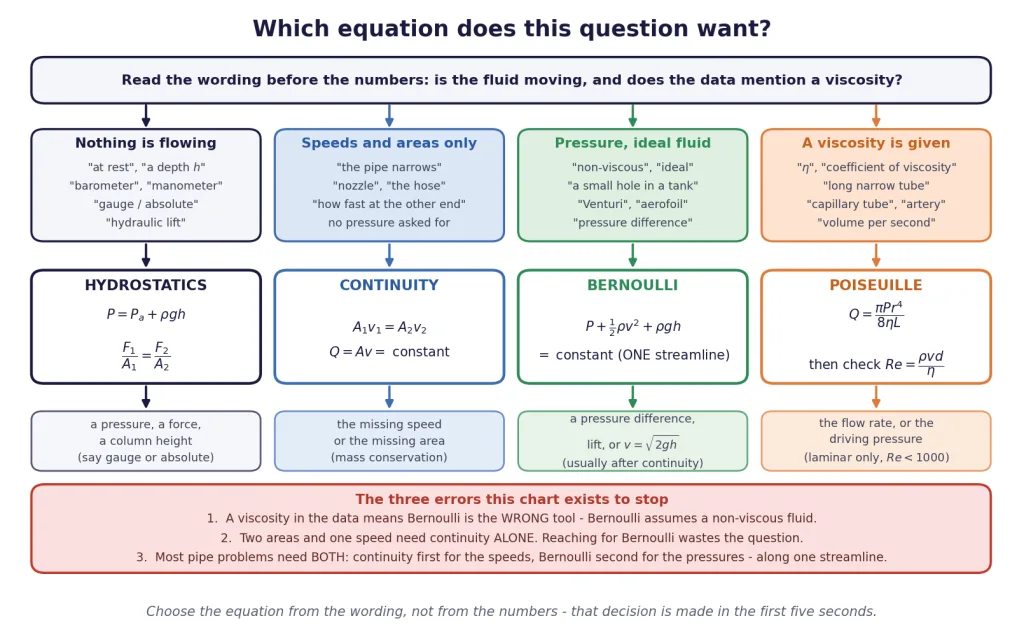
The two questions that decide it
Is the fluid moving at all, and does the data mention a viscosity? That is the whole test.
| If the fluid is… | and the data… | you want |
|---|---|---|
| at rest | gives a depth, a column, a piston area | hydrostatics: , |
| moving, and only speeds and areas are in play | says nothing about pressure | continuity alone: |
| moving, ideal, and a pressure is wanted | says non-viscous, or ignores friction | Bernoulli, usually after continuity |
| moving, and a viscosity is given | gives a long narrow tube and asks for a rate | Poiseuille: , then check |
The cue words, which is what you will actually recognise
| Wording in the question | What it is telling you |
|---|---|
| "at a depth of", "a barometer reads", "a manometer shows" | hydrostatics, and say gauge or absolute |
| "a hydraulic lift", "the two pistons" | Pascal's law, mechanical advantage |
| "floats with a fraction submerged", "weighs less in water" | Archimedes and the floating fraction |
| "the pipe narrows", "a nozzle of radius", "how fast does it emerge" | continuity, and often continuity alone |
| "find the pressure difference between the two sections" | continuity then Bernoulli |
| "a small hole in the side of a tank", "the range of the jet" | Torricelli, which is Bernoulli in disguise |
| "a Venturi meter", "the throat", "a manometer across the constriction" | Bernoulli plus continuity |
| "the wing", "the spinning ball", "the roof lifts off" | Bernoulli, dynamic lift |
| "coefficient of viscosity", "", "castor oil", "glycerine" | a viscous problem: Bernoulli is now the wrong tool |
| "a long narrow horizontal tube", "a capillary of length ", "per second" | Poiseuille |
| "is the flow laminar or turbulent?", "critical velocity" | Reynolds number |
| "a small sphere falling through", "settles steadily", "terminal" | Stokes and |
| "a soap film", "a drop is split", "the work done in blowing" | surface energy |
| "excess pressure", "inside a bubble" | count the surfaces: or |
| "rises in a tube of radius", "angle of contact" | capillarity, |
Six traps that live in exactly this decision
- A viscosity anywhere in the data kills Bernoulli. Bernoulli assumes a non-viscous fluid. If the question hands you , the intended tool is Poiseuille or Stokes, and any Bernoulli answer will be wrong by a lot rather than a little.
- Two areas and one speed need continuity alone. No pressure is asked for, so no Bernoulli is needed. Reaching for it wastes the question and usually invents an unknown.
- Bernoulli connects two points on ONE streamline. Applying it across streamlines — from inside a fast jet to the still air beside it, say — is not allowed and is a favourite trap.
- Poiseuille's law is only for laminar flow. Compute before you trust the answer. Above about 2000 the formula does not describe the flow at all.
- Stokes' law is only for low and only for a sphere. It predicts 121 m/s for a raindrop against an actual 6.6 m/s. Use it where the question intends it, but say so if asked to comment.
- Radius or diameter? Poiseuille and Stokes want the radius; Reynolds number wants the diameter. Halving the wrong one costs a factor of 16 in a Poiseuille answer.
[JEE Tip] When a pipe problem gives you areas and pressures, write both equations down before substituting anything: and . Two equations, two unknowns, and no guessing about which to start with.
Card 6 — The Mistakes That Cost the Most Marks
Every one of these was flagged somewhere in the earlier sections. They are ordered roughly by how often they actually turn up in answer scripts.
1. Not saying whether a pressure is gauge or absolute. The single commonest source of wrong answers in this chapter. ; . A tyre gauge reading 250 kPa means 351 kPa inside. The force on a submerged window uses the gauge pressure, because the atmosphere pushes on the other side too. Write the word next to the number, every time.
2. Reaching for Bernoulli in a viscous problem. If the data include a coefficient of viscosity, Bernoulli's central assumption has already been violated. The intended tool is Poiseuille's law for a tube or Stokes' law for a sphere.
3. Forgetting that a soap film has two surfaces. for a film on a frame, and for a soap bubble, against for a drop or a cavity. When a film's area changes, the new surface is created on both faces, so .
4. Mixing up and . Terminal velocity goes as the square of the radius; Poiseuille flow rate goes as the fourth power. Stokes drag itself goes as the first power. Three different exponents, three different situations.
5. Confusing radius with diameter. Reynolds number uses . Poiseuille, Stokes, capillary rise and excess pressure all use . A question that quotes a diameter is often testing exactly this.
6. Applying Bernoulli across streamlines instead of along one. The constant is only guaranteed along a single streamline. Two points in different parts of a flow need not share it.
7. Using with the wrong reference level, or the wrong . is the vertical depth below the free surface, not the length along a slanted tube. In a two-liquid U-tube, each column carries its own density.
8. Believing Stokes' law always works. It is a low-Reynolds-number result. For a 1 mm raindrop it predicts 121 m/s against a real 6.6 m/s. If the question asks you to comment, the mark is for saying the Reynolds number is far too large.
9. Forgetting to check whether a flow is laminar. Poiseuille's law is a laminar-flow formula. Compute and say which band it falls in before you trust the flow rate.
10. Getting the upthrust wrong. uses the density of the fluid and the volume displaced — not the density of the body and not its whole volume when it is only partly submerged. And the upthrust does not grow with depth once the body is fully under.
11. Drawing the meniscus the wrong way. Concave for water on glass (, it rises); convex for mercury (, it is depressed). The excess pressure is always higher on the concave side.
12. Thinking liquid spills from a short capillary tube. It does not. The meniscus flattens, its radius of curvature adjusts, and stays constant.
13. Using the meniscus radius where the tube radius belongs. In , is the radius of the tube. The meniscus radius is , and the two are equal only when .
14. Mixing and inside one problem. Pick one, write it at the top of your working, use it everywhere. The same goes for Pa against a rounded Pa.
Key Point: Three more that cost single marks each — quoting a viscosity in poise when the options are in Pa s ( poise Pa s), leaving an area in cm or a radius in mm when the rest of the working is in SI, and forgetting that Reynolds number is a pure number with no unit at all.
The 60-Second Revision
You are in the queue outside the hall. This is the irreducible minimum.
Statics. in pascal, a scalar, dimensions . , . Pascal: , advantage , and the work is equal at both ends. Barometer: 76 cm of mercury, 10.3 m of water, Pa.
Floatation. upward through the centre of buoyancy. Floating fraction . Ice is 91.7% under fresh water, 89.0% under sea water.
Continuity. , so is constant. Narrow means fast, and area goes as .
Bernoulli. constant along one streamline, for steady, incompressible, non-viscous flow. Divide by for the head form. Faster means lower pressure.
Efflux. , independent of density. , greatest at where . Emptying time .
Viscosity. , in Pa s, . Liquids thin on heating, gases thicken. Stokes , low only. , squared.
Pipes. , to the fourth. , series and parallel like resistors. : laminar below 1000, turbulent above 2000. .
Surface tension. in N/m; a film has two surfaces, so . Surface energy in J/m, numerically the same number. Splitting into drops: , .
Curvature. Drop , cavity , soap bubble . Higher pressure on the concave side. Small bubble empties into large.
Capillarity. , , mercury depressed because , short tube means constant and no spilling.
Habits. Say gauge or absolute. Check radius against diameter. Ask whether the fluid is viscous before choosing an equation. Convert to SI before substituting. Pick one value of .
The Fast Self-Test
Cover the answers. Sixteen questions, five minutes. Anything you miss tells you which card to reopen tonight.
- Why is pressure a scalar, and why is the force from a fluid at rest always normal to the surface?
- Write the absolute and the gauge pressure at a depth below a free surface. Which one does a tyre gauge read?
- State Pascal's law, and write the mechanical advantage of a hydraulic lift. Does it multiply the energy supplied?
- How tall is a water barometer, and why can a suction pump not lift water from a 15 m well?
- State Archimedes' principle. What fraction of a floating body is submerged?
- Write the equation of continuity. What happens to the speed when the diameter of a pipe is halved?
- Write Bernoulli's equation in both of its forms, and list the four conditions it needs.
- Write the speed of efflux from a hole at depth . Does it depend on the density of the liquid?
- At what depth is the range of the jet greatest, and what is that greatest range?
- Define the coefficient of viscosity and give its SI unit and dimensional formula.
- Write Stokes' law. When is it valid, and what does it predict for a 1 mm raindrop against the true answer?
- Write the terminal velocity of a sphere. Which power of the radius is it?
- Write Poiseuille's law. Which power of the radius is that? What happens to the flow if the radius falls by 20%?
- Write Reynolds number. What are the two threshold values, and what is its unit?
- Give the excess pressure inside a liquid drop, an air cavity in a liquid and a soap bubble. Why does one of them differ?
- Write the capillary ascent formula. Why is mercury depressed, and what happens if the tube is too short?
Answers. 1. Because at a point in a fluid at rest it is the same in every direction, so no single direction describes it; the force is normal because a tangential component would be a shear stress, and a fluid cannot sustain shear at rest. 2. and ; a tyre gauge reads gauge. 3. A pressure change applied to an enclosed fluid is transmitted undiminished throughout; advantage ; no — the small piston moves further and the work is the same at both ends. 4. About 10.3 m; because the atmosphere can support only that much water, so beyond about 10 m no amount of suction helps. 5. The upthrust equals the weight of fluid displaced, ; the submerged fraction is . 6. ; halving the diameter quarters the area and so the speed becomes four times as large. 7. constant, and constant; steady, incompressible, non-viscous, and along a single streamline. 8. ; no, it is independent of the density. 9. At , where . 10. , in Pa s, dimensions . 11. , valid only at low Reynolds number for a sphere; it predicts about 121 m/s against a real 6.6 m/s. 12. — the square. 13. — the fourth power; the flow falls to . 14. ; laminar below about 1000 and turbulent above about 2000; no unit at all. 15. , and ; the soap bubble's film has two surfaces while the other two have one. 16. ; mercury has so is negative; in a short tube the meniscus flattens, stays constant, and nothing spills.
That is the whole chapter. Go and get the marks.