
What JEE Adds to This Chapter
Sections 1 to 12 built this chapter properly, and that build is complete for the Board syllabus. What JEE adds is not new physics — it is still pressure, buoyancy, continuity, Bernoulli, viscosity and surface tension — but a family of set-ups where the quantity you want is not the same everywhere, or the frame you are standing in is not inertial, or the small-hole approximation you have been leaning on is no longer allowed.
A dam wall, where the pressure at the bottom is many times the pressure at the top, so you cannot multiply one pressure by one area. A tanker braking, where the free surface is no longer level. A bucket spun about its axis, where the surface curves into a paraboloid. A block of ice with a stone frozen inside it. A floating log pushed down and let go, which bobs in simple harmonic motion. A tank whose hole is wide enough that the water surface itself races downward. A siphon that suddenly refuses to work above a certain height.
Every one of them is answered the same way: stop treating the fluid as uniform, slice it, and add the slices up — and before you write a single , say out loud which way is "down".
Most of what follows sits outside the rationalised syllabus body text, but JEE Main and JEE Advanced ask it every year, so it is developed here from first principles.
The nine things this section teaches
| # | Skill | Why it earns marks |
|---|---|---|
| 1 | Force on a dam or a submerged gate by integration, and the centre of pressure | One pressure times one area is wrong, and the examiner knows it |
| 2 | Torque about a hinge, which is what actually decides whether a gate opens | Needs the resultant and where it acts |
| 3 | A container accelerating in a straight line — , and the pressure field | Three sub-questions from one set-up: tilt, spill, pressure |
| 4 | A container spun about its axis — the paraboloid, and pressure at the base | The only place enters a fluids paper |
| 5 | Buoyancy in a lift and in other non-inertial frames, and bodies with cavities | The floating fraction does something surprising |
| 6 | The melting-ice family — plain ice, ice with a stone, ice in a denser liquid | Three questions that look identical and have three different answers |
| 7 | SHM of a floating body and of a U-tube column | Two periods worth deriving once and carrying for ever |
| 8 | Efflux when the tank is not very wide, and the full time-to-empty integral | Torricelli is an approximation; here you must say how good |
| 9 | Siphons, converging pipes, the resistance analogy and drop splitting | The last quarter of the chapter, at exam difficulty |
Running underneath all nine is a single habit: name your reference level and name your pressure. Every needs a stated datum, and every pressure you write down is either gauge or absolute. Get careless about either and the algebra will be beautiful and the answer will be wrong.
Conventions, fixed now
Symbols. is density, is surface tension, is the coefficient of viscosity. is pressure, is atmospheric pressure, and where both readings are in play they are written and in full. is an area, is an acceleration or a small hole area (which one is always said), a speed, a volume flow rate, a radius, a diameter, a submerged depth, the upthrust, a terminal velocity.
Key Point — the pressure declaration:
- is the real total pressure. It can never be negative; zero is a perfect vacuum.
- . It can be negative, and often is — inside a siphon, above a fast-moving wing, and just under a concave meniscus.
- A force on a submerged surface with air on the other side uses gauge, because the atmosphere pushes back on the dry face and cancels.
- A question about boiling, cavitation, collapse or "will it still work" uses absolute, because those depend on the total, not on a difference.
Every solution below names which one it is quoting. Do the same in the exam hall.
Constants, unless a problem states otherwise: kg/m, kg/m, kg/m, Pa, N/m, Pa s, specific heat capacity of water J/kg/K, and m/s. No problem here mixes with .
Key Point — the master equation of this whole section: The first gives the resultant force on any surface; the second gives the depth at which that resultant acts. Constant collapses the first to and the second to the centroid. A varying is the whole of the dam-and-gate family, and there is no shortcut past it.
[Exam Tip] Three questions, asked before any algebra, decide almost every problem below. Is the pressure the same over the whole surface? Is my frame accelerating? Am I being asked for a difference of pressures or for a total? A "no" to the first means integrate. A "yes" to the second means replace by the effective gravity. The third decides gauge against absolute. Answer all three and the method is chosen before you have written a symbol.
Force and Torque on a Dam Wall or a Submerged Gate
Here is the thing every student gets wrong the first time. A dam wall holds back water 12 m deep. What force does the water exert on it? The tempting move is to take the pressure at the bottom, , and multiply by the wetted area. That answer is exactly twice too big, because the pressure at the top of the wall is zero and only at the very bottom is it .
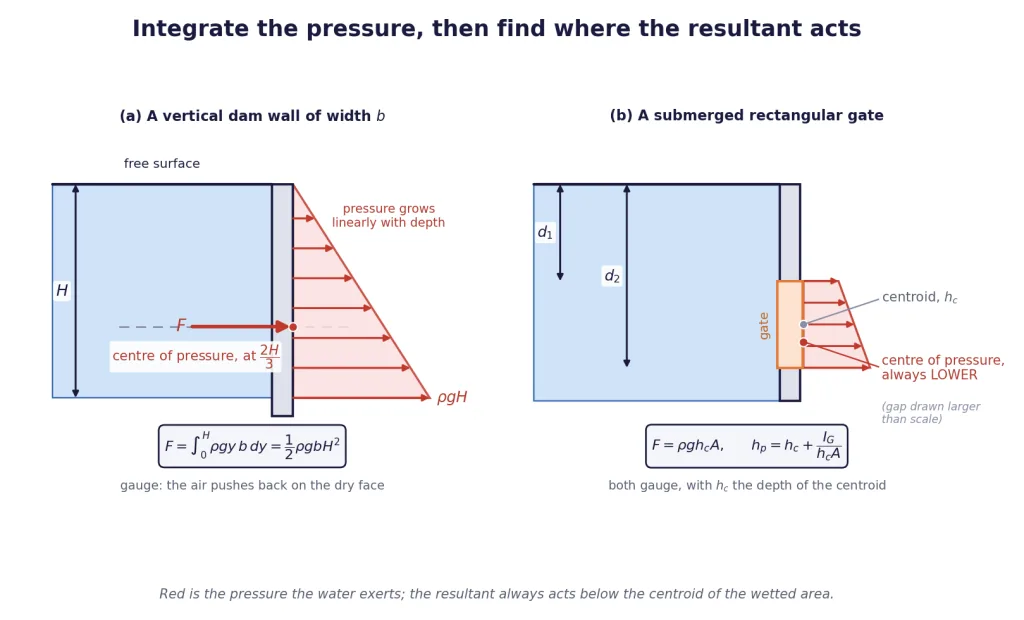
The method, in four lines
- Choose a datum and measure depth downward from the free surface. Say so in writing.
- Take a horizontal strip of thickness at depth . Across that strip the pressure is constant. Its area is , where is the width of the surface at that depth.
- The gauge pressure there is , and the elementary force is .
- Integrate. The centre of pressure follows from the same two integrals.
Why gauge and not absolute. The atmosphere presses on the water surface, so it is present on the wet side; it also presses on the dry face of the dam. The two contributions are equal and opposite over the same area, so they cancel exactly and the net force is the one you get from gauge pressure alone. If instead the far side were a vacuum — a submarine window, a sealed tank — you would use absolute. Say which case you are in, every time.
The vertical rectangular wall
Width , water depth , so throughout:
which is — the pressure at the mid-depth times the area. That is not a coincidence and it generalises:
Key Point: , where is the depth of the centroid of the wetted surface and its area. This holds for any flat surface at any orientation, because the pressure is linear in depth and the average of a linear function over an area is its value at the centroid.
The centre of pressure is a different point:
Two thirds of the way down, not half. The deeper strips are pushed harder, so they drag the resultant downward. It is always below the centroid, never above.
The torque, which is what actually matters
A dam does not slide; it topples. The torque of the water about the base line is
and you can read that as acting at a height above the base, which is the same statement as the centre of pressure at below the surface. The is the reason dams are built so thick at the base: doubling the water depth multiplies the force by 4 and the overturning torque by 8.
A submerged gate, top at and bottom at
with the second moment of the gate about its own horizontal centroidal axis. The second form is the one to memorise, because the correction term shows you at a glance that the deeper the gate, the closer the centre of pressure creeps to the centroid. Push a small gate very deep and the pressure is nearly uniform across it, so the two points almost coincide.
When the width varies: a triangular gate
Suppose a gate is a triangle with its apex at the free surface and its base of width at depth . Then and
Compare the two centres of pressure: for a rectangle running to the surface, for a triangle apex-up. You cannot guess these; the shape decides them, and is the only place the shape enters.
The five results, collected
| Surface | Resultant force (gauge) | Centre of pressure, below the free surface |
|---|---|---|
| vertical rectangle, top at the surface, depth | ||
| vertical rectangle from to | ||
| triangle, apex at the surface, base at | ||
| triangle, base at the surface, apex at | ||
| any flat surface, centroid at depth |
[Exam Tip] Two checks that cost five seconds each. First, the resultant must always lie below the centroid — if your answer comes out above it, you have divided the two integrals the wrong way round. Second, must have the units of force: is kg/m times m/s times m times m, which is kg m/s. If a or an has gone missing you will see it immediately.
Containers That Accelerate and Containers That Spin
A liquid at rest has a horizontal free surface because the only body force on it is gravity, and a free surface must sit perpendicular to the net body force. Change the body force and the surface changes shape with it. That single sentence generates this whole topic.
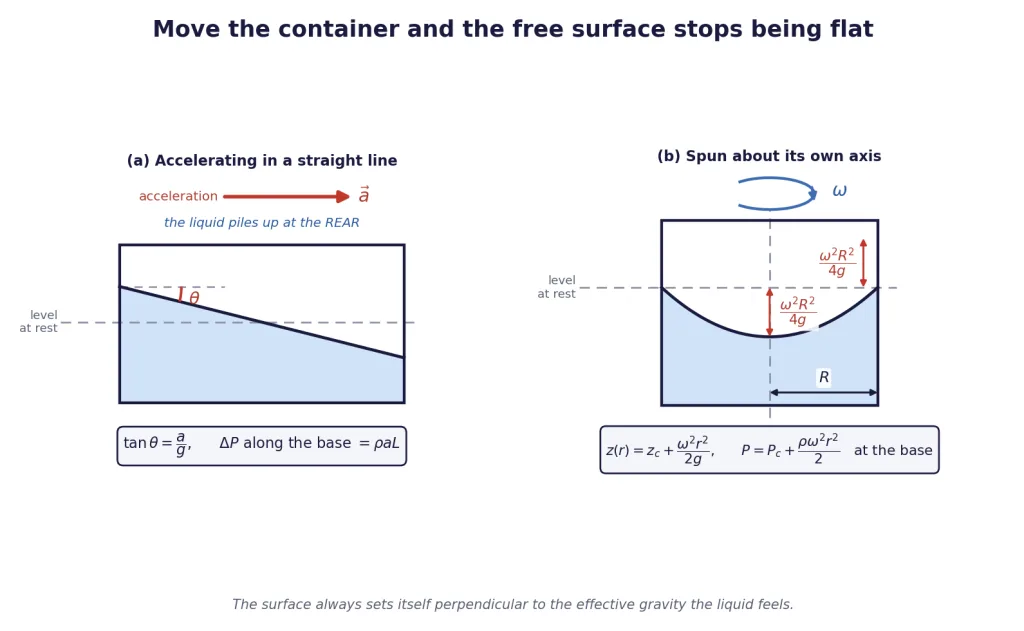
Straight-line acceleration: the surface tilts
Sit in the frame of a tank accelerating horizontally with acceleration . In that non-inertial frame every element of liquid feels, besides its weight downward, a pseudo-force pointing backward. The two combine into an effective gravity
tilted backward from the vertical. The free surface sets itself perpendicular to , so it tilts by an angle with
and the liquid piles up at the rear. (Brake instead of accelerate and everything reverses: the liquid surges to the front. That is the same physics with negative, and it is the version the paper usually sets, because a tanker braking is a picture everybody has.)
The pressure field. In the accelerating frame the liquid is in equilibrium, so hydrostatics still holds — but with respect to . Two consequences you will use:
- The gauge pressure at a point is , where is the vertical depth of that point below the tilted free surface directly above it. Vertical, not perpendicular to the surface.
- Along the horizontal base, over a length , Read that as Newton's second law for the slab of liquid between the two ends: the net horizontal force accelerates a mass .
Two things the paper always asks next. Does it spill? Compute the depth at the higher end, , and compare it with the height of the tank wall. What is the largest acceleration before it spills? Set that equal to the wall height and solve for .
Vertical acceleration is easier and is asked just as often. If the whole vessel accelerates upward with acceleration , then and
Accelerate downward and it is . In free fall, and the gauge pressure everywhere in the liquid is zero — no pressure difference between top and bottom at all, which is why liquid in a freely falling container is held together only by surface tension.
Rotation: the surface becomes a paraboloid
Now spin a cylindrical vessel of radius about its own vertical axis at angular speed , and wait until the liquid rotates with it. In the rotating frame the extra body force is the centrifugal per unit volume, pointing outward. Balancing along the free surface:
a paraboloid of revolution, with the height of the lowest point, on the axis. The rim stands higher than the axis by
Where does the original level sit in all that? A paraboloid of revolution fills exactly half the cylinder that contains it, so the volume of liquid is unchanged if the surface rises at the rim by as much as it falls at the axis. Hence
with the depth before spinning. Both halves are , and forgetting to split it in half is the standard error here.
The pressure field. At the base, measuring gauge pressure,
so the base is pressed hardest at the rim and least on the axis. The vessel is trying to be squeezed outward, which is exactly how a centrifuge separates a suspension.
Two limits the examiner likes. Spin fast enough and reaches the bottom — the liquid pulls away from the centre of the base and leaves a dry disc there. Spin faster still and liquid spills over the rim. Both are found by setting or vessel height and solving for .
Key Point: Whether the container is sliding or spinning, the recipe is one line: find the effective body force, make the free surface perpendicular to it, and do hydrostatics along the vertical. and are just that recipe carried out for the two cases the paper sets.
[Exam Tip] Set or in any answer you produce here. The tilt must vanish, the paraboloid must flatten, and the pressure must fall back to . A formula that does not collapse correctly is wrong, and you find out in ten seconds instead of at the end of the paper.
Buoyancy Off the Beaten Track: Lifts, Cavities and Melting Ice
Section 3 established Archimedes' principle and the law of floatation. This block takes both somewhere less comfortable.
Buoyancy in an accelerating lift
The upthrust comes from the pressure difference between the bottom and the top of the body, and in a lift accelerating upward at that pressure difference is built with instead of . So
Now the surprise. For a floating body, equilibrium reads
and cancels from both sides. The submerged fraction does not change at all. A block floating with three quarters of itself under water floats with three quarters under water in a lift accelerating upward, downward, or in free fall. What does change is the apparent weight of a fully submerged body hung from a spring balance:
which is why a stone weighed in water inside an accelerating lift reads differently while a floating cork sits exactly where it always did.
In free fall everything vanishes together: , so the upthrust is zero, the weight is zero, and a body released anywhere in the liquid simply stays where it is. A bubble in a freely falling bottle does not rise.
In a horizontally accelerating vessel, the effective gravity is tilted backward, so the upthrust has magnitude and points along that tilted "up". A bubble in an accelerating sealed bottle of water therefore drifts forward — it moves opposite to the effective gravity, and the effective gravity leans backward. A pendulum in the same car leans backward; the bubble leans forward. That contrast is a favourite one-mark question.
A floating body with a cavity
A hollow sphere, or a body with an air bubble sealed inside, floats by exactly the same rule — you just have to be careful about which volume is which.
- is the external volume, and that is what displaces fluid.
- is the volume of the material actually present, and is the mass.
Floating requires with , so a body just floats fully submerged when
That is the whole of the "what fraction of an iron shell must be hollow for it to float" family. Iron at 7800 kg/m in water needs a cavity fraction of , which is why a ship is mostly air.
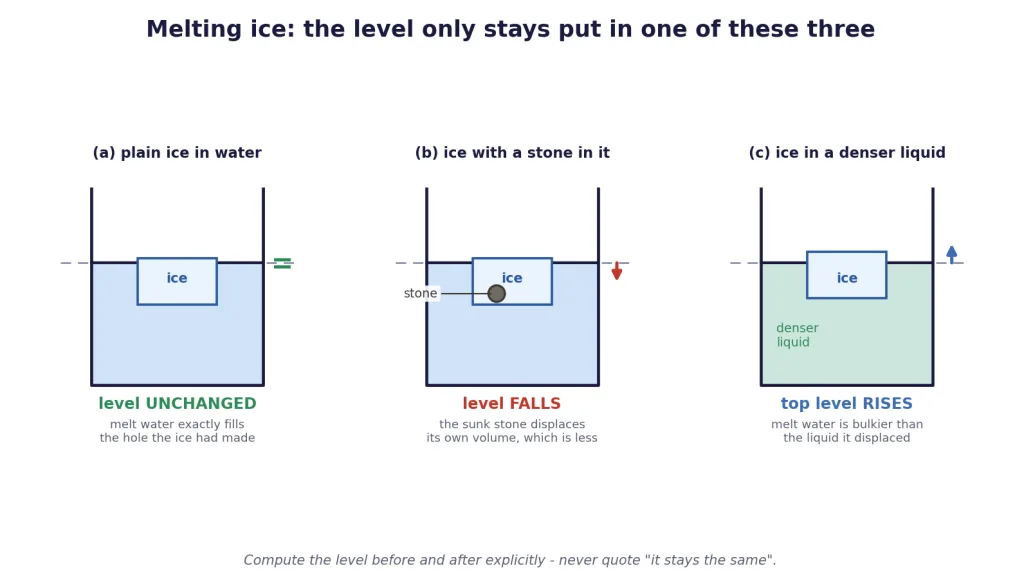
The melting-ice family — three questions, three answers
Case 1: plain ice floating in water. The level is unchanged. While floating, the ice displaces water of volume , because it must displace its own weight. When it melts, that same mass becomes water occupying — the very hole it had already made. Section 3 works this in full.
Case 2: ice with a stone (or a nail, or a coin) frozen inside, floating in water. The level falls. While the lump floats the stone's weight is carried by displaced water, so the stone is "worth" a displaced volume . Once the ice melts, the stone sinks and displaces only its own volume , which is smaller because . The drop in level is
Note what does not appear: the mass of the ice, and the density of the ice. Only the stone matters.
Case 3: ice floating in a liquid denser than water — brine, say, or any liquid of density that the melt water floats on rather than mixes with. The topmost level rises. Floating ice of mass displaces of the liquid; the melt water has the larger volume and ends up as a layer on top. Working the levels out explicitly:
And an honest footnote: the interface between the dense liquid and the water layer does not move at all, because the floating water layer displaces exactly the volume that the ice was displacing. It is the top surface that rises. If a question says "the level of the liquid", ask which surface it means; if it says "the level in the vessel", it means the top.
Case 4: ice floating in a liquid less dense than water. The same formula gives , so the level falls. But check the premise before using it: ice at 917 kg/m sinks in kerosene at 800 kg/m, so that particular pairing never floats in the first place and the whole analysis is void. And the margin can be thinner than you expect — most cooking oils sit at about 910 to 920 kg/m, straddling the density of ice, so with an oil you cannot call it by eye and the question must hand you the number. Always confirm the body floats before applying any of this.
Key Point — the one rule that generates all four cases:
Before melting, every floating object contributes a displaced volume equal to its mass divided by the density of the liquid it floats in. After melting, each piece contributes the volume it actually occupies — its own mass divided by its own density if it sinks, or its mass divided by the liquid's density if it floats. Compute both totals and subtract. Never quote a remembered verdict.
[Exam Tip] Do these with numbers, not with words. Write the volume before and the volume after as two explicit lines and subtract them. It takes twenty seconds longer than reciting "the level stays the same" and it is the only way to survive the versions where it does not.
Two Fluid Oscillators: A Floating Body and a U-Tube
Both of these are simple harmonic motion, both come out in three lines, and both have periods that look like a pendulum's — which is the fastest way to remember them.
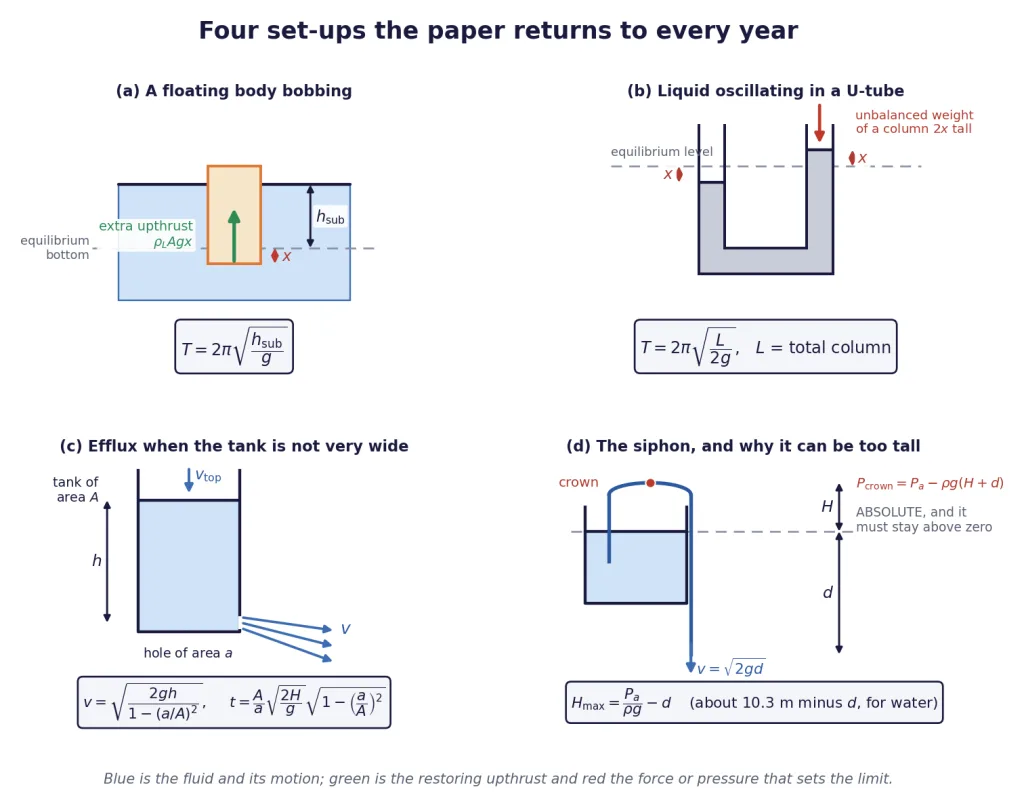
A floating body pushed down and released
Take a body of uniform cross-section floating upright, of total length and density , in a liquid of density . In equilibrium it floats with a submerged depth
which is just the law of floatation, .
Now push it down a further small distance and let go. The weight has not changed, but the upthrust has grown, because an extra volume is submerged. The net force is the extra upthrust alone:
the minus sign saying it points back toward equilibrium. That is Hooke's law with an effective force constant , and the mass being accelerated is . So
Read that. The period is exactly that of a simple pendulum whose length equals the submerged depth. Not the total length of the body, not the depth of the liquid — the depth to which it floats. And notice what has cancelled: is gone, so a fat log and a thin one of the same wood and the same length bob with the same period.
The small print. The derivation assumes the extra submerged slab has cross-section throughout, so the amplitude must be small enough that the body neither lifts clear of the water nor goes fully under: . It also ignores the liquid that has to be pushed aside, which in reality lengthens the period slightly. Say so if a question asks about assumptions.
Liquid oscillating in a U-tube
A U-tube of uniform bore, cross-section , contains a liquid of density ; the total length of the liquid column, measured along the tube from one free surface round the bend to the other, is . Push the liquid down by in one arm.
The liquid in that arm falls by ; the liquid in the other rises by . So one arm now stands a height above the other, and the unbalanced weight is that of a column of height :
The mass in motion is the whole column, . Hence
Two things fall out that students find surprising. The density has cancelled — mercury and water in the same U-tube oscillate with the same period. And the bore has cancelled too, so a wide U-tube and a narrow one agree, provided both are uniform.
If the arms are not vertical. Suppose one arm makes an angle with the horizontal and the other . A displacement along the tube raises one surface by and lowers the other by , so the restoring force is and
Put and you recover , as any correct generalisation must.
Key Point — the two periods, side by side: Both are pendulum periods in disguise: the first with length , the second with length — which is exactly the length of liquid in one arm when the tube is symmetric and the bend is short.
[Exam Tip] In both derivations the trap is the mass. For the floating body it is the mass of the body, not of the displaced liquid. For the U-tube it is the mass of the entire column, not the mass of the unbalanced bit. Write and on two separate lines before you divide, and neither can go wrong.
Efflux From a Real Tank, the Siphon, and the Converging Pipe
Section 6 derived Torricelli's law, , on the assumption that the hole is so small that the free surface barely moves. Here that assumption is dropped, and two more Bernoulli set-ups are taken to exam difficulty.
When the hole is not small
Let the tank have cross-section and the hole area , with the liquid standing a depth above the hole. Two equations, applied together:
- Continuity, because whatever leaves through the hole must come out of the top: , so .
- Bernoulli along a streamline from the free surface to the jet, both at atmospheric pressure:
Substituting and solving,
The efflux speed is larger than Torricelli predicts, because the descending surface has already given the liquid a head start. With the correction is 0.02% and nobody cares. With it is 3.2% and it changes an answer. That is what "small hole" actually means — small compared with the tank, not small in absolute terms.
The full time-to-empty integral
The level falls at , so
The first factor is the familiar small-hole result; the second is the correction, and it is less than one, so a real tank empties slightly faster than the simple formula says. Both facts follow from the same , which is a pleasant check that the algebra is consistent.
Two consequences worth carrying:
- The time to empty scales as , not as . So the tank spends of the total time draining the upper half of its water and on the lower half — the flow is fastest at the start, when the head is greatest.
- For a vessel whose cross-section is not constant, the same integral is , and you put the actual in. That is how conical and hemispherical vessels are handled.
The siphon
A siphon lifts liquid over a wall and delivers it lower down. Let the free surface in the tank be the datum, the highest point of the tube (the crown) be a height above it, and the outlet be a depth below it. The tube has uniform bore, so by continuity the speed is the same everywhere in it.
The outlet speed. Bernoulli from the free surface (where , , height ) to the outlet (where , height ):
Torricelli again — and it depends only on how far the outlet is below the surface, not on how high the crown is. Raise the crown and the flow rate does not change; only the pressure at the crown does.
The pressure at the crown, which is what the exam is really after. Bernoulli from the free surface to the crown:
using . That pressure is absolute, it is below atmospheric, and its gauge value is negative — a partial vacuum, which is exactly why a siphon must be primed and why it stops the moment air gets in.
The height limit. Absolute pressure cannot go below zero, so
For water that leading term is m, the same 10 m that limits a suction pump and forces a water barometer to be absurdly tall. In practice the limit arrives a little earlier, because the water boils once the absolute pressure falls to its vapour pressure (about 2.3 kPa at room temperature), which costs another 0.24 m.
[Exam Tip] This is the single cleanest example in the chapter of gauge versus absolute deciding an answer. Ask "can the pressure here go negative?" If the quantity is a difference — a net force on a wall, a manometer reading — gauge is fine and negative is meaningful. If the question is "will it collapse, boil, or cavitate", you need absolute, and the floor is zero.
The converging pipe, done properly
A horizontal pipe narrows from area to carrying a volume flow rate . Continuity fixes both speeds at once, and , and then Bernoulli along the axis gives
Three things to get right, every time:
- Diameters are not radii. If the pipe goes from 6.0 cm to 3.0 cm in diameter, the areas fall by a factor of 4 and the speed rises by a factor of 4, not 2.
- Gauge or absolute is a free choice here — but only because is a difference and the cancels. The moment the question asks whether the water will boil at the throat, or whether a side tube will suck air in, you must switch to absolute.
- Bernoulli holds along one streamline. Two points in different parts of the flow that are not connected by a streamline are not related by this equation at all.
[Exam Tip] Solve continuity first, on its own line, for both speeds. Then substitute into Bernoulli. Students who try to do both at once nearly always end up with where should be, and the answer comes out with the pressure rising into the constriction, which is physically backwards.
Bubbles, Tube Networks, Splitting Drops — and the Three Standard Traps
Terminal velocity when the body is lighter than the fluid
Stokes' law gives a drag opposing the relative motion, and Section 7 balanced weight, upthrust and drag for a sphere falling. Run the same balance for an air bubble of radius in a liquid of density and viscosity . Now the upthrust wins and the bubble rises, so the drag points downward:
It is the same formula as for a falling sphere with the density difference reversed in sign, which is the honest way to remember it: , and the sign of that bracket tells you which way the body goes. A negative from the falling formula is not an error; it is a rising bubble.
Drops that coalesce, drops that split
Volume is conserved, so drops of radius merging into one give
Since ,
so 8 drops coalescing give 4 times the terminal velocity, 27 drops give 9 times, and 1000 drops give 100 times. Never write or here; it is , and the two-thirds is the whole question.
Tubes in series and in parallel
Poiseuille's law rearranges into an Ohm's-law form,
with playing the part of voltage and of current. Everything you know about resistors then transfers unchanged:
| Series (end to end) | Parallel (side by side) | |
|---|---|---|
| what is shared | the flow rate | the pressure difference |
| what adds | the pressure drops | the flow rates |
| combination | ||
| the narrower tube | takes the bigger share of | carries less of the flow |
Because , a modest narrowing dominates everything. Two tubes in series of lengths and and radii and have resistances in the ratio , so 97% of the pressure drop happens in the narrow one. In parallel, two tubes of radii and behave as one tube of radius — barely more than the wide one alone, because the thin one is contributing almost nothing.
The work done and the cooling when a drop is split
A liquid drop has one surface, of area . Break it into identical droplets, each of radius , and the total area becomes . So
If that energy is supplied by the liquid's own internal energy — nobody heated it, so the new surface is paid for out of the thermal store — the drop cools. Equating to with :
a fall in temperature on splitting, and the same expression gives a rise when droplets coalesce. The dominates once is tiny, which is why an aerosol of very fine droplets is measurably colder than the bulk liquid it came from.
The two-surface trap sits right here. Everything above is for a liquid drop, which has one surface. Do the same sum for a soap bubble and every area counts twice, so — double. Section 9 states the rule; this is where it is most often forgotten.
The three traps that cost the most marks
Key Point — Trap 1: using gauge where absolute is needed.
Gauge is fine whenever the answer is a difference: the net force on a dam, a manometer reading, the pressure drop along a pipe, the lift on a wing. Absolute is compulsory whenever the answer depends on the total: whether a siphon crown will cavitate, whether water at a Venturi throat will boil, how a gas bubble expands as it rises (Boyle's law needs absolute pressure), and any time a pressure is asked for "at" a point rather than "across" something. Write the word "gauge" or "absolute" next to every pressure you put on paper.Key Point — Trap 2: forgetting that a film has two surfaces.
A soap film on a wire frame pulls with , because it has a front face and a back face. A soap bubble has excess pressure against a drop's , for the same reason. The work to blow a bubble of radius is , not . An air cavity inside a liquid has only one surface, so it is back to . Four objects, three answers, and the distractors are built from exactly these confusions.Key Point — Trap 3: applying Bernoulli across streamlines.
is constant along a streamline, and the derivation uses a single tube of flow. Two points in a flow that no streamline connects need not satisfy it. Air above and below an aerofoil is the classic case: the two do sit at nearly the same pressure far upstream, so the comparison happens to work, but that is an extra physical fact and not something Bernoulli gave you. Water on either side of a partition, fluid inside a rapid where the flow is turbulent, and any two points separated by a pump or a viscous section are all outside its reach. Before writing the equation, trace the streamline with your finger.
[Exam Tip] Three questions to ask before submitting any answer in this chapter. Did I say gauge or absolute? Is this a film, a bubble, a drop or a cavity? Can I draw the streamline joining my two points? They take ten seconds and they intercept the three commonest ways of losing four marks on a question you actually understood.
Solved Examples, Part 1: Integration, Non-Inertial Frames and Buoyancy
Values used throughout, unless a problem says otherwise: kg/m, kg/m, Pa, m/s. Every constant is restated inside the solution that uses it, and every pressure says whether it is gauge or absolute.
Example 1: The dam wall, its resultant and its overturning torque
A straight dam has a vertical face 40 m wide holding back fresh water 12.0 m deep, with air at atmospheric pressure on the other side. Find the total force the water exerts on the face, the depth at which that resultant acts, and the torque of the water about the base line of the dam. Take kg/m and m/s.
Solution:
Declare the datum and the pressure convention. Measure downward from the free surface. Because the atmosphere pushes equally on the water surface and on the dry face of the dam, those two contributions cancel and the net force comes from the gauge pressure alone.
Take a strip of thickness at depth . It has area with m, and the pressure is constant across it:
Integrate for the resultant:
Find where it acts. Divide the first moment of the pressure by the pressure itself:
The torque about the base, where the moment arm of a strip at depth is :
Cross-check. The resultant acts m above the base, so should be N m. It matches.
Final Answer: N (gauge), acting 8.00 m below the free surface, giving a torque of N m about the base.
Takeaway: Multiplying the bottom pressure Pa by the area m would have given N — exactly twice the right answer, because the pressure runs from zero at the top to at the bottom and averages to half of that. And note the in the torque: raise the water level by 20% and the force grows by 44% while the overturning torque grows by 73%.
Example 2: A submerged gate, and the force needed to hold it shut
A rectangular gate 2.0 m wide and 2.0 m tall is set vertically in the wall of a reservoir, with its top edge 3.0 m below the water surface and its bottom edge 5.0 m below. The gate is hinged along its top edge and there is air at atmospheric pressure behind it. Find the resultant force of the water on the gate, the depth at which that resultant acts, and the horizontal force that must be applied along the bottom edge to keep the gate closed. Take kg/m, m/s.
Solution:
Convention. Air behind the gate, so the net force uses gauge pressure, , with measured downward from the free surface.
The resultant. With m,
Sanity check with the centroid rule. The centroid of the gate is at m, its area is m, so N. Agreed.
Where does it act? The correction form gives the same: .
Torque about the hinge. The hinge is at 3.0 m, so the resultant's arm is m. The holding force acts at the bottom edge, an arm of 2.0 m:
Final Answer: N gauge, acting at a depth of 4.08 m, and a holding force of N is needed along the bottom edge.
Takeaway: The centre of pressure sits just 8.3 cm below the centroid — a 4% offset on a 2 m gate — yet it changes the required holding force by 8.3%, from N to N. The offset never matters for the force and always matters for the torque. And it shrinks as the gate goes deeper: the same gate 30 m down would have a centre of pressure only 1.1 cm below its centroid.
Example 3: The tanker that brakes
A road tanker of internal length 6.0 m and internal height 2.0 m is carrying water to a depth of 1.20 m. The driver brakes steadily, decelerating at 2.45 m/s. Find the angle the free surface makes with the horizontal, whether the water reaches the roof, and the gauge pressures at the bottom of the front and rear walls. Take kg/m, m/s.
Solution:
Work in the tanker's frame. Decelerating means the acceleration points backward, so the pseudo-force on each element points forward, and the water piles up at the front.
The tilt:
How much does the surface rise and fall? The surface pivots about the mid-length, so it rises at the front and falls at the rear by so the depth is m at the front and m at the rear.
Does it spill? The tank is 2.0 m tall and the water reaches 1.95 m. It just holds — with 5 cm to spare. Any deceleration above m/s would put water on the roof.
The pressures at the base, gauge, using the vertical depth below the tilted surface at each end:
Cross-check the difference with Newton's second law. The horizontal pressure difference must accelerate the slab of water: and indeed Pa.
Final Answer: The surface tilts at , the water rises to 1.95 m at the front and just fails to spill, and the base pressures are Pa gauge at the front and Pa gauge at the rear.
Takeaway: The check in step 6 is worth its weight in marks. along the base is Newton's second law for the whole body of liquid, and it is completely independent of the depth, so it verifies the tilt calculation without repeating it. If your two end pressures do not differ by , one of them is wrong.
Example 4: Spinning a cylinder of water
A cylindrical vessel of radius 0.20 m and height 0.50 m contains water to a depth of 0.30 m. It is spun about its own vertical axis at a steadily increasing rate. Find the angular speed at which water is just about to spill over the rim, the depth of water at the axis at that moment, and the gauge pressures at the centre and at the rim of the base. Take kg/m, m/s.
Solution:
The free surface is a paraboloid, , where is the depth at the axis.
Volume conservation fixes . A paraboloid of revolution occupies exactly half the cylinder that contains it, so the surface rises at the rim by exactly as much as it drops at the axis:
Just about to spill means m with m:
Depth at the axis: Positive, so the paraboloid has not yet reached the bottom and no dry patch has appeared on the base.
Pressures at the base, gauge, from the vertical column of water standing above each point:
Cross-check with the rotating pressure field. In the rotating frame the base pressure should satisfy Pa, and indeed Pa.
Final Answer: Water spills at rad/s, about 134 rev/min. At that speed the water is 0.10 m deep on the axis, and the base carries 980 Pa gauge at its centre against 4900 Pa gauge at its rim.
Takeaway: The rim rises by and the centre drops by the same amount — half the total sag each way. Using the whole as the rise is the standard error and gives an that is too small. Also notice how strongly enters: the same vessel with twice the radius would spill at half the angular speed.
Example 5: Buoyancy inside a lift
A block of wood of density 750 kg/m floats in a beaker of water. Separately, an aluminium block of volume m and density 2700 kg/m hangs fully submerged in the same water from a spring balance. Both are inside a lift. Find the fraction of the wooden block that is submerged, and the reading of the spring balance, (a) with the lift at rest, (b) with the lift accelerating upward at 2.00 m/s, and (c) with the lift in free fall. Take kg/m, m/s.
Solution:
Set up the effective gravity. Inside a lift accelerating upward at , every weight and every upthrust is built with instead of .
The floating block. Equilibrium reads and cancels from both sides, leaving regardless of .
So in all three cases the wooden block floats with 75.0% of its volume submerged. In free fall , the equation becomes , and the block simply stays wherever it is left — it is in equilibrium at any depth.
The spring balance, holding a fully submerged block:
Substitute the three cases:
Final Answer: The wooden block floats with 75.0% submerged in every case. The spring balance reads 16.7 N at rest, 20.1 N while accelerating upward at 2.00 m/s, and exactly zero in free fall.
Takeaway: These two results feel contradictory and are not. A floating body is held by a balance between two forces that both scale with , so the ratio between them — and therefore the submerged fraction — never changes. A submerged body hangs from a third force, the spring, which does not scale with anything, so it registers the full change. Ask which forces are in the balance before deciding whether matters.
Example 6: Ice with a stone frozen inside it
A cylindrical vessel of cross-section 100 cm contains water. Floating in it is a block of ice of mass 200 g with a small stone of mass 10.0 g frozen inside. The stone has density 2500 kg/m and the ice 917 kg/m. Find the change in the water level when the ice has melted completely. Take kg/m.
Solution:
First check that it floats. The lump's volume is m, and its mass is 0.210 kg, so its mean density is kg/m. Less than 1000, so it floats. (Freeze in a heavier stone and it would sink, and the whole question changes.)
Before melting. A floating body displaces its own weight, so the displaced volume is
After melting. Two separate contributions, and this is the whole problem:
- The 200 g of ice becomes 200 g of water, adding m to the body of water.
- The stone, now released, sinks and displaces its own volume, m.
The change:
The compact formula, and why it works. Only the stone changed its manner of support, so
Final Answer: The level falls by m, that is 0.600 mm.
Takeaway: Look at what dropped out of the answer: the mass of the ice and the density of the ice. Neither appears. Only the sinking stone matters, because the ice alone would have left the level exactly where it was. That is why the compact formula contains and and nothing else — and why the same question with a cork frozen in (which floats after melting) gives no change at all.
Solved Examples, Part 2: Oscillators, Efflux and Surface Energy
Values used throughout, unless a problem says otherwise: kg/m, Pa, N/m, specific heat capacity of water J/kg/K, m/s. Every pressure states gauge or absolute.
Example 7: Ice floating in brine
A vessel of uniform cross-section 200 cm contains brine of density 1200 kg/m, and a block of ice of mass 240 g floats in it. The melt water does not mix with the brine but settles as a layer on top of it. Find the change in the level of the topmost free surface when the ice has melted, and say what happens to the brine surface itself. Take kg/m.
Solution:
Before melting. The ice floats, so it displaces its own weight of brine: With the fixed volume of brine, the topmost surface sits at
After melting. The 240 g of ice becomes 240 g of water, of volume That layer floats on the brine, so the part of it below the brine surface is again m, and the rest, m, stands above it. Adding up from the bottom, the topmost surface is now at
The change:
What about the brine surface? Before melting it stood at ; afterwards the floating water layer pushes the same m of brine aside, so it stands at exactly the same height. The interface does not move; only the top does.
Final Answer: The topmost level rises by m, that is 2.00 mm. The brine surface itself is unchanged.
Takeaway: Compare with the plain case. There, the melt water slotted into the hole the ice had made, because both volumes were "mass divided by ". Here the two are computed with different densities — the displacement with and the melt water with — so they no longer cancel and the level rises by . And the fine print about which surface moves is the difference between a careless answer and a correct one.
Example 8: A floating cylinder set bobbing
A uniform wooden cylinder of length 0.30 m and density 600 kg/m floats upright in water. It is pushed down slightly and released. Find its submerged depth in equilibrium, the period of the resulting oscillation, and the largest amplitude for which the analysis is valid. Take kg/m, m/s.
Solution:
The equilibrium depth, from the law of floatation with the cross-section:
Displace it by downward. The weight is unchanged; the upthrust grows by the weight of the extra slab of water displaced: which is with .
The mass being moved is the cylinder's own mass, . So
The period:
The validity limit. The cross-section stays only while the body is neither lifted clear of the water nor pushed fully under, so
Final Answer: m, s, and the amplitude must stay below 0.120 m — set by the 0.120 m of cylinder standing above the water, not by the 0.180 m below it.
Takeaway: is a pendulum of length equal to the submerged depth, and the cross-section cancels completely, so a matchstick and a log of the same wood and length bob together. The one number that changes the period is the ratio of densities — float the same cylinder in mercury and collapses to 13.2 mm and the period drops to 0.231 s.
Example 9: Mercury oscillating in a U-tube
A U-tube of uniform bore contains mercury, the total length of the mercury column measured along the tube being 1.00 m. (a) Find the period of small oscillations with both arms vertical. (b) The tube is now replaced by one whose left arm is vertical and whose right arm makes with the horizontal, with the same 1.00 m of mercury. Find the new period. Take m/s.
Solution:
(a) Both arms vertical.
Displace the mercury by . One surface falls by , the other rises by , so the height difference is and the unbalanced weight is that of a column of length :
The mass in motion is the whole column, :
The period:
Both and have cancelled, so the answer would be identical for water in the same tube.
(b) One arm at .
Displace the liquid by measured along the tube. The vertical rise in an arm inclined at to the horizontal is , so the total height difference generated is and
Substitute and , so :
Final Answer: (a) s. (b) s — the tilted tube oscillates more slowly.
Takeaway: The general result contains the standard one as the case , and it explains the slowdown at a glance: tilting an arm reduces the vertical height gained per unit of liquid moved, which weakens the restoring force without changing the mass. Push to zero — one arm horizontal — and the period rises to s.
Example 10: Emptying a tank through a hole that is not small
A cylindrical tank of cross-section 400 cm is filled with water to a depth of 1.25 m. A hole of area 100 cm is opened in its base. Find the initial speed of efflux, the time for the tank to empty, and in each case state how far the small-hole formula is off. Take m/s.
Solution:
The ratio that matters. — nowhere near small, so the descending free surface cannot be ignored.
Continuity plus Bernoulli. With and both the surface and the jet at atmospheric pressure,
The initial efflux speed, with m: Torricelli alone would give m/s, which is 3.2% low.
The emptying time. The level falls at , so
Substitute. The small-hole part is and the correction factor is , giving The simple formula is 3.3% too long.
Final Answer: The jet starts at 5.11 m/s (against Torricelli's 4.95 m/s, 3.2% low), and the tank empties in 1.956 s (against the simple formula's 2.020 s, 3.3% too long).
Takeaway: Both corrections are the same working in opposite directions — a faster jet means a shorter emptying time. Notice how sharply the correction dies away: at it is 3%, but at it is only 0.02%, which is why the small-hole formula is quoted so freely. "Small hole" means small compared with the tank, and 3% is the price of a quarter.
Example 11: How high may a siphon climb?
A siphon of uniform bore 1.00 cm carries water out of a tank. The highest point of the tube, the crown, is 2.50 m above the water surface in the tank, and the outlet is 1.50 m below that surface. Find the discharge speed, the volume flow rate, the absolute pressure at the crown, and the greatest height above the surface at which a crown could work at all. Take kg/m, Pa, m/s.
Solution:
The outlet speed. Bernoulli from the free surface (atmospheric, essentially at rest, height 0) to the outlet (atmospheric, height m): Note that the crown height has not entered. A taller crown does not slow the siphon down.
The flow rate:
The crown pressure. The bore is uniform, so the speed at the crown is the same 5.42 m/s. Bernoulli from the free surface to the crown, in absolute pressures: which is Pa gauge — a partial vacuum, as it must be for the water to be held up there.
Compact form. Since , the two terms combine:
The height limit. Absolute pressure cannot fall below zero, so Allowing for the water boiling once the absolute pressure reaches its vapour pressure of about 2340 Pa at room temperature, the practical limit is m.
Final Answer: m/s, m/s, crown pressure Pa absolute ( Pa gauge), and the crown could not exceed about 8.84 m above the surface in the ideal case, or about 8.60 m once boiling is allowed for.
Takeaway: This problem cannot be done in gauge pressure. The whole question is how close the absolute pressure comes to zero, and a gauge answer of Pa tells you nothing about whether the siphon survives. When a question asks whether something will collapse, boil or cavitate, switch to absolute before you write anything down.
Example 12: Splitting a drop, and the cooling that goes with it
A spherical drop of water of radius 2.00 mm is broken up into 1000 identical droplets. Find the work that must be done against surface tension, and the fall in temperature of the water if that energy comes from the liquid's own internal energy. Take N/m, kg/m and specific heat capacity J/kg/K. State how the answer would change for a soap bubble.
Solution:
Conserve volume to get the droplet radius.
The areas. A liquid drop has one surface. Ten times as much area, which is the you would expect.
The work:
The cooling. The mass of water is
Check with the closed form:
The soap-bubble version. A soap bubble has two surfaces, an inner one and an outer one, so every area doubles and J — twice as much for the same radii.
Final Answer: J and the water cools by K. For soap bubbles of the same radii the work would be J.
Takeaway: Two habits to lock in. Conserve volume first — the radius ratio is where the whole calculation lives, and guessing it as or ruins everything downstream. And count the surfaces: a drop has one, a cavity in a liquid has one, a soap film has two, a soap bubble has two. The temperature change is tiny here, but it grows as , so an aerosol with micrometre droplets cools by a measurable fraction of a degree.