
Torricelli's Law: How Fast Does Water Leave a Hole?
Section 5 built the machinery. This section spends it. Everything below is one equation — constant — applied to a tank, a pipe, a ball and a wing.
Start with the simplest possible question. A tank of water has a small hole punched in its side, a depth below the surface. How fast does the water come out?
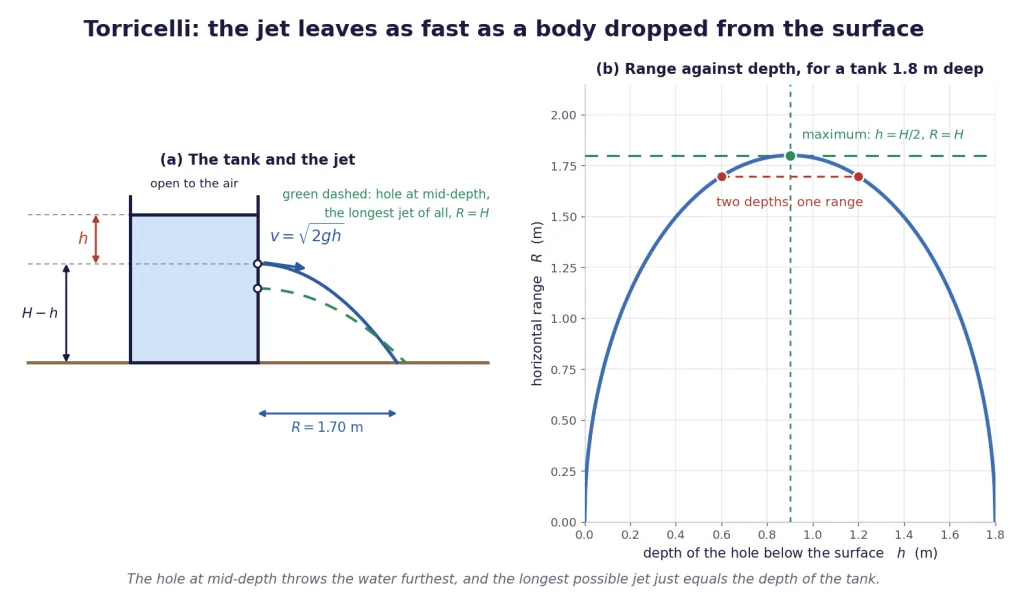
The set-up
Pick the two points on a single streamline: point 2 at the free surface and point 1 at the hole. A particle of water really does travel from one to the other, so Bernoulli is licensed.
- At the surface: the pressure is (the tank is open), the speed is , and the height is above the hole.
- At the hole: the pressure is again (the jet emerges into the open air, and we showed in Section 5 that a free jet is at atmospheric pressure), the speed is , and the height is 0.
Bernoulli, with the datum at the hole:
The terms cancel — one on each side, which is why this problem does not care whether you work in gauge or absolute pressure. That leaves
The small-hole approximation
Now we need , the speed at which the water surface is falling. Continuity says , so
If the hole is small compared with the tank, that ratio is tiny and is negligible. Setting :
Key Point — Torricelli's law of efflux: The speed of efflux from a small hole a depth below the free surface is exactly the speed a body would acquire falling freely through that same height . It does not depend on the density of the liquid, on the size of the hole, or on how much liquid is in the tank — only on .
That the answer is and not something else is not a coincidence. Look back at the equation: the terms cancelled and the tank speed was dropped, leaving , which is precisely the energy equation of a body in free fall. Every kilogram of water that leaves the hole has simply converted the potential energy of a drop of into kinetic energy. The tank does not care that the water travelled sideways to get there.
Some numbers to fix the scale, all with m/s²:
| Depth below the surface | Efflux speed |
|---|---|
| 0.20 m | 1.98 m/s |
| 0.80 m | 3.96 m/s |
| 1.25 m | 4.95 m/s |
| 5.0 m | 9.90 m/s |
| 20 m | 19.8 m/s |
Notice the pattern: quadrupling the depth only doubles the speed, because of the square root. A dam 20 m deep does not shoot water out ten times faster than one 2 m deep; it manages about 3.2 times.
If the tank is not open at the top
Suppose instead the space above the liquid is sealed and held at a pressure . Then the terms no longer cancel, and running the same argument gives
Key Point — the general efflux formula: where is the gauge pressure of the gas above the liquid. Set it to zero and Torricelli's law comes back.
Two limits are worth reading off.
- : the tank is effectively open and gravity does all the work, so .
- : the becomes negligible and . The speed is then set entirely by the container pressure and hardly at all by the depth. This is the regime of rocket propulsion, of an aerosol can, and of a fire extinguisher.
[JEE Tip] The formula contains a gauge pressure, , even though the derivation started with absolute pressures on both sides. That is the cancellation doing its work. If a question hands you an absolute tank pressure, subtract atmospheric before substituting.
The flow rate, and an honest correction
Multiply the speed by the area of the hole and you have the volume leaving per second:
That is the ideal answer, and reality falls short of it — measurably. The streamlines converging on the hole cannot turn a sharp corner, so the jet keeps contracting for a short distance after it leaves and its narrowest cross-section, called the vena contracta, is smaller than the hole. For a plain sharp-edged hole the actual discharge is about 0.62 of the ideal value.
Key Point: is an upper bound. A real sharp-edged hole delivers about 62% of it. Exam questions almost always want the ideal figure, so use it — but know that it is an idealisation, and say so if a question asks why the measured flow is less.
The Jet: How Far It Goes, and How Long the Tank Takes to Empty
The range of the jet
The water leaves the hole horizontally at , and from that moment it is an ordinary projectile: nothing pushes it sideways, and gravity pulls it down.
Let the tank be filled to a height and the hole be a depth below the surface. The hole is then a height above the ground.
Time to fall. Starting with no vertical velocity,
Horizontal distance covered in that time, at a constant horizontal speed:
The and the 2 collapse beautifully:
Key Point — the range of the jet: Notice what has gone: has cancelled. The jet from a tank on the Moon lands in exactly the same place. So does the jet of mercury, or of oil, since never appeared either.
The depth that throws the water furthest
depends on through the product . Two positive numbers with a fixed sum have the largest product when they are equal — that is the standard result — so
Key Point: The range is greatest when A hole at mid-depth throws the water furthest, and the longest jet a tank can produce is exactly as long as the tank is deep.
That is a lovely result and it is worth remembering as a fact in its own right.
The reason a middle hole wins is a tug of war. A deep hole gives a fast jet but very little time in the air. A shallow hole gives plenty of falling time but a feeble jet. Mid-depth is where the two effects balance.
Two depths, one range
Look at the formula again: is unchanged if you swap and . So
Key Point: A hole at depth and a hole at depth throw the water exactly the same distance. The graph of against is a symmetric arch, and every range except the maximum is achieved at two different depths, placed symmetrically about the mid-point.
For a tank 1.8 m deep, a hole 0.60 m down and a hole 1.20 m down both land the water 1.70 m away.
[JEE Tip] When a question says "two holes give the same range, find their depths", write immediately. That one line usually finishes the problem.
How long does the tank take to empty?
Now let the tank drain. The level falls, so the efflux speed falls too, so the draining slows down as it goes. This needs a little calculus.
Let the tank have cross-section , the hole have area , and the water stand at a height above the hole at time . The water leaves at , so the volume leaving per second is . That volume must come out of the tank, whose level therefore falls at
Integrate from at down to :
Key Point — the time to empty: Read it as: is proportional to and to . Double the depth and the tank takes only times as long to empty, not twice as long.
A neat corollary. To fall from to any level takes a time proportional to . So the time to drain the top half is proportional to , which is .
Key Point: Only 29.3% of the emptying time is spent draining the upper half of the tank; the other 70.7% goes on the lower half. The tank is fast while it is deep and crawls at the end.
How good is the small-hole approximation, really?
We threw away the speed of the falling surface. That deserves to be checked rather than trusted, so here is the check.
Keeping the surface speed, continuity gives , and the energy equation becomes , so
Feeding that into the same integration multiplies the emptying time by . Here is what that costs, computed for a tank draining from 2.0 m:
| Emptying time, simple formula | With the falling surface kept | Error of the simple formula | |
|---|---|---|---|
| 2500 | 1597.19 s | 1597.19 s | % |
| 100 | 63.888 s | 63.885 s | % |
| 20 | 12.778 s | 12.762 s | % |
| 10 | 6.389 s | 6.357 s | % |
| 5 | 3.194 s | 3.130 s | % |
| 3 | 1.917 s | 1.807 s | % |
| 2 | 1.278 s | 1.107 s | % |
So the claim that a small hole may be treated as small is now earned rather than assumed. For a genuinely small hole — a centimetre-scale hole in a metre-scale tank, which is in the thousands — the error is about eight millionths of a per cent, utterly beyond measurement. The approximation only starts to bite when the "hole" is a fifth of the tank's own width, at which point calling it a hole is generous.
But do not let that comfort mislead you, because there is a much larger error sitting next to it. The vena contracta correction from the last block, which cuts the real discharge to about 62% of the ideal, makes the true emptying time about 61% longer than the formula predicts. The geometric small-hole assumption is superb; the ideal-fluid assumption is the one that actually costs you.
The Venturi Meter: Measuring a Flow Without Stopping It
This block develops material that sits outside the rationalised syllabus body text. JEE Main, JEE Advanced and NEET ask it every year, so it is built here from first principles.
You want to know how much water is going down a pipe. You cannot open the pipe, and you cannot put a paddle wheel in it. What you can do is squeeze the pipe a little and watch what the pressure does.
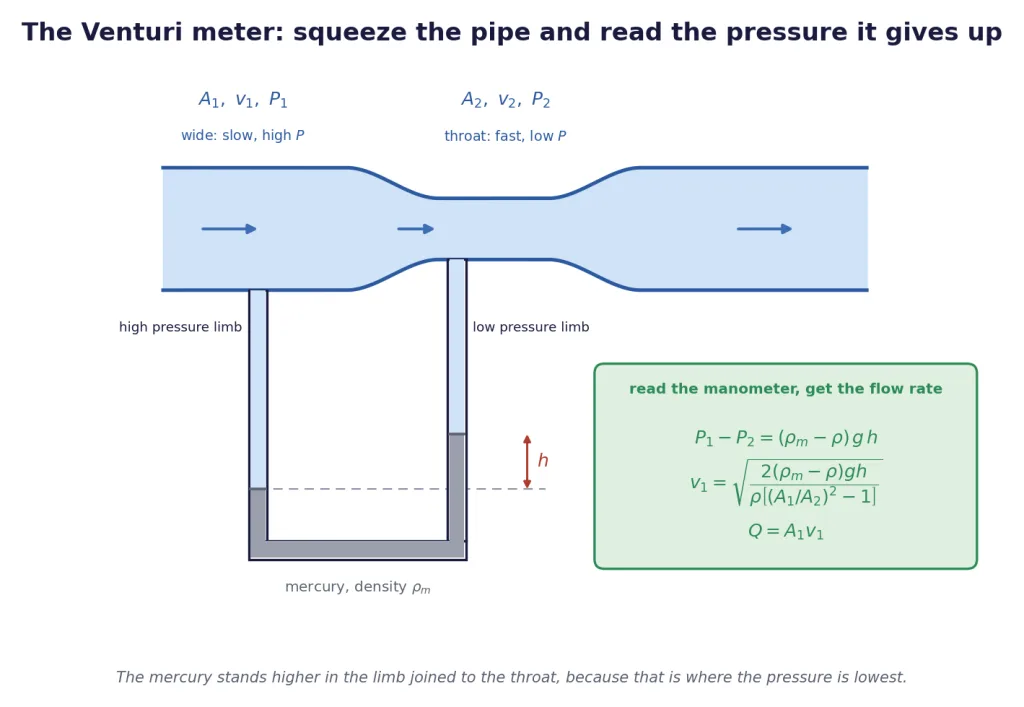
What the instrument is
A Venturi meter is a horizontal length of pipe with three parts: a gentle convergence from the full bore down to a narrow throat , and then a very gradual divergence back to the full bore. Two pressure tappings, one at the full bore and one at the throat, are joined to the two limbs of a U-tube manometer containing a heavy liquid of density — usually mercury.
The gentle taper is not decoration. A sudden expansion would break the flow up into eddies and destroy the streamline conditions the whole calculation needs.
The derivation
Step 1 — continuity gives the speeds.
Step 2 — Bernoulli, horizontal, gives the pressure drop.
Step 3 — the manometer reads that drop. Follow the pressure down the left limb, across the mercury and up the right limb, exactly as in Section 2. Between the two mercury surfaces, which differ in height by , the left limb has an extra column of water of height and the right limb has an extra column of mercury of the same height. Balancing:
The is not a detail to be skipped. It is there because the water in the manometer limb is itself pushing down.
Step 4 — combine and solve for .
Key Point — the Venturi meter: One manometer reading , two known areas, and the flow rate falls out. Nothing has to be inserted into the stream and nothing is stopped.
The simplified form, and what it costs
When the manometer liquid is far denser than the flowing one — mercury against water is a factor of 13.6 — the is commonly dropped, giving
That is a legitimate shortcut, but it is worth knowing its price. Dropping the overstates the pressure difference by , which is 7.9%, and since it overstates the speed by 3.9%. Use the full form if the question gives you both densities; use the shortcut only if it gives you just one.
If the manometer is the same liquid
Sometimes the two tappings are simply open vertical tubes and the flowing liquid itself rises in them. Then has no meaning and instead you read a height difference of the flowing liquid directly:
Even simpler, and note that has cancelled out completely.
The same idea, wearing four other hats
The Venturi is not just a meter. Anywhere you need a suction, the cheapest way to get one is to run a fluid fast through a constriction and tap the low pressure at the throat.
| Device | The fast stream | What the low pressure at the throat does |
|---|---|---|
| Carburettor of a petrol engine | air drawn in by the pistons | sucks petrol up the jet and sprays it into the air stream |
| Filter pump (aspirator) | tap water down a narrow throat | drags air out of the flask attached at the throat, giving a partial vacuum |
| Spray gun and atomiser | air squeezed from a bulb | lifts liquid up the vertical tube and shatters it into droplets |
| Bunsen burner | gas from the jet | pulls air in through the air-holes and mixes it with the gas |
| Scent bottle | air blown across the top of a tube | lifts the perfume and carries it away |
The physics is identical in all five. In each case the liquid or gas being lifted starts at atmospheric pressure, and it rises because the throat has fallen below atmospheric. The height it can be lifted follows straight from hydrostatics:
[NEET Important] The one-line reason to give for all of these: the fluid moves fastest at the constriction, so the pressure there is lowest, and the surrounding atmosphere pushes the second fluid into that low-pressure region. Note the last clause — nothing "sucks". It is always the atmosphere pushing.
Dynamic Lift: Spinning Balls and Aeroplane Wings
Dynamic lift is the sideways force a body feels because of its motion through a fluid — as opposed to buoyancy, which a body feels while sitting still. It is what makes a cricket ball swerve, a tennis ball dip and an aeroplane fly.
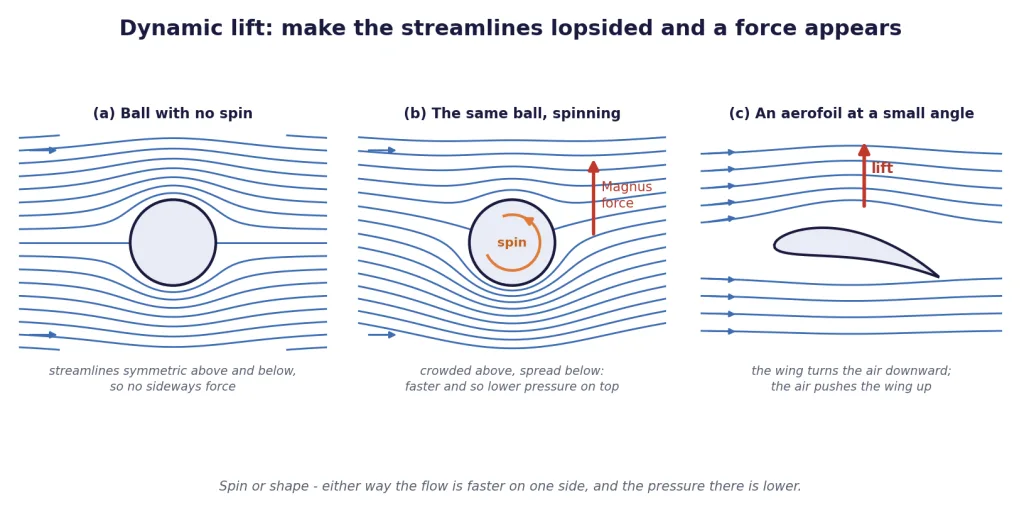
A ball with no spin: no force
Work in the frame of the ball, so the ball is at rest and the air streams past it. If the ball is not spinning, the picture is perfectly symmetric about the horizontal line through its centre. The air goes just as fast over the top as under the bottom, so the pressures on the two sides are equal, and there is no net sideways force. The ball follows a plain parabola.
(There is still a drag force, backwards along the motion. Drag is a different matter and belongs to Section 7.)
A ball with spin: the Magnus effect
Now spin the ball. Air is a real fluid, so the thin layer right against the surface — the boundary layer — sticks to it and is dragged around with the ball. A rough or seamed surface drags far more air round than a polished one, which is exactly why bowlers care so much about the state of the ball.
Add that dragged-around air to the oncoming stream and the symmetry is destroyed:
- On the side where the surface is moving with the oncoming air, the two add. The air there goes faster, and the streamlines crowd together.
- On the side where the surface is moving against the oncoming air, they partly cancel. The air there goes slower, and the streamlines spread apart.
Bernoulli finishes the argument. Faster air means lower pressure, so the pressure on the crowded side is lower than on the spread side, and the ball is pushed sideways — from the slow side towards the fast side.
Key Point — the Magnus effect:
A spinning ball moving through a fluid experiences a force towards the side where its surface is moving in the same direction as the air flowing past it. The force is and it is perpendicular both to the velocity and to the spin axis.
The sizes are not negligible. A cricket ball of radius 3.6 cm moving at 30 m/s, spun hard enough that the air passes at 32 m/s on one side and 28 m/s on the other, feels a Magnus force of about 0.59 N — which is 37% of the ball's own weight. Over the half-second of a delivery that bends the flight by more than half a metre, and half a metre is the difference between the middle of the bat and the edge.
| The spin | Where the force points | The effect on the game |
|---|---|---|
| topspin (top of the ball moving forward) | downward | the ball dips sharply and lands short — a tennis forehand |
| backspin | upward | the ball floats and carries further — a golf drive, a table-tennis chop |
| sidespin | sideways | the swerve of a football free kick, the drift of a spin bowler |
The aerofoil
An aeroplane wing achieves the same asymmetry without spinning, by being the right shape and being held at a small angle of attack to the oncoming air. The result is that the air is deflected and the streamlines above the wing are crowded closer together than those below, so the air above moves faster and its pressure is lower. The pressure difference, acting over the wing area, is the lift:
In level flight the lift equals the weight, and that lets you work backwards to the speed difference the wing needs. For a 120 tonne aircraft with 320 m² of wing flying at 200 m/s, the required pressure difference is only 3675 Pa — under 4% of atmospheric — and the air over the top has to travel just 7.7% faster than the air underneath. A very small asymmetry, carrying a very large aeroplane.
Key Point: The wing does not work because the two halves of a parcel of air must meet again at the trailing edge. There is no such rule, and in fact the air over the top arrives well ahead. What is true is that the wing deflects the oncoming air downward, and by Newton's third law the air pushes the wing upward. The pressure difference and the downward deflection are two descriptions of the same event, not rival explanations.
[Board Important] For a written answer, give both halves: the streamlines are crowded above so the speed there is higher and, by Bernoulli, the pressure lower; and equivalently the wing throws air downward and is pushed up in reaction. A one-sided answer will usually still score, but the two-sided one is the correct physics.
Why an aeroplane cannot fly on Bernoulli alone
Two honest caveats, worth a mark in a good answer.
- A wing works upside down. Aerobatic aircraft fly inverted quite happily, which they could not do if the lift came only from the wing's curved upper surface. What they do is increase the angle of attack, which restores the downward deflection.
- Increase the angle of attack too far and the lift collapses. Beyond about 15° the flow separates from the upper surface, turbulence takes over, and Bernoulli's assumptions fail entirely. This is a stall, and it is why aircraft have a minimum flying speed.
Four Demonstrations You Can Do This Afternoon
Every one of the following is the same sentence in disguise: fast fluid is at low pressure, and the still fluid on the other side pushes.
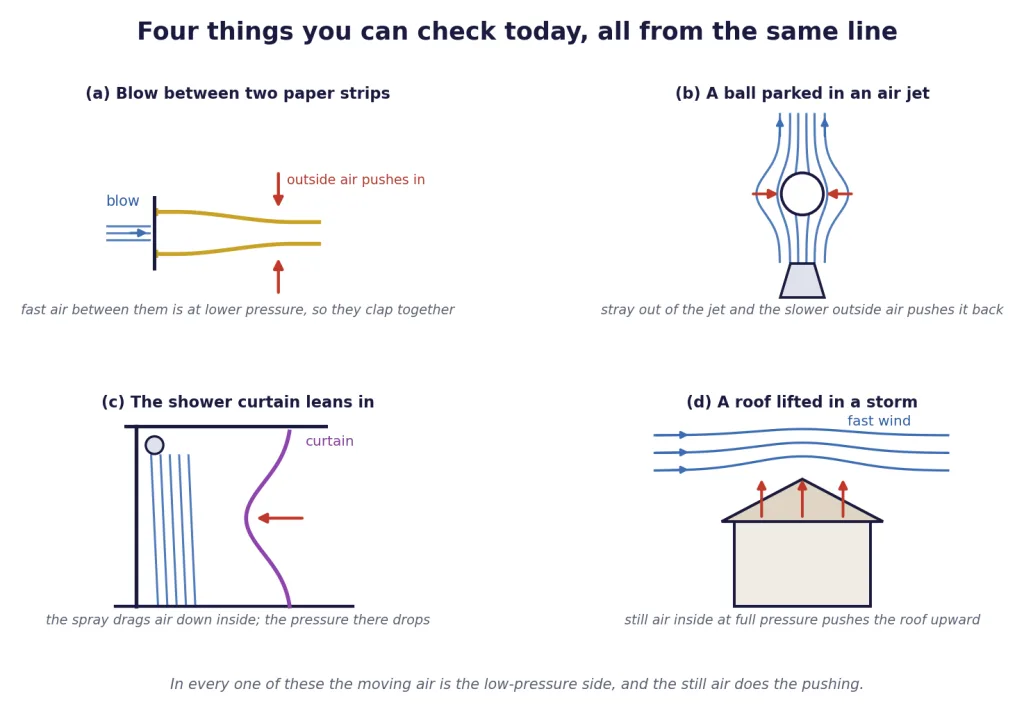
1. Two strips of paper. Hold two sheets of paper a few centimetres apart, hanging down in front of your mouth, and blow between them. They clap together instead of flying apart. The air you blow moves fast, so the pressure between the sheets falls below atmospheric, and the still air outside pushes them together. Almost everyone predicts the opposite the first time.
2. A ball in a jet of air. A ping-pong ball hovers in the stream from a hairdryer held pointing upwards, and stays there even if the dryer is tilted. If the ball drifts towards the edge of the jet, the fast air is then on one side of it only, so the pressure on that side is lower and the slower air on the far side pushes it back into the middle. The jet is a self-correcting trap.
3. The shower curtain. Turn a shower on and the curtain swings inward and sticks to your legs. The falling spray drags air downward with it, so the air inside the cubicle moves while the air in the bathroom does not, and the pressure inside is a little lower. The still air outside pushes the curtain in. (A small circulating vortex inside the cubicle contributes as well, but the pressure argument carries most of the effect.)
4. A roof in a storm. A gale blows across a roof at 108 km/h, which is 30 m/s. The air inside the house is still. So the pressure above the roof is lower than the pressure below it by
which over a roof of 250 m² is an upward force of N — the weight of nearly 14 tonnes, trying to lift the roof off. This is why roofs in a storm are lifted off rather than pushed in, and why opening a window on the sheltered side helps by letting the inside pressure fall too.
Two more of the family, one-liners each:
- Two ships sailing close and parallel are drawn together, because the water squeezed between them speeds up and its pressure drops. Naval regulations exist about this.
- Standing behind the yellow line on a railway platform matters because a fast train drags a sheet of air with it, dropping the pressure in the gap between you and the train, so the still air behind pushes you towards the track.
The whole section on one page
| Result | Formula | Notes |
|---|---|---|
| Speed of efflux | small hole, tank open at the top | |
| Efflux from a pressurised tank | is a gauge pressure | |
| Flow rate through the hole | ideal; a real sharp hole gives about 62% | |
| Range of the jet | and both cancel | |
| Depth for maximum range | , giving | two depths and give the same range |
| Time to empty a tank | proportional to ; the top half takes 29.3% of it | |
| Venturi meter | then | |
| Suction lift at a throat | atomiser, spray gun, carburettor | |
| Dynamic lift | Magnus effect and aerofoil alike |
The five traps
Trap 1 — using the depth from the bottom instead of from the surface. In , is the depth of the hole below the free surface. In the range formula, is the height of the hole above the ground. Questions deliberately give you one and ask for the other. Draw the picture and label both.
Trap 2 — thinking the efflux speed depends on the liquid. It does not. Water, mercury and petrol all leave a hole at the same depth at the same speed, because cancels. What differs is the force the jet delivers, which does depend on .
Trap 3 — forgetting the in the Venturi manometer. The pressure difference is , not , because the flowing liquid stands in the limbs too. For mercury against water the difference is 7.9% in the pressure and 3.9% in the speed.
Trap 4 — quoting when the tank is not full. The result assumes the liquid surface is at the top of the tank of height and the hole can be placed anywhere below it. If the tank is half full, means the depth of liquid, not the height of the vessel.
Trap 5 — saying that the low pressure "sucks" something. Never write that. A low pressure region does not pull; the higher pressure on the other side pushes. Say it the right way round and the physics stays honest.
Solved Examples
Constants used throughout this section, unless a problem states otherwise: m/s², kg/m³, kg/m³, kg/m³, Pa.
Example 1: Efflux speed and flow rate
A large open tank holds water to a depth of 5.0 m above a small hole of area 1.0 cm² in its side. Find (a) the speed at which the water leaves, (b) the ideal volume flow rate, and (c) the flow rate actually expected for a plain sharp-edged hole.
Solution: Both the surface and the jet are at atmospheric pressure, so the pressure terms cancel and the gauge-or-absolute question does not arise.
(a) Torricelli's law: Worth pausing on: that is the speed of a stone dropped 5.0 m, and the water knows nothing about the tank, the hole or its own density.
(b) Ideal flow rate, with cm² m²:
(c) The real rate. The jet contracts after leaving the hole, and for a sharp-edged hole the discharge is about 0.62 of the ideal:
Final Answer: (a) 9.90 m/s; (b) 0.99 L/s ideally; (c) about 0.61 L/s in practice.
Takeaway: is a free-fall speed and nothing else. If you can compute how fast a dropped stone would be going, you can compute the efflux speed without touching Bernoulli at all.
Example 2: Where does the jet land?
A tank stands on the ground and is filled with water to a height of 1.8 m. A small hole is made in the side, 0.60 m below the water surface. Find (a) the efflux speed, (b) the time the jet spends in the air, and (c) the horizontal distance from the tank at which it strikes the ground.
Solution:
(a) The efflux speed, with m:
(b) The hole is m above the ground, and the jet starts out horizontally, so its vertical motion is a free fall from rest through 1.20 m:
(c) Horizontal distance at constant horizontal speed:
Check with the compact formula: Agreed.
Final Answer: (a) 3.43 m/s; (b) 0.495 s; (c) 1.70 m from the tank.
Takeaway: Two heights, two different jobs. The depth below the surface sets the speed; the height above the ground sets the flight time. Mixing them up is the single commonest error in efflux problems, so label both on your diagram before you start.
Example 3: The best place to put the hole
For the same tank filled to 1.8 m, (a) at what depth should the hole be made for the jet to land as far away as possible, (b) what is that maximum range, and (c) at what other depth would a hole give the same 1.70 m range found in Example 2?
Solution:
(a) The range is . With fixed, the product is largest when the two factors are equal:
(b) The maximum range: which is exactly . Check the parts separately: m/s and s, and m.
(c) The partner depth. Since swapping and leaves unchanged, the other depth giving 1.70 m is Verify: m. Correct.
Final Answer: (a) 0.90 m below the surface; (b) 1.80 m, equal to the depth of water; (c) a hole 1.20 m below the surface.
Takeaway: is worth memorising as a fact. A tank can never throw its water further than it is deep, and it achieves that best case from a hole exactly halfway down.
Example 4: How long to empty, and how far the simple formula is off
A cylindrical tank of cross-section 0.50 m² has a hole of area 2.0 cm² in its base and is filled with water to a depth of 2.0 m. Find (a) the time to empty, (b) the time to drain the top half, and (c) by how much the small-hole approximation is in error here.
Solution:
(a) The emptying time:
(b) The top half. The time to fall from to goes as , so So under 8 minutes for the top metre and over 18 for the bottom metre.
(c) The error. Here , so keeping the speed of the falling surface would multiply the answer by which differs from 1 by — that is, the approximation is in error by eight millionths of one per cent. It is not merely acceptable; it is far below anything you could measure.
The correction that does matter. The vena contracta cuts the real discharge to about 62% of the ideal, so the tank actually takes roughly times as long, some 43 minutes. The assumption to worry about is the ideal-fluid one, not the small-hole one.
Final Answer: (a) 1597 s, about 26.6 minutes; (b) 468 s, about 7.8 minutes; (c) the small-hole error is %, utterly negligible, while the vena contracta lengthens the real time by about 61%.
Takeaway: A draining tank is fast when it is deep and slow when it is shallow, so the last half of the water takes more than twice as long as the first half. And an approximation is only worth trusting once someone has put a number on it.
Example 5: A pressurised tank
A closed tank contains water with compressed air above it at a gauge pressure of Pa. A small hole is opened in the side, 2.0 m below the water surface, and the water escapes into the atmosphere. Find the efflux speed, and compare it with the speed if the tank were open.
Solution: The formula contains the gauge pressure of the gas above the liquid, and Pa is already a gauge value.
The general efflux formula:
The two contributions to , kept apart so their sizes can be compared: The pressure supplies nearly eight times as much as gravity does.
Add and take the root:
The open tank, for comparison: The compressed air has multiplied the speed by 2.94.
Final Answer: 18.4 m/s pressurised, against 6.26 m/s open — a factor of 2.94.
Takeaway: When the tank pressure dominates, the depth almost stops mattering. Take very large and , which is why an aerosol can sprays just as hard when it is nearly empty as when it is full.
Example 6: A Venturi meter with a mercury manometer
A Venturi meter fitted in a horizontal water pipe has a bore of 10 cm and a throat of 5.0 cm. A mercury manometer connected between the two shows a difference of 5.0 cm. Find (a) the pressure difference, (b) the speeds at the bore and at the throat, and (c) the flow rate in litres per second.
Solution: Only a pressure difference appears, so gauge and absolute give identical answers.
Areas and their ratio:
(a) The manometer. Both limbs carry water above the mercury, so the working density is the difference:
(b) Bernoulli plus continuity. Writing ,
(c) The flow rate:
What the shortcut would have cost. Dropping the water density and writing Pa instead of 6174 Pa overstates the pressure difference by 7.9% and the speed by 3.9%, giving m/s.
Final Answer: (a) 6174 Pa; (b) 0.907 m/s at the bore and 3.63 m/s at the throat; (c) 7.13 L/s.
Takeaway: Always write , not , in a manometer balance. The liquid in the limbs above the mercury is pushing down too, and for mercury against water ignoring it costs you about 4% in the answer.
Example 7: A Venturi read with plain vertical tubes
A horizontal pipe carrying water has a cross-section of 8.0 cm² which narrows to 4.0 cm² at a throat. Two open vertical tubes are fitted, one at each station, and the water stands 15 cm higher in the first than in the second. Find the two speeds and the flow rate.
Solution:
The pressure difference, read directly as a head of the flowing liquid:
Continuity, with :
Bernoulli:
The flow rate:
Notice the simplification. With the same liquid in the tubes, cancels out of the speed formula entirely:
Final Answer: 0.990 m/s at the wide section, 1.98 m/s at the throat, and a flow rate of 0.792 L/s.
Takeaway: When the manometer holds the same liquid that is flowing, the density drops out. The reading is then a pure statement about , the height difference and the area ratio.
Example 8: How high can an atomiser lift the perfume?
In an atomiser, air is blown along a horizontal tube at 8.0 m/s. At the throat the area is one fifth of the inlet area, and a vertical tube runs from the throat down into a bottle of perfume of density 900 kg/m³. How far can the perfume be lifted?
Solution: The perfume surface in the bottle is at atmospheric pressure. We work in gauge pressure, so the throat sits at a negative gauge pressure.
Continuity gives the throat speed:
Bernoulli for the air, horizontally along the tube:
That deficit is what the atmosphere uses to push the perfume up the tube. Balancing against the weight of the raised column:
Final Answer: About 10.4 cm.
Takeaway: Say it the right way round: the throat does not suck, the atmosphere pushes. The height is set by how far the throat pressure has fallen below atmospheric, and 10 cm of a light liquid is about all a hand-squeezed bulb can manage.
Example 9: What the wing has to do
An aircraft of mass kg has a total wing area of 320 m² and is in level flight at 720 km/h. Estimate (a) the pressure difference between the lower and upper surfaces of the wings, (b) that difference as a fraction of atmospheric pressure, and (c) the percentage by which the air over the top must be moving faster than the air underneath.
Solution:
Convert the speed:
(a) In level flight the lift equals the weight:
(b) As a fraction of atmospheric: A very modest asymmetry indeed, for 120 tonnes of aeroplane.
(c) The speed difference. Use the exact factorisation from Section 5: With m/s, So the air passes over the top at about 208 m/s and underneath at about 192 m/s.
Final Answer: (a) 3675 Pa; (b) 3.6% of atmospheric; (c) about 7.7% faster over the top.
Takeaway: A tiny fractional difference in speed, spread over a very large area, lifts an enormous weight. Everything a wing does depends on that word "area" — which is why gliders have such long ones.
Example 10: The roof in the gale
Wind blows across a flat roof of area 250 m² at 108 km/h. The air inside the house is still. Find the net upward force on the roof, and express it as the weight of an equivalent mass.
Solution: Gauge pressures, with the still inside air taken as the reference.
Convert the speed:
Bernoulli, comparing the fast air above the roof with the still air inside, at effectively the same height:
The force on the roof:
As an equivalent mass:
Final Answer: N upward, equivalent to the weight of about 13.8 tonnes.
Takeaway: A pressure difference of only 540 Pa — half a per cent of atmospheric — becomes enormous once it acts over a roof. Force is pressure times area, and roofs have a great deal of area.
Example 11: How much does a spinning ball swerve?
A cricket ball of radius 3.6 cm and mass 0.16 kg travels at 30 m/s. Its spin is such that the air passes at 32 m/s on one side and 28 m/s on the other. Estimate (a) the pressure difference across the ball, (b) the Magnus force, (c) that force as a fraction of the ball's weight, and (d) the sideways deflection over a 0.60 s flight.
Solution: This is an estimate: the ball is treated as presenting its circular cross-section to a uniform pressure difference.
(a) The pressure difference, from Bernoulli:
(b) The force, over the cross-sectional area :
(c) Compared with the weight:
(d) The deflection. The sideways acceleration is
Final Answer: (a) 144 Pa; (b) 0.586 N; (c) 37% of the weight; (d) about 0.66 m of swerve.
Takeaway: Two thirds of a metre is the width of a wicket. A Magnus force of only a third of the ball's weight, acting for half a second, is the whole difference between a bowler who takes wickets and one who does not.
Example 12: Emptying times compared
A tank of cross-section with a hole of area empties in time from a depth . (a) How long does it take if it is filled to instead? (b) How long if the hole is made twice as large? (c) For and m, find .
Solution:
The formula is , so and .
(a) Doubling the depth: Twice the water takes only 1.41 times as long, because the deeper water also comes out faster.
(b) Doubling the hole area: Exactly half the time. Here the dependence is a straight inverse, with no square root.
(c) The numerical case: about 7.5 minutes.
Final Answer: (a) , that is 1.41 times as long; (b) ; (c) 452 s, about 7.5 minutes.
Takeaway: The area of the hole enters as but the depth only as . If you want a tank to drain faster, making the hole bigger works far better than lowering the water level.