
Why Anything Floats At All
This whole section develops material that sits outside the rationalised syllabus body text. Boards, JEE Main, JEE Advanced and NEET all ask about it every single year — it is one of the most examined topics in the chapter — so it is built here from first principles.
You already have everything you need. Section 2 established that pressure in a fluid at rest increases with depth,
and that the pressure at a point acts equally in every direction. That one fact, applied to a body sitting in the fluid, is the whole of this section.
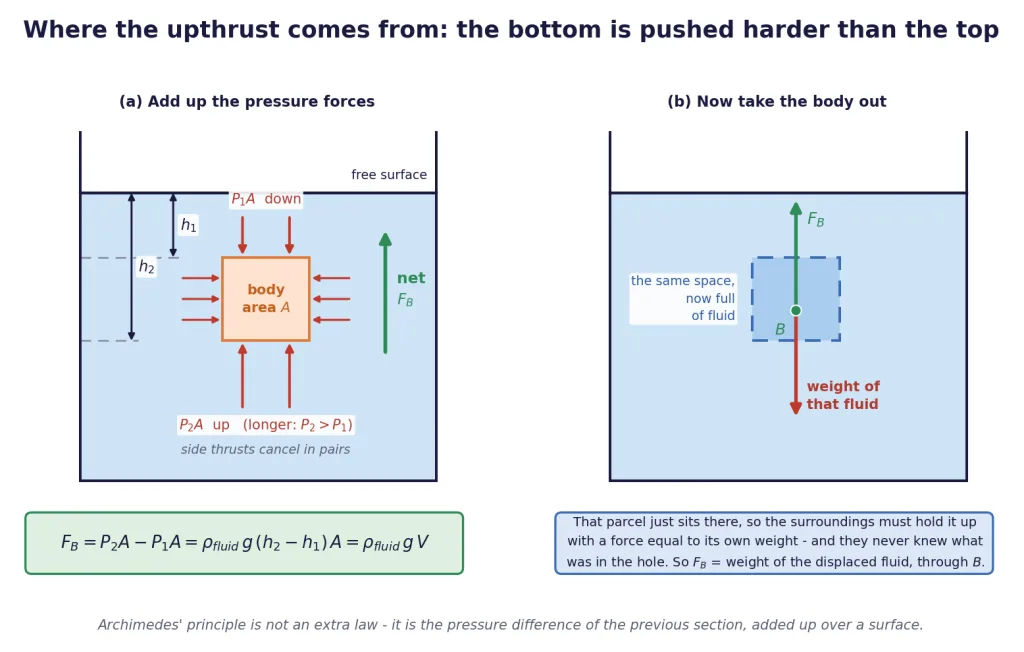
Here is the thing. A body immersed in a fluid has fluid pressing on it everywhere. The pressure on its lower surface is larger than the pressure on its upper surface, simply because the lower surface is deeper. So the push up beats the push down, and there is a net upward force. That net force is called the upthrust or buoyant force, and we write it .
Deriving it, not just asserting it
Take the simplest possible body: a rectangular block of horizontal cross-section and height , held completely under water with its faces horizontal and vertical. Let the top face be at a depth below the free surface and the bottom face at a depth , so .
The four side faces contribute nothing. Each side face is matched by an opposite face at the same range of depths, so the horizontal thrusts come in equal and opposite pairs and cancel exactly. That is worth saying out loud, because it is the reason buoyancy is purely vertical.
The top face. The pressure there is , and it pushes down:
The bottom face. The pressure there is , and it pushes up:
Subtract. The atmospheric term is the same in both and cancels:
and is exactly the volume of the block, which is the volume of fluid it has pushed aside. So
Key Point — Archimedes' principle: A body wholly or partly immersed in a fluid is buoyed up by a force equal to the weight of the fluid it displaces. is the density of the fluid, is the volume of fluid pushed aside — which is the submerged volume of the body, not necessarily its whole volume — and acts vertically upward.
[Board Important] That derivation, in those five steps, is a standard three- or four-mark question. Learn the order: sides cancel, write and , multiply each by , subtract, recognise as the volume.
The same answer without any block at all
The block argument works, but it looks as though it might depend on the body being a neat cuboid. It does not, and here is the cleaner argument that shows why.
Imagine the body is not there. Fill the hole it occupied with more of the same fluid, so that the fluid is now unbroken and at rest. That parcel of fluid just sits there, in equilibrium. Two forces act on it: its own weight, and whatever the surrounding fluid pushes on its boundary with. Since it is in equilibrium, those must balance, so
Now put the real body back. The surrounding fluid has no idea anything changed — the boundary is in exactly the same place, at exactly the same depths, so the pressure at every point of that boundary is exactly what it was. The push from the surroundings is therefore unchanged. And that push is the upthrust.
Key Point: The upthrust equals the weight of the displaced fluid whatever the shape of the body — a coin, a crown, a ship, a diver. The block derivation is a special case, not the general reason.
Notation
| Symbol | Means | Watch out for |
|---|---|---|
| density of the body | never appears in itself | |
| density of the fluid | this is the one in | |
| total volume of the body | ||
| volume of fluid displaced | equals the submerged volume | |
| upthrust, upward | also written or | |
| true weight | ||
| apparent weight | what a spring balance reads | |
| centre of buoyancy | centroid of |
Throughout the chapter is density, is surface tension and is viscosity. Elsewhere or often stands for surface tension and for viscosity.
What does and does not care about
Read carefully and three examinable facts fall straight out.
- It does not contain . A lead cube and an aluminium cube of the same size, both fully submerged in the same water, feel exactly the same upthrust. They behave completely differently, but that is because their weights differ, not their upthrusts.
- It does not contain depth. Push a fully submerged ball from 1 m down to 10 m down and the upthrust is unchanged, because both and grew by the same 9 m and only their difference mattered. (This assumes the fluid's density does not change with depth, which for a liquid is an excellent assumption.)
- It does not contain . Atmospheric pressure cancelled in the subtraction. So you may work the whole problem in gauge pressure and get the identical answer — and in this section we will, stating it each time.
[JEE Tip] "Same size, different material, which feels more upthrust?" — the answer is neither, they are equal. "Same material, different size?" — the bigger one. "Same body, deeper?" — unchanged. Those three one-liners cover a startling number of questions.
Apparent Weight, and Weighing Things in Water
Hang a body from a spring balance in air and the balance reads its true weight . Lower it into water and the reading drops. Nothing happened to the body's mass; what happened is that the water is now helping to hold it up.
Key Point — apparent weight: For a fully submerged body , so The apparent loss of weight is , exactly the weight of the displaced fluid.
That last line is the whole reason this topic is useful. It turns a spring balance and a beaker into a densitometer.
Measuring a density with nothing but a spring balance
Weigh the body in air: you get . Weigh it fully submerged in water: you get . Then
while . Divide one by the other and and both vanish:
Key Point — relative density by weighing: and since kg/m, the density in SI is just .
You never need to know the body's volume, and you never need to know .
If the second weighing is done in some other liquid instead of water, the same trick gives the density of the liquid. Weigh in air (), in water () and in the liquid (). The two apparent losses are and , so
[NEET Important] Both of those formulas are pure ratios of three weight readings. They work in newtons, in kilogram-force, in grams on a beam balance — any unit at all, as long as you use the same one throughout. That is exactly why they are so popular in single-step questions.
The centre of buoyancy
The weight of a body acts through its centre of gravity , the "average position of its mass". By exactly the same logic, the upthrust acts through the average position of the displaced fluid.
Key Point — centre of buoyancy:
The upthrust acts vertically upward through , the centroid of the displaced volume — that is, the centre of gravity the displaced fluid would have had, if it were still there.is a property of the submerged shape only. It knows nothing about how the mass is arranged inside the body. So and are, in general, at different places.
For a body of uniform density that is completely submerged, the displaced volume is the whole body, so and coincide. For a floating body they cannot: is the centroid of the part under water, while is the centroid of the whole thing, so is always the lower of the two. That separation is what the last block of this section is about.
[JEE Tip] If the mass inside a body is redistributed — cargo moved, a cavity shifted — then moves but does not, provided the submerged shape is unchanged. Half the stability questions in this topic are built on precisely that asymmetry.
A note on what a balance reads
There are two instruments in these problems and they behave differently.
- A spring balance measures the force in the string, which is . It reads less in water.
- A beam balance compares two masses. If the object and the counterweights are both in air, the tiny air upthrusts very nearly cancel and it reads the true mass. If only one side is immersed, it does not.
[Board Important] "Does an object weigh less under water?" The honest answer is that its weight is unchanged — weight is and did not change — but its apparent weight, the reading of a spring balance, is smaller by exactly . Say both halves of that and the mark is yours.
And yes, air does it too
Air is a fluid with kg/m, so every object around you is being buoyed up by the atmosphere. For a lump of steel the effect is about 0.016% of its weight and nobody cares. For a balloon full of helium ( kg/m) the upthrust beats the weight and the thing takes off. Same equation, no modification at all.
Sink, Hover or Float: One Comparison Settles It
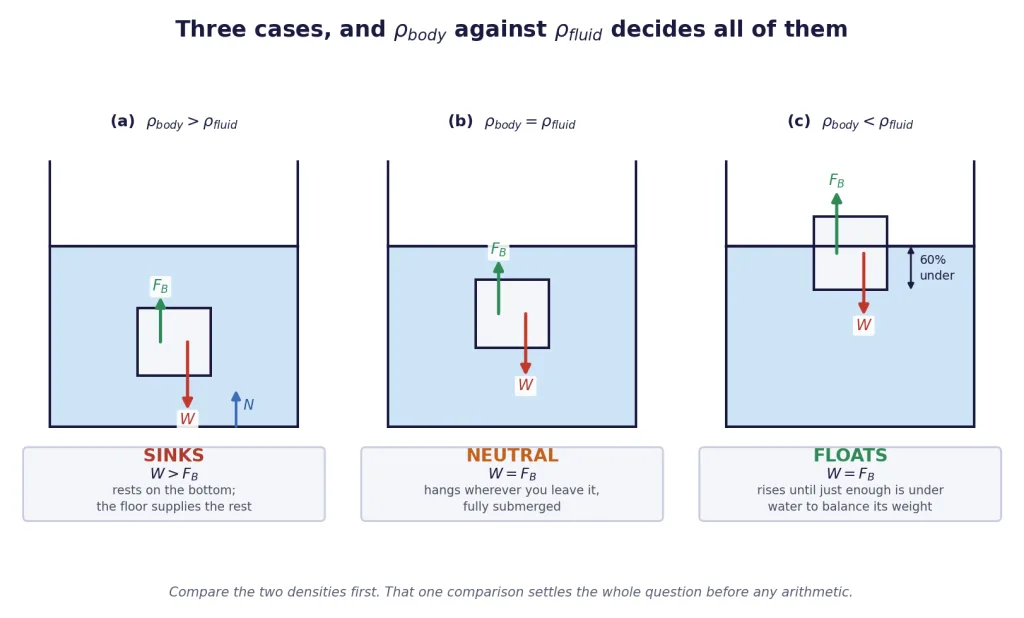
Put a body of uniform density into a fluid of density , hold it completely submerged, and let go. Two forces act: the weight down, and the upthrust up — note the same , because it is fully submerged. So the net force is
and the sign of that bracket decides everything.
| Case | What happens | Where it ends up |
|---|---|---|
| , net force down | sinks to the bottom and rests there | |
| , net force zero | neutral — stays wherever you leave it, fully submerged | |
| , net force up | rises, breaks the surface, and floats partly submerged |
Key Point: Compare the two densities before you compute anything. That single comparison tells you which of the three pictures you are in, and each picture has its own equation. Reaching for a formula before you know which case you are in is the fastest way to a wrong answer in this topic.
Case 1, sunk: what the floor does
Once a dense body is resting on the bottom, three forces act: down, up and the normal reaction from the floor, also up. Equilibrium gives
So the floor of the beaker carries only the apparent weight. That is why a heavy stone feels light while it is under water and suddenly heavy the moment you lift it clear.
Case 2, neutral: the submarine
If the body is in neutral equilibrium while fully submerged — it neither rises nor sinks, and it will stay at whatever depth you put it. A submarine works exactly this way: it floods ballast tanks with sea water to raise its average density and dive, and blows them out with compressed air to lower it and surface. A fish does the same thing more elegantly with a swim bladder.
[NEET Important] The human body has an average density of about 985 kg/m — very slightly less than fresh water — which is why a relaxed person with full lungs floats with just the face clear. Breathe out and the average density rises past 1000 and you begin to sink. In sea water, at about 1030 kg/m, floating is noticeably easier.
Case 3, floating: the body rises until it stops
This is the interesting one. A cork released at the bottom of a beaker accelerates upward, breaks the surface, and then — instead of flying out — settles with part of itself above the water. Why does it stop?
Because as the body emerges, less of it remains submerged, so falls, so falls. The body keeps rising until the shrinking upthrust has fallen to exactly the weight. Then it is in equilibrium, and there it stays.
Key Point — the law of floatation:
A floating body sinks until it has displaced its own weight of fluid.
Cancel and rearrange, and out comes the single most useful line in this section:
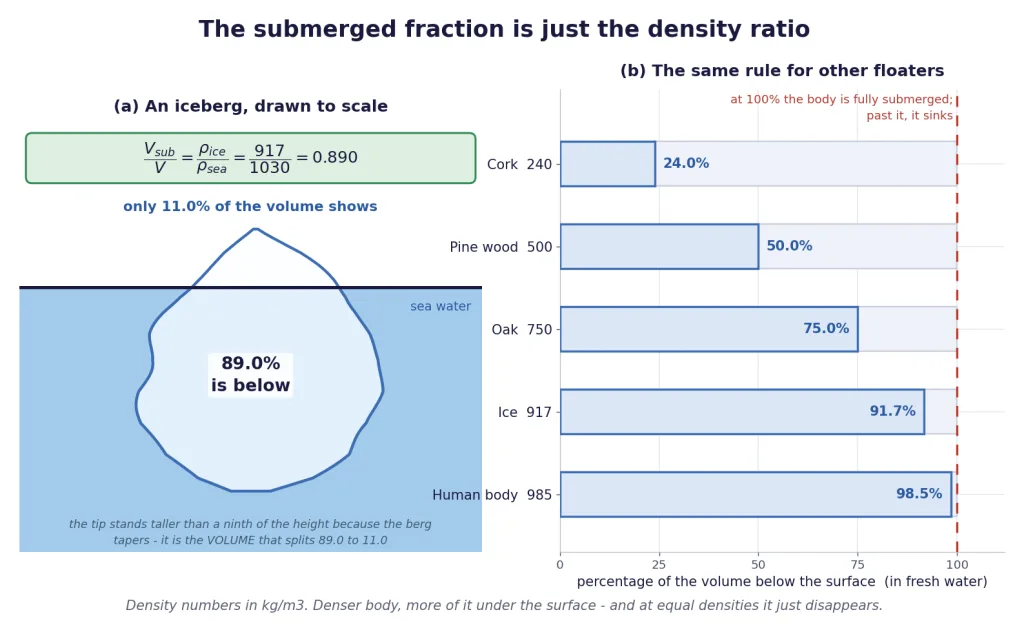
Key Point — the submerged fraction: The fraction of a floating body that lies below the surface is the ratio of the two densities. The fraction showing above is .
For a body of uniform cross-section floating upright — a rectangular block, a cylinder, a test tube — the volume ratio is also a depth ratio, so the same fraction tells you the draught directly. A wooden cube of density 600 kg/m and side 10 cm floats with 6 cm under the water and 4 cm above it, and it does so whatever the size of the beaker.
[JEE Tip] Notice that the fraction depends only on the two densities — not on , not on the size of the body, not on how much fluid is in the vessel. Take the same block to the Moon and it floats at exactly the same depth. That is a favourite one-line trap.
The Consequences: Icebergs, Ships and a Steel Nail
The submerged fraction looks like a small result. It explains an enormous amount.
The iceberg
Ice has a density of about 917 kg/m and sea water about 1030 kg/m. So
So 89.0% of an iceberg is under water — close to nine-tenths of it — and only about a ninth shows. That is the origin of "the tip of the iceberg", and it is why icebergs are so dangerous to shipping: the part you can see is a poor guide to the part that will hole your hull.
In fresh water the same ice floats with , or 91.7%, submerged — slightly more of it under, because fresh water is less dense and so gives less upthrust per cubic metre.
Here are more floaters, worked the same way, all in fresh water:
| Body | Density (kg/m) | Fraction submerged | What shows |
|---|---|---|---|
| Cork | 240 | 24.0% | about three quarters |
| Pine wood | 500 | 50.0% | exactly half |
| Oak | 750 | 75.0% | a quarter |
| Ice | 917 | 91.7% | a twelfth |
| Human body | 985 | 98.5% | just the face |
| Ebony | 1200 | sinks | nothing |
Why a ship rides higher at sea
A ship that has come down a river and out into the ocean floats higher in the water, and it does so without anything being unloaded.
The weight is unchanged, so by the law of floatation the weight of water displaced is unchanged. But sea water is denser — about 1030 kg/m against 1000 for river water — so the same weight of it takes up less volume. Less volume displaced means less of the hull is under the surface, so the ship rises.
This is not a curiosity. Every cargo ship carries load lines painted on its hull with separate marks for fresh water and for salt water, precisely because the safe draught differs between the two.
Key Point: Move a floating body from a less dense fluid to a more dense one and it rises, displacing a smaller volume but the same weight. Going the other way — sea to river — it sinks lower.
Why a steel ship floats and a steel nail sinks
This is the question every examiner loves, and there is exactly one correct answer.
Steel has a density of about 7800 kg/m, nearly eight times that of water. So a solid lump of steel — a nail, a spanner, a ball bearing — has , sinks, and that is that.
A ship is not a solid lump of steel. It is a thin steel shell enclosing a very large volume of air. What matters is the average density of the whole thing:
Make the hull big enough and drops below 1000 kg/m, and the ship floats. A loaded ship of kg contains only about 1540 m of actual steel, but its hull encloses far more than the 12 000 m of volume it needs to displace — well over 85% of what is inside the hull is air.
Key Point: It is never the material that decides, and never the weight on its own. It is — total mass over total enclosed volume — compared with . Hammer the same ship flat into a solid slab and it would sink like the nail, because you would have thrown away the enclosed air without changing the mass.
[Board Important] Write the answer in that order: (i) what floats or sinks is decided by average density, not by material; (ii) a nail is solid steel, so ; (iii) a ship is mostly air, so ; (iv) hence the ship displaces its own weight of water before it is fully immersed and floats, while the nail cannot.
Ice melting in a glass
A glass is filled with water and an ice cube floats in it. When the ice melts, does the water level rise, fall, or stay the same?
It stays exactly the same, and the reason is the law of floatation itself. While floating, the ice displaces a volume of water whose weight equals the ice's weight. When it melts, that same mass becomes water — of exactly the same weight — and water of that weight occupies exactly the volume that was being displaced. It slots into the hole it had already made.
[JEE Tip] The result is not universal — it holds for pure floating ice in the same liquid it melts into. Change either of those and it changes: ice with a stone frozen inside it makes the level fall, ice floating in brine or in mercury makes the level rise, and ice melting inside a sealed cavity behaves differently again. Those variants are worked in the JEE section of this chapter. What you must be able to do here is the plain case, and be able to say why.
Stability: Why a Boat Comes Back Upright
Floating is not the same thing as floating safely. A body can satisfy perfectly and still capsize the moment a wave tilts it. Stability is a separate question, and it is decided by where the two forces act, not by how big they are.
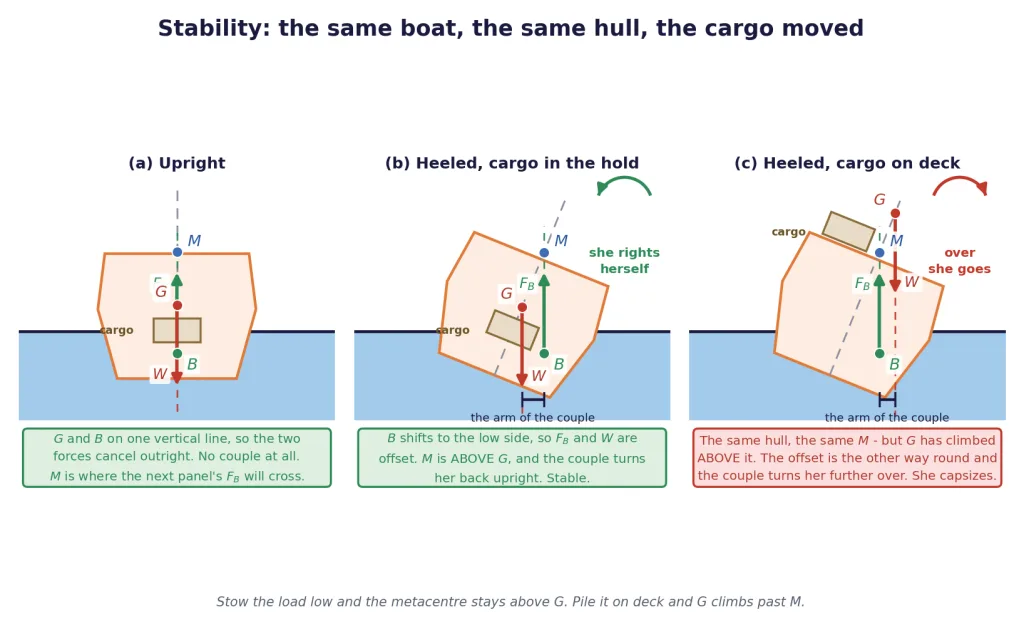
Recall the two points. The weight acts down through , the centre of gravity of the body. The upthrust acts up through , the centre of buoyancy, which is the centroid of the submerged part only.
Upright. and lie on the same vertical line. The two forces are equal and opposite and collinear, so they cancel completely — no net force, no couple. The boat sits still.
Heeled over. Tilt the boat through a small angle. stays put relative to the boat, because the mass has not moved inside it. But the shape of the submerged part changes — more of the low side is under water, less of the high side — so shifts toward the low side. Now the two forces are no longer collinear: they are equal, opposite and offset, which is precisely a couple.
Everything then turns on which way that couple acts.
Key Point — the metacentre:
Draw the new vertical line of action of through the shifted . Where it cuts the boat's original centreline is the metacentre, .
- above : the couple is a restoring one. The boat rights itself. Stable.
- below : the couple pushes it further over. Unstable — it capsizes.
- at : no couple at all. Neutral.
The distance is called the metacentric height, and a bigger means a stiffer, more stable boat.
Reading it as practical advice
The rule turns into one sentence a sailor could use: keep low.
- Cargo stowed deep in the hold keeps low and comfortably above it. Pile the same cargo on the deck and climbs; climb past and she goes over.
- Ballast — heavy material deliberately placed low down, or a deep weighted keel on a yacht — exists for no other reason than to drag downward.
- A wide, flat hull has a high metacentre, because a small tilt shifts a lot of displaced volume sideways and so moves a long way. That is why a raft is hard to overturn and a narrow canoe is easy.
- Passengers standing up in a small boat raise , which is why they are told not to.
[JEE Tip] For a body fully submerged — a submarine, a balloon — the shape of the displaced volume cannot change when it tilts, so does not move at all. Stability then reduces to a much simpler test: it is stable if lies above , and unstable if lies below. That is why a submarine carries its heavy machinery as low as it can, and why a hot-air balloon, with the basket and passengers slung well below the envelope, is inherently the right way up.
For a floating body the fully submerged test does not apply: is always below for a floating uniform body, and yet plenty of them are perfectly stable. It is , not , that has to be above .
That distinction — above for fully submerged, above for floating — is the whole of stability at this level, and it is as far as the syllabus asks you to go.
Pulling It Together
The whole section on one page
| Quantity | Formula | Read it as |
|---|---|---|
| Upthrust | weight of the fluid displaced | |
| From pressures | bottom pushed harder than top | |
| Apparent weight | what a spring balance reads | |
| Fully submerged | negative means it rises | |
| Relative density | three readings, no volume needed | |
| Density of a liquid | two apparent losses, compared | |
| Law of floatation | it displaces its own weight | |
| Submerged fraction | the single most used line here | |
| Floating in two liquids | the volume fractions in each | |
| Stability, floating | above | metacentric height |
| Stability, submerged | above | cannot move, so this is the test |
The six traps
Trap 1 — putting into . The upthrust formula contains the density of the fluid. A lead ball and a wooden ball of the same size, both held fully under water, feel exactly the same upthrust.
Trap 2 — using where belongs. They are equal only when the body is completely submerged. For a floating body is just the part under the surface, and using instead will inflate your upthrust.
Trap 3 — thinking the upthrust grows with depth. It does not. Only the difference of the pressures on the two faces matters, and pushing the body deeper raises both by the same amount.
Trap 4 — confusing weight with apparent weight. The weight of a submerged stone is unchanged. Its apparent weight is smaller. Say which one you mean, every time.
Trap 5 — answering "steel is denser than water" for the ship. True but insufficient, and it earns nothing on its own. The complete answer is about the average density of hull plus enclosed air.
Trap 6 — testing a floating body's stability with against . For a floating body is essentially always below , so that test would condemn every boat ever built. The floating test is against .
A checking habit
Before you write a final answer in this section, run these four checks.
- Which case am I in? Compare with first. Sunk, neutral or floating — the equations differ.
- Which volume did I use? Whole body, or just the submerged part? Write explicitly on your paper and never abbreviate it to .
- Gauge or absolute? For any buoyancy calculation the answer is the same either way, because cancels — but say which you used, because in the pressure questions of this chapter it genuinely matters.
- Is the size sensible? A floating fraction must lie between 0 and 1. An apparent weight cannot be negative for a body that is sinking. If either happens, you are in a different case than you thought.
[Board Important] The commonest full-mark question here is: state Archimedes' principle, derive it from the pressure difference on a submerged block, and then apply the law of floatation to a numerical body. Three parts, three separate marks — write the statement in words before you write any algebra.
Solved Examples
Constants used throughout this section, unless a problem says otherwise: m/s, kg/m, kg/m, kg/m, kg/m, kg/m, Pa.
Example 1: The upthrust, computed twice
A cube of side 10 cm is held completely submerged in water with its faces horizontal and vertical, its top face 20 cm below the free surface. Find (a) the force on the top face, (b) the force on the bottom face and (c) the upthrust, working first in gauge pressure and then in absolute pressure.
Solution:
Geometry first. Face area m. Top face at depth m, bottom face at m.
(a) Working in GAUGE pressure, so the pressures are measured relative to the atmosphere. On the top face,
(b) On the bottom face:
(c) The upthrust is the difference:
Now redo it in ABSOLUTE pressure, to see that it makes no difference. Add Pa to each: Identical, because appeared on both sides and subtracted out. The individual face forces are enormous; their difference is not.
Cross-check against Archimedes. m, so
Final Answer: 19.6 N down on the top, 29.4 N up on the bottom, upthrust 9.8 N — the same whether you use gauge or absolute pressure.
Takeaway: Buoyancy is a difference of pressures, so anything common to both faces cancels. That is why gauge is safe here, and why the upthrust does not change when you push the cube deeper.
Example 2: A density from two weighings
A metal block weighs 5.0 N in air and 4.0 N when completely immersed in water. Find its volume, its density and its relative density.
Solution:
The apparent loss of weight is the upthrust:
From , and since the block is completely immersed, : that is, about 102 cm.
The mass from the weight in air: kg.
The density:
Or skip steps 2 to 4 entirely with the ratio formula, which needs no and no volume:
Final Answer: m, kg/m, relative density 5.0.
Takeaway: Two weighings give you a density and you never touch a measuring cylinder. Learn the one-line ratio form — in an objective paper it turns this into five seconds of work.
Example 3: Is the crown gold?
A crown weighs 14.7 N in air and 13.4 N when fully immersed in water. Pure gold has a density of 19 300 kg/m. Is the crown solid gold?
Solution:
Apparent loss: N.
Relative density, straight from the ratio:
Compare with gold. Gold's relative density is 19.3, and the crown's is 11.31. So no — it is far too light for its volume, and something much less dense has been mixed in or hollowed out. (For scale, lead sits at about 11 300 kg/m.)
The check that makes the conclusion airtight. If it had been solid gold, its volume would have been m, giving an upthrust of only N and a reading in water of N. The balance actually read 13.4 N — well below that — so the crown displaces more water than gold of that weight possibly could.
Final Answer: Not gold. Relative density 11.31 against 19.3 for pure gold.
Takeaway: Weighing in water is a non-destructive test for density, and density identifies a material. Notice how step 4 converts "the number looks wrong" into "here is the reading gold would have given" — always the stronger way to write a conclusion.
Example 4: Finding the density of an unknown liquid
A solid body weighs 30 N in air, 26 N when fully immersed in water and 27 N when fully immersed in a liquid X. Find the relative density of X, and of the body.
Solution:
Two apparent losses, both from the same body, so both correspond to the same displaced volume :
Their ratio is the ratio of the densities, because and are common: so kg/m. X is lighter than water — an oil, perhaps.
And the body, from the water reading:
A consistency check on the volume. m, and kg/m, matching step 3.
Final Answer: ( kg/m); the body has ( kg/m).
Takeaway: Three readings give you two densities. The trick is that the same body is used in both liquids, so its volume cancels — which is exactly why the question always says "the same body".
Example 5: How deep does the block sit?
A wooden cube of side 10.0 cm and density 600 kg/m floats in water with its faces horizontal. (a) Find the depth of the submerged part. (b) Repeat for the same cube floating in an oil of density 800 kg/m, and comment.
Solution:
Check the case first. , so it floats partly submerged. Good — the law of floatation applies.
Write the equilibrium. Let be the submerged depth. Then with m, while m.
(a) Solve for . The cancels: So 6.0 cm is under water and 4.0 cm stands proud. Equivalently, , straight from the submerged fraction.
(b) In the oil, everything is the same but :
The comment matters. The oil is less dense than water, so each centimetre of immersion buys less upthrust, so the block must sink further before it balances. It floats lower in the lighter fluid — the same physics that makes a ship ride lower in a river than at sea.
Final Answer: 6.0 cm submerged in water; 7.5 cm in the oil.
Takeaway: For a body of uniform cross-section floating upright, the submerged fraction of the volume is also the submerged fraction of the height. That is what turns the density ratio straight into a draught.
Example 6: The iceberg
An iceberg floats in sea water. Take kg/m and kg/m. (a) What fraction of its volume is above the surface? (b) If m of it shows above the water, what is its total volume and its mass?
Solution:
(a) Use the submerged fraction: so the fraction above the surface is about 11.0%, or roughly a ninth — which is where "the tip of the iceberg" comes from.
(b) The visible 200 m is that 11.0%:
The mass: about 1672 tonnes, from a lump the size of a small house showing above the surface.
Verify the equilibrium. Weight N. Upthrust N. They balance.
Final Answer: (a) 11.0% shows; (b) m and kg.
Takeaway: Always decide whether the question wants the submerged fraction or the fraction showing, and write down which one you are using before substituting. Reading "above" as "below" is the only real difficulty in this question.
Example 7: A ship leaves the river for the sea
A ship of total mass kg sails from a river ( kg/m) out into the sea ( kg/m). (a) By how much does the displaced volume change? (b) If the hull has a roughly constant cross-section of 2500 m at the waterline, by how much does the ship rise?
Solution:
The law of floatation applies in both places, and the ship's weight has not changed, so in each fluid it displaces its own weight of water:
(a) The two volumes:
(b) That lost volume is a slab of hull that has come out of the water. With a waterline area m,
Sense check on the direction. Sea water is denser, so it supplies more upthrust per cubic metre, so less of it is needed, so the hull rises. About 14 cm — small compared with the ship, but very much worth marking on the hull.
Final Answer: 350 m less water displaced; the ship rides about 14 cm higher.
Takeaway: In both fluids the weight of water displaced is the same — it is the volume that changes. Start every one of these from "displaced weight is fixed" and the rest is one division.
Example 8: The steel ship and the steel nail
A ship of total loaded mass kg is built of steel of density 7800 kg/m and floats in fresh water. (a) What volume of actual steel is in it? (b) What is the minimum volume its hull must enclose? (c) What fraction of the hull's interior must therefore be air? (d) Why does a steel nail sink?
Solution:
(a) Volume of steel — this is the metal only, ignoring everything else:
(b) To float, it must be able to displace its own weight of water without going right under:
(c) The air fraction: so at least 87% of what the hull encloses has to be air — and in practice much more, because a ship that only just floats is not a ship anybody would sail.
(d) The nail. A nail is solid steel with no enclosed air at all, so its average density is the full 7800 kg/m. Fully submerged it displaces water weighing only of its own weight, about a thirteenth, and no amount of pushing it further under increases that. There is no depth at which the upthrust can match the weight, so it sinks.
The unified statement. In both cases the criterion is the same: average density against fluid density. For the ship ; for the nail .
Final Answer: (a) 1538 m of steel; (b) at least 12 000 m enclosed; (c) at least 87% air; (d) the nail has no enclosed air, so its average density is 7800 kg/m.
Takeaway: Shape has no magic in it — enclosing air is what a hull is for. The right question is never "is steel denser than water" but "what is the average density of the whole assembled object".
Example 9: How much can the raft carry?
A cubical block of wood of side 20.0 cm and density 600 kg/m floats in water. (a) Find its draught with nothing on it. (b) What is the largest mass that can be placed on top before water starts to come over the edge?
Solution:
(a) The empty draught. Submerged fraction , and for a cube floating upright that is also the fraction of the height: so there is 8.0 cm of freeboard above the water.
(b) At the limit, the block is exactly fully submerged — the water is level with its top face — and the upthrust is then at its maximum possible value:
Set that against the total weight of block plus load. The block's own mass is
So the load is the difference:
A shortcut worth knowing. The maximum load is in kilograms, here kg. It is the "spare" density multiplied by the volume.
Final Answer: (a) 12.0 cm submerged; (b) a maximum extra load of 3.20 kg.
Takeaway: The maximum load is set by the moment the body becomes fully submerged, because after that the upthrust cannot grow any further no matter what you do. Every "how much more can it carry" question turns on that one instant.
Example 10: Floating at the boundary of two liquids
A cube of side 10.0 cm and density 900 kg/m floats at the interface between water ( kg/m) and a layer of oil ( kg/m) resting on top of it, with the cube's faces horizontal. What fraction of the cube is in the water?
Solution:
Now there are two upthrusts, one from each liquid, and they add. Let be the fraction of the cube's volume lying in the water, so lies in the oil.
Write the equilibrium. With the cube's volume, and cancelling throughout:
Cancel and solve:
So two thirds is in the water — a depth of cm below the oil-water interface — and one third, 3.33 cm, is up in the oil.
Sense check. The cube's density, 900, lies between 700 and 1000, so it must sit at the interface, and being nearer to 1000 than to 700 it should have more of itself in the water. Two thirds against one third: correct. Note that if the cube's density had been below 700 it would have floated up on the oil's own surface instead, and the whole equation would have been different.
Final Answer: Two thirds of the cube lies in the water.
Takeaway: With layered liquids, the body's density is a weighted average of the two, weighted by the volume fractions. That one sentence solves the entire family of these questions.
Example 11: The melting ice cube
A glass of uniform cross-section 50.0 cm contains 200 mL of water, and a 20.0 g ice cube ( kg/m) floats in it. Find the water level before the ice melts and after it has melted, and hence the change in level.
Solution:
Before melting — what does the ice displace? It is floating, so by the law of floatation it displaces its own weight of water: (For interest, the cube's own volume is m, so about 8% of it is standing above the surface — consistent with the 91.7% figure for ice in fresh water.)
The level before. Everything below the waterline is either liquid water or the submerged part of the ice:
After melting. The 20.0 g of ice becomes 20.0 g of water, occupying so the glass now holds cm of liquid water and nothing else:
The change:
Why it had to come out that way. The melt water occupies exactly the volume the floating ice was displacing, because both are computed as "mass divided by " — one by the law of floatation, the other by the definition of density. The ice fills the hole it had already made.
Final Answer: 4.40 cm both before and after — the level does not change at all.
Takeaway: Compute the level before and after explicitly rather than quoting "it stays the same". Doing it in full is what tells you the result depends on the ice melting into the same liquid it was floating in — which is exactly the assumption the harder variants break.
Example 12: A helium balloon
A balloon of volume 10.0 m is filled with helium of density 0.180 kg/m. The surrounding air has density 1.29 kg/m. Ignoring the mass of the envelope, find (a) the upthrust from the air, (b) the weight of the helium and (c) the largest payload the balloon can lift.
Solution:
(a) The upthrust is the weight of the displaced air — the fluid is the atmosphere, not the helium:
(b) The weight of the gas inside:
(c) The payload is whatever is left over. At the point of just lifting,
A neater route to the same number: the "spare" density again, exactly as in Example 9.
Why balloons stop rising. As the balloon climbs, the air thins and falls, so falls. It rises until the upthrust has dropped to match the total weight, and then it levels off — the same "it rises until the upthrust has shrunk to the weight" logic as a cork in a beaker, just with a fluid whose density varies.
Final Answer: (a) 126 N; (b) 17.6 N; (c) about 11.1 kg.
Takeaway: Buoyancy in a gas obeys exactly the same equation as buoyancy in a liquid. Use the density of the surrounding fluid in , and the density of the contents in the weight — mixing those two up is the only mistake available here.