
Angular Momentum When the Axis Is Fixed
Section 6 gave the general machinery: for one particle, for a system, and to move it around. That is completely general and, frankly, a lot to carry.
Now specialise to the case that actually gets examined — a rigid body turning about a fixed axis — and it collapses into one line you will use for the rest of your life.
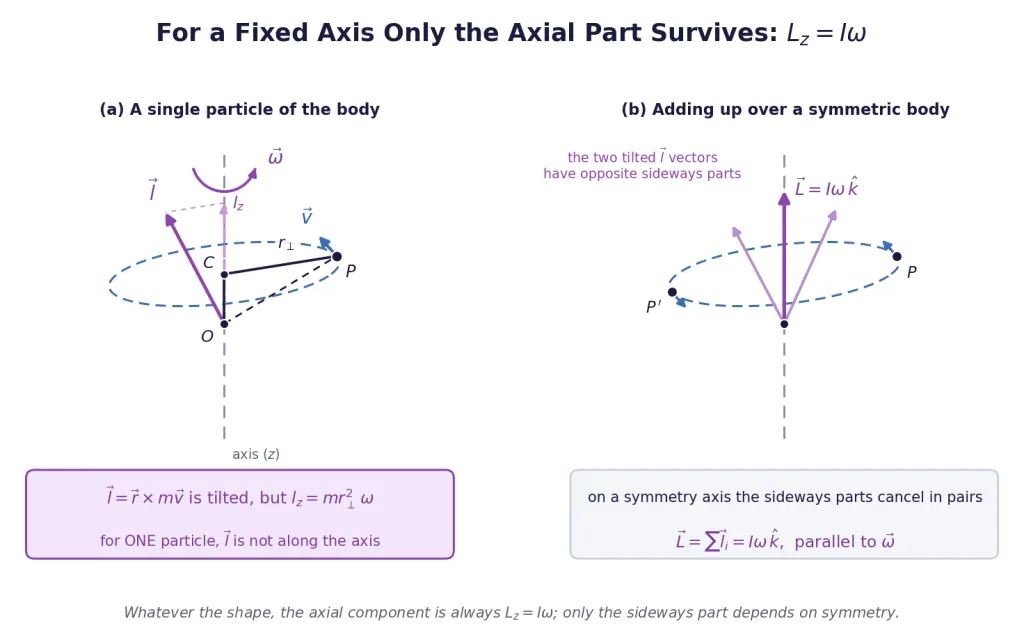
Doing it for one particle first
Take the axis to be the -axis, with origin on it. A particle of mass goes round a circle of radius whose centre lies on the axis. Split its position vector:
The first piece lies along the axis; the second lies in the plane of the circle, perpendicular to the axis and of length . The particle's velocity is tangential, of magnitude . So
Look at each term:
- : both vectors lie in the plane of the circle and are perpendicular to each other, so this product points along the axis, with magnitude .
- : is along the axis and is perpendicular to it, so this product is perpendicular to the axis.
Writing for the axial part,
Adding over the whole body
Every particle shares the same . So summing the axial parts,
and the bracket is exactly the moment of inertia about the axis from Section 8.
Key Point — angular momentum about a fixed axis: where is the component of along the axis of rotation, the moment of inertia about that axis, and the angular speed. This is the twin of , and it is the last row of the translation-rotation dictionary in Section 9.
Units and dimensions
so the SI unit is kg m/s. It is worth noticing that this is the same as a joule second (J s) — the unit of Planck's constant, which is itself a quantum of angular momentum. Both forms appear in exam papers and they mean the same thing.
[NEET Important] and are related by which follows by eliminating . Keep the second form in your head — it is the fastest route through half the problems in the next few blocks, and it is the key to the energy question at the end of this section.
Why Need Not Point Along the Axis
Here is the thing everyone glosses over, and it is genuinely important. We proved that . We did not prove that . Those are different statements, and the second one is often false.
Look again at that split for a single particle:
The first term is generally not zero. So for one particle, is tilted — it is not parallel to at all, even though the particle is going round in a perfectly good circle.
Key Point: For a particle, is always parallel to , but is not in general parallel to . This is one of the few places where the translation-rotation analogy genuinely breaks down.
When the tilts cancel
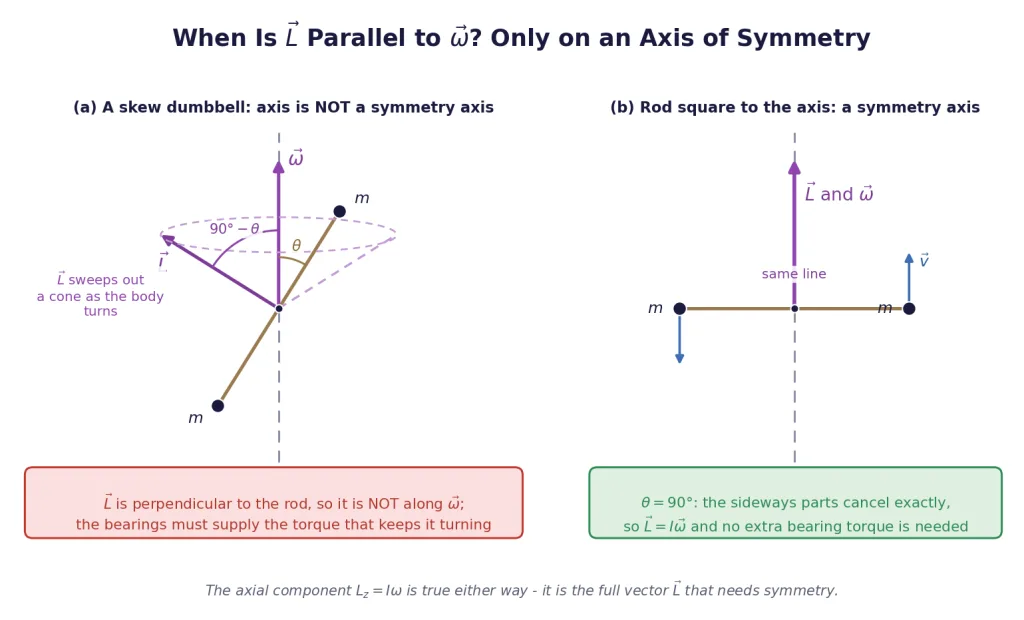
Now add up over a whole body. Suppose the axis of rotation is an axis of symmetry. Then for every particle at a given height on the axis there is a matching particle diametrically opposite on the same circle, moving with velocity . The two sideways contributions are equal and opposite, so they cancel in pairs.
Key Point — when is parallel to : If the axis of rotation is an axis of symmetry of the body, the perpendicular parts cancel completely and so and point the same way. If the axis is not an axis of symmetry, has a sideways component as well, and it is not along the axis.
In both cases, still holds. Only the sideways part depends on symmetry.
Nearly every body in this chapter — a ring about its central axis, a disc about its centre, a rod about its perpendicular bisector, a sphere about a diameter, a cylinder about its own axis — is being spun about a symmetry axis, which is exactly why we can be casual and write most of the time.
The case where it bites: a skew dumbbell
Take two equal masses on a light rod that passes through the origin at to the axis, and spin the whole thing about the axis. Each mass still moves in a circle, so as always. But the sideways parts of the two contributions now add rather than cancel, and the resultant comes out perpendicular to the rod, tilted away from the axis.
And here is the consequence. As the body turns, that tilted is dragged round with it, sweeping out a cone. A vector that changes direction is changing, so — and by there must be an external torque, even though the angular speed is perfectly constant. The bearings supply it, and they feel it as a shaking force that reverses twice per turn.
Where this matters in real life
- Wheel balancing. A car wheel whose mass is not symmetrically placed about its axle has a tilted , and the wheel shakes the steering at speed. The little lead weights the mechanic hammers onto the rim exist to make the axle a genuine symmetry axis.
- Rotor and turbine design. Every high-speed rotor is dynamically balanced for the same reason: an unbalanced means bearing loads that grow as .
- Fixed-axis problems in an exam. The perpendicular components of torque are quietly cancelled by the constraint forces at the bearings, which is what "fixed axis" means physically. That is why we may ignore them and keep only the axial component.
Key Point — the working rule: For rotation about a fixed axis, use only the axial component of everything: , , and . The perpendicular components are the bearings' problem, not yours.
From Back to the Equation of Motion
Differentiating with respect to time gives, since the direction of the axis is fixed,
Key Point — the equation of motion, in its honest form: If does not change with time, it comes out of the derivative and which is exactly the result Section 9 obtained from the work-energy route. Two independent derivations, one answer.
Why the general form matters
The moment is allowed to vary, is simply the wrong equation. Write it out properly:
The second term is the one that does all the interesting physics in this section. A skater who pulls her arms in has and speeds up without any external torque at all — because the extra term supplies the change in internally.
And the perpendicular part
For a fixed axis, the same analysis gives
so whatever sideways component of the body happens to have, it is held constant by the bearing forces. This is the formal statement of "the constraints look after the perpendicular components", and it is why one scalar equation is enough.
The three quantities on one card
For a rigid body turning about a fixed axis with moment of inertia and angular speed :
| Quantity | Formula | SI unit |
|---|---|---|
| angular momentum about the axis | kg m/s | |
| kinetic energy | J | |
| equation of motion | if is constant | N m |
| angular impulse | N m s |
[JEE Tip] The angular impulse row is easy to forget and turns up constantly. A torque acting for a short time changes by regardless of what or do in the meantime — the rotational twin of .
Conservation:
Set the external torque about the axis to zero and the whole of this section falls out in one step.
Key Point — conservation of angular momentum about a fixed axis: If the net external torque about the axis is zero, then is constant: The body may change its own shape as much as it likes — internal forces cannot change . If falls, must rise in exact proportion, and the other way round.
The condition, checked properly
Students apply this law where it does not hold, so learn to justify it in one line. For a person on a frictionless turntable, spinning about a vertical axis:
- Weight acts vertically downward. Its torque about a vertical axis is zero, because the force is parallel to the axis. (Its torque about a horizontal axis through the same point is huge — but that is not the axis we are using.)
- Normal reaction from the floor also acts vertically. Same argument, zero axial torque.
- The pivot reaction acts at the axis itself, so and its torque about the axis vanishes.
- The muscular forces the person uses to pull her arms in are internal. Internal torques cancel in pairs.
Net axial torque zero, so is conserved. Notice that the total torque on the person is emphatically not zero — only its component along the axis is, and that is all the law needs.
The four standard situations
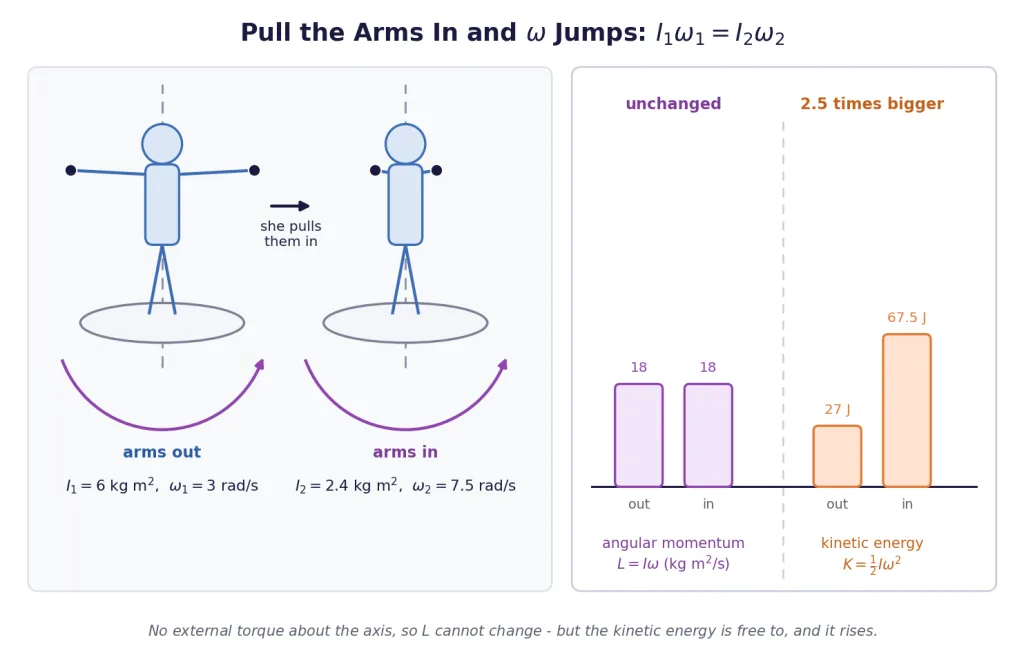
1. The skater, and the swivel-chair experiment. Sit on a swivel chair with your feet off the ground, holding a heavy book in each hand, and get someone to spin you with your arms stretched out. Pull the books in to your chest and you speed up dramatically. Push them out again and you slow down. went down by a factor of two or three; went up by the same factor.
2. The diver's tuck. A diver leaves the board with whatever angular momentum the board gave her, and there is no torque about her centre of mass while she is in the air. Tucking cuts her by a factor of about four, so she somersaults about four times as fast; opening out again slows the rotation so she can enter the water cleanly.
3. A person on a turntable with dumbbells. The quantitative version of the skater. Here you build explicitly out of the Section 8 results: the platform's own , plus for each dumbbell at its actual distance from the axis. Only the dumbbells' contribution changes when the arms move.
4. A merry-go-round taking on a passenger. Different in character. Here increases because mass is added, so falls. The passenger who steps on radially with no tangential speed contributes , and the final state is
The recipe
- Name the axis and check the net external torque about it is zero.
- Write and explicitly, adding up the standard shapes from Section 8. Point masses at distance contribute each.
- Apply to get the unknown angular speed. Keep the units of consistent — if you start in rpm you may finish in rpm, because the conversion factor cancels on both sides.
- Compute the kinetic energy before and after, separately. Never assume it is unchanged.
- Account for the difference — muscular work, or friction. The next block explains which.
The traps
Key Point: Three mistakes that cost marks every year.
- is not conserved, is. Writing because "there is no external torque" is a complete misreading.
- Kinetic energy is not conserved. Angular momentum being constant says nothing whatever about energy, and in these problems the energy always changes.
- The axis must be the same throughout. and must both be measured about the same fixed axis, or the equation is meaningless.
[Board Important] "State the law of conservation of angular momentum and give two examples" is a standard two- or three-mark question. The safe answer: state the condition (zero external torque about the axis), give , and use the skater and the diver, saying explicitly which way changes.
The Energy Question, Answered Honestly
The skater pulls her arms in. Her angular momentum is unchanged. Her kinetic energy roughly doubles. Where did that energy come from?
This is the single most-asked follow-up in the whole chapter, and hand-waving will not do.
First, the arithmetic
Eliminate using :
With held fixed, is inversely proportional to . So
Key Point: Halve the moment of inertia and the kinetic energy doubles. Double it and the kinetic energy halves. Kinetic energy and angular momentum simply do not behave the same way, and no amount of wishing makes them.
For the skater with kg m at 3 rad/s who folds down to kg m: rad/s, J and J. The extra 40.5 J is real and has to be paid for.
Where the energy comes from: the honest mechanism
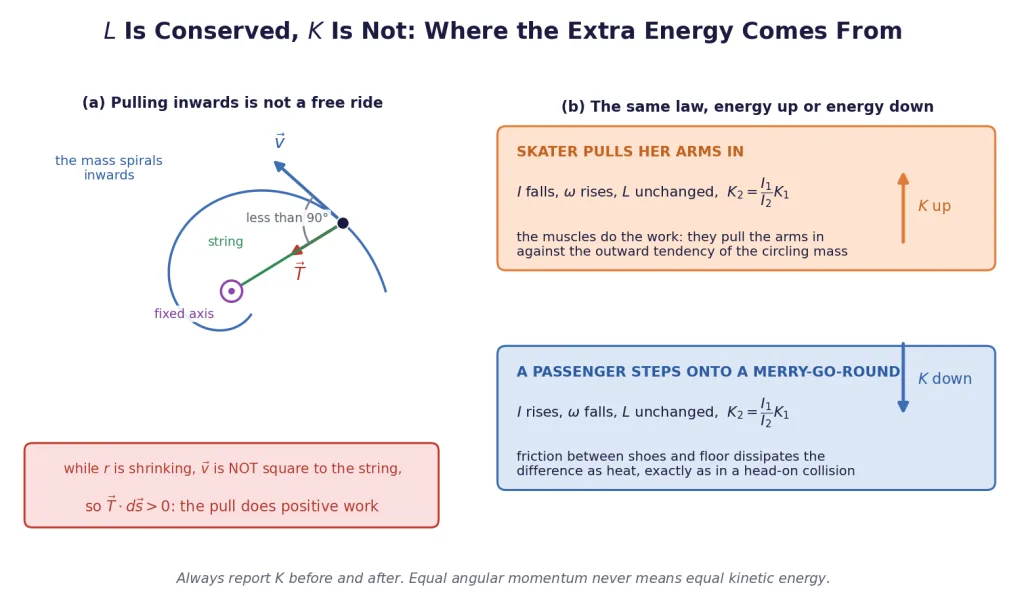
Her arms are going round in circles, so something must pull them inward to keep them there — that is the centripetal requirement, and the pull comes from her shoulder and back muscles. To reduce the radius she must pull harder than the circular motion needs, and while she does so the arms actually move inwards.
The force is inward. The displacement has an inward component. So the work done is positive:
Look at the figure: while is shrinking, the path is a spiral, and the velocity is not perpendicular to the arm — the angle between the inward pull and the displacement is less than . That is the whole answer. Do the integral,
and it comes out exactly equal to , every time. Her muscles did the work; her chemical energy paid for it.
Key Point: When a rotating system pulls its own mass inwards, the internal forces do positive work and the kinetic energy rises. When it lets mass move outwards, they do negative work and the kinetic energy falls — the muscles absorb energy on the way out, which is why the skater's arms feel heavy when she opens them.
Notice what did not happen: no external torque, so no change in . Internal forces can pump energy in and out of a system freely while leaving its angular momentum untouched. That is not a contradiction — it is the difference between a quantity and a quantity.
The other case: energy goes down
Not every conservation problem gains energy. When a passenger steps onto a moving merry-go-round, or a second disc is dropped onto a spinning one, the two parts arrive at different speeds and friction between them brings them to a common . Angular momentum is conserved because friction here is internal; kinetic energy is not, because friction generates heat.
For two bodies coupling together,
which is always negative. This is the exact rotational analogue of a perfectly inelastic collision, with in the role of mass and in the role of velocity — the same formula, the same conclusion.
The three cases, side by side
| What happens | Who pays | ||||
|---|---|---|---|---|---|
| skater pulls arms in; diver tucks | falls | rises | same | rises | muscles do positive work |
| skater opens out; beads slide outwards | rises | falls | same | falls | muscles absorb energy |
| passenger boards; discs couple | rises | falls | same | falls | friction, as heat |
Key Point — the working rule: In every conservation problem, compute before and after separately and state which way it went. Angular momentum conserved never means energy conserved, and an answer that quietly assumes it does is wrong even when the number happens to come out right.
[JEE Tip] A favourite one-liner: " is conserved and increases — is energy conservation violated?" The answer is no. Total energy is conserved; some of the skater's chemical energy became kinetic. Conservation of energy is a statement about all forms of energy, not about kinetic energy alone.
[NEET Important] For assertion-reason questions, remember the pair: Assertion — the skater spins faster when she pulls her arms in. Reason — her angular momentum is conserved. Both true, and the reason is the correct explanation. But swap the assertion for "her kinetic energy is unchanged" and it becomes false.
Section 11 takes the same machinery to a body whose axis is itself moving — rolling — where the kinetic energy splits into a translational piece and a rotational piece.
Solved Examples
For every conservation problem below, the kinetic energy before and after was computed separately and independently, and the direction of the energy change is stated explicitly — never assumed. Where muscular work is claimed, it was checked by integrating the inward force through the actual radial displacement, not by quoting . No problem in this section needs the value of .
Example 1: A child on a turntable folds his arms
A child stands at the centre of a frictionless turntable with his arms outstretched, the whole system having a moment of inertia of 6 kg m about the vertical axis and turning at 3 rad/s. He folds his arms in, reducing the moment of inertia to 2.4 kg m. Find (a) the new angular speed, (b) the kinetic energy before and after, and (c) account for the difference.
Solution:
(a) Check the condition, then conserve. Gravity and the normal reaction are both parallel to the vertical axis and exert no torque about it; the pivot reaction acts at the axis; the muscular forces are internal. So is conserved:
(b) Kinetic energy, both times, separately.
(c) The kinetic energy has gone up by 40.5 J, a factor of 2.5 — which is exactly , as demands. The extra energy came from the child's muscles: to bring his arms inwards he had to pull harder than the circular motion required, and that inward force acted through an inward displacement, doing positive work.
Final Answer: 7.5 rad/s; J, J, an increase of 40.5 J supplied by the child's muscles.
Takeaway: constant does not mean constant. [Board Important] Part (c) is where the marks are: name the muscular work explicitly and say the inward force acts through an inward displacement.
Example 2: The skater, in revolutions per second
A skater spinning at 1.2 rev/s with her arms outstretched has a moment of inertia of 4.0 kg m about her vertical axis. She pulls her arms in, reducing it to 1.6 kg m. Find her new rate of spin, and the kinetic energy before and after.
Solution:
Rate of spin. The conversion factor between rev/s and rad/s cancels on both sides of , so we may work directly in rev/s:
Energies need rad/s, so convert.
The difference. J of muscular work, and as expected.
Final Answer: 3.0 rev/s; J, J, an increase of about 170.5 J.
Takeaway: You may leave in rev/s or rpm for the conservation step, because the factor cancels — but you must convert to rad/s the moment you compute an energy. [JEE Tip] Mixing the two is the commonest source of a factor of or in a wrong answer.
Example 3: A man on a turntable with dumbbells
A man stands on a frictionless turntable holding a 2 kg dumbbell in each hand, arms outstretched so that each dumbbell is 0.9 m from the vertical axis. The turntable together with the man's body (excluding the dumbbells) has a moment of inertia of 3.0 kg m, and the system turns at 2 rad/s. He pulls the dumbbells in to 0.2 m from the axis. Find the new angular speed and the work he does.
Solution:
Build from the pieces, treating each dumbbell as a point mass contributing :
Conserve.
Energies, separately.
Work done by the man. No external torque acts, so every joule of the increase came from him:
Final Answer: about 3.95 rad/s; the man does about 12.2 J of work.
Takeaway: Only the part of that moves changes. The platform and the man's own body contribute 3.0 kg m throughout; the dumbbells' contribution drops from 3.24 to 0.16 kg m, and that is the whole story. [NEET Important] A point mass at distance from the axis always contributes exactly , whatever else is going on.
Example 4: A merry-go-round takes on a passenger
A merry-go-round of moment of inertia 500 kg m is turning freely at 2 rad/s about its vertical axis. A 50 kg child, initially at rest on the ground, steps radially onto its rim, 2 m from the axis, and stays there. Find (a) the new angular speed, (b) the kinetic energy before and after, and (c) where the missing energy went.
Solution:
(a) The child arrives moving radially, so contributes no angular momentum about the axis. Treating the child as a point mass on the rim:
(b)
(c) About 286 J has been lost, roughly 29% of the original. It went into heat, generated by friction between the child's shoes and the platform floor as the platform skidded under her feet and dragged her up to speed. This is a perfectly inelastic collision, in rotational dress.
Final Answer: about 1.43 rad/s; J, J, about 286 J lost as heat.
Takeaway: Here the kinetic energy went down, not up — so " conserved" tells you nothing about the direction of the energy change until you compute both numbers. [JEE Tip] The fraction of energy retained is , exactly as predicts.
Example 5: The diver's tuck
A diver leaves the board rotating at 1.4 rad/s in a stretched position with a moment of inertia of 14 kg m about the axis through her centre of mass. She tucks, reducing it to 3.5 kg m, and holds the tuck for 1.6 s. Find (a) her angular speed in the tuck, (b) how many somersaults she completes in those 1.6 s, and (c) the kinetic energy before and after.
Solution:
(a) While she is in the air, gravity acts through her centre of mass and exerts no torque about it, so is conserved: Four times the moment of inertia removed, four times the spin rate.
(b)
(c) The energy has risen by 41.16 J, supplied by the diver's muscles as she pulled her limbs in against the outward tendency of the rotation.
Final Answer: 5.6 rad/s; about 1.43 somersaults; rises from 13.72 J to 54.88 J.
Takeaway: A diver has a fixed amount of angular momentum from the moment her feet leave the board — she cannot change it in mid-air. All she can do is redistribute her mass, and by doing so she controls how fast that fixed turns her. [NEET Important] Note , as always.
Example 6: A disc dropped onto a spinning disc
A disc of moment of inertia 4 kg m is spinning freely at 12 rad/s about a vertical axle. A second disc, of moment of inertia 2 kg m and initially at rest, is dropped gently onto it so that the two share the same axle and quickly turn together. Find the common angular speed, and the energy lost.
Solution:
Conserve. Friction between the discs is internal, and the axle exerts no torque about itself:
Energy before and after.
Cross-check with the inelastic-collision formula. The two routes agree.
Final Answer: 8 rad/s; 96 J lost as heat at the rubbing surfaces.
Takeaway: This is a perfectly inelastic collision with for mass and for velocity — the algebra is identical to two railway trucks coupling. [JEE Tip] The fraction of kinetic energy retained is , which you can quote directly when only the ratio is asked.
Example 7: Counter-rotating discs
A disc of moment of inertia 3 kg m turning at 10 rad/s anticlockwise is brought into contact with a coaxial disc of moment of inertia 2 kg m turning at 5 rad/s clockwise, and they end up turning together. Find the final angular speed and the energy dissipated.
Solution:
Signs matter. Take anticlockwise positive, so rad/s. Positive, so the pair ends up turning anticlockwise — the way the disc with the greater angular momentum was going.
Energies.
Final Answer: 4 rad/s anticlockwise; 135 J dissipated.
Takeaway: Angular momenta add as signed quantities, kinetic energies add as positive ones — which is exactly why so much energy can vanish here (over 77% of it). [JEE Tip] Fix a positive sense before you write a single number; forgetting the minus sign gives 8 rad/s and every subsequent answer is wrong.
Example 8: An insect walks out to the rim
A uniform disc of mass 4.8 kg and radius 0.5 m spins freely at 10 rad/s about its central vertical axis. An insect of mass 0.2 kg sitting at the centre walks slowly out to the rim. Find the new angular speed and the change in kinetic energy.
Solution:
Moments of inertia, using the standard disc result and for the insect:
Conserve.
Energies. The kinetic energy has fallen by about 2.3 J.
Final Answer: about 9.23 rad/s; the kinetic energy falls by about 2.3 J.
Takeaway: A mass sitting on the axis contributes nothing to — which is why the insect's walk matters at all. [NEET Important] Compare this with the skater: mass moving outwards means falls and falls, because the constraint forces now do negative work on the moving mass.
Example 9: Beads sliding outwards on a rotating rod
A rod is free to rotate about a vertical axis through its centre, with a moment of inertia of 0.30 kg m of its own. Two beads, each of mass 0.5 kg, are held 0.1 m from the axis, and the system turns at 20 rad/s. The beads are released and slide out to 0.4 m, where stops catch them. Find the new angular speed and the change in rotational kinetic energy.
Solution:
Moments of inertia.
Conserve.
Rotational kinetic energy, before and after. a drop of about 20.2 J.
Where did it go? Two places, and it is worth being precise. While the beads slide outwards they also pick up radial speed, so some of the missing 20.2 J is temporarily carried as radial kinetic energy — which the formula does not include, since that counts only the circular motion. When the stops catch the beads, that radial energy is destroyed as heat in the impact.
Final Answer: about 13.5 rad/s; the rotational kinetic energy falls by about 20.2 J.
Takeaway: counts only the circular part of the motion. Whenever mass is moving radially as well, say so — the total kinetic energy and the rotational kinetic energy are then different quantities. [JEE Tip] The conservation step is unaffected by any of this: radial motion carries no angular momentum about the axis, so is exact.
Example 10: A person walks in to the centre of a turntable
A turntable is a uniform disc of mass 30 kg and radius 1.2 m, free to turn about its central vertical axis. A 60 kg person stands on its rim while the whole system turns at 1.5 rad/s. The person then walks slowly in to the centre. Find (a) the new angular speed, (b) the kinetic energy before and after, and (c) the work done by the person.
Solution:
Moments of inertia. For the disc, kg m. Treat the person as a point mass:
(a) Conserve. Five times faster, because fell by a factor of five.
(b) Energies.
(c) No external torque acts about the axis, so the whole increase came from the walker: That is genuine muscular effort: walking inwards on a spinning platform is startlingly hard work, because at every step you must push against the outward tendency of your own circular motion.
Final Answer: 7.5 rad/s; J, J; 486 J of work done by the person.
Takeaway: — the same ratio as the angular speeds, every time. [JEE Tip] When a walker reaches the exact centre their contribution to vanishes entirely, which is why these numbers come out so dramatic.
Example 11: Why gravity does not spoil the turntable problem
A 60 kg person stands 1.0 m from the vertical axis of a frictionless turntable. Taking the weight as 600 N, find the torque of the weight (a) about a horizontal axis through the pivot, and (b) about the vertical axis of rotation. Comment.
Solution:
(a) About a horizontal axis through the pivot and perpendicular to the line joining pivot and person, the weight acts at a perpendicular distance of 1.0 m: A large torque — and it is real. It is balanced by the normal reaction from the floor, which is what stops the turntable tipping over.
(b) About the vertical axis, the weight is parallel to the axis. A force parallel to an axis has no torque about it at all:
Comment. The total torque on the person is not zero. Only its component along the axis of rotation is zero — and that is the only component the conservation law requires. This is exactly why every swivel-chair and turntable problem may be solved with despite gravity acting throughout.
Final Answer: 600 N m about the horizontal axis, zero about the vertical axis.
Takeaway: Always name the axis before claiming a torque is zero. The same force, the same point, two axes, two completely different answers. [Board Important] This one-line justification is what turns "angular momentum is conserved" from an assertion into an argument, and it is often worth a mark on its own.
Example 12: A skew dumbbell, where is not along the axis
Two masses of 0.5 kg each are fixed at the ends of a light rod of total length 0.8 m, which passes through the origin at to a vertical axis. The whole thing is spun about that vertical axis at 10 rad/s. Find (a) the moment of inertia about the axis, (b) , (c) the magnitude of the full vector , and (d) the angle makes with the axis.
Solution:
(a) Each mass is at 0.4 m along the rod, so its perpendicular distance from the axis is
(b) The axial component always obeys the rule from the first block:
(c) For a dumbbell, comes out perpendicular to the rod, so it makes an angle of with the axis. Hence with a sideways component kg m/s.
(d) from the axis, on the opposite side to the rod's tilt.
Final Answer: kg m; kg m/s; kg m/s; tilted from the axis.
Takeaway: held perfectly — but was not along , because the axis is not a symmetry axis of this body. As the dumbbell turns, that tilted sweeps a cone, so and the bearings must supply a torque even at constant angular speed. [JEE Tip] Whenever a problem has a rod, plate or dumbbell set at an angle to its axle, expect this: the axial equations still work, but and part company.