
Same Chapter, Half the Clock
Section 13 has just taken this chapter apart the JEE way — angular momentum about arbitrary points, balls skidding into rolling, particles smashing into hinged rods, blocks toppling off planks. If you read it, you already know far more than this section will ever ask of you.
So why a separate corner? Because the skill being tested is different.
JEE gives you a hard question and enough time to think. NEET gives you a manageable question and almost no time at all. Physics is 45 questions, and inside a 180-minute paper shared with Chemistry and Biology those 45 deserve roughly 45 minutes. One minute each — and System of Particles and Rotational Motion is one of the highest-weightage chapters in Class 11 mechanics, so you will meet three or four items from it. Every one has to be finished in well under a minute, correctly, so that the time is banked for the questions that genuinely need it.
What is NOT asked from this chapter
This list matters as much as anything else here, because it tells you what to stop worrying about.
Key Point: Rotational motion at this level never leaves the core syllabus. No angular momentum about a randomly chosen point. No decomposition into spin plus orbital. No rolling with slipping and no transition to pure rolling. No particle-hits-rod collisions. No toppling. No moment of inertia by integration for cones or triangular plates. Everything on the paper is a definition you recall, one standard formula you substitute into, a set-up you have drilled, or one of the two special formats.
Every single item on that list belongs to Section 13. If you find yourself computing where an instantaneous axis sits, or worrying about a hinge impulse, you have wandered into the wrong section's version of the question.
The four types, and what each should cost you
| Type | What it looks like | Your budget | The right instinct |
|---|---|---|---|
| 1. Direct recall | "The moment of inertia depends on …" "When is angular momentum conserved?" "Where is the centre of mass of a ring?" | 15-20 s | You either know it or you do not. Never derive a definition. |
| 2. One-step plug-in | , , , , | 25-35 s | Spot the picture, pick the card, substitute once. |
| 3. Standard template | The skater pulling her arms in, a body rolling down an incline, a block over a heavy pulley | 25-40 s | Recognise the set-up. You should already know the shape of the answer. |
| 4. Assertion-Reason / Column matching | Two special formats, both drilled below | 35-45 s | Judge each statement alone, then judge the link. |
[Important] A diagnostic worth internalising: if a question from this chapter needs a fourth line of working, you have misread it. You are handed two of the quantities and asked for a third. If your page is filling up, stop and reread the stem — you have almost certainly imported an assumption that was never made.
The / arithmetic
Four marks for a correct answer, minus one for a wrong one, zero for a blank. On a doubtful item the real question is not "can I get this?" but "can I get this in 40 seconds?" If two options survive elimination and 40 seconds have gone, take the better one and move on — a 50-50 guess is worth marks on average. What you must never do is spend three minutes rescuing one mark's worth of doubt in a chapter where the very next question might be a one-liner about where the centre of mass of a uniform ring sits.
What this section does, and what it does not repeat
We will not re-derive the centre of mass (Section 2), re-derive (Section 3), rebuild the cross product (Section 4), re-derive (Section 5), re-derive (Section 6), redo the ladder problems (Section 7), re-derive the axis theorems (Section 8), re-derive (Section 9), re-derive (Section 10) or rebuild rolling from scratch (Section 11). What you get instead is the same material reorganised for recognition speed:
- The sentences that come back almost verbatim.
- The moment-of-inertia table as a recognition exercise, with a hook for each shape.
- Plug-and-play formula cards, with the traps attached.
- The three standard templates, with clean numbers.
- The rolling ranking that reappears every year.
- The two special formats, drilled properly.
- Speed habits and elimination tactics.
Throughout, m/s^2 unless a problem says otherwise, and no problem ever mixes 9.8 with 10.
The Sentences That Come Back Almost Verbatim
This block is pure recall ammunition. Read it as flashcards, not as prose. Every item here has appeared as a complete question by itself, and the wording stays close to the standard phrasing, because that is exactly how it gets asked.
Centre of mass: the four sentences
Key Point:
- The centre of mass is the mass-weighted average position of a system, . It is also written .
- It need not lie inside the material of the body. The centre of mass of a ring, of a hollow sphere, and of a horseshoe all sit in empty space.
- For a uniform body it sits at the geometric centre, and it always lies on any axis of symmetry.
- The centre of mass moves as if all the mass were concentrated there and all the external forces acted there: . Internal forces can never move it.
Moment of inertia: the four sentences
Key Point:
- . It is the rotational analogue of mass — the measure of how hard it is to change a body's rotation.
- depends on three things: the mass, the way that mass is distributed, and the position of the axis. It does not depend on the angular velocity, the angular acceleration, or the torque applied.
- is not a fixed property of a body. Change the axis and changes. Always ask "about which axis?"
- The radius of gyration is defined by : the single distance at which the whole mass could sit and give the same . Its SI unit is the metre.
Torque and angular momentum
Key Point:
- , magnitude . Torque is a vector, its SI unit is the newton metre, and it is not a unit of energy even though it has the same dimensions.
- The torque of a force whose line of action passes through the axis is ZERO, because then or . This is why a door will not turn if you push at the hinge.
- for a particle; for a rigid body about a fixed axis, . The SI unit is kg m/s, the same as J s.
- : the rotational form of Newton's second law.
Conservation of angular momentum: the sentence itself
Key Point: If the net external torque on a system is zero, its total angular momentum is constant. For a fixed axis that reads . Note what is not required: forces may act, energy may change, and the body may deform. Only the torque has to vanish.
And the consequence that gets asked as a trick:
Key Point: When decreases with fixed, rises and the kinetic energy RISES too, because . The extra energy comes from the internal work done by whoever pulled the mass inward. Angular momentum conserved does not mean energy conserved.
Rolling: the three sentences
Key Point:
- Rolling without slipping means , and it means the contact point is instantaneously at rest.
- Because the contact point is at rest, the friction acting there is STATIC, not kinetic, and because that point does not move, static friction does no work in ideal rolling. Mechanical energy is conserved.
- . On a rolling wheel the contact point has speed 0, the centre , and the top .
Equilibrium
Key Point: A rigid body is in equilibrium when both and . Either alone is not enough: a couple has zero net force and still spins the body.
The always-true / never-true table
Speed comes from knowing which sentences are safe.
| Statement | Verdict |
|---|---|
| The centre of mass must lie inside the body | Never required — a ring is the standard counter-example |
| depends on the choice of axis | Always |
| depends on the angular speed | Never |
| Torque is a scalar | False — it is a vector, unlike work |
| A force through the axis produces no torque | Always |
| Angular momentum is conserved whenever momentum is | False — the conditions are different, one needs zero force, the other zero torque |
| conserved implies kinetic energy conserved | False — pulling the arms in raises |
| In rolling without slipping, friction is kinetic | False — it is static |
| Static friction in ideal rolling does no work | Always |
| The radius of gyration has units of metres | Always |
| A ring and a disc of equal and have equal | False — the ring's is twice the disc's |
| The contact point of a rolling wheel is at rest | Always |
| Internal forces can shift the centre of mass | Never |
[Important] The three most reused distractors from this chapter are "moment of inertia depends only on mass", "angular momentum conserved means energy conserved" and "rolling friction is kinetic". Each appears somewhere almost every year, and each is worth four marks in under fifteen seconds.
The Moment of Inertia Table, as Recognition
Section 8 derived these. Your job here is different: see the shape, name the axis, write the answer. No derivation, ever.
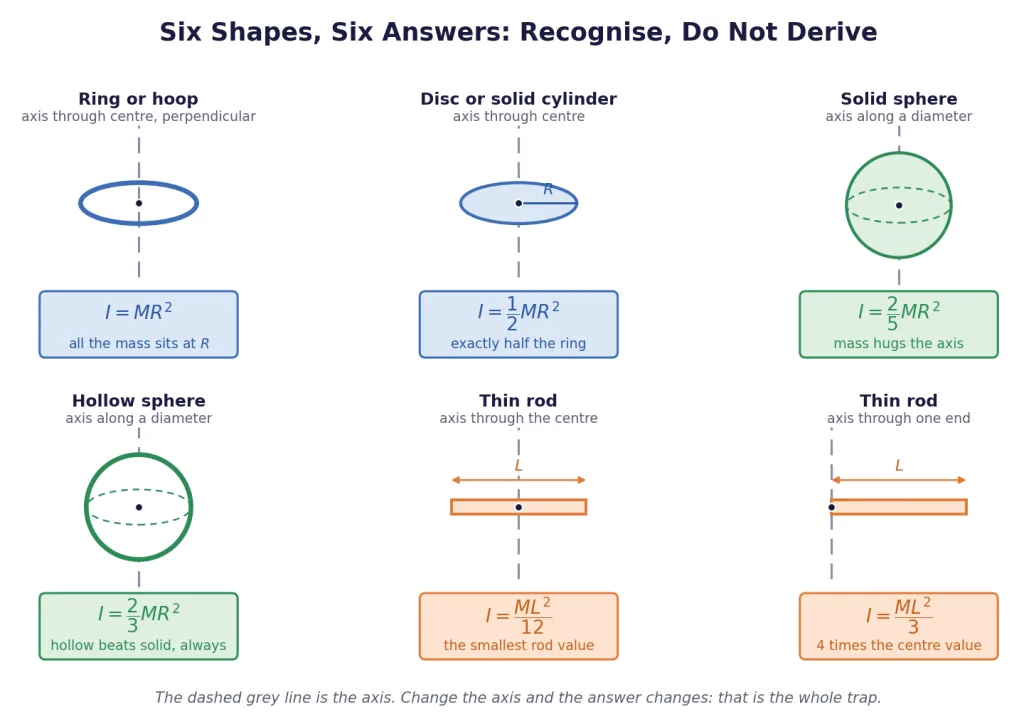
The six you must know cold
| Body | Axis | Memory hook | |
|---|---|---|---|
| Ring / hoop | centre, perpendicular to the plane | every gram sits at : the biggest possible | |
| Disc / solid cylinder | its own central axis | exactly half the ring | |
| Solid sphere | a diameter | the mass hugs the axis: the smallest | |
| Hollow sphere | a diameter | hollow always beats solid | |
| Thin rod | through the centre, perpendicular | the smaller rod number | |
| Thin rod | through one end, perpendicular | four times the centre value |
Key Point — the ordering, which answers half the questions on its own. For the same and the same : The further the mass sits from the axis, the larger . Hollow beats solid every time. That one sentence answers "which has the greatest moment of inertia", "which is hardest to spin up", "which rolls down slowest" and "which stores the largest fraction of its energy as rotation".
The second row of the table, worth knowing
These come from the two axis theorems, but you should read them off, not build them.
| Body | Axis | |
|---|---|---|
| Ring | a diameter | |
| Ring | tangent, in the plane | |
| Ring | tangent, perpendicular to the plane | |
| Disc | a diameter | |
| Disc | tangent, in the plane | |
| Disc | tangent, perpendicular to the plane | |
| Solid sphere | tangent to the surface | |
| Hollow cylinder | its own axis |
The two theorems in one line each. Parallel axis: , and the axis you start from must pass through the centre of mass. Perpendicular axis: , and it works only for a flat lamina, with perpendicular to it.
The radius of gyration, as a lookup
, so . It is a length, in metres.
| Body | Axis | |
|---|---|---|
| Ring | central, perpendicular | |
| Disc | central, perpendicular | |
| Solid sphere | a diameter | |
| Hollow sphere | a diameter | |
| Rod | through the centre |
[Important] Two questions get asked about almost interchangeably, and they have the same answer: "the radius of gyration of a disc about its central axis" and "the distance from the axis at which the whole mass of a disc could be placed without changing its moment of inertia". Both are .
The single trap in this whole block
Moment of inertia belongs to a body and an axis together, never to a body alone. A disc has about its central perpendicular axis, about a diameter, about a perpendicular tangent — three different numbers for one disc. If a question gives you a shape and no axis, read it again: the axis is in there somewhere.
Plug-and-Play Formula Cards
Every card here is one substitution wide. Read the picture, pick the card, put the numbers in once, move on.
Card 1 — Torque
- is the angle between and , not between and anything else.
- gives the maximum, . or gives zero.
- Unit: newton metre. Never call it a joule.
Worked in one line. A spanner 0.5 m long, a 20 N force at to the handle: N m.
Card 2 — The rotational Newton's second law
Worked in one line. A flywheel with kg m under a steady 10 N m torque: rad/s.
Card 3 — Angular momentum
Worked in one line. A disc of mass 2 kg and radius 0.5 m spinning at 10 rad/s: kg m, so kg m/s and J.
Card 4 — The rotational kinematic equations
Identical in form to the straight-line equations, with , , . Angles must be in radians, and one full turn is rad.
Card 5 — Work and power in rotation
Worked in one line. That flywheel again, from rest for 4 s: rad/s, rad, so J, which matches J.
Card 6 — The translation-rotation dictionary
| Straight line | Rotation |
|---|---|
| mass | moment of inertia |
| velocity | angular velocity |
| acceleration | angular acceleration |
| force | torque |
| momentum | angular momentum |
[Important] Learn the dictionary and half of this chapter becomes Chapter 4 in different clothes. The only genuinely new object is , and the only genuinely new habit is asking which axis it is measured about.
The four traps hidden in these cards
- Degrees where radians belong. in and in is always in radians. A wheel making revolutions has turned rad.
- Torque quoted in joules. Newton metres. Torque is a vector; work is a scalar; they are different quantities that happen to share a dimension.
- Using about the wrong axis. A rod pivoted at its end has , not .
- Forgetting to convert rpm. revolutions per minute is rad/s. A wheel at 300 rpm turns at rad/s.
The Three Templates, and the Ranking Nobody Should Have to Derive
Three set-ups cover the overwhelming majority of rotational numericals on this paper. Recognise which one you are looking at, write the boxed line, substitute.
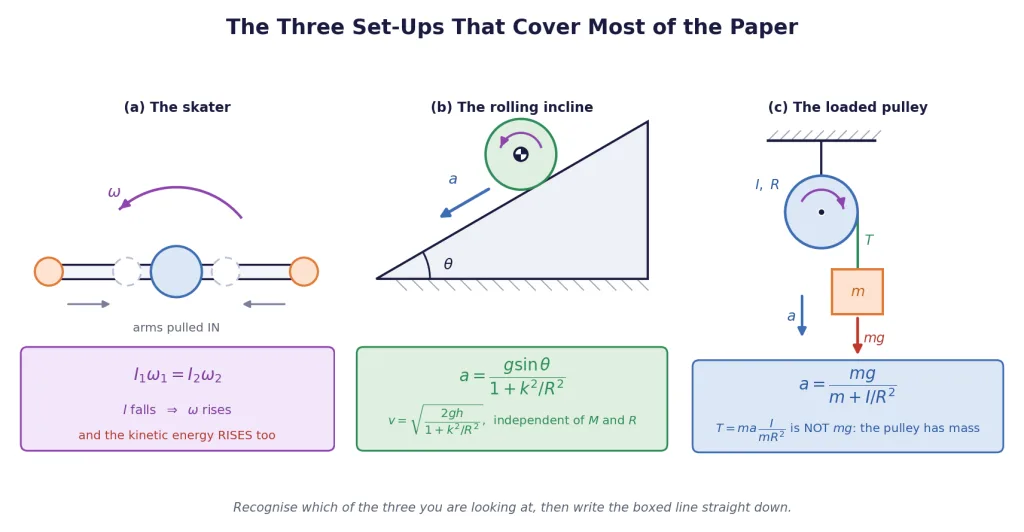
Template 1 — The skater (and the diver, and the turntable)
Whenever mass is pulled inward or pushed outward on a freely spinning system with no external torque:
The clean numbers. A skater with kg m spinning at 2 rad/s pulls her arms in to kg m. Then rad/s — three times faster, because fell to a third.
And the follow-up that catches people:
Key Point: The kinetic energy went up by the same factor that went up by. The skater's muscles did work pulling the arms in against the outward pull, and that work is the extra 24 J. Angular momentum conserved never means energy conserved.
Template 2 — The rolling incline
A body released from rest and rolling without slipping down a slope of angle , from a vertical height :
Both are independent of and of — only the shape factor matters. Two spheres of wildly different size and mass arrive together.
The clean numbers. A disc released from a height of 1.2 m with m/s^2: On a slope its acceleration is m/s^2, and a solid sphere on the same slope gets m/s^2.
Template 3 — The loaded pulley
A block of mass hangs from a light string wrapped round a pulley of moment of inertia and radius :
The clean numbers. With kg, kg m, m and m/s^2:
[Important] The tension is not the moment the pulley has mass. If you ever write for a moving block, you have said . And N is genuinely less than N, exactly as it must be for the block to accelerate downward.
The rolling ranking, which reappears every year
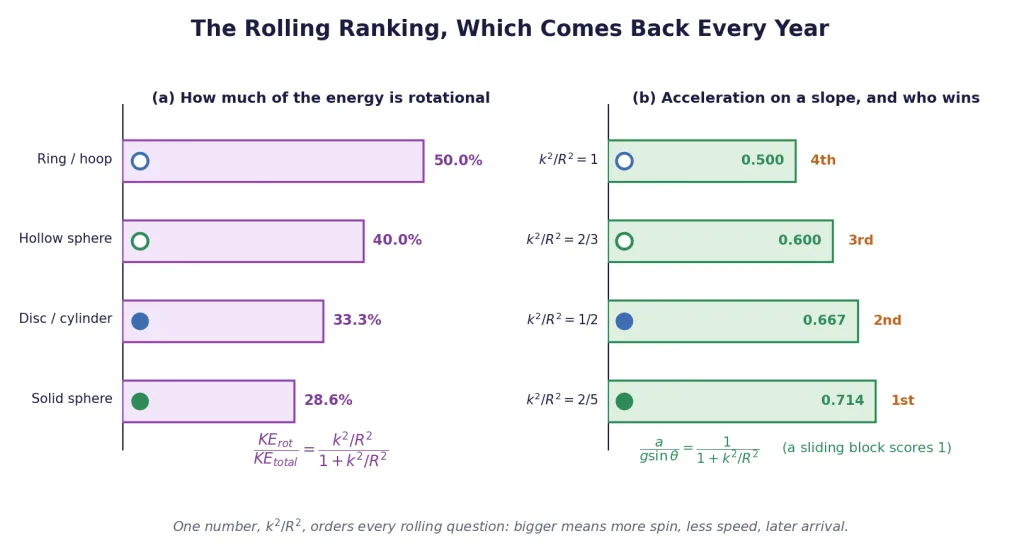
| Body | Rotational share of | Finishes | ||
|---|---|---|---|---|
| Ring or hoop | 4th | |||
| Hollow sphere | 3rd | |||
| Disc or solid cylinder | 2nd | |||
| Solid sphere | 1st | |||
| A block sliding on a smooth slope | beats them all |
Key Point: One number orders everything. Smaller means less energy diverted into spin, so more speed, larger acceleration and an earlier arrival. The solid sphere always wins; the ring always loses; a frictionless sliding block beats every one of them. Mass and radius never enter the ordering.
The two formulas behind that table:
Assertion-Reason and Column Matching: the Two Special Formats
These two are not harder physics. They are a different reading task, and both are entirely mechanical once you know the drill.
Assertion-Reason: the four codes
You are given an Assertion (A) and a Reason (R), and asked to choose:
| Code | Meaning |
|---|---|
| (a) | Both A and R are true, and R is the correct explanation of A |
| (b) | Both A and R are true, but R is not the correct explanation of A |
| (c) | A is true but R is false |
| (d) | A is false but R is true |
Some papers add "both false". Read the option list before you start — the order of these four is not fixed between papers, and picking "option (a)" from memory when the paper has shuffled them is a self-inflicted wound.
The attack: judge A, then R, then the link
Key Point: Three separate judgements, in this order, and never let one influence the next:
- Cover R. Is A true, on its own?
- Cover A. Is R true, on its own?
- Only if both are true: does R actually explain A, or is it merely another true fact about the same topic?
Step 3 is where the marks are, and it is the step people rush. "Both true" is not enough. Ask yourself: if R were false, would A stop being true? If yes, R explains A. If A would survive without R, the answer is (b).
The trap this format is built around is a true reason attached to a false assertion, which makes the assertion sound plausible. The defence is step 1: judge A with R covered.
Worked, four times
Item 1. A: In rolling without slipping, the friction acting at the contact is static. R: The contact point of a rolling body is instantaneously at rest. A alone: true. R alone: true. And R is exactly why A holds — a surface that is not sliding cannot have kinetic friction. So both true, R explains A.
Item 2. A: The moment of inertia of a body is not a fixed number. R: Moment of inertia is a scalar quantity. A alone: true, because changes with the axis. R alone: true. But does R explain A? No — being a scalar has nothing to do with depending on the axis. Mass is a scalar too, and it is perfectly fixed. So both true, R does NOT explain A.
Item 3. A: When a skater pulls her arms in, her kinetic energy stays the same. R: Her angular momentum is conserved because there is no external torque. A alone: false — the kinetic energy rises, since and has fallen. R alone: true. So A false, R true — and notice how a perfectly correct R makes the false A feel right.
Item 4. A: The centre of mass of a uniform circular ring lies at its centre. R: The centre of mass must always lie within the material of the body. A alone: true. R alone: false — the ring itself is the counter-example, since its centre is empty space. So A true, R false.
Column matching: anchor and kill
You are given Column I (four entries, A to D) and Column II (four results, i to iv), and four codes that pair them up.
Key Point: Never work out all four pairings. Find the one you are surest of, use it to eliminate every code that contradicts it, then check whichever single pairing still separates the survivors. Two confident pairings almost always settle a four-option matching question.
The drill:
- Scan Column II for the odd one out — a zero, the only entry with in it rather than , the only value bigger than .
- Anchor on that pairing and strike out every code that disagrees.
- Count the survivors. If one remains, stop. If two remain, find the single letter where they differ and settle just that one.
- Never check a pairing that all the surviving codes agree on. It cannot change the answer.
A worked anchor.
| Column I | Column II |
|---|---|
| (A) Ring, about its central perpendicular axis | (i) |
| (B) Disc, about a diameter | (ii) |
| (C) Rod, about an axis through one end | (iii) |
| (D) Solid sphere, about a diameter | (iv) |
Anchor on (C): it is the only rod, and (i) is the only entry containing instead of . C-i is certain, and every code without it dies. Then anchor on (A): the ring is the only body whose entire mass sits at , so it is the only one that can give the bare . A-iv. Two anchors, and the matching is settled: B-ii and D-iii follow without any thought.
[Important] Column matching is answered by elimination between the codes, not by solving the physics four times. If you find yourself computing all four entries, you have already lost thirty seconds you did not have.
Speed Habits: Finishing in Under 45 Seconds
Everything above is content. This block is technique — how to spend the 45 seconds you actually have.
The four-second triage
Read the stem once and put it in a box before writing anything:
| Signal in the stem | Box | First line you write |
|---|---|---|
| a definition, a unit, "depends on", "always/never" | recall | the answer |
| one shape, one axis named | table lookup | the from the table |
| a force and a distance, or and | one-step plug-in | the card |
| "pulls her arms in", "sits on a turntable", "a child walks inward" | skater | |
| "rolls down", "released from a height", "which reaches first" | incline | the shape factor |
| a pulley with a stated or mass | pulley | |
| Assertion and Reason | AR | judge A alone first |
| two columns and four codes | matching | find the anchor |
Five ways to kill an option without solving anything
- Dimensions. must come out in kg m, in metres, in N m, in kg m/s. An option in the wrong units is free to discard.
- Limits. Any expression for of a body of radius must sit between and for the standard shapes about a central axis. An option offering for a disc about its own axis is dead.
- Monotonicity. If mass moves outward, must increase. If decreases at constant , must increase. Any option going the other way is wrong before you compute.
- Independence. In rolling down an incline the answer cannot contain or . If three options have in them and one does not, you have probably found it.
- The symmetric pair. When two options are the same number with and in front, the question is testing a factor you either know or do not. Go back to the table rather than guessing between them.
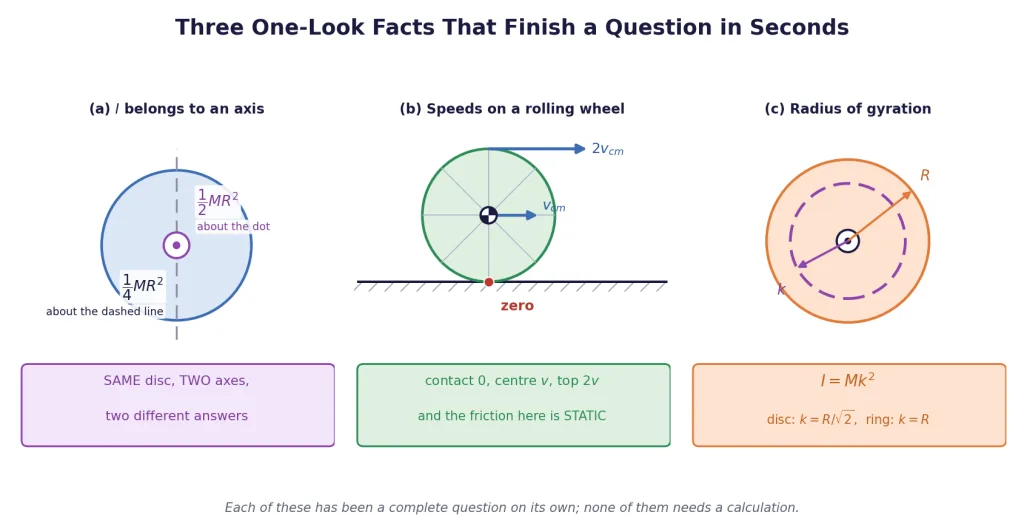
Six one-look facts
These have each been a complete question on their own, and none of them needs a calculation.
- The contact point of a rolling wheel is at rest; the top moves at .
- belongs to an axis. A disc is about its own axis but about a diameter.
- for a disc is , and for a ring is exactly .
- A solid sphere always wins the race down an incline, and a sliding block beats it.
- A force whose line passes through the axis exerts no torque.
- Pulling mass inward raises and raises , and leaves alone.
The stopwatch rule
Key Point: Give yourself 45 seconds. At 45 seconds, either you have an answer or you have two surviving options. If it is the second, choose the one your elimination rules favour and move on — the expected value of a 50-50 guess under is , and the two minutes you save are worth more than the mark you are chasing.
The three-question self-test before the exam
If you can answer these three in ten seconds each, this chapter is exam-ready.
- A ring and a disc have the same mass and radius. Which is harder to spin up about its central axis, and by what factor? — the ring, by a factor of exactly 2.
- A girl on a rotating stool pulls her weights in. What happens to , to and to ? — unchanged, up, up.
- A solid sphere, a disc and a ring roll from rest down the same incline. In what order do they arrive? — sphere, disc, ring.
[Important] If any of those three took you more than ten seconds, go back to the table block and the ranking table. Those two blocks alone carry most of the marks this chapter is worth on the paper.
Solved Examples
Twelve problems at exam level and exam pace. Give yourself 45 seconds on each before reading the solution. m/s^2 throughout unless stated otherwise.
Example 1: Ten one-liners, from the statements alone
Answer each in a single sentence, with no calculation.
(a) Does the centre of mass of a body have to lie inside the body? (b) On what three things does the moment of inertia of a body depend? (c) What is the SI unit of the radius of gyration? (d) When is the angular momentum of a system constant? (e) Is torque a scalar or a vector? What is its unit? (f) In rolling without slipping, is the friction static or kinetic, and how much work does it do? (g) What is the speed of the contact point of a wheel rolling at ? (h) A skater pulls her arms in. What happens to her kinetic energy? (i) Can internal forces shift the centre of mass of a system? (j) Which has the greater moment of inertia about a central axis: a ring or a disc of the same mass and radius?
Solution:
(a) No. A ring, a hollow sphere and a horseshoe all have their centre of mass in empty space.
(b) The mass, the distribution of that mass, and the position of the axis. Not on , or the applied torque.
(c) The metre. is a length, defined by .
(d) Whenever the net external torque is zero. Forces may still act; only the torque has to vanish.
(e) A vector, measured in newton metres. Same dimensions as energy, but not the same quantity, so never write it as a joule.
(f) Static, and it does zero work, because the point at which it acts is instantaneously at rest.
(g) Zero. That is the definition of rolling without slipping. The top of the same wheel moves at .
(h) It increases. is fixed and , so a smaller means a larger ; the extra energy comes from her own muscles.
(i) No, never. Internal forces cancel in pairs, so is untouched by them.
(j) The ring, and by exactly a factor of 2: against .
Final Answer: (a) no (b) mass, distribution, axis (c) metre (d) zero external torque (e) vector, N m (f) static, zero work (g) zero (h) increases (i) no (j) the ring, by 2.
Takeaway: Ten questions, no arithmetic, well under a minute in total. These are the sentences that come back year after year, and every second saved here is a second available for a numerical.
Example 2: The table, as a recognition drill
Without deriving anything, write down: (a) of a ring of mass and radius about a diameter. (b) of a disc of the same and about a tangent perpendicular to its plane. (c) The radius of gyration of a solid sphere about a diameter. (d) The ratio of for a rod about one end to about its centre. (e) Which of a ring, a disc, a solid sphere and a hollow sphere of equal and is hardest to spin up about a central axis.
Solution:
(a) A ring about its central perpendicular axis is . The perpendicular-axis theorem splits that equally between the two in-plane diameters:
(b) Start from about the central perpendicular axis and shift by :
(c) , so
(d) The end axis is always four times the central one for a uniform rod.
(e) The one with the largest , which is the ring at — all of its mass sits at the maximum distance from the axis. The order is ring hollow sphere disc solid sphere.
Final Answer: (a) (b) (c) (d) 4 (e) the ring.
Takeaway: Every one of these is a lookup plus at most one theorem. Recognise, do not derive — the derivation is Section 8's job and it has no place inside a 45-second window.
Example 3: Torque, three ways in one question
A spanner is 0.5 m long. A 20 N force is applied at its far end. Find the torque about the bolt when the force is applied (a) at to the spanner, (b) at to the spanner, (c) along the spanner. (d) A 25 N force is applied to a different spanner 0.4 m long, at . Find that torque too.
Solution:
The one card. , with measured between and .
(a) , : This is the maximum any 20 N force can manage on this spanner.
(b) , : Half the effect, for the same effort. This is why you pull a spanner perpendicular to its handle.
(c) , : The line of the force passes through the bolt, so it has no moment about it at all.
(d)
Final Answer: (a) 10 N m (b) 5 N m (c) zero (d) 5 N m.
Takeaway: is the whole story. Perpendicular is maximum, along the arm is zero, and a force through the axis can never turn anything.
Solved Examples (continued)
Example 4: A flywheel, start to finish
A flywheel of moment of inertia 2 kg m is at rest. A constant torque of 10 N m is applied for 4 s. Find (a) the angular acceleration, (b) the angular speed after 4 s, (c) the angle turned through, (d) the work done by the torque, and (e) check that work against the kinetic energy gained.
Solution:
(a)
(b)
(c) That is revolutions, if the question wants turns instead.
(d)
(e) The two agree exactly, which is the work-energy theorem in rotational clothing.
Final Answer: (a) 5 rad/s (b) 20 rad/s (c) 40 rad (d) 400 J (e) it matches.
Takeaway: This is Chapter 4 with new symbols. Every straight-line equation has a rotational twin, and if you know the dictionary you never learn a new formula, only a new letter.
Example 5: Angular momentum of a spinning disc
A uniform disc of mass 2 kg and radius 0.5 m spins about its central axis at 10 rad/s. Find (a) its moment of inertia, (b) its angular momentum, (c) its rotational kinetic energy, and (d) the constant torque needed to stop it in 5 s.
Solution:
(a)
(b)
(c) Cross-check with J.
(d) Stopping in 5 s means rad/s: Equivalently, the torque must remove all 2.5 kg m/s of angular momentum in 5 s: N m.
Final Answer: (a) 0.25 kg m (b) 2.5 kg m/s (c) 12.5 J (d) 0.5 N m.
Takeaway: , then , then — always in that order, because the last two both need the first. And is often quicker than going through .
Example 6: The skater template, with the follow-up
A skater spinning on frictionless ice has kg m and rad/s. She pulls her arms in and her moment of inertia drops to 2 kg m. Find (a) her new angular speed, (b) her kinetic energy before and after, (c) where the extra energy came from, and (d) what would have happened to her angular momentum if she had instead pushed against a wall.
Solution:
(a) No external torque acts about the vertical axis, so is conserved: Her spin rate tripled, because fell to one third.
(b) The energy also tripled — by exactly the ratio , as demands.
(c) From her own muscles. Pulling her arms inward against their tendency to fly outward takes work, and that 24 J of work ends up as extra rotational kinetic energy. Nothing external did anything.
(d) A wall push is an external force applied off the axis, so it would exert an external torque and would not be conserved. The whole template rests on there being no external torque.
Final Answer: (a) 6 rad/s (b) 12 J then 36 J (c) her muscles, 24 J of internal work (d) would change.
Takeaway: constant, up, up. Every part of that sentence is examinable, and the third part is the one that gets missed. The energy ratio is exactly the same as the ratio.
Example 7: The race down the incline
A ring, a solid disc, a hollow sphere and a solid sphere, all of the same mass and radius, are released from rest at the top of the same incline and roll down without slipping. (a) In what order do they arrive? (b) Which stores the largest fraction of its kinetic energy as rotation, and how much? (c) If a frictionless block is released alongside them, where does it finish? (d) Does doubling the mass of the solid sphere change anything?
Solution:
The single controlling number is the shape factor : ring 1, hollow sphere , disc , solid sphere .
(a) Since a smaller shape factor gives a larger acceleration. So the order of arrival is
(b) The rotational share is Ring: . Hollow sphere: 40%. Disc: 33.3%. Solid sphere: 28.6%. The ring stores the largest share, and it is exactly half.
(c) The block has , so — the largest possible. It beats every rolling body, because none of its energy is diverted into spin.
(d) No. Neither nor appears in or in . Two solid spheres of any masses and any radii arrive together.
Final Answer: (a) solid sphere, disc, hollow sphere, ring; (b) the ring, at 50%; (c) the block wins outright; (d) no change at all.
Takeaway: One number orders the whole family. Smaller shape factor means less energy lost to spin, larger acceleration, earlier arrival. Learn the four values and this entire class of question becomes a recall item.
Solved Examples (continued)
Example 8: The incline template, with numbers
(a) A uniform disc rolls without slipping from rest down a slope, dropping through a vertical height of 1.2 m. Find its speed at the bottom. (b) Find its acceleration on a slope. (c) Find the acceleration of a solid sphere on the same slope. (d) A body rolls down and arrives with 60% of its energy as translation. Identify it. Take m/s^2.
Solution:
(a) For a disc, : Neither the mass nor the radius was needed, and neither was the slope angle.
(b)
(c) For a solid sphere, : Faster than the disc, as the ranking promised.
(d) Translation is 60%, so rotation is 40%. Setting which is a hollow sphere.
Final Answer: (a) 4.0 m/s (b) 3.33 m/s (c) 3.57 m/s (d) a hollow sphere.
Takeaway: Part (d) is the reverse question and it turns up often: given the energy split, name the body. Solve for and read off the shape.
Example 9: The pulley template
A block of mass 5 kg hangs from a light string wound around a pulley of moment of inertia 0.2 kg m and radius 0.2 m. The string does not slip. Take m/s^2. Find (a) the acceleration of the block, (b) the tension, (c) the angular acceleration of the pulley, and (d) the speed of the block after it has fallen 2.5 m, checked by an energy audit.
Solution:
(a) The template: Exactly half of , because happens to equal here.
(b) Note it is not 50 N. If the tension equalled the weight, nothing would accelerate.
(c) Check with : N m, and N m. They agree.
(d) Energy audit. The block lost J. It gained J of translational energy, and the pulley gained J of rotational energy. Together, 125 J. The books balance.
Final Answer: (a) 5.0 m/s (b) 25 N (c) 25 rad/s (d) 5.0 m/s, with the energy audit balancing at 125 J.
Takeaway: A pulley with mass is a pulley that eats energy. Half the lost potential energy here went into spinning the pulley, and that is why the block accelerates at only . Never write when anything is moving.
Example 10: Centre of mass, three quick ones
(a) Masses of 2 kg and 3 kg sit at and m. Where is the centre of mass? (b) Two particles of 4 kg and 6 kg are 1 m apart. How far is the centre of mass from the 4 kg? (c) A shell moving through the air explodes into three fragments. What happens to the centre of mass of the fragments?
Solution:
(a) Closer to the heavier mass, as it must be.
(b) Measuring from the 4 kg, The centre of mass divides the separation in the inverse ratio of the masses: reversed.
(c) Nothing. The explosion is entirely internal, so it exerts no external force on the system. The centre of mass carries on along exactly the same parabola it was already following, as though nothing had happened.
Final Answer: (a) at m (b) 0.60 m from the 4 kg (c) it continues on the original parabola.
Takeaway: Two shortcuts worth memorising. The centre of mass of two particles divides the line joining them in the inverse ratio of their masses. And internal forces never move the centre of mass, which single-handedly answers every exploding-shell question.
Solved Examples (continued)
Example 11: Four assertion-reason items, judged properly
For each pair, decide which of these applies: (a) both true, R explains A; (b) both true, R does not explain A; (c) A true, R false; (d) A false, R true.
Item 1. A: A body rolling without slipping experiences static friction. R: The point of contact of a rolling body is instantaneously at rest. Item 2. A: The moment of inertia of a body is not a unique number. R: Moment of inertia is a scalar. Item 3. A: When a spinning skater pulls her arms in, her kinetic energy is unchanged. R: Her angular momentum is conserved. Item 4. A: A solid sphere reaches the bottom of an incline before a ring released with it. R: The sphere has a smaller moment of inertia for a given mass and radius.
Solution:
Item 1. Cover R: is A true? Yes — no sliding means no kinetic friction. Cover A: is R true? Yes — that is the definition of rolling without slipping. Does R explain A? Yes: it is because the contact point is at rest that the friction there must be static. Answer (a).
Item 2. A alone: true, changes with the axis, so a body has many moments of inertia. R alone: true, is indeed a scalar for a fixed axis. But does being a scalar cause the dependence on the axis? No — mass is a scalar too and is perfectly unique. Answer (b).
Item 3. A alone: false. With fixed and falling, must rise. R alone: true, there is no external torque about the vertical. Answer (d) — and note how a correct R makes a wrong A feel plausible.
Item 4. A alone: true, the sphere wins. R alone: true, . And R is exactly the reason: a smaller means a smaller shape factor, so less energy goes into spin and the acceleration is larger. Answer (a).
Final Answer: (a), (b), (d), (a).
Takeaway: Judge A with R covered, then judge R with A covered, then and only then ask about the link. Item 3 is the whole format in one line: a true reason bolted onto a false assertion.
Example 12: Column matching, done by anchoring
Match Column I with Column II. All bodies have mass ; discs, rings and spheres have radius , and rods have length .
| Column I | Column II |
|---|---|
| (A) Ring, about its central perpendicular axis | (i) |
| (B) Disc, about a diameter | (ii) |
| (C) Rod, about a perpendicular axis through one end | (iii) |
| (D) Solid sphere, about a diameter | (iv) |
Then do the same for a second pair of columns:
| Column I | Column II |
|---|---|
| (A) Torque of a 10 N force at 0.5 m, perpendicular | (i) 4 rad/s |
| (B) Angular momentum when kg m, rad/s | (ii) 8 J |
| (C) Rotational kinetic energy when kg m, rad/s | (iii) 5 N m |
| (D) Angular acceleration when N m, kg m | (iv) 6 kg m/s |
Solution:
First table, anchor 1. Scan Column II for the odd one out: entry (i) is the only one containing instead of , so it can only belong to the rod. C-i, certain, with no calculation.
Anchor 2. Entry (iv) is a bare — the largest possible for a body of radius about a central axis, and only achievable if all the mass sits at distance . That is the ring. A-iv.
The rest follows for free. Only (ii) and (iii) remain. The disc about a diameter is , so B-ii, and the solid sphere is , so D-iii.
Second table, by units alone. Column II has one entry in N m, one in kg m/s, one in J and one in rad/s — all four different. So the matching is settled by dimensions, with no arithmetic at all:
- (A) is a torque, in N m: A-iii, and indeed N m.
- (B) is an angular momentum, in kg m/s: B-iv, and .
- (C) is an energy, in J: C-ii, and J.
- (D) is an angular acceleration, in rad/s: D-i, and .
Final Answer: First table A-iv, B-ii, C-i, D-iii. Second table A-iii, B-iv, C-ii, D-i.
Takeaway: Anchor on the entry you are surest of, then eliminate. In the second table the units alone finish the job in about eight seconds — you never had to multiply anything. Look for that structure before you start computing.