
The Rolling Condition, and Where It Comes From
Section 1 left you with a promise. A cylinder rolling down a slope is not pure translation — its four rim points had four different velocities — and it is not rotation about a fixed axis either, because no line of it stays put. This section pays that promise off.
Rolling motion was trimmed out of the rationalised syllabus body text, but JEE Main, JEE Advanced and NEET set a question on it every single year and Board papers use it too, so it is built here from first principles rather than summarised.
What "rolling without slipping" actually says
Put a chalk mark on a wheel and roll it along a floor. The mark lays down paint on the floor exactly as fast as it comes off the rim. No sliding, no scuffing, no skidding. That single sentence is the whole physical content, and it has an immediate geometric consequence.
Let the wheel turn through an angle . The length of rim that has been laid on the ground is the arc length . The distance the centre has moved forward is . If nothing slipped, these two lengths are equal:
Now differentiate with respect to time. is a constant, so
and once more:
Key Point — the rolling condition: For a body of radius rolling without slipping, These are not laws of nature. They are constraints — geometric statements that follow from the surfaces not sliding over each other. They are what tie the linear motion to the angular motion and turn two unknowns into one.
The contact point is instantaneously at rest
Here is the fact everything else hangs on. Take the point of the body that is touching the ground right now and ask how fast it is moving.
That point carries two velocities. The whole body is translating forward at . On top of that, the body is spinning about its centre, and the bottom of a forward-rolling wheel is being swept backwards at speed . Add them:
Key Point: In rolling without slipping the point of contact is instantaneously at rest. It is not moving slowly; at that instant it is not moving at all.
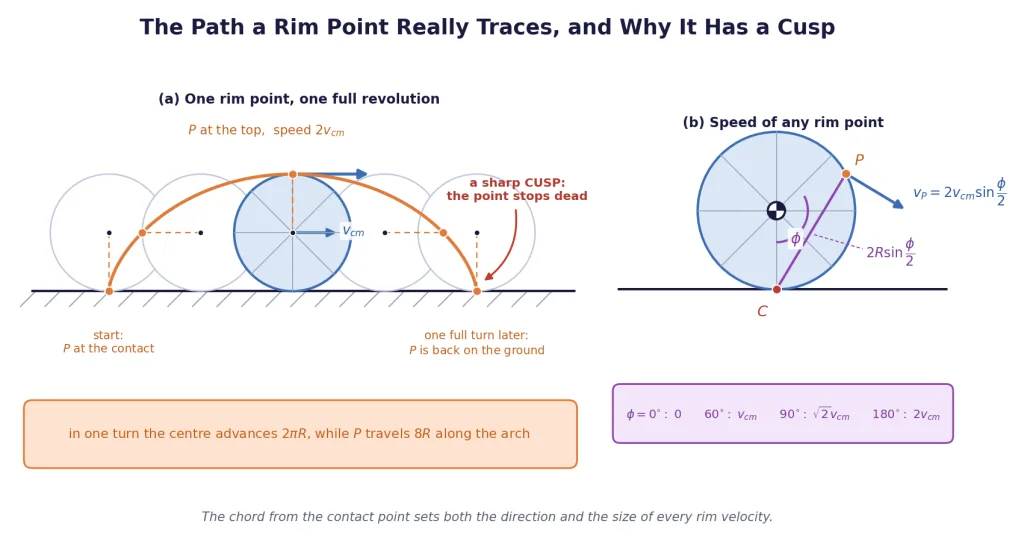
The figure shows what this does to the path. A rim point does not trace a circle and does not trace a straight line — it traces a cycloid, an arch that comes down to the ground with a sharp cusp. A cusp is exactly what a curve looks like where the speed drops to zero and the direction reverses. In one revolution the centre advances while the rim point travels along its arch, which is about 27% further.
Why that means STATIC friction, not kinetic
Friction is kinetic only when the two surfaces are sliding across each other. In rolling without slipping they are not: the material point in contact has zero velocity relative to the ground. So the friction acting is static friction.
That changes everything about how you treat it:
| kinetic friction | static friction in rolling | |
|---|---|---|
| when it acts | surfaces slide | surfaces do not slide |
| magnitude | fixed at | whatever is needed, up to |
| direction | always opposes sliding | whichever way the problem demands |
| work done on the body | negative, energy lost as heat | zero |
[JEE Tip] The single biggest error in rolling problems is writing on an incline. That is wrong unless the body is on the verge of slipping. Static friction is an unknown you solve for, exactly like a normal reaction or a tension. Find it from the equations; only then compare it with to check the answer is legal.
Why static friction does no work
Work is force times the displacement of the point where the force is applied. The friction here is applied at the contact point, and that point has zero velocity, so the power it delivers is
at every instant. Integrate zero and you still get zero.
There is a subtler way to say the same thing, worth carrying because examiners like it. Friction pushes backwards on the centre of mass through a distance , doing of work on the translational motion. Meanwhile its torque turns the body through , doing of work on the rotational motion. Since , those two are equal and opposite:
So static friction in rolling is an internal accountant. It moves energy from the translational column into the rotational column and takes no commission. [Board Important] This is why you may use conservation of mechanical energy for a body rolling without slipping, even though friction is present — a statement that looks illegal until you see this cancellation.
(A real wheel does slowly lose energy, to rolling friction — the tiny deformation of the wheel and the surface at the contact. That is a separate, much smaller effect, and it is ignored throughout this section.)
Two Pictures of the Same Motion, and They Agree
Rolling can be described in two completely different ways, and being fluent in both is what makes hard problems easy. They must give the same velocity for every point — and they do.
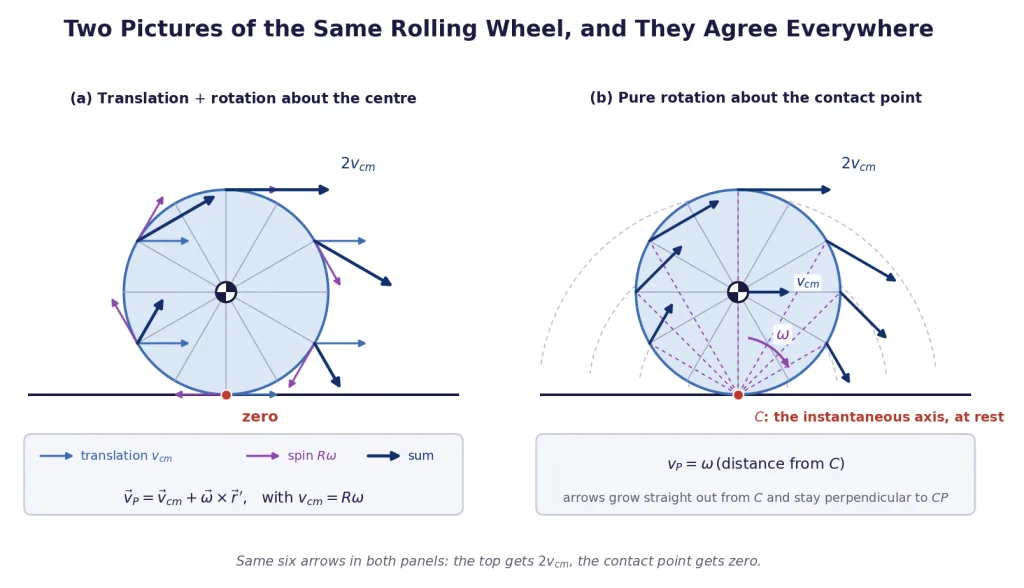
Picture 1: translation of the centre of mass plus rotation about it
This is the decomposition Section 1 introduced. Any point of the body has
where is the position of measured from the centre of mass. Every point gets the same ; the spin term is what makes them differ. On the rim, the spin term has magnitude and points along the tangent.
Run it round the wheel, with the wheel rolling to the right:
- Top point. Translation is forward, spin is forward: .
- Contact point. Translation is forward, spin is backward: .
- Centre. No spin contribution at all, since : just .
- Ends of the horizontal diameter. The two contributions are perpendicular and equal, so the resultant is at to the ground.
Picture 2: pure rotation about the contact point
Since the contact point is at rest, you are entitled to treat the whole body, at that instant, as if it were rotating about a fixed axis through with the same angular speed . That axis is called the instantaneous axis of rotation.
Key Point — the instantaneous axis: At each instant a rolling body may be regarded as being in pure rotation about the line of contact with the ground. The velocity of any point is then directed perpendicular to the line joining to . The axis is "instantaneous" because a moment later a different material point is touching the ground and the axis has moved on.
Check it against the same four points, with :
| Point | distance from | speed distance |
|---|---|---|
| contact point | ||
| centre | ||
| top | ||
| end of horizontal diameter |
Identical, line by line. Two different stories, one velocity field.
The general rim point, from either picture
Take a rim point at an angle round from the contact point. The chord has length — that is just the chord formula for a circle of radius . So Picture 2 gives immediately
Picture 1 gets there too, with more work: add two vectors of equal magnitude separated by the angle , and the parallelogram rule gives a resultant . Same answer, three extra lines of trigonometry.
[JEE Tip] Two things fall straight out of that formula and both get asked. The maximum speed on a rolling body is , at the top. And the rim points moving at exactly — the same speed as the centre — are the two at from the contact point, not the ones on the horizontal diameter.
Which picture should you use?
Use Picture 2 when a question asks for the velocity of a point or when taking torques about the contact point kills off an awkward unknown — friction and the normal reaction both pass through , so both have zero moment about it. Use Picture 1 for energy and for anything where you need and separately. The next block shows both doing the same job on kinetic energy.
The Kinetic Energy of a Rolling Body
A rolling body is moving and spinning at once, so it stores energy in both. Section 9 gave you for spin; here is how it combines with the familiar .
The split
For any rigid body in general motion the kinetic energy separates cleanly into a translational part built on the centre of mass and a rotational part built on the spin about the centre of mass:
Nothing about rolling is needed to write that. Now impose the rolling condition. Substitute and , where is the radius of gyration from Section 8:
Key Point — kinetic energy of a rolling body: The bracket is a pure shape factor. It contains no mass, no radius and no speed — only the way the body's mass is distributed about its axis.
The same answer from the instantaneous axis
If rolling really is pure rotation about the contact point, then writing the energy as a single rotational term about that axis must give the same number. Let us check.
The moment of inertia about the contact line follows from the parallel axis theorem of Section 8, since the contact line is parallel to the central axis and a distance from it:
So
Identical. The two pictures agree on energy exactly as they agreed on velocity.
Reading the shape factor
The ratio of the rotational share to the total is
and it depends on nothing but the shape.
| Body | rotational share | translational share | |
|---|---|---|---|
| ring or hollow cylinder | |||
| spherical shell | |||
| disc or solid cylinder | |||
| solid sphere |
Read the physical story off the table. A ring carries all its mass out at the rim, so at a given it has to spin with a lot of energy locked into that spin — half its total. A solid sphere has most of its mass close to the axis, so it gets away with putting only two-sevenths into spinning.
Key Point: measures how expensive it is to spin the body, per unit of forward motion. A large means a large slice of any energy budget is taken by rotation, leaving less for going forward. That one sentence explains the whole incline race in the next two blocks.
[NEET Important] Two bodies rolling with the same : the one with the bigger has more total kinetic energy. Two bodies with the same kinetic energy: the one with the bigger is moving more slowly. Read which is fixed before you answer.
A three-line summary you can use as a formula
Because and :
so for a disc the rotational energy is exactly half the translational, for a ring it equals it, and for a solid sphere it is two-fifths of it. Those three ratios cover most of what gets examined.
Rolling Down an Incline
This is the setting almost every rolling question uses. A body of mass , radius and radius of gyration is released from rest on a slope of angle and rolls down without slipping. Find its acceleration, the friction acting, and how rough the slope must be.
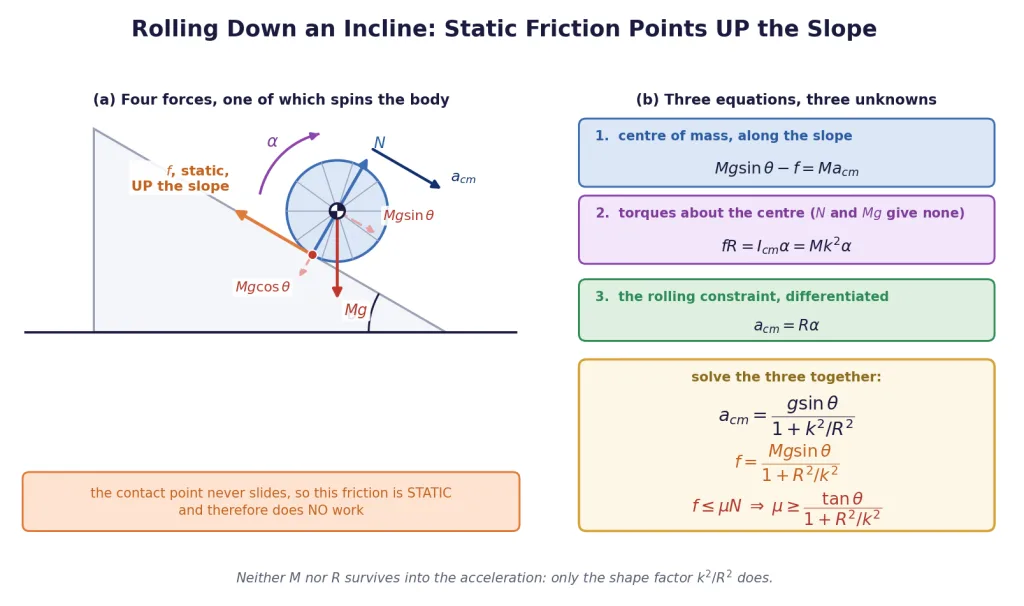
Set it up: three forces, three equations
Three forces act. Weight vertically down, acting at the centre. Normal reaction perpendicular to the slope, at the contact point. Static friction along the slope, also at the contact point.
Which way does friction point? Suppose there were none — the body would simply slide down without turning, and no rolling would happen. Something has to supply the torque that spins it up, and only friction can, because and both pass through the centre and have no moment about it. To spin the body forwards as it goes down, friction must act up the slope.
Equation 1 — the centre of mass, along the slope. Taking down-slope as positive:
Equation 2 — torques about the centre of mass. acts at the centre, so its moment arm is zero. passes through the centre, so its moment arm is zero too. Only is left, with a moment arm :
Equation 3 — the rolling constraint. .
Three equations, three unknowns (, , ).
Solve
From Equation 2 with Equation 3, . Put that into Equation 1:
Every cancels, and rearranging gives the result of the section.
Key Point — acceleration of a body rolling down an incline: and the friction that makes it happen is
Sanity checks first. If — all the mass on the axis, nothing to spin up — you get and , the frictionless block. Every real body has , so every rolling body accelerates more slowly than a block sliding down a smooth slope of the same angle, because part of the gravitational pull is being spent on spinning it up rather than on moving it along.
The energy route, which is usually faster
You do not need forces at all if the question only asks for a speed. Static friction does no work and does no work, so mechanical energy is conserved. Falling a height :
Compare with for a block on a smooth slope: the rolling body always arrives slower, by the factor .
[Board Important] Notice what is: the vertical drop, not the length of the slope. If you are given the slope length , then .
How rough must the slope be?
The friction we solved for is static, so it is only available if it does not exceed the maximum the surface can supply, . With :
and cancel again, leaving
Key Point — the condition for rolling to be maintained: If the coefficient of static friction is smaller than this, the surface cannot deliver the torque the body needs, the contact point starts to slide, and the motion is no longer rolling without slipping.
Read what this says. The required grows with — steepen the slope enough and every body eventually slips. And it depends on shape: for a solid sphere the requirement is , for a ring it is . A ring needs the roughest surface of the four standard bodies, because it demands the largest friction to spin it up.
The point that catches everyone: and vanished
Look at the boxed acceleration again. There is no and no in it. Neither is in the speed at the bottom, nor in the condition on .
- A steel sphere and a wooden sphere of the same size roll down together.
- A marble and a bowling ball roll down together.
- A bicycle wheel and a tiny toy hoop roll down together.
Key Point: For a body rolling down an incline, the acceleration, the speed at the bottom and the minimum depend only on and on the shape factor — never on mass and never on radius.
[JEE Tip] This is a favourite trap. A question offers two solid cylinders, one twice the mass and three times the radius of the other, and asks which reaches the bottom first. The answer is neither: they arrive together. Only the friction force carries an — the motion does not.
The Race, and the Full Comparison Table
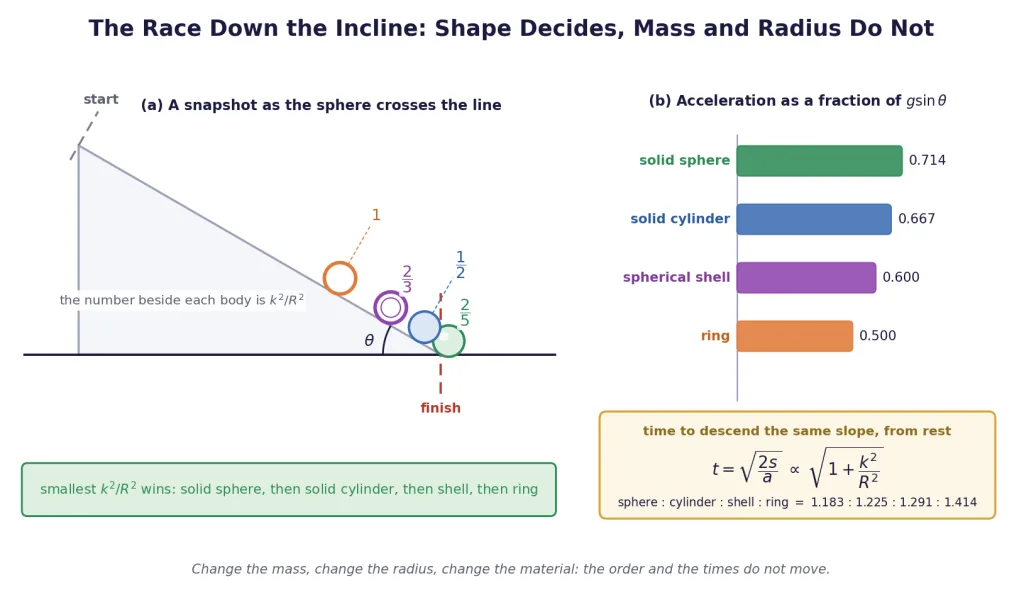
Release a ring, a disc, a spherical shell and a solid sphere from the same point on the same slope at the same moment. Who wins?
The rule, in one line
Every result of the previous block runs through the same bracket, . It sits in the denominator of the acceleration and of the final speed. So:
Key Point — the race rule: The body with the smallest wins. It has the largest acceleration, the largest speed at the bottom and the shortest time. Ordering the four standard bodies by : so the finishing order is solid sphere, then disc, then shell, then ring — and the ring comes last every time.
Why, physically? The bracket is the shape factor from the energy split. A ring must put half of everything gravity gives it into spin; only the other half is available for getting down the hill. The solid sphere only surrenders two-sevenths. The body that spins cheaply travels fast.
The complete table
Everything you need, for a slope of angle and a vertical drop . Here means the minimum coefficient of static friction for rolling to be maintained.
| Body | rotational share of | down the incline | after dropping | minimum | |
|---|---|---|---|---|---|
| ring / hollow cylinder | |||||
| spherical shell | |||||
| disc | |||||
| solid cylinder | |||||
| solid sphere |
A disc and a solid cylinder are the same row twice, because a solid cylinder is nothing but a stack of discs and has the same about its own axis. A ring and a hollow cylinder pair up in the same way. [NEET Important] Expect a question that lists "disc" and "solid cylinder" among the options and asks which is faster — the correct response is that they tie.
Times, if you want the numbers
Starting from rest and covering a slope length , gives , so
which puts the four in the ratio
for sphere : cylinder : shell : ring. The gaps are small — a solid sphere beats a solid cylinder by under 4%, which is why this race is worth doing on a long slope if you ever set it up.
And the sliding block beats them all
Put a fourth competitor on the slope: a block on a frictionless surface. It has no rotation to pay for, so and it arrives at — faster than every rolling body. [JEE Tip] If an option list includes "a block sliding down a smooth incline", it wins. The rolling bodies are handicapped precisely by the energy they must divert into spin.
The Traps, and a Checklist
Rolling is a small topic with a large number of ways to get it wrong. Here they are, collected.
Trap 1: writing when nothing is slipping
Already flagged, and worth flagging again because it is the commonest error in the whole chapter. On an incline the friction is static and unknown; solve for it. The formula applies only at the verge of slipping, when the question says so, or when the body is actually skidding.
Trap 2: assuming friction always opposes the motion
For a body rolling freely on an incline the friction acts up the slope, whether the body is rolling down and speeding up or rolling up and slowing down. Run the algebra with down-slope positive and it comes out positive in both cases, because the equations never asked about the sign of . When you roll a hoop up a slope, friction still points up it.
Friction reverses only when something else supplies a torque — a driven wheel with the engine pushing it, for instance. That case belongs to more advanced work and is not needed here.
Trap 3: no friction is needed on level ground
A wheel rolling at constant speed along a flat road needs no friction at all. There is nothing to accelerate and nothing to spin up, so the required is zero, and it will continue for ever on a perfectly rigid surface. Real wheels slow down because of rolling friction and air resistance, not because static friction is stealing energy.
Trap 4: mixing up and
The rolling condition is , using the centre's speed. The topmost point moves at . If a question gives you "the speed of the topmost point of a rolling wheel is 12 m/s", the angular speed is , not .
Trap 5: forgetting that is the vertical drop
needs the height fallen. If you are given the slope length , you must use first.
Trap 6: assuming heavier or bigger means faster
It does not. Say it once more: , at the bottom and all depend only on and .
The checklist for any rolling problem
- Is it rolling without slipping? If yes, write and immediately — that is your third equation.
- Does the question ask only for a speed or a height? Use energy: . It is two lines.
- Does it ask for acceleration, friction, or time? Use forces: along the surface, about the centre, then the constraint.
- Does it ask for the velocity of a point? Use the instantaneous axis: (distance from the contact point), perpendicular to that line.
- Look up , do not re-derive . Ring 1, shell , disc and solid cylinder , solid sphere .
- Finally, check the friction is legal: is ? If not, the body is slipping and the rolling formulae do not apply.
The formulae, on one card
Solved Examples
Every numerical problem in this set uses m/s, and no problem mixes values with 9.8. Problems 1 to 5 need no at all.
Example 1: Every speed on a rolling wheel
A wheel of radius 0.50 m rolls without slipping along level ground with its centre moving at 4.0 m/s. Find (a) its angular speed, (b) the speed of the topmost point, (c) the speed of the contact point, (d) the speed of a point at the end of the horizontal diameter, and (e) the speed of a rim point round from the contact point.
Solution:
(a) The rolling condition.
Set up the instantaneous-axis picture. Everything else is now (distance from the contact point ).
(b) Topmost point. It is m from :
(c) Contact point. Its distance from is zero, so . It is instantaneously at rest.
(d) End of the horizontal diameter. Its distance from is m:
(e) The point. Use the chord formula directly:
Final Answer: rad/s; top 8.0 m/s; contact 0; horizontal-diameter end 5.66 m/s; the point 4.0 m/s.
Takeaway: Part (e) is the one worth remembering: the rim points moving at exactly the speed of the centre are at from the contact point, not on the horizontal diameter. [JEE Tip] Whenever a question asks for the velocity of a point on a rolling body, drop the two-vector addition and use perpendicular to . It is one line instead of four.
Example 2: Turns, distance, and the path the rim really takes
A wheel of radius 0.35 m rolls without slipping and completes 40 revolutions in 20 s. Find (a) the distance the centre travels, (b) the speed of the centre, (c) the angular speed, and (d) the length of path actually traced by a point on the rim during one revolution.
Solution:
(a) Distance. One revolution lays down one circumference of rim, so
(b) Speed of the centre.
(c) Angular speed. Two routes, and they must agree. Agreed, which confirms the rolling condition held.
(d) Path of the rim point. It traces one cycloid arch, whose length is : compared with m for the centre. The ratio is .
Final Answer: 87.96 m; 4.40 m/s; 12.57 rad/s; the rim point travels 2.80 m per revolution.
Takeaway: The centre and a rim point cover the same horizontal displacement but very different path lengths — the rim point travels about 27% further because it is swinging up and over. [Board Important] "Distance travelled by the wheel" always means the distance moved by the centre, per turn.
Example 3: The two pictures give the same kinetic energy
A uniform disc of mass 1.5 kg and radius 0.20 m rolls without slipping at 3.0 m/s. Find its kinetic energy (a) by splitting it into translational and rotational parts, and (b) by treating the motion as pure rotation about the contact point.
Solution:
(a) The split. With and :
(b) About the contact point. The parallel axis theorem gives and rad/s, so
Check against the shape formula.
Final Answer: 10.125 J by all three routes.
Takeaway: Three methods, one number — that is what "the two pictures agree" means in practice. [JEE Tip] The single-term form is faster when you already know , and it is the natural one to use when you are also taking torques about the contact point.
Example 4: Where a rolling sphere keeps its energy
A solid sphere of mass 2.0 kg and radius 0.10 m rolls without slipping at 5.0 m/s. Find its translational kinetic energy, its rotational kinetic energy, the total, and the percentage of the total that is rotational.
Solution:
Translational part.
Rotational part. For a solid sphere , and :
Total.
Rotational percentage.
Final Answer: 25.0 J, 10.0 J, 35.0 J in total, of which 28.6% is rotational.
Takeaway: Note that step 4 never used the mass or the radius — is fixed for every solid sphere. [NEET Important] The four percentages to carry are ring 50%, shell 40%, disc 33.3%, solid sphere 28.6%. A one-line recall question on any of them is standard.
Example 5: Identifying a body from how it stores energy
(a) A body rolls without slipping and 40% of its kinetic energy is rotational. What shape is it? (b) A ring and a solid sphere of equal mass roll with the same speed. Find the ratio of their total kinetic energies.
Solution:
(a) Set up the fraction. The rotational share is
Solve for the shape factor. Write . Then , so and
Read it off. means : a hollow sphere, that is, a spherical shell.
(b) Equal , equal . The kinetic energies are in the ratio of their brackets:
Final Answer: (a) a spherical shell; (b) .
Takeaway: The quickest route from a rotational fraction back to the shape is . [JEE Tip] Learn to run the shape factor in both directions — given the body, quote ; given an energy ratio, an acceleration or a , recover and name the body.
Example 6: A solid cylinder down a slope
A solid cylinder is released from rest at the top of a incline and rolls 6.0 m down the slope without slipping. Take m/s. Find (a) its acceleration, (b) its speed at the bottom, and (c) the time taken. Then check (b) by energy.
Solution:
(a) Acceleration. A solid cylinder has :
(b) Speed after 6.0 m along the slope, from with :
(c) Time, from :
The energy check. The vertical drop is m, so Agreed.
Final Answer: m/s, m/s, s.
Takeaway: Two independent routes, one answer — always worth the extra thirty seconds in an exam. [Board Important] Watch step 4: the 6.0 m is measured along the slope, so the drop is m. Feeding 6.0 m into the energy equation is the standard way to lose this question.
Example 7: A solid sphere, and why its size does not matter
A solid sphere rolls without slipping from rest down a track, dropping a vertical height of 7.0 m. Take m/s. (a) Find its speed at the bottom. (b) Compare with a block sliding down a smooth slope through the same height. (c) A second sphere has three times the mass and twice the radius. What is its speed at the bottom?
Solution:
(a) Energy conservation, with so the bracket is :
(b) The smooth block has no rotation to pay for: The rolling sphere arrives at of the block's speed. The missing kinetic energy is not lost — it is sitting in the sphere's spin.
(c) The second sphere. Look at the formula in step 1: it contains , and the shape factor, and nothing else. cancelled and never appeared. So the answer is again
Final Answer: 10.0 m/s; the smooth block gets 11.83 m/s; the bigger, heavier sphere also gets 10.0 m/s.
Takeaway: [JEE Tip] Part (c) is the whole trap in one line. If two bodies have the same shape, nothing about their size or weight can separate them on an incline. The only way to change the answer is to change .
Example 8: The friction that does the spinning, and does no work
A disc of mass 4.0 kg rolls without slipping down a incline. Take m/s. Find (a) the friction force acting on it, (b) the normal reaction, (c) the minimum coefficient of static friction needed, and (d) the work done by friction after the disc has rolled 5.0 m.
Solution:
(a) Friction. For a disc : It points up the slope.
(b) Normal reaction.
(c) Minimum coefficient. which matches the shape formula .
(d) Work done by friction: zero. The contact point is instantaneously at rest, so friction never acts through a displacement. Checking it the long way: friction does J on the translation, and its torque does J on the rotation, since . The sum is zero.
Final Answer: N up the slope, N, , and friction does no work.
Takeaway: Static friction here is a torque supplier, not an energy thief. [Board Important] That is the licence to use conservation of mechanical energy on a rolling body even though a friction force is drawn on the diagram, and it is worth writing that sentence explicitly in a Board answer.
Example 9: How rough must the slope be, for each body?
A incline is available. Take m/s where needed. Find the minimum coefficient of static friction that allows each of a ring, a spherical shell, a disc and a solid sphere to roll down it without slipping, and say which is the most demanding.
Solution:
The formula. , with .
Ring, , so :
Spherical shell, , so :
Disc, , so :
Solid sphere, , so :
Final Answer: ring 0.289, shell 0.231, disc 0.192, solid sphere 0.165. The ring is the most demanding.
Takeaway: The order here is the reverse of the race order, and for the same reason: the ring needs the largest friction because it needs the largest torque to spin up. [NEET Important] On a slope of a given roughness, the ring is the first body to start slipping and the solid sphere the last.
Example 10: The race, with numbers
A ring, a spherical shell, a solid cylinder and a solid sphere are released from rest at the same instant from the top of a incline and roll 10.0 m down it without slipping. Take m/s. Find each body's acceleration and time of descent, and state the finishing order.
Solution:
The common part. m/s, and with m.
Solid sphere, bracket : m/s, s.
Solid cylinder, bracket : m/s, s.
Spherical shell, bracket : m/s, s.
Ring, bracket : m/s, s.
Final Answer:
| Body | (m/s) | (s) | finish |
|---|---|---|---|
| solid sphere | 3.571 | 2.37 | 1st |
| solid cylinder | 3.333 | 2.45 | 2nd |
| spherical shell | 3.000 | 2.58 | 3rd |
| ring | 2.500 | 2.83 | 4th |
Takeaway: The whole table came from one number per body, . [JEE Tip] If a question adds "the ring has twice the mass and half the radius of the sphere", ignore it completely — it changes nothing in this table. Only a change of shape moves a body up or down the order.
Example 11: Rolling UP a slope
A hoop rolls without slipping along level ground at 6.0 m/s and then rolls up a incline. Take m/s. Find (a) how far up the slope it travels before stopping, (b) the vertical height gained, and (c) the direction of friction while it climbs.
Solution:
(a) and (b) by energy. A hoop is a ring, , so its bracket is . All of its kinetic energy converts to potential energy: and the distance along the slope is
Cross-check with kinematics. Going up, the deceleration has the same magnitude as the downhill acceleration, m/s, so Agreed.
(c) Direction of friction. Take down-slope as positive and the equations are unchanged: and with , giving , that is, up the slope, exactly as when the hoop rolls down.
Final Answer: 7.2 m along the slope, a vertical gain of 3.6 m, with friction acting up the slope throughout.
Takeaway: For a hoop the energy equation collapses to the pretty result — twice the height a frictionless sliding block would reach with the same speed, because the hoop brings its spin energy along too. [JEE Tip] Part (c) is the counter-intuitive bit: friction on a freely rolling body points up the slope whether it is going up or down.
Example 12: Will it actually roll?
A solid sphere and a ring are placed on a incline whose coefficient of static friction is 0.20. Take m/s. (a) Decide for each body whether it rolls without slipping. (b) For any body that does roll, give its acceleration.
Solution:
The test. Compare the available with the required , with .
Solid sphere. . Since , the surface can supply what is needed: the sphere rolls without slipping.
Ring. . Since , the surface cannot supply enough friction: the ring slips as it rolls. The rolling formulae no longer apply to it, and its friction saturates at instead.
(b) The sphere's acceleration. For the ring, whose contact point is now sliding, the centre accelerates at m/s — faster than the sphere, because the ring is no longer being forced to spin up in step with its motion. Working out how it then settles into rolling is a topic for advanced problems.
Final Answer: The sphere rolls (), the ring slips (); the sphere's acceleration is 3.57 m/s.
Takeaway: Always run the check in step 1 before quoting — that formula is only valid while rolling holds. [JEE Tip] The last line of step 4 is worth noticing: a slipping ring beats a rolling sphere down the slope, because slipping releases it from the obligation to convert energy into spin.