
Close the Book. Start the Clock.
Sections 1 to 13 taught you this chapter — the rigid body and its kinds of motion, the centre of mass and how it moves, the cross product, angular velocity, torque and angular momentum, equilibrium, moment of inertia with both axis theorems, rotational kinematics and dynamics, conservation of angular momentum, rolling, forty-odd worked problems and the advanced extensions. This section asks one different question: can you use any of it with a timer running?
There is no new theory below. There are 30 single-correct questions built to the exam pattern, and a marking scheme designed to punish the two habits this chapter rewards most cruelly — reaching for a moment-of-inertia value before checking which axis the question means, and writing before checking whether the axis is fixed.
The rules of engagement
Key Point: This is not a reading exercise. Blank sheet, pen, timer. Attempt all 30 questions in one unbroken sitting, and do not open a single explanation until the last answer is written.
| The setup | What it is |
|---|---|
| Number of questions | 30, single correct option |
| Marking scheme | correct, incorrect, unattempted |
| Maximum score | marks |
| Minimum possible score | marks |
| Suggested time limit | 45 minutes (a shade under a minute and a half per question) |
| Take as | 10 m/s^2 throughout. No question here uses 9.8 |
| Useful values | , , , , , , , |
| Allowed | rough sheet, your own head |
| Not allowed | calculator, formula sheet, a glance back at Sections 1 to 13 |
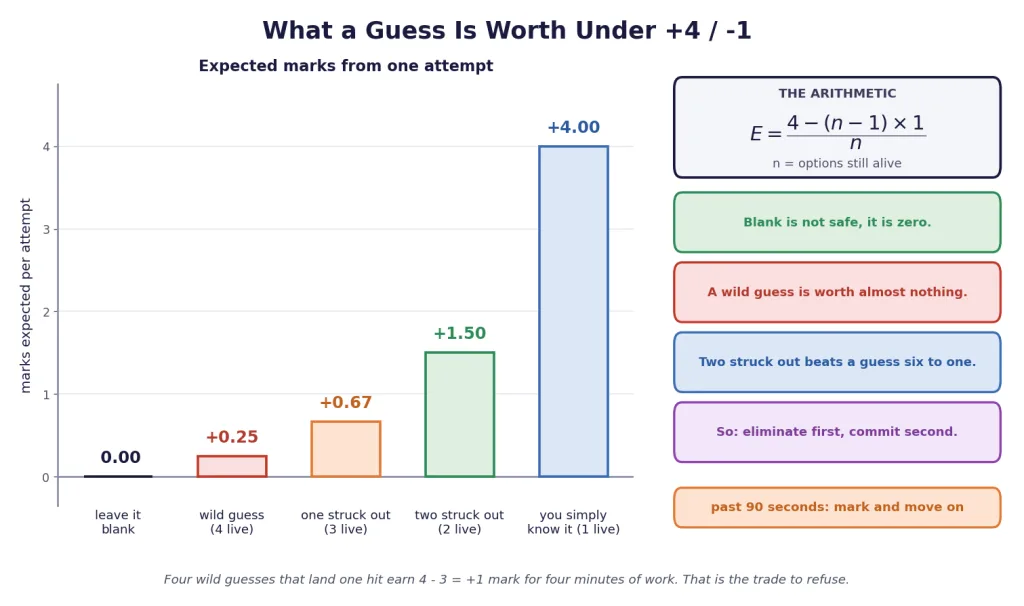
[Exam Tip] That is not decoration. Four wild guesses that land one lucky hit earn mark for four minutes of work — a terrible trade. But a question narrowed to two options returns marks on average, which is a very good one. Narrow first, then commit. Leave blank only what you could not narrow at all.
What this set covers
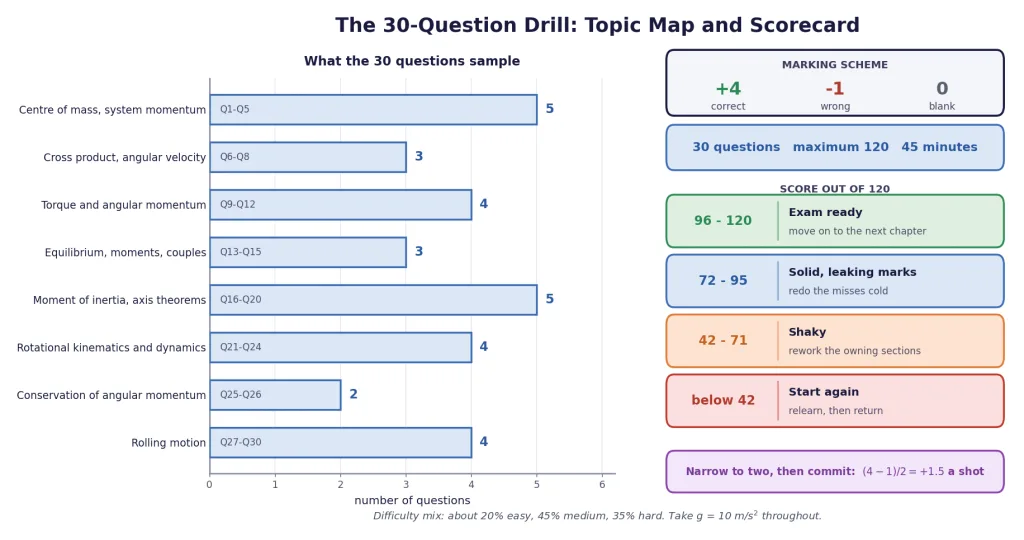
| Topic | Questions | How many |
|---|---|---|
| Centre of mass: discrete, continuous, cavities, and the motion of the centre of mass | Q1 to Q5 | 5 |
| Cross product, angular velocity, and | Q6 to Q8 | 3 |
| Torque and angular momentum about a chosen point | Q9 to Q12 | 4 |
| Equilibrium, the principle of moments, couples | Q13 to Q15 | 3 |
| Moment of inertia and the two axis theorems | Q16 to Q20 | 5 |
| Rotational kinematics and dynamics, work, energy, power | Q21 to Q24 | 4 |
| Conservation of angular momentum | Q25 to Q26 | 2 |
| Rolling motion | Q27 to Q30 | 4 |
That spread mirrors how the paper actually samples this chapter. Moment of inertia and centre of mass are 10 of the 30, because between them they carry the most marks here — and they are the two places where a confident wrong answer is easiest to produce. A rod's quoted for an axis through its end; a cavity problem solved by subtracting distances instead of subtracting mass; a tangent treated as a diameter.
The difficulty mix is roughly 20% easy, 45% medium and 35% hard. A handful will feel brutal. They are meant to.
[Exam Tip] Before you start, write four lines at the top of your sheet: which point or axis?, is the axis fixed?, is anything conserved here?, and does the body roll or slip? Those four questions decide the method for almost every problem below, and choosing the method is where the marks in this chapter are actually won.
Scoring Yourself Honestly
Mark your sheet with the real scheme — , , — and total it. No half marks for "I knew that one really". The number you get is the number that matters.
The bands
| Your score (out of 120) | Verdict | What to do next |
|---|---|---|
| 96 to 120 | Exam ready. 80% or more on a hard set, inside the time. | Move on. This chapter will not cost you marks. Revisit only the specific items you missed. |
| 72 to 95 | Solid, but leaking marks. | Almost always slips rather than gaps — a wrong axis, a dropped in , a written as . Redo every wrong question without the explanation first. |
| 42 to 71 | Shaky. The ideas are there; the execution is not. | For each wrong answer go back to the section that owns it (use the topic map above) and rework its solved examples before re-attempting. |
| Below 42 | Start again. | Work Sections 1 to 11 properly, then Section 12's worked problems, then Section 13. Re-attempting this set now teaches you nothing but the answer key. |
Read your own answer sheet
Before you touch a single explanation, sort your mistakes into three piles. This is the most valuable ten minutes in the whole section.
- Method errors — you used where angular momentum conservation would have taken one line, or conserved across a collision in which an external hinge force had a torque. You treated a rolling body as though only mattered. You applied the perpendicular axis theorem to a solid body. These are the expensive ones, because the whole solution is wrong from line one.
- Execution errors — right method, wrong arithmetic. The classic three in this chapter: squaring the distance in and forgetting to square it, dropping the from , and using degrees where the formula wanted radians.
- Reading errors — the question asked about the axis through the end, not the centre; about the tangent, not the diameter; about the rotational part of the kinetic energy, not the total; about the speed of the topmost point, not the centre.
Key Point: In this chapter pile 3 is dominated by four traps: which axis, about which point, rolling or slipping, and before or after the rearrangement. Check which of the four caught you, every single time.
The eight habits this set is drilling
- Name the axis before you name the formula. has no meaning until an axis is fixed. A disc is , , or depending only on where you put the axis.
- A cavity is negative mass, not a shifted distance. Fill the hole, subtract the plug, and weight both by their masses, not by their radii.
- The centre of mass ignores every internal force. If nothing external pushes horizontally, its horizontal position simply does not move, whatever the pieces do.
- Torque and angular momentum are always about something. Change the point and both change. Write the point down before you write the cross product.
- Both axis theorems have conditions. Parallel axes: the two axes must be parallel and one must pass through the centre of mass. Perpendicular axes: the body must be a plane lamina, and the two in-plane axes must meet on the third.
- needs a fixed axis and an about that same axis. Mixing an about the centre with a torque about the hinge is the single most common wrong line in this topic.
- In rolling without slipping, at every instant, and the friction is static, so it does no work. The instant the question says smooth, rolling stops being possible and the spin simply freezes.
- Check the size of the answer. A rolling body cannot beat down a slope. A body cannot gain kinetic energy while its angular momentum is conserved unless something did internal work.
[Exam Tip] Every explanation below is a full step-by-step solution, so this set doubles as revision. Read the explanation even for the questions you got right — several of these have a two-line route and a two-page route, and it is the two-line route you will need in the hall.