
From a Point to a Real Body: the Rigid Body Idealisation
Everything you have done in mechanics so far has quietly assumed one thing: that a body can be shrunk to a point. A block on an incline, a ball thrown off a cliff, a car braking — in every case we drew a dot, hung the forces off it, and applied .
That worked because we only ever asked where the body went. But look at what the particle model cannot answer:
- Why does a spinning cricket ball swerve, when a non-spinning one does not?
- Why is it easier to open a door by pushing at the handle than near the hinge?
- Why does a hollow pipe lose a race down a slope to a solid cylinder of the same mass and radius?
- Why does a spinning top stay up, while a stationary one falls over instantly?
Not one of these has anything to do with where the body's dot is. They are all about shape, size, and turning. So we have to give the body back its size.
The idealisation
An extended body is, in the first place, a system of particles — a huge collection of atoms, each with its own position and velocity. That is far too much to track. So we make one enormous simplification.
Key Point — the rigid body: A rigid body is a body whose shape is perfectly definite and unchanging: the distance between every pair of its particles stays the same, no matter what forces act on it.
Take any two atoms of the body, call them and . In a rigid body,
That one condition is doing an astonishing amount of work. Read what it rules out:
| The rigid body cannot | Real example where this matters |
|---|---|
| stretch or compress | a spring, a rubber band, a bungee cord |
| bend | a steel beam sagging under a heavy load |
| twist out of shape (warp) | a metal rod under a large torque |
| vibrate internally | a struck tuning fork, a plucked string |
| flow or change shape at all | water in a bucket, a lump of dough, a chain |
No real body is truly rigid
Every real body deforms a little under load. Push hard enough on a steel girder and it bends; spin a flywheel fast enough and it stretches outwards. So the rigid body is a model, not a fact — exactly like the frictionless surface and the massless string.
The question is never "is it rigid?" but "is the deformation small enough to ignore?" For a wheel, a top, a steel beam under ordinary loads, a molecule, a planet — yes, comfortably. For a spring, a rubber band, a rope being stretched, or water — no, and this chapter's methods do not apply.
[Board Important] The one-line definition — a body in which the distance between every pair of particles remains unchanged — is a standard one-mark answer. Learn it in exactly that form.
What the constraint buys us
Here is the payoff, and it is the reason the whole chapter is possible. A system of free particles needs numbers to specify (three coordinates each). A rigid body made of atoms would need .
But once you fix the distances, almost all of that freedom vanishes. Fix three non-collinear points of a rigid body and the entire body is pinned down — every other atom's position follows from the rigid distance conditions. And those three points, with three fixed mutual distances, need only independent numbers.
Key Point: A rigid body — however many atoms it contains — has exactly six degrees of freedom: three to say where it is, three to say which way it is facing.
Six numbers instead of . That is what "rigid" is worth, and everything from here on is a study of how those six numbers change with time.
Motion Type 1: Pure Translation
Start with the simplest thing a rigid body can do.
Slide a rectangular block down a smooth inclined plane, with no sideways slewing. Mark two points on it, near the front and near the back, and watch them. They move together. They cover the same distance in the same time, in the same direction. At any instant they have the same velocity.
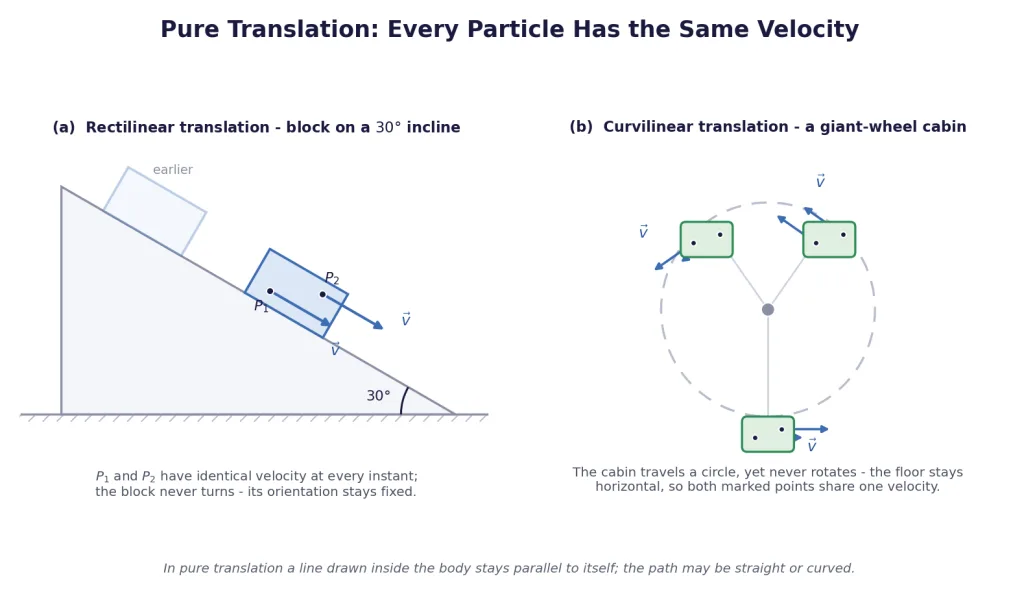
Key Point — pure translation: A rigid body is in pure translation when, at every instant, all its particles have the same velocity. Equivalently, every particle undergoes the same displacement in the same time interval, so every line drawn inside the body stays parallel to itself throughout the motion.
Two tests that mean the same thing
The velocity test. Pick any two particles. If at every instant, for every pair, the motion is pure translation. (And if always, then differentiating gives too — all particles share one acceleration as well.)
The orientation test. Draw an arrow inside the body and watch the angle it makes with the horizontal. If that angle never changes, the body is translating. The body may move, but it never turns.
The second test is the practical one in an exam, because you can apply it to a picture.
Translation does not mean a straight line
This is the trap, and it catches people every year.
Look at panel (b) of the figure: a cabin on a giant wheel. Its centre travels a perfect circle. Yet the cabin never tips — the floor stays horizontal, the passengers stay upright, and the line joining any two bolts in the cabin stays parallel to itself all the way round. Every particle of the cabin has the same velocity at any instant (that velocity is tangential and changes direction as the wheel turns, but it is the same for every particle of the cabin at each instant).
That is pure translation along a curved path, and it has a name.
| Kind of translation | Path of each particle | Everyday example |
|---|---|---|
| Rectilinear translation | a straight line | a block sliding down an incline, a lift going up |
| Curvilinear translation | a curve, the same curve for every particle | a giant-wheel cabin, the pedals of a bicycle relative to the frame |
[JEE Tip] "Translation" is a statement about orientation staying fixed, never about the path being straight. A body moving on a circle is translating if it does not turn, and rotating if it does. Judge by the orientation, not by the trajectory.
What is NOT pure translation
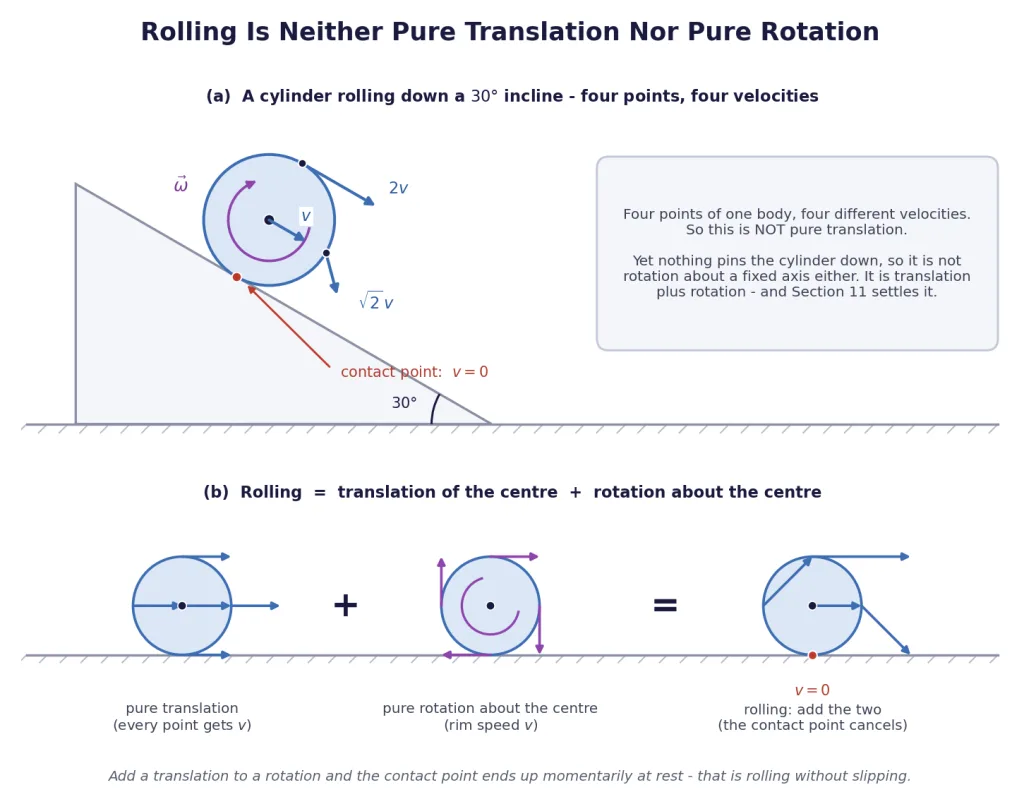
Take the same inclined plane and roll a solid cylinder down it instead of sliding a block. The cylinder clearly moves from top to bottom — so surely it is translating? Look closer at its particles and the answer is no: the point at the top of the cylinder is racing along, while the point touching the plane is, at that instant, not moving at all. Different particles, different velocities. The velocity test fails, so this is not pure translation.
Its motion is translation plus something else, and identifying that "something else" is the business of the next two blocks.
Motion Type 2: Rotation About a Fixed Axis
The cleanest way to see what the "something else" is, is to take a rigid body and forbid it to translate at all.
The usual way of doing that is to fix the body along a straight line — a rod through it, a pair of hinges, a spindle. A ceiling fan is bolted to a rod. A door hangs on hinges that define a vertical line. A potter's wheel turns on a spindle. In every case the body is not free to go anywhere; the only motion left to it is rotation.
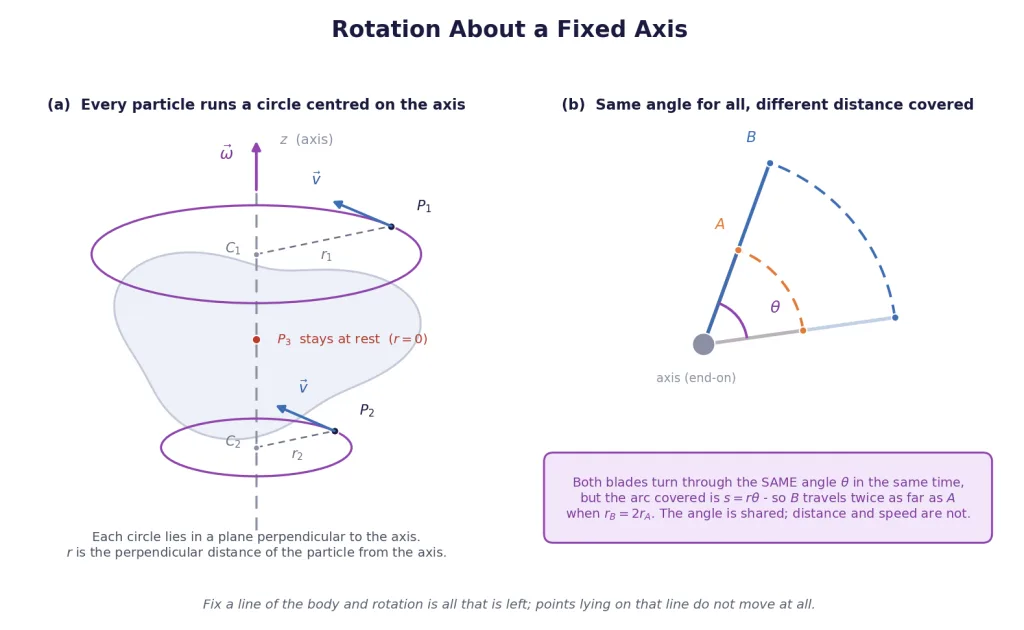
Key Point: The line about which a rigid body turns is its axis of rotation. In rotation about a fixed axis, every particle of the body moves in a circle whose centre lies on the axis and whose plane is perpendicular to the axis. Particles lying on the axis itself do not move at all.
Reading the geometry carefully
Take the axis to be the -axis. Now pick any particle of the body:
- traces a circle, not an arbitrary curve.
- The centre of that circle, , lies on the axis — directly "across" from .
- The radius is the perpendicular distance of from the axis — not its distance from the origin, and not its distance from some other point. This distinction matters throughout the chapter.
- The circle lies in a plane perpendicular to the axis.
Now pick a second particle at a different height. It does the same thing, in its own circle of radius , in its own plane. The two planes are different, but both are perpendicular to the same axis. They are parallel to each other.
Finally pick a particle that happens to lie on the axis. Its perpendicular distance from the axis is , so its circle has zero radius: stays exactly where it is while the rest of the body sweeps round it. That is not a special trick — it is forced by the axis being fixed.
The one quantity every particle shares
Different particles of a rotating body move at wildly different speeds. The tip of a fan blade whips round; a point near the hub barely crawls. So what do they have in common?
The angle. In any given time interval, every single particle of the body turns through the same angle — because the body is rigid and cannot come apart.
Key Point — angular displacement: The angular displacement is the angle turned through by any line of the body drawn perpendicular to the axis. It is the same for every particle of a rigid body, and it is measured in radians. The arc length a particle at perpendicular distance covers is
Look at panel (b) of the figure. Blades and turn through the same angle . But if , then covers twice the arc in the same time, so moves twice as fast. Angle is shared; distance and speed are not. Section 5 turns this into the rate quantities and and the relation ; for now the geometric statement is enough.
A radian reminder
Angular displacement is a pure ratio (arc over radius), so it has no dimensions. One full turn is radians, so
[NEET Important] Every rotational formula in this chapter assumes the angle is in radians. Converting degrees to radians is the single most common silent error in this topic — if gives you an answer that is about 57 times too big, you forgot to convert.
Recognising a fixed axis
| Body | Axis of rotation | Fixed? |
|---|---|---|
| Ceiling fan | the vertical rod it hangs from | yes |
| Door on hinges | the vertical line through the hinges | yes |
| Potter's wheel, giant wheel, merry-go-round | the central spindle | yes |
| Grindstone, flywheel, CD in a drive | the shaft through the centre | yes |
| A car's wheel while the car drives | the axle | no — the axle itself is moving |
That last row is the interesting one, and the next block takes it up.
When the Axis Itself Moves: Precession, and General Motion
Fixing a line of the body forces pure rotation. But you can constrain a body less severely than that: you can fix just a single point.
The spinning top
Set a top spinning on the floor. Its tip touches the ground and stays put — assume it does not slither about, so it has no translational motion at all. Yet the top is plainly not doing simple fixed-axis rotation, because you can watch its axis lean over and swing round the vertical, tracing out a cone.
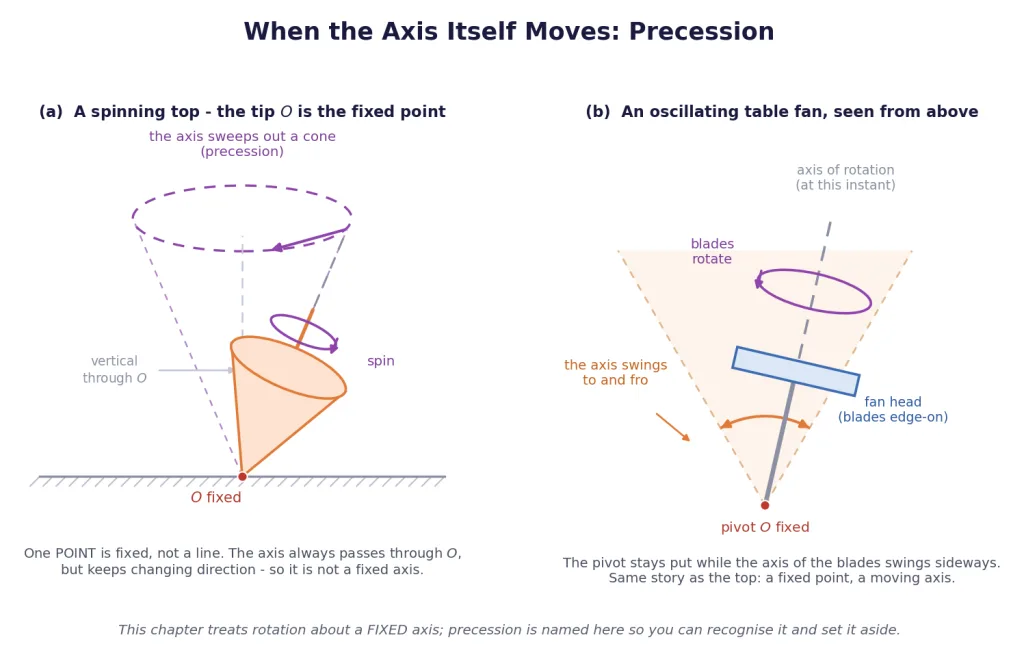
Key Point — precession: When the axis of a spinning body itself moves around, sweeping out a cone about a fixed direction, the motion of the axis is called precession. Here one point of the body is fixed, not one line. The axis of rotation always passes through that fixed point, but its direction keeps changing.
So the top is doing two things at once:
- spin — the fast turning of the body about its own axis;
- precession — the slow, majestic swing of that axis about the vertical.
The oscillating table fan
You do not need a top to see this. A pedestal fan on "swing" does exactly the same thing, only in a flatter way. Its pivot is fixed. The blades rotate about the head's axis. And the head's axis itself swings to and fro in a horizontal plane about the vertical through .
Again: one point fixed, axis moving.
Where this chapter draws the line
Precession is real, important (it is why gyroscopes work, and why the Earth's axis traces a circle every 26 000 years), and firmly beyond this chapter. Handling it properly needs applied to a vector that is changing direction, which Section 6 sets up but does not push this far.
Key Point: In this chapter, "rotation" means rotation about a FIXED axis unless it is explicitly said otherwise. Precession is named so that you can recognise it and set it aside.
The general case: no constraint at all
Now remove every constraint. Throw a spanner across the room, tumbling. Nothing is pinned — no fixed line, no fixed point. What happens?
The answer is the organising idea of the whole chapter:
Key Point — the general motion of a rigid body:
- A rigid body that is pivoted or fixed in some way can only rotate. (About a fixed axis if a line is fixed; about a moving axis through a fixed point if only a point is fixed.)
- A rigid body that is not pivoted or fixed is in pure translation, or in a combination of translation and rotation.
There is no third possibility. Every motion in this chapter is translation, rotation, or the two superposed — and the way we handle the combination is to split it:
That split is why the very next section is about the centre of mass. It is not a detour; it is the hinge the whole chapter turns on.
The Case That Needs Both: Rolling
Come back to the rolling cylinder, because it is the example the chapter is really building towards.
Why it is not pure translation
Mark four points on the rim and the centre and compare their velocities at one instant. If the centre moves with speed :
| Point | Velocity |
|---|---|
| the top of the cylinder | , along the direction of motion |
| the centre | |
| the leading and trailing points of the diameter | , at to the surface |
| the point touching the surface | zero |
Four points, four different velocities. The velocity test for pure translation fails outright. The contact point is the striking one: at the instant it touches, the point of the cylinder in contact with the ground is momentarily at rest, which is exactly why a rolling wheel does not scuff the road.
Why it is not pure rotation about a fixed axis either
Nothing pins the cylinder down. No line of it is held fixed — the axis through its centre is itself travelling down the slope. So it is not the fixed-axis rotation of the previous block.
The resolution
Rolling is translation plus rotation, and panel (b) shows how the sum works. Superpose two motions:
- a pure translation in which every point of the cylinder gets velocity forward, and
- a pure rotation about the centre in which every rim point gets speed tangentially.
At the top, the two add: . At the contact point, the rotation contributes backwards while the translation contributes forwards, and they cancel exactly: . In between you get the intermediate values.
Key Point: Rolling without slipping is a combination of translation of the centre of mass and rotation about the centre of mass, related by the condition — which is precisely the condition that makes the contact point come out at zero velocity.
[JEE Tip] The single most useful fact about rolling is that the contact point is instantaneously at rest. It means the contact point behaves like a momentary pivot, and a great many "hard" rolling problems collapse the moment you take moments about it. Section 11 develops all of this properly, including the incline race and the friction condition.
The same body, two different motions
One last picture worth carrying. Take a heavy dictionary and slide it across a table from A to B without turning it: pure translation, and the angle its spine makes with the table edge is the same at the start, the middle and the end. Now do it again, letting the dictionary rotate as it slides: the centre follows exactly the same path, but the edge's angle is different at every instant. Same trajectory of one point, completely different motion of the body. Tracking one point is never enough for an extended body — that is the whole reason this chapter exists.
The Vocabulary, and Counting Degrees of Freedom
Time to pin down the words, because the rest of the chapter uses them without apology.
The vocabulary list
| Term | What it means |
|---|---|
| Rigid body | a body in which the distance between every pair of particles is unchanging |
| Pure translation | all particles have the same velocity at every instant; orientation never changes |
| Rectilinear / curvilinear translation | translation along a straight path / along a curved path |
| Rotation about a fixed axis | every particle describes a circle centred on a fixed line, in a plane perpendicular to it |
| Axis of rotation | the fixed line about which the body turns; its particles stay at rest |
| Angular displacement | the angle turned through, in radians; the same for every particle |
| Precession | motion in which the axis of rotation itself sweeps a cone about a fixed direction |
| General (combined) motion | translation of the centre of mass plus rotation about the centre of mass |
| Rolling without slipping | the combined motion in which the contact point is instantaneously at rest |
Degrees of freedom
The number of degrees of freedom of a system is the number of independent coordinates you must specify to fix its configuration completely. It is the cleanest way to say how much freedom a constraint has taken away.
Key Point: A free particle has 3 degrees of freedom (its , , ). A free rigid body has 6: three coordinates to locate it, plus three angles to orient it. Each rigid constraint removes freedom, and the count drops.
Where do the six come from? Choose three non-collinear particles of the body, , , . Nine coordinates in all — but rigidity imposes three fixed distances , , , so survive. And once , , are placed, every other particle is determined. Add a fourth atom and it brings 3 new coordinates and 3 new distance conditions: net zero. The count stays at 6 no matter how many atoms the body has.
| System | Degrees of freedom | Where they went |
|---|---|---|
| Free particle | 3 | , , |
| free particles | 3 each, no constraints | |
| Free rigid body | 6 | 3 translational + 3 rotational |
| Rigid body with a fixed axis (door, fan, flywheel) | 1 | only is left |
| Rigid body with one point fixed (spinning top) | 3 | three orientation angles, no translation |
| Rigid body confined to a plane (a coin on a table) | 3 | , and one angle |
| Cylinder rolling without slipping in a straight line | 1 | and , tied by |
| A diatomic molecule, treated as a rigid dumb-bell | 5 | 3 translational + 2 rotational; spin about the bond line does nothing |
[JEE Tip] That last row is worth memorising — it is the reason a diatomic gas has molar heat capacity in Chapter 12. A rotation about the line joining the two atoms moves no mass anywhere, so it does not count.
The recognition drill
Given any moving object, ask three questions in this order.
- Is anything of the body held fixed?
- A whole line fixed rotation about a fixed axis.
- Only a point fixed rotation about a moving axis; expect precession.
- Nothing fixed go to question 2.
- Does the body's orientation change?
- No pure translation (straight path or curved, does not matter).
- Yes translation plus rotation.
- Do all particles have the same velocity at this instant? This is the decisive check, and it agrees with question 2 every time.
Worked through some real objects
| Object | Classification |
|---|---|
| Ceiling fan | rotation about a fixed axis |
| Door being opened | rotation about a fixed axis (the hinge line) |
| Block sliding down an incline | pure translation (rectilinear) |
| Giant-wheel cabin | pure translation (curvilinear) |
| Lift going up a shaft | pure translation (rectilinear) |
| Cylinder rolling down an incline | translation + rotation |
| Wheel of a moving car | translation + rotation |
| Spinning top on the floor | rotation about a moving axis (precession) |
| Oscillating table fan | blades rotate; the axis itself oscillates |
| Piston in an engine cylinder | pure translation (rectilinear) |
| Crank of the same engine | rotation about a fixed axis |
| Connecting rod joining them | translation + rotation (general plane motion) |
| The Earth | spins about its own axis while its centre travels the orbit: translation + rotation |
[Board Important] "Give two examples each of pure translation, rotation about a fixed axis, and combined motion" is a standard three-mark question. Keep one clean example of each ready — block on an incline, ceiling fan, rolling cylinder — and say why each qualifies, using the velocity test.
Solved Examples
This section is about recognising and classifying motion, so most of these problems are argued rather than computed. The few that carry numbers use pure geometry — arc length with in radians, and distances between points — and each has been re-checked by rotating actual coordinates numerically. No value of is needed anywhere in this set.
Example 1: Sorting a list of everyday motions
Classify each of the following as pure translation, rotation about a fixed axis, rotation about a moving axis, or a combination of translation and rotation: (a) a ceiling fan running, (b) a suitcase being wheeled along a level corridor, (c) a merry-go-round, (d) a lift descending, (e) a spinning top on the floor, (f) a football rolling across a pitch.
Solution:
Run the recognition drill on each. Ask first whether anything is held fixed, then whether the orientation changes.
(a) Ceiling fan. The rod holding it is a fixed line. Every blade particle circles that line; particles on the rod do not move. Rotation about a fixed axis.
(b) Wheeled suitcase. Two parts behave differently. The body of the suitcase never turns — its handle stays vertical, its base stays horizontal — so the body is in pure translation. Its wheels are in translation plus rotation: their centres move forward while they spin.
(c) Merry-go-round. Fixed central spindle, everything circles it. Rotation about a fixed axis.
(d) Lift. Nothing turns; every bolt in the lift has the same velocity at every instant. Pure translation (rectilinear).
(e) Spinning top. Only the tip is fixed, a single point rather than a line, and the axis sweeps a cone. Rotation about a moving axis — precession.
(f) Rolling football. Nothing fixed, and the orientation certainly changes. The contact point is momentarily at rest while the top races. Translation plus rotation.
Final Answer: (a) fixed-axis rotation; (b) body translates, wheels translate + rotate; (c) fixed-axis rotation; (d) pure translation; (e) rotation about a moving axis; (f) translation + rotation.
Takeaway: Part (b) is the one that catches people. A single object can have parts in different states of motion — always ask which part the question means. [Board Important] The examiner's marking scheme wants the reason as well as the label, so add "because all its particles have the same velocity" or "because its axis stays fixed".
Example 2: Which of these may be treated as rigid?
State, with a reason, whether each of the following can reasonably be modelled as a rigid body: (a) a steel spanner being used to tighten a nut, (b) a spring being stretched, (c) water sloshing in a bucket, (d) a rubber band being pulled, (e) a compact disc spinning at 500 revolutions per minute, (f) a long steel beam carrying a very heavy load at its centre.
Solution:
The test. Ask whether the distances between the body's particles change appreciably during the motion of interest.
(a) Spanner: yes, rigid. It does flex microscopically under the torque you apply, but by an amount far too small to affect the physics. Model it as rigid.
(b) Spring: no. Its whole purpose is to change length. The distance between its ends is exactly the variable of interest, so calling it rigid destroys the problem.
(c) Water: no. A fluid has no definite shape at all; its particles slide freely past one another.
(d) Rubber band: no. Same objection as the spring, and worse.
(e) Spinning disc: yes, rigid. At ordinary speeds the centrifugal stretching is negligible. (Spin it a thousand times faster and it would bulge and eventually burst — the model has limits.)
(f) Loaded beam: no, not for this question. The sag is the thing being asked about, so the deformation cannot be ignored. If instead you were asked how the beam as a whole slides on a truck, treating it as rigid would be fine.
Final Answer: rigid: (a), (e), and (f) only if the sag is irrelevant; not rigid: (b), (c), (d), and (f) when the sag is the point.
Takeaway: Rigidity is a property of the model, not of the object. The same steel beam is rigid in one problem and elastic in the next. Ask what the question is about before you decide.
Example 3: The cabin that goes round without turning
A cabin on a giant wheel of radius 8 m is attached by a pivot so that it always hangs upright. The wheel turns steadily. Two bolts and are fixed in the cabin, 1.2 m apart horizontally. (a) Does travel a circle? (b) Is the cabin rotating? (c) At a given instant, how do and compare?
Solution:
(a) Yes. Every point of the cabin traces a circle of radius 8 m — the circles are not the same circle, but they are congruent, each of radius 8 m, with centres offset from the wheel's hub by exactly the position of that point within the cabin.
(b) No, the cabin is not rotating. Apply the orientation test: the cabin's floor stays horizontal the whole way round, so the line stays horizontal, so its angle with a fixed direction never changes. A body whose orientation never changes is translating.
(c) They are equal. Both and run congruent circles of the same radius, with the same angular rate, and the two circles are simply shifted copies of each other. Their velocity vectors are therefore identical in magnitude and direction at every instant.
The label. Curved paths, unchanging orientation, one shared velocity: this is curvilinear translation.
Final Answer: (a) yes, a circle of radius 8 m; (b) no, it is translating; (c) at every instant.
Takeaway: A curved path does not make a motion a rotation. Rotation requires the body to turn. [JEE Tip] If a question tells you a body is "always kept upright", "always parallel to itself", or "attached by a pivot so that it does not tip", it is quietly telling you the motion is pure translation and you may treat the body as a single particle.
Example 4: Same angle, different distance
A ceiling fan blade carries two marks, one 15 cm from the axis and the other 45 cm from the axis. The fan turns through 2 complete revolutions. Find (a) the angular displacement of each mark, and (b) the distance each travels.
Solution:
(a) Angular displacement. For a rigid body, every particle turns through the same angle. Two revolutions is Both marks: the same rad.
(b) Distance travelled. Arc length depends on radius:
Sanity check with circumferences. Two turns of a circle of radius 0.15 m is m, and of radius 0.45 m is m. Agreed.
The ratio. , exactly the ratio .
Final Answer: both turn through rad; the inner mark travels about 1.885 m and the outer mark about 5.655 m.
Takeaway: In a rigid body every particle shares the angle but not the distance. That single sentence is the reason rotational motion needs its own set of variables — you cannot describe a fan with one number for "speed", but you can with one number for "angle". [NEET Important] The ratio of distances (and of speeds) equals the ratio of the perpendicular distances from the axis.
Example 5: The door, and the point that never moves
A door 0.90 m wide swings through on its hinges. Find the distance travelled by (a) a point on the outer edge, (b) a point 0.30 m from the hinge line, and (c) a point on the hinge line itself. What is the axis of rotation, and is it fixed?
Solution:
Convert the angle. rad.
(a) Outer edge, m:
(b) At m:
(c) On the hinge line, : That point does not move at all.
The axis. The vertical line through the hinges. It is fixed — nothing about it moves while the door swings — so this is a clean case of rotation about a fixed axis, with a single degree of freedom (the angle ).
Final Answer: (a) 1.414 m, (b) 0.4712 m, (c) 0; the axis is the fixed vertical hinge line.
Takeaway: Part (c) is the definition made visible. Points on the axis of rotation are at rest, which is exactly why a hinge does not have to move for a door to swing. [Board Important] If a question asks "which points of a rotating body remain stationary?", the answer is always "those lying on the axis of rotation".
Example 6: Testing whether a motion is rigid, and what kind
Two particles and belong to the same body. At their position vectors are and (in metres). Two different later configurations are proposed:
Case I: and . Case II: and . Case III: and .
For each case, decide whether the body could be rigid, and if so, what kind of motion has occurred.
Solution:
The rigid test: has changed? Initially
Case I. , magnitude 5 m. Distance preserved, so the body can be rigid. Moreover the separation vector is not merely the same length, it is the same vector — so the body has not turned. Both particles have moved by . This is pure translation.
Case II. , magnitude m. Distance preserved, so rigid. But the direction has changed: the separation vector has turned. Since has not moved at all, the body has rotated about an axis through perpendicular to the plane. The turn is anticlockwise, since rotated by gives .
Case III. , magnitude 10 m. The separation has doubled — the body has stretched. It cannot be rigid.
Final Answer: Case I rigid, pure translation; Case II rigid, rotation about through ; Case III not rigid.
Takeaway: The rigidity test is a distance check and nothing more: compare before and after. Then, if it passed, compare the vector: unchanged means translation, rotated means rotation. [JEE Tip] This two-step test is the fastest way to attack any "is this motion possible for a rigid body?" question.
Example 7: The velocities on a rolling wheel
A wheel of radius 0.40 m rolls without slipping along level ground, its centre moving at 3.0 m/s. Find the speed of (a) the topmost point, (b) the point in contact with the ground, (c) the point at the end of the horizontal diameter. Hence say why the motion is neither pure translation nor pure rotation about a fixed axis.
Solution:
Split the motion. Rolling is a translation of the whole body at m/s plus a rotation about the centre in which every rim point has tangential speed m/s (that equality is the rolling condition ).
(a) Top point. Translation gives 3.0 m/s forward; rotation gives 3.0 m/s forward as well, since the top of a forward-rolling wheel is being carried forward by the spin. They add:
(b) Contact point. Translation gives 3.0 m/s forward; rotation gives 3.0 m/s backward at the bottom of the wheel. They cancel:
(c) End of the horizontal diameter. Here the translation (3.0 m/s, horizontal) and the rotational contribution (3.0 m/s, vertical) are perpendicular, so add as vectors: at to the ground.
The classification. Four points, four different speeds — so it fails the "all particles share one velocity" test and is not pure translation. And no line of the wheel is held fixed — the axle is travelling along with the wheel — so it is not rotation about a fixed axis. It is the combination.
Final Answer: 6.0 m/s, 0, and m/s; the motion is translation plus rotation.
Takeaway: The contact point of a rolling body is instantaneously at rest. That is not an approximation — it is what "rolling without slipping" means, and it is why tyres grip rather than skid. Section 11 builds the dynamics on top of this fact.
Example 8: Counting degrees of freedom
State the number of degrees of freedom of each: (a) a free particle, (b) a system of 4 free particles, (c) a free rigid body, (d) a door on its hinges, (e) a spinning top with its tip fixed, (f) a coin sliding and spinning flat on a table, (g) a cylinder rolling without slipping in a straight line.
Solution:
(a) Three coordinates , , . 3.
(b) Each particle brings 3, and there are no constraints between them: 12.
(c) 3 to locate the body plus 3 to orient it. 6. (Check it the long way: three non-collinear points give 9 coordinates, minus 3 fixed mutual distances, leaves 6.)
(d) The hinge line is fixed, so no translation and only one possible turn. Once you state the angle the door is fully specified. 1.
(e) The tip is fixed, killing all 3 translations. The 3 rotational freedoms survive, because the axis can point anywhere and the body can spin about it. 3.
(f) Confined to a plane: and to locate it, one angle to orient it. 3.
(g) Free coordinates would be (position along the ground) and (spin angle) — but rolling ties them together by . One constraint removes one freedom. 1.
Final Answer: (a) 3, (b) 12, (c) 6, (d) 1, (e) 3, (f) 3, (g) 1.
Takeaway: Count freely first, then subtract one for each independent constraint. [JEE Tip] The rolling case in (g) is the classic: the rolling condition is a constraint, and it is what makes and a single unknown rather than two.
Example 9: Spin, precession, and what is actually fixed
For a top spinning on the floor without slipping from place to place, and for a pedestal fan on "swing": (a) name the point or line that is fixed, (b) say whether the axis of rotation is fixed, (c) explain in one sentence why neither is an example of fixed-axis rotation.
Solution:
The top. (a) The tip, a single point, is fixed. (b) The axis of rotation passes through that tip at every instant, but it leans and swings round the vertical, sweeping out a cone — so no, it is not fixed. (c) Fixed-axis rotation demands that a whole line of the body stays put; here only one point does.
The pedestal fan. (a) The pivot at the top of the stand — again a single point. (b) The blades rotate about the head's axis, but that axis itself oscillates from side to side in a horizontal plane. Not fixed. (c) Same reason: one point fixed, not one line.
Naming the extra motion. In both cases, the motion of the axis about a fixed direction is called precession.
Final Answer: top: tip fixed, axis moving; fan: pivot fixed, axis moving; neither has a fixed line, so neither is fixed-axis rotation.
Takeaway: One line fixed gives rotation about a fixed axis; one point fixed gives rotation about a moving axis. That distinction is the whole content of this idea, and it is a favourite one-mark question. This chapter deals only with the first case.
Example 10: The engine — three parts, three kinds of motion
In a piston engine, the crank turns on a fixed bearing, the piston slides up and down inside a straight cylinder, and a connecting rod joins the crank pin to the piston pin. Classify the motion of each of the three parts.
Solution:
The crank. It turns on a bearing that holds a fixed line — the crankshaft axis. Every particle of the crank circles that line, and the particles on the shaft stay put. Rotation about a fixed axis.
The piston. It is guided by the cylinder walls and can only move along the cylinder's straight line. It never turns; every particle of it has the same velocity at every instant. Pure translation, rectilinear.
The connecting rod. Its lower end is dragged round a circle by the crank pin, while its upper end is forced to move in a straight line by the piston. Neither end is fixed, and the rod's inclination visibly changes through the cycle. Its two ends therefore have different velocities. Translation plus rotation — general plane motion.
Cross-check with the velocity test. For the crank, only the axis particles are at rest, everything else circles: fixed-axis rotation. For the piston, take any two particles: same velocity: translation. For the rod, the two end pins clearly have different velocities: combined motion.
Final Answer: crank — fixed-axis rotation; piston — pure translation; connecting rod — translation plus rotation.
Takeaway: Real machines are built from exactly these three motions bolted together. [Board Important] The connecting rod is the standard illustration of general plane motion, and "give an example of a body in combined translational and rotational motion" is answered perfectly by it, by a rolling wheel, or by a thrown spanner.
Example 11: How much freedom does the rigid constraint remove?
A body is modelled as 5 particles held at fixed mutual distances. (a) How many coordinates would 5 free particles need? (b) How many independent distance constraints are needed to make it rigid? (c) Confirm that the surviving count is 6. (d) Repeat the argument for 100 particles.
Solution:
(a) Each particle needs 3 coordinates, so 15.
(b) Count the constraints properly, not naively. There are pairs, but those 10 distances are not independent — once enough of them are fixed, the rest follow automatically. The efficient way to count is to build the body up:
- Particles 1, 2, 3 (non-collinear): fixing the 3 distances among them locks that triangle. Constraints so far: 3.
- Particle 4: its position relative to the locked triangle is fixed by 3 more distances (to particles 1, 2 and 3). Constraints: 3.
- Particle 5: likewise, 3 more.
- Total independent constraints .
(c) Degrees of freedom 6. As promised.
(d) With 100 particles. Free coordinates . The first three particles cost 3 constraints; each of the remaining 97 costs 3. Total constraints . Degrees of freedom 6, again.
The pattern. For particles: . Every extra particle brings exactly as many constraints as coordinates, so the count never changes.
Final Answer: (a) 15, (b) 9 independent constraints, (c) 6, (d) 6 again — always 6.
Takeaway: A rigid body has 6 degrees of freedom no matter how many atoms it has, and this calculation is why. It is the reason a body with particles can be described by six numbers — and the reason this chapter is only about a dozen equations long rather than .