
From an Angle to a Rate: Angular Velocity
You already have the geometry. When a rigid body turns about a fixed axis, every particle sweeps a circle centred on that axis, and every particle turns through the same angle in the same time. That shared angle is the angular displacement , measured in radians, and a particle at perpendicular distance from the axis covers an arc .
That was a statement about how much. Now we want how fast.
Average and instantaneous angular velocity
Watch a particle of the body. In a time interval the body turns through . Define
Now squeeze the interval. As the ratio settles on a limit, and that limit is the instantaneous angular velocity:
Key Point — angular velocity: Its SI unit is the radian per second (rad/s). Since the radian is dimensionless, the dimensional formula of is simply .
This is exactly the definition of velocity , with the angle playing the part of the position. That parallel is not a coincidence — the rest of the chapter is built on it.
One for the whole body
Here is the thing that makes useful. Because the body is rigid, the angle is the same for every particle at every instant. Differentiate that statement and you get:
Key Point: In rotation about a fixed axis, every particle of the body has the same angular velocity at any instant. We therefore stop calling it "the angular velocity of the particle" and call it the angular velocity of the body.
Compare the two clean kinds of motion:
| Shared by every particle | Different for different particles | |
|---|---|---|
| Pure translation | the velocity | nothing |
| Pure rotation | the angular velocity | the linear velocity |
That second row is the sentence to remember. It is the whole of this section in one line.
Reading off a practical figure
Rotation rates are almost never quoted in rad/s in real life. They come as revolutions per minute (rpm) or revolutions per second (rps), and converting is the single most common first step in a problem.
| Rotation rate | In rad/s |
|---|---|
| 1 rpm | |
| 60 rpm (1 rev per second) | |
| 300 rpm (a slow ceiling fan) | |
| 3000 rpm (a small motor) |
[NEET Important] If a question quotes rpm and your answer comes out about 9.55 times too large or too small, you have divided by where you should have multiplied, or forgotten the 60. Do the conversion on a separate line, every time.
Frequency and period
For steady rotation the same information travels under three names, and they are related exactly as they were for circular motion:
where is the frequency in revolutions per second (hertz) and is the time for one full turn.
Angular Velocity Is a Vector, and It Points Along the Axis
So far looks like a plain number. It is not. Angular velocity is a vector, and getting its direction right is what makes torque and angular momentum work later.
Why it needs a direction at all
A spinning body has a definite orientation in space, and two different things about the spin can vary: how fast it turns, and about what line, in which sense. A single number cannot carry both. So we need a vector — and there is only one sensible direction to choose.
Think about it this way. Almost every direction in a rotating body is being swung around. A radius pointing east now points north a moment later. The one direction that the rotation leaves alone is the axis itself. So the axis is the only honest home for the vector.
That leaves a choice of two: up the axis or down it. The convention is fixed by the right hand.
Key Point — the right-hand rule for : lies along the axis of rotation. To find which way it points, curl the fingers of your right hand in the sense the body is turning; your outstretched thumb points along . Equivalently, a right-handed screw turned with the body advances along . The magnitude of the vector is .
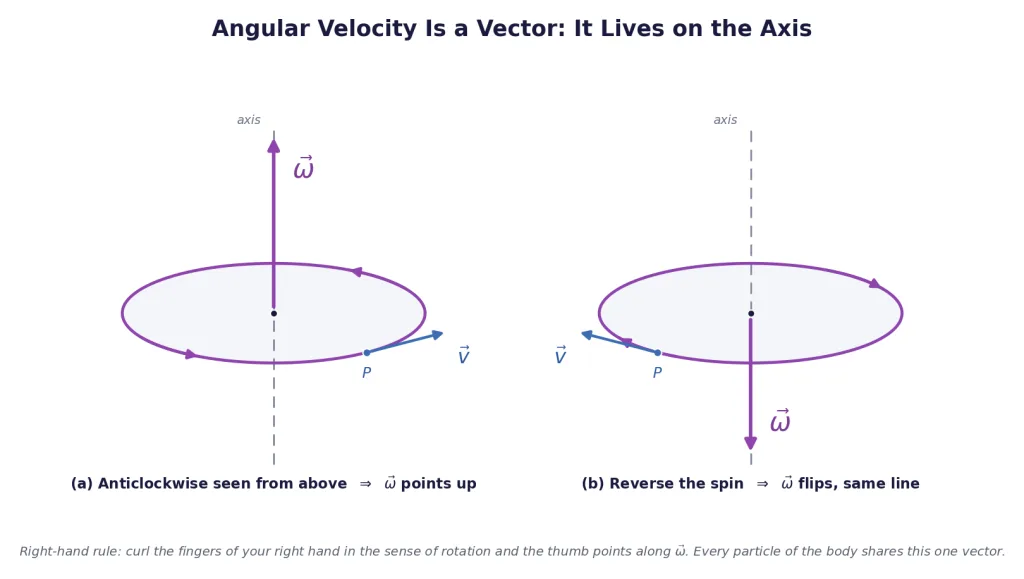
Reverse the sense of rotation and nothing about the axis changes — but flips end for end. That single fact is why anticlockwise and clockwise get opposite signs in every problem you will ever solve on this topic.
The sign convention you will actually use
For rotation about a fixed axis you can drop the full vector notation and work with a signed number, exactly as you did with one-dimensional motion:
- Take the axis as the -axis, out of the page towards you.
- Anticlockwise as seen from the side along , so .
- Clockwise as seen from the same side along , so .
[JEE Tip] State your positive sense once, in writing, at the top of the solution, and then never think about it again. Most sign errors in rotation come from a student silently changing convention halfway through.
Fixed axis versus general rotation
| Situation | Direction of | Magnitude of |
|---|---|---|
| Rotation about a fixed axis (fan, door, grindstone) | fixed for all time | may change from instant to instant |
| Rotation about a fixed point (spinning top, gyroscope) | may swing about | may change too |
Everything in this chapter, unless it says otherwise, is the first row.
A warning worth its own line
is a genuine vector, but finite angular displacements are not. Take a book, rotate it about a horizontal axis and then about a vertical one; now start again and do the two turns in the opposite order. It ends up in two different orientations. Vectors add the same way round either way, so finite rotations cannot be vectors.
Infinitesimally small angular displacements do commute, and they do add like vectors — which is exactly why , and hence , is a legitimate vector after all.
[JEE Tip] "Is angular displacement a vector?" is a standard trap. The full answer is: a finite one is not; an infinitesimal one is; angular velocity always is.
The Central Relation:
Now we tie the spin to the motion of an individual particle. This one relation carries the rest of the chapter.
Set up the geometry carefully, because every symbol matters. Let the axis be the -axis. Put the origin anywhere on that axis. Take a particle of the body; it runs a circle whose centre lies on the axis. Write for its position vector.
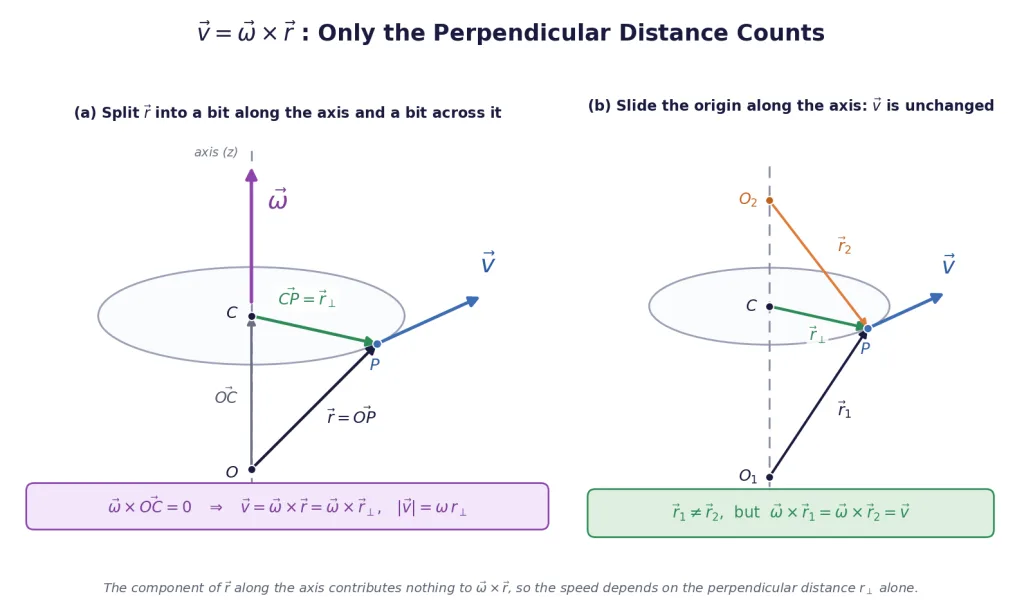
Splitting
Break the trip from to into two legs: go up the axis to , then straight out to .
Now form the cross product with , using the distributive property established in the previous section:
The first term dies. lies along the axis, and so does — two parallel vectors, so their cross product is zero. That leaves
Look at what survives. is the radius of the particle's circle; call its length , the perpendicular distance of from the axis. It is at right angles to . So
- has magnitude ;
- is perpendicular to , so it lies in the plane of the particle's circle;
- is perpendicular to , so it points along the tangent to that circle.
Magnitude , direction along the tangent — that is precisely the linear velocity of . Hence:
Key Point — the link between spin and motion: where is the position vector of the particle measured from any point on the axis. The magnitude is with the perpendicular distance from the axis — not the distance from the origin.
Two things this buys you immediately
1. The direction is free. You never have to reason about which way a particle is moving. Feed and into the cross product and the right-hand rule hands you the tangent, pointing the correct way round.
2. The origin does not matter. Slide up or down the axis and changes — but only by a vector along the axis, which contributes nothing to the product. The velocity you compute is the same. This is worth checking once by hand; it is done in the worked examples.
It also covers the fixed-point case
The relation holds unchanged for a body rotating about a fixed point rather than a fixed line — a spinning top pivoted at its tip, say. There, is measured from the fixed point, and is the instantaneous axis through it. The algebra is identical; only the fact that may swing about is new, and that is set aside in this chapter.
[Board Important] The derivation above — split , kill the axial term, identify the survivor — is a standard three-mark question. Learn the three steps, not the final line alone.
Reading the Relation: One Shared, a Different for Everybody
is compact. Unpacked, it says something you can see on any ceiling fan.
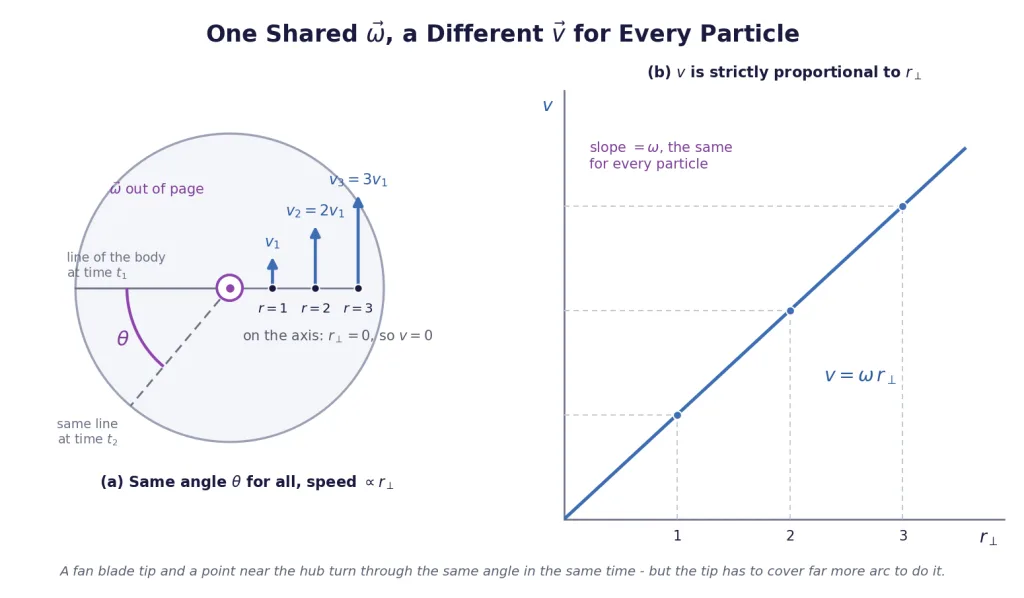
The reading
For particles of one rigid body at perpendicular distances from the axis,
The same appears in every equation. So
and speed grows strictly in proportion to distance from the axis. Double the distance and you double the speed; the graph of against is a straight line through the origin whose slope is .
| Point on a fan running at 300 rpm ( rad/s) | Speed | |
|---|---|---|
| on the hub, right on the axis | 0 | 0 |
| a screw near the hub | 0.05 m | 1.6 m/s |
| middle of a blade | 0.30 m | 9.4 m/s |
| blade tip | 0.60 m | 18.8 m/s |
The tip of that blade is moving at about 68 km/h while the hub it is bolted to is not moving at all. Same body, same instant, same .
Particles on the axis do not move
Put and you get . The particles lying on the axis stay exactly where they are while everything else sweeps round them. That is not a special case bolted on — it is forced by the axis being fixed, and it is why a hinge does not travel while a door swings.
Why and not — the error that costs marks
This is the single most common slip in the whole topic. When a particle is given by a position vector such as and the rotation is about the -axis, the number that goes into is
The -component is the part of that lies along the axis, and the derivation already told you it contributes nothing. Using instead of inflates the answer, sometimes badly.
Key Point: In , drop every component of the position vector that lies along the axis before you take the length. What is left is the radius of the circle the particle actually travels.
[JEE Tip] In component questions, do not compute at all — just evaluate as a determinant and take the length of the answer. The cross product deletes the axial part for you automatically, so you cannot make this mistake.
Angular Acceleration:
Bodies do not spin at a fixed rate for ever. A fan runs up when you switch it on; a potter's wheel slows when the potter stops kicking. We need the rate at which the spin itself changes.
Key Point — angular acceleration: the time rate of change of the angular velocity vector. Its SI unit is the radian per second squared (rad/s), and its dimensional formula is .
This is built in exact analogy with . Line them up:
| Straight-line motion | Rotational motion |
|---|---|
| position | angular position |
| velocity | angular velocity |
| acceleration | angular acceleration |
Section 9 turns this correspondence into a full working toolkit, complete with equations of motion and the dynamics. Here we only need the definition and how to read it.
can change in two quite different ways
Because is a vector, "changing" is richer than it looks.
Case 1 — the magnitude changes, the axis does not. This is the ordinary case: a fixed axis, a body speeding up or slowing down. Since never leaves the axis, points along the same line and the vector equation collapses to a signed scalar one:
- parallel to : the body is spinning faster.
- antiparallel to : the body is spinning slower. (Note that and then have opposite signs, exactly as and do for a decelerating car.)
Case 2 — the direction changes, the magnitude does not. Imagine a wheel spinning at a perfectly steady rate while somebody slowly tilts its axle. is constant, so the wheel is neither speeding up nor slowing down — yet is changing, so is not zero. In this case turns out to be perpendicular to .
Key Point: requires to be constant in both magnitude and direction. A body can have while its rate of spin never changes at all.
[JEE Tip] A quick test: split into a part along and a part across it. The parallel part changes the spin rate; the perpendicular part swings the axis. If then is momentarily constant, and all the angular acceleration is going into turning the axis.
Where comes from in a problem
Almost always one of three ways:
- You are handed and differentiate twice.
- You are handed at two times and asked for the average, .
- You are told a torque acts, and use — the dynamics, which Sections 6, 8 and 9 build up to.
[Board Important] Watch the units. An answer in rev/min is not in rad/s; convert before you put the number into any formula in this chapter.
The Acceleration of a Particle: Two Pieces, at Right Angles
A particle on a rotating body is speeding up along its circle and being pulled round the bend at the same time. Its acceleration therefore has two parts, and they are perpendicular to each other.
Start from the relation we already have and differentiate it:
Take the two terms in turn for the standard case of a fixed axis, writing for the perpendicular distance .
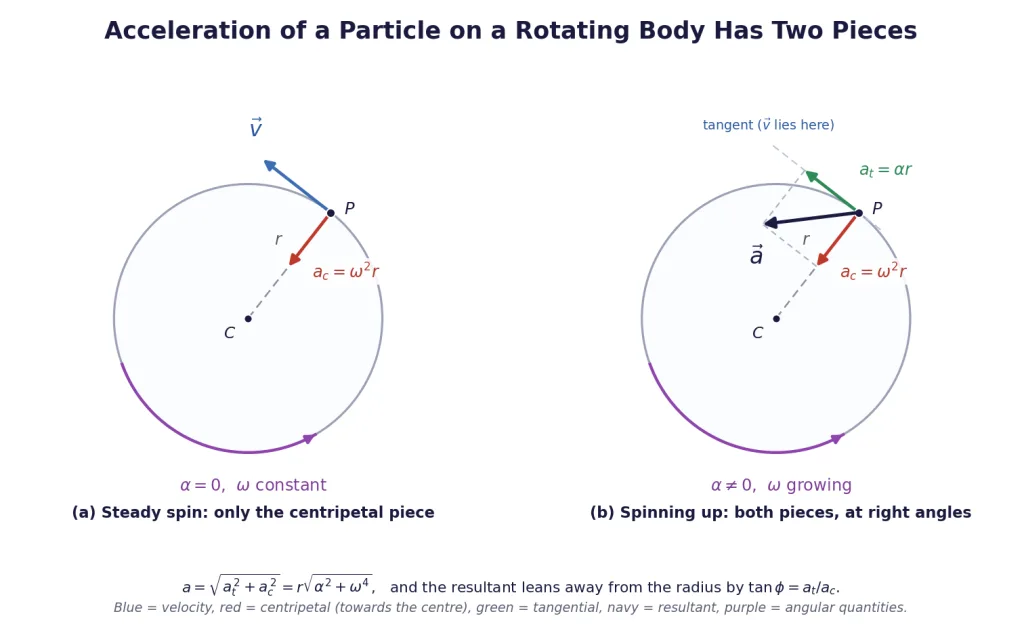
The tangential part
has magnitude and, since lies along the axis, points along the tangent — the same line as .
This is the piece that changes the speed. Turn off and the particle keeps going round at the same speed for ever.
The centripetal part
has magnitude and points from the particle straight towards the centre of its circle. This is the centripetal acceleration you met with circular motion, in its rotational clothing:
This piece changes only the direction of the velocity. It is present whenever the body is turning at all, even at a perfectly steady rate.
Key Point — the two accelerations: They are at right angles, so the total acceleration has magnitude and makes an angle with the inward radius given by .
The two special cases you must recognise instantly
| Motion | Direction of | |||
|---|---|---|---|---|
| Uniform rotation (steady spin) | 0 | 0 | straight at the axis | |
| Starting from rest, first instant | given | 0 | along the tangent | |
| General instant | given | leans between the two |
[NEET Important] "Uniform circular motion has no acceleration" is false and is examined every year. Uniform means zero tangential acceleration; the centripetal acceleration is still there, and it is what keeps the particle on the circle.
The whole section on one card
| Angular quantity | Symbol | Linear partner for a particle at perpendicular distance | SI unit |
|---|---|---|---|
| angular displacement | arc | rad | |
| angular velocity | , so | rad/s | |
| angular acceleration | tangential | rad/s | |
| — | — | centripetal | m/s |
Every relation in the third column carries a factor of — and in every one of them means the perpendicular distance from the axis. Section 6 now asks the next question: what makes change in the first place?
Solved Examples
Every number below has been re-checked numerically by finite-differencing the actual path of a rotating point, rather than by re-using the formula being demonstrated. Angles are always converted to radians before use, and no problem in this section needs .
Example 1: A ceiling fan, from rpm to metres per second
A ceiling fan runs steadily at 300 revolutions per minute. Each blade is 0.60 m long, measured from the axis. Find (a) the angular velocity in rad/s, (b) the speed of a blade tip, and (c) the speed of a small screw fixed 0.20 m from the axis.
Solution:
Convert the rate first, on its own line. Three hundred revolutions carry the fan through radians, and it takes 60 s.
(b) The blade tip. Its perpendicular distance from the axis is m, so
(c) The screw. Same , smaller radius:
Sanity check on the ratio. , and . Speeds scale exactly with distance from the axis, as they must.
Final Answer: (a) about 31.4 rad/s; (b) about 18.8 m/s; (c) about 6.28 m/s.
Takeaway: The blade tip is moving at nearly 68 km/h while the hub it is bolted to is stationary. One , many — and the conversion from rpm always comes first. [NEET Important] Multiply rpm by , never by anything else.
Example 2: Two riders on a merry-go-round
A merry-go-round turns at a steady 2.0 rad/s. Ravi sits 1.5 m from the centre; Meera sits 3.0 m from the centre. Find each rider's speed and centripetal acceleration, and state what the two riders have in common.
Solution:
Speeds. Both share the platform's :
Centripetal accelerations. The rotation is steady, so and there is no tangential part. Only survives:
What is shared. The angular velocity, the angular acceleration (zero), the period of one turn, and the angle swept in any interval. Nothing else.
Final Answer: Ravi 3.0 m/s and 6.0 m/s; Meera 6.0 m/s and 12.0 m/s; they share , , and .
Takeaway: Sitting twice as far out doubles your speed and doubles the force you need to hold on with. That is why the outer horses on a carousel feel so different from the inner ones. [Board Important] A steady spin still has an acceleration — the centripetal one.
Example 3: The relation in components, and the trap in it
A rigid body rotates about the -axis with rad/s. A particle of the body sits at m, measured from an origin on the axis. Find its velocity vector and its speed. Then show why is the wrong answer.
Solution:
Evaluate the cross product as a determinant (the machinery of the previous section):
The speed.
Check it against . The perpendicular distance from the -axis uses only and : Agreement.
Why is wrong. m, which would give m/s — over 70% too big. The tells you how high up the particle sits, not how far out it is, and the cross product deleted it for you: notice that has no component at all.
Final Answer: m/s, speed about 14.4 m/s. The distance that matters is m, not m.
Takeaway: Evaluate the determinant and you cannot fall into this trap. The cross product throws away the axial part of automatically. [JEE Tip] Two free checks on any answer: must be 0, and here indeed.
Example 4: Moving the origin along the axis
Keep rad/s from the previous problem. The same particle is described by m from an origin at the foot of the axis, and by m from a second origin that sits 5 m higher up the same axis. Show that both give the same velocity, and explain why.
Solution:
From : already done — m/s.
From : Identical.
Why. The two position vectors differ by , a vector along the axis, therefore parallel to . Its contribution to the cross product is So the difference between the two answers is exactly zero.
Note what did change. The lengths are different: m and m. Only the second happens to equal , because was chosen to lie in the particle's own plane.
Final Answer: Both origins give m/s; the difference between the position vectors is parallel to , so it contributes nothing.
Takeaway: You may put the origin anywhere on the axis — the velocity is unaffected. Choose the point that makes simplest, usually the centre of the particle's own circle.
Example 5: How fast is your classroom moving?
The Earth turns once on its axis in about 24 hours, and its radius is about 6400 km. Find the speed, due to this rotation alone, of (a) a point on the equator and (b) a point at latitude . Take the Earth as a sphere.
Solution:
The angular velocity. One revolution in s: Every point on the Earth shares this — the Earth is our rigid body.
(a) On the equator the perpendicular distance from the axis is the full radius, m:
(b) At latitude the point sits on a smaller circle. Drop a perpendicular to the axis and the radius of that circle is
Check the ratio. , as it must be.
Final Answer: about 465 m/s at the equator and about 403 m/s at latitude .
Takeaway: This is the cleanest possible illustration of : the whole planet shares one , and your speed depends only on how far you are from the axis. At the poles and you merely turn on the spot. [JEE Tip] — cosine of the latitude — is the standard trap; students reach for .
Example 6: Angular velocity and acceleration from
A flywheel turns so that its angular position is , with in radians and in seconds. Find its angular velocity and angular acceleration at s. Then find the speed, the tangential acceleration and the centripetal acceleration of a point 0.25 m from the axis at that instant, and the total acceleration.
Solution:
Differentiate once for , twice for .
Substitute .
Speed of the point.
The two accelerations.
Combine them — they are perpendicular, so use Pythagoras.
Final Answer: rad/s, rad/s; m/s, m/s, m/s, total about 42.4 m/s at about from the inward radius.
Takeaway: At any decent rotation rate the centripetal part dominates completely — here it is ten times the tangential part, so the total acceleration points very nearly straight at the axis. [JEE Tip] Because goes as and only as , the resultant swings towards the radius as the body speeds up.
Example 7: A spin rate that never changes, and yet
A gyroscope's angular velocity is , in rad/s with in seconds. Show that the body's rate of spin is constant, find , and describe what is happening.
Solution:
The magnitude. constant for all time. The body spins at a fixed rate.
Differentiate the vector, component by component.
Check the angle between them. So is perpendicular to at every instant.
Read the physics. has fixed length but its tip runs round a circle in the -plane. The axis of rotation itself is swinging round, at a rate rad/s, while the spin rate stays pinned at 5 rad/s.
Final Answer: rad/s always; rad/s, of magnitude 10 rad/s, perpendicular to . The axis is precessing at 2 rad/s.
Takeaway: A non-zero does not have to mean "speeding up". Whenever , all the angular acceleration is going into turning the axis and none into changing the spin. [JEE Tip] Split along and across and you can read off, in one line, how much of it does each job.
Example 8: When do the two accelerations become equal?
A disc starts from rest and is given a constant angular acceleration of 2.0 rad/s. At what instant does the tangential acceleration of a point on its rim become equal in magnitude to its centripetal acceleration? Find the angular velocity and the angle turned at that moment. Does the answer depend on the radius?
Solution:
Get . With constant, integrating from rest gives . (Section 9 develops the full set of these equations; here one integration is all we need.)
Write the condition. For a point at radius , Setting them equal, the cancels straight away:
Solve for the time.
The other quantities.
The radius. It cancelled in step 2, so every point of the disc reaches this condition at the same instant — as it must, since and belong to the body, not to any one point.
Final Answer: at s, when rad/s and the disc has turned through 0.50 rad. The answer is independent of the radius.
Takeaway: The two accelerations balance when , a condition on the body alone. Before that instant the motion is tangential-dominated; after it, the centripetal part takes over and grows without limit.
Example 9: A belt over two pulleys
Two pulleys, of radii 0.20 m and 0.50 m, are joined by a belt that does not slip. The small pulley turns at 600 rpm. Find the belt speed and the angular velocity of the large pulley, in rad/s and in rpm.
Solution:
The physical condition. A belt that does not slip carries every point of itself at one speed, and that speed equals the rim speed of both pulleys:
Convert and find .
The large pulley.
Check the ratio. . Angular speeds are in the inverse ratio of the radii.
Final Answer: belt speed about 12.6 m/s; the large pulley turns at about 25.1 rad/s, that is 240 rpm.
Takeaway: Belted or geared bodies share a rim speed, not an angular velocity. Particles of one rigid body share ; two separate bodies linked at their rims share . Mixing these two up is the classic error in gear problems. [NEET Important] Big wheel, slow turn: .
Example 10: Which way does point?
You are looking at the right-hand side of a bicycle wheel, held in a vertical plane, with the -axis pointing forwards (the way the bike would go), the -axis vertically up, and the -axis into the page away from you. The wheel is spun so that its topmost point moves forwards, in the direction, at 1.4 m/s. The wheel's radius is 0.35 m. Find , and find the velocity of the lowest point.
Solution:
Find the magnitude first. The top point is at perpendicular distance 0.35 m from the axle, so
Find the direction with the right hand. The axle is along . Curl your right hand so the fingers go forwards over the top and back underneath — the sense in which the wheel is turning. Your thumb points into the page, along . So
Verify with the cross product. The top point is at from the axle: Forwards, as stated.
The lowest point is at : Backwards, at the same speed.
Final Answer: rad/s (into the page); the lowest point moves at 1.4 m/s in the direction.
Takeaway: Top and bottom of a spinning wheel move in opposite directions, at equal speeds, because their position vectors from the axis are opposite. [JEE Tip] Reverse and every particle's velocity reverses — the cross product is linear in .
Example 11: Total acceleration of a point on a disc
At one instant a disc of radius 0.40 m has rad/s and rad/s. For a point on the rim, find the speed, the two components of acceleration, the magnitude of the total acceleration and the angle it makes with the radius.
Solution:
Speed.
Tangential component.
Centripetal component. (You could equally write m/s.)
Resultant.
Angle from the inward radius.
Final Answer: m/s, m/s, m/s, total about 14.4 m/s, leaning about off the inward radius.
Takeaway: Notice that the total acceleration rounds to the same 14.4 m/s as the centripetal part alone — adding a perpendicular component 12 times smaller barely changes the length. [NEET Important] In a multiple-choice question, if you can often quote and still land on the right option.
Example 12: A rod swinging about one end
A thin rod of length 1.2 m is hinged at one end and swings in a horizontal plane. At a certain instant it is turning at 3.0 rad/s. Find the speed of (a) the hinged end, (b) the midpoint, (c) the far tip, and (d) the centripetal acceleration of the tip. (e) What is the mean speed of the rod's particles at that instant?
Solution:
All parts share rad/s. Speeds differ only through .
(a) The hinged end lies on the axis, :
(b) The midpoint, m:
(c) The tip, m:
(d) The tip's centripetal acceleration. The rod is not said to be speeding up, so we are asked only for the radial part:
(e) The mean speed. Since grows linearly from 0 at the hinge to at the tip, the average over the length is the average of the two ends: which is the speed of the midpoint. That is a property of a linear profile, and it is exactly why the midpoint of a uniform rod turns out to be so useful later.
Final Answer: (a) 0; (b) 1.8 m/s; (c) 3.6 m/s; (d) 10.8 m/s; (e) 1.8 m/s, the same as the midpoint's speed.
Takeaway: A rigid body has no single speed. When a question says "the speed of the rod", it must mean the speed of some named point — usually the centre of mass or the tip. Read the wording, then pick the right .