
One Angle Is Enough
A brick sliding across a table needs three numbers to pin it down. A rigid body tumbling through the air needs six. But a body bolted to a fixed axle — a fan, a grindstone, a flywheel, a door — needs exactly one.
Here is why. Every particle of the body goes round a circle whose centre lies on the axis. When the body turns through some angle, every particle turns through the same angle. So one angle describes the entire body, and rotation about a fixed axis has one degree of freedom, exactly like a bead on a straight wire.
That single fact is what makes this section easy. One variable means the whole apparatus of straight-line kinematics carries over, symbol for symbol.
Setting up the one variable
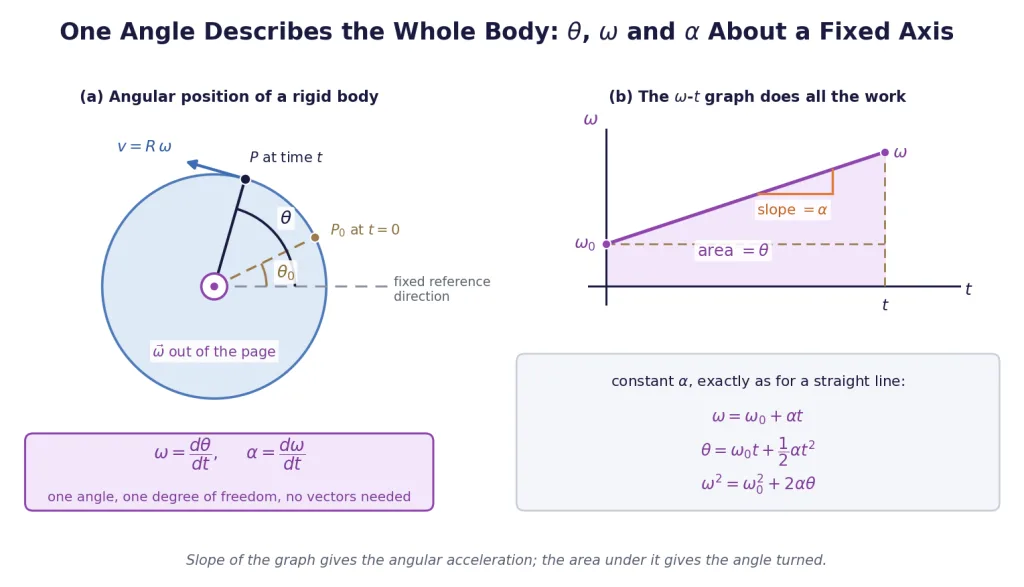
Pick any particle of the body that is not on the axis, and measure its angle from a fixed reference direction in the plane of its circle. Then:
Key Point — the three kinematic quantities: Because the axis is fixed, and can only point along that axis — one way or the other. So we drop the vector notation entirely and use signed scalars: anticlockwise positive, clockwise negative. That convention is the whole of the vector story here.
Section 5 developed and as genuine vectors and gave the right-hand rule. Nothing is lost by simplifying: for a fixed axis the vector equations reduce exactly to the signed equations we are about to write.
Reading the signs
and having the same sign means the body is speeding up. Opposite signs mean it is slowing down. This is the same rule you used for and on a straight line, and it catches people out in exactly the same way: a wheel with rad/s and rad/s is decelerating, not going backwards — not yet.
Units, and the conversion you will need every day
- in radians (rad). One full turn is rad.
- in rad/s; in rad/s.
- Everyday machines are rated in revolutions per minute (rpm).
So 1 rpm is about 0.105 rad/s, and 3000 rpm is rad/s.
Key Point: Every formula in this section needs in rad/s and in radians. Substituting rpm or degrees is the single most common arithmetic disaster in the topic. Convert first, on its own line, before you touch the equations.
[Board Important] Radians are dimensionless (arc length divided by radius), which is why and — the same dimensions as frequency and as . That is also why comes out in joules with no stray factors.
Where we are going
The rest of this section builds the full dictionary between straight-line motion and rotation: three kinematic equations first, then , then work, energy and power. By the end, every formula you learned in Chapters 3, 4 and 5 will have a twin.
The Three Kinematic Equations, Derived Rather Than Quoted
Take the case that matters: constant. This is the rotational twin of uniform acceleration, and the derivation is the same two integrations.
First equation, by integrating
Integrate with respect to time:
At the body already has some angular speed , so :
Second equation, by integrating
Now feed that into :
Measuring from the position at makes :
If you prefer to keep a starting angle , write on the left; the in these equations is always the angle turned through, never the angle measured from some unrelated line.
Third equation, by eliminating
From the first equation . Substitute into the second and tidy up:
Key Point — the three equations, valid only for constant : Compare them with , and . They are not analogous; they are the same equations with new names.
The graph does it too
Draw against for constant and you get a straight line of slope starting at . The area under it between and is a trapezium of area — which is . Slope gives ; area gives . Exactly as in Chapter 2.
Two more forms worth carrying
The first says the angle turned equals the mean angular speed times the time — very quick when you know both speeds and the time but not . The second gives the angle turned during the th second alone.
Joining the angular to the linear
A point at perpendicular distance from the axis has, from Section 5,
and this is how a belt, a rope or a cord gets into a rotation problem:
Key Point — the unwinding-cord link: If a length of cord peels off a wheel of radius without slipping, the wheel has turned through and the free end of the cord moves with speed and acceleration . This one line converts every "rope over a pulley" problem into a rotation problem.
[JEE Tip] Angles in revolutions are the commonest trap in this block. Convert to radians the moment you see them: 20 revolutions is rad, not 20.
A quick one, to fix the method
A wheel starting from rest reaches 24 rad/s in 8 s. Then rad/s, and rad, which is revolutions. Three lines, no cleverness needed.
Work, Kinetic Energy and Power in Rotation
Kinematics does not tell you why a wheel speeds up. For that we need forces — but forces enter rotation only through their torques, and it is worth seeing exactly how.
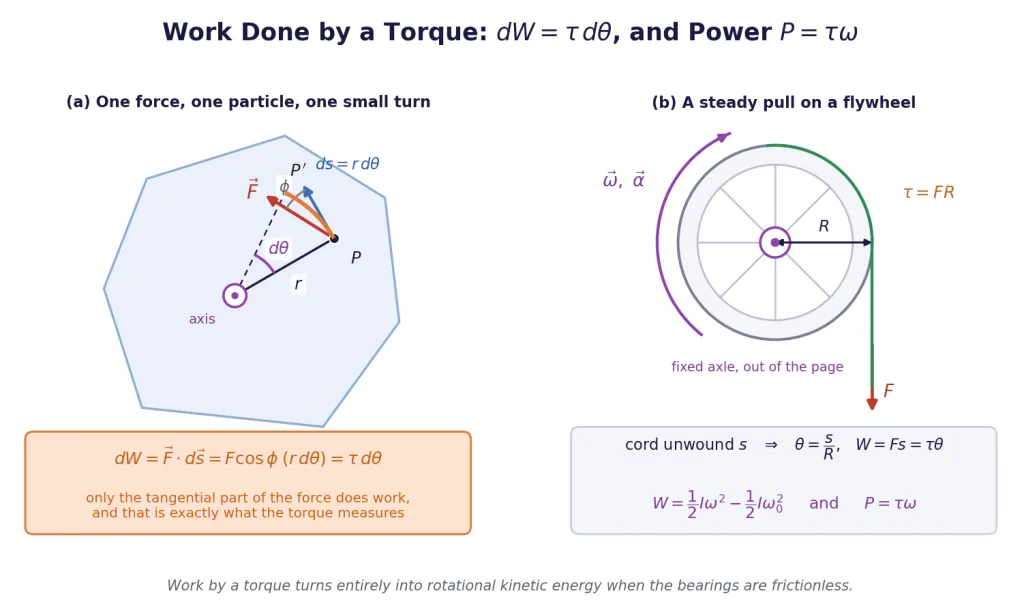
Work done by a torque
Let a force act on a particle of a body rotating about a fixed axis, with lying in the plane of 's circle. In a small time the body turns through , and moves along its circle by
tangentially. The work done is
where is the angle between and the tangent. But is precisely the tangential component of the force, and is precisely the torque about the axis. Hence
Key Point — work done by a torque: This is the exact twin of . If several forces act, their torques about the axis simply add — the angular displacement is common to all of them — so here means the net torque about the axis.
Two consequences fall out at once:
- A force parallel to the axis, or one whose line of action meets the axis, has zero torque about it and therefore does no work on the rotating body, however large it is. The bearing reactions are the standard example.
- A radial force does no work either: it is perpendicular to the displacement, which is tangential.
Rotational kinetic energy
Section 8 got this by adding up with :
with the moment of inertia about the axis of rotation. Nothing new is needed here; we simply use it.
Power
Divide by :
Key Point — rotational power: the twin of . With in newton metres and in rad/s, comes out in watts. This is the equation printed on every motor's nameplate: rated power, rated speed, and the torque it can deliver at that speed.
Read it the way an engineer does: for a given power, torque and speed trade off against each other. That is what a gearbox is for. A car in first gear turns the wheels slowly with enormous torque; in fifth gear, fast with little.
The work-energy theorem, rotational form
Key Point: For a rigid body turning about a fixed axis with constant, The net work done by all the external torques equals the change in rotational kinetic energy. In a perfectly rigid body there is no internal motion to absorb energy, so nothing is lost on the way.
[JEE Tip] When a problem gives you a torque and an angle (or a length of cord) and asks for a speed, use the work-energy theorem and skip the kinematics entirely. When it gives you a torque and a time, use and the kinematic equations. Choosing the right route saves half the working.
[NEET Important] , and all come out in joules — but by itself, though it also has the dimensions of energy, is not energy. It is a moment. Keep the two ideas apart.
The Equation of Motion:
Now the centrepiece. There are two honest routes to it, and both are worth seeing.
Route 1: from the rate of doing work
The rate at which the external torque feeds energy in is . In a rigid body that energy has nowhere to hide, so it all goes into the kinetic energy:
(assuming does not change with time — the body stays rigid and the axis keeps its place in the body). Equating the two rates,
Route 2: particle by particle
Take the particle of mass at perpendicular distance . Its tangential acceleration is , so the tangential force on it is , and the torque of that force about the axis is
Add over the whole body. Internal forces cancel in pairs (Section 6), leaving only the external torques:
Key Point — Newton's second law for rotation about a fixed axis: where is the net external torque about the axis, the moment of inertia about that same axis, and the angular acceleration. Torque produces angular acceleration exactly as force produces acceleration, and measures the resistance exactly as mass does.
The small print, which examiners love
Key Point: in this simple form requires:
- a fixed axis (or an axis through the centre of mass, moving with it);
- constant in time — the body rigid, and the axis fixed in the body as well as in space;
- and taken about the same axis;
- only the components of torque along the axis counted. Components perpendicular to the axis are cancelled by the bearings, which is exactly what "fixed axis" means physically.
When changes — a skater pulling her arms in — you must go back to . Section 10 does precisely that.
The standard set-up: a cord, a pulley and a hanging block
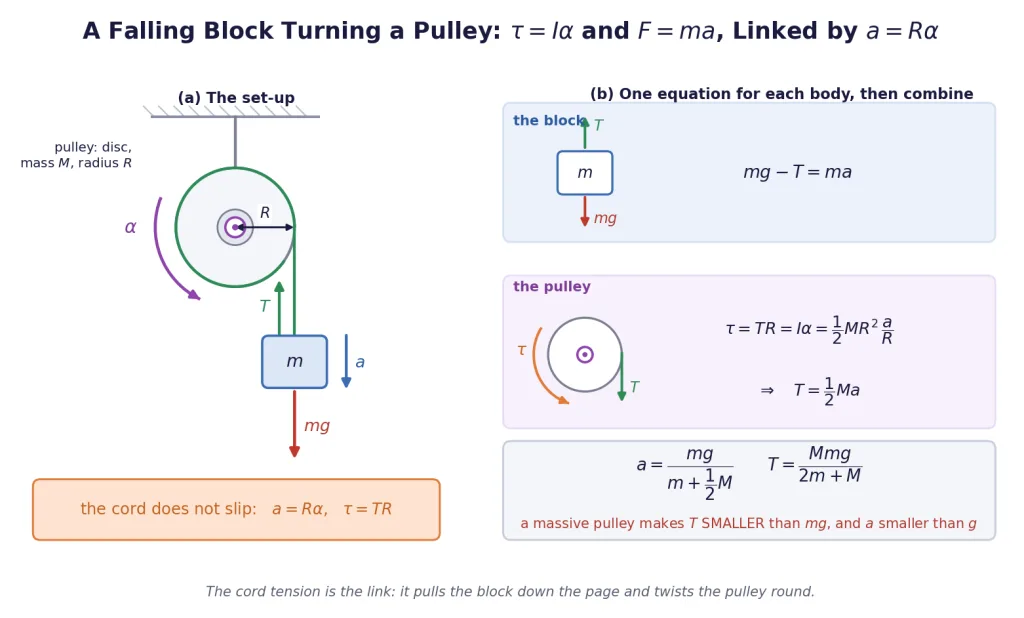
This is the most-asked configuration in the whole chapter, so learn it as a routine rather than as a puzzle.
- One equation per body. For the hanging block, . For the pulley, .
- Link them with the constraint , which is just the unwinding-cord rule differentiated twice.
- Solve. With a uniform disc pulley, , and
Key Point: With a massive pulley the tension is not , and the two sides of a cord passing over it do not carry equal tensions. A difference in tension is exactly what supplies the torque that spins the pulley up. Treating a heavy pulley as massless is the single most expensive mistake in this topic.
Check the limits, always: as we get and , the free-fall answer. As , and , a block hanging from an immovable wheel. Both are right.
Choosing your weapon
| The problem gives you | Use |
|---|---|
| torque and time, wants or | , then the kinematic equations |
| torque and angle (or cord length), wants | work-energy theorem, |
| power and speed, wants torque | |
| heights and speeds, no torque asked | energy conservation |
| a changing | conservation of angular momentum (Section 10) |
The Complete Dictionary
Everything in this section, and much of the chapter, is one idea repeated: replace each straight-line quantity by its rotational partner and every formula survives.
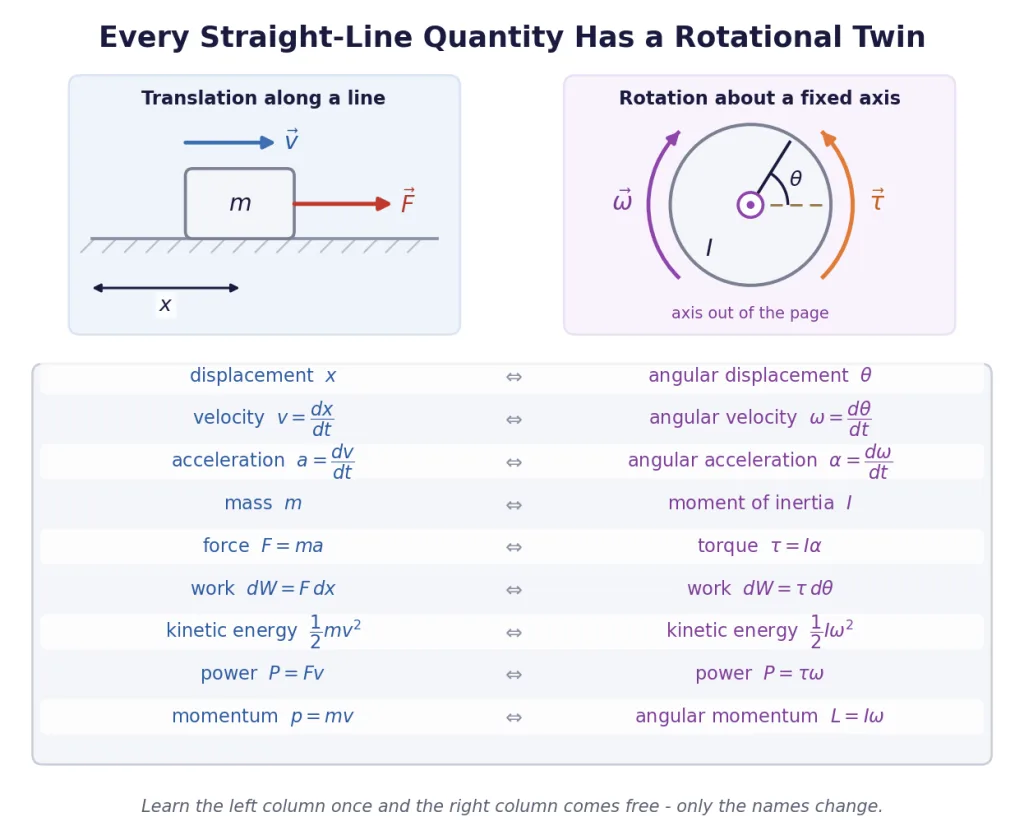
| Translation along a line | Rotation about a fixed axis |
|---|---|
| displacement (m) | angular displacement (rad) |
| velocity (m/s) | angular velocity (rad/s) |
| acceleration (m/s) | angular acceleration (rad/s) |
| mass (kg) | moment of inertia (kg m) |
| force (N) | torque (N m) |
| work | work |
| kinetic energy | kinetic energy |
| power | power |
| momentum | angular momentum |
| impulse | angular impulse |
| equilibrium: | equilibrium: |
Learn the left column properly and the right column costs you nothing.
Where the analogy is not perfect
Analogies that are sold too hard become traps. Four places to be careful:
- Mass is a number; is not. A body has one mass but a different moment of inertia about every axis. "The moment of inertia of a disc" is a meaningless phrase until you name the axis.
- can change during the motion. Mass cannot (in mechanics). A skater changes her by a factor of two in half a second, and then is no longer the right equation — is.
- Torque needs a reference point or axis; force does not. and are meaningless until you say "about what".
- need not be parallel to , whereas is always parallel to . That subtlety is the opening business of Section 10.
The checklist for an exam
- Convert rpm to rad/s and revolutions to radians, on their own line.
- Name the axis, and take and about that same axis.
- Fix the positive sense and give retarding torques a minus sign.
- Choose the route — for time questions, work-energy for angle questions.
- Write one equation per body, and link them with .
- Check the limits of your answer as a mass or a radius goes to zero.
[Board Important] "Derive " and "Obtain the kinematic equations for rotational motion with uniform angular acceleration" are both standard derivations worth three marks each. Both are done in full in the blocks above; reproduce the integration, not just the result.
[NEET Important] A ranked list worth memorising, for equal mass and radius under equal torque: the disc gains angular speed twice as fast as the ring, and a solid sphere two and a half times as fast as a ring — because and runs , , .
Section 10 takes the last row of the table — — and asks what happens when the net torque is zero. Section 11 takes the whole apparatus and lets the axis itself move, which is rolling.
Solved Examples
Where a value of is needed it is 10 m/s, stated in the problem.
Example 1: Spinning up a grinding wheel
A grinding wheel at rest is given a constant angular acceleration of 3 rad/s for 8 s. Find (a) its angular speed at the end, (b) the angle it has turned through, (c) the number of revolutions made.
Solution:
(a) With :
(b)
(c) One revolution is rad, so
Check with the third equation: , giving rad/s. Consistent.
Final Answer: 24 rad/s, 96 rad, about 15.3 revolutions.
Takeaway: Three equations, three questions, no thinking required once , and are identified. [Board Important] Always finish by converting radians to revolutions if the question asks for turns — dividing by is worth a mark.
Example 2: A motor wheel picking up speed
The angular speed of a motor wheel rises steadily from 600 rpm to 1500 rpm in 15 s. Find (a) the angular acceleration, and (b) the number of revolutions the wheel makes in that time.
Solution:
Convert first — always.
(a) Angular acceleration.
(b) Angle turned. The mean-speed form is quickest here:
Final Answer: rad/s; 262.5 revolutions.
Takeaway: Working in multiples of keeps the arithmetic exact right to the end, and the cancels beautifully when you convert back to revolutions. [JEE Tip] The mean-speed equation is the fastest route whenever you know both speeds and the time.
Example 3: A grindstone braking to rest
A grindstone spinning at 40 rad/s is brought to rest in exactly 20 revolutions by a constant braking torque. Its moment of inertia about the axle is 2 kg m. Find (a) the angular retardation, (b) the time taken, (c) the braking torque, and (d) the heat generated at the brake.
Solution:
Convert the angle. rad.
(a) Use the equation with no in it:
(b)
(c)
(d) All the rotational kinetic energy ends up as heat: and as a cross-check, J. The two routes agree, as they must.
Final Answer: rad/s, 6.28 s, 12.7 N m, 1600 J.
Takeaway: A braking problem is a spinning-up problem with a minus sign. [NEET Important] The heat generated is the initial kinetic energy — computing it as is the independent check that catches sign slips.
Example 4: A steady pull on a flywheel
A cord of negligible mass is wound round the rim of a flywheel of mass 20 kg and radius 0.25 m, mounted on a horizontal axle with frictionless bearings. A steady pull of 30 N is applied to the cord, and the wheel starts from rest. Treating the flywheel as a uniform disc, find (a) its angular acceleration, (b) the work done by the pull while 3 m of cord unwinds, (c) the angular speed at that moment, and (d) the kinetic energy then.
Solution:
Moment of inertia, from the standard disc result:
(a) Torque and angular acceleration. The pull is tangential, so :
(b) Work done by the pull. The cord end moves 3 m in the direction of the 30 N force:
(c) Angular speed. The wheel has turned through rad, so
(d) Kinetic energy.
Final Answer: 12 rad/s, 90 J of work, 17.0 rad/s, 90 J of kinetic energy.
Takeaway: Parts (b) and (d) came out identical — the work done by the pull went entirely into rotational kinetic energy, because the bearings are frictionless and nothing else absorbed any. That equality is the work-energy theorem in rotational form, and it is worth quoting explicitly in a written answer. Note also that J gives the same number a third way.
Example 5: A rotor held at constant speed
An engine must keep a rotor turning at a uniform 150 rad/s, and to do so it transmits 30 kW. Assuming the engine is fully efficient, find (a) the torque it delivers, (b) the work done in one minute, and (c) explain why any torque is needed at all when the angular speed is not changing.
Solution:
(a) From :
(b)
(c) Constant means , so by the net torque is zero. That is not the same as no torque: the engine's 200 N m is exactly balanced by a 200 N m frictional torque at the bearings and against the air. The engine's work does not raise the kinetic energy at all — it is dissipated as heat at the same rate it is supplied.
Final Answer: 200 N m; 1.8 MJ; the applied torque balances friction, net torque zero.
Takeaway: "Uniform angular speed" means the net torque is zero, never that the applied torque is zero. [JEE Tip] In the ideal frictionless problem no torque would be needed at all — but a question that quotes a power at constant speed is telling you friction is present, and that all the power goes into heat.
Example 6: A block falling from a cord round a pulley
A light cord is wound round a uniform disc pulley of mass 4 kg and radius 0.2 m, free to turn on a fixed horizontal axle. A 2 kg block hangs from the free end and is released from rest. Take m/s. Find (a) the acceleration of the block, (b) the tension in the cord, (c) the angular acceleration of the pulley, and (d) the speed of the block after it has fallen 1.6 m, checked by energy.
Solution:
Moment of inertia. kg m.
One equation per body.
Constraint. The cord does not slip, so , i.e. .
Solve. Substituting, , so . Then , giving
(d) Speed after falling 1.6 m. Energy check. The block loses J of potential energy. It gains J, and the pulley, turning at rad/s, gains J. Total 32 J. The books balance.
Final Answer: m/s, N, rad/s, m/s.
Takeaway: The tension is 10 N, not 20 N — the block is not in free fall and the cord is not carrying the full weight. Half the energy released ended up in the pulley, which is exactly what next to in the formula is telling you.
Example 7: Equal torques on a ring and a disc
A ring and a uniform disc each have mass 3 kg and radius 0.4 m. Each is free to turn about its own central axis, perpendicular to its plane, and each is given the same torque of 6 N m from rest. Compare their angular accelerations, their angular speeds after 4 s, and their kinetic energies at that moment.
Solution:
Moments of inertia.
Angular accelerations.
After 4 s from rest.
Kinetic energies.
Cross-check with : the ring has turned rad, so J; the disc has turned 200 rad, so J. Both match.
Final Answer: The disc has twice the angular acceleration, twice the angular speed and twice the kinetic energy of the ring.
Takeaway: Under equal torques for equal times, , and the body with its mass nearer the axis wins every comparison. [NEET Important] Note where the extra energy comes from: the disc turned through twice the angle in the same time, so the same torque did twice the work on it.
Example 8: A torque that dies away
A wheel of moment of inertia 3 kg m, initially at rest, is acted on by a torque N m, where is the angle in radians turned from the start. Find (a) the work done up to rad, (b) the angular speed there, and (c) the angle at which the angular speed is greatest.
Solution:
(a) The torque is not constant, so integrate:
(b) Work-energy theorem, starting from rest:
(c) The wheel keeps speeding up while and starts slowing once , so the maximum speed occurs where the torque changes sign: There, J, so rad/s.
Final Answer: 32 J, 4.62 rad/s, maximum speed at rad.
Takeaway: is the definition; is only its special case for constant torque. [JEE Tip] "Maximum angular speed" always means "where the net torque changes sign", never "where the torque is largest" — exactly as maximum speed on a line means zero acceleration.
Example 9: A rod let go from horizontal
A uniform rod of length 1.2 m is pivoted at one end on a smooth horizontal axle and held horizontal, then released. Take m/s. Find (a) its angular acceleration at the instant of release, (b) its angular speed when it reaches the vertical, and (c) the speed of the free end at that moment.
Solution:
(a) At release. The only torque about the pivot is that of the weight, acting at the centre of mass, a distance from the pivot. About the end, . The mass cancels — the rod's angular acceleration does not depend on how heavy it is.
(b) At the vertical. is not constant here (the torque falls as the rod swings), so the kinematic equations are useless. Use energy instead. The centre of mass falls by :
(c) The free end is at distance from the axis:
Final Answer: 12.5 rad/s, 5 rad/s, 6 m/s.
Takeaway: Spot the non-constant torque. The moment the torque depends on position, the three kinematic equations are off the table and energy is the tool. [JEE Tip] The tip of the rod is moving at 6 m/s while its centre of mass moves at 3 m/s — a falling rod's tip can even outrun a freely dropped ball, which is a classic demonstration.
Example 10: Power while spinning up
A constant torque of 40 N m acts on a flywheel of moment of inertia 8 kg m, initially at rest. Find (a) the angular speed after 5 s, (b) the instantaneous power being delivered at that moment, (c) the total work done in the 5 s, and (d) the average power.
Solution:
(a) rad/s, so rad/s.
(b)
(c) rad, so Check: J. Agreed.
(d)
Final Answer: 25 rad/s, 1000 W instantaneous, 2500 J, 500 W average.
Takeaway: For a constant torque from rest the power grows linearly with time, so the average power is exactly half the final power — the twin of the constant-force result on a straight line. [Board Important] Quoting instantaneous power where average power was asked (or the reverse) costs the whole mark; read which one the question wants.
Example 11: An Atwood machine with a real pulley
Two blocks of mass 3 kg and 2 kg hang from the two ends of a light cord passing over a pulley which is a uniform disc of mass 2 kg and radius 0.15 m. The cord does not slip. Take m/s. Find the acceleration of the blocks and the tension on each side.
Solution:
Set up. kg m. Note kg, which is the pulley's "effective mass" in this problem.
Three equations. Taking down as positive for the heavier block:
Combine. The torque equation becomes . Adding all three:
Tensions.
Check the torque. N m, and N m. They match.
Final Answer: m/s; N, N.
Takeaway: The two tensions are different, and their difference N is exactly what turns the pulley. Add to the total mass in the denominator and the massless-pulley formula still works. [JEE Tip] For a disc pulley, — the pulley behaves like half its own mass added to the system.
Example 12: A brake pad on a wheel
A wheel of moment of inertia 0.5 kg m is spinning at 60 rad/s when a brake pad presses on it, producing a friction force of 20 N tangentially at a radius of 0.25 m. Find (a) the time to stop, (b) the number of revolutions before stopping, and (c) the heat generated.
Solution:
Torque and retardation.
(a)
(b)
(c) Two independent routes, and they must agree:
The average braking power is W.
Final Answer: 6 s, about 28.6 revolutions, 900 J of heat.
Takeaway: Friction at a brake converts rotational kinetic energy into heat at the rate , which falls to zero as the wheel stops — so the braking power is greatest at the start. [NEET Important] Whenever a problem says "brought to rest by friction", the heat generated is the initial kinetic energy; you rarely need the kinematics at all.