
Mass Was Enough for Straight Lines. Rotation Needs More.
Push a 5 kg block and a 50 kg block with the same force and the answer is obvious: mass measures how hard it is to change a body's straight-line motion.
Now try the rotational version. Take a metre rule and spin it about a vertical axis through its centre. Easy. Now spin the same rule about a vertical axis through one end. Distinctly harder — and the mass has not changed by a gram. Something other than mass is at work, and finding out what is the whole business of this section.
Where the new quantity comes from
Let a rigid body rotate about a fixed axis with angular speed . Every particle goes round a circle centred on the axis. The particle labelled , at a perpendicular distance from the axis, moves with speed
and is the same for all of them — that is what makes a rigid body rigid. Add up the kinetic energies:
Everything that depends on the body has collected itself into the bracket. Give it a name.
Key Point — moment of inertia: For a body rotating about a given axis, where is the perpendicular distance of the th particle from the axis of rotation. In terms of it, the rotational kinetic energy is which is the exact twin of , with in the role of mass and in the role of velocity.
Units and dimensions
so the SI unit is the kilogram metre squared (kg m). There is no special name for it.
[Board Important] , with no time in it — a favourite one-mark question. Note it is not the dimension of energy; that needs a as well.
The distance is measured from the AXIS
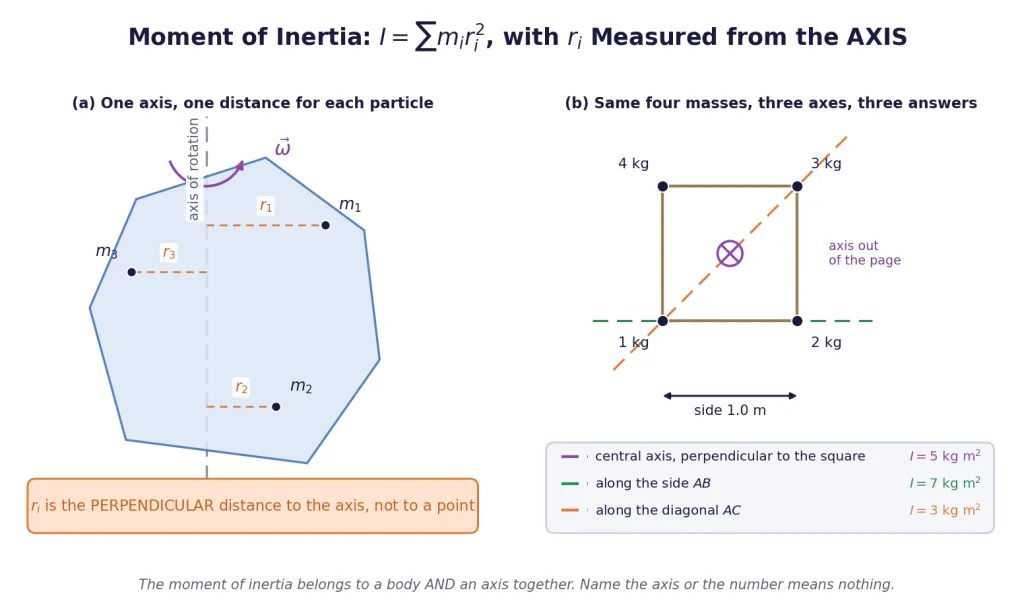
This is the single most common error in the whole topic. is not the distance from the origin, and not the distance from the centre of mass. It is the perpendicular distance from each particle to the line about which the body turns. A particle sitting on the axis contributes nothing at all, however heavy it is.
belongs to a body and an axis, together
Look at the four masses in the figure — 1 kg, 2 kg, 3 kg and 4 kg at the corners of a square of side 1.0 m. One body, three sensible axes, three completely different answers:
| Axis | |
|---|---|
| through the centre, perpendicular to the square | 5 kg m |
| along the side | 7 kg m |
| along the diagonal | 3 kg m |
Key Point: Mass is a single number belonging to a body. Moment of inertia is not. It depends on the mass, on how that mass is distributed, and on the position and orientation of the axis. A sentence like "the moment of inertia of a disc is " is incomplete: it is about the central axis perpendicular to the disc, and about a diameter.
[JEE Tip] If a question gives you a value of without naming an axis, the axis is hiding somewhere in the wording — "about its centre", "about one end", "about a tangent". Find it before you write a single line.
Why engineers care
Because resists changes in spin, machines that must run smoothly are given a heavy wheel with its mass concentrated far out at the rim — a flywheel. A car engine fires in bursts, but the flywheel's large swallows the jerks and the crankshaft turns at a nearly steady rate. Mass at the rim is what does the work: for the same mass and radius, a ring has twice the moment of inertia of a solid disc.
Section 9 will show you the rest of the analogy — that plays the part of , and that plays the part of . Everything there depends on being able to calculate , which is what we do next.
From a Sum to an Integral
Real bodies are not four masses on a light frame; they are continuous. Chop such a body into elements of mass , each small enough to sit at a definite perpendicular distance from the axis, and the sum becomes an integral.
Key Point: For a continuous body, the integral running over the whole body, with the perpendicular distance of the element from the axis.
The recipe, in four steps
- Choose an element every point of which is at the same distance from the axis. This choice is the whole art — get it right and the integral is one line.
- Write using the appropriate density: for a wire of linear density , for a lamina of surface density , for a solid.
- Express in terms of the integration variable.
- Integrate over the correct limits — and note that the limits carry the physics of where the axis is.
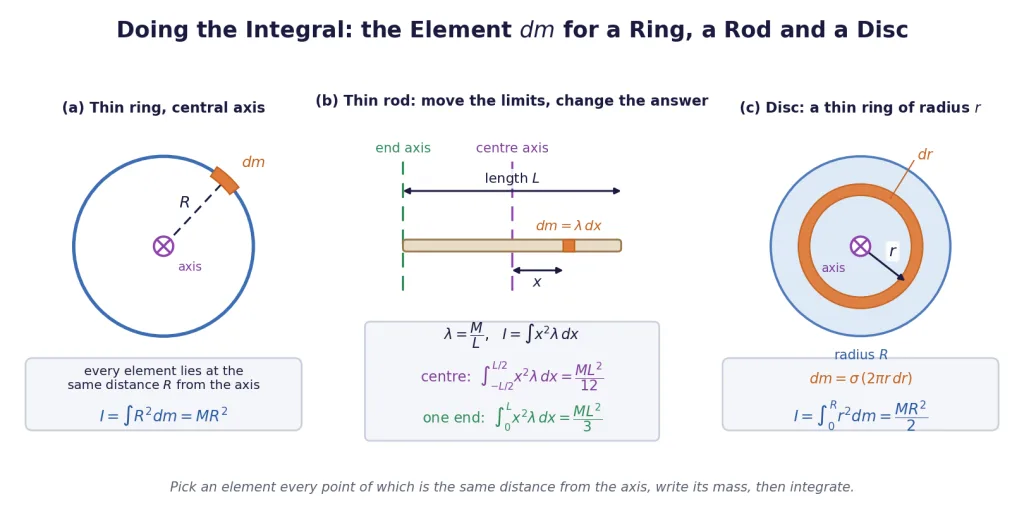
Thin ring, about the central axis perpendicular to its plane
Every single element of a ring of radius is at distance from that axis. So is constant and comes straight out:
No calculus was really needed — which is why the ring is the one shape everybody remembers.
Thin rod, about a perpendicular axis through its centre
Take a rod of mass and length along the -axis with its centre at the origin, so . The element between and has mass and sits at distance from the axis:
The same rod, about a perpendicular axis through one end
Nothing changes except the limits. Put the origin at the end:
Four times as large. Move the axis and you change the answer by a factor of four — a vivid demonstration that belongs to the body-and-axis pair.
Uniform disc, about the central axis perpendicular to it
Here the good element is a thin ring of radius and width , because every point of that ring is at the same distance . With , its area is , so
and since ,
Hollow cylinder and solid cylinder, about their own axis
A hollow cylinder (a thin-walled pipe) of radius is just a stack of rings, and every element of every ring is at distance :
A solid cylinder is a stack of discs, each contributing :
Key Point: For rotation about its own axis, the length of a cylinder does not appear in . A short coin and a long rolling pin of the same mass and radius have the same moment of inertia about the axis. That is because length runs along the axis, and only distances from the axis count.
[NEET Important] This gives you four results for the price of two: ring and hollow cylinder both , disc and solid cylinder both .
The Standard Results, and the Radius of Gyration
You will use these constantly, so here they are in one place, each one obtained by the integration of the previous block. is the total mass throughout.
| Body | Axis | ||
|---|---|---|---|
| thin ring, radius | central, perpendicular to its plane | ||
| thin ring, radius | any diameter | ||
| uniform disc, radius | central, perpendicular to the disc | ||
| uniform disc, radius | any diameter | ||
| thin rod, length | perpendicular, through the centre | ||
| thin rod, length | perpendicular, through one end | ||
| hollow cylinder, radius | its own axis | ||
| solid cylinder, radius | its own axis | ||
| solid sphere, radius | any diameter | ||
| hollow sphere (thin shell), radius | any diameter | ||
| rectangular lamina, sides and | central, perpendicular to it |
Read the pattern rather than memorising eleven separate facts:
- The further the mass sits from the axis, the bigger is. Ring beats disc ; hollow sphere beats solid sphere . In each pair the hollow body has its mass out at the rim.
- Two shapes with the same "profile" about an axis give the same answer — ring and hollow cylinder, disc and solid cylinder.
- The rod about its end is four times the rod about its centre. You will see why in the parallel axis theorem.
Radius of gyration
Every entry in that last column is the same idea. Notice that every result can be written as for some length .
Key Point — radius of gyration: The radius of gyration of a body about a given axis is defined by It is the distance from the axis at which the whole mass could be concentrated at a single point without changing the moment of inertia. It has the dimension of length, and like itself it depends on the axis as well as the body.
So a disc of radius spinning about its central axis behaves exactly like a single particle of the same mass placed at from the axis. A rod about its centre behaves like its whole mass placed at from the middle.
is a geometric property: it is fixed by the shape and the axis and does not depend on how much the body weighs. Two discs of the same radius, one of aluminium and one of lead, have the same radius of gyration and wildly different moments of inertia.
[JEE Tip] is the quickest way to compare shapes, and it is exactly what turns up in the rolling formula in Section 11. Learn the ratios : ring 1, disc , solid sphere , shell .
Key Point: is not the distance of the centre of mass from the axis, and it is not an average of the distances of the particles. It is the root-mean-square distance, weighted by mass — squares first, then average, then square root.
The Theorem of Perpendicular Axes
The two theorems in this block and the next sit outside the rationalised syllabus body text, but almost every moment-of-inertia question in JEE Main, JEE Advanced and NEET needs one of them, so both are developed here in full, from first principles.
The first one is a gift: it turns one integration into two, and it is proved by Pythagoras.
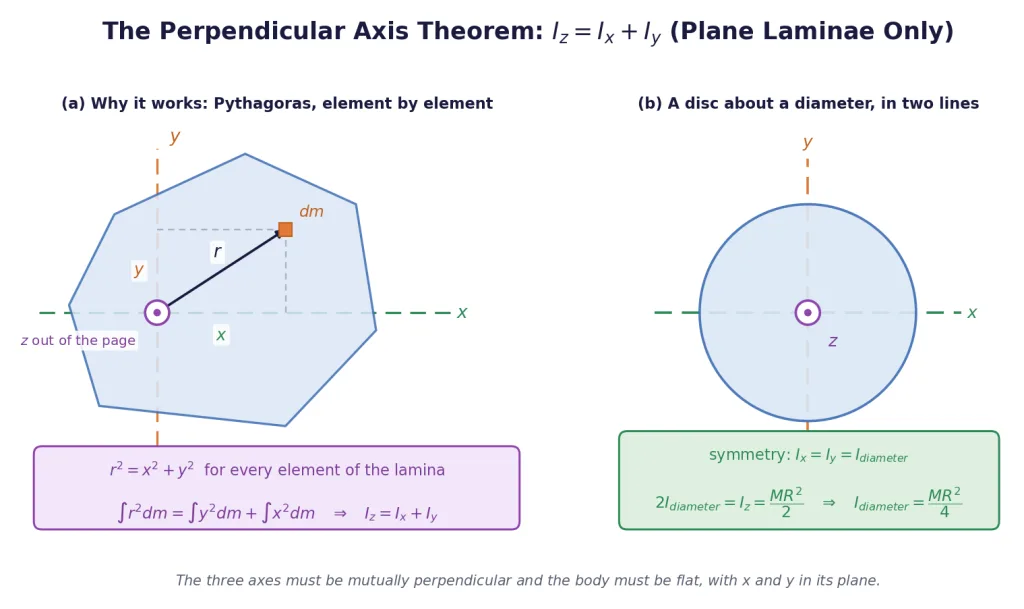
Key Point — the perpendicular axis theorem: For a plane lamina, the moment of inertia about an axis perpendicular to its plane equals the sum of the moments of inertia about two mutually perpendicular axes lying in the plane and meeting the first axis at the same point:
The proof
Let the lamina lie in the -plane with the -axis through the origin , perpendicular to it. Take an element of mass at the point .
- Its distance from the -axis is , so it contributes to .
- Its distance from the -axis is , so it contributes to .
- Its distance from the -axis is , where , so it contributes to .
Integrate over the whole lamina:
Three lines, and no assumption about the shape at all — the lamina may be a disc, a rectangle, or an irregular blob cut out with scissors.
The conditions, which examiners test directly
Key Point: The theorem holds only if
- the body is a plane lamina (flat, with negligible thickness);
- the three axes are mutually perpendicular;
- and lie in the plane of the lamina and is perpendicular to it;
- all three meet at one point. That point need not be the centre of mass.
Application 1: a ring about its diameter
We know for the central perpendicular axis. Take and to be two perpendicular diameters. By symmetry , so
Application 2: a disc about its diameter
Identically, with :
Two of the hardest entries in the standard table, obtained in a line each, with no integration.
Application 3: a square lamina about a diagonal
For a square lamina of side , . Now choose the two in-plane axes to be the two diagonals. They are perpendicular to each other and meet the -axis at the centre, so the theorem applies, and by symmetry the two are equal:
Which is exactly the same as its moment of inertia about a central axis parallel to a side. For a square lamina, every central axis in the plane gives the same value — a neat result worth remembering.
The trap: it fails for solid bodies
Key Point: Never apply the perpendicular axis theorem to a three-dimensional body. For a solid sphere, ; the theorem would demand , which is nonsense. The proof used , which is only true when every element has .
[NEET Important] "Which of these can the perpendicular axis theorem be applied to?" — the answer is always the flat one: ring, disc, square plate, rectangular sheet. Never sphere, cylinder, cone or cube.
The Theorem of Parallel Axes
The second theorem is the workhorse. It answers the question: I know about an axis through the centre of mass — what is it about any parallel axis?
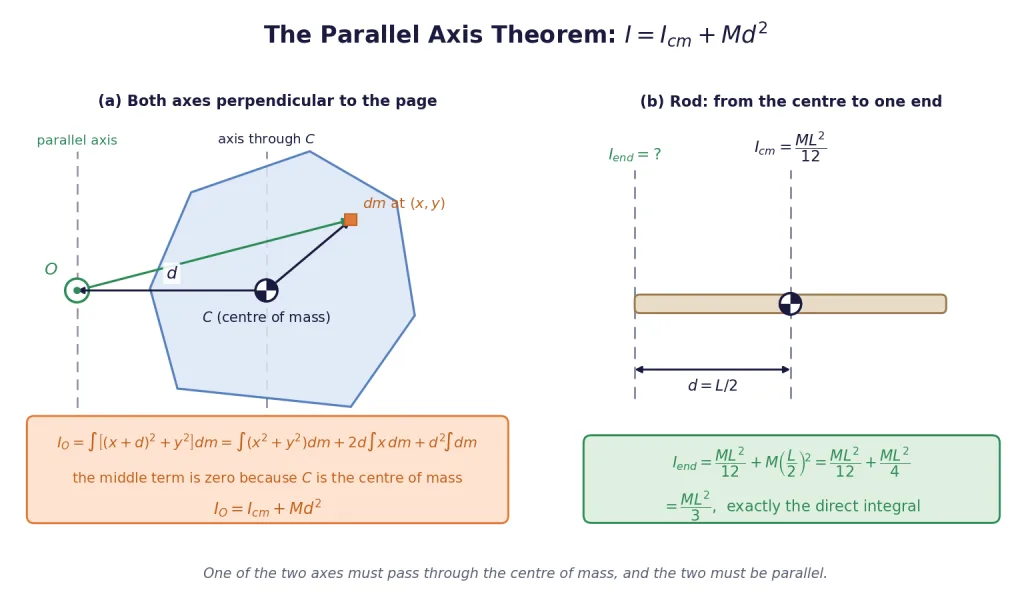
Key Point — the parallel axis theorem: The moment of inertia of a body about any axis equals its moment of inertia about a parallel axis through the centre of mass, plus the total mass times the square of the distance between the two axes: Here is the perpendicular distance between the two parallel axes.
The proof
Set up coordinates with the origin at the centre of mass and both axes perpendicular to the page, one through and one through a point a distance away along the -direction. An element sits at relative to , so its distance from the -axis satisfies
Integrate term by term:
Now read the three pieces:
- , by definition.
- , because the origin is the centre of mass — that is precisely what "centre of mass" means, from Section 2.
- .
The middle term dying is the entire content of the theorem, and it dies only because one axis passes through the centre of mass.
Two consequences worth stating
Key Point: Since is never negative, is smallest about an axis through the centre of mass, among all axes in a given direction. Moving the axis away from the centre of mass can only increase , and it does so quadratically.
And a warning that costs marks every year:
Key Point: One of the two axes must pass through the centre of mass. You cannot hop from any axis to any other parallel axis by adding . To go from one end of a rod to the other end, you must go via the centre: . Adding to gives , which is simply wrong.
Application 1: a rod about one end
Exactly the value the direct integration gave, which is a satisfying independent check of both.
Application 2: a ring about a tangent perpendicular to its plane
The axis is parallel to the central perpendicular axis, and :
Application 3: a disc about a perpendicular axis through a point on its rim
Application 4: a solid sphere about a tangent line
Application 5: an off-centre axis that is not a tangent
A disc of mass 4 kg and radius 0.3 m, about a perpendicular axis 0.12 m from the centre:
Nothing special about tangents — any will do.
[JEE Tip] When a problem says "about an axis through one end", "about a tangent", "about an edge" or "through a point on the rim", it is asking for the parallel axis theorem. Identify first, then , and be careful that is the distance between the axes, not between two points.
Using Both Theorems Together
Some of the standard results need one theorem and then the other. The order matters, and the trick is always the same: use the perpendicular axis theorem to change the direction of the axis, and the parallel axis theorem to change its position.
The model calculation: a disc about a tangent in its own plane
Step 1 — perpendicular axis theorem, to get from the central perpendicular axis to a diameter:
Step 2 — parallel axis theorem, to slide that diameter out to the tangent, a distance away:
Do it the other way round and you get nonsense, because after the parallel-axis step you no longer have an axis through the centre of mass to apply the perpendicular-axis theorem to.
The results these two theorems generate
| Body and axis | Route | |
|---|---|---|
| ring, about a diameter | perpendicular axes | |
| ring, tangent in its plane | perpendicular, then parallel | |
| ring, tangent perpendicular to its plane | parallel axes | |
| disc, about a diameter | perpendicular axes | |
| disc, tangent in its plane | perpendicular, then parallel | |
| disc, perpendicular axis through a rim point | parallel axes | |
| rod, perpendicular axis at one end | parallel axes | |
| solid sphere, about a tangent | parallel axes | |
| hollow sphere, about a tangent | parallel axes |
Bodies made of several pieces
Key Point — additivity: Moments of inertia about the same axis simply add. For a composite body, and for a body with a piece removed, treat the missing piece as negative mass: Every term must be taken about the same axis, so you will usually need the parallel axis theorem to bring each piece to that axis first.
This is exactly the negative-mass trick you used for the centre of mass in Section 2, and it works for the same reason.
The checklist to run in an exam
- Name the axis. Write it down in words before you write any symbols.
- Is the body flat? If yes, the perpendicular axis theorem is available.
- Does the axis pass through the centre of mass? If not, you will need the parallel axis theorem, and you need about a parallel axis first.
- Is the body made of pieces? Compute each about the required axis and add.
- Sanity-check the size. must come out somewhere between and , where is the greatest distance of any part of the body from the axis. And about a centre-of-mass axis must be the smallest among parallel axes.
The mistakes, collected
- Using the distance from a point rather than from the axis.
- Applying the perpendicular axis theorem to a sphere, cylinder or cube.
- Applying the parallel axis theorem between two axes when neither passes through the centre of mass.
- Forgetting that a diameter of a disc () is not a diameter of a ring ().
- Adding moments of inertia taken about different axes.
- Using with a belonging to a different axis.
[Board Important] "State and prove the theorem of parallel axes" and "State and prove the theorem of perpendicular axes" are both standard three-mark derivations. The proofs are in the two blocks above; each is three or four lines and needs a labelled diagram.
Solved Examples
No problem in this section needs the value of .
Example 1: Four masses, three axes
Masses of 1 kg, 2 kg, 3 kg and 4 kg are fixed at the corners , , , of a square of side 1.0 m, joined by a light rigid frame. Find the moment of inertia about (a) an axis through the centre perpendicular to the square, (b) the side , (c) the diagonal .
Solution:
Put at , at , at and at , with masses 1, 2, 3, 4 kg in that order.
(a) Central perpendicular axis. Every corner is the same distance from the centre :
(b) Axis along the side . This axis is the -axis, so the distance of each mass from it is its -coordinate. The 1 kg and 2 kg masses lie on the axis and contribute nothing:
(c) Axis along the diagonal . The 1 kg and 3 kg masses sit on this axis and contribute nothing. The perpendicular distance of (and of ) from the line is
Final Answer: (a) 5 kg m, (b) 7 kg m, (c) 3 kg m.
Takeaway: Same body, three axes, three answers. A mass sitting on the axis contributes nothing at all, however heavy it is — which is exactly why the diagonal gives the smallest value here. [JEE Tip] Always identify which masses lie on the axis first; they cost you no work.
Example 2: A ring, four ways
A thin circular ring has mass 2 kg and radius 0.5 m. Find its moment of inertia about (a) the central axis perpendicular to its plane, (b) a diameter, (c) a tangent lying in its plane, (d) a tangent perpendicular to its plane.
Solution:
(a) Central perpendicular axis. Every element is at distance :
(b) A diameter — perpendicular axis theorem. Two perpendicular diameters give equal contributions:
(c) A tangent in the plane — now slide the diameter out by using parallel axes: In symbols, .
(d) A tangent perpendicular to the plane — parallel axes from the central perpendicular axis: In symbols, .
Final Answer: (a) 0.5, (b) 0.25, (c) 0.75, (d) 1.0, all in kg m.
Takeaway: Perpendicular axes change the direction of the axis; parallel axes change its position. Part (c) needed both, in that order. Note the ordering of the four answers — the further the axis is from the mass, the bigger gets.
Example 3: A rod, and what moving the axis costs
A thin uniform rod has mass 3 kg and length 1.2 m. Find its moment of inertia about a perpendicular axis through (a) its centre, (b) one end, (c) a point one quarter of the length from the centre. Find the ratio of (b) to (a).
Solution:
(a) About the centre.
(b) About one end, where m: which is , as the direct integration also gives.
(c) About an axis m from the centre.
The ratio.
Final Answer: (a) 0.36, (b) 1.44, (c) 0.63 kg m; the end value is exactly 4 times the central one.
Takeaway: The factor of 4 is universal for a rod — it comes from and holds whatever the mass and length. [NEET Important] The centre gives the smallest possible value, as the parallel axis theorem guarantees, and grows quadratically as you move the axis away.
Example 4: A disc, five axes
A uniform disc has mass 4 kg and radius 0.3 m. Find its moment of inertia about (a) the central axis perpendicular to the disc, (b) a diameter, (c) a perpendicular axis through a point on the rim, (d) a tangent lying in the plane of the disc, (e) a perpendicular axis 0.12 m from the centre.
Solution:
(a) Central perpendicular axis.
(b) A diameter, by the perpendicular axis theorem.
(c) Perpendicular axis at the rim, parallel to the central perpendicular axis with m:
(d) Tangent in the plane — start from the diameter, which is parallel to it, and shift by :
(e) Perpendicular axis 0.12 m off centre.
Final Answer: (a) 0.18, (b) 0.09, (c) 0.54, (d) 0.45, (e) 0.2376 kg m.
Takeaway: Parts (c) and (d) look alike and are not. Both are "tangents", but one is perpendicular to the disc and one lies in its plane, so they start from different values, 0.18 and 0.09. [JEE Tip] Draw the axis before you compute; the words alone will trick you.
Example 5: Radius of gyration, four bodies
(a) A flywheel is a uniform disc of mass 40 kg and radius 0.5 m. Find its moment of inertia about its central axis and its radius of gyration. (b) Find the radius of gyration of a 1.2 m rod of mass 3 kg about a perpendicular axis through its centre, and about one end. (c) Find the radius of gyration of a ring of radius 0.5 m about its central axis.
Solution:
(a) The flywheel. Equivalently m, since always gives .
(b) The rod about its centre, using kg m from the previous example:
The same rod about one end, with kg m: Twice the previous value — as it must be, since went up by a factor of 4 and goes as .
(c) The ring. Every element really is at , so The ring is the one body whose radius of gyration about its central axis is exactly its radius.
Final Answer: (a) 5 kg m and 0.354 m; (b) 0.346 m and 0.693 m; (c) 0.5 m.
Takeaway: depends on the axis, exactly as does — the same rod gives 0.346 m and 0.693 m. And is a pure shape number: doubling the flywheel's mass leaves at 0.354 m while doubles.
Example 6: A rod bent into a ring
A thin uniform rod of mass 1.2 kg and length 1.885 m is bent into a circular ring. Find the moment of inertia of the ring about its central axis perpendicular to its plane, and compare it with the moment of inertia of the straight rod about a perpendicular axis through its centre.
Solution:
Find the radius. Bending conserves the length, which becomes the circumference:
The ring.
The straight rod, for comparison.
The ratio, in symbols. Substituting :
Final Answer: kg m, about 3.29 times smaller than the straight rod's 0.355 kg m.
Takeaway: Bending the rod pulls its mass inward. The far ends of a straight rod are 0.94 m from the axis; once bent, no part of it is further than 0.30 m. The mass is unchanged, the moment of inertia drops by a factor of . [JEE Tip] In any "bent into" problem the first line is always "the length is conserved".
Example 7: A rectangular plate, and a test of the perpendicular axis theorem
A uniform rectangular plate has mass 2 kg, length 0.4 m and breadth 0.3 m. Find its moment of inertia about (a) a central axis in its plane parallel to the length, (b) a central axis in its plane parallel to the breadth, (c) the central axis perpendicular to the plate. Check the perpendicular axis theorem.
Solution:
(a) About the axis parallel to the length. Along this axis the plate behaves like a rod of length equal to the breadth, since the breadth is the only dimension measured away from the axis:
(b) About the axis parallel to the breadth, now the length is what counts:
(c) The central perpendicular axis, from the standard result:
The check.
Final Answer: (a) 0.015, (b) 0.0267, (c) 0.0417 kg m; and the theorem holds exactly.
Takeaway: The perpendicular axis theorem is where the formula comes from — it is simply the sum of two rod-like results. Note which dimension goes with which axis: the one measured away from the axis is the one that appears.
Example 8: A dumbbell, done honestly
A dumbbell is made of a uniform rod of mass 2 kg and length 1.0 m with a solid sphere of mass 0.5 kg and radius 0.1 m fixed at each end, so that each sphere touches the end of the rod. Find the moment of inertia about a perpendicular axis through the centre of the rod, and the radius of gyration. How much error would treating the spheres as point masses cause?
Solution:
The rod.
Locate each sphere's centre. The rod end is 0.5 m from the axis and the sphere's centre is a further m out:
Each sphere, by the parallel axis theorem. A sphere's own moment of inertia about a diameter is :
Add all three pieces about the same axis.
Radius of gyration, with total mass kg:
The point-mass approximation. Dropping the terms gives kg m, low by 0.75%.
Final Answer: kg m, m; the point-mass approximation is 0.75% low.
Takeaway: Add moments of inertia only about the same axis, and bring every piece to that axis with the parallel axis theorem first. The 0.75% tells you when the point-mass shortcut is safe: whenever the body's own size is small compared with its distance from the axis.
Example 9: A square plate about a diagonal
A uniform square plate has mass 1.5 kg and side 0.4 m. Find its moment of inertia about (a) the central axis perpendicular to the plate, (b) a central axis in its plane parallel to one side, (c) a diagonal.
Solution:
(a) The central perpendicular axis. With :
(b) A central axis parallel to a side.
(c) A diagonal. The two diagonals are perpendicular to each other, lie in the plane, and meet the -axis at the centre, so the perpendicular axis theorem applies to them just as well as to the sides. By symmetry the two diagonals give equal values:
Read the result. Parts (b) and (c) are equal. For a square lamina every axis in its plane through the centre gives the same moment of inertia, , whatever its direction.
Final Answer: (a) 0.04 kg m, (b) 0.02 kg m, (c) 0.02 kg m.
Takeaway: The perpendicular axis theorem does not care which perpendicular pair you pick, so long as both lie in the plane and both pass through the same point. Choosing the diagonals instead of the sides is what makes part (c) a one-liner.
Example 10: Working the parallel axis theorem backwards
A rigid body of mass 4 kg has a moment of inertia of 0.60 kg m about an axis that is 0.30 m away from, and parallel to, an axis through its centre of mass. Find (a) its moment of inertia about the centre-of-mass axis, (b) its radius of gyration about that axis, and (c) its moment of inertia about a parallel axis 0.50 m from the centre of mass.
Solution:
(a) Rearrange the theorem.
(b) Radius of gyration about the centre-of-mass axis.
(c) Now go outward again, from the centre-of-mass axis, not from the 0.30 m axis:
The wrong route, for contrast. Adding to the given 0.60 gives 0.76 kg m, which is simply wrong — the theorem cannot be used between two axes when neither passes through the centre of mass.
Final Answer: (a) 0.24 kg m, (b) 0.245 m, (c) 1.24 kg m.
Takeaway: Always route through the centre of mass. Come back to first, then go out to wherever you need. [JEE Tip] This backwards form is a favourite: you are given about some off-centre axis and asked for another, and the only safe path is via .
Example 11: A solid sphere and a hollow one
A solid sphere has mass 5 kg and radius 0.2 m. Find its moment of inertia (a) about a diameter and (b) about a tangent line. (c) Compare with a thin spherical shell of the same mass and radius, about a diameter, and explain the difference.
Solution:
(a) About a diameter.
(b) About a tangent. A tangent line is parallel to a diameter, at a distance :
(c) The thin shell.
Why the shell wins. Both have the same mass and the same outer radius, but the solid sphere keeps a great deal of its mass close to the centre, where it contributes almost nothing to , while every gram of the shell sits at the full distance . The ratio is .
Final Answer: (a) 0.08 kg m, (b) 0.28 kg m, (c) 0.133 kg m for the shell, about 1.67 times the solid sphere's value.
Takeaway: What matters is where the mass is, not how much there is in total. This single fact decides every "which rolls down faster" race in Section 11 — the body with the smaller wins, and the solid sphere, at , beats everything else.
Example 12: A disc with a hole punched in it
A uniform disc of mass 8 kg and radius 0.4 m has a circular hole of radius punched out of it, the centre of the hole lying at a distance from the centre of the disc. Find the moment of inertia of what remains, about the original central axis perpendicular to the disc, and its radius of gyration.
Solution:
Find the mass punched out. The surface density is uniform, so mass goes as area: so the remaining mass is kg.
The full disc, about the central axis:
The punched-out piece, about the same axis. It is a disc of mass 2 kg and radius 0.2 m whose centre is 0.2 m from the axis, so it needs the parallel axis theorem:
Subtract — the negative-mass method. In symbols this is , with the mass of the original full disc.
Radius of gyration, using the mass that is actually left:
Final Answer: kg m about the original central axis, with a radius of gyration of 0.294 m.
Takeaway: Treat the hole as negative mass, but take its moment of inertia about the same axis as everything else — which means the parallel axis theorem, because the hole is off-centre. [NEET Important] In the final , is the remaining 6 kg, not the original 8 kg. Using the wrong mass here is the standard trap.