
How to Use This Section
This is the last section of the chapter, and it is built for one job: to be read the night before the paper, and again in the queue outside the hall.
Nothing new is taught here. Every card below is a compression of something Sections 1 to 16 worked through properly, in the same notation and with the same results. So if a line here surprises you, that is not a line to memorise — it is a signal to go back and reread the section that owns it.
Ten formula cards, one mistake checklist, one 60-second panic list, one fast self-test. Screenshot the three figures.
Three notation reminders.
- is the centre of mass. Plenty of coaching material writes for exactly the same thing. Read both without blinking.
- is the angular momentum of a system, the angular momentum of a single particle. is the moment of inertia, the radius of gyration, the torque, the angular acceleration.
- Where a card puts a number on the page it uses m/s, because that is what makes the arithmetic land cleanly. Some worked examples elsewhere use 9.8 m/s; the difference is about 2%, which is enough to move you between two adjacent options in a multiple-choice paper. Never mix the two inside one problem.
Two of the topics below — the axis theorems and rolling motion — sit outside the rationalised syllabus body text but are asked in JEE Main, JEE Advanced and NEET every year, so they are on these cards in full.
Card 1 — Centre of Mass, and How It Moves
The definition, in three forms
Key Point: In every case it is a mass-weighted average of position. The centre of mass is a point, measured in metres — never a mass.
Two consequences that get asked directly:
- The inverse-ratio rule. For two particles, , so the centre of mass lies on the line joining them, always between them, and always nearer the heavier one.
- The balance identity. Measured from the centre of mass itself, and . That single fact is what kills the middle term in the parallel axis theorem later.
The symmetry shortcut, and the standard positions
Key Point: For a body of uniform density, the centre of mass sits at the geometric centre, and if the body has an axis or a plane of symmetry it lies on it. It does not have to lie inside the material of the body.
| Body | Centre of mass |
|---|---|
| uniform rod, length | the midpoint |
| uniform ring or hollow sphere | the geometric centre, where there is no material at all |
| uniform disc, solid sphere, cylinder | the geometric centre |
| triangular lamina | the centroid, at above the base |
| semicircular wire, radius | from the centre |
| semicircular lamina, radius | from the centre |
| solid hemisphere, radius | from the flat face |
| solid cone, height | above the base |
Cavities: the negative-mass trick
Cut a piece out of a body and treat the missing piece as a negative mass sitting where it used to be:
The same trick works for moment of inertia, and for the same reason.
How the centre of mass moves
Key Point — the result that makes the idea useful: Internal forces cancel in action-reaction pairs, so the centre of mass accelerates as though all the mass sat there and every external force acted there — no matter how violent the internal motion is.
Key Point — conservation of linear momentum: If , then is constant and is constant. A shell exploding in flight scatters fragments everywhere, and its centre of mass sails on along the original parabola as if nothing had happened — because gravity, the only external force, has not changed.
[NEET Important] Two people on frictionless ice pulling a rope always meet at their centre of mass, which never moves. The lighter one covers the greater distance, in the inverse ratio of the masses.
Card 2 — The Vector Product
The definition
Key Point: Magnitude , direction perpendicular to the plane containing and , sense given by the right-hand rule. Take as the smaller angle, so and . The result is a VECTOR.
The properties
| Property | Statement | Read it as |
|---|---|---|
| anticommutative | order matters, unlike the dot product | |
| a vector with itself | and for any parallel pair | |
| distributive | you may multiply out brackets | |
| perpendicularity test | the answer is at right angles to both inputs | |
| maximum and minimum | at , zero at or | exactly the opposite of the dot product |
The unit vectors and the determinant
Write round a circle: forward round the wheel is plus the third, backwards is minus.
Key Point — the form you should actually use: Note the middle term's order: it is , not . That flipped sign is the single most expensive slip in this topic. Check every answer by dotting it with both inputs — you must get zero twice.
Geometry, and the contrast with the dot product
and a triple product vanishes exactly when the three vectors are coplanar.
| scalar (dot) product | vector (cross) product | |
|---|---|---|
| result | a scalar | a vector |
| formula | along | |
| order | ||
| zero when | the vectors are perpendicular | the vectors are parallel |
| maximum when | parallel | perpendicular |
| in this chapter | work, power | torque, angular momentum, |
Card 3 — Angular Velocity and the Link to Linear Motion
Key Point: lies along the axis of rotation, its sense fixed by curling the right hand the way the body turns. Its unit is rad/s and its dimension is ; is in rad/s with dimension .
Read properly. Every particle of a rotating rigid body shares the same , but each has its own , growing linearly with distance from the axis. A point on the axis has ; the rim moves fastest.
Key Point: In magnitude, where is the perpendicular distance from the axis, not the distance from the origin. Drop every component of that lies along the axis before you take its length.
The angular-to-linear dictionary for one point
| Angular | Linear, at perpendicular distance |
|---|---|
| angle turned (rad) | arc |
| angular velocity | speed |
| angular acceleration | tangential acceleration |
| — | centripetal acceleration |
| — | total |
changes the size of the velocity; changes its direction. In uniform circular motion , so and only survives.
Conversions you will need at speed
[JEE Tip] Revolutions and rpm are the commonest trap in every rotation numerical. Convert on their own line, before anything else: 300 rpm is rad/s, and 20 revolutions is rad.
Card 4 — Torque and Angular Momentum
Torque, the moment of a force
Key Point: One number, three routes — use whichever the data hands you. is the perpendicular distance from the chosen point to the line of action of the force. The unit is the newton metre (N m).
Key Point — the unit trap: torque has the dimensions of energy, , but it is not energy. Never write the unit of torque as a joule. Work is a scalar built from a dot product; torque is a vector built from a cross product.
if , or if , or if or — that is, whenever the line of action passes through the point you are taking moments about. A force aimed at the pivot cannot turn anything about it.
Torque is always about a point or an axis. Say which, before you write a number.
Angular momentum
Key Point: a vector, unit kg m/s (equivalently J s), dimension . For a system, .
The rotational Newton's second law
Internal torques cancel in pairs provided the internal forces act along the lines joining the particles, which is why only external torques survive.
Key Point — conservation of angular momentum: If then is constant in magnitude and direction. Component by component: if then is constant, even when the other components are not.
[JEE Tip] can be conserved while is not, and the other way round. A planet orbiting the Sun has a constantly changing but a rigorously constant , because the gravitational pull is central — it acts along , so . That is where Kepler's law of equal areas comes from: the areal velocity is .
Card 5 — Equilibrium, the Principle of Moments and Centre of Gravity
The two conditions
Key Point: A rigid body is in mechanical equilibrium when both of these hold: Either one alone is not enough. For coplanar forces this is three scalar equations: , , .
Two facts that save time in the exam:
- If the net force is zero, the net torque is the same about every point. So you may take moments wherever you like, and you should.
- Choose the pivot through which the most unknowns pass. Their moment arms are zero, so they vanish from the equation and what is left often has a single unknown in it.
Partial equilibrium is when one condition holds and the other does not. A couple — two equal and opposite forces on different lines of action, a distance apart — has zero resultant force but a moment that is the same about every point. It gives rotation without translation.
The principle of moments
Key Point: For a lever in equilibrium about its fulcrum, and the mechanical advantage is a pure number with no units. A long effort arm buys force and costs distance; energy is never created.
Centre of gravity
Key Point: The centre of gravity is the point through which the total weight of the body acts, so that the net gravitational torque about it is zero. In a uniform gravitational field it coincides exactly with the centre of mass. They separate only for a body large enough for to vary across it.
That is why balancing a lamina on a fingertip locates its centre of mass: the body settles where the weight has no moment about the support.
[Board Important] The standard three-mark problems all come from these two equations: a bar on two knife-edges, a ladder leaning on a smooth wall, a loaded axle, a see-saw. The method never changes — draw the free body diagram, resolve twice, take moments once about the smartest point.
Card 6 — Moment of Inertia, the Standard Table and Both Axis Theorems
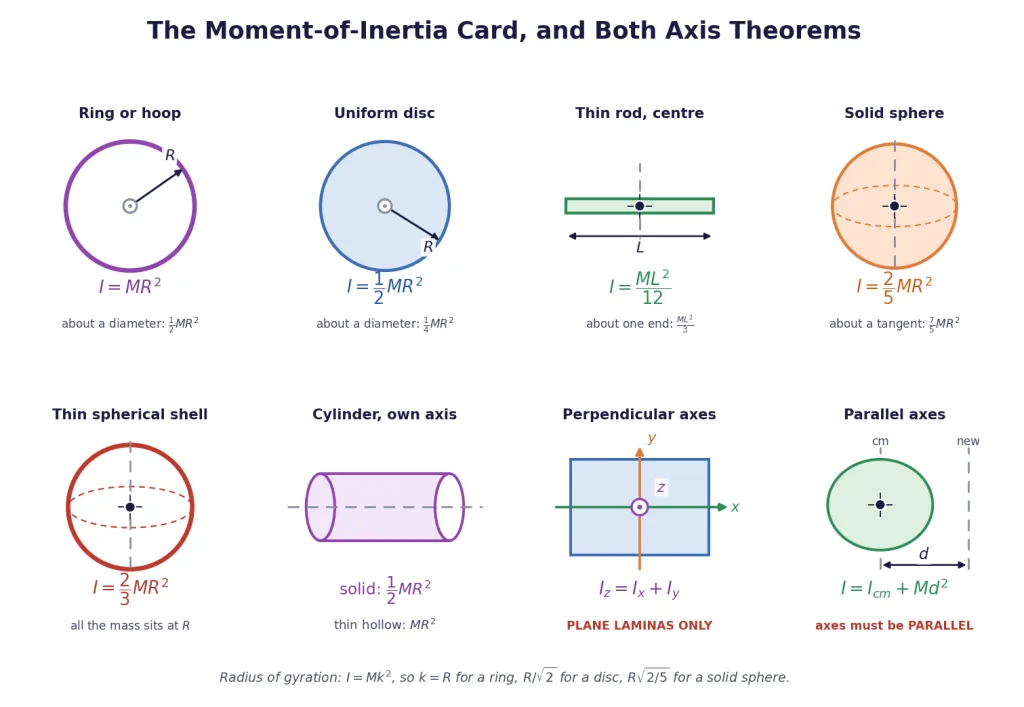
The definition
Key Point: where is the perpendicular distance from the axis of rotation. Unit kg m, dimension , and it is a scalar for a fixed axis.
Key Point — the sentence that costs the most marks: is not a property of the body alone. It belongs to the body and the axis together. "The moment of inertia of a disc is " is an incomplete statement: it is about the central axis perpendicular to the disc, and about a diameter. A particle sitting on the axis contributes nothing, however heavy.
The table — learn this column by column
is the total mass throughout, and is the radius of gyration.
| Body | Axis | (or ) | |
|---|---|---|---|
| thin ring / hoop, radius | central, perpendicular to its plane | ||
| thin ring, radius | any diameter | ||
| uniform disc, radius | central, perpendicular to the disc | ||
| uniform disc, radius | any diameter | ||
| thin rod, length | perpendicular, through the centre | ||
| thin rod, length | perpendicular, through one end | ||
| hollow (thin) cylinder, radius | its own axis | ||
| solid cylinder, radius | its own axis | ||
| solid sphere, radius | any diameter | ||
| thin spherical shell, radius | any diameter | ||
| rectangular lamina, sides and | central, perpendicular to it | — |
Read the patterns instead of memorising eleven separate lines:
- Mass further from the axis means a bigger . Ring beats disc; shell beats solid sphere. In each pair the hollow body has its mass out at the rim.
- Two shapes with the same profile about the axis give the same answer — ring and hollow cylinder both , disc and solid cylinder both . Four results for the price of two.
- The length of a cylinder never appears in about its own axis. A coin and a rolling pin of the same mass and radius are identical here.
- Rod about the end is four times rod about the centre.
Key Point — radius of gyration: , so — the distance at which the whole mass could sit as a single point without changing . It is a geometric property: aluminium and lead discs of the same radius have the same . It is the root-mean-square distance of the mass from the axis, not the mean distance and not the distance of the centre of mass.
The ratios worth having by heart: for a ring, for a disc, for a shell, for a solid sphere.
The theorem of perpendicular axes
Key Point: for a PLANE LAMINA only, with and two perpendicular axes in the plane and perpendicular to it, all three meeting at the same point. That point need not be the centre of mass.
It comes straight out of , which is only true when every element has — which is exactly why it fails for any solid body. Applied to a sphere it would demand , which is nonsense.
Its two famous outputs: a ring about a diameter, so ; and a disc about a diameter, so .
The theorem of parallel axes
Key Point: where is the perpendicular distance between the two parallel axes, and one of them must pass through the centre of mass. Holds for any body, flat or solid.
Since is never negative, is smallest about an axis through the centre of mass, among all parallel axes.
Key Point: You may not hop from any axis straight to any other parallel axis. To get from one end of a rod to the other you must go via the centre. Adding to is simply wrong.
What the two theorems generate
Use the perpendicular axis theorem to change the direction of the axis, and the parallel axis theorem to change its position — in that order.
| Body and axis | Route | |
|---|---|---|
| ring, tangent perpendicular to its plane | parallel axes | |
| ring, tangent in its plane | perpendicular, then parallel | |
| disc, perpendicular axis through a rim point | parallel axes | |
| disc, tangent in its plane | perpendicular, then parallel | |
| rod, perpendicular axis at one end | parallel axes | |
| solid sphere, about a tangent | parallel axes | |
| spherical shell, about a tangent | parallel axes |
And for a composite body, moments of inertia about the same axis simply add; for a body with a piece missing, subtract the piece as a negative mass. Bring every piece to the same axis first.
[NEET Important] "Which of these can the perpendicular axis theorem be used on?" — the answer is always the flat one: ring, disc, square plate, rectangular sheet. Never a sphere, cylinder, cone or cube.
Card 7 — Rotational Kinematics, Dynamics, and the Full Analogy
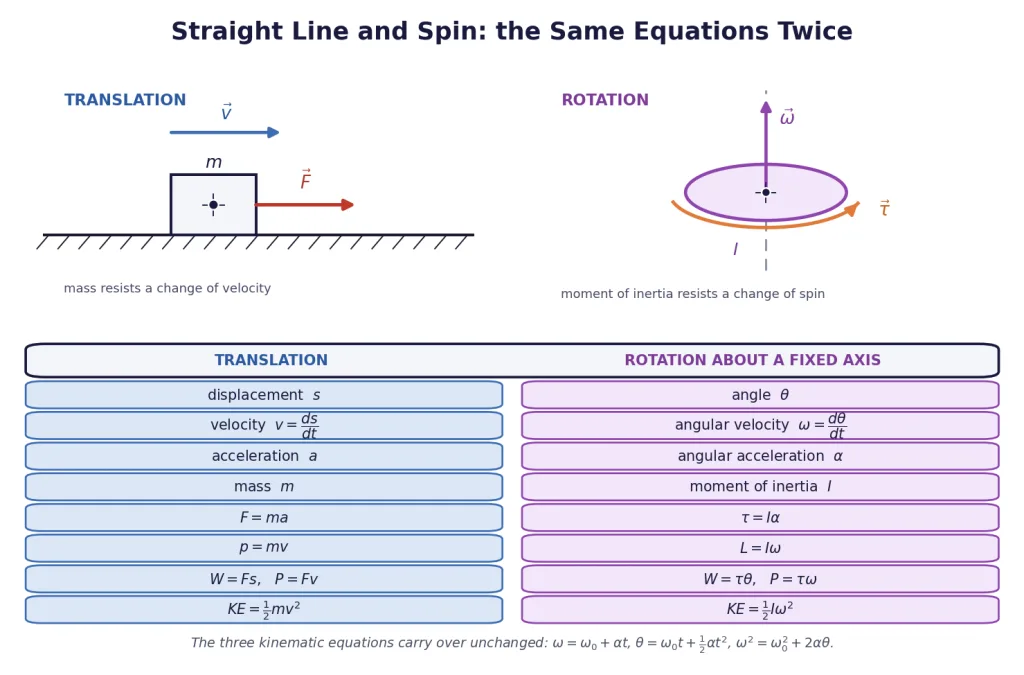
The three kinematic equations
Key Point — valid only for CONSTANT : These are not merely analogous to , and . They are the same equations with new names.
Two extra forms worth carrying:
the first for when you know both angular speeds and the time but not , the second for the angle turned during the th second alone. And the graph reading is the same as ever: on an - graph the slope is and the area is .
The dynamics
Key Point: with in general, and the work-energy theorem in rotational form: is the honest special case of , valid when does not change during the motion.
And for a body that is translating and rotating at once, the kinetic energy splits cleanly:
The dictionary — the whole chapter in one table
| Translation along a line | Rotation about a fixed axis |
|---|---|
| displacement (m) | angular displacement (rad) |
| velocity (m/s) | angular velocity (rad/s) |
| acceleration (m/s) | angular acceleration (rad/s) |
| mass (kg) | moment of inertia (kg m) |
| force (N) | torque (N m) |
| work , | work , |
| kinetic energy | kinetic energy |
| power | power |
| momentum | angular momentum |
| impulse | angular impulse |
| equilibrium: | equilibrium: |
Learn the left column properly and the right column costs you nothing.
The four places the analogy is NOT perfect
- Mass is a single number; is not. A body has one mass but a different about every axis.
- can change during the motion — a skater changes hers by a factor of two in half a second. Then is the wrong equation and is the right one.
- Torque and angular momentum need a reference point or axis; force and momentum do not.
- need not be parallel to , whereas is always parallel to .
[NEET Important] For equal mass and radius under the same torque, ranks them: the disc spins up twice as fast as the ring, and a solid sphere two and a half times as fast as the ring.
Card 8 — Angular Momentum About a Fixed Axis, and Its Conservation
Key Point: is the component of along the axis — the twin of .
Key Point — when is parallel to ? Only when the axis is an axis of symmetry of the body. Then and the two point the same way. For any other axis has a sideways component that sweeps round with the body, and the bearings have to supply the torque that keeps the axis in place. Never assume for a non-symmetric axis.
Conservation
Key Point: If the net external torque about the axis is zero, The body may change its own shape as much as it likes — internal forces cannot change . If falls, rises in exact proportion.
| Situation | What changes | Result |
|---|---|---|
| skater pulls her arms in | drops | rises; she spins faster |
| diver tucks | drops sharply | fast somersaults, then opens out to slow down |
| person on a turntable lowers dumbbells | drops | the turntable speeds up |
| merry-go-round takes on a passenger | rises | falls |
| a planet at perihelion | small | large; equal areas in equal times |
The energy question, which is asked every year
Key Point: When halves, doubles — and the kinetic energy doubles as well, since Angular momentum is conserved; kinetic energy is not. The extra energy is real work done by the skater's muscles as she drags her arms inwards against the outward push she feels. Nothing is created from nothing.
The same formula run the other way: when the merry-go-round picks up a passenger, rises, so the kinetic energy falls — and that lost energy goes into the friction of the passenger scrambling aboard.
[JEE Tip] For a merry-go-round or turntable taking on a rider, angular momentum about the axis is conserved but linear momentum is not — the axle supplies whatever external force it needs to.
Card 9 — Rolling Motion
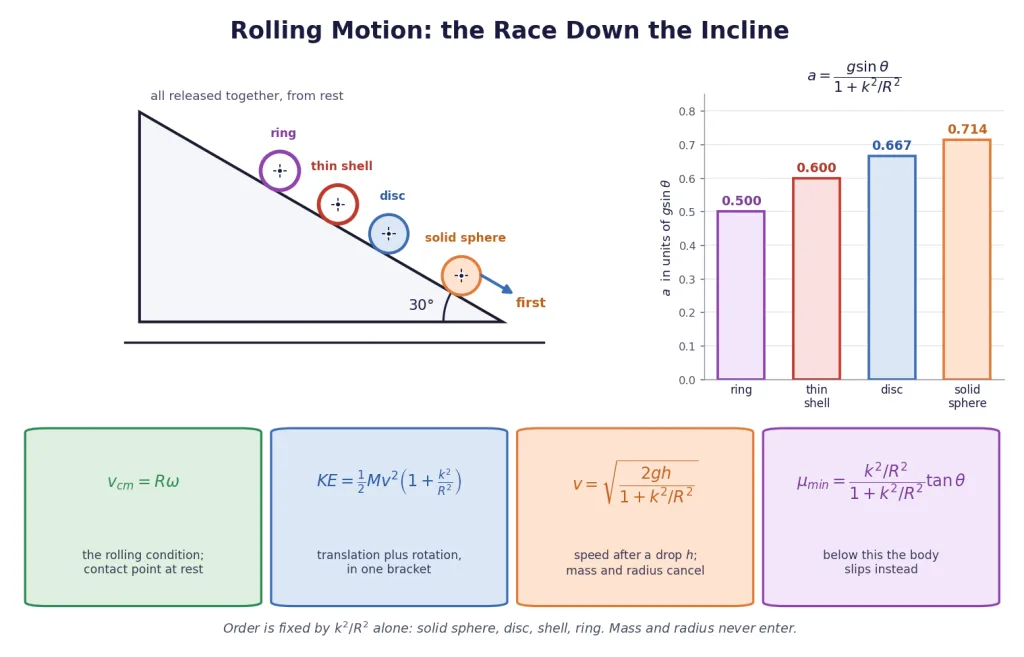
The condition, and where it comes from
Key Point: These are constraints, not laws — they follow from the surfaces not sliding on each other. They are what turn two unknowns into one.
Because of them, the contact point is instantaneously at rest: . Three consequences follow immediately.
- The friction acting is static, not kinetic. Its size is whatever the problem needs, up to — it is an unknown you solve for, exactly like a tension.
- Static friction in rolling does NO work, because the point it acts at is not moving: . Mechanical energy is therefore conserved in ideal rolling.
- Rolling may be treated as pure rotation about the contact point — the instantaneous axis.
Velocities on a rolling wheel
with measured round from the contact point. The fastest point of a rolling body is the top, at , and the ends of the horizontal diameter move at .
The energy split
Key Point: The bracket is a pure shape factor — no mass, no radius, no speed in it. And
On an incline
No and no anywhere in , in , or in . A marble and a bowling ball roll down together. And is the vertical drop, so if you are given a slope length , use first.
The race
Key Point — the race rule: The body with the smallest wins. The finishing order is always and a block on a smooth incline beats all four, because it has no spin to pay for.
| Body | rotational share of | after a drop | |||
|---|---|---|---|---|---|
| ring / hollow cylinder | |||||
| spherical shell | |||||
| disc / solid cylinder | |||||
| solid sphere |
[NEET Important] A disc and a solid cylinder are the same row twice — they tie. So do a ring and a hollow cylinder. If both appear in an option list, that is the point being tested.
[JEE Tip] On level ground a wheel rolling at constant speed needs no friction at all. And on an incline, friction acts up the slope whether the body is rolling down or rolling up.
Card 10 — The Mistakes That Cost the Most Marks
Every one of these was flagged somewhere in Sections 1 to 16. They are ordered roughly by how often they actually turn up in answer scripts.
1. Using about the wrong axis. The one that costs the most, by a distance. belongs to a body and an axis together. A disc has about the central perpendicular axis, about a diameter, about a perpendicular axis at the rim and about a tangent in its plane — four different numbers for one disc. Name the axis in words before you write any symbols.
2. Forgetting the axis theorems, or using them illegally. Three separate errors live here. Applying the perpendicular axis theorem to a solid body — it is for plane laminas only. Applying the parallel axis theorem between two axes when neither passes through the centre of mass — you must always route via the centre. And applying them in the wrong order: perpendicular first to change the axis direction, parallel second to change its position.
3. Assuming the centre of mass lies inside the material of the body. It need not. For a uniform ring it sits at the geometric centre, where there is no material at all; the same is true of a hollow sphere, a horseshoe and an L-shaped lamina. The centre of mass is a point in space, not a piece of the body.
4. Mixing up and . Every particle of a rotating rigid body has the same and its own . They are not interchangeable and they do not even have the same units — rad/s against m/s. In the is the perpendicular distance from the axis, not from the origin and not from the centre of mass.
5. Forgetting that static friction in rolling does no work. It acts at the contact point, and in rolling without slipping that point is instantaneously at rest, so the power it delivers is exactly zero. Mechanical energy is conserved for a body rolling down an incline. Students who "correct" for friction losses here throw the question away. The partner error is writing on an incline: static friction is an unknown you solve for, and only at the verge of slipping.
6. Assuming kinetic energy is conserved whenever angular momentum is. It is not. When the skater pulls her arms in, is constant but rises — it doubles when halves. When the merry-go-round takes on a passenger, is constant and falls. Write and then compute the two kinetic energies separately; never assume they match.
7. Treating as parallel to for a non-symmetric axis. always gives the component along the axis, but the full vector is along only if the axis is an axis of symmetry. This is the one place where the translation-rotation analogy genuinely breaks, since is always parallel to .
8. Writing the unit of torque as a joule. Torque has the dimensions of energy but is a completely different quantity — a vector from a cross product, not a scalar from a dot product. Write N m. The mirror error is giving angular momentum in kg m/s instead of kg m/s.
9. Forgetting the minus sign in , and getting the middle term of the determinant the wrong way round. It is . Check every cross product by dotting the answer with both inputs; you must get zero twice.
10. Not converting revolutions and rpm. , and in every formula are in radians. 300 rpm is rad/s; 20 revolutions is rad. Convert on its own line before you touch the kinematic equations.
11. Confusing with the speed of the top of a rolling wheel. The rolling condition uses the centre's speed. The topmost point moves at . If a question hands you "the topmost point moves at 12 m/s", then m/s.
12. Assuming a heavier or bigger body rolls down faster. It does not. , the speed at the bottom and depend only on and . Mass and radius cancel out of all three.
Key Point: Three more that cost single marks each — forgetting that in the rolling formula is the vertical drop and not the slope length; adding moments of inertia taken about different axes; and mixing with inside one problem. Pick one value of , write it at the top of your working, and use it everywhere.
The 60-Second Revision
You are in the queue outside the hall. This is the irreducible minimum.
Centre of mass. . Inverse ratio for two particles; geometric centre if uniform; may lie outside the body; cavities are negative mass. and , so with no external force the centre of mass never accelerates.
Cross product. along , right-hand rule, , zero for parallel vectors, determinant with rows then then , magnitude equals the parallelogram area.
Rotation kinematics. , , , . Constant : , , .
Torque and angular momentum. , , unit N m. , , unit kg m/s. , so zero torque means constant .
Equilibrium. and . Principle of moments , M.A. . Centre of gravity coincides with the centre of mass in a uniform field.
Moment of inertia. , units kg m, body plus axis together. Ring , disc , rod centre and end , solid sphere , shell , hollow cylinder , solid cylinder . . laminas only; one axis through the centre of mass.
Rotational dynamics. , , , , . Every straight-line formula with , , , , .
Conservation. when . , so halving doubles the kinetic energy. conserved does not mean conserved.
Rolling. , contact point at rest, static friction does no work, top point at . , , . Race order sphere, disc, shell, ring; mass and radius are irrelevant.
Habits. Name the axis. Convert rpm to rad/s. Decide energy or torques before writing. Check whether changes during the motion. Pick one value of and keep it.
The Fast Self-Test
Cover the answers. Twelve questions, four minutes. Anything you miss tells you which section to reopen tonight.
- Write the centre of mass of a system of particles, in one line.
- Where is the centre of mass of a uniform ring, and is there any material there?
- What is when the two vectors are parallel?
- In , from what is measured?
- Give the three equivalent expressions for the magnitude of a torque.
- What are the two conditions for a rigid body to be in mechanical equilibrium?
- State the moment of inertia of a rod about a perpendicular axis through one end, and about its centre.
- To which bodies may the perpendicular axis theorem be applied?
- Write the parallel axis theorem, and state the condition that makes it legal.
- A skater's moment of inertia halves. What happens to , and what happens to her kinetic energy?
- Why does static friction do no work on a body rolling without slipping?
- Rank a ring, a disc, a spherical shell and a solid sphere by the time they take to roll down the same incline.
Answers. 1. . 2. At the geometric centre, and there is no material there. 3. Zero. 4. From the axis of rotation, perpendicular to it. 5. , , . 6. and . 7. and — a factor of four. 8. Plane laminas only. 9. , with one of the two parallel axes passing through the centre of mass. 10. doubles and the kinetic energy doubles, the extra energy coming from her muscles. 11. Because it acts at the contact point, which is instantaneously at rest. 12. Solid sphere fastest, then disc, then shell, then ring slowest.
That is the whole chapter. Go and get the marks.