
How to Use This Problem Bank
Everything in this chapter now has to work together. A rolling-cylinder question is a moment-of-inertia question wearing a disguise; an exploding-shell question is a centre-of-mass question; a ladder question is a torque question. These 44 problems are arranged so that the early ones drill one idea each and the later ones need two or three at once.
Work them with a pen, not with your eyes. Cover the solution, try it, then compare — including the checks, because the checks are where the marks are lost.
The four questions to ask before you write anything
- What is the system? One particle, a rigid body, or a body plus something sitting on it?
- Which point or axis am I taking moments about? Choose it so that the forces you do not know pass straight through it and vanish.
- Is anything conserved? No external force gives you momentum; no external torque about a point gives you angular momentum about that point.
- Does the answer have the right units and the right size? A moment of inertia in kg m, an angular speed in rad/s, an answer that is bigger than the thing it came from is a mistake.
Key Point: Torque, angular momentum and moment of inertia are all defined about something. An answer that does not say "about which axis" or "about which point" is not an answer. Write the axis down before the number.
The standard moments of inertia used throughout
Everything below is about an axis through the centre of mass unless the row says otherwise. is the total mass, the radius, the length, the radius of gyration with .
| Body | Axis | ||
|---|---|---|---|
| Thin ring / hoop | through centre, perpendicular to plane | ||
| Thin ring | any diameter | — | |
| Disc / solid cylinder | central axis | ||
| Disc | any diameter | — | |
| Hollow cylinder (thin) | central axis | ||
| Solid sphere | any diameter | ||
| Spherical shell | any diameter | ||
| Thin rod, length | through centre, perpendicular | — | |
| Thin rod, length | through one end, perpendicular | — | |
| Rectangular plate, sides | through centre, perpendicular | — |
And the two theorems that move an axis for you:
A note on , and on notation
Each problem states the value of it uses in its own statement, and no problem mixes 9.8 and 10. Several problems need no at all. Position of the centre of mass is written or ; the two mean exactly the same thing. is the angular momentum of a whole system and that of a single particle.
[Board Important] Every solution below quotes the formula on its own line before substituting numbers into it. Do the same in the exam — a correct formula with an arithmetic slip still earns most of the marks, while a bare number earns none.
Solved Examples
Part 1: Locating the Centre of Mass, and the Vector Toolkit
Example 1: Three particles strung out along a line
Particles of mass 1 kg, 2 kg and 3 kg sit on the -axis at , m and m. Find the centre of mass. Then redo the calculation with the origin moved to the 2 kg particle, and show that the two answers describe the same physical point.
Solution:
Quote the definition.
Substitute, in the original frame.
Move the origin to the 2 kg particle. The new coordinates are m, 0 and 3 m:
Translate back. The new origin sits at m in the old frame, so the same point.
Sanity check. Most of the mass is bunched to the right, so the centre of mass must lie to the right of the middle particle at 2 m. It does.
Final Answer: The centre of mass is at m, and it is the same physical point whichever origin you choose.
Takeaway: The centre of mass is a point in space, not a number on a particular ruler. [JEE Tip] Put your origin on the heaviest particle or at a corner where several coordinates are zero — you will kill two or three terms before you start.
Example 2: Symmetric solids, and whether the centre of mass must lie inside
State where the centre of mass lies for a uniform sphere, a uniform solid cylinder, a uniform ring and a uniform cube. Then answer the question that always follows: must the centre of mass of a body lie inside the material of the body?
Solution:
The rule that does all four at once. For a body of uniform density, the centre of mass lies at the geometric centre, because every mass element has a partner directly opposite it that cancels its contribution.
Apply it.
Body Centre of mass Is it inside the material? Uniform sphere its centre yes Uniform solid cylinder mid-point of the axis yes Uniform ring its centre no Uniform cube intersection of the body diagonals yes The ring settles the question. All of a ring's mass sits on the rim, yet the centre of mass is at the middle of the hole, where there is nothing at all.
More cases of the same kind. A hollow sphere, a bangle, a horseshoe, a boomerang, a hollow pipe — in every one the centre of mass lies in empty space. A high jumper doing a Fosbury flop arches so much that her centre of mass passes under the bar while she goes over it.
Final Answer: All four lie at the geometric centre; and no, the centre of mass need not lie within the material of the body — a ring is the standard counter-example.
Takeaway: "Centre of mass" is a weighted average of positions, and an average need not be one of the things averaged. [NEET Important] This one-liner is asked almost verbatim: the centre of mass of a ring lies at its centre, which contains no mass.
Example 3: The centre of mass of a water molecule
In a water molecule each hydrogen nucleus sits 95.8 pm from the oxygen nucleus, and the angle between the two bonds is . Oxygen is 16 times as massive as hydrogen, and essentially all the mass of an atom is in its nucleus. Locate the centre of mass.
Solution:
Choose axes that exploit the symmetry. Put the oxygen nucleus at the origin and let the -axis run along the bisector of the bond angle. Each bond then makes an angle of with that bisector.
Coordinates of the two hydrogens.
The -coordinate of the centre of mass. The two hydrogens have equal masses at pm and pm, so by symmetry, exactly as it had to be.
The -coordinate. Take the hydrogen mass as 1 unit and the oxygen as 16:
Read the answer physically. The centre of mass lies on the bisector, 6.52 pm from the oxygen nucleus, displaced towards the hydrogens.
Final Answer: On the bond-angle bisector, 6.52 pm from the oxygen nucleus, on the hydrogen side.
Takeaway: With a heavy atom and two light ones, the centre of mass barely moves off the heavy nucleus — 6.52 pm out of a 95.8 pm bond is under 7%. [JEE Tip] Always align one axis with a symmetry line first. It turns a two-coordinate problem into a one-coordinate problem.
Example 4: A uniform wire bent into an L
A uniform wire is bent at right angles so that one arm is 0.60 m long and the other 0.80 m. Taking the corner as the origin with the arms along the - and -axes, find the centre of mass of the bent wire.
Solution:
Split it into two straight pieces. For a uniform wire the mass of a piece is proportional to its length, so take the masses as 0.60 and 0.80 in any convenient unit, giving a total of 1.40.
Locate each piece's own centre of mass. A uniform straight rod has its centre of mass at its midpoint:
Combine.
Distance from the corner.
Check the position makes sense. The longer arm lies along , so the centre of mass should sit closer to the -axis than to the -axis. It does: 0.129 across, 0.229 up.
Final Answer: At m, which is 0.262 m from the corner, in the empty space between the two arms.
Takeaway: A composite body is just a small discrete system whose "particles" are the pieces, each placed at its own centre of mass. [Board Important] Note again that the centre of mass is off the wire entirely — it sits in the air inside the elbow.
Example 5: A square plate with a circular hole punched in it
A uniform square plate of side 0.40 m has its centre at the origin. A circular hole of radius 0.10 m is punched out, the centre of the hole being 0.10 m from the centre of the plate along the -axis. Find the centre of mass of what is left.
Solution:
Use the negative-mass idea. Treat the intact plate as a full plate plus a disc of negative mass sitting where the hole is. Masses go as areas for a uniform sheet:
Write the combination with the hole carrying a minus sign.
Substitute. The full plate is centred at and the hole at m:
The -coordinate. Both the plate and the hole are centred on , so .
Read the sign. The centre of mass has moved 2.44 cm to the side away from the hole, which is what removing mass from the right-hand side must do.
Final Answer: At m, that is 2.44 cm from the plate's centre, on the side opposite the hole.
Takeaway: Cutting a hole shifts the centre of mass away from the hole, never towards it. [JEE Tip] The shift is — memorise that shape and you can do any cavity problem in one line.
Example 6: The centre of mass of a solid hemisphere, from scratch
Derive the position of the centre of mass of a uniform solid hemisphere of radius , and evaluate it for m.
Solution:
Set up. Put the flat face on the -plane with the curved surface above, centre of the flat face at the origin. By symmetry the centre of mass lies on the -axis, so only has to be found.
Choose the mass element. Slice the hemisphere into thin discs of thickness at height . The radius of such a disc is , so
Quote the definition and integrate the numerator.
The denominator is just the mass.
Divide.
Put the number in.
Final Answer: , which is 0.045 m for m.
Takeaway: for a solid hemisphere is worth memorising, alongside for a hemispherical shell and for a semicircular wire. [JEE Tip] The integration always follows the same three steps: pick a slice whose points all share the coordinate you are averaging, write , integrate.
Example 7: A cross product, and the trap in recovering the angle
Given and , find , the area of the parallelogram they span, a unit vector perpendicular to both, and the angle between them.
Solution:
Set up the determinant.
Expand.
Check it is perpendicular to both — this takes four seconds and catches sign errors:
Magnitude, which is the area of the parallelogram.
Unit vector perpendicular to both. and is equally valid — there are always two.
The angle, done carefully. With and , which alone gives either or . The dot product decides:
Final Answer: ; area 15.65 square units; ; .
Takeaway: The sine alone can never tell an acute angle from its obtuse partner. [JEE Tip] Get the angle from the dot product, and use the cross product only as a check that comes out right.
Example 8: A scalar triple product, a volume, and a test for coplanarity
For , and , evaluate and interpret it. Then decide whether , and are coplanar.
Solution:
Inner cross product first.
Now the dot product.
Interpret it. The scalar triple product is the signed volume of the parallelepiped with the three vectors as edges, so that volume is 28 cubic units. The positive sign says the three form a right-handed set.
Check by the single determinant, which is the faster route in an exam:
The coplanarity test. Three vectors are coplanar exactly when their scalar triple product vanishes: So yes, those three are coplanar — the box they would span has zero volume.
Final Answer: , a parallelepiped of volume 28 cubic units; and the second set of three vectors is coplanar.
Takeaway: A zero scalar triple product means "flat", a zero cross product means "parallel", a zero dot product means "perpendicular". [JEE Tip] Cyclic swaps leave the value alone, , so rearrange until the easiest cross product is on the inside.
Part 2: Angular Quantities, Torque and the First Equilibrium Problems
Example 9: From the speedometer to the wheel
A car travels at a steady 54 km/h on wheels of radius 0.35 m, which roll without slipping. Find (a) the angular speed of a wheel in rad/s and in rpm, (b) how many turns a wheel makes in 1 km, (c) the centripetal acceleration of a point on the tyre as seen from the wheel's centre, and (d) the angular retardation if the car is brought uniformly to rest in 5.0 s.
Solution:
Convert the speed first.
(a) Angular speed, from the rolling relation :
(b) Turns per kilometre. Each turn lays down one circumference:
(c) Centripetal acceleration of a tyre point about the centre. Cross-check with the other form: m/s. Agreed.
(d) Angular retardation. Uniform braking to rest in 5.0 s:
Final Answer: 42.86 rad/s, that is 409.3 rpm; 454.7 turns per kilometre; 642.9 m/s; and a retardation of 8.57 rad/s.
Takeaway: That 643 m/s is about 65 times — which is why a stone lodged in a tyre tread flies out so violently. [NEET Important] The conversion rpm is worth memorising as a single number.
Example 10: A torque in components, and the moment arm hiding in it
A force N acts at the point m measured from the origin. Find the torque about the origin, its magnitude, and the perpendicular distance from the origin to the line of action of the force.
Solution:
Quote the definition.
Expand the determinant.
Check perpendicularity both ways.
Magnitude.
Extract the moment arm. Since and N,
Final Answer: N m, of magnitude 23.04 N m; the line of action passes 3.74 m from the origin.
Takeaway: The two dot-product checks cost nothing and catch the single commonest error in this chapter — a sign lost in the middle term of the determinant. [JEE Tip] is how you get a perpendicular distance without any geometry at all.
Example 11: Three forces on a square plate
A square plate of side 2.0 m has its centre at the origin, so its corners are at m. Three forces act in the plane of the plate: 10 N along at the corner ; 15 N along at the corner ; and 20 N along at the corner . Find the net force and the net torque about the centre, and then the net torque about the corner .
Solution:
Net force, added component by component: It is not zero, which matters for the last part.
Torque about the centre. For forces in the -plane, only the -component survives, and
Apply it force by force.
Add. The minus sign means clockwise, seen from the side.
Now about the corner . Shift every position vector by :
Why the two differ. Shifting the reference point by changes the total torque by . Here , and N m, which is exactly .
Final Answer: Net force N; net torque N m about the centre and N m about the corner .
Takeaway: Net torque depends on the reference point unless the net force is zero — and when the net force is zero the system is a couple, whose moment is the same about every point. [JEE Tip] If a question gives you a torque without naming the point, look for a couple.
Example 12: The Earth's two angular momenta
Treat the Earth as a uniform sphere of mass kg and radius m, spinning once in 24 hours, and orbiting the Sun in a circle of radius m once in s. Find its spin angular momentum about its own axis and its orbital angular momentum about the Sun, and compare them.
Solution:
Spin: moment of inertia first.
Spin angular speed.
Spin angular momentum.
Orbit: treat the Earth as a point mass at distance , so :
Compare.
Final Answer: kg m/s and kg m/s; the orbital value is about 3.8 million times the spin value.
Takeaway: Angular momentum is dominated by how far the mass is from the axis, not by how fast the body spins — the Earth turns 365 times faster about its own axis, yet the orbit still wins by a factor of millions. [JEE Tip] Treating an orbiting body as a point mass, , is legitimate whenever the body is tiny compared with its orbit.
Example 13: A non-uniform bar hung from two slanting strings
A bar of weight and length 2.0 m hangs at rest from two light strings tied to its two ends. The left string makes with the vertical and the right string . The bar is not uniform. Find the distance of its centre of gravity from the left end, and the two tensions if the bar weighs 40 N. No value of is needed.
Solution:
Name the forces. Tension along the left string, along the right string, and the weight acting vertically down through the centre of gravity, a distance from the left end.
Horizontal equilibrium. The horizontal components of the two tensions must cancel:
Vertical equilibrium.
Solve the pair. From step 2, . Substituting,
Take moments about the left end, where acts and therefore drops out. The horizontal component of acts along the line of the bar, so its moment arm about the left end is zero too. Only the vertical component of and the weight survive:
Numbers for N.
Check. The left string is more nearly vertical, so it should carry more load — and it does, 32 N against 24 N. The centre of gravity must therefore lie nearer the left end: 0.72 m out of 2.0 m. Consistent.
Final Answer: m from the left end; N and N for a 40 N bar.
Takeaway: The weight cancels out of entirely — the geometry of the strings alone fixes where the centre of gravity is. [Board Important] Since , the two strings are perpendicular, and falls out in one line. Spotting that saves two minutes.
Example 14: The load a car puts on each of its wheels
A car of mass 1800 kg has its front and rear axles 1.8 m apart, and its centre of gravity lies 1.05 m behind the front axle on the line joining them. Find the force the level ground exerts on each front wheel and on each back wheel. Take m/s.
Solution:
Weight of the car.
Set up the two equilibrium conditions. Let be the total upward force on the front axle and that on the rear axle.
Take moments about the rear axle, which removes . The centre of gravity is m in front of the rear axle:
Back-substitute.
Split each axle between its two wheels, which is legitimate because the car is symmetric side to side:
Check. The centre of gravity is nearer the front axle (1.05 m against 0.75 m from the rear)… and yet the rear carries more. Look again: the load on an axle goes with the distance from the other axle, so being 1.05 m from the front means the front carries the smaller share. the wheel loads gives N. Correct.
Final Answer: 3675 N on each front wheel and 5145 N on each back wheel.
Takeaway: A support always carries a share proportional to the distance from the opposite support — the far support takes the larger load. [Board Important] This is the same principle-of-moments arithmetic as a see-saw; only the words change.
Example 15: Lifting a wheel over a kerb
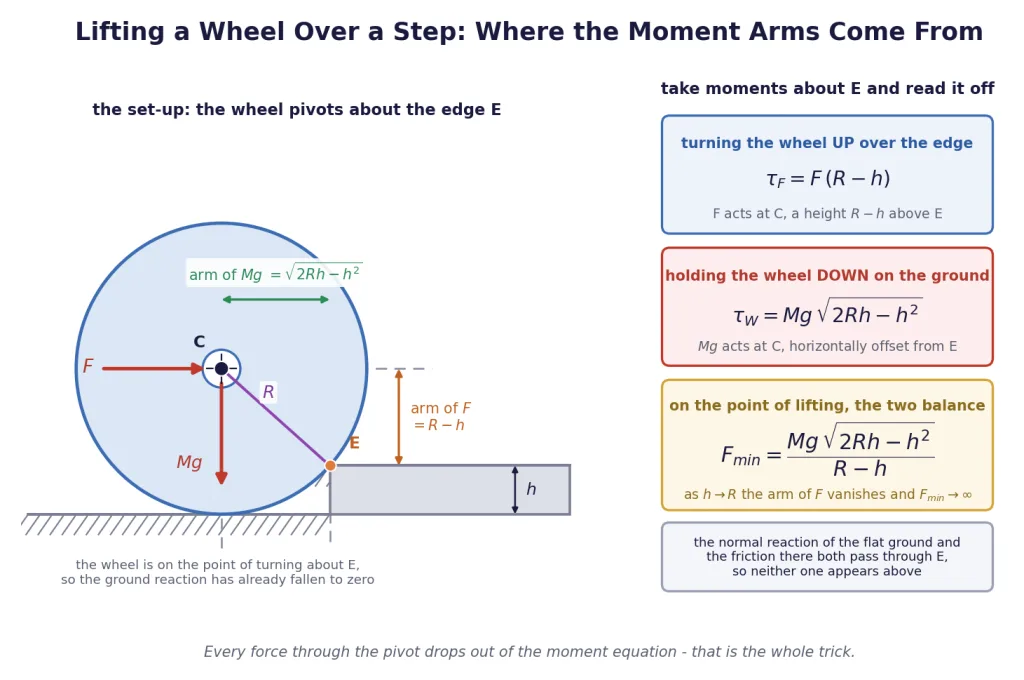
A wheel of radius 0.60 m and mass 20 kg rests on level ground against a step 0.20 m high. Find the least horizontal force, applied at the wheel's centre, that will just lift it onto the step. Take m/s.
Solution:
Identify the pivot. As the wheel begins to lift, it loses contact with the flat ground and turns about the edge of the step. Take moments about ; the ground's normal reaction and the friction there both pass through and disappear from the equation.
Moment arm of the weight. The centre is a horizontal distance from , where by Pythagoras on the right triangle with hypotenuse and vertical side :
Moment arm of the applied force. is horizontal and acts at , which is a height m above .
Balance the moments at the point of lifting.
Sanity check on the limit. If the step were as tall as the radius, , the arm of would shrink to zero and no horizontal force at the centre could ever lift the wheel. The formula agrees: the denominator goes to zero and .
Final Answer: About 224 N, which is more than the wheel's own weight of 200 N.
Takeaway: Choose the pivot so that the forces you do not know pass through it — here that killed two unknowns at once. [JEE Tip] If the same force is applied at the top of the wheel instead, its arm becomes and the force needed drops sharply. Questions love that comparison.
Example 16: A shopkeeper's balance with unequal arms
A shopkeeper's beam balance has arms of slightly different lengths. A packet placed in the left pan appears to weigh 9.0 kg; placed in the right pan the same packet appears to weigh 4.0 kg. Find the true mass of the packet and the ratio of the arm lengths. The beam itself is balanced when empty.
Solution:
Set up. Let the arms be (left) and (right), the true mass , and the two readings kg and kg.
First weighing — packet on the left, standard masses on the right. By the principle of moments,
Second weighing — packet on the right, standards on the left:
Multiply the two equations. The arm lengths cancel completely:
Substitute.
Arm ratio, by dividing the two equations instead of multiplying:
The trap. The arithmetic mean kg is not the answer, and it is always an offered option.
Final Answer: The true mass is 6.0 kg, and the left arm is 1.5 times the right arm.
Takeaway: The true value is the geometric mean of the two readings, , never the arithmetic mean. [NEET Important] Notice also that always, so a false balance of this kind always over-reads on average.
Part 3: Equilibrium Finished, and Moments of Inertia Built From Scratch
Example 17: How far can he walk before the plank tips?
A uniform plank of mass 30 kg and length 4.0 m rests on two supports: support at the left end, and support 1.0 m in from the right end. A boy of mass 50 kg starts at and walks to the right. Find (a) the reactions at the two supports when he stands at the middle of the plank, and (b) how far past he can walk before the plank tips. Take m/s.
Solution:
Set up coordinates. Measure from the left end. Then is at , is at m, the plank's weight of 300 N acts at m, and the boy's weight is 500 N.
(a) Moments about , with the boy at m, which removes :
Vertical equilibrium gives the other one.
(b) What "about to tip" means. The plank tips about the instant the reaction at falls to zero. Take moments about with . The plank's weight acts 1.0 m to the left of and holds it down; the boy, a distance to the right, lifts that end.
Solve.
State it usefully. He can walk 0.6 m past support , reaching a point 0.4 m short of the right-hand end.
Final Answer: N and N with the boy at the middle; he may walk 0.6 m beyond , that is up to m.
Takeaway: Toppling always begins the moment a reaction reaches zero, not the moment it becomes negative — a support can push, but it cannot pull. [JEE Tip] Set the reaction you are abandoning to zero, take moments about the other support, and the tipping condition falls out in one line.
Example 18: A ladder with someone standing on it
A uniform ladder of mass 20 kg and length 5.0 m leans against a smooth vertical wall, its foot resting on rough ground 3.0 m from the wall. A person of mass 60 kg stands on the ladder 4.0 m from its foot, measured along the ladder. Find the reaction of the wall, the friction at the floor, the normal reaction at the floor, and the least coefficient of friction that will keep the ladder from slipping. Take m/s.
Solution:
Get the geometry. Base 3.0 m, ladder 5.0 m, so the top rests up the wall. The ladder makes with the ground.
List the forces. Weight of ladder 200 N at its midpoint; weight of person 600 N; normal reaction and friction at the floor; and, because the wall is smooth, a purely horizontal reaction at the top.
Vertical equilibrium.
Horizontal equilibrium.
Moments about the foot, which removes both and at once. Convert distances along the ladder into horizontal distances by multiplying by :
Solve.
Least coefficient of friction. Slipping is prevented as long as :
Final Answer: N, N, and the floor must supply .
Takeaway: A smooth wall can only push horizontally, so the whole of the ladder's tendency to slip has to be met by friction at the floor. [Board Important] Distances measured along a ladder are not the moment arms. Project them onto the horizontal before you use them.
Example 19: A step ladder with a tie rope
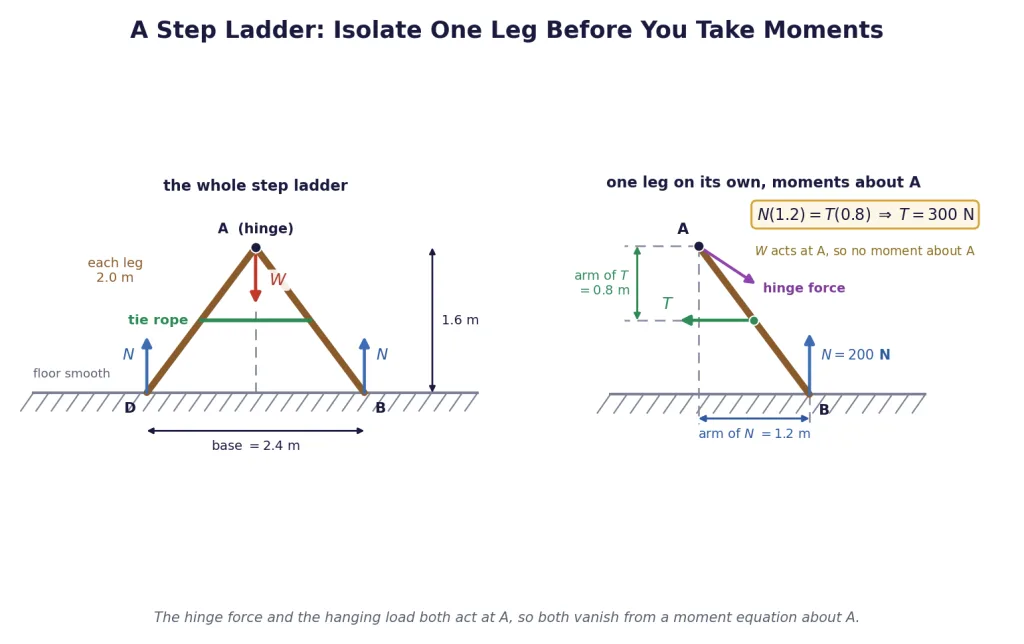
A step ladder is made of two light legs each 2.0 m long, hinged at the top and standing on a smooth floor with their feet 2.4 m apart. A rope joins the mid-points of the two legs. A load of 400 N hangs from the hinge at the top. Find the reaction under each foot, the tension in the rope, and the force at the hinge on one leg. Treat the legs as weightless.
Solution:
Geometry first. Each leg is 2.0 m long and reaches out 1.2 m horizontally, so the hinge stands above the floor. The rope joins the mid-points, which are 0.6 m out horizontally and 0.8 m up.
The whole ladder, by symmetry. The floor is smooth so it pushes straight up, and the two legs are identical:
Now isolate ONE leg — this is the step everyone skips, and the one that makes the problem solvable. The forces on the right-hand leg are: N up at its foot, the rope tension pulling inwards (horizontally, towards the other leg) at its mid-point, and whatever force the hinge transmits at the top.
Take moments about the hinge . The hinge force vanishes because it acts there, and the 400 N load vanishes too because it also hangs from . Measure moment arms about : the foot is 1.2 m horizontally from , and the mid-point of the leg is 0.8 m vertically below .
Solve for the tension.
The hinge force on this leg, from the equilibrium of the leg itself:
Final Answer: 200 N under each foot, a rope tension of 300 N, and a hinge force of magnitude 360.6 N on each leg (300 N horizontal, 200 N vertical).
Takeaway: A hinged structure is never solved as one object — cut it at the hinge and write the equilibrium of one piece. [JEE Tip] Take moments about the hinge and both the hinge reaction and any load hanging from the hinge vanish together, leaving one equation in one unknown.
Example 20: A rod, about an axis a quarter of the way along
A uniform rod of mass 3.0 kg and length 1.6 m is free to turn about an axis perpendicular to it, passing through a point 0.40 m from one end. Find its moment of inertia by direct integration, then confirm the result using the parallel axis theorem, and find the radius of gyration.
Solution:
Set up the integral. Measure along the rod from the end nearest the axis, so the axis is at . The linear mass density is and an element at position lies a distance from the axis.
Quote the definition and integrate. Substituting , the limits run from to :
Put the numbers in.
Independent confirmation by the parallel axis theorem. The axis is m from the centre of mass:
Radius of gyration.
Final Answer: kg m, and m.
Takeaway: Two completely different routes landing on 1.12 kg m is what a verified answer looks like. [JEE Tip] Note that m is larger than the distance from the axis to either end's midpoint — the radius of gyration is a root-mean-square distance, and squaring always favours the far mass.
Example 21: An annular disc, and both axis theorems on one body
A flat annulus (a washer) has inner radius 0.10 m, outer radius 0.20 m and mass 2.4 kg, uniformly distributed. Find its moment of inertia (a) about the central axis perpendicular to its plane, by integration, (b) about a diameter, and (c) about a tangent lying in its plane. Also find the radius of gyration for the central axis.
Solution:
(a) Set up the integration. The surface density is Take a thin ring of radius and width : every point on it is exactly from the axis, so
Integrate between the two radii. and since , this collapses to
Evaluate.
(b) About a diameter, by the perpendicular axis theorem. The annulus is flat, and by symmetry the two in-plane axes give the same value, :
(c) About a tangent in its plane, by the parallel axis theorem. That tangent is parallel to a diameter and m away from it:
Radius of gyration for the central axis. which sits between 0.10 m and 0.20 m, as it must.
Final Answer: 0.06 kg m about the central axis, 0.03 kg m about a diameter, 0.126 kg m about an in-plane tangent, and m.
Takeaway: The perpendicular axis theorem moves you from the face-on axis to an in-plane one; the parallel axis theorem then slides that axis sideways. Used in that order they reach almost any axis of a flat body. [JEE Tip] Set and reappears — always test a general result by collapsing it to a case you know.
Example 22: The solid sphere, derived by stacking discs
Derive for a uniform solid sphere about a diameter, and evaluate it for a sphere of mass 5.0 kg and radius 0.20 m. Then find its moment of inertia about a tangent line.
Solution:
Choose the element. Slice the sphere perpendicular to the chosen diameter (the -axis) into discs of thickness at height . Such a disc has radius and mass
Use the disc result for each slice. Every disc shares the -axis as its own central axis, so
Integrate from to .
Replace using .
Evaluate.
About a tangent line. A tangent is parallel to a diameter and a distance from it:
Final Answer: kg m about a diameter, and kg m about a tangent.
Takeaway: Building a sphere from discs works because a disc's central axis and the sphere's diameter are the same line. [JEE Tip] Slice a body into pieces whose moment of inertia you already know, and the "integration" is one line of algebra plus a standard integral.
Example 23: A ceiling fan switched off
A ceiling fan turning at 900 rpm is switched off and comes uniformly to rest after 75 revolutions. Find (a) the initial angular speed in rad/s, (b) the angular retardation, (c) the time it takes to stop, and (d) how many revolutions it makes in the first 5.0 s.
Solution:
(a) Convert to rad/s.
Convert the angle too.
(b) Use the equation with no time in it.
(c) Time, from .
Cross-check with the average. For uniform retardation the mean angular speed is rad/s, and
(d) The first 5.0 s.
Final Answer: 94.25 rad/s; a retardation of 9.425 rad/s; 10.0 s to stop; and 56.25 of the 75 revolutions happen in the first half of that time.
Takeaway: 75% of the turning happens in the first half of the stopping time — a decelerating body always covers more ground early. [NEET Important] The three rotational equations are the linear ones with , , . Learn one set, not two.
Example 24: The angle turned during one particular second
A wheel starts from rest and reaches 300 rpm in 10 s under constant angular acceleration. Find (a) the angular acceleration, (b) the total number of revolutions in those 10 s, and (c) the angle turned during the fifth second alone.
Solution:
(a) Final angular speed and .
(b) Total angle.
(c) The fifth second means from s to s. Take the difference of two totals:
The standard shortcut, for the same answer. For a body starting from rest, the angle in the -th second is
Read it as a pattern. The angles in successive seconds go as , exactly as distances do in uniformly accelerated straight-line motion.
Final Answer: rad/s; 25.0 revolutions in 10 s; and 14.14 rad, that is 2.25 revolutions, during the fifth second.
Takeaway: "In the -th second" always means between and , so subtract two totals rather than substituting . [NEET Important] The odd-number pattern is a free way to check any answer of this type.
Part 4: Torque, Angular Acceleration and Rotational Energy
Example 25: A rope unwinding from a hollow cylinder
A rope of negligible mass is wound round a hollow cylinder of mass 3.0 kg and radius 0.40 m, free to turn about its own axis. The rope is pulled with a steady force of 30 N and does not slip. Find (a) the angular acceleration of the cylinder, (b) the linear acceleration of the rope, and (c) after 2.0 s, the angular speed, the length of rope unwound, the work done by the pull and the kinetic energy of the cylinder. No value of is needed — the cylinder turns about a horizontal axis and gravity exerts no torque about it.
Solution:
Moment of inertia. For a thin hollow cylinder about its own axis all the mass is at radius :
Torque. The rope leaves the surface tangentially, so its full moment arm is :
(a) Angular acceleration.
(b) Linear acceleration of the rope. The rope does not slip, so its acceleration equals the tangential acceleration of the rim:
(c) After 2.0 s.
Energy check, which must match.
Final Answer: rad/s; the rope accelerates at 10 m/s; after 2.0 s, rad/s, 20 m of rope has run off, and 600 J of work has become 600 J of rotational kinetic energy.
Takeaway: The rope's acceleration is , not — the two have different units and mixing them is the standard slip here. [Board Important] Work by a torque, , and work by the force, , are the same number written two ways: .
Example 26: Equal torques on two different bodies
Torques of equal magnitude are applied to a hollow cylinder and to a solid sphere of the same mass and radius, both starting from rest. The cylinder turns about its axis of symmetry and the sphere about a diameter. Which acquires the greater angular speed in a given time, and by what factor? Work it out for kg, m, N m and s, and compare the kinetic energies and the angular momenta.
Solution:
Write both moments of inertia.
Apply to each.
Angular speeds after 4.0 s, from :
The ratio, done symbolically so it holds in general. The sphere wins by a factor of exactly 2.5 whatever the mass, radius, torque or time.
Kinetic energies. Confirmed by the work done: rad so J, and rad so J.
Angular momenta — the surprise. Equal. They had to be: for both, and the torque and time were the same.
Final Answer: The sphere, by a factor of 2.5. It also ends with 2.5 times the kinetic energy, but with exactly the same angular momentum.
Takeaway: Equal torque for equal time gives equal angular momentum, never equal angular speed or equal energy. [JEE Tip] is the angular version of ; reach for it whenever a question says "the same torque for the same time".
Example 27: A spinning solid cylinder, energy and angular momentum
A solid cylinder of mass 16 kg and radius 0.30 m rotates about its own axis at 120 rad/s. Find its moment of inertia, its rotational kinetic energy, its angular momentum about the axis and its radius of gyration.
Solution:
Moment of inertia, from the standard solid-cylinder result:
Rotational kinetic energy.
Angular momentum about the axis.
Cross-check using the relation between them, which is the fastest guard against arithmetic error:
Radius of gyration. Note m, which is the general result for any solid cylinder.
Final Answer: kg m, J kJ, kg m/s, m.
Takeaway: — three faces of one quantity, and each is the quickest route in some question. [NEET Important] For any solid cylinder or disc, , independent of mass.
Example 28: Two blocks and a pulley that is not massless
A 4.0 kg block sits on a frictionless horizontal table, connected by a light inextensible cord over a pulley at the table's edge to a 6.0 kg block hanging freely. The pulley is a uniform disc of mass 2.0 kg and radius 0.15 m, and the cord does not slip on it. Take m/s. Find the acceleration of the blocks, the tension in each part of the cord, the angular acceleration of the pulley, and the speed of the hanging block after it has descended 1.0 m.
Solution:
Moment of inertia of the pulley.
One equation per body. Because the pulley has mass, the two tensions are different.
The constraint. No slipping means , so and the pulley equation becomes
Add the three. Substituting and into step 3:
Back-substitute.
Speed after a 1.0 m drop.
Energy audit, as an independent check. The lost potential energy is J. The kinetic energy gained is
Final Answer: m/s, N, N, rad/s, and m/s after 1.0 m.
Takeaway: A massive pulley shows up in exactly two places — the tensions on its two sides differ, and it adds (for a disc) to the effective mass. [JEE Tip] The shortcut is worth memorising, with for a disc and for a ring.
Example 29: How long a flywheel can keep a machine running
A flywheel is a uniform disc of mass 200 kg and radius 0.60 m, spinning at 1200 rpm. It is used to supply 5.0 kW to a machine, and is allowed to slow to 600 rpm before the motor cuts back in. For how long can it supply that power?
Solution:
Moment of inertia.
Convert both speeds.
Energy stored at each speed.
Energy released.
Divide by the power.
A neat check. Halving quarters the kinetic energy, so exactly three quarters of the stored energy is released. J. Agreed.
Final Answer: About 42.6 s, releasing J, which is three quarters of what the flywheel held at full speed.
Takeaway: Because energy goes as , dropping the speed to half releases 75% of the store, not 50%. [JEE Tip] For a fixed mass and radius, a flywheel stores far more by spinning faster than by getting heavier — energy is linear in but quadratic in .
Example 30: A merry-go-round with friction at the pivot
A merry-go-round is a uniform disc of mass 180 kg and radius 1.5 m turning about a vertical axle. Two children each push tangentially at the rim with a force of 40 N for 8.0 s, starting from rest. The axle has a constant frictional torque of 30 N m. Find the angular acceleration, the angular speed and the number of revolutions after 8.0 s, and check the energy.
Solution:
Moment of inertia.
Applied torque. Two tangential forces at the rim, both pushing the same way round:
Net torque, remembering friction opposes the motion.
Angular acceleration.
After 8.0 s.
Energy check. The children actually did J; the missing 427 J went into the bearings as heat.
Final Answer: rad/s, rad/s, 2.26 revolutions, and 1280 J of kinetic energy out of 1707 J of effort.
Takeaway: Only the net torque appears in , and only the net torque's work becomes kinetic energy. [Board Important] Two children pushing at the rim means two separate torques — do not forget the factor of 2, and do not use the diameter as the moment arm.
Example 31: A cylinder falling on the end of a string
A light string is wound many times round a solid cylinder of mass 2.0 kg and radius 0.10 m. The free end of the string is held fixed and the cylinder is released, so that it falls while unwinding. Take m/s. Find the acceleration of its centre, the tension in the string, and its speed after falling 1.2 m. Check the answer by energy.
Solution:
Two equations, one for each kind of motion. The forces are the weight down at the centre and the tension up along the string, which is tangent to the surface.
The constraint. The string does not slip and its held end is fixed, so the centre falls exactly as fast as the surface unwinds:
Eliminate. From the rotation equation, . Substituting into the translation equation:
Tension. which is one third of the weight of 20 N.
Speed after 1.2 m.
Energy check. The centre falls 1.2 m, so the string does no work (its contact point is instantaneously at rest) and gravity supplies everything:
Final Answer: m/s (two thirds of ), N, and m/s after 1.2 m.
Takeaway: The falling cylinder is the incline problem in disguise: replace by and the same denominator appears. [JEE Tip] The answer covers every unwinding body — for a cylinder, for a ring, for a sphere.
Example 32: A motor turning a grinding wheel through twelve revolutions
A grinding wheel of moment of inertia 0.50 kg m is at rest when a motor applies a constant torque of 8.0 N m. Find the work done and the angular speed reached after 12 revolutions, the time this takes, and both the average and the final instantaneous power.
Solution:
Convert the angle.
Work done by a constant torque.
Work-energy theorem for rotation. Starting from rest, all of it becomes rotational kinetic energy:
Time taken. First rad/s, then Cross-check from the angle: s. Agreed.
Average power.
Instantaneous power at the end.
Why one is exactly twice the other. With constant torque and constant , rises linearly from 0, so the average of over the run is half its final value.
Final Answer: 603 J of work, rad/s, in 3.07 s; average power 197 W, final power 393 W.
Takeaway: is the rotational twin of , and like it, the instantaneous value at the end of a constant-acceleration run is twice the average. [JEE Tip] When a question gives a torque and an angle, go straight to and the work-energy theorem — you never need the time.
Part 5: Systems, Explosions and Conservation of Angular Momentum
Example 33: A shell that bursts into three fragments
A shell of mass 9.0 kg is fired from level ground with horizontal and vertical velocity components of 30 m/s and 40 m/s. At the very top of its path it explodes into three equal fragments, and the explosion gives all three purely horizontal velocities, so they land together. One fragment drops straight down and lands 120 m from the launch point; a second lands 200 m from it. Where does the third land? Take m/s.
Solution:
Describe the flight before the burst.
Where the centre of mass goes. The explosive forces are internal; gravity is the only external force and it was acting before the burst too. So the centre of mass carries on along the original parabola and lands at the original range:
All three land at the same instant. Each leaves the apex at height 80 m with zero vertical velocity, so each takes the same 4.0 s to fall. That is what lets us apply the centre-of-mass rule to the landing points directly.
Write the centre of mass of the landing points. With equal masses of 3.0 kg each,
Solve.
Check with momentum instead. The horizontal velocities after the burst are , m/s and m/s. Total horizontal momentum after:
Final Answer: The third fragment lands 400 m from the launch point.
Takeaway: An explosion cannot move the centre of mass — it keeps travelling on the path the unexploded shell would have followed. [Board Important] The "all fragments land together" condition is what makes the one-line centre-of-mass method exact. If a fragment were thrown upward or downward it would land at a different time and you would have to track each one separately.
Example 34: How fast does an oxygen molecule tumble?
An oxygen molecule has mass kg and a moment of inertia of kg m about an axis through its centre perpendicular to the line joining the two atoms. In a gas its mean speed is 500 m/s, and its rotational kinetic energy is two thirds of its translational kinetic energy. Find its mean angular speed, and the separation of the two nuclei.
Solution:
Translational kinetic energy.
Rotational kinetic energy, from the given ratio.
Quote the rotational energy formula and invert it.
Substitute.
The bond length, as a bonus. Model the molecule as two equal masses at from the centre: That is 121 pm, exactly the measured oxygen bond length — a good sign that the model is right.
Final Answer: rad/s, and the nuclei are m apart.
Takeaway: A molecule completes about a million million turns a second, which is why rotational energy has to be counted in the heat capacity of a gas. [JEE Tip] Whenever a moment of inertia and a mass are both given for a two-atom object, you can always extract the separation from .
Example 35: A star that collapses
A star of radius m rotates once every 30 days. It collapses without losing mass into a neutron star of radius m. Treating it as a uniform sphere before and after, find its new rotation period, and say what happens to its rotational kinetic energy.
Solution:
Check the conservation condition. The collapse is driven by the star's own gravity, which is an internal force and exerts no external torque. So the angular momentum about the spin axis is conserved:
Both moments of inertia have the same form, , and does not change, so
Periods go the other way. Since ,
State it in words. The star goes from one turn a month to about 840 turns a second.
The energy, which is NOT conserved. With fixed, , so the kinetic energy rises in the same ratio as : For a star of mass kg the numbers are J and J.
Where the extra energy comes from. Gravity does the work: as the star shrinks, gravitational potential energy is released, and part of it goes into spin. Nothing is created from nothing.
Final Answer: A new period of about 1.19 ms, with the rotational kinetic energy multiplied by , paid for by released gravitational potential energy.
Takeaway: Conserving never means conserving kinetic energy — when falls, rises, and something must have done work. [JEE Tip] Pull the ratio out symbolically first ( here) and you only ever plug numbers in once.
Example 36: An angular impulse, and then a brake
A flywheel of moment of inertia 4.0 kg m is at rest. A tangential force acting at a radius of 0.25 m delivers a total linear impulse of 60 N s. Find the angular speed and kinetic energy it acquires. A constant braking torque of 2.5 N m is then applied: find how long the wheel takes to stop, through what angle it turns, and confirm the energy balance.
Solution:
Quote the angular impulse relation, which is integrated over the time of action:
Substitute. The force acts tangentially throughout, so its moment arm is at every instant:
Angular speed.
Kinetic energy.
The brake: time to stop. Angular impulse again, this time removing :
Angle turned while stopping. With rad/s,
Energy balance. exactly the kinetic energy that had to be removed.
Final Answer: rad/s and J; the brake stops it in 6.0 s after 11.25 rad, dissipating all 28.1 J.
Takeaway: You never need the detailed time history of a force to find the angular momentum it delivers — only the impulse and the moment arm. [JEE Tip] Use for stopping times and for stopping angles. Both are one-liners that skip entirely.
Example 37: A person walking round the rim of a free turntable
A turntable is a uniform disc of mass 100 kg and radius 2.0 m, free to turn about a frictionless vertical axis, and initially at rest. A person of mass 60 kg standing on the rim starts walking round the rim at 1.2 m/s relative to the turntable. Find the angular speed of the turntable, the person's speed over the ground, and how far round the turntable has turned by the time the person has completed one lap of it.
Solution:
Check the conservation condition. Gravity and the axle reaction give no torque about the vertical axis, and the friction between the shoes and the disc is internal. So the total angular momentum about the axis stays at its initial value of zero.
Set up the moments of inertia.
Be careful with "relative to the turntable". The person's angular speed relative to the turntable is so, if the turntable turns at over the ground, the person's angular speed over the ground is .
Write the conservation statement.
Solve. The minus sign says the turntable turns backwards, opposite to the walker.
The person over the ground. Check:
One lap relative to the turntable takes in which the turntable itself has turned
Final Answer: The turntable turns backwards at 0.327 rad/s; the person moves over the ground at 0.545 m/s; and the turntable has swung 196° backwards by the time the person completes one lap of it.
Takeaway: "Relative to the platform" is the whole difficulty — convert to ground-frame angular velocities before writing the conservation equation. [JEE Tip] Whenever a walker's speed is given relative to a rotating platform, write first, on its own line, and the rest is arithmetic.
Example 38: A puck spiralling in on a shortening string
A puck of mass 0.20 kg slides on a frictionless horizontal table in a circle of radius 0.80 m at 2.5 m/s, tied to a string that passes down through a hole at the centre. The string is slowly pulled from below until the radius is 0.40 m. Find the new speed, the tension before and after, the change in kinetic energy, and who supplied it.
Solution:
Why angular momentum is conserved. The string's tension always points straight at the hole, so its moment arm about the hole is zero and it exerts no torque about that point — however hard it is pulled.
Evaluate .
New speed. Halving the radius doubled the speed, since here.
Tensions, from : The tension has gone up by a factor of 8, because .
Kinetic energies.
Who paid. The hand pulling the string. The string is being shortened, so the tension acts through a displacement and does work:
Final Answer: m/s; the tension rises from 1.56 N to 12.5 N; the kinetic energy rises by 1.875 J, all of it work done by the hand pulling the string.
Takeaway: A central force conserves angular momentum but is free to change kinetic energy — the two conservation questions are separate and must be answered separately. [NEET Important] In this set-up , and . Knowing the three powers lets you answer most versions instantly.
Part 6: Rolling Bodies, and Putting It All Together
Example 39: A spherical shell released on a slope
A thin spherical shell of mass 1.5 kg and radius 0.20 m rolls without slipping from rest down a incline, travelling 3.6 m along the slope. Take m/s. Find its acceleration, the time taken, its speed and angular speed at the bottom, the friction force acting, and the least coefficient of friction that makes pure rolling possible. Check the answer by energy.
Solution:
Quote the rolling-on-an-incline result, with for a thin shell:
Time down the slope, from rest:
Speed and angular speed at the bottom.
Energy check. The drop in height is m:
Friction force, from the standard expression:
Least coefficient of friction. With ,
Final Answer: m/s; 1.55 s to the bottom; m/s and rad/s there; N, requiring .
Takeaway: Every rolling-incline answer depends only on , never on the mass or the radius — a marble and a cannonball roll down together. [NEET Important] The four values of to carry: sphere 1.4, cylinder 1.5, shell 1.667, ring 2.
Example 40: Working out what the body is from how fast it rolls
A body of circular cross-section is released on a incline and is measured to roll without slipping with an acceleration of 3.33 m/s. Take m/s. Identify the body, state what fraction of its kinetic energy is rotational, and predict its acceleration on a slope.
Solution:
Invert the incline formula.
Substitute.
Identify it. A value of belongs to a uniform disc or solid cylinder, for which .
Rotational fraction of the kinetic energy.
On a slope. Only changes:
A useful extra. If this cylinder has m, its radius of gyration is
Final Answer: It is a uniform disc or solid cylinder; one third of its kinetic energy is rotational; and on a slope it would accelerate at 4.71 m/s.
Takeaway: One measured acceleration identifies the body, because is a fingerprint that mass and radius cannot disguise. [JEE Tip] Remember the rotational fractions directly: ring 50%, shell 40%, disc 33.3%, solid sphere 28.6%.
Example 41: Stopping and starting a rolling disc
A uniform disc of mass 4.0 kg and radius 0.25 m rolls without slipping along level ground at 6.0 m/s. Find (a) the work needed to bring it to rest, (b) the work needed instead to raise its speed from 6.0 m/s to 9.0 m/s, and (c) the constant horizontal force, applied at its centre, that would stop it in 12 m, together with the resulting deceleration.
Solution:
Quote the rolling kinetic energy.
(a) Work to stop it equals all of that energy:
(b) Work to speed it up, from the difference of two energies: More work is needed for the second 3 m/s than to remove the first 6 m/s, because energy goes as .
(c) The stopping force, from the work-energy theorem over 12 m:
The deceleration it produces. A force at the centre of a rolling body accelerates an effective mass of :
Consistency check.
Final Answer: 108 J to stop it; 135 J to go from 6.0 to 9.0 m/s; and a 9.0 N force stops it in 12 m, decelerating it at 1.5 m/s.
Takeaway: To stop a rolling body you must remove its rotational energy too, so it takes 50% more work than stopping a sliding block of the same mass and speed. [Board Important] Do not use on a rolling body. Use , or go through energy.
Example 42: The angular momentum of a rolling ring
A ring of mass 3.0 kg and radius 0.40 m rolls without slipping at 5.0 m/s. Find its angular momentum about (a) its own centre and (b) the point of contact with the ground, and find its kinetic energy two ways.
Solution:
Angular speed, from the rolling condition.
(a) About the centre. Only the spin contributes, since the centre is the reference point:
(b) About the contact point, route one. Rolling is pure rotation about the contact point, and by the parallel axis theorem :
(b) About the contact point, route two. Use the general decomposition, spin plus the orbital term of the centre of mass: For a ring the two halves happen to be equal.
Kinetic energy, route one — as pure rotation about the contact point:
Kinetic energy, route two — translation plus rotation:
Final Answer: kg m/s, kg m/s, and J by both routes.
Takeaway: For a rolling body, about the contact point is always , and for a ring that is exactly twice . [JEE Tip] is the master formula. Learn it once and every "angular momentum about a point" question becomes routine.
Example 43: Rolling up a rough slope and up a smooth one
A solid sphere is rolling without slipping along level ground at 7.0 m/s when it meets a slope. Find the vertical height it rises (a) if the slope is rough enough for it to keep rolling, and (b) if the slope is perfectly smooth. Take m/s. Explain the difference.
Solution:
(a) Rough slope: everything converts. Rolling friction at the contact point does no work (that point is instantaneously at rest), so all the kinetic energy becomes potential energy:
(b) Smooth slope: think about the torque. On a frictionless surface the only forces are the weight (acting at the centre) and the normal reaction (whose line passes through the centre). Neither exerts any torque about the centre, so the sphere keeps spinning at its original rate the whole way up.
Only the translational part is available, then:
Compare.
Where the missing height went. At the top of the smooth slope the sphere is still spinning, carrying which is exactly of the kinetic energy it had at the bottom. That share never became height, because there was no friction to convert spin into climb.
Final Answer: 3.43 m on the rough slope and only 2.45 m on the smooth one, a ratio of 1.4.
Takeaway: Smooth is not always "better" — here removing friction makes the sphere climb less, because friction is the only agent that can turn spin into height. [JEE Tip] This comparison is a favourite because it inverts the usual instinct. A frictionless slope traps the rotational energy.
Example 44: A cylinder pulled along by a horizontal force
A solid cylinder of mass 10 kg and radius 0.20 m lies on level ground. A horizontal force of 30 N is applied at its centre and it rolls without slipping. Take m/s. Find the acceleration of the centre, the friction force (with its direction), the least coefficient of friction needed, and check the energy after the cylinder has moved 4.0 m.
Solution:
Write the two equations of motion. Let the friction be , taken backwards for now, and see whether the sign confirms it.
Rolling constraint.
Combine.
Friction. The positive sign confirms the guess. Friction acts backwards here, because it is the only force that can supply the forward-rolling torque about the centre.
Check it with the torque equation independently.
Least coefficient of friction. The normal reaction is N, so
Energy after 4.0 m. The speed is m/s, so Friction did no net work, exactly as pure rolling requires.
Final Answer: m/s; friction 10 N acting backwards; ; and all 120 J of the applied force's work appears as kinetic energy.
Takeaway: When the force is applied at the centre, friction acts backwards; when it is applied at the top of the cylinder, friction reverses and acts forwards. Work out its direction from the torque it must supply, never by instinct. [JEE Tip] The rolling-without-slipping assumption must always be checked against . If the required exceeds , the body slips and is no longer true.